Wrist Mobility Guide: Why Stiff Wrists Limit Your Press, Squat, and Push-Up – 8 Exercises and 4-Week Fix
Wrist mobility exercises involving loaded extension or flexion place stress on the distal radius, carpal bones, and triangular fibrocartilage complex (TFCC). Individuals with active wrist tendinopathy, carpal tunnel syndrome, Kienbock’s disease, or a history of distal radius fracture within 12 months should obtain physiotherapy clearance before starting progressive wrist loading. Sharp or shooting pain (distinct from a stretch sensation) during any wrist exercise is a stop signal requiring assessment before continuing.
Most gym-goers never think about their wrists until something hurts.
Wrist mobility is one of the most overlooked limiting factors in upper body training — and one of the most frequently the root cause of shoulder, elbow, and even neck symptoms that trainees spend months trying to fix at the wrong joint.
Restricted wrist extension limits push-up depth, front squat rack position, overhead press alignment, and handstand development. Restricted wrist flexion affects barbell back squat grip, pull-up hang position, and Olympic lifting wrist positioning. This guide identifies which restrictions affect which exercises, provides the diagnostic tests to find your specific limitations, and delivers the exercises and programme that produce measurable improvement.
Self-Diagnosis: Which Wrist Restriction Do You Actually Have?
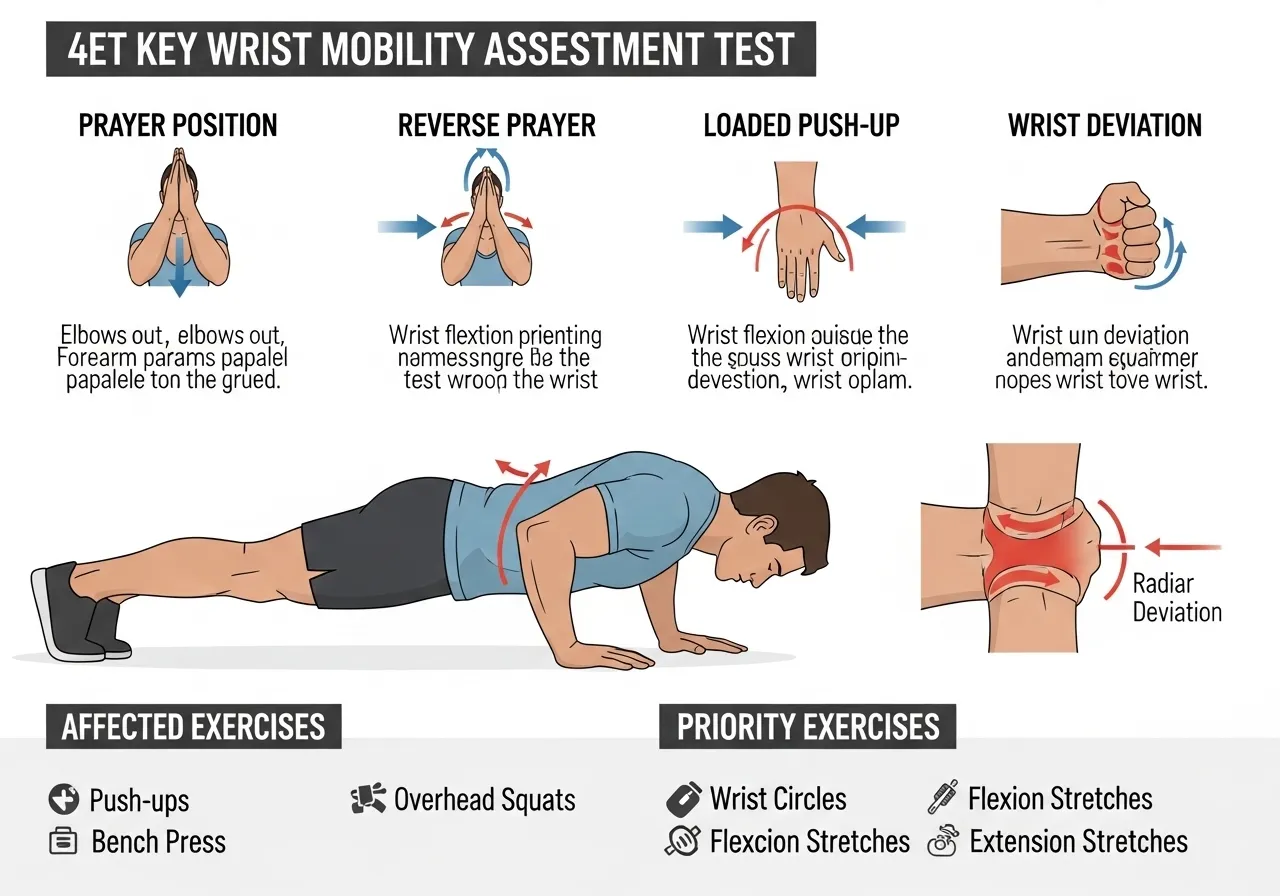
The 4 Key Wrist Assessments
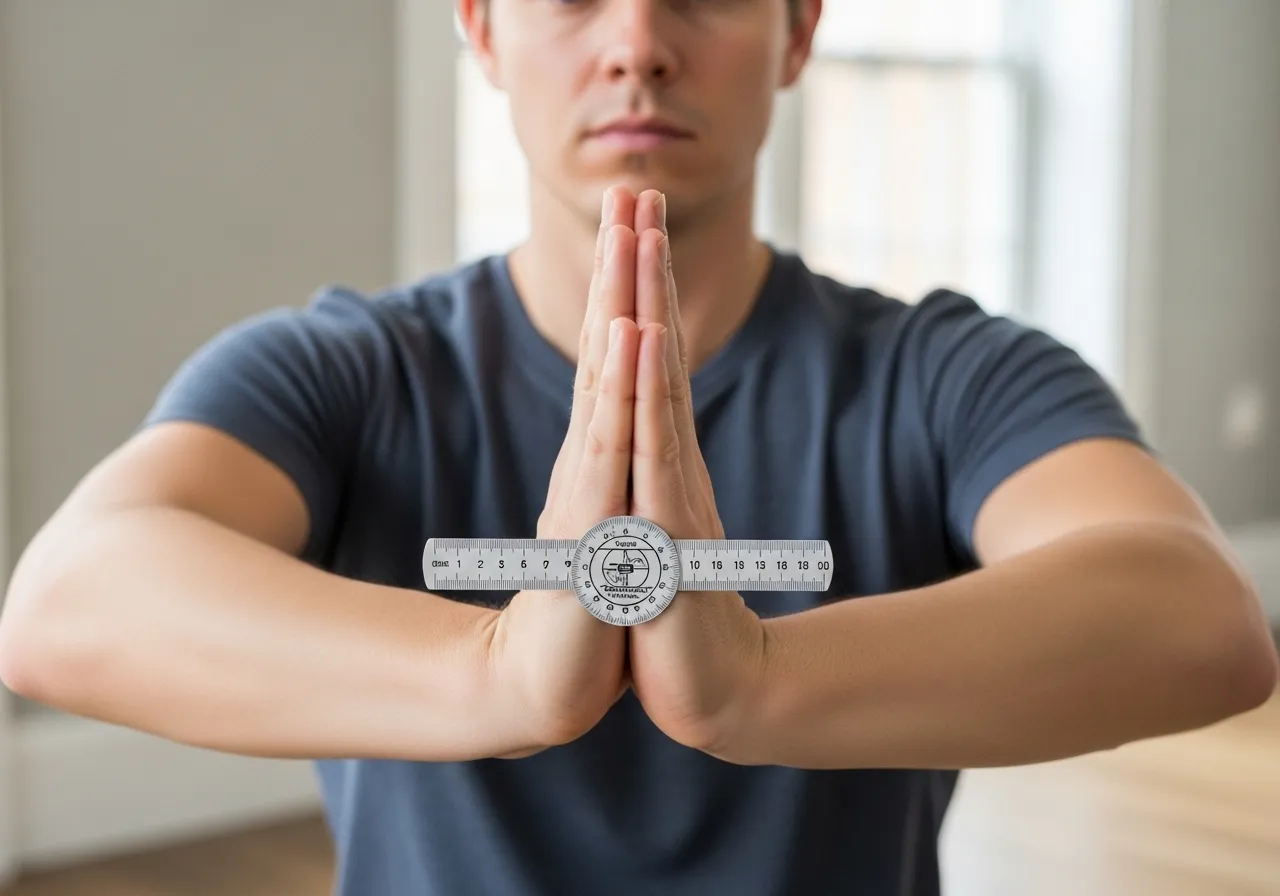
Test 1 — Wrist Extension (Prayer Position): Place both palms together in front of the chest, fingers pointing upward. Lower the hands toward the floor while keeping the palms in contact and elbows parallel to the floor. Normal wrist extension is approximately 70–90°. If the hands cannot lower to elbow height without separating, extension is restricted.
Test 2 — Wrist Flexion (Reverse Prayer): Place the backs of both hands together, fingers pointing downward. Raise the hands toward the ceiling while keeping hand contact. Normal wrist flexion is approximately 60–80°. Significant restriction here affects barbell back squat grip and Olympic clean positions.
Test 3 — Radial and Ulnar Deviation: With the forearm flat on a table, move the hand toward the thumb side (radial deviation, ~20°) and pinky side (ulnar deviation, ~30°). Restricted ulnar deviation affects golf, racquet sports, and some throwing patterns.
Test 4 — Loaded Extension (Push-Up Position): Get into a push-up position with hands flat on the floor. Note whether the wrist can comfortably support the body weight in full extension. Discomfort or inability to keep the hand flat indicates functional wrist extension restriction under load.
Which Test Identifies Which Problem
| Restriction | Exercises Affected | Priority Level |
|---|---|---|
| Extension limited | Push-ups, front squat rack, overhead press, handstand | High — affects most gym movements |
| Flexion limited | Barbell back squat grip, clean catch, barbell hang | Medium — affects specific lifts |
| Loaded extension painful | All push variations, plank, front-loaded carries | High — requires progressive loading approach |
| Ulnar/radial deviation limited | Racquet sports, golf, throwing | Sport-specific — lower general priority |
Why Wrist Restriction Is More Common Than You Think
Keyboard use, smartphone scrolling, and mouse operation all maintain the wrist in a neutral-to-slightly-extended position for hours daily — but never take it through a meaningful range of motion in either direction. Cumulative tissue shortening and joint capsule stiffening over months and years progressively reduces the available range without producing acute pain — until a loaded exercise demand reveals the deficit.
Most trainees discover their wrist restriction when they first attempt a front squat, a handstand push-up progression, or a loaded barbell squat with a close grip. The restriction did not develop overnight; it simply was never tested until the exercise demanded it.
What the Research Shows: How Wrist Mobility Affects Exercise Performance
Push-Up Biomechanics and Wrist Extension
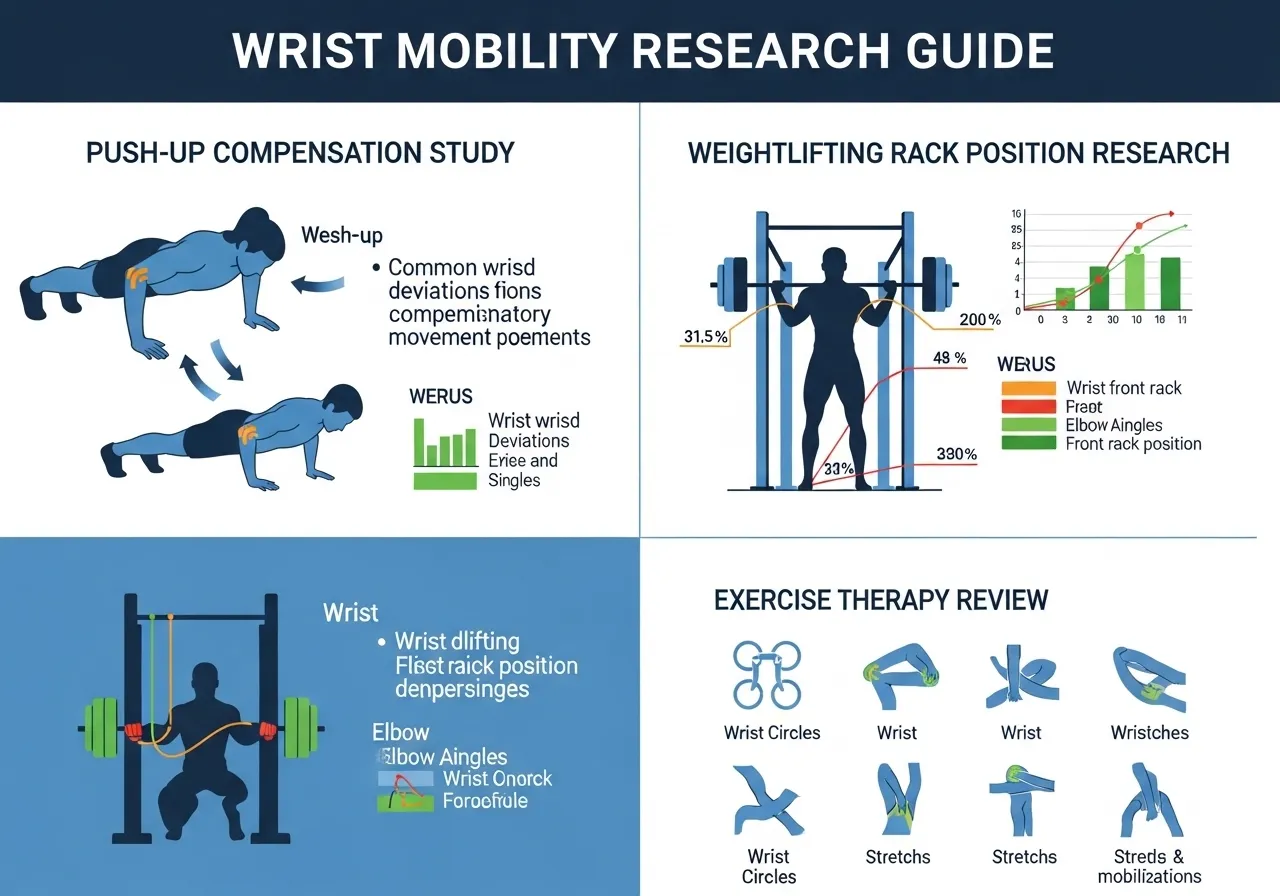
A study examining the relationship between wrist extension range of motion and push-up biomechanics in healthy adults finds that individuals with restricted wrist extension demonstrated significantly altered push-up mechanics — including reduced elbow flexion angle at the bottom position and compensatory changes in shoulder and trunk positioning — confirming that wrist extension restriction limits push-up depth and forces compensatory movement strategies that reduce both the training stimulus and the safety margin of the exercise.
Restricted wrist extension doesn’t just cause wrist discomfort — it changes push-up mechanics throughout the entire kinetic chain, reducing depth and forcing shoulder and trunk compensation that undermines the exercise’s effectiveness.
Wrist Mobility in Weightlifting Technique
A study examining wrist mobility requirements across Olympic weightlifting positions finds that adequate wrist mobility is critical for achieving correct rack position in the clean and jerk — with insufficient wrist extension preventing the elbow elevation and forearm horizontal position that characterise technically correct bar support — confirming that wrist mobility is a primary determinant of technique quality in barbell overhead and rack positions, and that improving wrist extension directly improves the safety and mechanics of front-loaded barbell exercises.
Wrist extension directly determines rack position quality in front-loaded barbell exercises. Improving wrist mobility improves front squat and clean technique — without any other technical coaching change.
Exercise Therapy for Wrist Mobility: What Works
A systematic review examining conservative and exercise therapy approaches for wrist and hand mobility conditions finds that exercise therapy for wrist mobility conditions demonstrates positive outcomes across multiple domains including range of motion, pain reduction, and functional capacity — with specific loading exercises showing superiority over passive approaches alone — confirming that active loading exercises (not merely passive stretching) produce the most durable wrist mobility improvements, particularly when the restriction involves joint capsule and tendon stiffness rather than purely muscular tightness.
Active loading exercises outperform passive stretching for lasting wrist mobility improvement. The wrist responds to progressive loading — not just gentle range of motion work.
Can You Fix Wrist Mobility With Stretching Alone — or Do You Need to Load It?
Why Wrist Stretching Alone Produces Limited Results
Standard wrist stretching — the classic “bend the hand back with the other hand” stretch performed for 30 seconds — produces temporary increases in wrist extension range that disappear within minutes to hours without reinforcement. Most trainees who have stretched their wrists daily for months see minimal lasting improvement.
The reason mirrors the broader flexibility research: passive stretching alone addresses the muscular component of restriction (forearm flexor and extensor tightness) but does not adequately address the capsular component (joint capsule stiffness, often the primary limiting factor after years of restricted range use) or the tendon-loading component (developing the connective tissue capacity to accept load at end range).
The Loading Principle for Wrists
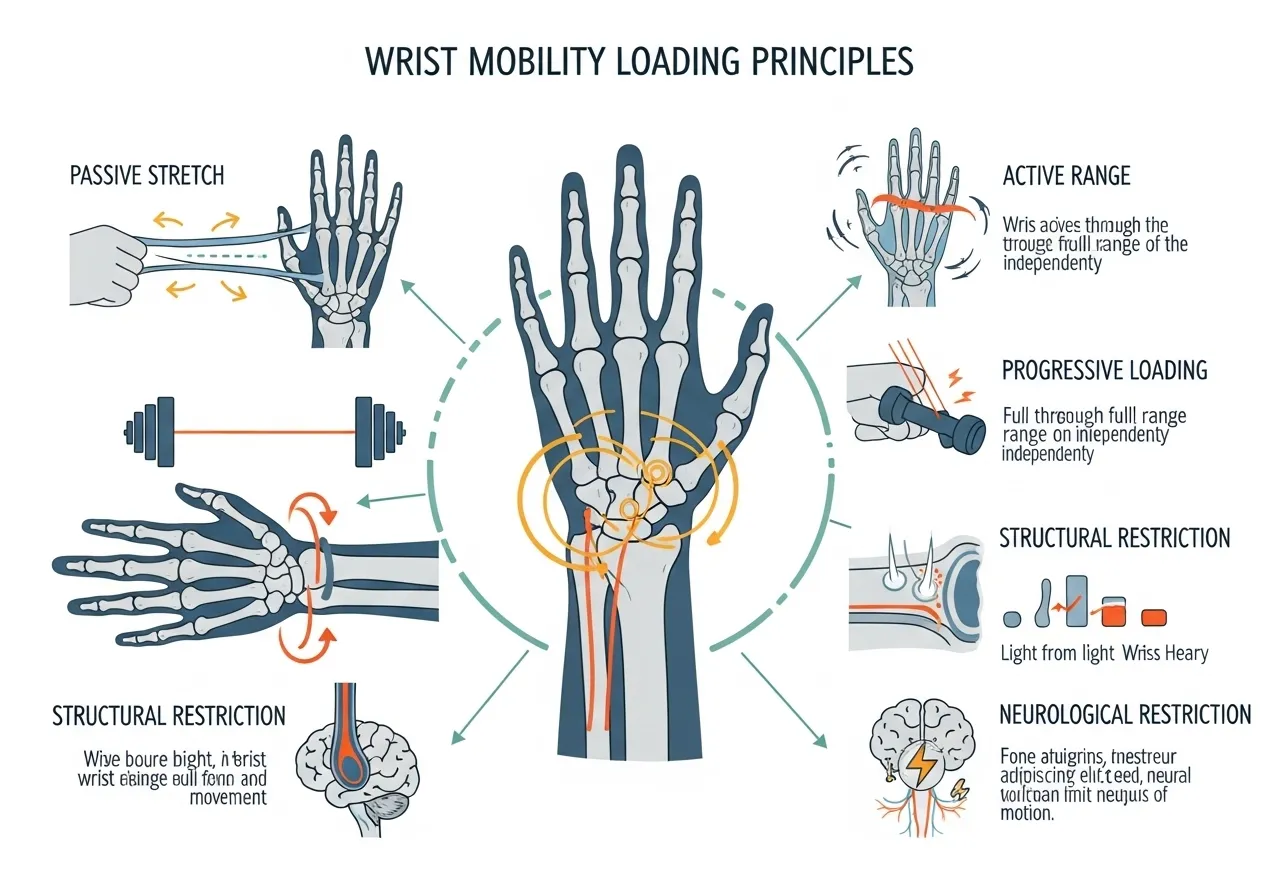
Wrist mobility improvement requires three progressive components — in sequence:
- Passive stretching: Temporarily increases range and prepares the tissue for subsequent work
- Active range development: Training the wrist to move actively through the available range (wrist circles, controlled articular rotations) — the nervous system must learn to use the range passively gained
- Progressive loading: Applying gradually increasing compressive and tensile load through the new range — this is what produces lasting capsular, tendon, and bone adaptation
Most trainees do step 1 only. The systematic review evidence supports all three — and particularly highlights loading as the key differentiator between temporary range gains and durable functional improvement.
Structural vs Neurological Restriction: The Distinction That Determines Your Timeline
Wrist restriction falls into two broad categories with different response timelines:
- Neurological/muscular restriction: Forearm muscles are tight, and the nervous system defensively limits range under load. Responds to mobility work within 2–4 weeks consistently. Most common in sedentary office workers.
- Structural/capsular restriction: The joint capsule itself is thickened or adherent (often from old injuries, surgery, or immobilisation). Requires longer intervention (8–16 weeks) and responds best to sustained end-range loading. If wrist restriction persists for years without response to standard stretching, this category is more likely.
The simple test: does wrist extension improve immediately after 5 minutes of mobility work? If yes, the restriction is primarily neurological/muscular and responds quickly. If there is minimal immediate improvement, structural restriction is more likely and requires a longer, more progressive approach. See also: mobility training guide for the CARs protocol framework that applies to wrist joint health alongside other mobility priorities.
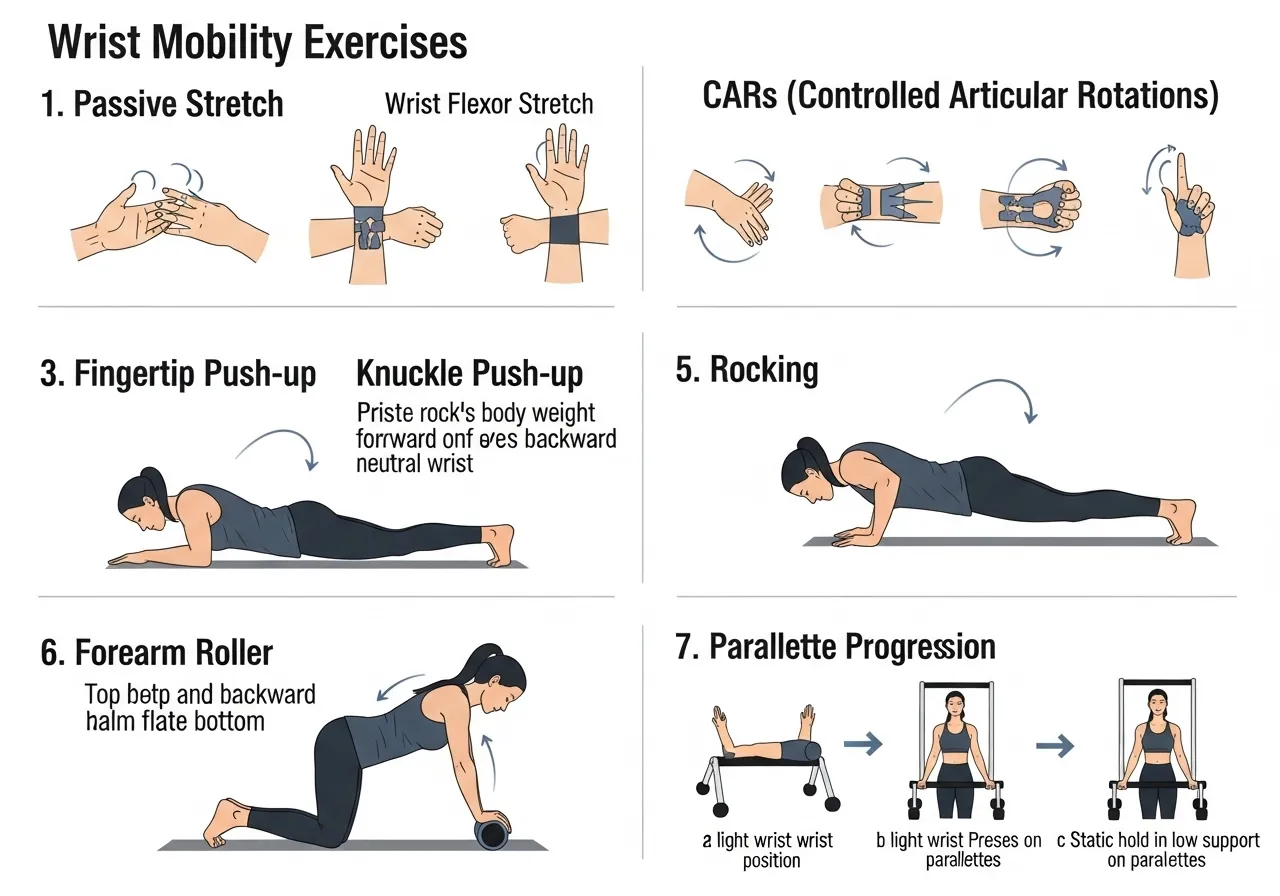
8 Wrist Mobility Exercises: From Passive Stretch to Progressive Loading
🏋️ 1. Passive Wrist Extension Stretch
Target: Wrist flexor group (flexor carpi radialis, flexor carpi ulnaris, finger flexors)
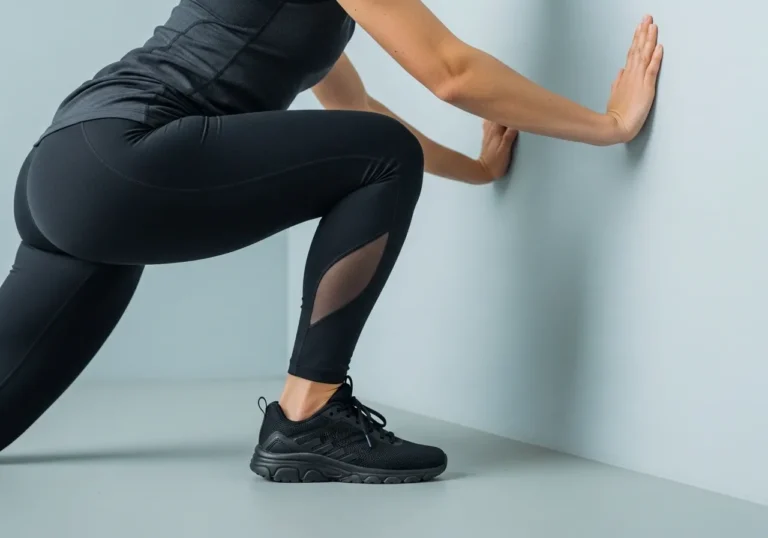
How: Place palm on a flat surface, fingers pointing away from you, arm straight. Gently lean body weight forward to increase extension. Hold 30–45 seconds per side. Alternatively: use the other hand to bend the wrist back while the arm extends forward.
Key point: The floor-based version provides a more stable loading surface and allows gradual bodyweight increase — a first step toward the loaded push-up position that the progressive exercises build toward.
🏋️ 2. Passive Wrist Flexion Stretch
Target: Wrist extensor group (extensor carpi radialis, extensor carpi ulnaris)
How: Extend the arm forward, palm down. Use the other hand to gently bend the wrist downward (into flexion). Hold 30–45 seconds. Alternatively: kneel and place the backs of the hands on the floor, fingers pointing toward the knees, and sit back gently.
Key point: The kneel-back version also stretches the finger extensors and the dorsal wrist capsule — important for trainees who grip the barbell tightly during squats and pulls.
🏋️ 3. Wrist CARs (Controlled Articular Rotations)
Target: Full wrist joint range, articular health, nervous system access to full range
How: Isolate one wrist by holding the forearm still with the opposite hand. Slowly rotate the wrist through the full available range — flexion, ulnar deviation, extension, radial deviation — as a controlled circle. Apply end-range pressure for 2 seconds at each extreme. 5 circles each direction per wrist.
Key point: CARs are motor control work — the nervous system learns to actively access the range rather than only tolerating passive movement into it. Perform after passive stretching while the tissue is most responsive.
🏋️ 4. Fingertip Push-Up (Progressive Loading Phase 1)
Target: Wrist extension under partial bodyweight load, finger flexor tendons
How: Incline push-up position with hands on a wall or raised surface. Perform the push-up on the fingertips rather than the full palm — this requires the wrist to extend further than in a standard push-up position. 3×10 on incline before progressing to floor level.
Key point: The first loading step — introduces wrist extension under load at a fraction of bodyweight. The incline reduces load progressively as the surface approaches floor level.
🏋️ 5. Knuckle Push-Up
Target: Wrist extension under bodyweight load, wrist stability
How: Standard push-up position but on closed fists (knuckles on floor). The fist position places the wrist in a neutral position — taking it out of full extension while still loading the wrist structure. An intermediate step between elevated push-ups and flat-palm push-ups for those with extension pain.
Key point: Excellent bridge exercise for trainees whose wrists are painful in the push-up position — maintains training stimulus while the wrist adapts to the loaded position progressively.
🏋️ 6. Wrist Push-Up Rocking
Target: Wrist extension loading through progressive range, loaded mobility
How: Get into a push-up position with palms flat. Rock the body forward slowly, increasing the wrist extension angle as more weight shifts onto the hands. Rock back to reduce load. Repeat slowly for 10 rocks, gradually increasing forward range over the set.
Key point: This is loaded progressive wrist extension — it directly trains the wrist to accept increasing load through increasing extension range. The most direct bridge to flat-palm push-up and front squat rack position tolerance.
🏋️ 7. Wrist Roller / Forearm Strengthening
Target: Forearm flexors and extensors (strength endurance), wrist stability under load
How: Hold a dowel or wrist roller with both hands. Rotate slowly to wind the attached weight up, then unwind slowly. Alternate winding direction each set. 3 sets each direction. Alternatively: rice bucket training — bury the hands in a bucket of uncooked rice and perform extension, flexion, and rotation movements against the rice resistance.
Key point: Strength endurance in the forearm flexors and extensors provides the muscular support that makes wrist mobility sustainable under prolonged loading — preventing the flexor fatigue that causes wrist collapse during long sets of push-ups or front squats.
🏋️ 8. Parallette / Push-Up Handle Work
Target: Wrist neutral position under full bodyweight — training alongside mobility work
How: Perform push-ups or holds on parallettes or push-up handles (which keep the wrist in neutral rather than full extension). This maintains the pressing training stimulus while the wrist develops the capacity for flat-palm extension work.
Key point: Not a mobility exercise but a training accommodation — allows continued push-up and pressing training during the wrist mobility development period without aggravating an extension-sensitive wrist. Gradually transition from handles to flat-palm as extension capacity improves.
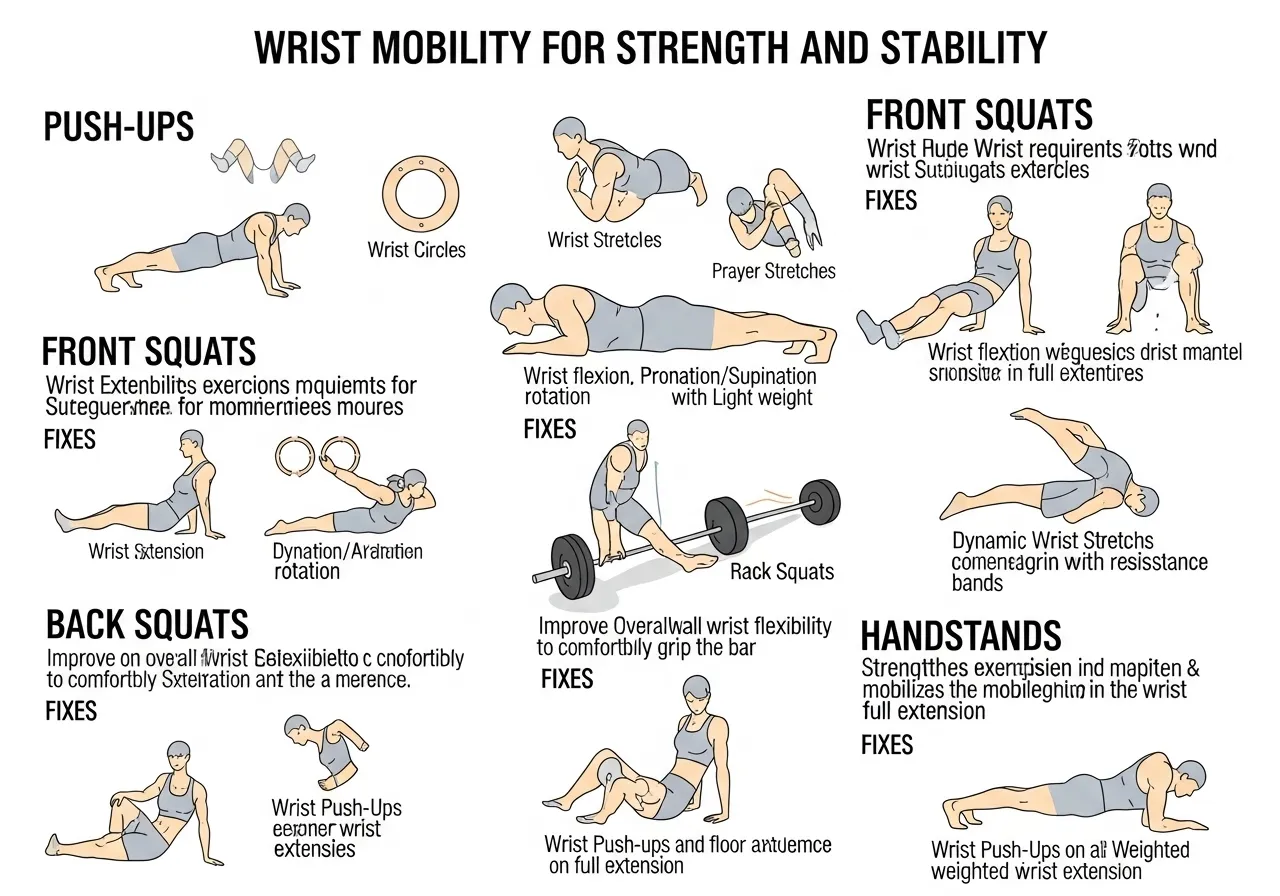
Exercise-Specific Wrist Prescriptions: What to Fix for Each Lift
For Push-Ups and Plank: Loaded Extension Capacity
The flat-palm push-up requires approximately 70–80° of wrist extension under body weight load. If your wrist cannot comfortably accept this position, the progression is:
- Passive wrist extension stretch 3×45 sec (daily)
- Wrist CARs 2×5 each direction (daily)
- Inclined push-up on fingertips 3×10 (3× per week)
- Wrist push-up rocking 3×10 (3× per week)
- Flat-palm push-up when rocking is pain-free at full extension
For Front Squat Rack Position
The front squat rack position requires wrist extension combined with forearm horizontal — the wrist must extend sufficiently for the bar to rest on the deltoids with the elbows elevated. The specific mobility requirement:
- Wrist extension: Minimum 70° for comfortable rack position — less than this forces the elbows to drop and shifts bar load onto the wrists rather than the shoulders
- Forearm flexibility: The wrist extensors and brachioradialis must be flexible enough to allow the forearm to reach horizontal without the wrist collapsing
- Daily drill: 3 minutes of rack position holds with a barbell at light weight (10–20 kg) — this directly loads and stretches the exact position required
For Barbell Back Squat Grip
The close-grip barbell back squat requires wrist flexion beyond neutral — the wrist bends toward the forearm as the hands grip the bar. Trainees with limited wrist flexion often present with wrist, elbow, or shoulder discomfort during low-bar squatting.
The prescription: daily passive wrist flexion stretch (3×45 sec), wrist CARs with emphasis on the flexion portion, and gradual close-grip barbell holds for time (starting with an empty bar and building to working sets).
For Handstand and Gymnastics Pressing
Handstand push-ups require near-full wrist extension under full bodyweight — the most demanding wrist extension requirement in gym training. The progression requires all 8 exercises in sequence across 8–12 weeks before attempting handstand work with wrist pain history. Parallettes allow handstand practice with neutral wrist position during the development phase.
General Wrist Maintenance for All Lifters
Even without specific restrictions, 3–5 minutes of daily wrist CARs and passive extension/flexion stretching maintains the range available and prevents the gradual restriction that accumulates over years of loaded gym training. The investment is minimal; the downstream benefit to pressing, squatting, and pulling mechanics is significant. See also: foam rolling guide for soft tissue preparation that complements wrist mobility work.
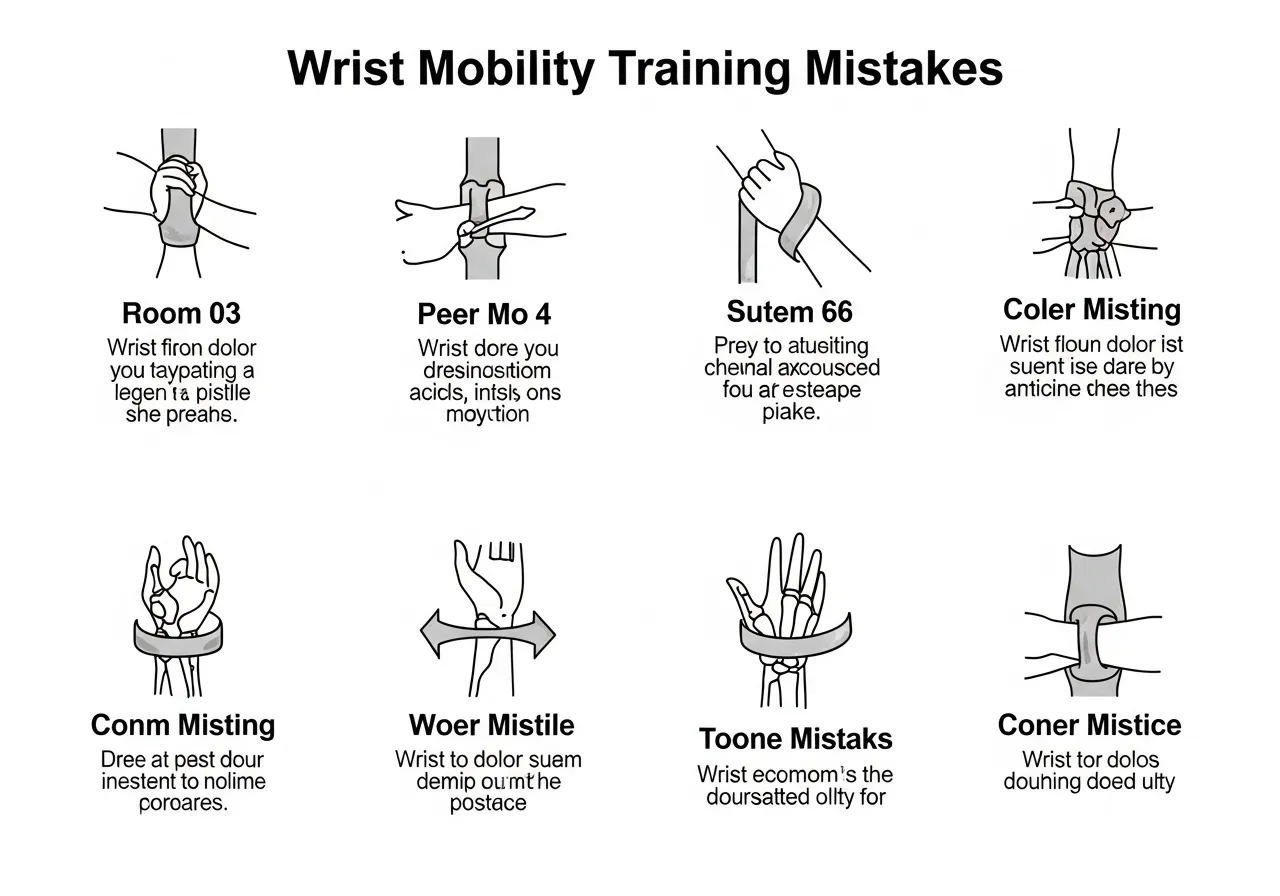
4 Wrist Mobility Mistakes That Keep the Problem Unresolved
Mistake 1: Only Stretching, Never Loading
The systematic review evidence is clear: passive stretching alone produces temporary range gains that do not translate to functional improvement under load. Most trainees with wrist restriction stretch briefly before training and wonder why their push-up pain or front squat discomfort never resolves over months.
The loading component — fingertip push-ups, wrist rocking, forearm roller work — is non-negotiable for lasting improvement. Passive stretching prepares the tissue; loading produces the structural adaptation that makes the range available under the demands of actual gym exercises.
Mistake 2: Ignoring Asymmetry
Most people have a dominant hand and forearm that is stronger and more restricted than the non-dominant side. Years of dominant-side grip work creates asymmetric forearm flexor and extensor development — and asymmetric wrist restriction.
Testing both wrists individually (Test 1 with each hand independently) almost always reveals a significant difference. A trainee whose right wrist extends 85° and left extends 60° is systematically overloading the left wrist in every bilateral pushing exercise. Addressing the restricted side with additional unilateral mobility work — 2 extra sets on the limited side per session — typically produces visible improvement within 4–6 weeks.
Mistake 3: Using Wrist Wraps as a Permanent Solution
Wrist wraps provide compression and stability that can reduce pain during pressing and squatting with restricted wrists. They are a legitimate acute accommodation tool — appropriate for heavy training sessions while mobility work proceeds in parallel.
The mistake is treating wraps as a permanent solution and never progressing to pain-free training without them. Reliance on wraps without concurrent mobility work means the underlying restriction never improves — and the wrap dependency can become a psychological requirement even after the restriction resolves. Use wraps for heavy work sessions; train without them for mobility-specific sessions and lighter work.
Mistake 4: Progressing Too Fast to Loaded Exercises
The fingertip push-up and wrist rocking progressions build the connective tissue and joint capsule tolerance for loaded wrist extension over weeks. Skipping directly to flat-palm push-ups or front squat rack work when the wrist is not yet capable produces the acute pain that most trainees use as evidence that “wrist mobility exercises don’t work.”
Connective tissue adaptation — capsular remodelling, tendon stiffness reduction — requires 6–12 weeks at minimum. The progression must be gradual: incline before floor level, light before heavy, controlled range before full range under load. Rushing produces pain, not progress.
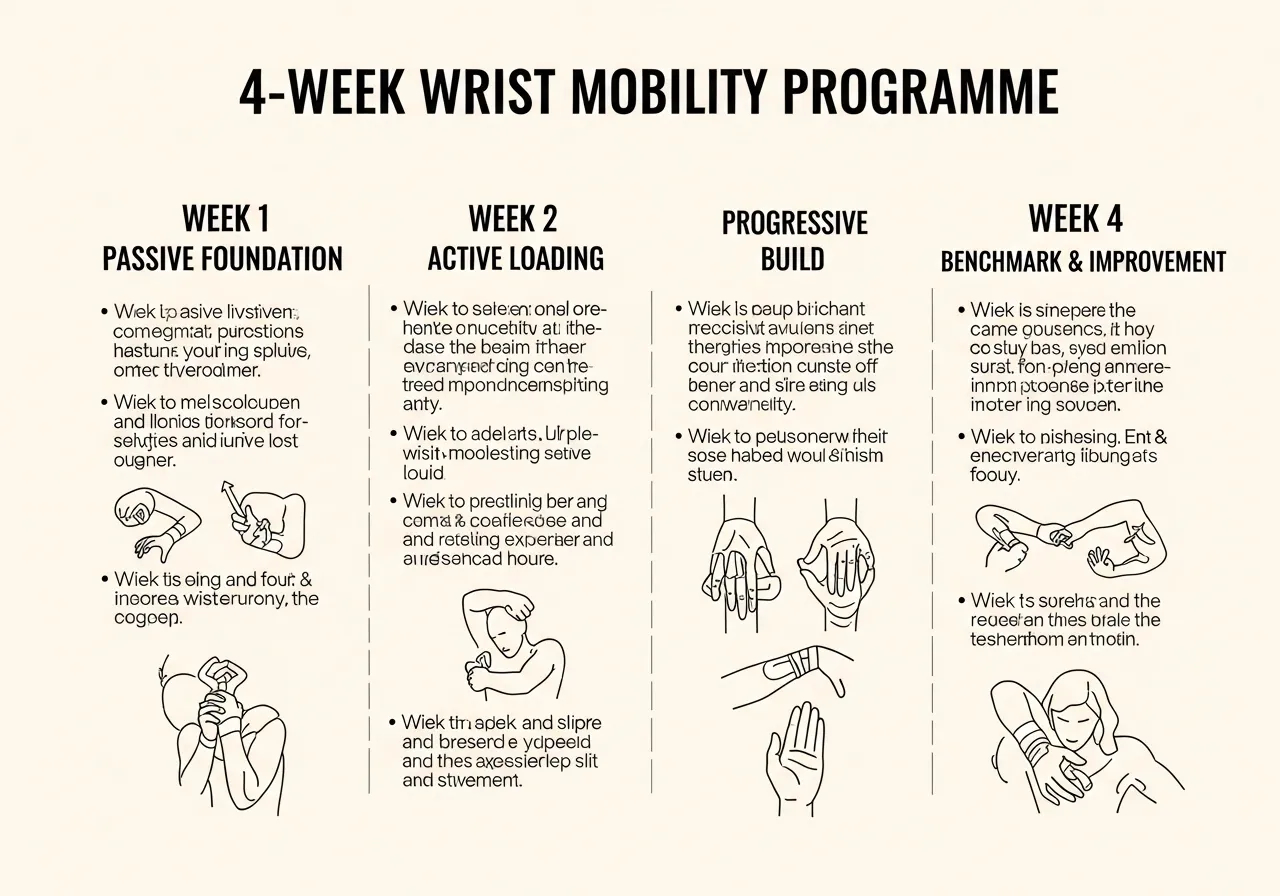
4-Week Wrist Mobility Programme
Perform this programme daily — 8–10 minutes per session. Run it for 4 weeks as a dedicated phase, then transition to a 3-minute daily maintenance routine.
Before starting: test and record your wrist extension using the Prayer Position test. Note whether one side is more restricted. Retest at Week 4.
📅 Week 1: Passive Flexibility Foundation
- Passive wrist extension stretch 3×45 sec each side
- Passive wrist flexion stretch 2×45 sec each side
- Wrist CARs 2×5 each direction each wrist
- No loading exercises yet
Focus: Identify which side is more restricted and which direction is tighter. This determines the loading emphasis in Weeks 2–4.
📅 Week 2: Active Range + First Loading
- Passive extension stretch 2×45 sec
- Wrist CARs 2×5 each direction
- Incline fingertip push-up (wall or elevated surface) 3×10
- Wrist rocking (floor, partial range) 3×8 — rock forward only to the point of mild discomfort, not sharp pain
Focus: The fingertip push-up and rocking should feel challenging, not painful. Sharp pain = stop and regress to the incline.
📅 Week 3: Progressive Loading Build
- Passive stretch 2×45 sec
- Wrist CARs 2×5 each direction
- Fingertip push-up (floor level if Week 2 was comfortable) 3×10
- Wrist rocking (full forward range) 3×10
- Forearm roller 2 sets each direction OR rice bucket 2×60 sec
Focus: Full-range wrist rocking — the wrist should now tolerates its full bodyweight in extension without sharp pain
📅 Week 4: Integration + Benchmark
- Full sequence daily (10 min)
- Benchmark: Retest Prayer Position test vs Week 1. Retest loaded flat-palm push-up comfort. A 10–20° improvement in passive extension range and pain-free flat-palm push-up position are typical 4-week outcomes with daily work.
- Maintenance (after Week 4): 3 min daily — CARs + passive extension stretch only. Full programme 2× per week maintains the gains permanently.
Focus: Test the specific exercises that revealed your restriction initially (push-up, front squat rack, barbell grip) — these are the true functional benchmarks
Frequently Asked Questions About Wrist Mobility
How long does it take to improve wrist extension?
Neurological/muscular restriction typically responds within 2–4 weeks of daily mobility work — noticeable improvement at the end-range position and reduced discomfort during push-up and pressing exercises. Structural/capsular restriction (common after wrist injuries or prolonged immobilisation) requires 8–16 weeks of consistent progressive loading for meaningful change. The daily maintenance commitment after improvement is 3–5 minutes — a small investment relative to the functional gain.
Should I train through wrist discomfort during push-ups?
Mild discomfort (a stretch or pressure sensation) during push-up work while wrist mobility improves is acceptable and expected. Sharp, shooting, or stabbing pain — particularly at the dorsal wrist or ulnar side — is a stop signal. Train around the restriction using parallettes or push-up handles while the mobility programme addresses the underlying limitation, rather than pushing through pain that indicates tissue overload.
Do wrist wraps help or hinder wrist mobility development?
Wrist wraps reduce pain in the short term by limiting wrist extension range. They are appropriate for heavy training sessions where wrist restriction would otherwise compromise performance or safety. For mobility training sessions specifically, removing the wraps and working through the available range (with appropriate load reduction) produces the tissue loading that drives improvement. Use wraps for heavy work; leave them off for mobility-focused sessions and lighter training.
Why does my wrist crack during mobility exercises?
Wrist cavitation (cracking from gas bubble release in the joint) during CARs or stretching is common and generally harmless in the absence of pain. Repetitive clicking accompanied by pain, or a consistent mechanical catching sensation during rotation, warrants assessment — these patterns may indicate TFCC pathology or carpal instability that requires professional diagnosis before continuing with progressive loading.
Can I do wrist mobility work every day?
Yes — with appropriate volume. The passive stretching and CARs components can be performed daily without recovery concerns. The loaded exercises (fingertip push-ups, wrist rocking, forearm roller) produce mild connective tissue stress that benefits from 48 hours of recovery between sessions — performed 3× per week during the development phase. Daily passive stretching with 3× per week loading produces optimal results without overuse accumulation. See also: ankle mobility guide for the equivalent lower-body mobility programme that addresses the other most commonly restricted joint in gym training.