⚠️ Health & Fitness Disclaimer This article is for general educational purposes only and does not replace professional medical advice. If you have any elbow, wrist, or shoulder conditions, please consult a qualified healthcare professional before beginning any curl training program.
The seated row guide curl may be the most practised isolation exercise in any gym — yet the research on grip type, bar selection, and shoulder position reveals that small technique adjustments can meaningfully change which muscles are recruited and how effectively they are trained. (Related: barbell row guide)
This guide covers the anatomy of the elbow flexors, what EMG research says about curl variations, a breakdown of the six most effective curl exercises, programming guidelines, and an 8-week training plan.
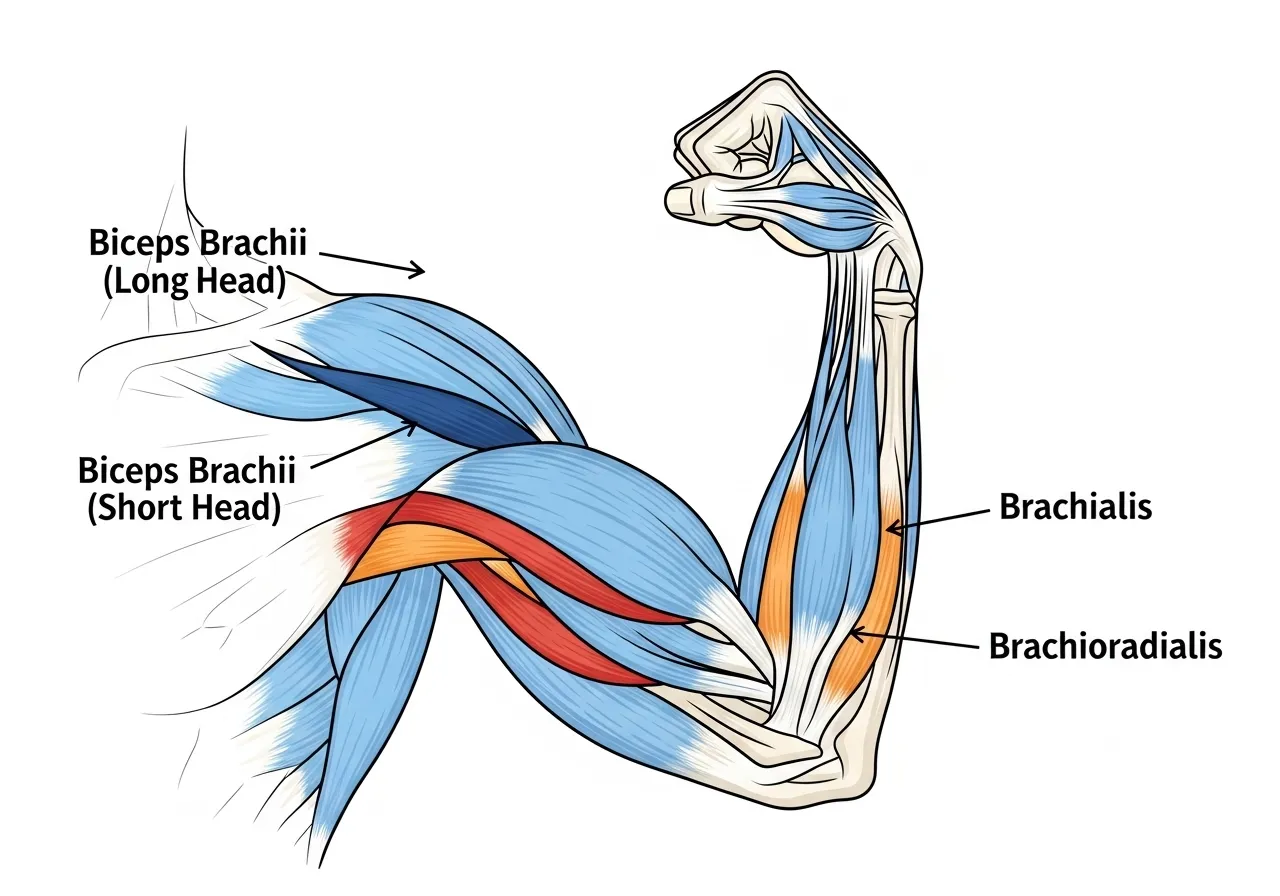
Bicep Curl Anatomy: The Three Elbow Flexors
Biceps Brachii — The Primary Target
The biceps brachii (a two-headed muscle on the front of the upper arm) is responsible for two actions: elbow flexion and forearm supination (rotating the palm upward).
Its two heads originate from different points on the scapula, meaning shoulder position during the curl can influence how much each head is recruited.
Long head: originates from the supraglenoid tubercle — more active when the shoulder is extended (as in the incline curl)
Short head: originates from the coracoid process — more active when the shoulder is flexed (as in the preacher curl)
Brachialis — The Hidden Size Builder
The brachialis (a muscle that lies beneath the biceps brachii and attaches directly to the ulna) is a pure elbow flexor — it cannot supinate the forearm.
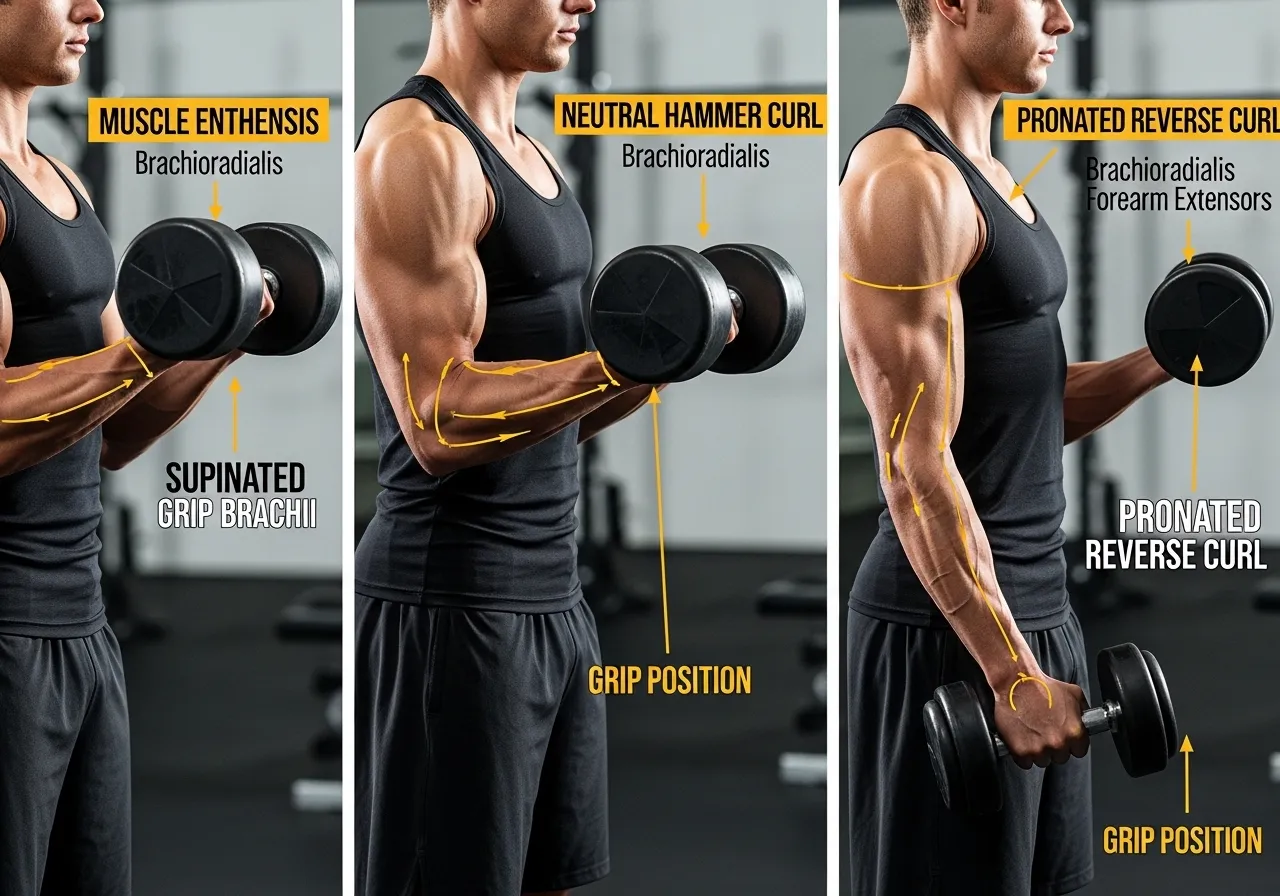
Because it sits under the biceps, developing the brachialis physically pushes the biceps upward, creating the appearance of greater arm peak and thickness. Hammer curls and reverse curls target the brachialis more selectively than supinated curls.
Brachioradialis — The Forearm Contributor
The brachioradialis (a muscle running along the thumb side of the forearm) assists with elbow flexion, particularly when the forearm is in a neutral or pronated position.
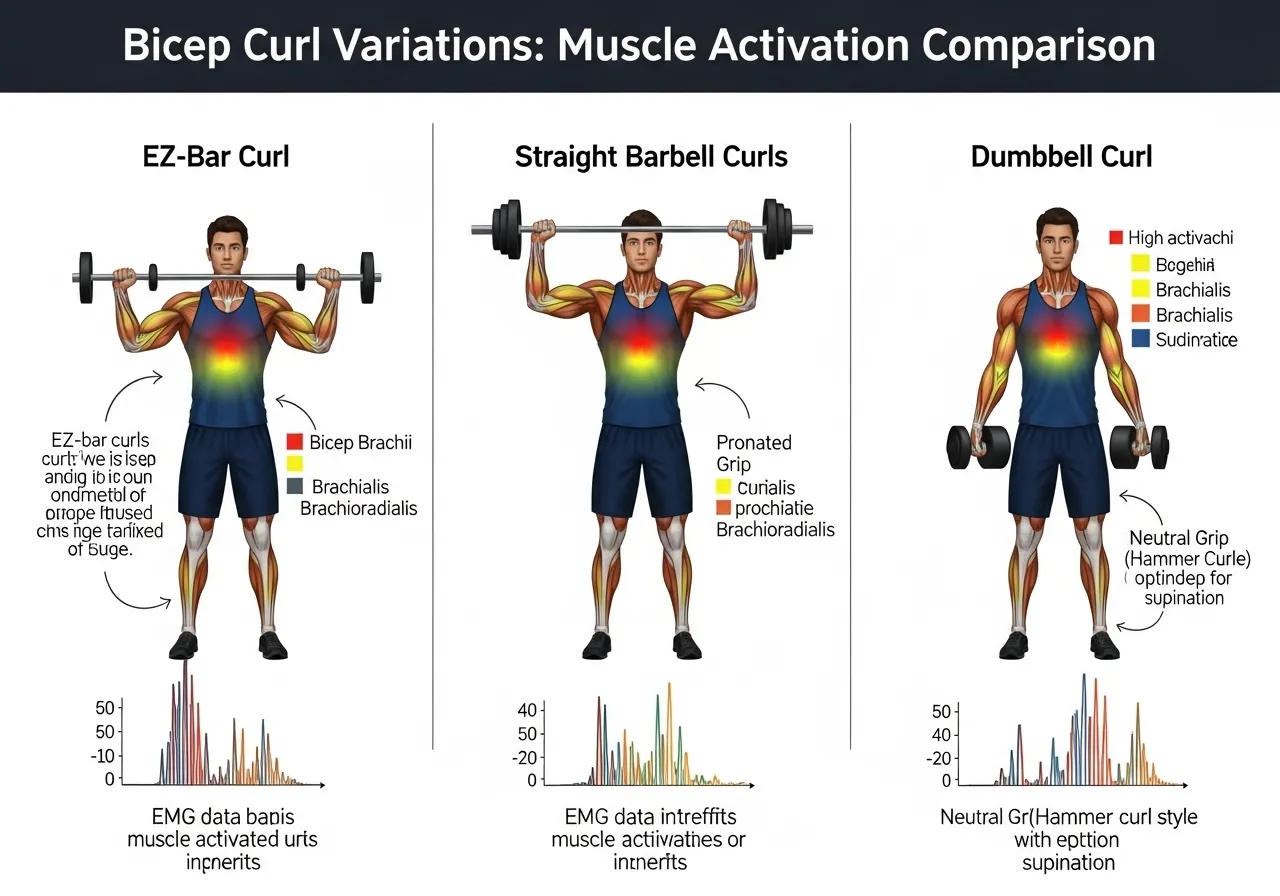
EMG research confirms that the brachioradialis is more active during EZ-bar and hammer curls than during supinated dumbbell training guide curls — making these variations useful for complete elbow flexor development.
📌 Key Point
Complete bicep development requires targeting all three elbow flexors. A well-designed program may benefit from including supinated curls (biceps brachii), neutral-grip curls (brachialis), and EZ-bar or reverse curls (brachioradialis).
Common Errors in Bicep Curl Technique
Even experienced trainees may develop technique habits that reduce bicep tension and increase injury risk over time. The most common errors involve elbow and torso position.
Error
Why It Reduces Effectiveness
Correction
Elbows drifting forward
Reduces the moment arm — bicep does less work
Keep elbows fixed at the sides throughout the lift
Torso swinging
Transfers load to the lower back and shoulders
Use a wall or bench to brace the back if needed
Cutting the range short
Omits the stretched position — reduces stimulus on the long head
Lower fully to near-full elbow extension on every rep
Rushing the eccentric
The eccentric phase may contribute significantly to hypertrophy stimulus
Take 2–3 seconds to lower the weight on each rep
The Eccentric Phase: Often Overlooked, Potentially Important
The eccentric phase (the lowering portion of the curl) may contribute meaningfully to muscle hypertrophy through mechanisms including greater mechanical tension and muscle damage stimulus.
Research on tempo training suggests that a 2–3 second eccentric combined with a moderate load may produce a different hypertrophic stimulus compared to fast, momentum-assisted lowering.
Practically, this means slowing the lowering phase may allow a trainee to accumulate a greater hypertrophic stimulus at the same load — a useful strategy for breaking plateaus without necessarily increasing weight.
What Does EMG Research Actually Say About Curl Variations?
Research on shoulder angle during dumbbell curls confirms that the incline dumbbell curl (performed with the shoulder extended behind the body) produces the highest biceps brachii activation across the full range of motion — because shoulder extension places the long head under a greater stretch.
The preacher curl, by contrast, places the shoulder in flexion, which shortens the long head at the start — producing a pronounced peak contraction but limiting activation in the early phase of the movement.
⚠️ Important: EMG studies measure acute muscle activation and may not directly predict long-term hypertrophy. Consistent progressive overload, adequate volume, and recovery remain the primary drivers of muscle growth.
How to Add Progressive Overload to Curl Training
Progressive overload — the gradual increase of training stress over time — is the primary driver of long-term muscle and strength development. For isolation exercises like curls, the following methods may be applied systematically:
Increase load: Add 1–2 kg when the top of the rep range can be completed with strict form across all sets
Increase reps: Move from 8 to 10 reps at the same weight before increasing load
Add a set: Progress from 3 to 4 working sets per exercise before increasing load
Slow the eccentric: Move from a 2-second to a 3-second lowering phase as a form of load increase without changing weight
Reduce rest: Gradually reducing rest from 90 seconds to 60 seconds between sets may increase training density
Mind-Muscle Connection in Curl Training
Attentional focus during exercise — specifically, consciously focusing on the muscle being trained rather than on the load — may influence muscle activation in isolation exercises.
Practically, this may mean consciously squeezing the bicep at the top of each rep, visualising the bicep contracting during the upward phase, and ensuring the sensation of the exercise is felt in the target muscle rather than in the forearms or shoulders.
While the research on attentional focus is not yet conclusive for long-term hypertrophy, many coaches include brief peak contraction holds (1 second at the top of the curl) as a practical application of this concept.
✅ Quick Takeaway: Technique quality, eccentric control, and progressive overload are more predictive of bicep development than exercise selection alone. Choosing one or two primary curl variations and progressing them consistently over 8–12 weeks may produce better results than frequently rotating between many exercises.
Does Grip Width on the Barbell Actually Matter?
Close vs Standard vs Wide Grip — What Changes
Grip width on the barbell curl modifies the forearm angle and the moment arm at the elbow, which may influence how force is distributed across the elbow flexors.
Grip Width
Forearm Position
Likely Emphasis
Close grip (hands ~15 cm apart)
More supinated
Biceps short head, inner bicep
Shoulder-width (standard)
Neutral supination
Balanced biceps activation
Wide grip (hands ~60 cm apart)
Less supinated at top
Biceps long head, outer sweep
EZ-Bar: Wrist Comfort vs Pure Bicep Activation
The EZ-bar places the wrists in a semi-pronated position (approximately 45° between fully supinated and neutral). This reduces wrist and elbow joint stress compared to the straight barbell — making it a practical choice for trainees with wrist discomfort.
While one study found that the straight bar produced slightly higher biceps brachii activation during certain phases of the movement, the practical difference is small. For most trainees, wrist comfort may be the more relevant factor when choosing between the two.
📌 Key Point
Grip variation is a useful tool for programme diversity, not a critical performance variable. Rotating grip widths and bar types over training cycles may provide more comprehensive elbow flexor development than using a single grip exclusively.
The Role of Compound Exercises in Bicep Development
Pull-ups, chin-ups, and rowing variations provide significant bicep stimulus alongside larger back muscles. Chin-ups (underhand grip) in particular place the biceps in a mechanically similar position to a supinated curl — making them one of the most effective compound exercises for simultaneous back and bicep development.
For trainees with limited training time, prioritising compound pulling movements and adding 2–4 direct curl sets may provide the majority of the stimulus needed for continued bicep growth.
Superset Strategies for Time-Efficient Programming
Supersets — pairing two exercises back-to-back with minimal rest — can increase training density and reduce session time when programmed appropriately.
Common effective bicep supersets include:
Bicep curl + tricep pushdown: Opposing muscle group superset — allows near-full recovery of each muscle while the other works
Barbell curl + hammer curl: Same muscle group, different emphasis — accumulates bicep and brachialis volume in less time
Incline curl + preacher curl: Stretched position followed by peak contraction — targets the long head through two complementary movement angles
⚠️ Important: Supersets within the same muscle group may reduce performance on the second exercise due to accumulated fatigue. Reducing load by approximately 10–15% on the second exercise when training supersets is a practical starting adjustment.
Curl Exercise Selection: How to Build a Balanced Programme
Rather than performing many different curl variations in every session, a balanced programme typically selects two to three exercises per session that cover different movement angles and grip positions.
A practical session structure for intermediate trainees may look like this:
Primary curl (compound emphasis): Barbell curl or EZ-bar curl — 3–4 sets, 6–10 reps — the heaviest loaded exercise in the session
Stretch-position curl: Incline dumbbell curl — 3 sets, 10–12 reps — targets the long head at a lengthened position
Brachialis/accessory curl: Hammer curl or reverse curl — 2–3 sets, 12–15 reps — develops the brachialis and brachioradialis for complete arm development
Unilateral vs Bilateral Curl Training
Bilateral curls (both arms simultaneously) allow heavier loading per session and are more time-efficient. They may also produce greater systemic hormone response due to higher total load used.
Unilateral curls (alternating or single-arm) allow individual focus on each arm and may help identify and address strength differences between sides. Research suggests side-to-side strength differences of more than 10–15% may be worth addressing with targeted unilateral training.
A practical recommendation is to use bilateral curls as the primary movement when strength or load progression is the priority, and unilateral curls as accessory work when addressing imbalances or adding variety.
Cable Curls vs Free Weight Curls
Cable curls provide a constant resistance profile throughout the range of motion — unlike dumbbell curls, where resistance changes with the angle of the forearm relative to gravity.
At full elbow extension (the bottom of the curl), a cable machine guide attached below provides more resistance than a dumbbell in the same position — potentially increasing the stimulus in the stretched position of the bicep. This makes cable curls a useful complement to free weight curls in a programme that aims to load the muscle at different points in its range.
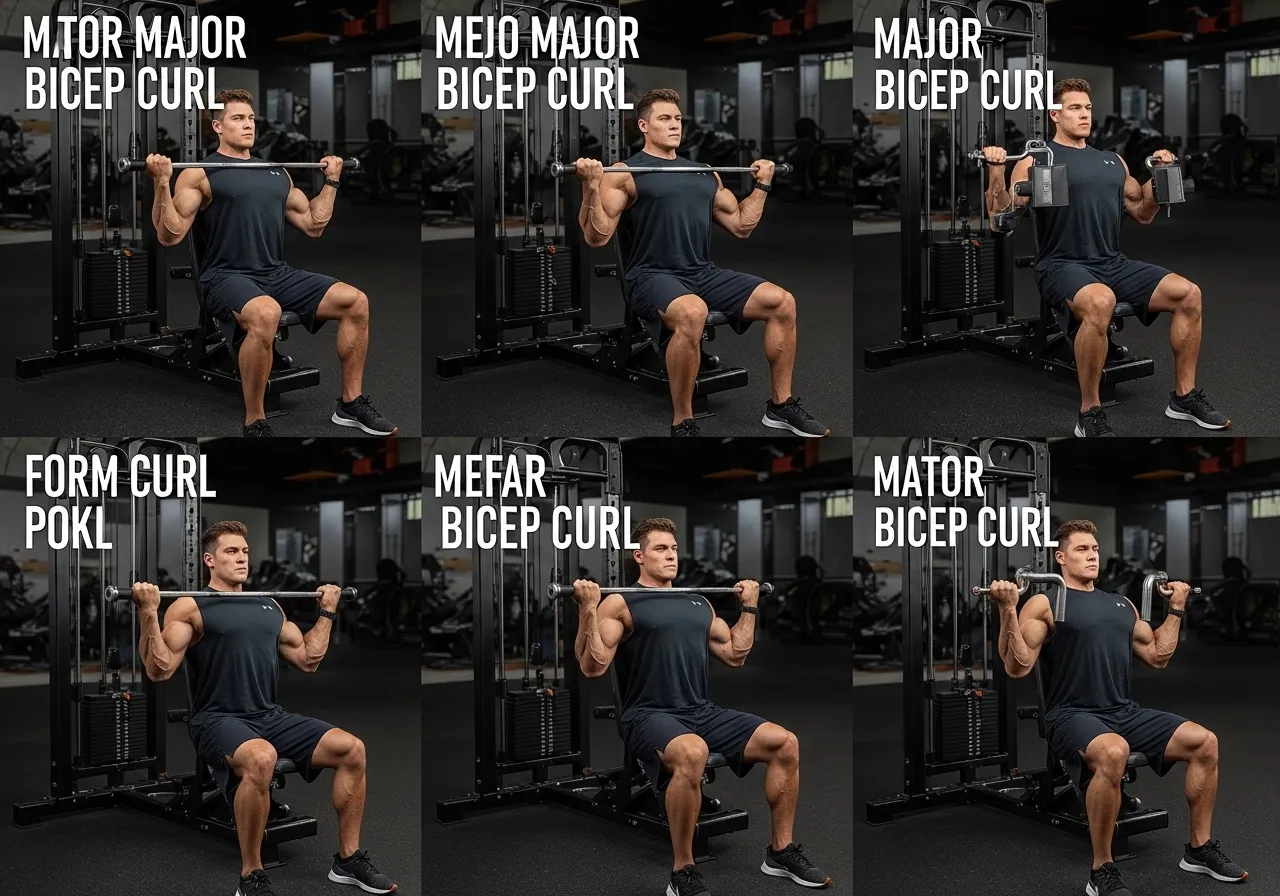
The Six Most Effective Bicep Curl Variations
Foundational Curls
🏋️ Barbell Curl (Straight Bar)
Target: Biceps brachii, brachialis
How: Stand with shoulder-width supinated grip. Curl bar to shoulder height while keeping elbows fixed at the sides. Lower under control over 2–3 seconds.
Key point: Avoid swinging the torso — this shifts load to the lower back and reduces bicep tension. A slight forward lean at the start is acceptable; excessive body swing is not.
🏋️ EZ-Bar Curl
Target: Biceps brachii, brachioradialis
How: Use the inner angled grips (semi-pronated). Curl to shoulder height with elbows stationary. The EZ-bar naturally reduces wrist rotation stress.
Key point: EMG research supports the EZ-bar as one of the highest-activation curl variations. A practical primary exercise for trainees with wrist discomfort from straight bars.
🏋️ Alternating Dumbbell Curl
Target: Biceps brachii (with supination emphasis)
How: Starting with a neutral grip, supinate the wrist as the dumbbell is curled upward. This supination movement recruits the biceps through its full functional role.
Key point: The wrist rotation during the lift is what distinguishes the dumbbell curl from a hammer curl. If the wrist does not rotate, the exercise becomes a neutral-grip curl.
Targeted Variations
🏋️ Incline Dumbbell Curl
Target: Biceps brachii long head (stretched position emphasis)
How: Set an incline bench to 45–60°. Sit back with arms hanging straight down behind the hips. Curl from this extended shoulder position.
Key point: The shoulder extension places the long head under a greater pre-stretch — research suggests this may increase activation through the full range of motion. Use a lighter load than standard curls.
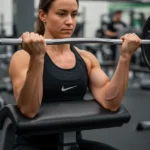
🏋️ Preacher Curl
Target: Biceps brachii short head (peak contraction emphasis)
How: Rest upper arms on the preacher pad at approximately 45°. Curl from full elbow extension to maximum flexion. The pad prevents elbow drift and momentum use.
Key point: Research confirms the preacher curl produces concentrated activation at peak contraction but lower activation in the early phase. Best used as an accessory, not a primary movement.
🏋️ Hammer Curl
Target: Brachialis, brachioradialis
How: Hold dumbbells with a neutral grip (thumbs up). Curl without supinating the wrist. Can be performed alternating or simultaneously.
Key point: The neutral grip removes the supination component, shifting load to the brachialis. Because the brachialis pushes the biceps upward, developing it contributes to visible arm thickness and peak.
Deload After the 8-Week Program
After completing the 8-week cycle, a deload week (reducing training volume by approximately 40–50% with the same or slightly reduced load) may support recovery of connective tissue and prevent accumulated fatigue from building into overuse injury.
During a deload week, maintaining the movement pattern with lighter loads preserves neuromuscular skill and maintains training habit without adding to the cumulative fatigue of the preceding high-volume weeks.
How to Progress After the 8-Week Program
After the deload, one of the following progression strategies may be applied:
Increase starting loads: Begin a second 8-week cycle with loads approximately 5–10% heavier than the first cycle’s Week 1
Change primary exercises: Swap the EZ-bar curl for a barbell curl, or the incline dumbbell curl for a cable curl to provide a different mechanical stimulus
Increase weekly set count: Begin the second cycle at the volume where the first cycle peaked — 14–16 sets per week — and build toward 18–20
Introduce specialisation techniques: Add drop sets, rest-pause sets, or slow eccentrics to the final set of each exercise to extend the training stimulus
📌 Key Point
Long-term bicep development typically follows a pattern of progressive training cycles rather than continuous linear loading. Planning deloads and programme transitions in advance — rather than training until performance stagnates — is a practical strategy for sustained progress.
Tracking Progress in the 8-Week Programme
Tracking training performance across the 8-week cycle allows objective assessment of whether progressive overload is occurring. Key metrics to log for each session include:
Load used per exercise: Record the weight for each exercise and set
Reps completed: Note whether the target rep range was achieved on all sets
Perceived effort (RPE): Rate of perceived exertion on a 1–10 scale — if completing target reps feels easier at the same load, this signals readiness to increase load at the next session
Arm measurements: Optional — measure upper arm circumference at the same point (midway between shoulder and elbow, flexed) at Weeks 1, 4, and 8
Nutrition Considerations for Bicep Development
Muscle hypertrophy requires adequate protein intake alongside appropriate training stimulus. Evidence-based guidelines generally recommend 1.6–2.2 g of protein per kg of body weight per day for individuals engaged in consistent resistance training.
Distributing protein intake across 3–5 meals throughout the day, with at least one protein-containing meal within a few hours of training, may support muscle protein synthesis more effectively than consuming the same total amount in one or two large meals.
Adequate total calorie intake — at or slightly above maintenance for those prioritising muscle gain — provides the energy substrate needed for both training performance and tissue repair and growth.
✅ Quick Takeaway: Consistent adherence to a progressive programme, sufficient protein intake, and adequate sleep are likely more impactful for bicep development than any specific curl variation or technique detail.
Sample Session Structure for the 8-Week Programme
Below is an example of how a single training session from Phase 2 of the programme may be structured, including warm-up and cool-down considerations:
Order
Exercise
Sets × Reps
Rest
Warm-up
Light dumbbell curl (50% work weight)
2 × 15
45 sec
A1
Barbell curl
4 × 10
90 sec
B1
Incline dumbbell curl
3 × 10
75 sec
C1
Hammer curl
3 × 12
60 sec
D1
Preacher curl (peak contraction hold)
2 × 12
60 sec
Cool-down
Bicep stretches (doorframe stretch, overhead)
2 × 30 sec per arm
—
Adapting the Programme for Different Schedules
The programme is designed around two dedicated bicep sessions per week. For trainees who integrate bicep work into full-body or upper body days, the following adjustments may be made:
Upper/lower split: Add 2–3 curl sets at the end of each upper body day — the volume per session is lower, but frequency (2×/week) is maintained
Push/pull/legs split: Add 3–4 curl sets at the end of pull days — biceps receive direct work after already being stimulated by compound pulling exercises
Full-body split (3×/week): Add 2 curl sets per session — biceps are trained 3× per week at lower per-session volume, which some research suggests may be advantageous for muscle protein synthesis frequency
📌 Key Point
The most effective programme is one that is consistently followed. Adapting the template to a training schedule that fits your weekly routine — rather than forcing an inconvenient structure — typically leads to better long-term adherence and results.
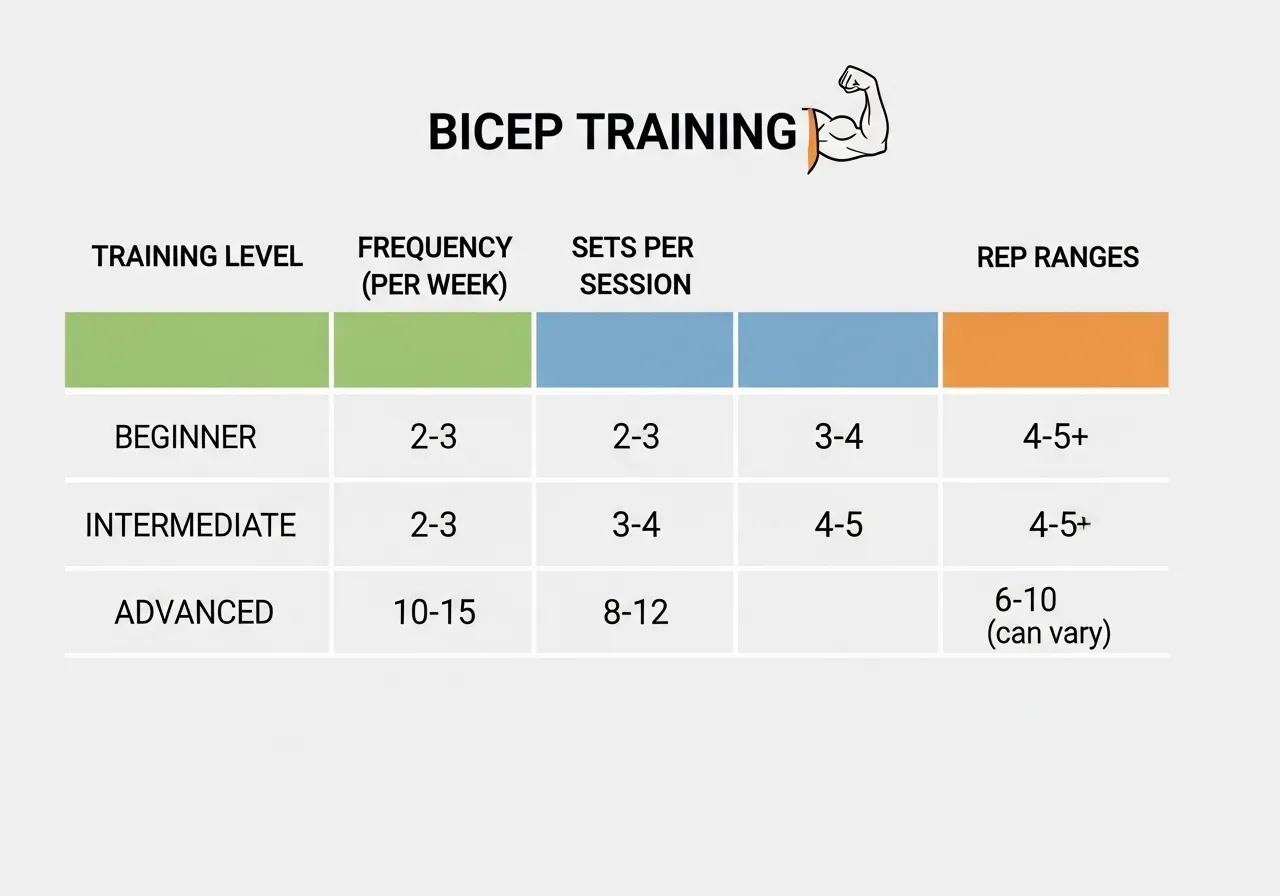
Bicep Curl Programming: Volume, Frequency, and Intensity
Weekly Volume Guidelines
According to NSCA evidence-based guidelines on resistance training volume, muscle hypertrophy responds to progressive increases in weekly training volume — with most intermediate trainees benefiting from a range of 10–20 weekly sets per muscle group.
Training Level
Weekly Sets (Biceps)
Frequency
Beginner
6–10 sets
2× per week
Intermediate
10–16 sets
2–3× per week
Advanced
16–20 sets
3× per week
Note: Back training (rows, pull-up guide, lat pulldowns) provides indirect bicep stimulus. Trainees with high back training volume may require fewer direct curl sets to achieve adequate weekly bicep volume.
Rep Ranges and Intensity
Bicep hypertrophy can be stimulated across a range of rep zones. Rather than relying solely on the classic 8–12 rep range, rotating through different intensities may help target different aspects of muscle adaptation:
4–6 reps @ ~85% 1RM: Strength-focused — develops the neurological capacity to use heavier loads in moderate rep work
8–12 reps @ 67–80% 1RM: Classic hypertrophy zone — balances mechanical tension and time under tension
15–20 reps @ ~60% 1RM: Metabolic stress emphasis — useful for accumulation phases and as finisher sets
Rest Intervals Between Sets
For hypertrophy-focused curl training, rest intervals of 60–90 seconds between sets may be appropriate for moderate rep ranges. Strength-focused sets at heavier loads may benefit from 2–3 minutes to allow adequate neuromuscular recovery.
✅ Quick Takeaway: Weekly volume and progressive overload are more important than any single rep range. Choose a rep zone, progress consistently, and rotate zones every 4–6 weeks.
Is it safe to train biceps with elbow or wrist pain?
It depends on the type and severity of discomfort. General muscle soreness after a new exercise or increased volume is typically a normal adaptive response and not a reason to stop training.
However, sharp joint pain, tendon pain at the elbow insertion, or wrist pain during loaded supination may indicate conditions requiring assessment by a sports medicine professional or physiotherapist before continuing bicep curl training.
Common modifications for trainees managing elbow sensitivity include switching to an EZ-bar (which reduces wrist rotation stress), reducing load and increasing reps, or temporarily substituting cable curls which allow a more controlled resistance profile.
What is the best single curl exercise for overall development?
There is no single best exercise — each variation trains the elbow flexors with a different emphasis. If only one exercise were to be selected, the EZ-bar curl may offer a practical balance of high EMG activation, wrist comfort, and easy load progression.
However, for complete elbow flexor development — including the brachialis and brachioradialis — including at least one neutral-grip exercise (hammer curl) alongside a primary supinated curl is a more comprehensive approach.
How many sets of curls should I do per session?
For most intermediate trainees, 6–10 sets of direct bicep work per session may be appropriate when training biceps twice per week. This distributes the weekly volume across two sessions, which research suggests may support better muscle protein synthesis frequency compared to performing all sets in a single session.
If bicep training is performed only once per week, performing 10–14 sets in that session may be needed to achieve a sufficient weekly stimulus — though recovery demands will be higher.
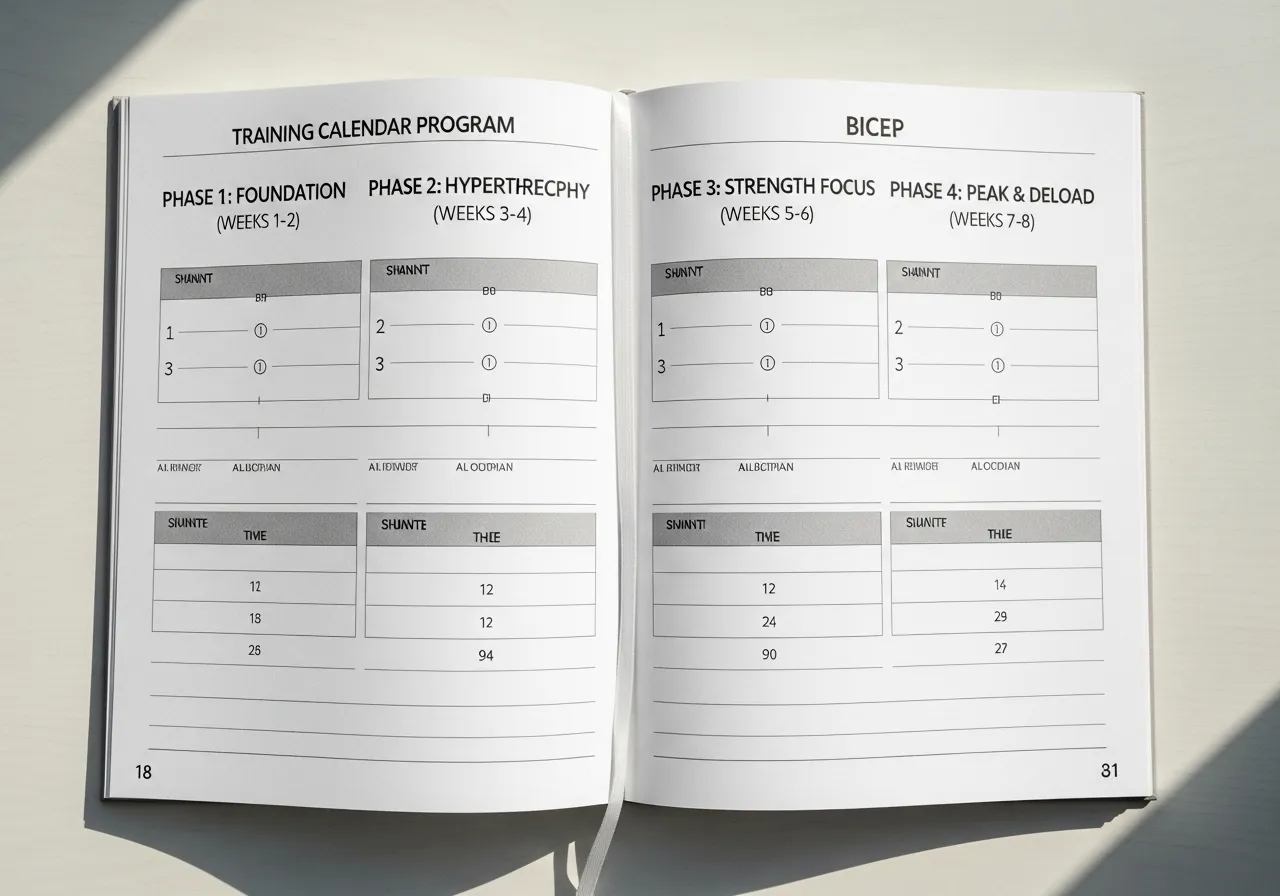
8-Week Bicep Curl Training Program
Program Overview
This program is structured around 2 bicep-focused sessions per week, each lasting 20–30 minutes when added to a full training session, or approximately 45 minutes as a standalone arm session.
Sessions should be separated by at least 48 hours to allow adequate muscle protein synthesis and connective tissue recovery between sessions.
📅 Phase 1 — Weeks 1–2: Foundation
EZ-bar curl: 3 × 12 @ moderate load — focus on strict form and full ROM
Preacher curl: 2 × 12 — max contraction, slow eccentric
Focus: Highest volume phase (~16 sets/week). Deload after Week 8.
Sample Session Structure for the 8-Week Programme
Below is an example of how a single training session from Phase 2 of the programme may be structured, including warm-up and cool-down considerations:
Order
Exercise
Sets × Reps
Rest
Warm-up
Light dumbbell curl (50% work weight)
2 × 15
45 sec
A1
Barbell curl
4 × 10
90 sec
B1
Incline dumbbell curl
3 × 10
75 sec
C1
Hammer curl
3 × 12
60 sec
D1
Preacher curl (peak contraction hold)
2 × 12
60 sec
Cool-down
Bicep stretches (doorframe, overhead)
2 × 30 sec per arm
—
Adapting the Programme for Different Training Splits
The 8-week programme is designed around two dedicated bicep sessions per week. For trainees who integrate bicep work into upper body or full-body days, the following adjustments may be made without changing the total weekly volume:
Upper/lower split: Add 2–3 curl sets at the end of each upper body day — frequency is maintained at 2× per week at lower per-session volume
Push/pull/legs split: Add 3–4 curl sets at the end of pull days — biceps receive direct work after being stimulated by compound rowing and pulldown exercises
Full-body split (3×/week): Add 2 curl sets per session — biceps are trained 3× per week at lower per-session volume, which may support higher muscle protein synthesis frequency
Post-Programme: What to Do After Week 8
After completing the 8-week cycle, a deload week — reducing training volume by approximately 40–50% at the same or slightly reduced loads — may support connective tissue recovery and prevent cumulative fatigue from carrying into the next training block.
To continue progressing after the deload, one of the following strategies may be applied to the next training cycle:
Increase starting loads by approximately 5–10% compared to Week 1 of the previous cycle
Change one or two primary exercises to provide a different mechanical stimulus — for example, replacing the barbell curl with a cable curl
Begin at the volume level where the first cycle peaked (~14–16 sets per week) and build toward 18–20 sets across the next cycle
📌 Key Point
Long-term bicep development follows progressive training cycles rather than continuous linear loading. Planning deload weeks and programme transitions in advance helps prevent accumulated fatigue from limiting long-term progress.
Frequently Asked Questions About Bicep Curls
Are bicep curls necessary if I already do a lot of back training?
Not necessarily for beginners, but direct curl work may become beneficial as training experience increases.
Back exercises such as pull-ups, rows, and lat pulldowns provide substantial bicep stimulus — particularly underhand-grip variations. However, as the muscles surrounding the biceps become stronger through compound training, the biceps may become a limiting factor that benefits from targeted work.
Why do I feel curls more in my forearms than my biceps?
This may indicate one of the following:
Load too heavy: Excess weight recruits the brachioradialis and forearm flexors as compensators
Grip not supinated: A non-supinated grip reduces biceps brachii activation and shifts load to the forearm musculature
Elbow drifting forward: Allowing the elbows to swing forward reduces the moment arm and shifts tension away from the biceps
Should I train biceps on the same day as back?
Either approach may be effective. Training biceps after back (when the biceps are already partially fatigued from pulling exercises) means lighter loads will be needed — but this is not necessarily a disadvantage for hypertrophy, as long as sufficient volume is completed.
Training biceps on a separate day allows full freshness, which may support heavier loading. The best option is likely the one that fits most consistently into a weekly schedule.
How long does it take to see visible bicep growth?
Visible changes in muscle size typically require 8–12 weeks of consistent progressive overload, combined with adequate protein intake (approximately 1.6–2.2 g per kg of body weight per day) and recovery.
Neuromuscular adaptations (improved recruitment and motor pattern) often occur within the first 3–4 weeks, which may be experienced as feeling stronger before visible size changes appear.
Is it better to curl with both arms at the same time or alternating?
Both approaches may be effective. Bilateral curls (both arms simultaneously) allow heavier loading and more time-efficient sessions. Alternating unilateral curls may allow greater focus on each arm individually and can help identify and address side-to-side strength differences.
Including both in a programme may offer a practical compromise across training phases.
⚠️ Fitness Disclaimer: The information in this article is for general educational purposes only and does not constitute professional fitness or medical advice. Always consult a qualified healthcare professional before starting any new exercise program. The dumbbell vs barbell bench Plateau Nobody Talks About Honestly I hit 100kg on the bench press and then —…
⚠️ Health & Fitness DisclaimerThis article is for general educational and informational purposes only and does not replace professional medical or fitness advice. If you have any pre-existing shoulder, elbow, or wrist condition — please consult a qualified healthcare professional before beginning any pull-up program. The pull-up is widely regarded as the gold standard of…
⚠️ Fitness Disclaimer: The information in this article is for general educational purposes only and does not constitute professional fitness or medical advice. Exercise carries inherent risks. Always consult a qualified healthcare professional or certified personal trainer before starting or modifying any exercise program, especially if you have a pre-existing medical condition, injury, or health…
Why the Barbell Row Is the Most Misunderstood Back Exercise in the Gym I spent three years doing barbell rows without ever actually feeling them in my back. I would load up the bar, bend over, and pull — and walk away with tired biceps and a sore lower back, wondering why my back never…
⚠️ Fitness Disclaimer: The information in this article is for general educational purposes only and does not constitute professional fitness or medical advice. Always consult a qualified healthcare professional before starting any new exercise program, especially if you have existing injuries or medical conditions. Why the Front Squat Is the Smarter Squat for hack squat…
⚠️ Health & Fitness DisclaimerThis article is for general educational purposes only and does not replace professional medical advice. If you have any elbow, shoulder, or wrist conditions, please consult a qualified healthcare professional before beginning any tricep training programme. The triceps brachii makes up roughly two-thirds of upper arm mass — yet most trainees…