⚠️ Health & Fitness Disclaimer This article is for general educational and informational purposes only. It does not replace professional medical or fitness advice. If you have any pre-existing shoulder, neck, or upper back condition — please consult a qualified healthcare professional or certified personal trainer before starting or modifying any pressing program.
The overhead press is the most direct test of vertical pushing strength — and one of the most technically demanding upper body movements in resistance training.
Whether performed with dumbbells, a barbell, or a machine, the overhead press develops the deltoids, triceps, and upper trapezius in a way that no horizontal pressing movement can replicate.
This guide covers the EMG research on shoulder press variations, breaks down technique for standing and seated versions, addresses the most common shoulder concerns, and provides a complete programming approach from beginner to intermediate level.
Shoulder Press Anatomy: The Muscles Trained and How Load Position Changes the Stimulus
Primary and Secondary Muscles
Muscle
Role During Overhead Press
Activation Level
Anterior Deltoid (front)
Primary shoulder flexor — the main driver of the upward press
Very High
Medial Deltoid (middle)
Shoulder abduction — widens the shoulders and assists the press
High
Triceps Brachii
Elbow extension — drives the final phase of the press
High
Upper Trapezius
Scapular elevation and upward rotation during overhead movement
Moderate–High
Serratus Anterior
Scapular protraction and upward rotation — essential for safe overhead movement
The practical implication: standing overhead pressing requires more muscle activation per kilogram of load than seated pressing — but maximum load capacity is highest in the seated position due to external stabilization from the bench.
This makes the overhead press irreplaceable for complete shoulder development — it occupies a distinct training role that incline and flat pressing cannot fill.
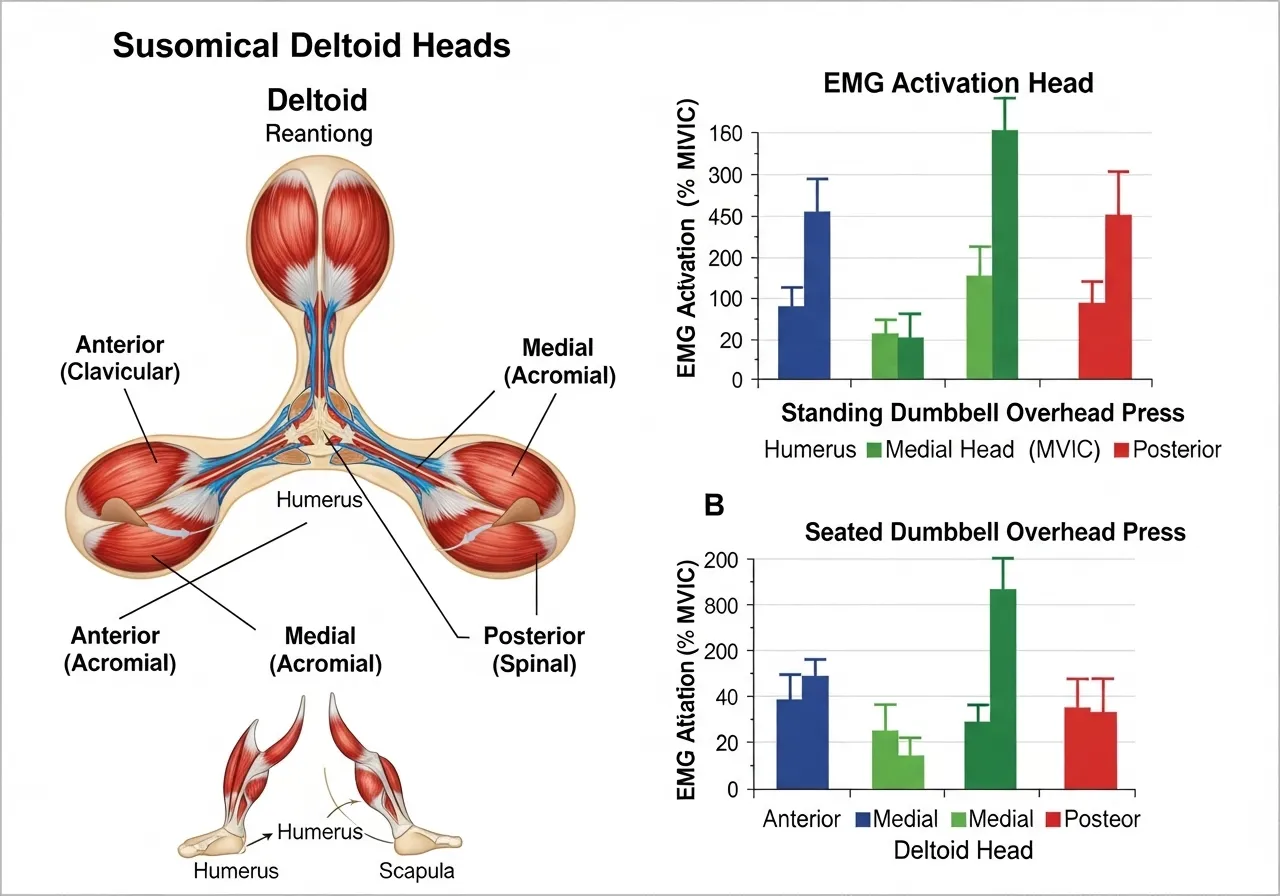
The Three Deltoid Heads and Why All Three Matter
The deltoid muscle has three distinct heads (portions), and developing all three produces the “rounded shoulder” appearance associated with shoulder muscularity:
Anterior deltoid: Trained by overhead pressing, front raises, and incline pressing — typically the most developed head in pressing-heavy programs
Medial deltoid: Best trained by lateral raises and overhead pressing — responsible for the “width” of the shoulder when viewed from the front
Posterior deltoid: Trained by face pulls, rear delt flyes, and horizontal row variations — often underdeveloped relative to the anterior head in most gym programs
A complete shoulder development program includes all three — the overhead press primarily develops the anterior and medial heads, while rear delt work should be included separately to maintain balance and shoulder joint health.
Why the Overhead Press Is Often Underutilized
In many gym programs, the overhead press is either absent entirely or treated as an accessory movement after heavy bench pressing — despite the evidence that it develops distinct shoulder musculature that horizontal pressing cannot replicate.
Several factors contribute to this underutilization:
The overhead press requires more mobility (shoulder flexion range, thoracic extension) than horizontal pressing — trainees with desk-worker posture often find it uncomfortable initially
Overhead press loads are always lower than bench press loads, which some trainees interpret as the movement being “weaker” or less important
Shoulder discomfort during early pressing attempts leads many trainees to abandon the movement rather than address the technical or mobility factors causing it
Working through these initial barriers — with appropriate technique instruction and gradual load progression — typically produces the anterior deltoid and upper shoulder development that distinguishes a well-balanced physique from one that is bench-press-dominant.
Overhead Pressing and Thoracic Mobility
The ability to press directly overhead without compensating through lumbar hyperextension requires adequate thoracic spine extension (the ability of the mid-back to extend into an upright or slightly backward position).
Many individuals with desk-based work or forward-leaning postures have reduced thoracic extension — which forces the lumbar spine to hyperextend when attempting to reach true overhead extension.
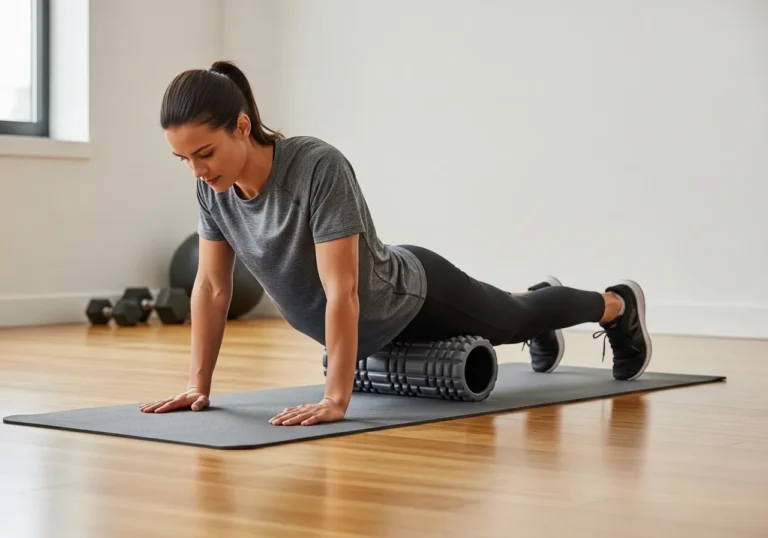
A brief pre-pressing thoracic mobility routine — 10 thoracic spine extensions over a foam roller, 10 thread-the-needle movements per side — may meaningfully improve overhead pressing comfort for individuals with stiffness in the mid-back.
Including this as a 5-minute pre-session routine before overhead pressing often accelerates the development of press technique quality more than additional technical cuing alone.
Range of Motion in the Overhead Press: Full Extension Matters
Research on overhead press muscle activation consistently shows that greater range of motion — specifically reaching full arm extension at the top — produces meaningfully higher activation across all assessed shoulder muscles compared to partial-range pressing.
Many trainees instinctively stop the press slightly short of full extension — either from habit, discomfort, or concern about joint stress at the top position.
For healthy shoulders, full overhead extension (arms straight above the head) is not inherently stressful and may actually produce better long-term shoulder stability by training the serratus anterior and upper trapezius through their full functional range.
If full overhead extension causes discomfort specifically at the top position — rather than as a general shoulder ache — this warrants assessment by a physiotherapist to identify whether the cause is a technique issue, mobility limitation, or a structural concern requiring treatment.
Overhead Press in a Complete Upper Body Program
For complete upper body development, the overhead press complements rather than competes with horizontal pressing exercises:
Exercise Category
Example
What It Develops That Overhead Press Does Not
Horizontal push
Bench press, push-up
Pectoralis major (chest), lower anterior deltoid
Vertical pull
Lat pulldown, pull-up
Latissimus dorsi, biceps
Horizontal pull
Barbell row, cable row
Mid-back, rear deltoid, biceps
Isolation (rear delt)
Face pull, rear delt fly
Posterior deltoid — crucial for shoulder balance
A weekly program including one vertical press, one horizontal press, one vertical pull, one horizontal pull, and dedicated rear deltoid work provides comprehensive upper body development that the overhead press alone cannot achieve.
This balanced approach to upper body programming produces the symmetrical shoulder development and long-term joint health that pressing alone cannot reliably achieve over a multi-year training career.
Dumbbell vs. Barbell vs. Machine Shoulder Press
Dumbbell Overhead Press
The dumbbell press allows independent arm movement — each arm works separately, which:
Corrects left-right strength imbalances (one arm cannot compensate for the other)
Allows a more natural pressing arc — the dumbbells can travel slightly inward at the top for a more comfortable shoulder position
Requires more stabilization from the rotator cuff and serratus anterior throughout the movement
Limits absolute load compared to barbell pressing — each arm works harder per unit of load
The barbell press allows higher absolute loads and provides a fixed bar path — advantages for maximal strength development and precise progressive overload tracking.
The barbell press can be performed:
Standing: Greater core and total body stabilization demand — a full-body exercise with the highest functional transfer; lower absolute loads
Seated: External back support reduces core demand; allows heavier loads; appropriate for hypertrophy-focused training
Behind the neck (not recommended): Places the cervical spine in forced flexion and the shoulder in an extreme external rotation position — no activation advantage over front pressing, with meaningfully higher injury risk
Machine Shoulder Press
Machine presses provide a fixed movement path, external seat support, and precise load increments — making them accessible for beginners and appropriate for rehabilitation contexts.
The machine reduces stabilization demand significantly — which lowers injury risk but also reduces the serratus anterior and rotator cuff activation that contributes to shoulder health when trained over time.
Machine presses are most appropriate as a supplementary volume exercise or when free-weight pressing is temporarily contraindicated (not recommended due to a condition or circumstance).
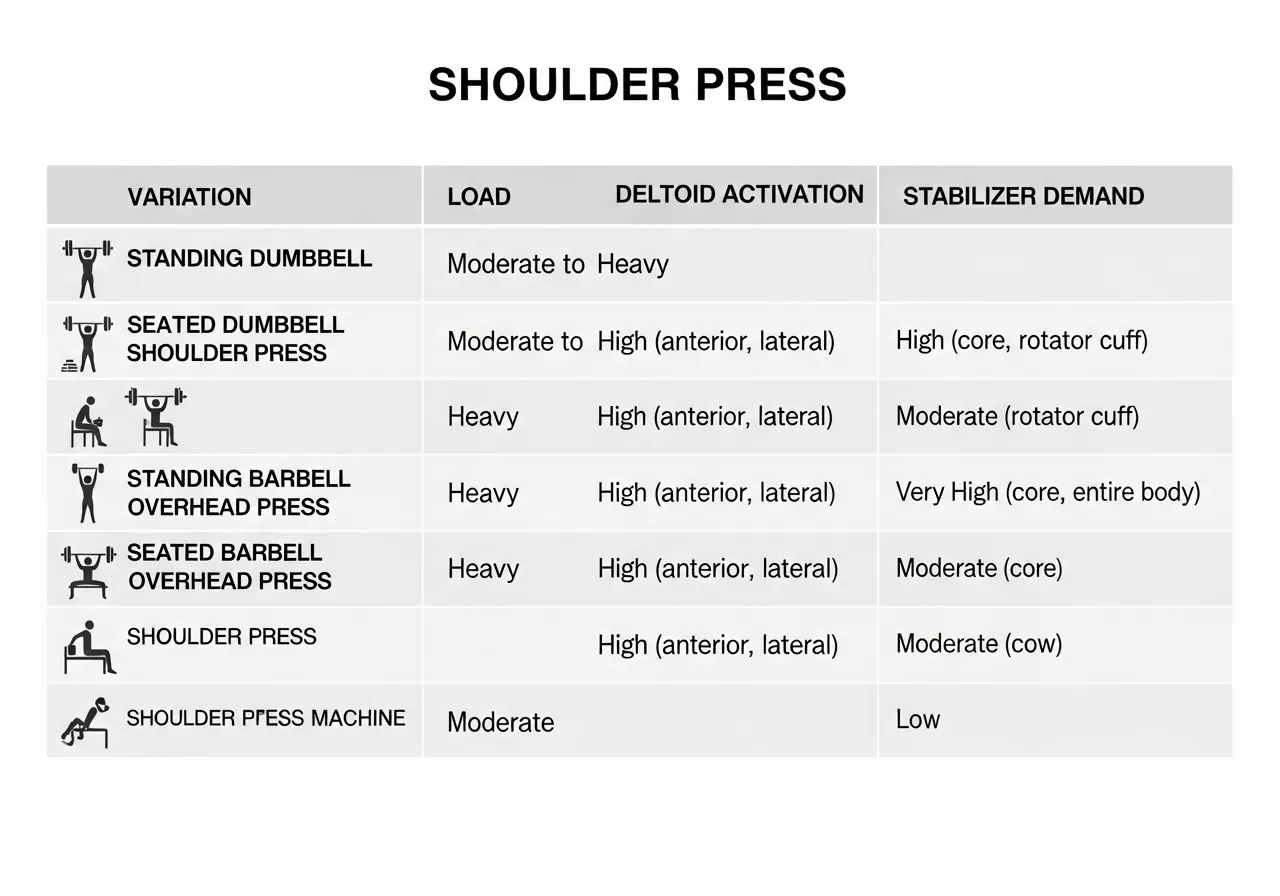
Variation Comparison Summary
Variation
Load Capacity
Deltoid Activation
Stabilizer Demand
Best For
Standing Dumbbell
Lowest
Highest per kg
Highest
Shoulder health + deltoid activation
Seated Dumbbell
Moderate
High
Moderate
Hypertrophy; asymmetry correction
Standing Barbell
Moderate-High
High
High
Strength; functional overhead pressing
Seated Barbell
Highest
Moderate-High
Moderate
Maximal strength; heavy loads
Machine Press
Precise
Moderate
Lowest
Beginners; rehabilitation; accessory volume
The Arnold Press: A Notable Variation
The Arnold Press — named after Arnold Schwarzenegger — combines a rotating motion with the overhead press: dumbbells start in a pronated position in front of the shoulders (similar to the top of a curl) and rotate to the standard palms-forward position during the press.
Research comparing the Arnold Press to standard overhead dumbbell pressing found that the Arnold Press produces significantly greater anterior and medial deltoid activation — attributed to the greater range of motion the rotating grip creates through the shoulder’s full movement arc.
The Arnold Press is most appropriate for intermediate to advanced trainees comfortable with standard pressing technique — the rotating motion requires more shoulder mobility and coordination than the standard version.
Single-Arm Dumbbell Press
Performing the overhead press with one arm at a time — while seated or standing — increases core and hip stability demand as the body resists lateral flexion against the unilateral load.
Identifies and addresses left-right strength imbalances — if one shoulder is significantly weaker, bilateral pressing masks this disparity
Increases serratus anterior and oblique demand compared to bilateral pressing
Useful as an occasional variation or during periods when a bilateral load is temporarily contraindicated due to injury
Smith Machine Shoulder Press: A Useful Compromise
The Smith machine shoulder press — pressing a barbell on a fixed vertical track — sits between a machine press and a free-weight barbell press in terms of stability and activation profile.
The fixed path prevents the bar from drifting forward or backward, removing one dimension of stabilization demand while retaining the others.
Smith machine pressing may be appropriate for:
Beginners developing the overhead pressing motor pattern before transitioning to free weights
Individuals returning from shoulder injury who need a controlled, guided movement path during the early stages of reloading
Advanced trainees who use it specifically for higher-rep accessory volume after heavy free-weight work
The Smith machine is not a long-term primary overhead pressing tool for most trainees — the fixed path prevents the natural scapulohumeral (shoulder blade and arm bone) rhythm (the coordinated movement of the scapula and humerus during arm elevation) that free-weight pressing develops.
Most experienced trainers recommend working through all major variations over the course of a complete yearly training plan to ensure no aspect of shoulder strength or stability is neglected.
Overhead Press Technique: Seated and Standing
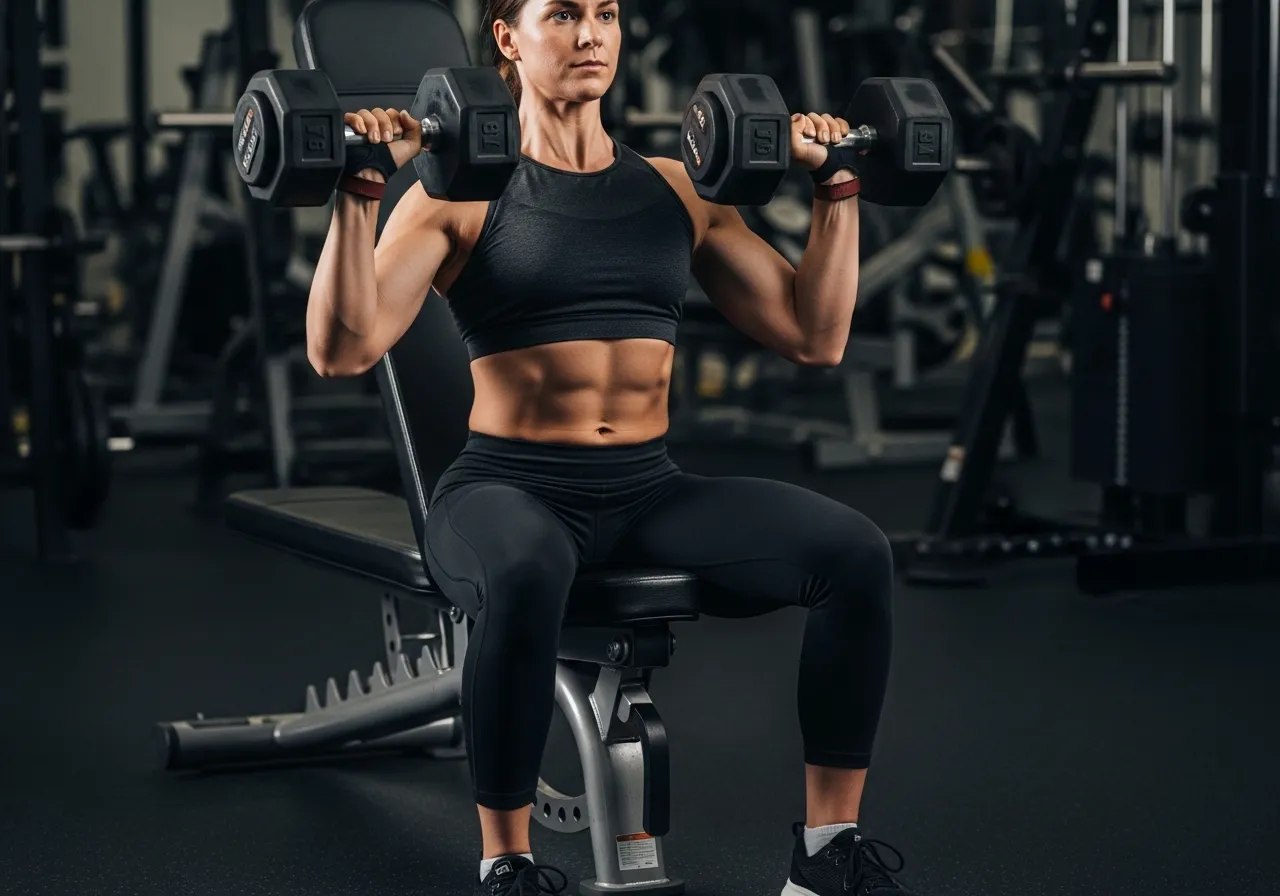
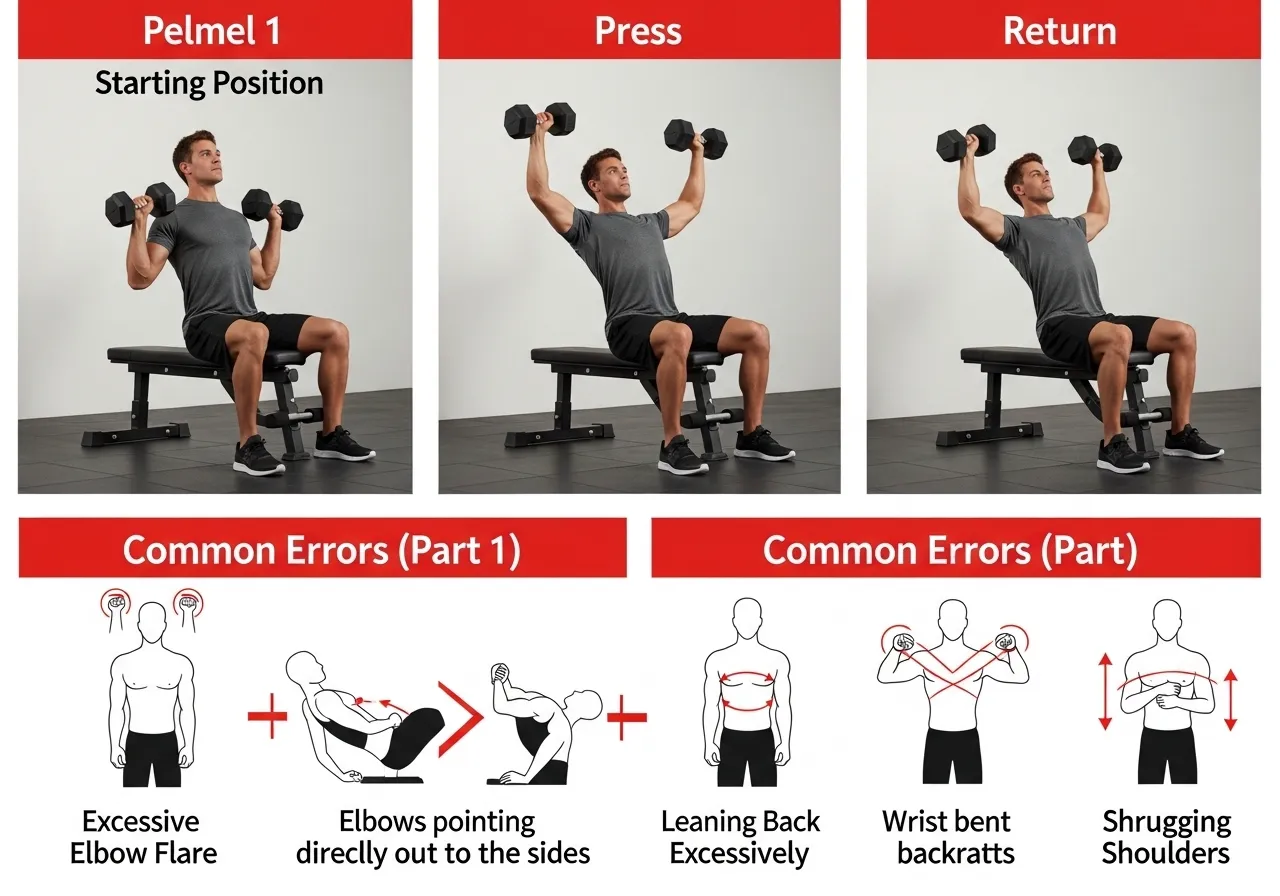
Setup: Seated Dumbbell Shoulder Press
Sit on a bench with back support, back pressed firmly against the pad
Hold dumbbells at shoulder height, elbows bent at approximately 90°, palms facing forward (or slightly inward for a neutral grip)
Feet flat on the floor, core braced before beginning each set
Starting position: upper arms parallel to the floor or slightly above — the exact “shelf” where the dumbbells rest at the bottom
The Press Phase
Step 1: Press both dumbbells upward simultaneously, allowing them to travel slightly inward as they rise — they should converge toward each other at the top without touching. Step 2: At full extension, the elbows should be locked or nearly locked, arms straight overhead — not stopped midway. Step 3: The head and neck remain neutral throughout — a common error is jutting the chin forward to “make room” for the bar or dumbbells. Step 4: Exhale during the press phase.
The Return Phase
Step 5: Lower the dumbbells in a controlled manner — 2–3 seconds down is the recommended eccentric tempo. Step 6: Return to the starting position with upper arms approximately parallel to the floor — do not drop below this point, as the shoulder ligaments bear increased stress when the elbows descend significantly below shoulder height at the bottom. Step 7: Inhale during the return phase. Reset core brace before the next rep.
Standing Overhead Press: Additional Cues
The standing press requires active management of the entire body’s position:
Foot position: Shoulder-width stance, feet parallel or slightly turned out — a stable base is essential
Hip and core bracing: A slight forward pelvic tilt and braced core prevent the lower back from hyperextending as the weight overhead creates a forward bending moment
The “lean-back trap”: Many trainees lean excessively backward as the weight gets heavy — this increases lumbar loading and reduces the shoulder-pressing stimulus. A mild lean (5–10°) is natural; anything beyond this reduces the overhead pressing challenge
5 Common Technique Errors
Error
Risk
Correction
Elbows too far forward (internally rotated starting position)
Shoulder impingement risk
Elbows at or slightly in front of the coronal plane (side-to-side plane through the body)
Not fully extending at the top
Reduced deltoid and triceps activation at end-range
Keep wrists stacked directly over elbows — neutral wrist position
Grip Width for Barbell Overhead Press
For the barbell overhead press, grip width affects:
Narrow grip (inside shoulder width): Increases triceps involvement; may be uncomfortable for some wrists
Shoulder-width grip: Standard starting position — balanced between deltoid and triceps emphasis
Wide grip (outside shoulder width): Reduces range of motion; may increase shoulder stress at the bottom position
The shoulder-width or slightly wider grip is the most commonly recommended starting position — adjustments within a comfortable range are appropriate based on individual shoulder anatomy and mobility.
Shoulder Press Warm-Up Protocol
Preparing the shoulder complex before heavy overhead pressing reduces injury risk and improves the quality of working sets:
Recommended 10-minute pre-press warm-up:
✅ Arm circles — 15 each direction (increases shoulder blood flow and range of motion)
✅ Band pull-aparts — 2 × 20 (activates posterior deltoid and scapular retractors)
✅ Band external rotations — 2 × 15 per side (activates infraspinatus and teres minor)
✅ Light overhead press — 2 × 12 @ 40% (movement rehearsal with minimal load)
✅ First working set warm-up @ 65% × 5 before main working sets
Shoulder Press for Athletes
Overhead pressing strength has direct sport relevance for athletes in several disciplines:
Throwing sports (baseball, volleyball, handball): Overhead pressing develops the anterior deltoid and triceps strength underlying throwing power — though sport-specific overhead mobility patterns are also needed
Swimming: Shoulder pressing strength contributes to pull-through power in freestyle and butterfly strokes — the combination of overhead press and external rotation training reflects the force-velocity demands of swimming
Combat sports: Pushing strength in the overhead plane contributes to clinch control and shove mechanics
Olympic weightlifting: The overhead position in the snatch requires both overhead press strength and the shoulder stability to maintain a locked overhead position under maximal load
Nutrition Timing for Shoulder Press Sessions
Overhead pressing sessions — particularly heavy strength-focused sessions — benefit from appropriate pre-training nutrition:
1–3 hours before: A balanced meal containing carbohydrates and protein supports the energy demands and neuromuscular performance of heavy pressing sets
Post-session protein: 20–40 g of protein within 1–3 hours supports the shoulder muscle protein synthesis that heavy pressing stimulates — particularly relevant for trainees specifically aiming to develop deltoid size
Hydration: Adequate hydration supports muscular endurance across multiple working sets — dehydration of even 2% body weight can meaningfully reduce strength performance
These guidelines reflect general nutritional principles for resistance training — individual needs vary based on body size, training intensity, and overall dietary habits.
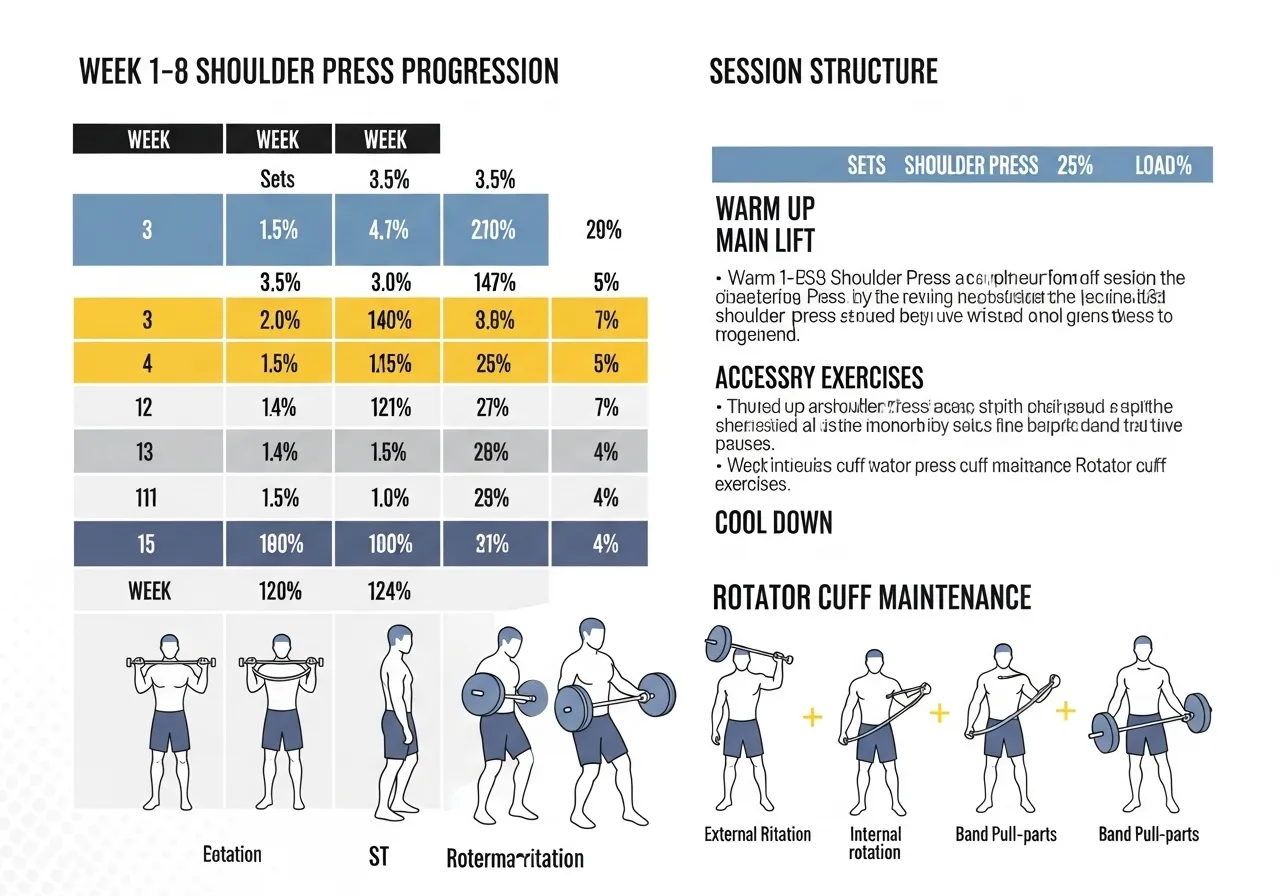
Shoulder Press Programming: Sets, Reps, and 8-Week Progression
Place the overhead press early in an upper body session — it is a technically demanding compound movement that benefits from full neurological freshness
2× per week is a practical starting frequency — once as primary push with heavy load, once as secondary volume with moderate load
48–72 hours minimum between heavy overhead press sessions — the anterior deltoid, triceps, and upper trapezius require adequate recovery before reloading
Combining Overhead Press With a Complete Shoulder Program
This structure ensures all three deltoid heads receive dedicated stimulus — the overhead press for anterior and medial, lateral raises for medial, and face pulls for posterior — while the rotator cuff accessories maintain the shoulder health that allows continued heavy pressing over the long term.
When the overhead press plateaus with standard load increases, several proven strategies can restart progress:
Pause reps: Adding a 2-second pause at the bottom (at shoulder height) before pressing eliminates the stretch-shortening cycle (the elastic energy stored and released at the bottom of a movement), forcing the muscles to work harder from a dead stop
Eccentric emphasis: Lowering the weight to a 4–5 second count while maintaining standard press speed — increases time under tension and may accelerate hypertrophy without requiring heavier loads
Half-rep finishers: After completing full-range sets, performing 3–5 partial reps in the top half of the range extends the set past the sticking point using the mechanically stronger position
Variation rotation: Alternating between standing and seated pressing, dumbbell and barbell, each 4–6 week block — prevents accommodation and ensures development across different stability demands
Shoulder Press, Shoulder Health, and Long-Term Development
Shoulder Impingement: When Overhead Pressing Causes Pain
Shoulder impingement syndrome (compression of the supraspinatus tendon and subacromial bursa between the humeral head and the acromion during arm elevation) is one of the most common reasons trainees stop overhead pressing.
The most frequent technical contributors to impingement-related pain during pressing:
Internal rotation at the starting position — elbows too far forward and internally rotated before pressing
Behind-the-neck pressing — places the shoulder in maximum external rotation and horizontal abduction under load
Rapid volume increases without adequate rotator cuff strength to stabilize the shoulder during increased pressing load
Modifying elbow position, reducing load, and adding rotator cuff strengthening (external rotations, face pulls) resolves many technique-related impingement presentations.
Persistent shoulder pain during or after pressing that does not resolve with technique correction requires evaluation by a physiotherapist or sports medicine physician — not simply a different exercise variation.
Rotator Cuff Strengthening: Non-Negotiable for Long-Term Pressers
The rotator cuff is a group of four muscles — supraspinatus, infraspinatus, teres minor, and subscapularis (the acronym SITS is sometimes used to remember them) — that stabilize the humeral head (the ball of the shoulder joint) against the glenoid fossa (the socket) during arm movement.
Heavy overhead pressing without corresponding rotator cuff strengthening creates a progressive imbalance:
The large pressing muscles (anterior deltoid, pectoralis major) become progressively stronger
The rotator cuff muscles — which provide fine stabilization of the joint — may lag behind if not specifically trained
Over time, this imbalance can contribute to superior humeral head migration (the ball riding up in the socket during arm elevation), increasing impingement risk
Including 2–3 sets of external rotation exercises (band external rotation, cable external rotation) in each pressing session is a practical and widely-recommended maintenance approach.
Overhead Press Strength Standards
General strength benchmarks for the seated dumbbell shoulder press at 8-repetition working weight:
Level
Per Dumbbell (8RM)
Note
Beginner (under 6 months)
5–12 kg
Technique development phase
Intermediate (1–3 years)
15–25 kg
Consistent progressive loading
Advanced (3+ years consistent)
28–40 kg+
Long-term strength development
Individual variation based on body weight, arm length, and training history is significant — these figures are population estimates, not personal targets.
Practical Questions About the Shoulder Press
Is it better to press with dumbbells or a barbell?
Both are effective for shoulder development — the choice depends on training goals.
Dumbbells allow greater range of motion, correct asymmetries, and provide higher deltoid activation per kilogram of load at matched effort levels.
Barbells allow heavier absolute loads, simpler progressive overload tracking, and are preferred in strength sport contexts where maximum pressing load is the goal.
Including both in a training program — barbell pressing for strength blocks, dumbbell pressing for hypertrophy blocks — often produces better overall shoulder development than committing exclusively to one modality.
Should beginners use a machine instead of free weights for shoulder pressing?
Machine pressing is appropriate as a starting point for individuals who are new to resistance training and lack confidence with free weights, or those with existing shoulder conditions where the fixed path reduces injury risk.
Transitioning to dumbbell or barbell pressing within 4–8 weeks of machine practice is generally recommended for healthy individuals — the stabilization demand of free-weight pressing develops the shoulder’s muscular and structural resilience that machine pressing cannot fully replicate.
✅ Key Takeaways
The standing dumbbell press produces the highest deltoid activation per kilogram of load — but the lowest absolute load capacity of all press variations
The overhead press uniquely develops the anterior deltoid and upper trapezius in a way that incline and flat pressing cannot replicate
Elbows should be at or slightly in front of the coronal plane at the starting position — not forward and internally rotated, which increases impingement risk
Posterior deltoid and rotator cuff work should always accompany a pressing program for long-term shoulder health
Shoulder pain that does not resolve with technique correction requires professional evaluation before continuing to load the overhead press pattern
Long-Term Shoulder Press Development: What to Expect
Shoulder press strength tends to develop more slowly than bench press strength for most trainees — the shoulder is a more mobile and less stable joint than the shoulder-blade-supported bench press position allows.
Realistic long-term progression for the dumbbell shoulder press:
First 6 months (beginner): Relatively rapid gains of 2.5–5 kg per dumbbell per month as neural adaptations dominate
Months 6–24 (early intermediate): Slower gains of 1–2.5 kg per dumbbell per month as structural adaptations (actual muscle growth) become the primary limiting factor
After 2+ years (intermediate–advanced): Progress may slow to 1–2 kg per dumbbell per month or less — small increments accumulated consistently over years produce substantial long-term strength
This slow progression is not a failure — it reflects the normal adaptation timeline for the shoulder complex.
Consulting a certified strength and conditioning specialist (CSCS) or qualified personal trainer can provide personalized program design that optimizes shoulder development for specific goals, addresses any technical limitations, and ensures the rotator cuff maintenance work needed for injury-free pressing over the long term is included.
The Relationship Between Shoulder Press and Neck/Upper Back Health
The upper trapezius — the muscle running from the neck and upper thoracic spine to the top of the shoulder — is an active contributor to overhead pressing, providing upward rotation of the scapula during arm elevation.
In many desk workers, the upper trapezius is chronically shortened and overactive from forward head posture — making it susceptible to becoming the dominant muscle in pressing rather than working in coordination with the serratus anterior and lower trapezius.
Trainees who consistently feel their neck or upper trap “taking over” during overhead pressing benefit from:
Serratus anterior activation work before pressing sessions (scapular push-ups, serratus punches)
Lower trapezius exercises (Y-T-W movements on an incline bench)
Reducing pressing load to the point where the neck and upper trap domination disappears — then building load gradually from that baseline
A qualified physiotherapist or sports medicine specialist can conduct a specific shoulder movement assessment to identify individual contributors to these patterns and prescribe targeted corrective exercises as needed.
The overhead press, approached with patience and proper technique, has the potential to be a cornerstone upper body strength exercise for decades of productive training.
⚠️ Fitness Disclaimer: The information in this article is for general educational purposes only and does not constitute professional fitness or medical advice. Always consult a qualified healthcare professional before starting any new exercise program. ⚠️ Cardiovascular Health Notice: If you have a history of heart disease, high blood pressure, or any cardiovascular condition, obtain…
Why Running Is the Most Accessible and Most Misstarted Fitness Activity Running has the lowest barrier to entry of any fitness activity — it requires no equipment beyond supportive shoes, no gym membership, and no specific skill level to begin. It is also the fitness activity most commonly attempted and abandoned within the first few…
⚠️ Health & Fitness DisclaimerThis article is for general educational and informational purposes only.It does not replace professional medical or fitness advice.If you have any pre-existing condition, injury, or chronic pain — please consult a qualified healthcare professional or certified personal trainer before starting or modifying any foam rolling or mobility program. Foam rolling has…
⚠️ Fitness Disclaimer: The information in this article is for general educational purposes only and does not constitute professional fitness or medical advice. Always consult a qualified healthcare professional before starting any new exercise program. ⚠️ Cardiovascular Health Notice: If you have a history of heart disease, high blood pressure, or any cardiovascular condition, obtain…
⚠️ Health & Fitness DisclaimerThis article is for general educational and informational purposes only.It does not replace professional medical or fitness advice.If you have any pre-existing condition, injury, or cardiovascular concern — please consult a qualified healthcare professional or certified personal trainer before starting or modifying any exercise program. Battle ropes sit at an unusual…
⚠️ Fitness Disclaimer: The information in this article is for general educational purposes only and does not constitute professional fitness or medical advice. Exercise carries inherent risks. Always consult a qualified healthcare professional or certified personal trainer before starting or modifying any exercise program, especially if you have a pre-existing medical condition, injury, or health…