⚠️ Health & Fitness Disclaimer This article is for general educational and informational purposes only and does not replace professional medical or fitness advice. If you have chronic lower back pain, spinal pathology, or any musculoskeletal condition — please consult a qualified physiotherapist or healthcare professional before beginning any core stability program.
Core stability training has evolved considerably over the past two decades — from its origins in clinical rehabilitation for lower back pain into one of the most widely applied training concepts in both performance sport and general fitness.
Yet the term “core” is frequently misunderstood, and the exercises labeled “core work” in many programs — situps, crunches, and machine-based ab exercises — often address only the superficial layer of the abdominal wall rather than the deep stabilizing muscles that the research consistently identifies as most important for spinal health and athletic performance.
This guide explains the anatomy and function of the core musculature, summarizes what the research shows about the most effective exercises, and provides a complete programming approach from foundational movements to advanced progression.
Understanding the Core: More Than Just Abs
The True Anatomy of the Core
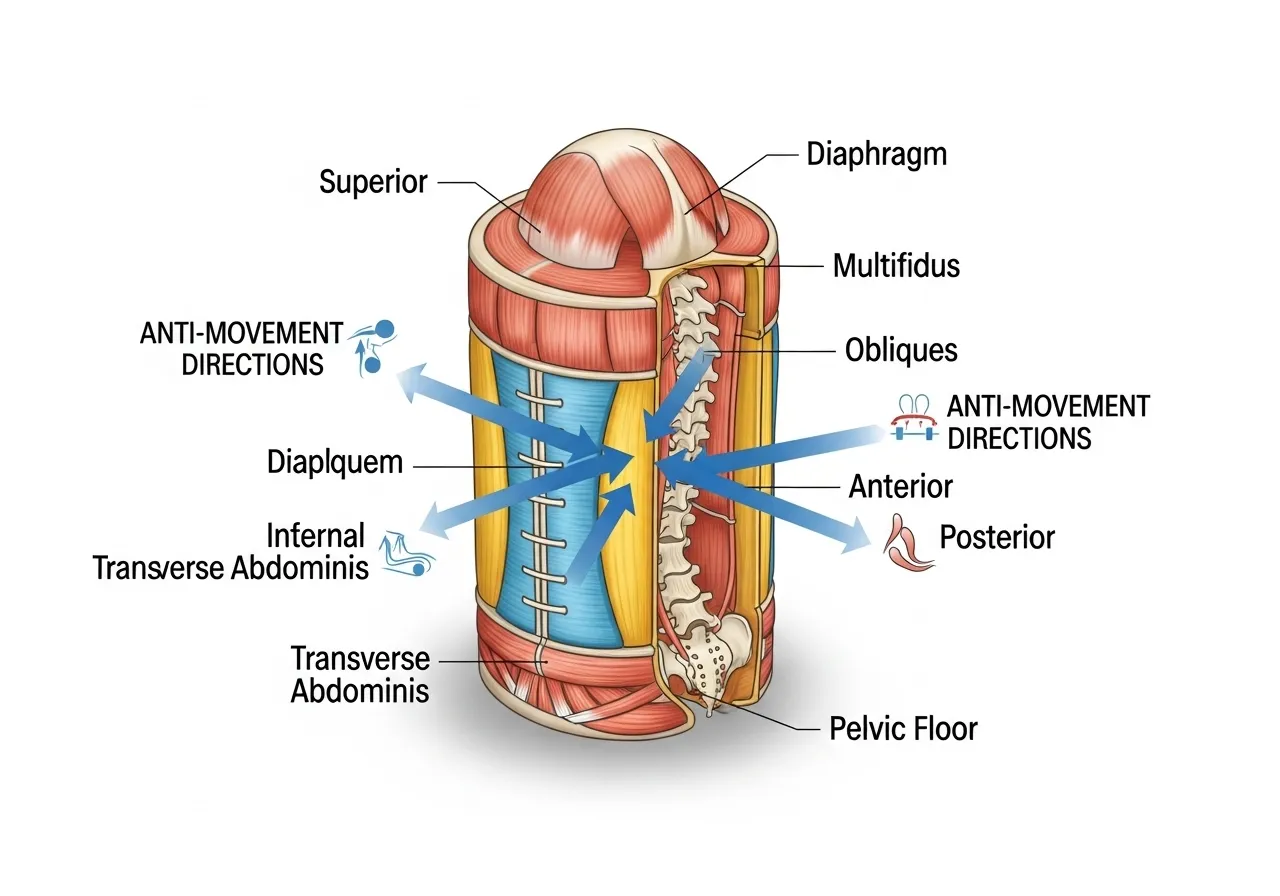
The “core” is not a single muscle — it is a cylindrical system of muscles that encases the lumbar spine and pelvis from all directions, functioning together to stabilize and transfer force rather than to produce movement independently.
The core system comprises four primary structural layers:
Layer
Primary Muscles
Primary Function
Front (anterior)
Rectus abdominis, transverse abdominis
Spinal flexion (RA); deep stabilization (TrA)
Sides (lateral)
Internal and external obliques, quadratus lumborum
Rotation, lateral flexion, anti-lateral-flexion
Back (posterior)
Multifidus, erector spinae
Spinal extension and fine segmental stabilization
Floor/ceiling
Diaphragm (top), pelvic floor (bottom)
Intra-abdominal pressure management
The Transverse Abdominis: The Deep Stabilizer
The transverse abdominis (TrA — the deepest of the abdominal muscles, wrapping horizontally around the abdomen like a corset) is the muscle most closely linked to spinal stability in the research literature.
Unlike the rectus abdominis, which produces trunk flexion, the TrA produces no visible movement when it contracts — it simply stiffens the abdominal wall and increases intra-abdominal pressure, which in turn stabilizes the lumbar spine against external loading.
Research by Stuart McGill and others has established that the TrA activates anticipatorily before limb movement — preparing the spine for load before the load arrives — rather than reactively like superficial muscles. This anticipatory activation is what distinguishes trained core stability from simple abdominal strength.
The Multifidus: The Neglected Back Stabilizer
The multifidus (a group of small, deep muscles running along either side of the spine from the sacrum to the cervical vertebrae) plays a critical role in segmental spinal stabilization — controlling the fine movements between individual vertebrae that larger muscles cannot manage.
Research consistently shows that multifidus atrophy (reduction in muscle size and function) is among the earliest changes observed after a first episode of lower back pain — and that without specific rehabilitation, the multifidus does not spontaneously recover even after pain resolves.
This finding underlies why core stability exercises — particularly those that specifically activate the multifidus — are central to clinical rehabilitation of lower back pain and to prevention of recurrence.
The Distinction Between Core Strength and Core Stability
Core strength and core stability are frequently conflated but are distinct qualities:
Core strength: The maximum force the core muscles can produce — tested by exercises like the plank hold duration or maximum load deadlift
Core stability: The ability to maintain a neutral spine position under dynamic loading conditions — controlling the spine’s position rather than simply producing force around it
Most people who present with lower back pain have adequate core strength — their rectus abdominis and obliques are typically functional. What they lack is the timing and motor control that constitute core stability — the automatic pre-activation of deep stabilizers that protects the spine in everyday and athletic contexts.
This distinction explains why simple ab exercises (crunches, leg raises) frequently fail to resolve lower back pain — they develop superficial core strength without addressing the deep motor control deficit.
What the Research Shows About Core Stability and Back Pain
These findings make core stability training one of the most robustly evidence-supported exercise interventions in clinical practice — not just an athletic performance tool, but a genuine medical rehabilitation approach.
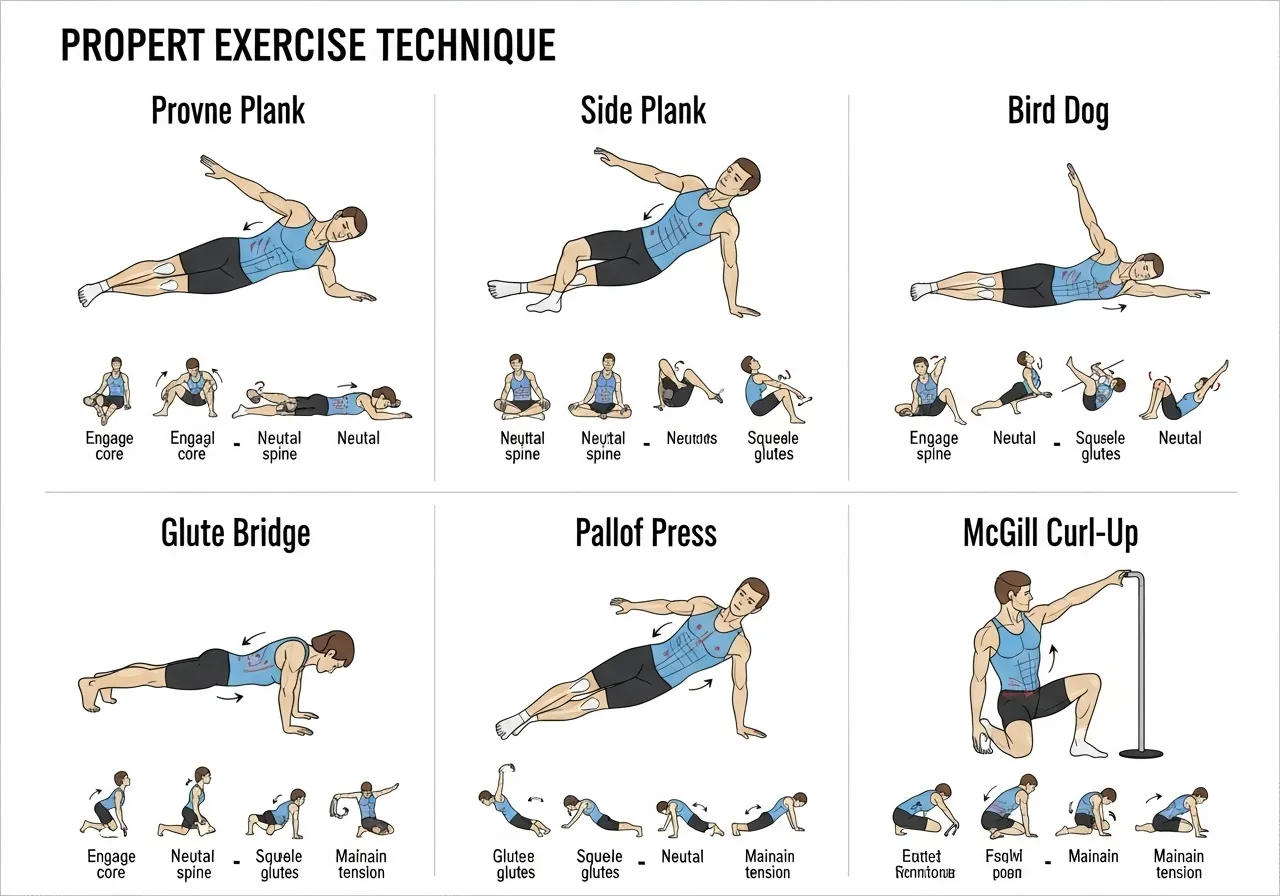
The 7 Best Core Stability Exercises: Technique and Research Rationale
Exercise 1 — The Plank (Prone)
The standard prone plank is the foundational core stability exercise — holding a push-up position with forearms on the floor, creating full-body tension from the ankles to the shoulders.
Setup: Forearms flat on the floor, elbows under shoulders. Feet hip-width apart on toes. Key cues: Straight line from heels to head — no sagging at the hips, no raising the hips too high Core engagement: “Squeeze the glutes, brace the abs as if about to take a punch, pull the elbows toward the feet” Duration: Build to 30–60 seconds with perfect form — duration without form is not the goal Progression: Longer holds → arm lift → leg lift → arm + opposite leg lift → push-up plank
Exercise 2 — The Side Plank
The side plank specifically trains lateral core stability — the ability to resist lateral flexion (the spine bending sideways under load) — which is critical for athletes and for protecting the spine during asymmetric loading in daily life.
Setup: Lie on one side, forearm on the floor perpendicular to the body. Stack the feet or stagger them for a wider base. Lift: Raise the hips until the body forms a straight line from ankles to shoulders Key cue: “Push the floor away with the forearm” — rather than pulling the hips up, which activates different muscles Duration: 20–45 seconds each side | Progress to the top arm reaching overhead, then to hip dips
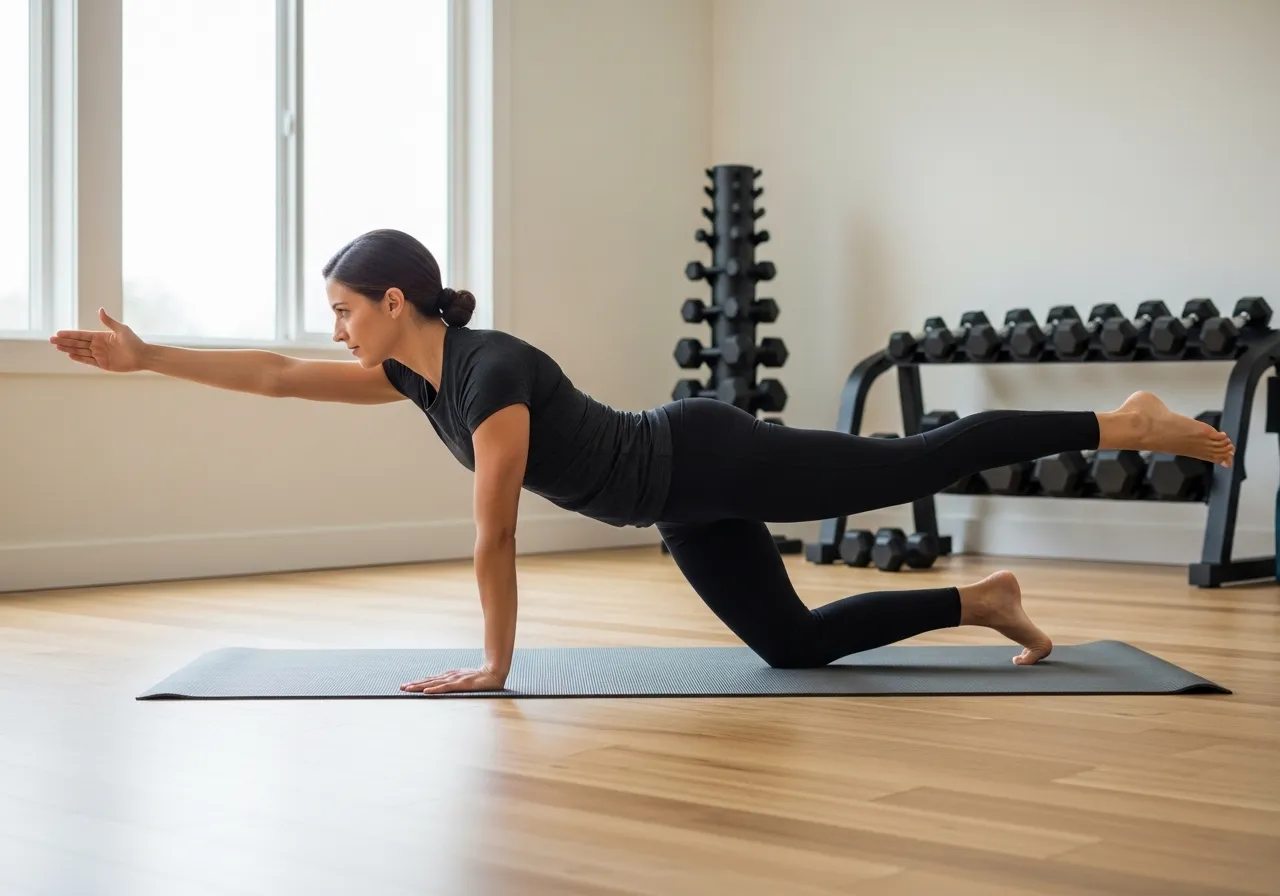
The bird dog involves simultaneously extending one arm and the opposite leg from a quadruped (hands and knees) position — creating a diagonal anti-rotation challenge that specifically targets the multifidus and TrA.
Setup: Hands under shoulders, knees under hips. Neutral spine — no arching or rounding Movement: Simultaneously extend the right arm and left leg — both reaching parallel to the floor Key cues: “Pour water from the cup on your lower back” — no rotation; “reach long, not high” Return: Control the return to the start — do not let the limbs drop Sets/Reps: 3 × 8–10 each side | Pause 1–2 seconds at the extended position
Exercise 4 — The Dead Bug
The dead bug trains the ability to maintain a neutral spine while the limbs create destabilizing loads — the foundational anti-extension pattern that protects the spine during pressing, pulling, and daily activities.
Setup: Lie supine (on your back). Arms vertical above the chest, knees bent 90° above the hips — like a table-top position Lower back contact: Press the lower back firmly into the floor and maintain this throughout Movement: Simultaneously lower the right arm overhead and extend the left leg toward the floor — but do NOT let the lower back lift off the floor Return: Bring both limbs back to start; switch sides Key principle: The lower back pressing into the floor throughout is the entire exercise — if the back lifts, the range is too large; reduce it
Exercise 5 — The Glute Bridge
The glute bridge is classified as a core stability exercise because it trains the hip extensors and posterior pelvic tilt coordination — the same muscle patterning needed to maintain pelvic neutral during standing, walking, and lifting activities.
Setup: Supine, knees bent at 90°, feet flat on the floor hip-width apart Drive: Squeeze the glutes and drive the hips upward until the thighs and torso form a straight line Key cue: “Tuck the pelvis at the top” — a slight posterior tilt at the bridge peak activates the glutes more fully Hold: 1–2 seconds at the top, then lower with control Progressions: Single-leg bridge → feet elevated bridge → barbell hip thrust
Exercise 6 — Pallof Press
The Pallof press — described in detail in the cable machine article — is one of the most effective anti-rotation core exercises available. It uses a cable or resistance band to create a lateral pulling force that the core must resist throughout a pressing and returning movement.
The anti-rotation demand of the Pallof press specifically trains the obliques and deep stabilizers in the function they most commonly perform during sport and daily activity: resisting unwanted rotation rather than producing it.
Exercise 7 — The McGill Curl-Up
The McGill curl-up (developed by Dr. Stuart McGill, the leading researcher in spine biomechanics) addresses the major limitation of the traditional crunch — spinal flexion under load, which increases disc compressive forces — by keeping the lumbar spine in a neutral position throughout.
Setup: Supine. One knee bent, one leg flat (this position reduces hip flexor activation). Place hands under the lower back to support the natural lumbar arch. Movement: Raise only the head and shoulders — not the entire back. The spine does not flex; the head and chest lift while the lower back maintains its arch. This is not a crunch — the lumbar spine moves only minimally Sets/Reps: 3 × 8–10, slow and controlled
Hollowing vs. Bracing: The Activation Technique Debate
What Is Abdominal Hollowing?
Abdominal hollowing (also called the “drawing-in maneuver”) involves pulling the navel inward toward the spine — activating specifically the transverse abdominis without co-contracting the more superficial muscles.
Hollowing was popularized in the 1990s based on research showing that the TrA activates ahead of limb movement — suggesting that training this specific pre-activation would improve spinal stability.
What Is Abdominal Bracing?
Abdominal bracing involves contracting all the abdominal muscles simultaneously — creating a 360° expansion of pressure around the spine, similar to tightening a belt around the abdomen.
Bracing increases intra-abdominal pressure and co-contracts all layers of the core musculature, providing maximum spine stiffness appropriate for heavy external loading.
What the Research Shows
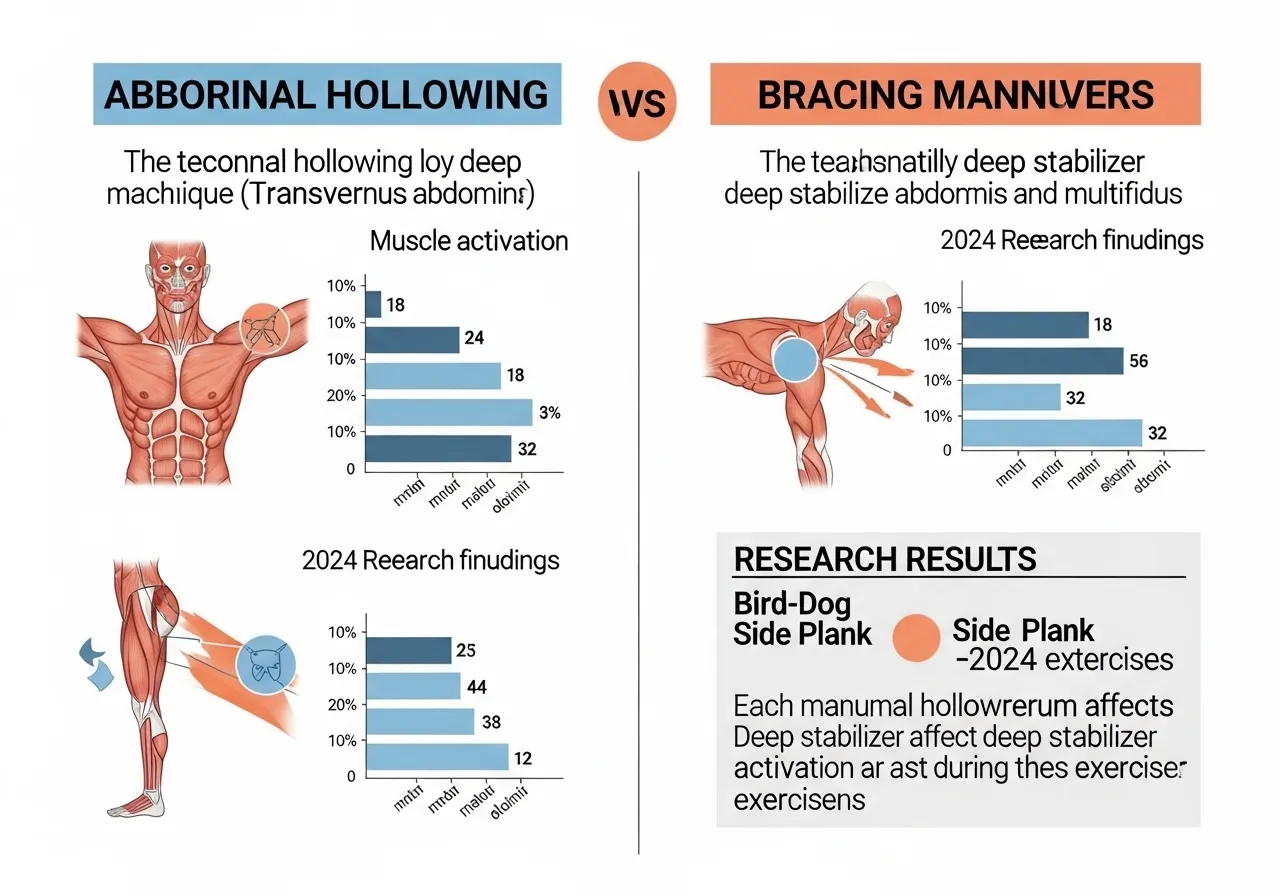
the PMC study comparing core stability exercises with both hollowing and bracing maneuvers found that hollowing produced greater TrA, internal oblique, and multifidus thickness than bracing during the bird dog and side plank exercises — supporting hollowing as superior for activating the deep stabilizers during stability-focused work.
However, bracing produces greater overall abdominal stiffness and is superior for heavy loading contexts like deadlifts and squats.
The practical recommendation that emerges from the research:
Rehabilitation and low-load core exercises: Hollowing technique — prioritizes deep stabilizer activation
Athletic performance and heavy lifting: Bracing — provides maximum spinal stiffness under load
General fitness core work: A combination — hollow lightly first, then add the brace on top
Teaching the Hollowing Maneuver
Many people struggle to perform the hollowing maneuver correctly, particularly if they have chronically inhibited TrA function following injury or extended inactivity:
Step-by-step hollowing practice:
1. Lie supine with knees bent and feet flat
2. Place one hand on the lower abdomen just inside the hip bones
3. Breathe in to expand the abdomen, then breathe out slowly
4. At the end of the exhale, gently draw the lower abdomen inward — away from the waistband
5. The movement should be subtle — 10–20% of maximum abdominal tension
6. Maintain normal breathing while holding this activation
The TrA draws the abdomen inward symmetrically — if one side moves more than the other, asymmetric function is present and warrants physiotherapy assessment
Breathing and Core Activation: Why They Are Inseparable
The diaphragm (the dome-shaped breathing muscle that forms the roof of the abdominal cylinder) and the pelvic floor (the hammock of muscles forming the floor of the cylinder) are integral parts of the core stability system — not separate from it.
When breathing mechanics are dysfunctional — shallow thoracic breathing, breath-holding during everyday activities, or chronic mouth breathing — the diaphragm cannot contribute to intra-abdominal pressure regulation effectively, placing greater demand on the muscular walls of the abdomen and potentially contributing to chronic spinal loading dysfunction.
Practicing diaphragmatic breathing (deep breaths that expand the abdomen rather than raising the shoulders) during rest and during core exercises is a foundational component of core rehabilitation that is often overlooked in fitness contexts.
Practical Breathing Exercise for Core Activation
Diaphragmatic breathing can be practiced actively as the first step in any core stability session:
2-minute pre-session breathing practice:
1. Lie on your back, one hand on your chest, one hand on your abdomen
2. Breathe in — the hand on the abdomen should rise; the hand on the chest should barely move
3. Breathe out slowly — let the abdomen fall naturally
4. At the end of the exhale, apply the hollow — gently draw the lower abdomen in
5. Hold the hollow while breathing normally for 5–10 seconds, then release
Repeat 5–8 times before beginning core exercises
This brief routine activates the deep stabilizers and resets dysfunctional breathing patterns that may have developed during prolonged sitting or stress — making subsequent core exercises significantly more effective.
Core Stability Programming: Beginner to Advanced
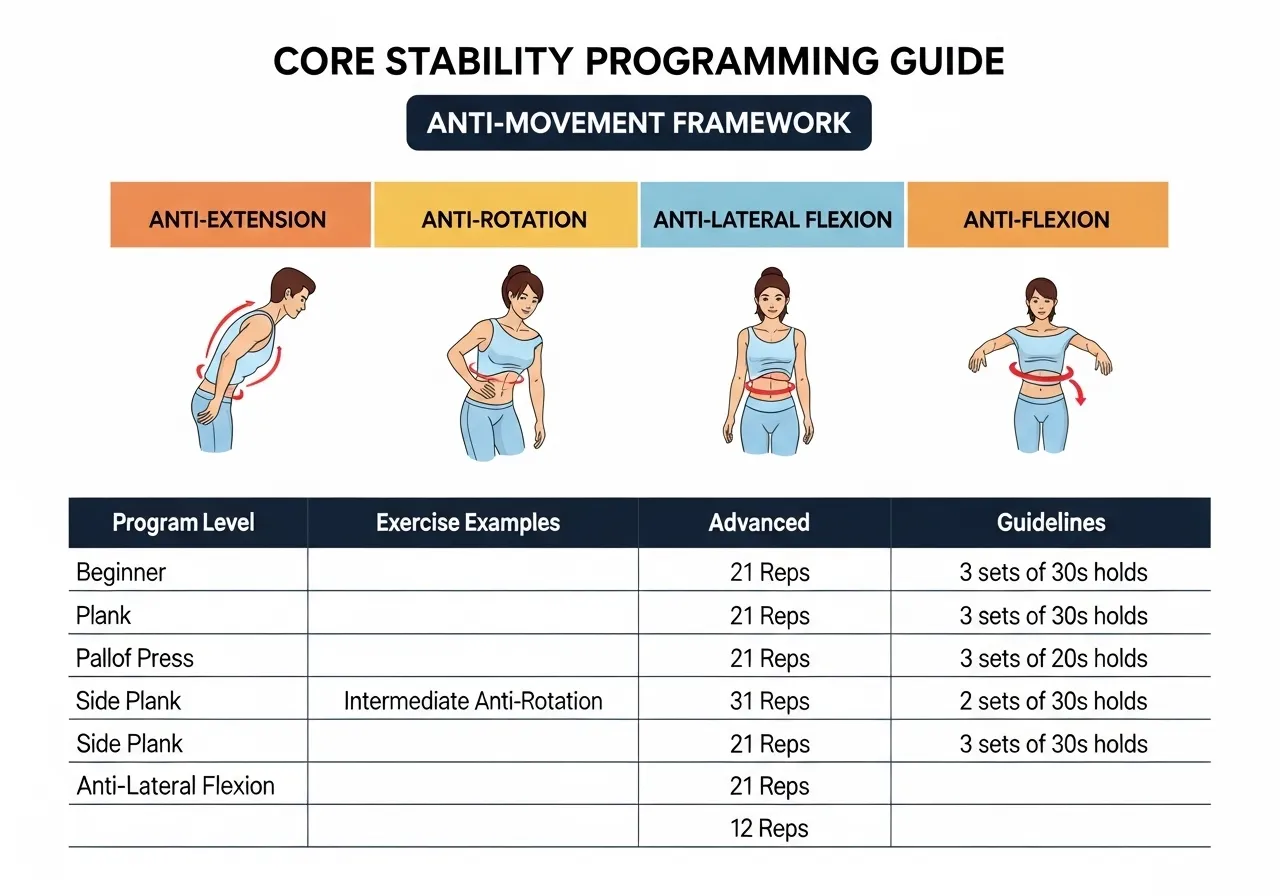
The Anti-Movement Framework: A Better Way to Think About Core Training
The most evidence-aligned framework for core exercise selection, developed from the research of Stuart McGill and others, categorizes core exercises by the movement they resist rather than the movement they produce:
Anti-extension: Resisting the spine from extending (arching) — Plank, Dead Bug, Ab Wheel Rollout
Anti-lateral flexion: Resisting the spine from bending sideways — Side Plank, Suitcase Carry, Farmer’s Carry
Anti-rotation: Resisting the spine from twisting — Pallof Press, Bird Dog, Single-Arm Press
Hip extension stability: Maintaining pelvic position during hip extension — Glute Bridge, Hip Thrust, RDL
A complete core program addresses all four categories — relying only on anti-extension work (the most common gap) leaves lateral and rotational stability underdeveloped.
Beginner Foundation Program (Weeks 1–4)
3 sessions per week, 20–25 minutes:
Prone Plank: 3 × 20–30 sec (build toward 45 sec)
Side Plank: 3 × 15–20 sec each side
Bird Dog: 3 × 8 each side (pause 2 sec at top)
Dead Bug: 3 × 8 each side (lower back pressed to floor throughout)
Glute Bridge: 3 × 12 (1-sec hold at top)
Focus: Movement quality over duration; no compensations or substitutions
Intermediate Program (Weeks 5–8)
3 sessions per week, 25–35 minutes:
Push-Up Plank: 3 × 45–60 sec
Side Plank with Hip Dip: 3 × 10 dips each side
Bird Dog with 3-sec hold: 3 × 10 each side
Dead Bug with weight (1–3 kg): 3 × 10 each side
Single-Leg Glute Bridge: 3 × 10 each side
Pallof Press: 3 × 10 each side
Progress by: Increasing hold duration, adding limb complexity, or adding light external load
Advanced Exercises for Core Stability
Once the foundational movements are controlled, these progressions add significant challenge:
Ab Wheel Rollout: Kneeling or standing, roll the wheel forward as far as possible while maintaining a neutral spine — do not allow the hips to pike upward or the lower back to arch. One of the highest anti-extension demands available without equipment beyond the wheel.
Hanging Knee/Leg Raise: Hanging from a pull-up bar, raise the knees (or straight legs) — develops the hip flexors and lower rectus abdominis while demanding significant grip and shoulder stability.
TRX/Ring Plank: Performing the plank with hands on TRX handles or gymnastics rings — the instability of the suspension creates far greater muscle activation in the anterior core and rotator cuff than the stable floor plank.
Stir the Pot (Swiss Ball): In a forearm plank position on a Swiss ball, make small circles with the forearms — the ball’s instability creates constant micro-correction demand for all core layers simultaneously.
Sets, Reps, and Duration Guidelines
Exercise Type
Beginner
Intermediate
Advanced
Isometric holds (plank, side plank)
3 × 20–30 sec
3 × 45–60 sec
3 × 60–90 sec
Repetition exercises (bird dog, dead bug)
3 × 8 each side
3 × 10–12 each side
3–4 × 12–15 each side
Dynamic loaded (Pallof press, rollout)
2–3 × 8–10
3 × 10–12
3–4 × 12–15
Integrating Core Stability Into a Training Program
Core stability exercises are most effectively placed at specific points in a training session:
Before heavy compound lifts: 2–3 brief activation sets (bird dog, dead bug, glute bridge) prime the deep stabilizers before loading — particularly effective before deadlifts, squats, and overhead pressing
At the end of a session (dedicated core work): When the goal is building core endurance and strength rather than just activating for the session
As a standalone daily practice: 10–15 minutes of core work every day (even on rest days from resistance training) accumulates motor pattern improvements that cannot be achieved in 2–3 longer-but-less-frequent sessions
Core Stability for Back Pain, Athletes, and Older Adults
Core Training for Chronic Lower Back Pain
Non-specific lower back pain (lower back pain without a clearly identified structural cause) affects approximately 80% of adults at some point in their lives and is one of the leading causes of disability worldwide.
The research is clear that core stability exercises are more effective than general exercise or rest for this condition — reducing pain, improving function, and preventing recurrence when practiced consistently.
The specific exercises most supported for back pain rehabilitation:
Bird dog — activates deep stabilizers without spinal loading
McGill curl-up — develops anterior stability without disc-compressive spinal flexion
Side plank — specifically targets the quadratus lumborum and obliques, which are commonly weak in LBP patients
Glute bridge — addresses the hip extensor weakness commonly associated with LBP
Individuals with diagnosed lumbar conditions (disc herniation, stenosis, spondylolisthesis) should receive a specific exercise program from a physiotherapist rather than a general core stability program — the specific exercise selection, progression, and contraindicated movements vary significantly between conditions.
Core Stability for Athletic Performance
The connection between core stability and athletic performance is well-established across multiple sports:
Force transfer: The core transfers force between the lower and upper body during throwing, striking, kicking, and lifting — a stable core allows more force to reach the extremities
Injury prevention: Athletes with documented core stability deficits show higher rates of knee and ankle injuries, not just back injuries — the proximal (close to center) stability enables safe distal (far from center) force production
Running economy: Reduced lateral sway during running is associated with better running economy — core stability reduces the energy wasted in lateral trunk movement with each stride
Core Stability for Older Adults
Core stability training has particular importance for older adults, where age-related declines in trunk muscle function contribute to:
Increased fall risk — reduced ability to rapidly correct for unexpected balance perturbations
Reduced functional capacity — difficulty with sit-to-stand, picking objects from the floor, and overhead reaching
Accelerated lumbar spine degeneration — without adequate spinal stability, joint loading patterns become less optimal over decades
For older adults, the bird dog and glute bridge are particularly well-suited starting exercises — both are performed close to the floor (eliminating fall risk during the exercise itself) and both specifically target the muscles most commonly atrophied in aging adults.
Older adults with balance impairment, significant musculoskeletal conditions, or cardiovascular concerns should begin core stability training under the guidance of a physiotherapist, exercise physiologist, or certified personal trainer with experience in older adult populations.
✅ Key Takeaways
The core is a cylindrical system — training it effectively requires exercises that address all four directions: anti-extension, anti-lateral-flexion, anti-rotation, and hip extension stability
The bird dog produces the greatest transverse abdominis activation of common core exercises — making it the most effective movement for deep spinal stabilizer development
Core stability exercises are among the most robustly evidence-supported interventions for non-specific chronic lower back pain
Hollowing (drawing-in) is preferred for rehabilitation and stability work; bracing is preferred for heavy lifting
Daily 10–15 minute core practice produces better long-term results than infrequent longer sessions
Common Core Training Mistakes, Myths, and Long-Term Development
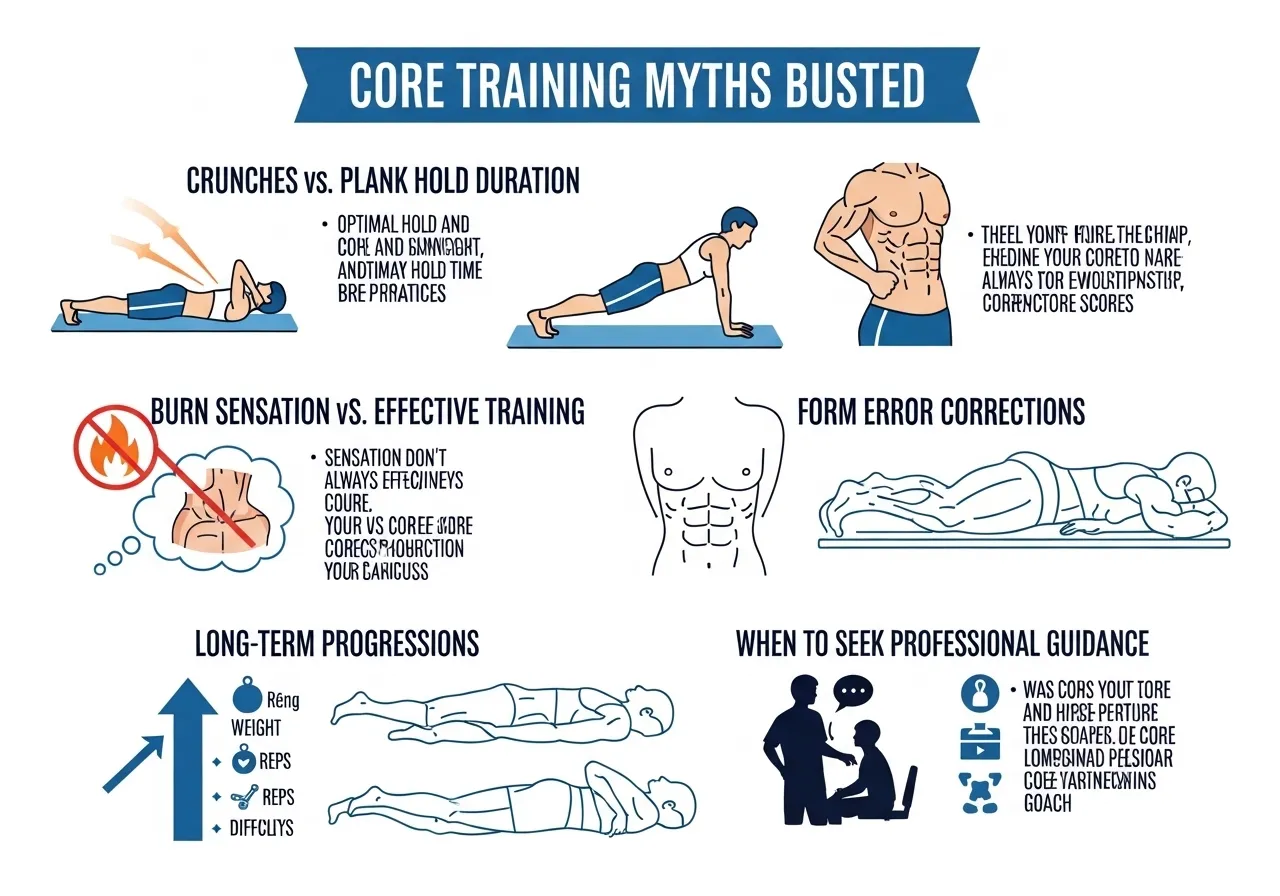
Myth 1: Crunches Are the Foundation of Core Training
The crunch and situp remain the default “ab exercise” in popular fitness despite research from Stuart McGill’s lab showing that repeated spinal flexion under load — the movement pattern of the crunch — is one of the primary mechanisms of lumbar disc injury.
This does not mean crunches cause injury in every person who performs them — many people perform crunches for years without issue. But it does mean they are not the most effective or safest foundation for core training, particularly for individuals with any history of lower back pain.
The McGill curl-up produces similar anterior core stimulus to the crunch while eliminating the lumbar flexion component — making it a straightforward upgrade in most situations.
Myth 2: A Long Plank Hold Means a Strong Core
Plank duration is frequently used as a proxy for core fitness, with some athletes and fitness enthusiasts pursuing plank holds of several minutes as goals.
The research does not support this — McGill’s work suggests that 10-second holds repeated multiple times (for example, 3 × 10-second holds with brief rest) produce equivalent or superior muscle activation to a single long hold, with less compensatory tension from superficial muscles that “take over” during extended holds.
A trainee who can plank for 4 minutes may have considerable muscular endurance, but this does not necessarily mean their deep stabilizers are functioning optimally — a shorter plank performed with perfect hollowing technique may be more therapeutically valuable.
Myth 3: Core Exercises Should Always Burn
The metabolic “burn” sensation during core work comes from the rectus abdominis and external obliques — the superficial muscles that are easily fatigued and produce the characteristic burning sensation.
The deep stabilizers (TrA, multifidus) do not produce the same burning sensation because they work at much lower intensities and do not accumulate metabolic byproducts in the same way.
An exercise that produces no burn — like the bird dog — may be simultaneously producing the highest transverse abdominis activation of any movement in a session, without any subjective sensation to indicate this is occurring.
This is why subjective effort is a poor indicator of deep stabilizer activation — an evidence-based exercise selection based on what the research shows actually activates these muscles is more reliable than feeling-based exercise choices.
Spine extends — the exercise goal is lost entirely
Reduce limb range; keep limbs closer to body
Side Plank
Hips sagging or rotating forward
Hip sag reduces QL activation; rotation reduces specificity
Reduce hold time; keep feet stacked or stagger them
Glute Bridge
Hyperextending at the top (arching the lower back)
Lumbar compression; glutes not reaching full activation
Tuck the pelvis at the top; squeeze glutes first
Progressing Core Training Over the Long Term
Core stability training follows a different progression logic than strength training:
Movement complexity before load: Perfect a simpler exercise before adding weight or instability — a bird dog with rotation compensation is less valuable than a simple plank held correctly
Instability before load: Adding surface instability (BOSU ball, Swiss ball, TRX) increases deep muscle activation before adding external weight
From isolated to integrated: Move from dedicated core exercises toward compound movements performed with excellent core stability — the deadlift and squat performed with perfect spinal stabilization are ultimately the most functional core exercises available
From slow to fast: Athletic core training progressively challenges the core at higher movement speeds, ultimately training the rapid reflexive stabilization needed in sport
When to Seek Professional Guidance
Self-directed core stability training is appropriate for most healthy adults following the evidence-based guidelines in this article.
However, professional assessment and guidance adds significant value in these situations:
Active lower back pain or sciatica (radiating pain into the leg from lumbar nerve compression) — specific exercises are indicated and contraindicated based on the nature of the condition
Post-surgical rehabilitation — core retraining after abdominal surgery, spinal surgery, or hip surgery requires precise parameter selection
Pelvic floor dysfunction — the pelvic floor is part of the core system, and generic core exercise may aggravate certain pelvic floor conditions
Persistent asymmetry in bird dog or single-leg exercises that does not resolve with consistent practice
A physiotherapist specializing in musculoskeletal or sports rehabilitation can conduct a specific core function assessment — including ultrasound visualization of TrA activation in some clinical settings — to identify the precise deficits and design a targeted intervention. Even 2–4 sessions with a specialist can produce a personalized program that outperforms self-directed general core work.
⚠️ Health & Fitness DisclaimerThis article is for general educational and informational purposes only.It does not replace professional medical or fitness advice.If you have any pre-existing condition, injury, or shoulder concern — please consult a qualified healthcare professional or certified personal trainer before starting or modifying any exercise program. The lat pulldown mastery guide is…
⚠️ Health & Fitness DisclaimerThis article is for general educational and informational purposes only. It does not replace professional medical or fitness advice. If you have any pre-existing condition, injury, or health concern — consult a qualified healthcare professional or certified personal trainer before starting or modifying any exercise program. Hip flexor tightness is one…
⚠️ Health & Fitness DisclaimerThis article is for general educational and informational purposes only and does not replace professional medical or fitness advice.If you have any pre-existing shoulder, back, or joint condition — consult a qualified healthcare professional or certified trainer before beginning any cable machine mastery program. The cable machine is arguably the most…
⚠️ Health & Fitness DisclaimerThis article is for general educational and informational purposes only.It does not replace professional medical or fitness advice.If you have any pre-existing condition or injury — please consult a qualified healthcare professional or certified personal trainer before starting any new exercise program. Resistance bands are dismissed by many gym-goers as beginner…
⚠️ Health & Fitness DisclaimerThis article is for general educational and informational purposes only. It does not replace professional medical or fitness advice. If you have any pre-existing condition, injury, or health concern — consult a qualified healthcare professional or certified personal trainer before starting or modifying any exercise program. The Romanian conventional deadlift guide…
⚠️ Health & Fitness DisclaimerThis article is for general educational and informational purposes only.It does not replace professional medical or fitness advice.If you have any pre-existing condition, injury, or chronic pain — please consult a qualified healthcare professional or certified personal trainer before starting or modifying any foam rolling basics or mobility program. Foam rolling…