⚠️ Health & Fitness Disclaimer This article is for general educational and informational purposes only and does not replace professional medical or fitness advice. If you have any pre-existing shoulder, back, or joint condition — consult a qualified healthcare professional or certified trainer before beginning any cable machine mastery program.
The cable machine is arguably the most versatile piece of equipment in the gym — yet many trainees limit its use to bicep curls and tricep pushdowns.
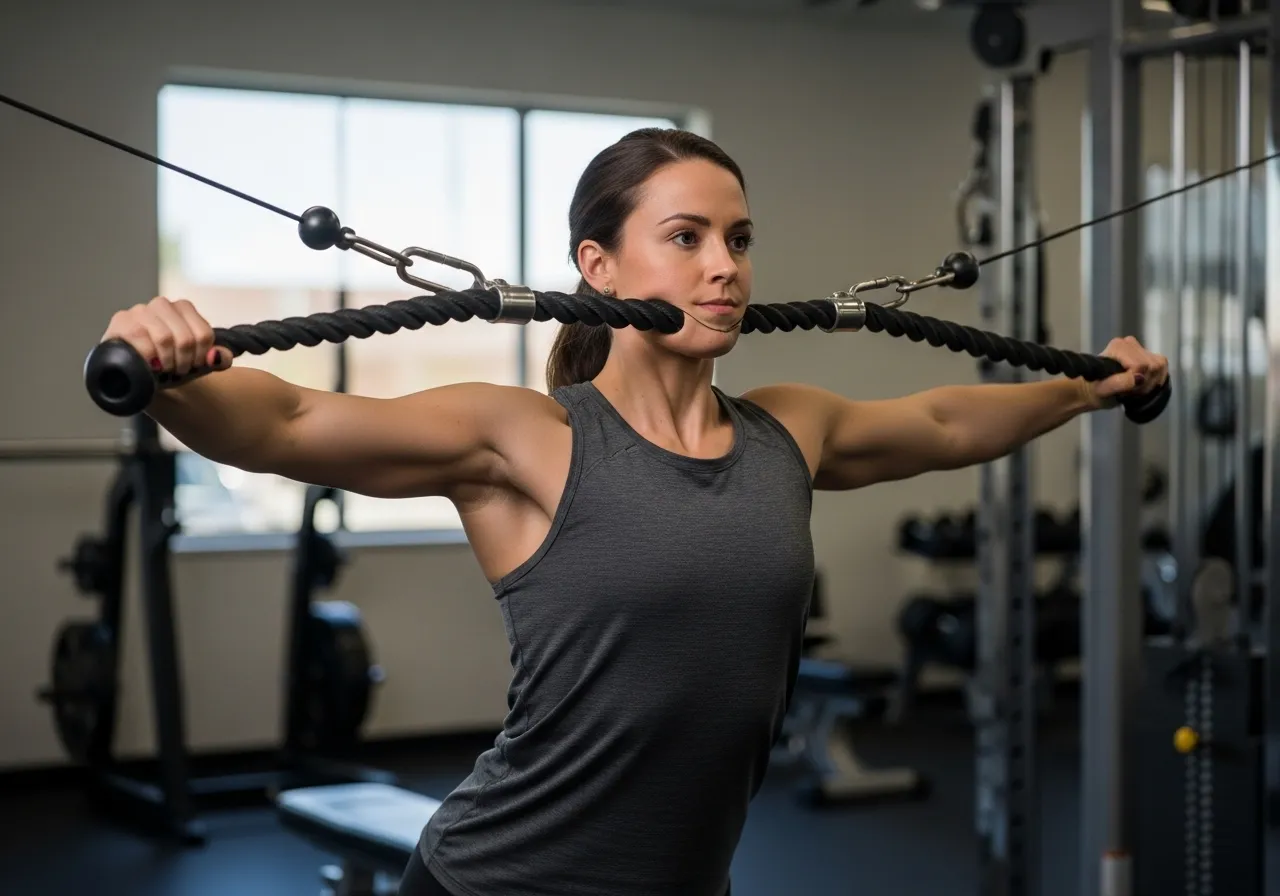
The cable’s unique mechanical property — cable machine overview throughout the entire movement range — makes it distinct from both free weights and selectorized machines, and creates training stimuli that neither can fully replicate.
This guide explains the science behind cable training, breaks down 12 high-value exercises with correct technique, and provides a structured programming approach for integrating cables into any training program.
Why Cable Machines Are Different: The Physics of Constant Tension
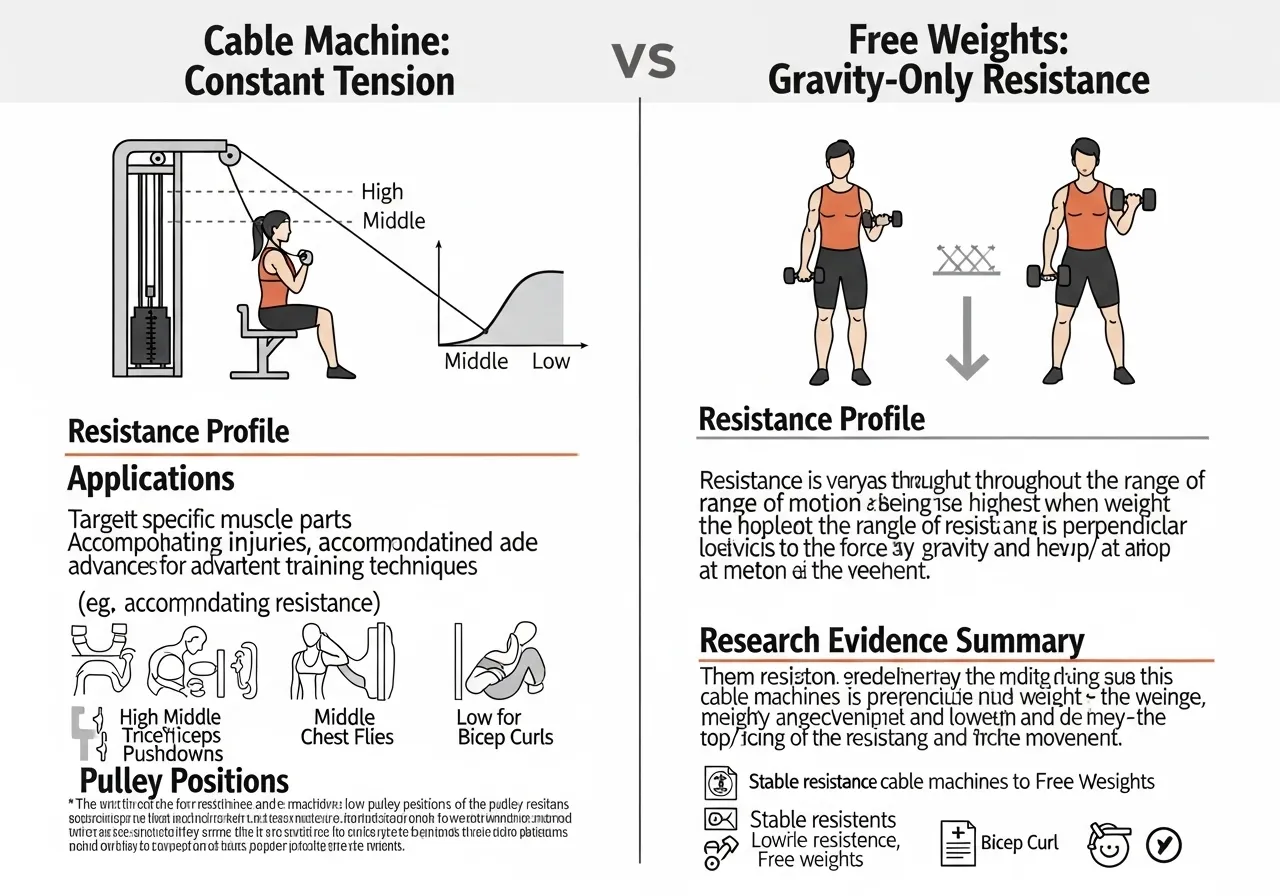
Free Weights vs. Cables: The Key Mechanical Difference
With free weights (dumbbells, barbells), resistance is dictated by gravity — it acts only in the vertical plane. This means:
At certain joint angles during a lift, the lever arm (the perpendicular distance between the joint and the line of force) is minimal — reducing the effective resistance, even though the weight on the bar hasn’t changed
Free weights only resist movement in the downward direction — they cannot meaningfully resist horizontal or upward movement
Cables, by contrast, provide resistance in any direction — up, down, horizontal, diagonal — because the force comes from the pulley-weight stack system rather than gravity alone.
This property enables exercises that free weights cannot: woodchops, cable crossovers, face pulls, and any movement where the resistance direction matters as much as the load.
Cable machines maintain tension on the target muscle throughout the complete range of motion — including at the fully shortened position where free weights often produce minimal resistance.
This property has two practical implications:
End-range loading: Muscles experience mechanical tension at positions where free weights cannot effectively load them — the fully contracted bicep at the top of a cable curl, or the fully squeezed chest at the finish of a cable crossover
Eccentric loading consistency: The return phase of cable exercises maintains constant resistance, producing a more consistent eccentric stimulus (the muscle-lengthening under load phase associated with hypertrophy) than gravity-dependent free weights
The Three Cable Pulley Positions
Pulley Position
Force Direction
Primary Applications
High pulley
Downward pull from above
Lat pulldown, tricep pushdown, face pull, cable crossover (upper-to-lower)
The Stretch-Mediated Hypertrophy Advantage of Cables
Recent research has highlighted the importance of training muscles in their lengthened (stretched) position for maximizing hypertrophic stimulus.
Cable exercises can be specifically configured to load muscles at the fully lengthened position — a mechanical advantage that is difficult to replicate with free weights:
Cable lateral raise (low pulley): At the starting position (arm at side), the low cable creates maximal tension precisely when the deltoid is most lengthened — unlike a dumbbell, which provides no resistance at this position
Cable chest fly (high pulley, arms spread wide): The stretched pectoral position at the widest arm spread receives meaningful cable tension — the most important position for pectoral hypertrophy stimulus
Cable curl (low pulley, arm extended down): The bicep receives tension at the fully lengthened position, which is the low-resistance “dead zone” for dumbbell curls
This advantage makes cables particularly effective for muscles whose peak hypertrophic stimulus occurs at the lengthened position — the medial deltoid, pectorals, and biceps being the primary examples in resistance training practice.
Cable Machines and Functional Movement Patterns
One of the strongest arguments for including cable training is the ability to train movement patterns that mirror real-world activities:
Rotational patterns: The woodchop and reverse woodchop train the diagonal, rotational movement patterns used in throwing, swinging, and reaching across the body — patterns that neither free weights nor fixed machines can replicate with the same freedom
Anti-rotation patterns: The Pallof press trains the core’s ability to resist rotation — a critical functional demand for almost all sports and daily activities involving unilateral loading
Diagonal pulling: Cable rows at various angles train pulling through multiple planes — more functionally representative than the strictly horizontal row that machines enforce
Comparing Cable Machines to Free Weights: An Honest Assessment
Cable machines produce a genuinely different mechanical stimulus than free weights — but the differences are often misunderstood in both directions:
Factor
Free Weights
Cable Machines
Resistance direction
Vertical (gravity) only
Any direction — highly versatile
End-range loading
Often minimal (lever arm collapses)
Consistent through full ROM
Absolute load capacity
Higher (limited by strength)
Limited by weight stack
Neural demand
Higher (balance, coordination)
Moderate (guided but not fixed)
Functional transfer
High for vertical patterns
High for multi-plane patterns
Injury risk (beginner)
Higher without technique
Lower — no dropped weights
The optimal approach is not choosing between cables and free weights, but understanding when each is most advantageous — and building a program that systematically exploits both.
This makes the cable machine not merely a supplement to free-weight training, but a genuinely indispensable component of any complete resistance program.
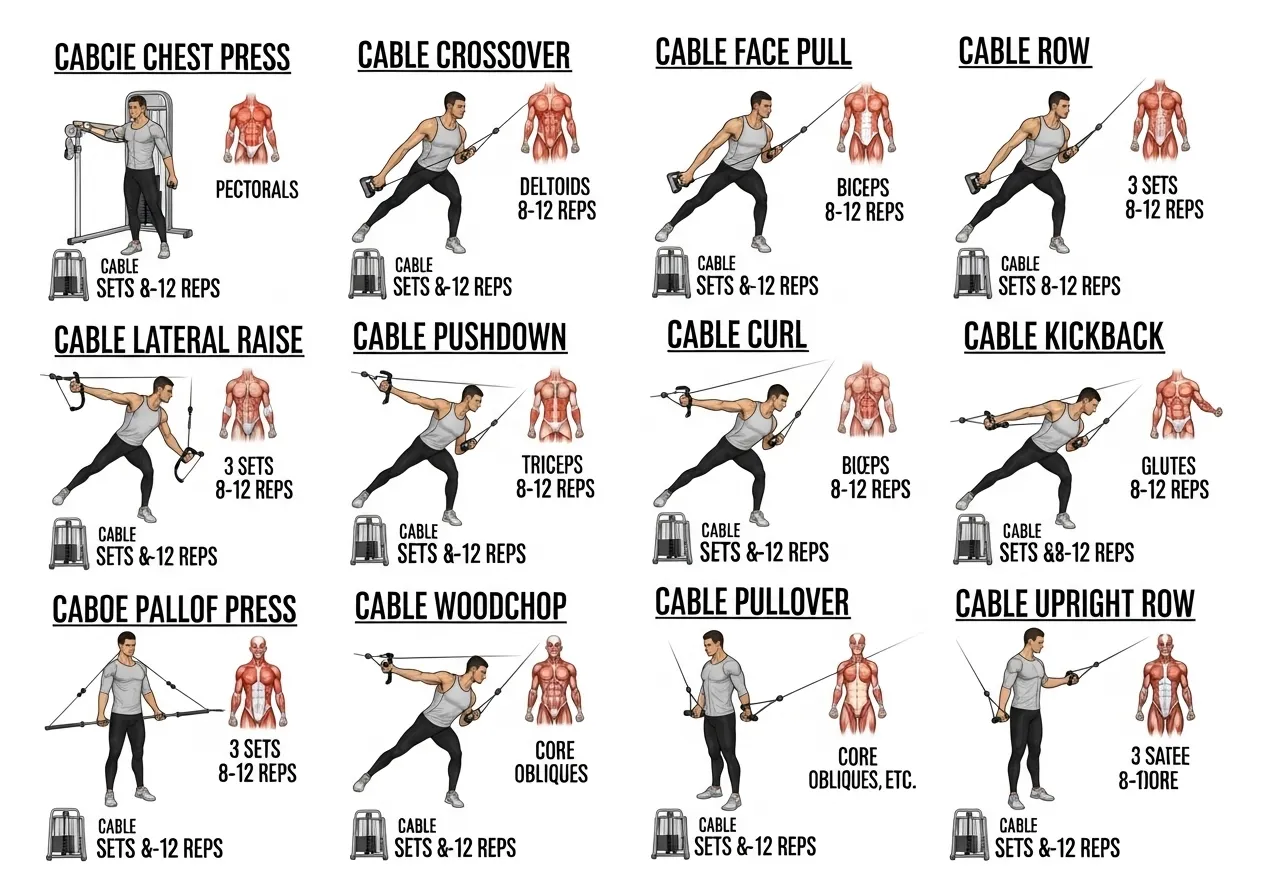
The 12 Most Effective Cable Machine Exercises
Upper Body Push
Cable Chest Press (Mid Pulley):
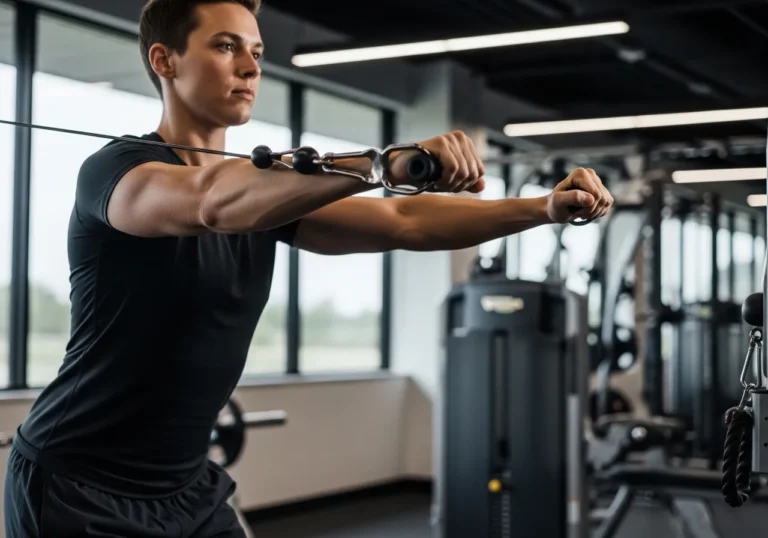
Stand facing away from the cable machine, one handle in each hand at chest height. Press both arms forward until fully extended, then return with control. Target muscles: Pectoralis major, anterior deltoid, triceps Cable advantage: Constant chest tension at full extension — unlike the barbell bench press where the pectorals are significantly unloaded at the top
Cable Crossover (High Pulley, Upper-to-Lower):
Stand between two high cables. Bring handles from high position forward and down, crossing them at the bottom. The slight forward lean of the torso allows greater pec stretch at the starting position. Target muscles: Pectoralis major (especially sternal/lower fibers), anterior deltoid Sets/Reps: 3 × 12–15
Upper Body Pull
Cable Face Pull (High Pulley with Rope Attachment):
Attach a rope to a high pulley. Pull the rope toward the face — elbows high and wide, hands splitting apart at the face. One of the most important exercises for shoulder health and long-term pressing ability. Target muscles: Rear deltoid, infraspinatus, teres minor, rhomboids Sets/Reps: 3 × 15–20 (high rep, moderate weight)
Cable Row (Mid Pulley, Seated or Standing): (see also: seated row guide)
Pull handle toward lower ribs, squeezing the shoulder blades together at the finish. Maintain upright posture — no torso swing. Target muscles: Latissimus dorsi, rhomboids, middle trapezius, rear deltoid, biceps Sets/Reps: 3–4 × 10–12
Biceps and Triceps
Cable Bicep Curl (Low Pulley):
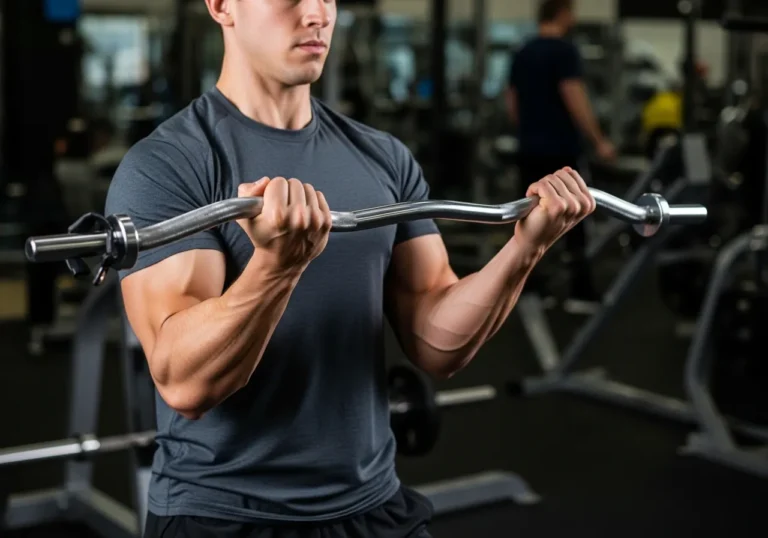
Using a straight bar or EZ-bar at a low pulley. The cable maintains tension at the top of the curl — where free weights provide almost none. Target muscles: Biceps brachii, brachialis Sets/Reps: 3 × 12–15
Cable Tricep Pushdown (High Pulley, Rope or Bar):
Elbows pinned to sides. Push down until elbows are fully extended. Return slowly — 2–3 seconds — for maximum eccentric stimulus. Target muscles: Triceps brachii (all three heads) Sets/Reps: 3 × 12–15
Shoulder
Cable Lateral Raise (Low Pulley):
Stand sideways to the machine, handle in the far hand. Raise arm out to shoulder height while keeping elbow slightly bent. The low cable provides tension even at the bottom — where a dumbbell offers almost none. Target muscles: Medial deltoid (primary), supraspinatus Sets/Reps: 3 × 15 (this is the strongest argument for cables over dumbbells for lateral raises)
Lower Body
Cable Romanian Deadlift (Low Pulley):
Stand facing the cable machine, handle at low pulley. Hip hinge back while maintaining a neutral spine. The cable angle creates a unique resistance vector compared to the barbell version. Target muscles: Hamstrings, gluteus maximus, erector spinae Sets/Reps: 3 × 10–12
Cable Kickback (Low Pulley with Ankle Attachment):
Attach ankle strap to low pulley. In a slightly forward-leaning position, drive the leg back and up — maintaining hip extension range throughout. Target muscles: Gluteus maximus (isolation), with hamstring assistance Sets/Reps: 3 × 15 per side
Core
Pallof Press (Mid Pulley):
Stand sideways to the cable. Press both hands straight out from chest — the cable’s rotational pull requires the core to resist rotation. Return to chest position. This is an anti-rotation exercise, not a rotation exercise. Target muscles: Obliques, transverse abdominis, rectus abdominis Sets/Reps: 3 × 10 per side
Cable Woodchop (High-to-Low or Low-to-High Pulley):
Pull the cable diagonally across the body in a controlled chopping motion. Rotate through the torso, not just the arms. Target muscles: Obliques, transverse abdominis, hip flexors (low-to-high), gluteus medius Sets/Reps: 3 × 10–12 per side
Cable Exercises for Specific Bodybuilding Goals
In bodybuilding contexts, cables are used specifically to maximize end-range muscle contraction and achieve a “pump” (the temporary swelling of a muscle from increased blood flow during high-rep training) that contributes to metabolic stress — one proposed driver of hypertrophy.
High-rep cable work (15–25 reps) at the end of a training session accumulates significant metabolic fatigue in target muscles without the joint stress of similarly high-rep free weight work:
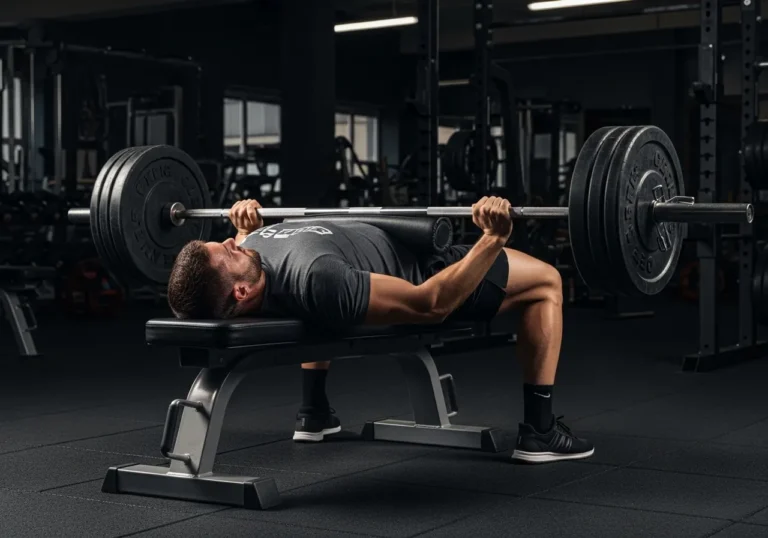
Post-exhaust technique: Heavy compound movement first (barbell bench press), then high-rep cable crossovers immediately after — the pre-fatigued pectorals receive maximum stimulus from the cable exercise at reduced absolute load
Peak contraction holds: Adding a 1–2 second deliberate squeeze at the fully contracted position on each cable rep (especially lateral raises and crossovers) produces intense end-range stimulus that free weights cannot replicate
Continuous tension sets: Never letting the weight stack fully rest between reps — keeping the muscle under constant tension for an entire set — is easily achievable on cables and produces exceptional metabolic stress
Cable Exercises for Athletic Performance
Athletes use cable machines specifically for training movement patterns that transfer to sport performance:
Rotational power (woodchop, reverse woodchop): Baseball hitting, tennis groundstrokes, golf swing, throwing mechanics all require rotational power through the trunk — cable woodchops train this pattern at a resistance level and direction that free weights cannot match
Hip extension power (cable pull-through, kickback): Sprint acceleration, jumping, and kicking all require rapid hip extension — loading this pattern with cables provides an injury-safe alternative to barbell training during high competition periods
Core anti-rotation (Pallof press): Almost every athletic movement requires the core to resist rotation while generating force in other planes — the Pallof press directly trains this demand
Consulting a strength and conditioning specialist familiar with the specific demands of a given sport can help identify which cable exercises produce the greatest athletic performance transfer for individual athletes.
Cable Machine Technique: Key Principles Across All Exercises
The Importance of Consistent Pulley Alignment
The direction of the cable relative to the target muscle significantly affects which portion of the movement range receives the greatest tension.
A practical rule: position your body so that the peak tension in the exercise occurs at the muscle’s most shortened position — this ensures the cable’s constant-tension property is maximally exploited.
For the cable lateral raise, for example, the cable angle at full arm abduction should create tension directly opposing the deltoid’s line of pull — ensuring the fully raised position is the most challenging part of the movement.
Attachment Selection: How Handle Choice Changes the Stimulus
This finding supports using varied attachments and positions to match the training stimulus to the specific functional or aesthetic goal.
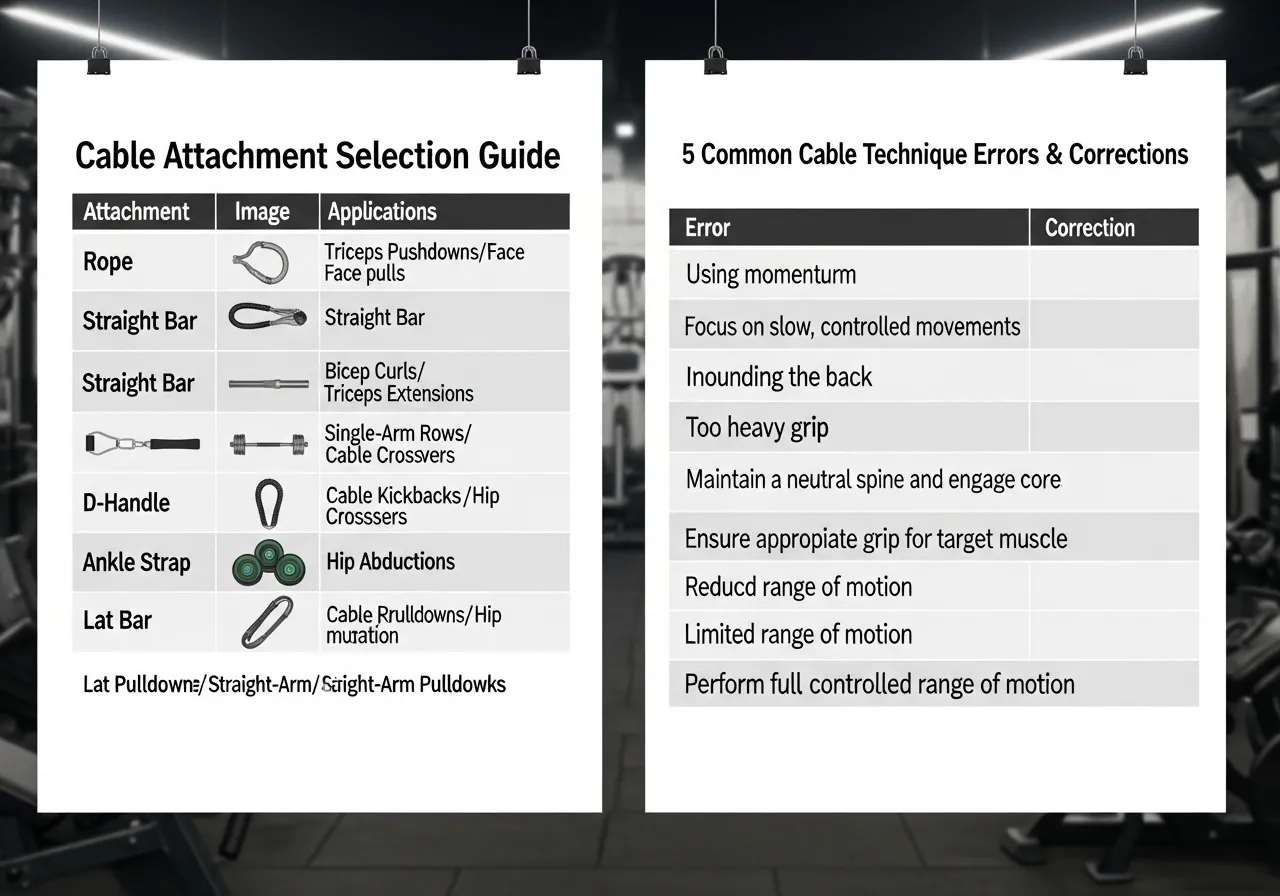
Common attachment options and their applications:
Attachment
Best Exercises
Key Advantage
Rope
Face pull, tricep pushdown, hammer curl
Allows neutral wrist position; hands can separate at end range
Straight bar
Bicep curl, pushdown, upright row
Symmetrical loading; precise bilateral force
D-handle (single)
Lateral raise, crossover, kickback
Independent arm work; identifies asymmetries
Ankle strap
Kickback, hip abduction/adduction, leg curl
Lower body cable exercises from low pulley
Wide/lat bar
Lat pulldown, straight-arm pulldown
Wide-grip pulling; maximizes lat breadth stimulus
Common Technique Errors Across Cable Exercises
Error
What Happens
Correction
Momentum-driven reps
Swinging to initiate movement
Pause at the start; control the eccentric
Shoulder shrugging in pulls
Traps dominate instead of target muscles
“Shoulders down and back” before and during the pull
Stack touching between reps
Weight stack rests — muscle tension released
Stop 2–3 cm before stack contact; maintain tension throughout
Wrong pulley height for exercise
Resistance direction doesn’t match movement
Set pulley height so peak tension matches peak contraction position
Locked elbows on pulling exercises
Elbow joint stress at full extension
Stop just short of full extension on rows and pulldowns
Cable Machine Safety Considerations
⚠️ Before every cable session:
→ Check the cable itself for fraying or kinks — a damaged cable can snap under load
→ Ensure the attachment pin is fully seated in the weight stack
→ Verify the selector pin is completely through the weight plate hole
→ Never stand directly under the weight stack — position yourself to the side
→ When releasing the attachment at the end of a set, lower the weight stack slowly — do not let it drop
Setting Up and Adjusting the Cable Machine
Many gym users are unsure how to properly adjust cable machines — limiting their exercise variety.
Most modern cable machines allow:
Pulley height adjustment: Moving the attachment point from ankle height (fully low) to above head height (fully high) — adjust before selecting the attachment
Weight stack adjustment: The selector pin changes the total weight — fine-tuning may be possible with small plates placed on top of the stack
Cable column position (dual cable stations): The width between the two columns is fixed, but standing closer to or further from the machine changes the effective resistance angle
Time spent learning to adjust the machine — including unfamiliar pulley heights and attachment combinations — pays dividends in exercise variety and training effectiveness over the long term.
Most gym staff are available to explain machine adjustment mechanics if the controls are unclear — asking for a brief orientation is always appropriate for new members or unfamiliar equipment.
Cable Pull-Through: An Underrated Posterior Chain Exercise
The cable pull-through — standing facing away from a low cable, pulling it between the legs in a hip-hinge pattern — is one of the most effective and least-used cable exercises for posterior chain development:
Setup: Attach a rope to a low pulley. Stand facing away from the machine, feet shoulder-width apart, rope between legs. Movement: Hip hinge backward (pushing the hips toward the machine), allowing the rope to travel back between the legs. Drive the hips forward to return to standing — the movement is a hip extension, not a back extension. Target muscles: Gluteus maximus, hamstrings, erector spinae Sets/Reps: 3 × 15 Cable advantage: Unlike the barbell Romanian deadlift, the cable pull-through has zero spinal compression — making it particularly suitable for those with back sensitivity who still need posterior chain training.
Cable Machine Programming: Full-Body and Upper/Lower Split
Cable Training Goals and Appropriate Applications
Training Goal
Cable Machine Role
Primary Cable Exercises
Muscle hypertrophy
Isolation volume; constant-tension stimulus
Lateral raise, crossover, pushdown, curl, face pull
Shoulder health
Rotator cuff + rear delt maintenance
Face pull, external rotation, band pull-apart analog
Controlled eccentric (3 sec return on each exercise)
3
3–4 × 10
Moderate–Heavy
Progressive overload; peak contraction squeeze
4
4 × 8–10
Heavy
Strength emphasis; full ROM at controlled tempo
Progressive Overload on Cable Machines
Progressive overload on cables requires slightly different strategies than free weights, since weight stacks typically increment by larger amounts (5–10 kg per plate) than the small jumps useful for isolation exercises:
Half-plate technique: Some cable stacks allow placing a small plate on top of the selector pin for smaller increments — check if the machine allows this
Rep progression: Before increasing weight, progress from 10 to 15 clean reps — then increase the stack and drop back to 10
Tempo manipulation: Extending the eccentric from 2 to 3 to 4 seconds at the same load increases time under tension without requiring a heavier stack
Technique advancement: Adding a deliberate 1-second isometric hold (a static contraction) at peak contraction before returning increases metabolic and mechanical stimulus at the same load
Cable Machine FAQ
Are cables better than free weights?
Neither is universally better — they serve different purposes within a complete training program.
Free weights develop absolute strength and functional coordination more effectively, while cables provide constant tension throughout the range and allow resistance in any plane — making them superior for isolation exercises and end-range loading.
The most effective programs incorporate both, using free weights for primary compound movements and cables for accessory and isolation work.
Can you build muscle with cables only?
Yes — the mechanical tension that drives muscle growth can be achieved with cable machines, provided the load is adequate and progressive overload is applied consistently.
Cable-only programs are practical for individuals without access to free weights, and for rehabilitation contexts where machine-controlled movement paths reduce injury risk during reloading.
✅ Key Takeaways
Cables provide resistance in any direction — not just vertically — enabling exercises impossible with free weights
Constant tension throughout the range of motion loads muscles at fully shortened positions where free weights cannot
Research supports cable machines as producing distinct and complementary adaptations to fixed-path selectorized machines
The face pull and Pallof press are among the highest-value cable exercises for shoulder health and core stability
Never let the weight stack drop — always lower it with control and check the cable and pin before each set
Cable Training Volume Guidelines
Cable exercises are primarily used as accessory and isolation movements — and are typically programmed at higher repetition ranges (10–20 reps) than primary compound free-weight movements:
Isolation exercises (lateral raise, face pull, pushdown, curl): 3–5 sets × 12–20 reps — the higher rep range maximizes metabolic stress and time under tension in smaller muscles
Compound cable exercises (row, chest press, RDL): 3–4 sets × 8–12 reps — similar to free-weight accessory work
Core cable exercises (Pallof press, woodchop): 2–3 sets × 10–15 reps per side — total volume is relatively modest as these are typically used to complement primary core training rather than replace it
Total weekly cable volume should be integrated within the overall training volume budget — typically 2–4 cable-specific sets per muscle group per week, on top of any free-weight work targeting the same muscles.
Advanced Cable Techniques and Long-Term Programming
Unilateral Cable Training: Why It Matters
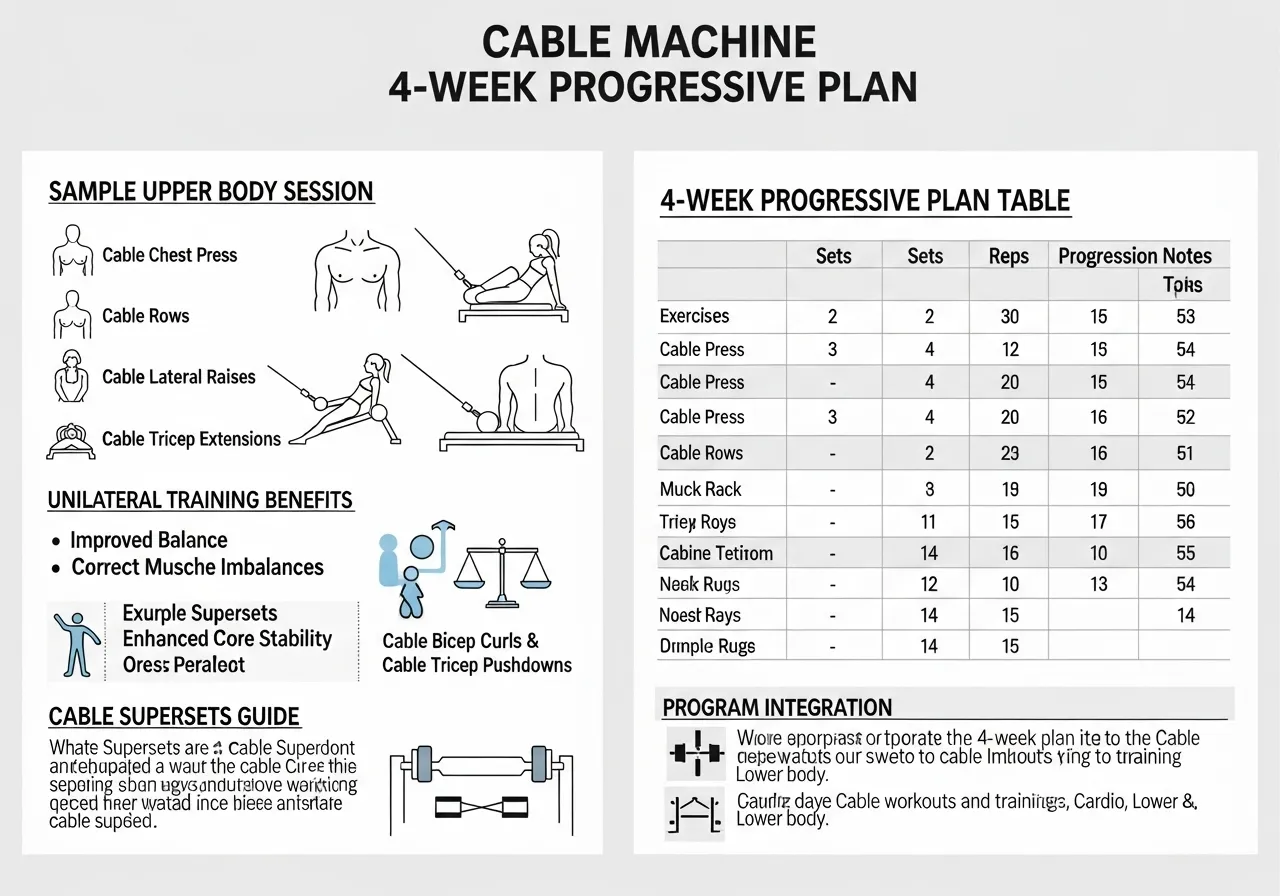
Performing cable exercises one arm or one leg at a time (unilateral training) provides distinct advantages over bilateral work:
Symmetry correction: Bilateral cable exercises allow the dominant side to compensate — unilateral work forces each side to work independently, exposing and correcting strength imbalances
Core stabilization demand: A single-arm cable push or pull requires the core to resist the unilateral rotational force — training anti-rotation stability not developed by bilateral pressing or pulling
Range of motion: Single-arm pressing and pulling typically allows greater range of motion than bilateral — the opposite arm does not constrain the movement arc
Incorporating 1–2 unilateral cable exercises per session — alternating with bilateral variations across weeks — maintains both symmetry and bilateral strength development.
Cable Supersets for Efficient Training
The cable machine’s rapid adjustability makes it particularly suited to superset training (performing two exercises back-to-back without rest between them):
High-efficiency cable supersets:
→ Cable bicep curl (low pulley) + Cable tricep pushdown (high pulley): Antagonist muscles — one rests while the other works
→ Cable chest press (mid pulley) + Cable face pull (high pulley): Push + pull pairing
→ Cable lateral raise + Cable rear delt fly: All three deltoid heads in one superset
→ Pallof press + Cable woodchop: Progressive core rotation challenge
Cable Machines for Rehabilitation and Return-to-Training
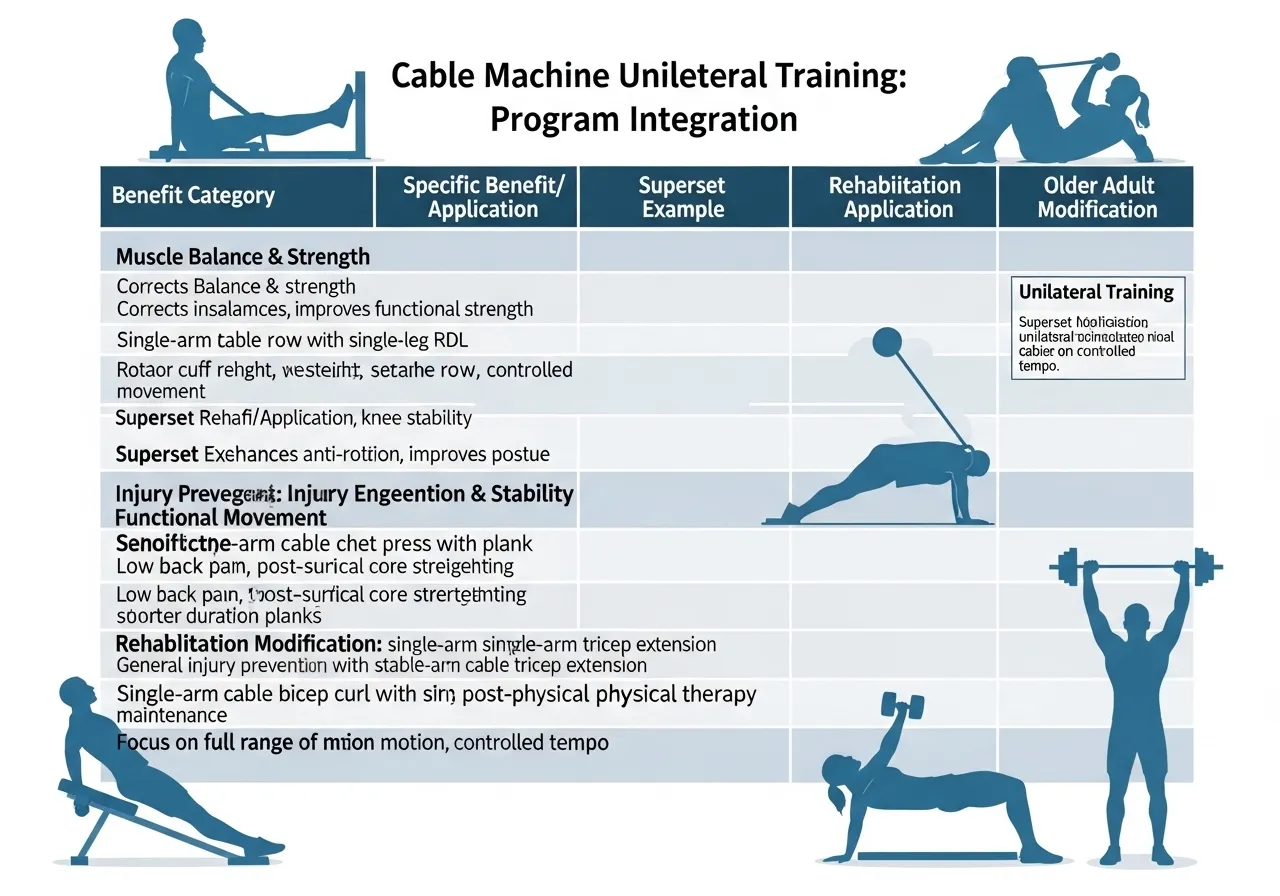
The controlled, guided resistance direction of cable machines makes them particularly suitable for rehabilitation contexts:
Shoulder rehabilitation often uses low-load cable external rotation and face pulls to rebuild rotator cuff strength with precise, consistent resistance direction
Lower back rehabilitation protocols frequently include cable pull-throughs and standing cable rows to gradually reload the hip extensors and back musculature under controlled conditions
Post-surgical recovery for knee conditions often incorporates seated cable leg press variations at limited ROM before progressing to free-weight loading
Any cable training as part of an active rehabilitation program should be prescribed and supervised by the treating physiotherapist or sports medicine physician — the specific parameters appropriate for rehabilitation differ from general fitness training and require clinical judgment to implement safely.
Cable Training for Older Adults
The cable machine’s smooth, predictable resistance profile and the ability to perform exercises in a standing or seated position make it particularly practical for older adult fitness programs:
Standing cable exercises develop the balance and functional strength needed for daily activities — picking up objects, reaching overhead, turning and reaching
Cable resistance is adjustable to very low loads — appropriate for individuals beginning resistance training from a low baseline
The absence of dropped weights and the controlled nature of cable exercises reduces injury risk compared to free weights for older adults learning new movement patterns
Older adults with significant balance limitations may benefit from performing cable exercises with one hand on a stable surface for support until balance and core stability improve sufficiently to support unsupported standing cable work.
The Cable Machine in a Complete Training Program
Training Block
Cable Proportion
Rationale
Strength focus (low reps)
20–30% of session
Accessory volume; shoulder/core health maintenance
Hypertrophy focus (moderate reps)
40–50% of session
Isolation volume and constant-tension stimulus
Conditioning/fat loss
50–60% of session
Circuit-based cable supersets; time-efficient
Rehabilitation
60–80% of session
Controlled loading; precise resistance direction
A qualified personal trainer or certified strength and conditioning specialist can design a cable machine program calibrated to individual goals, available equipment, and any physical limitations — particularly useful for individuals learning cable machine use for the first time or transitioning from machine-only to free-weight-plus-cable programming.
The Role of Cable Machines in Injury Prevention
The predictable, controlled resistance direction of cable machines makes them a valuable injury prevention tool alongside their strength and hypertrophy applications:
Rotator cuff maintenance: Regular face pulls and cable external rotations (2–3 sets × 15–20 reps, 2–3 times per week) provide the rotator cuff strengthening that heavy pressing programs require to maintain shoulder joint health
Postural muscle balance: Most gym programs develop the pushing muscles (pectorals, anterior deltoid) more than the pulling muscles — regular cable rows and face pulls counterbalance this common imbalance
Knee-friendly lower body options: Cable kickbacks and cable pull-throughs provide lower body stimulus without the knee compression of squatting movements — useful during periods of knee sensitivity
Getting Started With Cable Machines: A First Session Guide
For individuals new to cable machines, an initial session should focus on understanding the equipment before pursuing intensity:
Suggested first cable session (30 min):
✅ Spend 5 minutes adjusting and readjusting the pulley height — familiarize yourself with the adjustment mechanism
✅ Try 3 different attachments (rope, straight bar, D-handle) at low weight to feel the difference
✅ Perform 2 × 15 face pulls, 2 × 15 lateral raises, 2 × 15 cable rows at light loads focusing entirely on technique
✅ Practice the Pallof press at both sides — feel the anti-rotation demand
✅ Note any exercises that feel awkward or produce discomfort — these warrant technique review before loading
The learning curve for cable machine competency is typically 2–4 sessions — after which the versatility of the equipment significantly expands the effective exercise vocabulary available within a training program.
The combination of injury prevention value and versatility positions the cable machine as one of the highest return-on-investment pieces of equipment available in any commercial gym.
The lateral raise is the only exercise that directly targets the medial deltoid head, the muscle responsible for shoulder width. Every pressing movement loads the anterior deltoid heavily. No pressing movement meaningfully loads the medial deltoid. Yet most trainees perform lateral raises as an afterthought: a few sets of dumbbell swings at the end of…
⚠️ Fitness Disclaimer: The information in this article is for general educational purposes only and does not constitute professional fitness or medical advice. Always consult a qualified healthcare professional before starting any new exercise program, especially if you have existing injuries or medical conditions. The Exercise That Changed How I Understood Glute Training For the…
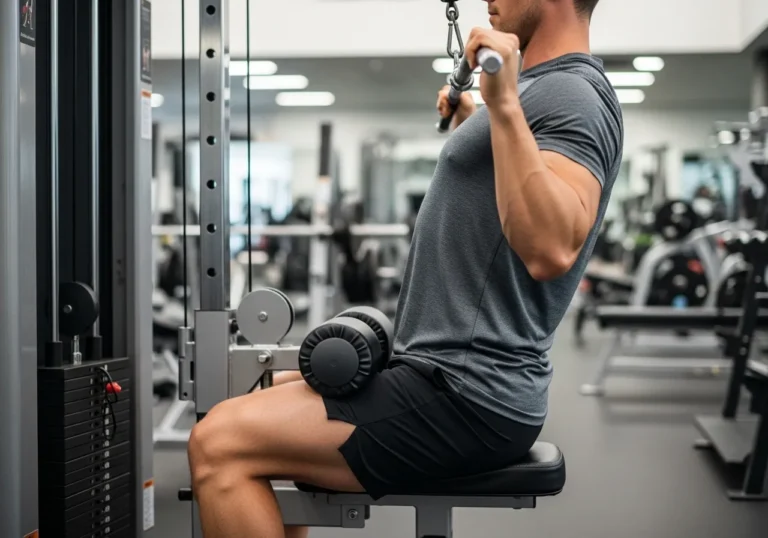
⚠️ Health & Fitness DisclaimerThis article is for general educational and informational purposes only.It does not replace professional medical or fitness advice.If you have any pre-existing condition, injury, or shoulder concern — please consult a qualified healthcare professional or certified personal trainer before starting or modifying any exercise program. The lat pulldown mastery guide is…
The dumbbell shoulder press EMG Debate: Why Both Tools Have a Place in Your Training The dumbbell shoulder press versus barbell overhead press guide debate has persisted in training communities for decades, with advocates on each side claiming superiority for their preferred implement. The reality is more nuanced and more practically useful: the two variations…
The straight barbell curl is the classic bicep exercise. Most programmes include it, most beginners start with it, and most experienced trainees return to it as their primary loaded curl movement. It also produces wrist and forearm discomfort in a significant proportion of trainees, particularly those who have had wrist injuries, naturally have limited forearm…
⚠️ Fitness Disclaimer: The information in this article is for general educational purposes only and does not constitute professional fitness or medical advice. Exercise carries inherent risks. Always consult a qualified healthcare professional or certified personal trainer before starting or modifying any exercise program, especially if you have a pre-existing medical condition, injury, or health…