Most recreational endurance athletes train by feel. Some days hard, some days easy. Occasionally very hard. They improve for the first six months, plateau, and then wonder why more miles are not producing better results.
The answer is almost always the same: they are training in the middle. Not easy enough to build aerobic base. Not hard enough to drive adaptation. Just moderately uncomfortable, all the time.
Understanding lactate threshold explains why this happens and how to fix it. It also explains why the most successful endurance athletes in the world train the way they do, and why their approach looks counterintuitive from the outside.
This guide covers what lactate threshold is, why it predicts performance better than VO2 max alone, how to test it without a laboratory, and a progressive training plan built around it.
What Lactate Threshold Actually Is and Why It Predicts Performance
The Physiology: Why Lactate Accumulates
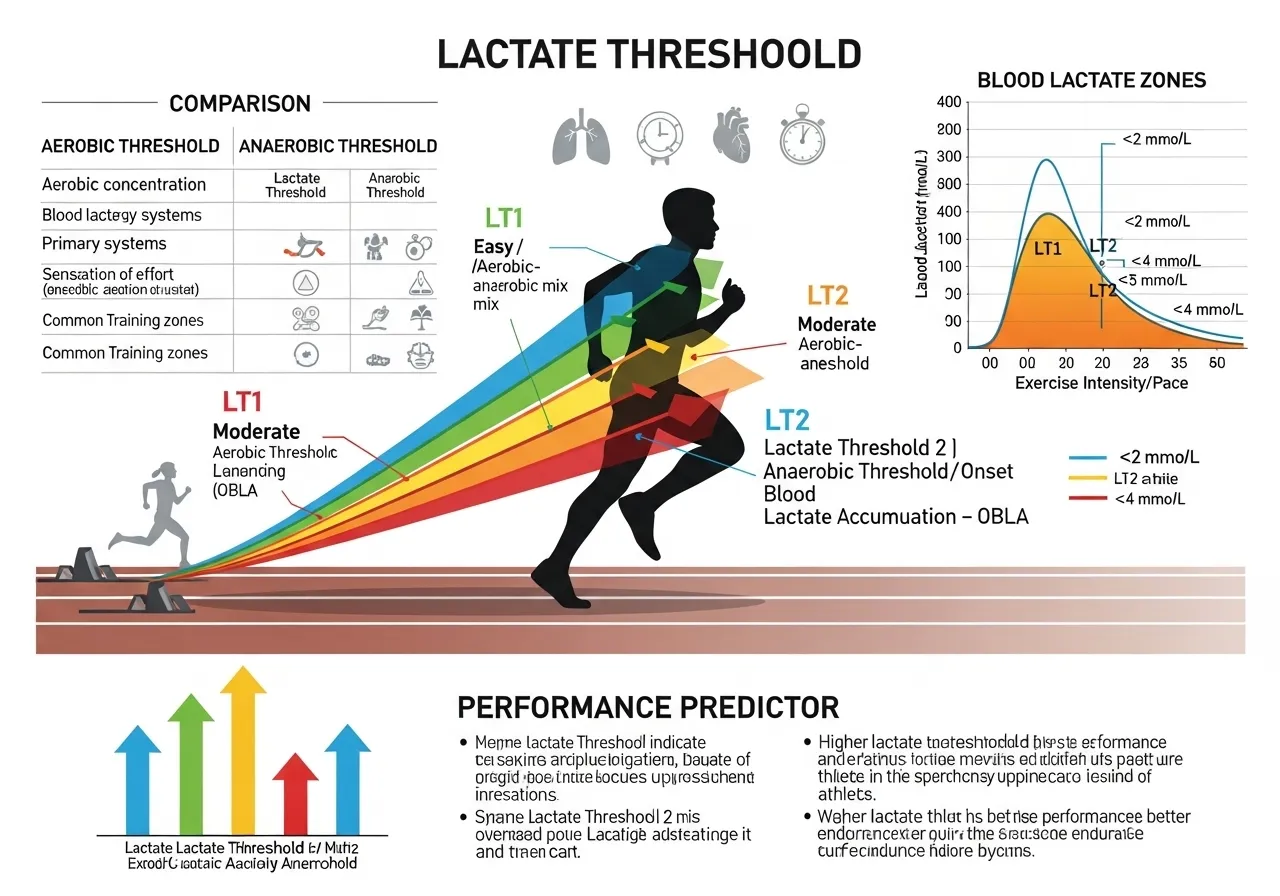
Lactate is produced continuously during exercise as a byproduct of carbohydrate metabolism. At low intensities, the body clears lactate as fast as it produces it. The bloodstream lactate concentration stays near resting levels of 1 to 2 mmol per litre.
As intensity increases, lactate production begins to outpace clearance. Blood lactate rises. At a specific intensity, typically identified as the point where blood lactate rises sharply or where it reaches 4 mmol per litre by convention, this is defined as the lactate threshold.
Above the lactate threshold, accumulation accelerates rapidly. Exercise feels progressively harder, muscle pH falls, and the ability to sustain the effort drops dramatically. Below it, sustainable exercise can continue almost indefinitely at adequate fuelling.
Why Lactate Threshold Outperforms VO2 Max as a Performance Predictor
VO2 max, the maximum rate of oxygen consumption, is often treated as the gold standard of endurance fitness. It is a ceiling. Lactate threshold determines how close to that ceiling you can race.
📌 Key Finding
Lactate threshold improves with training even when VO2 max does not change. It is the more sensitive and more relevant performance predictor for trained athletes who have already developed a high aerobic ceiling.
LT1 and LT2: The Two Thresholds That Matter
Endurance physiology identifies two distinct lactate breakpoints rather than one:
Threshold
Also Called
Blood Lactate
Training Zone
Practical Feel
LT1
Aerobic threshold, Zone 2 ceiling
~2 mmol/L
Zone 2
Can hold full conversation
LT2
Anaerobic threshold, MLSS
~4 mmol/L
Zone 4
Can speak in short sentences only
Most recreational athletes train predominantly between LT1 and LT2 without realising it. This moderate zone is sometimes called the “grey zone” or “black hole” of training. It is hard enough to accumulate significant fatigue but not intense enough to drive the specific adaptations that threshold training targets.
The most productive endurance training spends most volume below LT1 to build the aerobic base, and a smaller volume at or near LT2 to push the threshold upward. Understanding what VO2 max is and why it relates to these thresholds is covered in the VO2 max guide.
Why the Same VO2 Max Can Produce Vastly Different Race Times
Two runners with identical VO2 max values can have dramatically different race performances. The difference is almost always their lactate threshold as a percentage of VO2 max.
Runner A has a VO2 max of 60 ml/kg/min and a lactate threshold at 75% of VO2 max. They race at approximately 45 ml/kg/min equivalent intensity.
Runner B has the same VO2 max of 60 ml/kg/min but a lactate threshold at 88% of VO2 max. They race at approximately 53 ml/kg/min equivalent intensity.
Runner B is significantly faster despite identical aerobic ceiling. This is why training programmes that raise the lactate threshold as a percentage of VO2 max consistently produce race performance improvements even without increasing VO2 max itself.
It also explains why recreational athletes who have already improved their VO2 max significantly often continue improving race times for years afterward, simply by raising their threshold closer to their ceiling through structured training.
The Research Behind Lactate-Guided Training: What Elite Athletes Do
The Norwegian Model and Lactate-Guided Threshold Interval Training
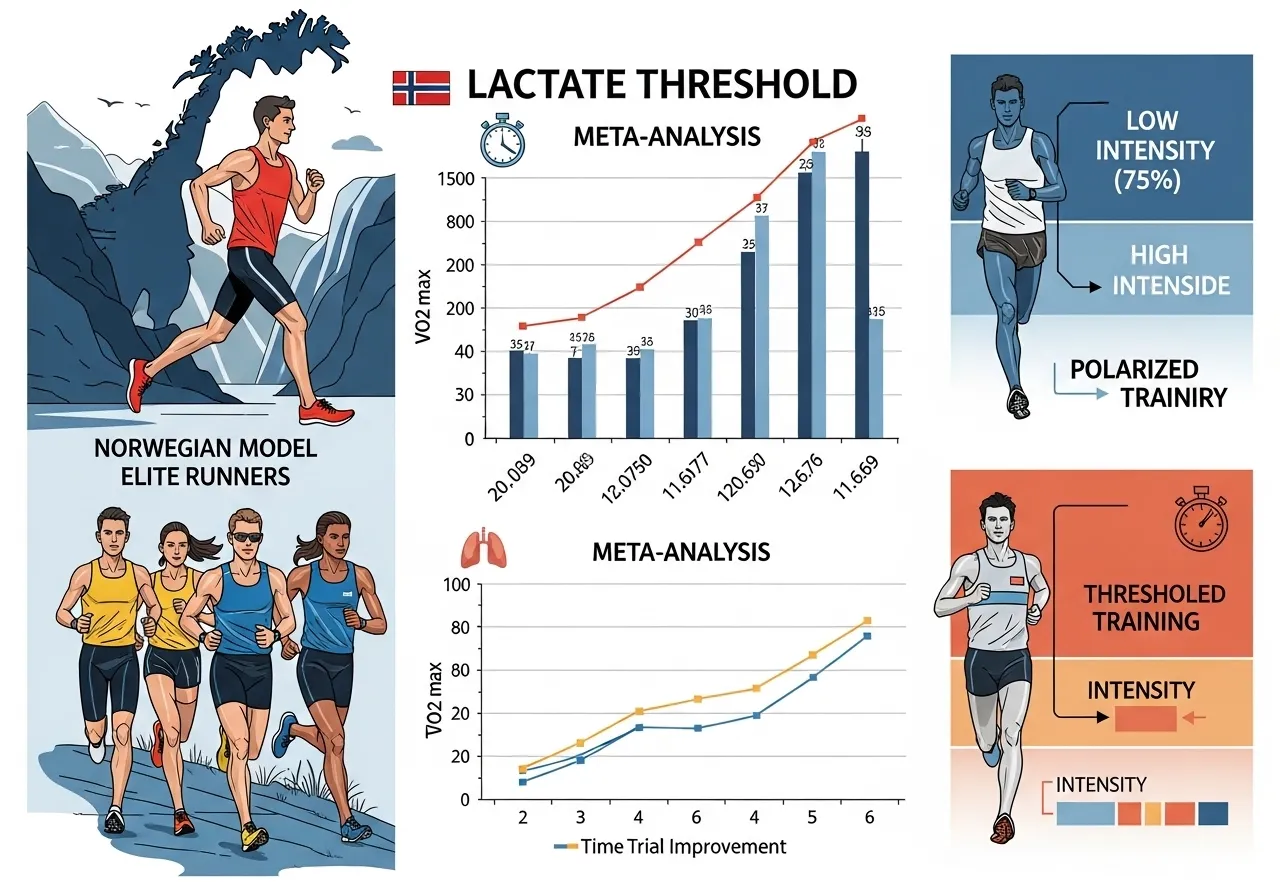
Norway’s dominance in middle and long-distance running and triathlon over the past decade has renewed scientific interest in how exactly elite athletes structure their training. The answer, across multiple studies of world-class performers, consistently shows a model that differs significantly from what most recreational athletes practise.
📌 Key Finding
Elite endurance athletes perform most volume at low intensity with a small number of precisely-guided threshold sessions. The key is the precision: threshold work is calibrated to actual blood lactate, not pace or perceived effort.
Polarised vs Threshold Training: What the Meta-Analysis Shows
📌 Key Finding
Polarised training, where most volume is easy and a smaller portion is genuinely hard, outperforms spending most training time at moderate threshold intensities. The grey zone between LT1 and LT2 produces the least return per hour invested.
The Review That Changed Polarised Training Understanding
Recreational athletes training four to six hours per week cannot replicate the absolute volumes of elite performers. They can replicate the distribution.
The principle translates directly: most training easy, some training hard, very little in the middle. For a four-hour-per-week athlete, this means approximately three hours below LT1 and forty to sixty minutes at or above LT2. The remaining time can include threshold-specific work at LT2 during quality sessions. The zone 2 framework for building the aerobic base is covered in the Zone 2 training guide.
How to Test Your Lactate Threshold Without a Laboratory
Why Field Tests Work
Laboratory lactate testing requires repeated blood samples during incremental exercise on a treadmill or cycle ergometer. It is the gold standard. It is also inaccessible to most recreational athletes.
Field tests estimate lactate threshold from heart rate and pace data using the physiological principle that LT2 corresponds closely to the maximum effort sustainable for approximately one hour. They are not as precise as laboratory testing. They are precise enough to guide training effectively.
Field Test Option 1: The 30-Minute Time Trial
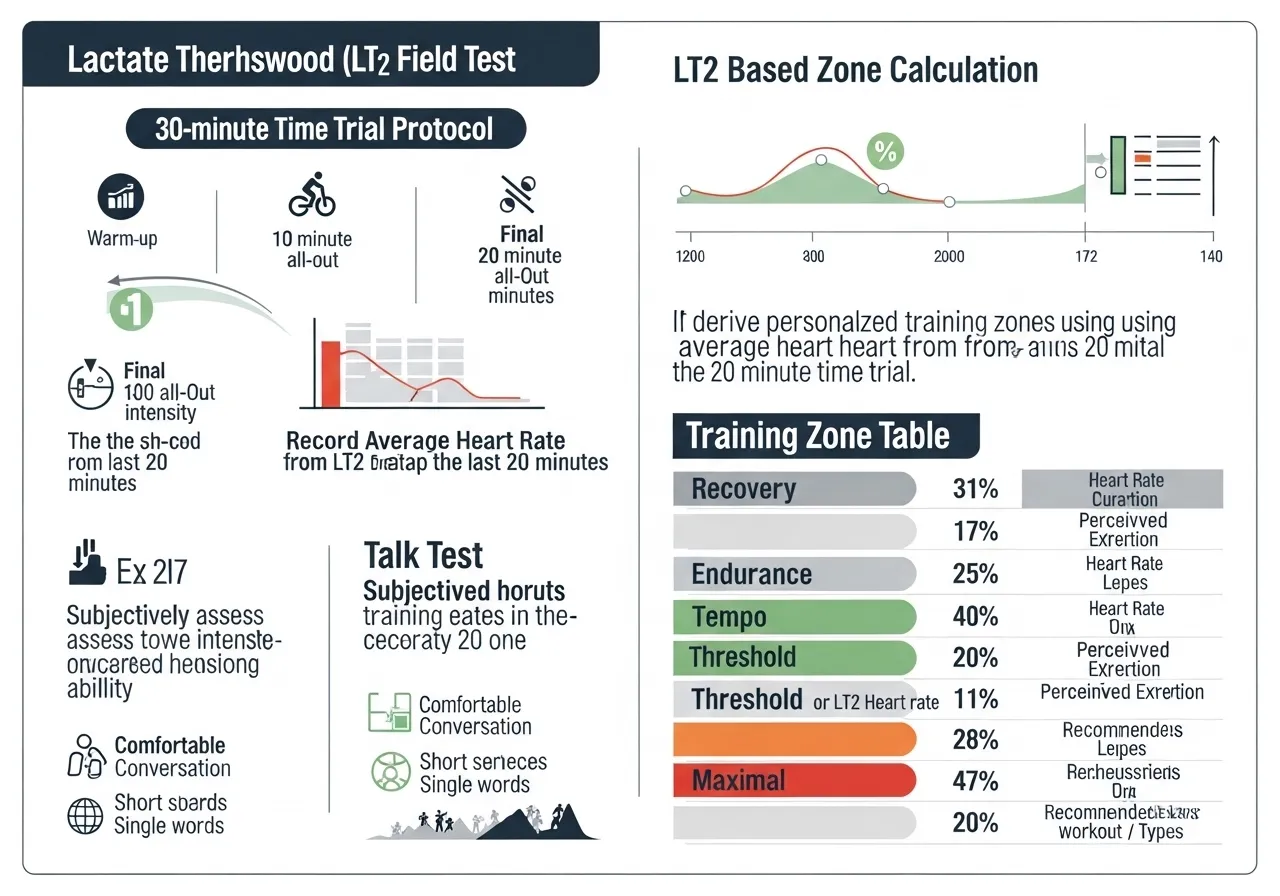
Warm up for 15 minutes at easy pace. Then run, cycle, or row at the highest effort you can sustain for exactly 30 minutes. Record heart rate for the final 20 minutes of the effort. The average heart rate over the final 20 minutes is your estimated LT2 heart rate.
This test works because LT2 corresponds closely to one-hour race pace. Thirty minutes of maximal effort produces a heart rate that slightly overestimates true LT2 by approximately 5%, which is corrected by using the final 20-minute average rather than the full 30-minute average.
Field Test Option 2: The Talk Test
The talk test is a validated, simple method for estimating LT1 without any equipment. During exercise, attempt to speak a full sentence comfortably. If you can speak freely, you are below LT1. If you can speak in short phrases only, you are between LT1 and LT2. If speaking is difficult or impossible, you are above LT2.
The talk test consistently identifies LT1 within 5 to 10% of laboratory-measured values in trained individuals. It is not precise enough for elite training prescription but is accurate enough for recreational training zone identification.
Using Heart Rate Zones From Your Field Test
Once you have your LT2 heart rate from the 30-minute test, derive training zones as follows:
Zone 1 (Recovery): Below 75% of LT2 heart rate. Active recovery only. Zone 2 (Aerobic base): 75 to 85% of LT2 heart rate. The primary training zone. Most volume here. Zone 3 (Tempo/grey zone): 85 to 95% of LT2 heart rate. Moderately hard. Minimise time here. Zone 4 (Threshold): 95 to 105% of LT2 heart rate. Sustainable for 20 to 40 minutes. Quality sessions target this zone. Zone 5 (VO2 max): Above 105% of LT2 heart rate. Interval work only. Short efforts of 3 to 8 minutes.
The 6-Week Threshold Development Plan
The following structure assumes two quality sessions per week alongside three to four easy Zone 2 sessions:
📅 Weeks 1 to 2: Threshold Introduction
Quality session 1: 4 x 5 minutes at LT2 heart rate, 90 seconds easy between efforts
Quality session 2: 20-minute tempo at LT2 heart rate
All other sessions: Zone 1 to 2 only, below LT1
📅 Weeks 3 to 4: Volume Build
Quality session 1: 5 x 5 minutes at LT2, 75 seconds easy between efforts
Quality session 2: 25-minute tempo at LT2 heart rate
All other sessions: Zone 1 to 2 only
📅 Weeks 5 to 6: Consolidation and Re-Test
Quality session 1: 3 x 10 minutes at LT2, 2 minutes easy between efforts
Quality session 2: 30-minute tempo at LT2 heart rate
Week 6: Repeat the 30-minute field test to establish new LT2 heart rate
Threshold Training Workouts: The 3 Most Effective Session Types
Session Type 1: Cruise Intervals
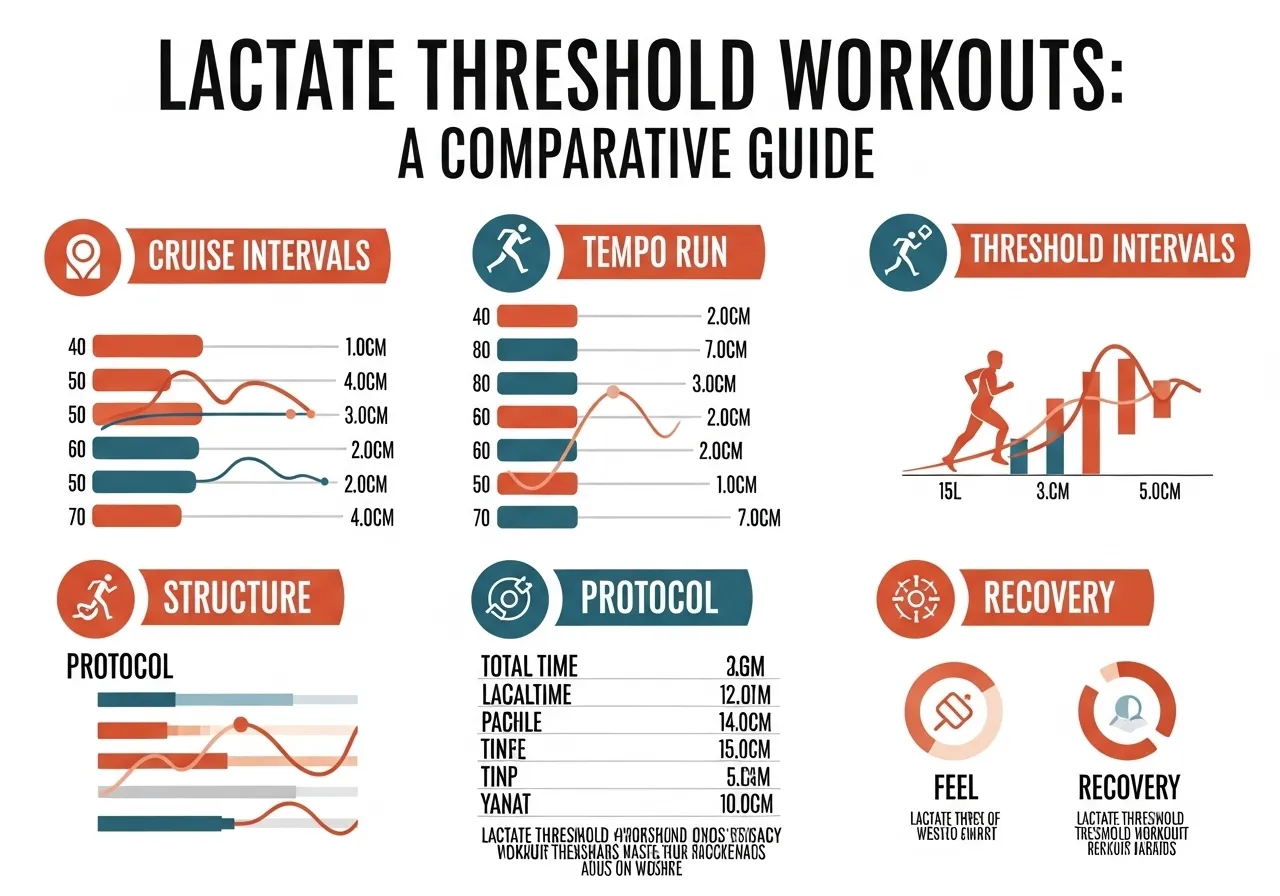
Cruise intervals are the most practical threshold training format for recreational athletes. The workout consists of repeated efforts at LT2 intensity separated by short recovery intervals.
🏃 Cruise Intervals: Standard Protocol
Structure: 4 to 6 repetitions of 5 minutes at LT2 pace or heart rate, with 60 to 90 seconds of easy jogging between efforts
Total threshold time: 20 to 30 minutes per session
Feel: Comfortably hard. You can speak in short phrases. By the last interval, it is genuinely difficult to maintain pace.
Why it works: The short recovery intervals allow more total time at LT2 intensity than a single continuous effort of the same duration, while the brief rest prevents lactate from accumulating beyond the threshold point.
Session Type 2: Tempo Run
The tempo run is a single continuous effort at LT2 intensity. It is more mentally demanding than cruise intervals and accumulates more physiological stress in a shorter time.
🏃 Tempo Run: Standard Protocol
Structure: 20 to 40 minutes of continuous running at LT2 pace or heart rate
Progression: Begin at 20 minutes. Add 5 minutes every two weeks until reaching 40 minutes.
Feel: Hard but controlled. The pace should feel like it could be maintained for about one hour in a race. Not a sprint, not a comfortable jog.
Why it works: Sustained time at LT2 produces the maximal lactate steady state adaptation. The body learns to clear lactate more efficiently at this specific intensity through mitochondrial density increases and improved lactate transport protein expression.
How to Warm Up and Cool Down for Threshold Sessions
Threshold sessions require a proper warm-up to raise core temperature, increase blood flow to working muscles, and gradually bring heart rate toward the threshold zone before the quality effort begins.
A standard threshold session warm-up: 10 to 15 minutes of easy Zone 1 to 2 jogging, followed by 4 to 6 strides of 20 seconds at slightly faster than threshold pace with full recovery between each. The strides prime the neuromuscular system for the demands of the threshold effort without pre-fatiguing the lactate clearance system.
Cool-down after threshold work: 10 minutes of easy jogging below Zone 2 allows lactate to clear from the bloodstream, reduces delayed onset muscle soreness, and begins the physiological recovery process. Stopping abruptly after threshold work causes blood pooling and unnecessarily prolongs recovery.
Session Type 3: Lactate Threshold Intervals (Longer)
Longer threshold intervals target the upper end of the LT2 zone and develop the ability to sustain threshold pace under progressive fatigue.
🏃 Threshold Intervals: Advanced Protocol
Structure: 3 repetitions of 10 minutes at LT2 pace, with 2 to 3 minutes of easy jogging between efforts
Total threshold time: 30 minutes per session
Feel: Each successive interval feels harder at the same pace. The 3rd interval requires significant focus to maintain pace without slowing.
Best used: After 4 to 6 weeks of cruise interval and tempo run work. The longer intervals require a lactate clearance capacity that takes weeks of threshold training to develop.
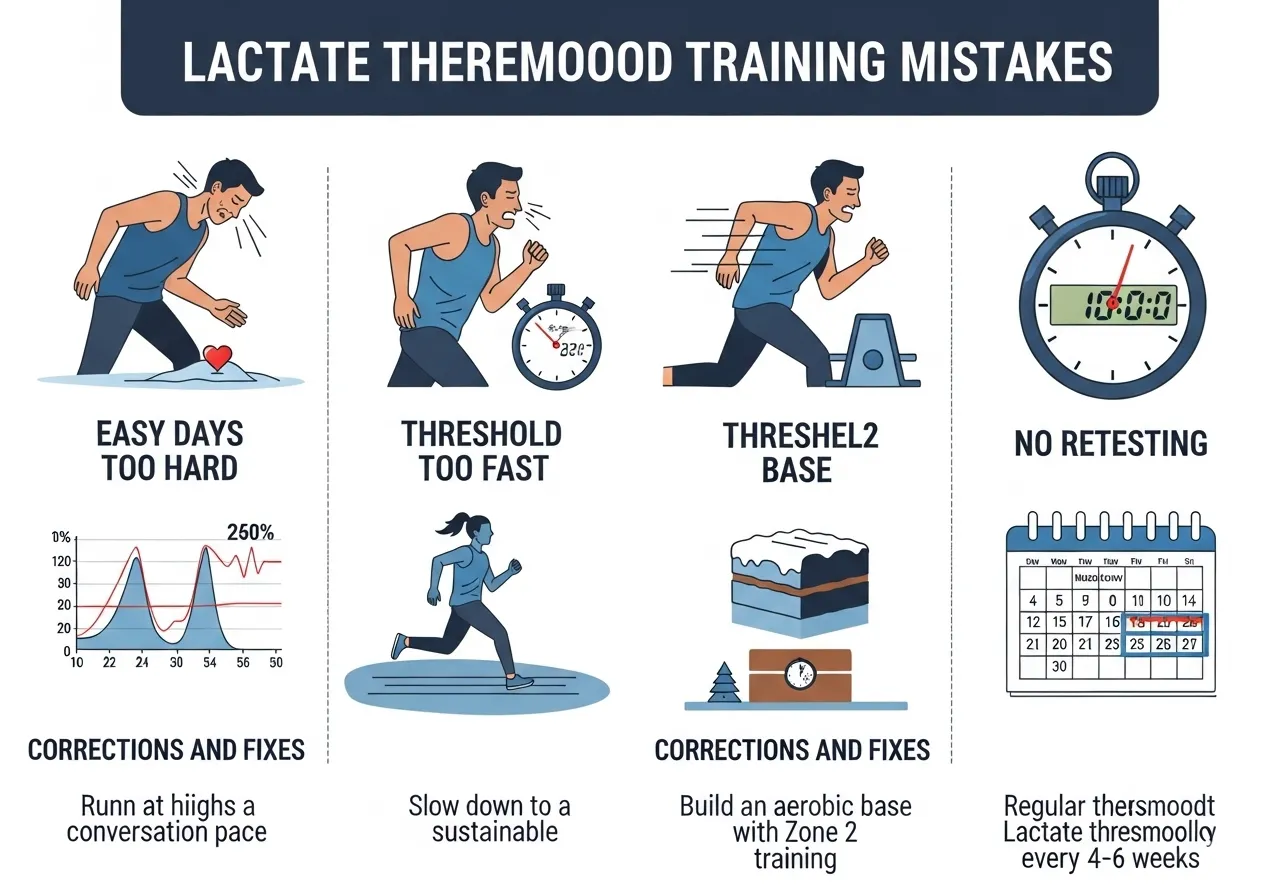
The 4 Mistakes That Prevent Lactate Threshold Improvement
Mistake 1: Training Too Hard on Easy Days
The single most common endurance training error is performing easy days at moderate intensity rather than genuinely easy intensity. Moderate effort feels productive. It produces more fatigue than adaptation per hour invested.
When easy days are performed at Zone 3 (between LT1 and LT2) rather than Zone 1 to 2 (below LT1), two problems occur simultaneously. The accumulated fatigue reduces the quality of the subsequent threshold session. The moderate-intensity stimulus also fails to drive the mitochondrial adaptations that low-intensity training specifically produces.
The fix is uncomfortable: easy days must feel genuinely easy. For most recreational athletes, this means slowing down significantly from their habitual easy pace. Heart rate should stay below 75 to 80% of LT2 heart rate. If maintaining a conversation is difficult, the pace is too fast.
Mistake 2: Performing Threshold Work Too Fast
Threshold training at intensities significantly above LT2 is not threshold training. It is VO2 max or supramaximal interval work, which produces different adaptations through different mechanisms.
When trainees perform tempo runs or cruise intervals at race pace rather than threshold pace, they train above LT2. The session produces rapid lactate accumulation, forces early termination, and leaves significant residual fatigue. It does not produce the sustained time at LT2 that drives threshold adaptations.
LT2 pace is approximately 10 to 20 seconds per kilometre slower than 5 km race pace for most recreational runners. It is the pace you could race for about an hour, not the pace you race for 20 minutes. Starting threshold sessions slightly slower than feels natural is almost always the correct approach.
Mistake 3: Neglecting Zone 2 Volume
Threshold training without adequate Zone 2 base volume is like building a second floor before completing the first floor. Threshold adaptations, specifically improved lactate clearance capacity and mitochondrial density at LT2 intensity, depend on the aerobic infrastructure that only Zone 2 training develops.
Trainees who perform threshold sessions without a Zone 2 base plateau rapidly and often develop overuse injuries from the high-intensity load without the aerobic base to support recovery. A minimum of three to four weeks of consistent Zone 2 training before introducing threshold work is appropriate for most recreational athletes beginning structured endurance training.
Mistake 4: Not Re-Testing the Threshold
Lactate threshold improves with training. The heart rate and pace corresponding to LT2 shifts upward over weeks and months of structured training. Training zones derived from a test performed three months ago are no longer accurate.
The practical consequence: an athlete who trained at 155 beats per minute as their LT2 heart rate in January may have a true LT2 of 162 beats per minute by March after consistent threshold work. If they continue training at 155 bpm, every threshold session falls short of the required intensity. The sessions feel easier. Progress stalls. The athlete concludes threshold training has stopped working.
Repeating the 30-minute field test every six to eight weeks recalibrates the training zones to the current threshold. Without recalibration, threshold sessions progressively drift below LT2 as fitness improves, eventually providing insufficient stimulus for further adaptation.
Most trainees see measurable threshold improvement after six weeks of structured work. Regular re-testing is not optional maintenance. It is the mechanism that ensures the programme continues producing the right stimulus as fitness improves.
Frequently Asked Questions About Lactate Threshold Training
How do I know if I am training at my lactate threshold?
The most reliable field indicator is the talk test combined with perceived exertion. At LT2, you can speak in short phrases of three to five words but cannot hold a comfortable conversation. Your breathing is noticeably faster and deeper than at easy pace. You are working hard but the effort feels controllable.
Heart rate provides a more objective guide once you have established your LT2 heart rate from a field test. Threshold sessions should keep heart rate within 95 to 105% of your LT2 heart rate throughout the quality portion of the workout.
How many threshold sessions per week is optimal?
One to two threshold sessions per week is appropriate for most recreational athletes training four to six hours weekly. Elite athletes performing high volumes may complete three to four threshold sessions per week because their total training volume provides sufficient easy-pace recovery between quality sessions.
For recreational athletes, more than two threshold sessions per week without proportional increases in total volume typically produces diminishing returns and elevated injury risk. Quality of execution matters more than frequency. One well-executed threshold session produces more adaptation than two poorly-executed ones.
How long does it take to raise the lactate threshold?
Measurable threshold improvement, defined as a faster pace or higher power output at the same LT2 heart rate, typically occurs within four to six weeks of structured threshold training combined with adequate Zone 2 volume.
Significant threshold improvement, enough to noticeably change race performance, requires eight to twelve weeks of consistent work. Elite endurance athletes develop their lactate threshold over years of progressive training. Recreational athletes can expect meaningful improvement in a single training block but should understand that threshold development is a long-term process rather than a short-term fix.
Is lactate threshold training appropriate for beginners?
Structured threshold training is appropriate for athletes who have established a consistent aerobic base of at least three to four months of regular cardiovascular exercise. Complete beginners benefit more from simply establishing consistency and building Zone 2 volume than from adding threshold complexity.
The prerequisite is not a specific fitness level. It is the aerobic base infrastructure that allows threshold work to produce adaptation rather than simply accumulating fatigue. HIIT protocols offer an alternative approach to high-intensity cardiovascular development during the early training stages. The research comparing HIIT to steady-state methods is covered in the HIIT training guide.
What is the difference between lactate threshold and anaerobic threshold?
In practical usage, lactate threshold and anaerobic threshold refer to the same physiological point: the exercise intensity above which lactate accumulation accelerates sharply.
The “anaerobic threshold” terminology is older and somewhat misleading because the transition is not a switch to anaerobic metabolism but a shift in the balance between lactate production and clearance rates. Muscle cells continue producing energy aerobically above this point. The difference is that lactate production now exceeds the body’s clearance capacity.
Modern exercise physiology uses lactate threshold or maximal lactate steady state (MLSS) as more precise terms. For practical training purposes, the distinction is irrelevant. Both refer to the upper limit of sustainable aerobic effort.
Does altitude training affect lactate threshold?
Yes. At altitude, reduced oxygen availability lowers the absolute pace and power output corresponding to LT2, even though the physiological threshold itself may not change immediately.
Athletes training at altitude find their threshold pace is slower than at sea level. Heart rate-based zones remain valid at altitude when based on effort, but pace-based zones must be adjusted. After returning to sea level following an altitude training block, many athletes experience a temporary improvement in threshold performance as red blood cell count remains elevated while pace limitations disappear.
Key Takeaways
Lactate threshold improves with training even when VO2 max does not change, making it the more sensitive performance indicator for trained athletes
Elite endurance athletes perform most volume below LT1 with a smaller proportion at or near LT2. The grey zone between the two thresholds produces the least adaptation per hour invested.
Polarised training, with approximately 75 to 80% of volume at low intensity and 15 to 20% at high intensity, outperforms threshold-dominated training distribution for VO2 max and time-trial performance
The 30-minute time trial field test provides a reliable LT2 heart rate estimate without laboratory equipment. Re-test every 6 to 8 weeks as fitness improves.
Easy days must be genuinely easy. Moderate effort on recovery days reduces threshold session quality and produces less total adaptation than a proper easy-hard distribution.
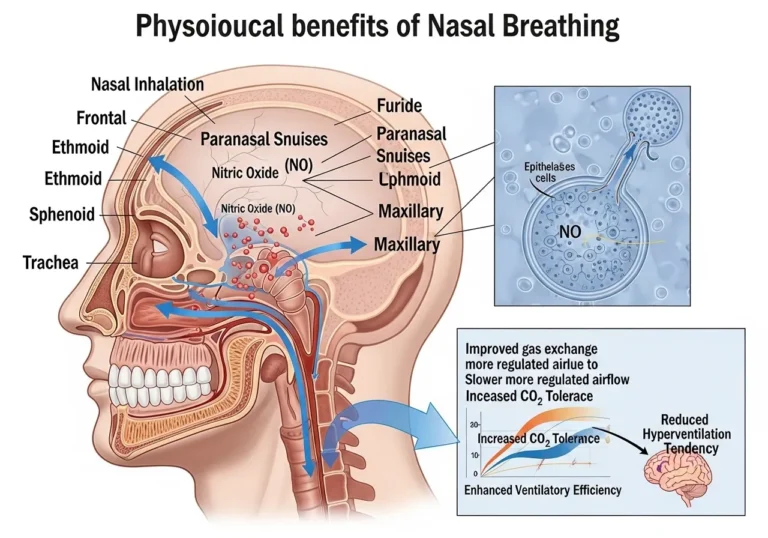
Breathing through the mouth during exercise is the default for most people. It feels necessary at moderate intensity, instinctive at high intensity, and the idea of restricting breathing to the nose during a training run sounds like an experiment in self-imposed oxygen deprivation. The research tells a more nuanced story. Nasal breathing during exercise activates…
⚠️ Health & Fitness DisclaimerThis article is for general educational and informational purposes only. It does not replace professional medical or fitness advice. If you have any pre-existing condition, injury, or health concern — consult a qualified healthcare professional or certified personal trainer before starting or modifying any exercise program. VO2 max is one of…
⚠️ Health & Fitness DisclaimerThis article is for general educational and informational purposes only and does not replace professional medical or fitness advice.If you have any pre-existing lower back, hip, or knee condition — consult a qualified healthcare professional before starting any deadlift program. The conventional deadlift is one of the most effective strength exercises…
⚠️ Health & Fitness DisclaimerThis article is for general educational and informational purposes only. It does not replace professional medical or fitness advice. If you have any pre-existing condition, injury, or health concern — consult a qualified healthcare professional or certified personal trainer before starting or modifying any exercise program. Sandbag training occupies a unique…
⚠️ Fitness Disclaimer: The information in this article is for general educational purposes only and does not constitute professional fitness or medical advice. Always consult a qualified healthcare professional before starting any new exercise program, especially if you have existing injuries or medical conditions. Why Two Straps Changed What I Thought Training Equipment Needed to…
⚠️ Health & Fitness DisclaimerThis article is for general educational and informational purposes only.It does not replace professional medical or fitness advice.If you have any pre-existing condition or injury — please consult a qualified healthcare professional or certified personal trainer before starting any new exercise program. Resistance bands are dismissed by many gym-goers as beginner…