Nasal Breathing: The Endurance Science Behind Nose-Only Training and How to Build the Habit at Every Level
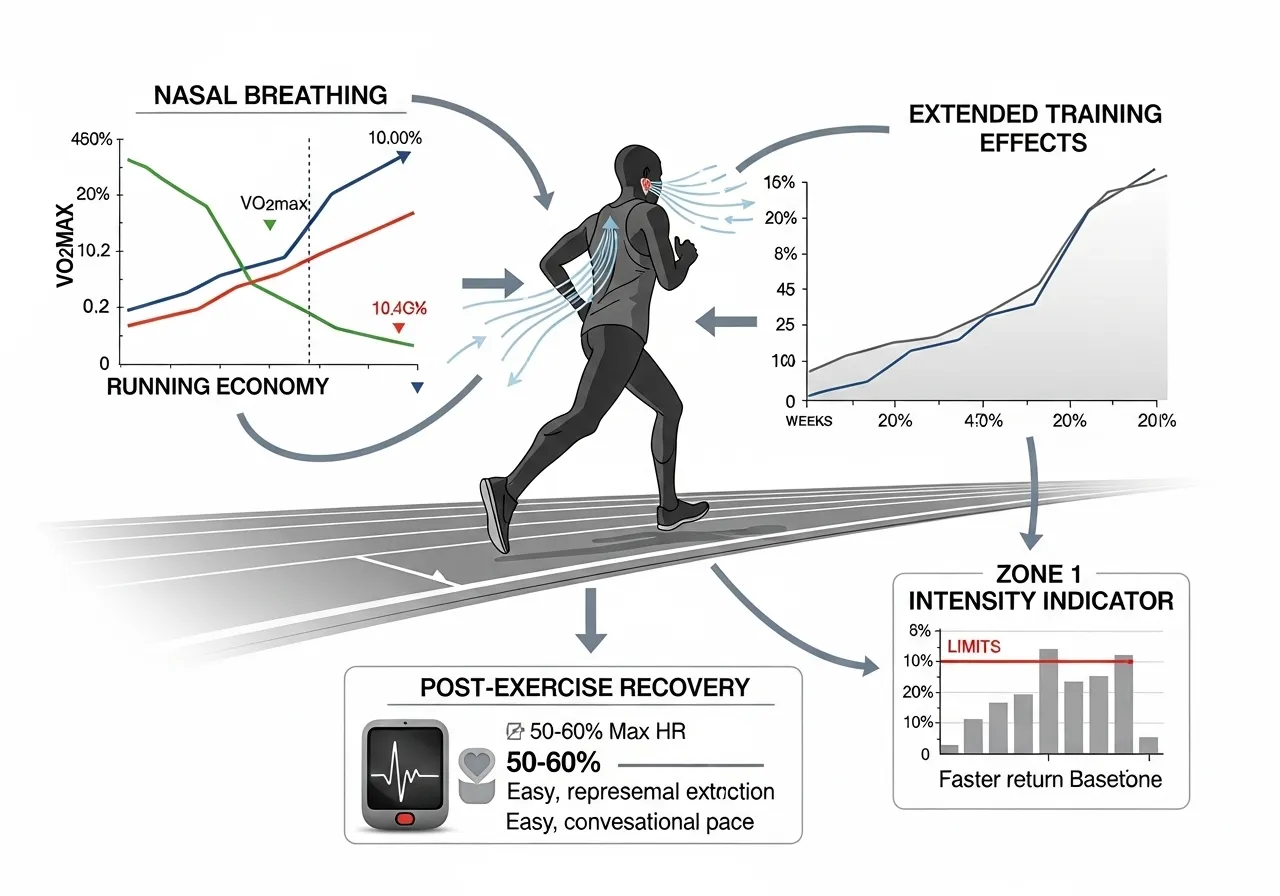
Breathing through the mouth during exercise is the default for most people. It feels necessary at moderate intensity, instinctive at high intensity, and the idea of restricting breathing to the nose during a training run sounds like an experiment in self-imposed oxygen deprivation. The research tells a more nuanced story.
Nasal breathing during exercise activates fundamentally different physiology than oral breathing. The nasal passage warms and humidifies inhaled air, filters particulates, and produces nitric oxide from the paranasal sinuses that oral breathing entirely bypasses. Nitric oxide dilates the bronchial airways and pulmonary blood vessels, improving ventilation-perfusion matching and oxygen delivery to working muscles. Nasal breathing also slows the respiratory rate, reduces hyperventilation at submaximal intensities, and produces measurable differences in post-exercise muscle recovery that oral breathing does not.
This guide covers what the research shows about nasal versus oral breathing during exercise, the nitric oxide mechanism that explains the physiological advantage, why building a nasal breathing habit requires training, beginners through advanced protocols for introducing nasal breathing at each experience level, and the practical limits of nasal breathing at high exercise intensities.
Why Does Nasal Breathing Produce Different Exercise Outcomes Than Oral Breathing?
The Nasal Passage as an Active Respiratory System
The nasal passage performs four functions that oral breathing bypasses entirely. It warms inhaled air to body temperature before it reaches the bronchi, reducing cold-air-induced bronchoconstriction that is common in outdoor training. It humidifies the air, reducing the dehydration of airway mucosa that oral breathing produces at high ventilation rates. It filters particles, pathogens, and allergens through the mucous membranes and cilia that line the turbinates. And most importantly for exercise physiology, it exposes inhaled air to the nitric oxide produced continuously by the paranasal sinuses.
Each of these functions is completely absent from oral breathing, which delivers air to the lungs unwarmed, unhumidified, unfiltered, and without nitric oxide. At rest, these differences are modest in their consequences. During exercise, where ventilation rates are 10 to 20 times the resting rate and the physiological demands on oxygen delivery are high, these differences produce measurable effects on exercise efficiency and recovery.
Nitric Oxide: The Primary Mechanism
Nitric oxide produced in the paranasal sinuses is delivered with each nasal breath to the bronchi and pulmonary vasculature, where it acts as a selective bronchodilator and pulmonary vasodilator. Bronchodilation reduces airway resistance, allowing the same ventilation volume at lower respiratory muscle effort. Pulmonary vasodilation improves ventilation-perfusion matching, the efficiency with which ventilated alveoli are matched with perfused pulmonary capillaries, increasing the proportion of each breath that participates in gas exchange.
This ventilation-perfusion improvement means that nasal breathers can achieve similar arterial oxygen saturation at lower total ventilation volumes compared to oral breathers at matched workloads. Lower ventilation volumes at matched oxygen delivery reduce the metabolic cost of breathing, leaving more oxygen available for working skeletal muscle rather than respiratory musculature.
Respiratory Rate Reduction and CO2 Tolerance
Nasal breathing mechanically slows respiratory rate compared to oral breathing at the same ventilation volume because the narrower nasal airway increases inspiratory resistance. This resistance effect is not simply a limitation; it extends the inhalation phase, increases tidal volume per breath, and reduces the number of breaths per minute. Slower, deeper breathing produces lower respiratory rates that allow greater CO2 accumulation between breaths, maintaining higher arterial CO2 levels that stimulate peripheral vasodilation and improve oxygen delivery from haemoglobin to tissues through the Bohr effect.
Ventilatory Efficiency: The Key Performance Metric
A study assessing whether nasal breathing improves exercise ventilatory efficiency in cardiac patients found that nasal breathing during exercise led to improved ventilatory efficiency with increased PETCO2 and decreased PETO2 during nasal compared to oral breathing conditions, with the authors noting that nasal breathing leads to higher nitric oxide concentrations in inhaled air than oral breathing as the paranasal sinuses are the main production site of nitric oxide and are circumvented by oral breathing, and that the ventilatory efficiency improvements indicate either more efficient oxygen extraction or better reflection of alveolar partial pressures based on the fact that breathing at higher frequency increases the ratio of air going to anatomical dead space.
Nasal breathing improves ventilatory efficiency through increased PETCO2 and decreased PETO2. The paranasal sinuses, bypassed entirely by oral breathing, are the primary production site of nitric oxide that drives these ventilatory improvements.
The Hyperventilation Reduction Effect
A study comparing the effects of nasal versus oral breathing on anaerobic power output and metabolic responses found that nasal breathing was effective in reducing hyperventilation as RER remained below 1.0 in the nasal condition whereas the oral breathing condition returned RER values similar to those found at the end of maximal exertion VO2max treadmill tests, and that ventilatory equivalent for oxygen data supports nasal breathing as a more efficient mode given that the same amount of mechanical work could be completed at a lower metabolic cost compared to oral respiration at submaximal exercise intensities.
Nasal breathing prevents hyperventilation at submaximal intensities and reduces the metabolic cost of breathing for equivalent mechanical work. The same workload is achievable at lower oxygen cost during nasal breathing compared to oral breathing at submaximal exercise intensities.
Research: Nasal Breathing Training Effects on VO2max and Running Economy
The Dallam Protocol: Extended Nasal Breathing Training
A study examining the effect of nasal versus oral breathing on VO2max and physiological economy in recreational runners following an extended period of nasal breathing training found that recreational runners who trained using nasally restricted breathing for an extended period demonstrated changes in physiological economy and VO2max compared to oral breathing conditions, with the research confirming that extended nasal breathing training produces adaptations in respiratory mechanics and efficiency that are not present in untrained nasal breathing, and that the adaptation period required before nasal breathing produces performance benefits rather than simply representing a restriction requires dedicated training rather than a single session assessment.
Extended nasal breathing training produces respiratory economy adaptations that single-session nasal breathing does not. The nasal breathing adaptation requires weeks of dedicated practice before its physiological benefits become measurable in trained conditions.
Post-Exercise Recovery: The Nasal Breathing Advantage
Research on the effect of oral versus nasal breathing on muscle oxygenation and post-exercise recovery has found that nasal breathing results in significantly faster post-exercise muscle recovery compared to oral breathing, as nasal breathing produced faster and greater post-exercise muscle re-saturation rates based on near-infrared spectroscopy measurements, confirming that the nitric oxide mechanism produces benefits that persist into the post-exercise recovery period rather than being limited to the exercise duration itself.
The Zone 1 Breathing Test: Identifying Your Nasal Threshold
The most practical immediate application of nasal breathing research is using nasal breathing capacity as a Zone 1 intensity indicator. At true Zone 1 intensity (below the first lactate threshold), nasal breathing is physiologically possible and can be sustained comfortably. At Zone 2 and above, ventilation demands exceed comfortable nasal airway capacity for most untrained nasal breathers, and oral breathing becomes mechanically necessary.
This means the pace at which nasal-only breathing becomes uncomfortable is approximately the pace of the Zone 1 ceiling for most recreational runners and cyclists. Using nasal breathing as an intensity limiter during easy sessions automatically enforces Zone 1 discipline without heart rate monitoring. If nasal breathing becomes difficult or uncomfortable, the pace is above Zone 1. This nasal-only intensity marker is one of the simplest available tools for maintaining the low-intensity discipline that Zone 2 training requires. The Zone 2 physiology and how to determine Zone 1 intensity without heart rate is covered in the Zone 2 training guide.
The Limits of Nasal Breathing: When to Switch to Oral
Nasal breathing has a physiological ceiling above which it cannot meet exercise ventilation demands. At intensities above approximately 70 to 75% of VO2max for most individuals, the nasal airway’s flow resistance becomes the limiting factor for ventilation and switching to oral or oronasal breathing is both necessary and appropriate. Training nasal breathing does not eliminate this ceiling; it raises the absolute intensity at which nasal breathing becomes limiting by improving the respiratory efficiency and nasal airway capacity that determine when the ceiling is reached.
Nasal Breathing and Sleep: The Recovery Extension
The nasal breathing training habit developed for exercise produces a secondary benefit in sleep quality when it leads to nasal breathing during sleep. Mouth breathing during sleep reduces nitric oxide availability, increases upper airway resistance, and is associated with sleep disordered breathing patterns including snoring. Trainees who develop consistent nasal breathing habits for exercise training and who tape their mouth during sleep (using medical-grade lip tape) to enforce nasal breathing at night report improved sleep quality and reduced morning respiratory symptoms. This sleep benefit, while separate from the exercise physiology, represents a meaningful additional return on the nasal breathing training investment.
Beginner Level: Building the Nasal Breathing Foundation
Why Beginners Struggle With Nasal Breathing During Exercise
Most recreational athletes who attempt nasal-only running immediately find it uncomfortable and feel they are not getting enough air. This experience is physiologically real in the short term: they are not getting enough air through the untrained nasal airway at the pace they want to run. The problem is not their lungs but their pace. Nasal-only breathing requires running at a speed slow enough that the nasal airway can meet the ventilation demand. For most recreational runners, this is meaningfully slower than their current easy run pace, and the reduced speed feels like failure rather than appropriate calibration.
🌬️ Exercise 1: Seated Nasal Breathing Practice (5 Minutes Daily)
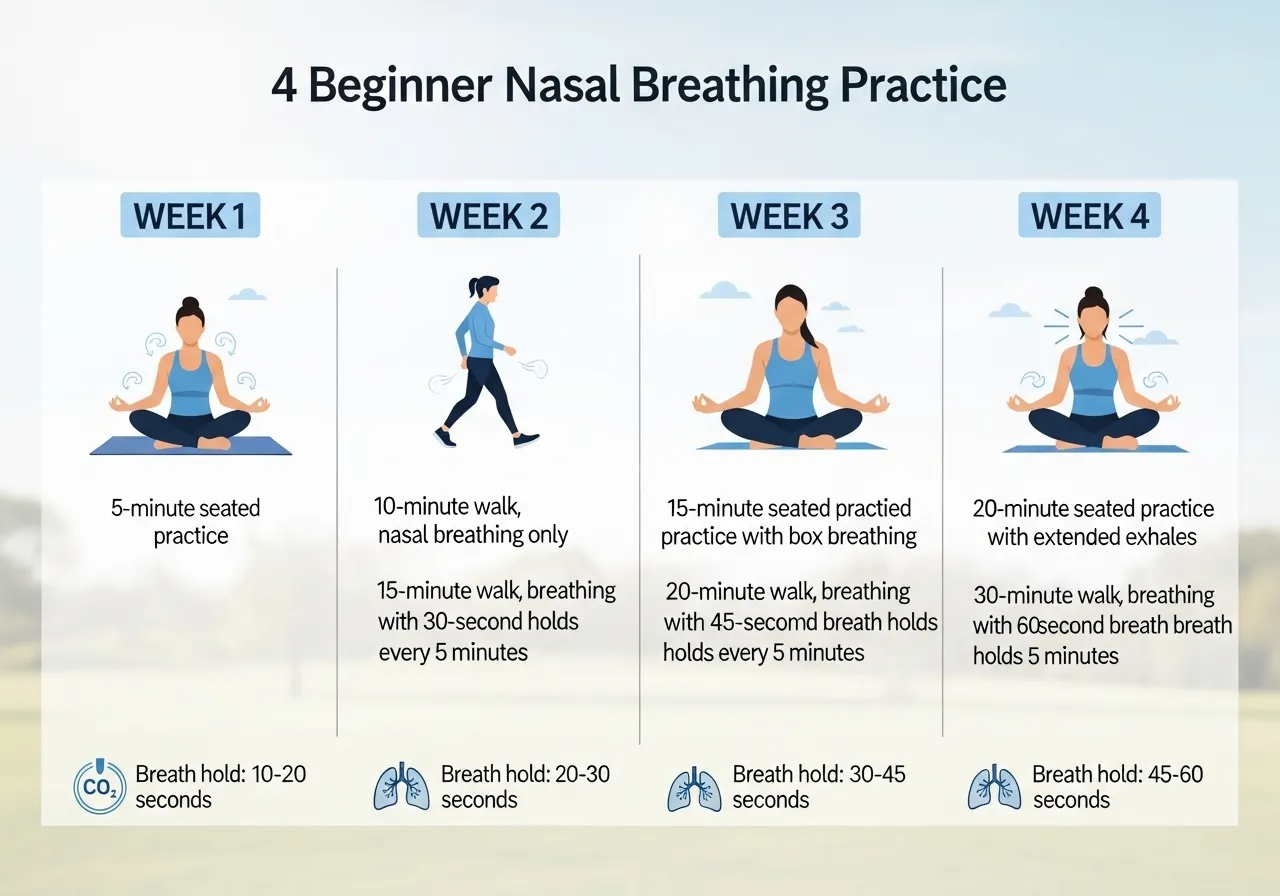
How: Sit comfortably. Breathe exclusively through the nose for 5 minutes at rest, focusing on slow diaphragmatic inhalation and complete exhalation. Extend the exhalation to twice the length of the inhalation (4-second inhale, 8-second exhale). Practise daily before or after training.
Why: Establishes the nasal breathing pattern at rest before exercise intensity is introduced. Develops CO2 tolerance and familiarises the respiratory system with the slower, deeper nasal breathing rhythm that exercise nasal breathing requires.
🌬️ Exercise 2: Walking with Nasal-Only Breathing
How: Walk at a comfortable pace for 20 to 30 minutes breathing exclusively through the nose. If nasal breathing becomes uncomfortable, slow the pace rather than opening the mouth. Accept the slower pace as the correct starting intensity for nasal breathing training.
Why: Walking is the intensity at which nasal breathing is achievable for most untrained nasal breathers. Establishing the nasal pattern during walking creates the foundation before jogging intensity is introduced.
🌬️ Exercise 3: Nasal Breathing Intervals During Easy Runs
How: During a standard easy run, alternate 5 minutes of nasal-only breathing with 5 minutes of normal oral or oronasal breathing. Reduce pace during nasal sections as needed to maintain comfort. Over weeks, increase the proportion of nasal breathing minutes.
Why: Introduces nasal breathing at jogging intensity progressively. The alternating structure allows recovery from the additional respiratory effort of nasal breathing before the next nasal interval, building nasal breathing capacity without the performance decrement of attempting full-session nasal breathing prematurely.
🌬️ Exercise 4: Breath Hold Walk (CO2 Tolerance)
How: After a normal nasal exhale, hold the breath and walk until a strong urge to breathe develops. Resume nasal breathing. Rest 1 to 2 minutes. Repeat 5 times.
Why: Develops CO2 tolerance, the ability to maintain calm despite elevated CO2 levels. Higher CO2 tolerance allows longer comfortable nasal breathing at higher intensities because the discomfort of nasal breathing limitation is partly CO2-driven anxiety rather than true oxygen insufficiency.
The Beginner Timeline: What to Expect in the First 4 Weeks
Most beginners find nasal breathing during jogging uncomfortable for the first 2 to 3 weeks. The nasal airway is not accustomed to high airflow rates during exercise, nasal congestion from habitual mouth breathing reduces airway patency, and CO2 tolerance is low. By Week 4, most consistent practitioners report reduced nasal congestion during training (the nose opens more with regular nasal exercise breathing), improved CO2 tolerance, and the ability to sustain nasal-only breathing at comfortable jogging pace for 10 to 15 minutes continuously.
Intermediate Level: Extending Nasal Breathing Through Zone 1 Training
The Intermediate Goal: Full Zone 1 Sessions Nasal-Only
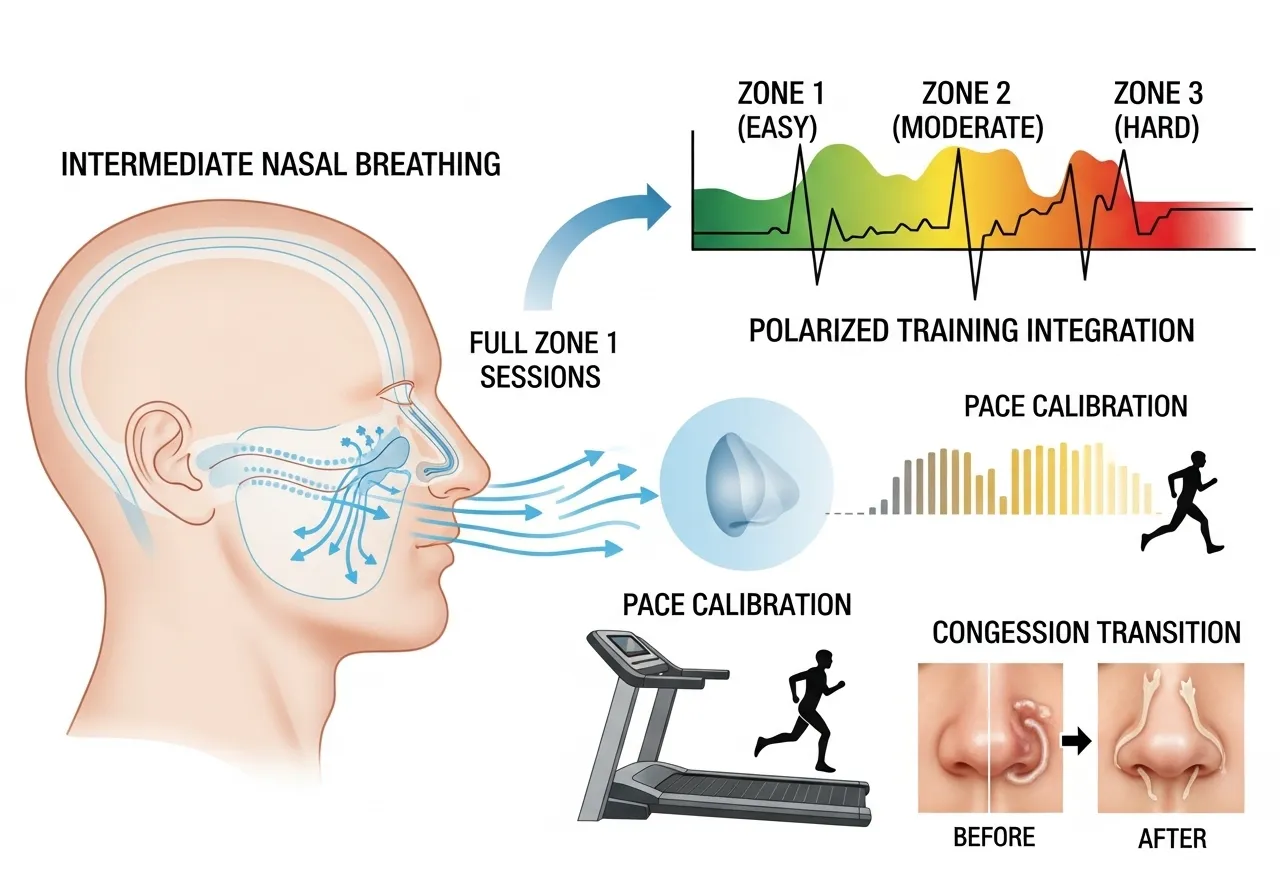
Intermediate nasal breathing training targets the ability to sustain nasal-only breathing for complete Zone 1 training sessions of 45 to 90 minutes, with the pace naturally calibrated to whatever speed maintains nasal breathing comfort. This full-session nasal breathing is achievable for most trainees after 6 to 8 weeks of consistent beginner-level progression and represents the practical implementation of nasal breathing as a training tool rather than a training curiosity.
Integrating Nasal Breathing with Zone 1 Polarised Training
The polarised training model’s Zone 1 component (80% of weekly volume at low intensity) is the natural home for nasal breathing training. Zone 1 sessions performed with nasal-only breathing develop both the aerobic base that Zone 1 training is intended to build and the nasal breathing capacity that Zone 3 high-intensity sessions will eventually benefit from. Using nasal breathing as the intensity limiter for Zone 1 sessions simultaneously enforces Zone 1 discipline and trains the respiratory adaptation. The polarised training framework and how Zone 1 sessions fit within the 80/20 distribution is covered in the polarised training guide.
The Nasal Breathing Pace Calibration
At the intermediate stage, the correct approach to nasal breathing session pacing is to use breathing comfort rather than pace or heart rate as the primary intensity signal. Begin a nasal-only run at a conversational pace and adjust based on breathing. If nasal breathing is comfortable and effortless, the pace is at or below Zone 1. If nasal breathing requires noticeable effort but is maintainable, the pace is approaching the Zone 1 ceiling. If nasal breathing becomes uncomfortable or forced, slow down. The nasal breathing indicator is as accurate a Zone 1 boundary marker as heart rate for most trainees and requires no equipment.
Nasal Breathing in Cycling and Swimming
Nasal breathing training is not limited to running. Cyclists performing Zone 1 rides can apply the same nasal-only breathing discipline to calibrate easy ride intensity. Swimming presents a specific nasal breathing challenge because exhalation into water naturally occurs through the nose during the underwater phase, and inhalation during the rotation phase can be trained to be nasal-only in dedicated drills. The respiratory efficiency developed through nasal breathing training in running and cycling transfers across modalities because the primary adaptations (nitric oxide pathway, CO2 tolerance, respiratory efficiency) are systemic rather than exercise-specific.
Managing the Transition From Oral to Nasal Dominance
Many trainees at the intermediate stage experience persistent nasal congestion that limits nasal breathing capacity during training. This congestion is often a result of years of habitual oral breathing creating chronic low-grade nasal inflammation from disuse. Consistent nasal breathing training typically reduces this congestion over 4 to 8 weeks as regular nasal airflow stimulates the mucosal drainage and circulation that maintains nasal airway patency. Nasal saline rinse before training sessions can accelerate this transition by clearing mucus and reducing congestion during the adaptation period.

Advanced Level: Nasal Breathing at Threshold and the Race-Day Application
Extending Nasal Breathing Above Zone 1
After 3 to 6 months of consistent nasal breathing training at Zone 1 intensity, many trainees develop sufficient nasal airway capacity and CO2 tolerance to sustain nasal breathing into Zone 2 (threshold) intensity. This extension represents a genuine respiratory fitness development: the nasal airway’s capacity to deliver ventilation has increased, CO2 tolerance has improved, and the respiratory muscles have adapted to the higher airflow resistance of nasal breathing at elevated intensities.
The pace at which nasal breathing becomes uncomfortable will have increased from the beginner level, where nasal breathing was limited to slow walking, to an intensity that may approach threshold pace for well-adapted trainees. An advanced nasal breather who can sustain nasal-only breathing at their lactate threshold pace has developed respiratory efficiency that produces meaningfully lower ventilatory cost at that intensity compared to their pre-training baseline.
Nasal Breathing as a Competition Tool
Some endurance athletes use nasal breathing intentionally during the early portions of races at Zone 1 to Zone 2 intensity, switching to oronasal breathing only as intensity increases toward threshold and above. The rationale is that maintaining nasal breathing for the first 30 to 40% of a race maintains the nitric oxide advantage and reduces the metabolic cost of breathing during the pacing phase, preserving metabolic capacity for the race-deciding final portion where oral breathing is necessary regardless of nasal training status.
Altitude Training and Nasal Breathing
At altitude, reduced oxygen partial pressure increases the ventilation required to maintain adequate arterial oxygen saturation, making nasal breathing at any given absolute pace more demanding than at sea level. Altitude training and acclimatisation temporarily limits nasal breathing capacity at speeds that were achievable at sea level. This is expected and should not prompt abandonment of nasal breathing training at altitude. The nasal breathing practices at reduced intensity during altitude acclimatisation maintain the habit and respiratory pattern while the physiological adjustments to altitude occur.
Nasal Breathing and High-Intensity Intervals
Zone 3 high-intensity intervals at vVO2max pace require ventilation volumes that exceed nasal-only capacity for virtually all athletes, trained nasal breathers included. Nasal breathing during Zone 3 intervals is neither appropriate nor advisable. The appropriate application of nasal breathing in a high-intensity session is during the warm-up, the recovery periods between intervals, and the cool-down, where intensity is at or below Zone 1. Maintaining nasal breathing in these lower-intensity portions of a high-intensity session preserves the nasal breathing habit and the nitric oxide benefit during the portions of the session where nasal airway capacity is not exceeded. The VO2 max interval structure and how recovery periods are used in polarised training are covered in the VO2 max interval training guide.
Measuring Nasal Breathing Progress
Three practical measures track nasal breathing development. First, the nasal-only comfortable pace: the fastest pace at which nasal-only breathing is comfortable without effort should increase over months of consistent training. Second, the nasal breathing duration: how long a continuous nasal-only running or cycling effort can be sustained before oral breathing becomes necessary. Third, resting morning heart rate: improved respiratory efficiency from nasal breathing training often reduces resting heart rate by 2 to 4 bpm over training months, reflecting improved cardiovascular efficiency at rest.
The Practical Transition: How to Build a Nasal Breathing Habit
The Primary Obstacle: Mouth Breathing Is a Habit, Not a Necessity
Most adults are habitual mouth breathers during physical activity not because oral breathing is physiologically superior but because the habit develops in childhood and persists unchallenged into adult training. The respiratory system can adapt to nasal breathing at training intensities, but only if nasal breathing is consistently practiced rather than abandoned the moment it feels less comfortable than oral breathing. Treating nasal breathing as a skill to be developed, with an expected adaptation period of weeks to months, reframes the initial discomfort as expected skill-building rather than evidence that nasal breathing does not work.
Daily Nasal Breathing Practices Beyond Training
Building nasal breathing as a default behaviour outside of training accelerates the adaptation to nasal breathing during training. Consciously breathing through the nose during desk work, commuting, and low-intensity daily activities reduces the chronic nasal congestion that habitual mouth breathing produces and conditions the nasal airway for the higher flow rates of training. Many practitioners also use nasal breathing during sleep, enforced through medical-grade lip tape, which develops nasal breathing capacity and CO2 tolerance during the 7 to 8 hours of sleep that previously produced no nasal training benefit.
Troubleshooting: What to Do When Nasal Breathing Fails
Three common nasal breathing failures have specific solutions. First, nasal congestion preventing nasal breathing: saline nasal rinse before training, consistent nasal breathing practice between sessions to reduce chronic congestion, and nasal breathing during sleep to reduce inflammation. Second, feeling of air hunger during nasal-only running: slow the pace rather than opening the mouth; the air hunger is CO2 tolerance limitation, not oxygen insufficiency, and resolves with consistent practice. Third, mouth opening involuntarily during sleep: medical-grade lip tape prevents this and forces the nasal breathing pattern during sleep that reduces congestion and improves CO2 tolerance simultaneously.
Nasal Breathing and Vocal Health
Athletes who speak, sing, or teach professionally have an additional incentive for nasal breathing training. Chronic oral breathing during exercise dries and irritates the mucous membranes of the oral cavity and throat, contributing to vocal fatigue and hoarseness. Maintaining nasal breathing during training preserves the humidification of the upper airway that professional voice users require. Coaches, teachers, and performers who train regularly find that switching from habitual oral to nasal breathing during easy training sessions reduces vocal fatigue on days immediately following training.
The Evidence Ceiling: What Nasal Breathing Cannot Do
Nasal breathing is not a performance enhancement at maximum intensity. Studies consistently show that at intensities above approximately 75% of VO2max, nasal breathing cannot maintain the ventilation volume required and oral or oronasal breathing is necessary for performance. The benefits of nasal breathing are concentrated at Zone 1 and Zone 2 intensities, where it improves ventilatory efficiency and reduces the metabolic cost of breathing, and in the post-exercise recovery period, where the nitric oxide-mediated vasodilation accelerates tissue recovery. Setting realistic expectations about where nasal breathing produces measurable benefits prevents the disappointment of attempting nasal breathing at high-intensity effort and finding it limiting rather than helpful.
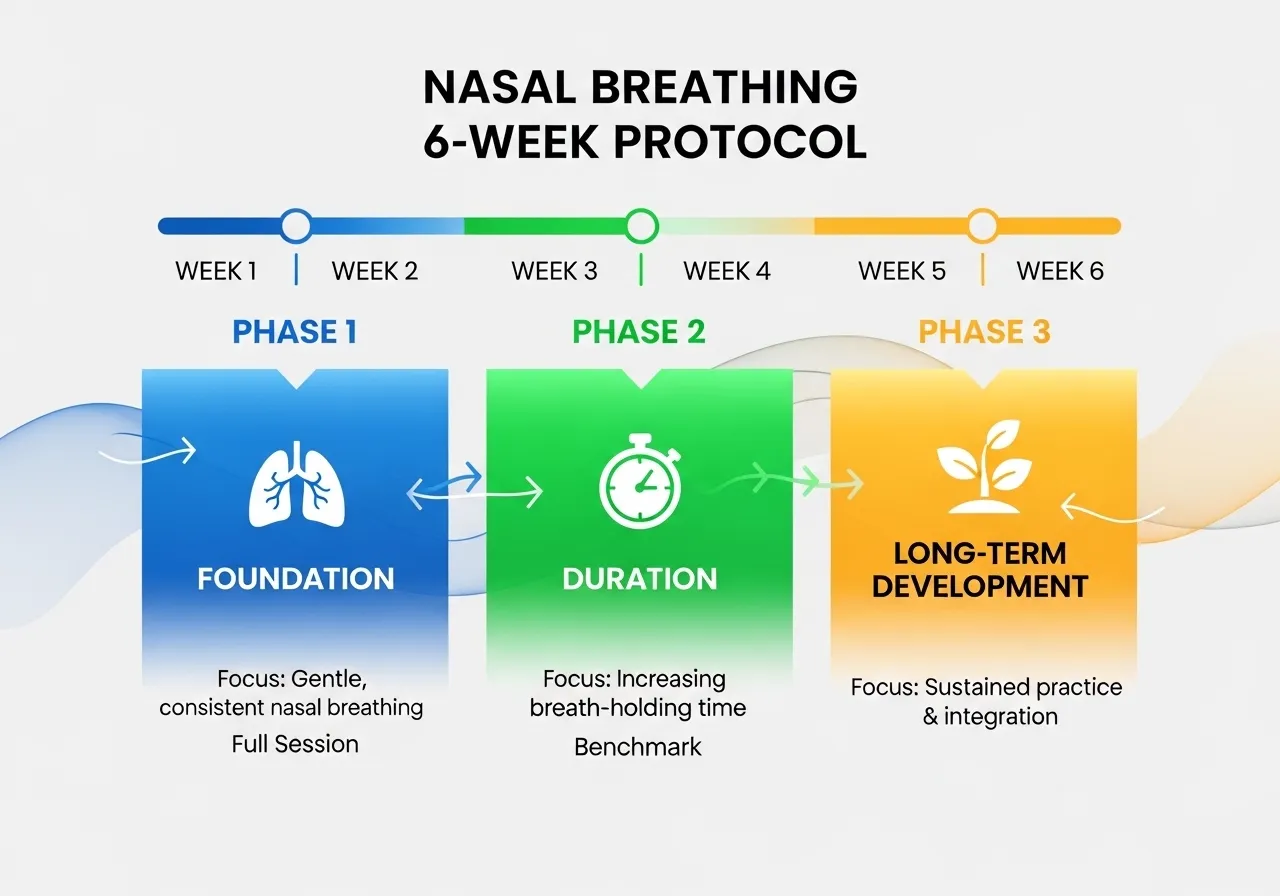
6-Week Nasal Breathing Training Protocol
The Protocol Structure: Slow to Fast, Short to Long
The 6-week protocol follows the same progression as any motor skill development: establish the pattern at low intensity and short duration, then progressively increase both intensity and duration as the skill consolidates. Most trainees who attempt to begin nasal breathing at their current running pace immediately fail, not because nasal breathing is impossible but because the starting intensity is too high for an untrained nasal airway. The protocol below begins where nasal breathing is achievable and progresses based on demonstrated comfort rather than a fixed timeline.
📅 Phase 1: Weeks 1 to 2: Nasal Foundation
- 5 minutes seated nasal breathing practice daily
- 5 breath hold walks per day for CO2 tolerance
- All walking activities: nasal breathing only
- Easy runs: 5 minutes nasal-only alternating with 5 minutes normal breathing
Phase 1 establishes the nasal breathing habit at rest and walking before exercise intensity is introduced. The breath hold walks develop the CO2 tolerance that makes the air hunger sensation during nasal exercise breathing manageable.
📅 Phase 2: Weeks 3 to 4: Increasing Nasal Duration
- Easy runs: increase to 10 minutes nasal-only alternating with 5 minutes normal
- Target: complete at least one 20-minute continuous nasal-only run by end of week 4
- Introduce nasal breathing during sleep using lip tape (optional but recommended)
- Nasal saline rinse before each training session to optimise airway patency
The 20-minute continuous target is the primary Phase 2 milestone. Most trainees achieve this at a slower pace than their usual easy run, this is correct calibration, not failure.
📅 Phase 3: Weeks 5 to 6: Full Session Nasal Breathing
- Target: complete Zone 1 sessions of 45 to 60 minutes entirely nasal-only
- Allow pace to be dictated by breathing comfort, not distance or time targets
- High-intensity sessions: nasal breathing during warm-up, recovery periods, cool-down
- Week 6: benchmark pace at which nasal-only breathing is comfortable vs Week 1
Expected Phase 3 outcome: the pace at which nasal breathing is comfortable is 5 to 15% faster than the Week 1 baseline, reflecting the combined adaptation of nasal airway capacity, CO2 tolerance, and respiratory efficiency development.
Long-Term Nasal Breathing Development
Beyond 6 weeks, consistent nasal breathing during all Zone 1 training sessions produces continuous improvement in the comfortable nasal breathing pace as aerobic base and nasal respiratory capacity develop together. The 6-week protocol establishes the foundation. Long-term performance returns from nasal breathing training accumulate across months and years of consistent practice as the respiratory system adapts to the nasal airway’s demands at progressively higher training intensities.
Frequently Asked Questions About Nasal Breathing
Will nasal breathing make me slower?
In the short term, yes. Untrained nasal breathing requires slowing pace to stay within the nasal airway’s current ventilation capacity. This is not a permanent performance reduction but a temporary recalibration while the nasal breathing adaptation develops. After 4 to 8 weeks of consistent nasal breathing practice, the comfortable nasal breathing pace typically returns toward the previous easy run pace as respiratory adaptation occurs.
The longer-term question is whether nasal breathing training improves performance at previous oral-breathing paces. The research on recreational runners suggests that extended nasal breathing training improves physiological economy, meaning the same pace requires less oxygen cost. Whether this translates to faster race times depends on whether the trained individual’s performance limiter is respiratory efficiency or another factor. Nasal breathing training is most likely to produce performance improvements in trainees whose aerobic efficiency is currently suboptimal, rather than in already-efficient elite athletes.
Is nasal breathing safe for people with nasal conditions like deviated septum or allergies?
Mild nasal conditions including mild allergic rhinitis, minor nasal valve collapse, and mild nasal congestion are not contraindications for nasal breathing training. Consistent nasal breathing practice often reduces mild allergic rhinitis symptoms over time through habituation of the nasal mucosa to regular airflow challenge. Moderate to severe nasal obstruction, active nasal infections, and significant nasal polyps should be assessed by an ear, nose, and throat specialist before attempting nasal breathing training, as forcing high-flow breathing through partially obstructed nasal passages can aggravate these conditions.
Can I use nasal strips to improve nasal breathing during exercise?
External nasal dilator strips increase nasal airway patency by mechanically holding the nasal valve open, reducing the airway resistance that limits nasal breathing at higher exercise intensities. Studies show they reduce subjective breathing effort and perceived exertion during exercise at intensities where nasal breathing is otherwise uncomfortable. They are a useful tool during the adaptation period when nasal airway capacity is still developing, allowing nasal breathing at higher intensities than would otherwise be possible while the underlying adaptation occurs.
The risk of long-term dependence on nasal strips is modest: unlike pharmacological interventions, mechanical nasal dilation does not cause dependence. Using strips during training sessions to extend the nasal breathing range while the nasal airway capacity adapts, then progressively reducing strip use as adaptation occurs, is a practical strategy for accelerating the early stages of nasal breathing training.
Does nasal breathing help with exercise-induced bronchoconstriction?
Exercise-induced bronchoconstriction (EIB) is triggered primarily by the inhalation of cold, dry air that oral breathing delivers directly to the bronchi. Nasal breathing warms and humidifies inhaled air before it reaches the bronchi, reducing the thermal and osmotic triggers that produce EIB in susceptible individuals. Research on athletes with EIB consistently shows that nasal breathing reduces the frequency and severity of EIB episodes compared to oral breathing at matched exercise intensities.
For athletes who experience coughing, wheezing, or chest tightness during or after outdoor training in cold weather, transitioning to nasal breathing for the warm-up and early portions of sessions provides the most immediate EIB reduction benefit. The nasal air conditioning effect is most pronounced in cold, dry conditions where the temperature difference between ambient and body temperature air is greatest, making nasal breathing particularly relevant for winter outdoor training where EIB risk is highest.
How does nasal breathing interact with altitude training?
At altitude, the reduced oxygen partial pressure increases ventilatory demand at any given absolute pace. The nasal airway’s resistance becomes the limiting factor at lower absolute intensities than at sea level, meaning the pace at which nasal breathing is comfortable decreases at altitude. This is expected and should not be interpreted as regression in nasal breathing capacity. Maintaining nasal breathing practice at altitude-appropriate reduced intensities preserves the habit while altitude acclimatisation occurs. As acclimatisation develops over 1 to 2 weeks, the comfortable nasal breathing pace partially recovers toward sea-level levels at the same altitude, reflecting the haematological and ventilatory adaptations that altitude training produces.
- Nasal breathing delivers nitric oxide from the paranasal sinuses to the bronchi and pulmonary vasculature, producing bronchodilation and improved ventilation-perfusion matching that oral breathing entirely bypasses.
- Nasal breathing improves ventilatory efficiency at submaximal intensities and reduces the metabolic cost of breathing for equivalent mechanical work, as confirmed by RER and ventilatory equivalent data.
- The comfortable nasal breathing pace is approximately the Zone 1 intensity ceiling, making nasal breathing a practical and equipment-free Zone 1 intensity indicator.
- Nasal breathing adaptation requires weeks of dedicated practice. Initial performance reduction is expected and reverses as nasal airway capacity, CO2 tolerance, and respiratory efficiency develop.
- Nasal breathing benefits are concentrated at Zone 1 and Zone 2 intensities. Above approximately 75% of VO2max, nasal breathing cannot meet ventilation demand and oronasal breathing is necessary and appropriate.