Glute Activation: Why Your Glutes Shut Down, the EMG Science of Firing Them Up, and a Daily Warm-Up Protocol
You squat, deadlift, and hip thrust consistently. Your glutes still do not look or feel like they are working. Your quads and lower back fatigue first. The glutes seem to sit out.
This is not a motivation or effort problem. It is a neuromuscular activation problem. The glutes are the largest and most powerful muscles in the body. They also happen to be the muscles most prone to inhibition from modern sedentary postures, tight hip flexors, and training programmes that bypass the hip extension demand entirely.
This guide covers what the EMG research shows about which exercises actually activate the glutes, why inhibition occurs and how to reverse it, six targeted activation exercises, and a daily warm-up protocol that prepares the glutes to contribute fully to every training session.
Why Glutes Shut Down: The Inhibition Science
Reciprocal Inhibition and Hip Flexor Dominance
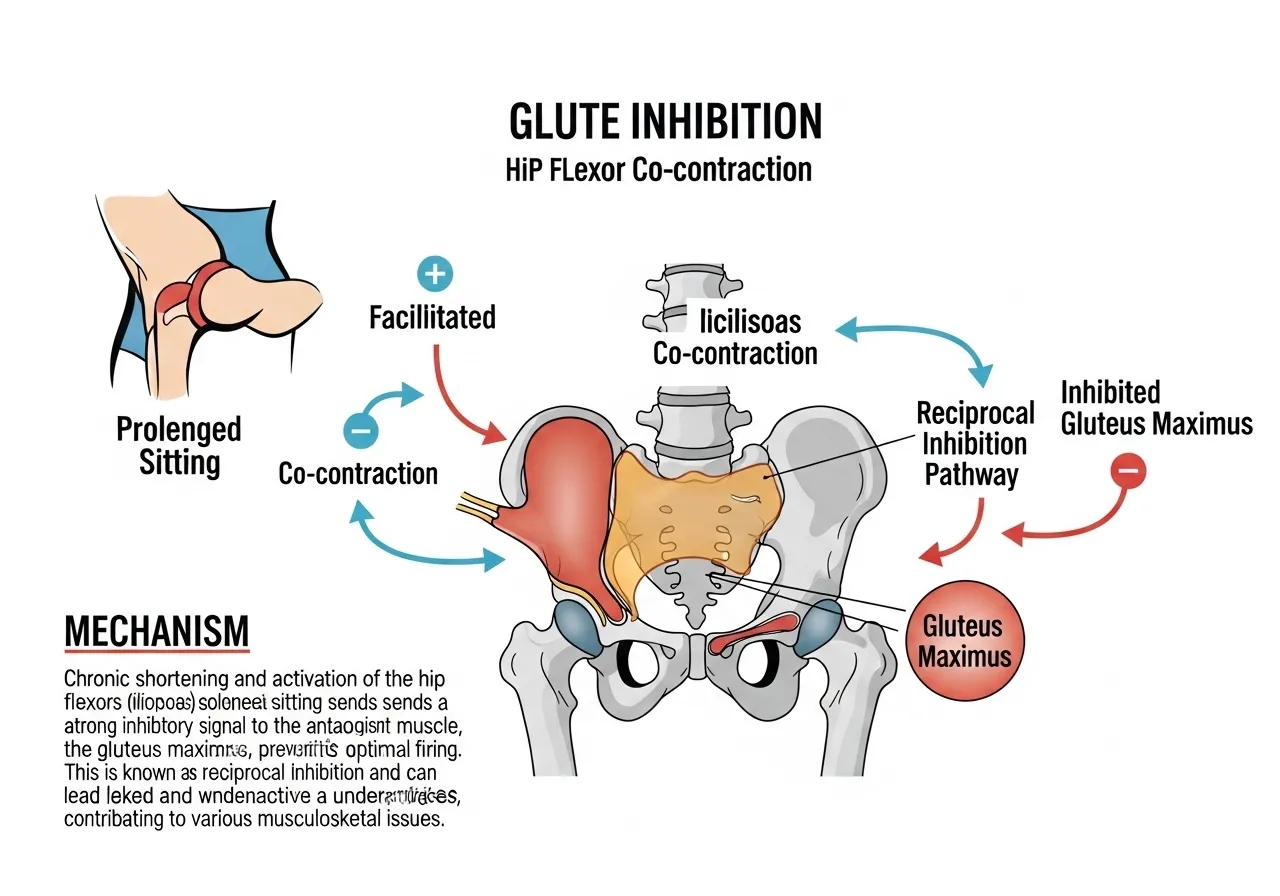
When a muscle contracts, its antagonist receives an inhibitory signal through the nervous system. This reciprocal inhibition is a normal and efficient mechanism that prevents unnecessary co-contraction during movement.
The problem arises when one side of this antagonist pair becomes chronically shortened and facilitated through prolonged static posture. Extended sitting places the hip flexors, specifically the iliopsoas and rectus femoris, in a shortened position for hours at a time. Over weeks and months, these muscles become tonically facilitated.
A facilitated hip flexor continuously sends inhibitory signals to the gluteus maximus on the same side. The glute does not receive a clear activation signal. Movements that should load the glute heavily, such as hip extension in a deadlift or squat, are instead dominated by the quadriceps and lumbar erectors as the nervous system routes around the inhibited gluteal pathway.
The Research on Hip Flexor Co-Contraction and Glute Inhibition
Research examining peak muscle activity during acceleration-specific pre-activation and traditional strength exercises found that hip flexor co-contraction causes reciprocal inhibition of the gluteus maximus in the stance leg, which impairs ipsilateral hip extension and contralateral hip flexion resulting in a decreased thigh separation angle, with higher gluteus maximus activity suggested to decrease co-contraction of the hip flexor muscles and thus enhance the thigh separation angle that is crucial for horizontal power generation.
Hip flexor co-contraction directly inhibits gluteus maximus activation. Addressing hip flexor tightness before glute activation work is not optional warmup protocol: it is the mechanism that allows the activation work to produce any effect.
Why Standard Squats and Deadlifts Do Not Always Fix the Problem
Many trainees assume that simply performing more squats and deadlifts will resolve glute inhibition. For individuals with minimal hip flexor facilitation, this is largely true. For individuals with significant inhibition from prolonged sitting, compound movements often worsen the compensation pattern rather than resolving it.
The nervous system prefers efficiency. If the gluteal pathway is inhibited and an alternative pathway exists through the lumbar erectors and quadriceps, the body routes the hip extension demand through that alternative pathway during compound movements.
The trainee squats and deadlifts consistently. The quads and lower back develop. The glutes remain underactivated. The compensation pattern becomes more entrenched rather than less, because it is being repeatedly practised at heavier loads.
Breaking this pattern requires two steps: reducing hip flexor facilitation to reduce the reciprocal inhibition signal, and then specifically activating the gluteal muscles before loading them in compound movements. The hip flexor stretching and mobility work that supports this process is covered in the hip flexor stretching guide.
What the EMG Research Shows About Glute Activation Exercises
Gluteus Maximus: The Systematic Review Evidence
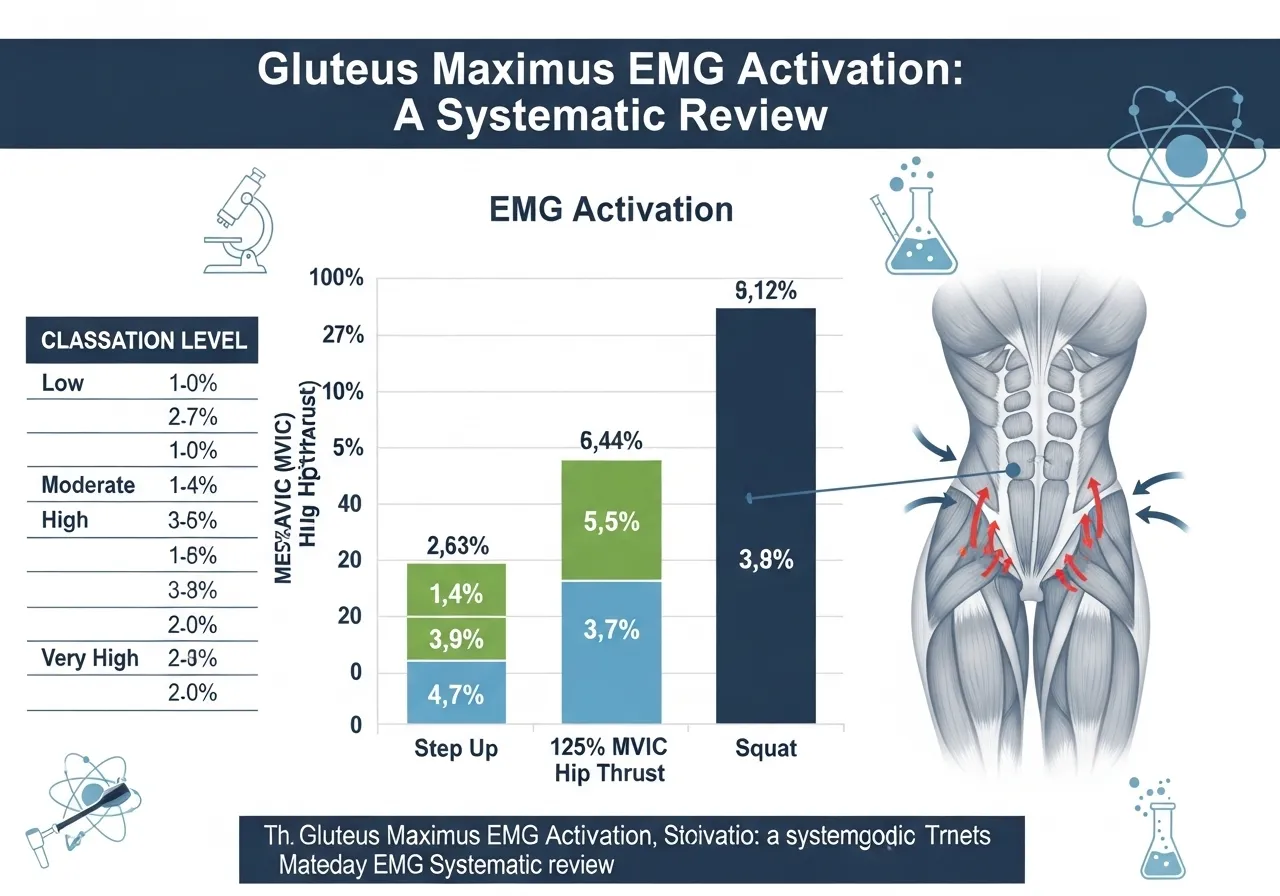
A systematic review describing gluteus maximus activation levels during strength exercises found that exercises classified at very high levels of gluteus maximus activation exceeding 60% of maximal voluntary isometric contraction included step-up variations, hex bar deadlift, barbell hip thrust variations, belt squat, split squat, lunge variations, modified single-leg squat, conventional deadlift, and band hip thrust, with the step-up exercise and its variations presenting the highest gluteus maximus activation overall, followed by several loaded exercises including deadlifts, hip thrusts, lunges, and squats.
Step-up variations produce the highest gluteus maximus activation of all exercises reviewed, exceeding hip thrusts and squats. Unilateral and multi-plane movements consistently outperform bilateral sagittal-plane movements for peak glute activation.
Gluteus Medius: The Hip Abduction EMG Evidence
A systematic review quantifying gluteal EMG activity during hip abduction and external rotation exercises found that the highest gluteus maximus activity was elicited during the lateral step up, cross over step up and rotational single leg squat ranging from 79 to 113% of maximal voluntary isometric contraction, with several hip abduction and external rotation exercises producing high levels of both gluteus maximus and gluteus medius activation, confirming that exercises incorporating hip abduction and external rotation with unilateral loading produce the strongest gluteal activation stimulus.
Lateral step-ups and cross-over step-ups produce 79 to 113% MVIC gluteus maximus activation, exceeding hip thrust and squat activation in direct comparison. Adding multi-plane and unilateral movements to glute programming activates regions that bilateral pressing exercises underserve.
Gluteus Medius vs Gluteus Maximus: Different Roles, Different Exercises
The gluteus maximus and gluteus medius serve distinct mechanical roles that require different exercise selections for complete development.
The gluteus maximus is the primary hip extensor and external rotator. It drives the hip from flexion to extension in squatting, deadlifting, sprinting, and stair climbing. It works hardest in the hip extension range, particularly at full extension during hip thrusts and step-ups.
The gluteus medius is the primary hip abductor and pelvic stabiliser during single-leg loading. It prevents the pelvis from dropping toward the unsupported side during every step of walking, running, and single-leg exercise. Weakness here manifests as knee valgus during squats, IT band tightness during running, and hip hiking during lunges.
Complete glute development and function requires targeted work for both muscles. Bilateral compound exercises, including squats and hip thrusts, primarily develop the gluteus maximus. Clamshells, fire hydrants, lateral walks, and single-leg work develop the gluteus medius. An activation and training programme that addresses only one will leave the other underserved.
What EMG Cannot Tell Us: The Force vs Activation Nuance
EMG amplitude measures electrical activity in muscle tissue but does not directly measure force output or hypertrophic stimulus. High EMG does not automatically equal high muscle growth. The relationship between activation amplitude and adaptation depends on load, range of motion, and time under tension simultaneously.
The practical implication: activation exercises that produce high EMG at bodyweight loads are excellent warm-up tools but do not replace loaded hip extension work for long-term glute development. They prepare the neural pathway. The barbell hip thrust, split squat, and deadlift then load that pathway under progressive resistance for hypertrophy and strength development. The complete hip thrust programming and glute development science is covered in the hip thrust guide.
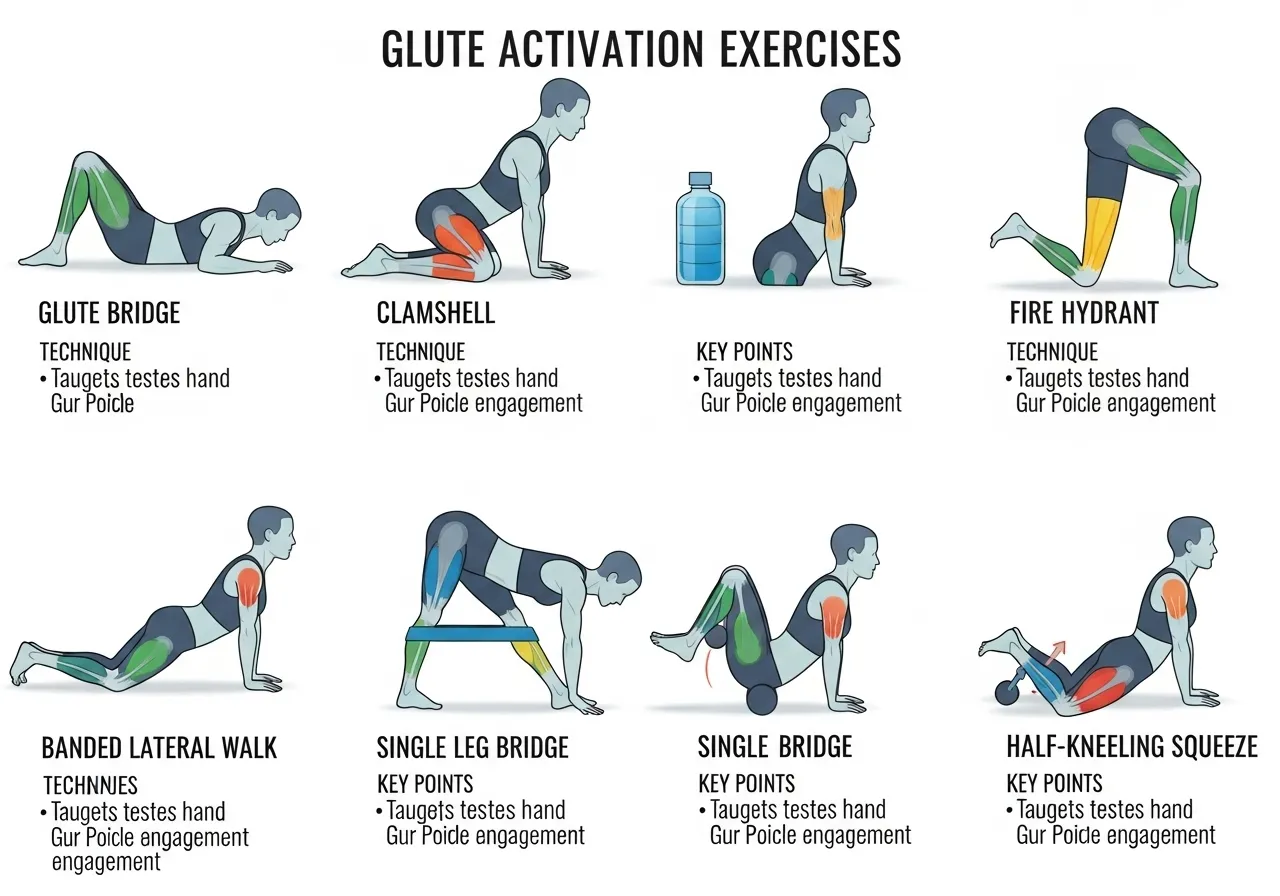
6 Glute Activation Exercises: Targets, Technique, and When to Use Each
Glute activation exercises are low-load movements designed for neuromuscular preparation rather than strength development. They should not produce pain in the hip joint, sacroiliac joint, or knee. Individuals with diagnosed hip impingement, labral tears, or IT band syndrome should obtain physiotherapy guidance on which activation patterns are appropriate before beginning the exercises below.
🟢 1. Glute Bridge
Target: Gluteus maximus, hamstrings, core stabilisers
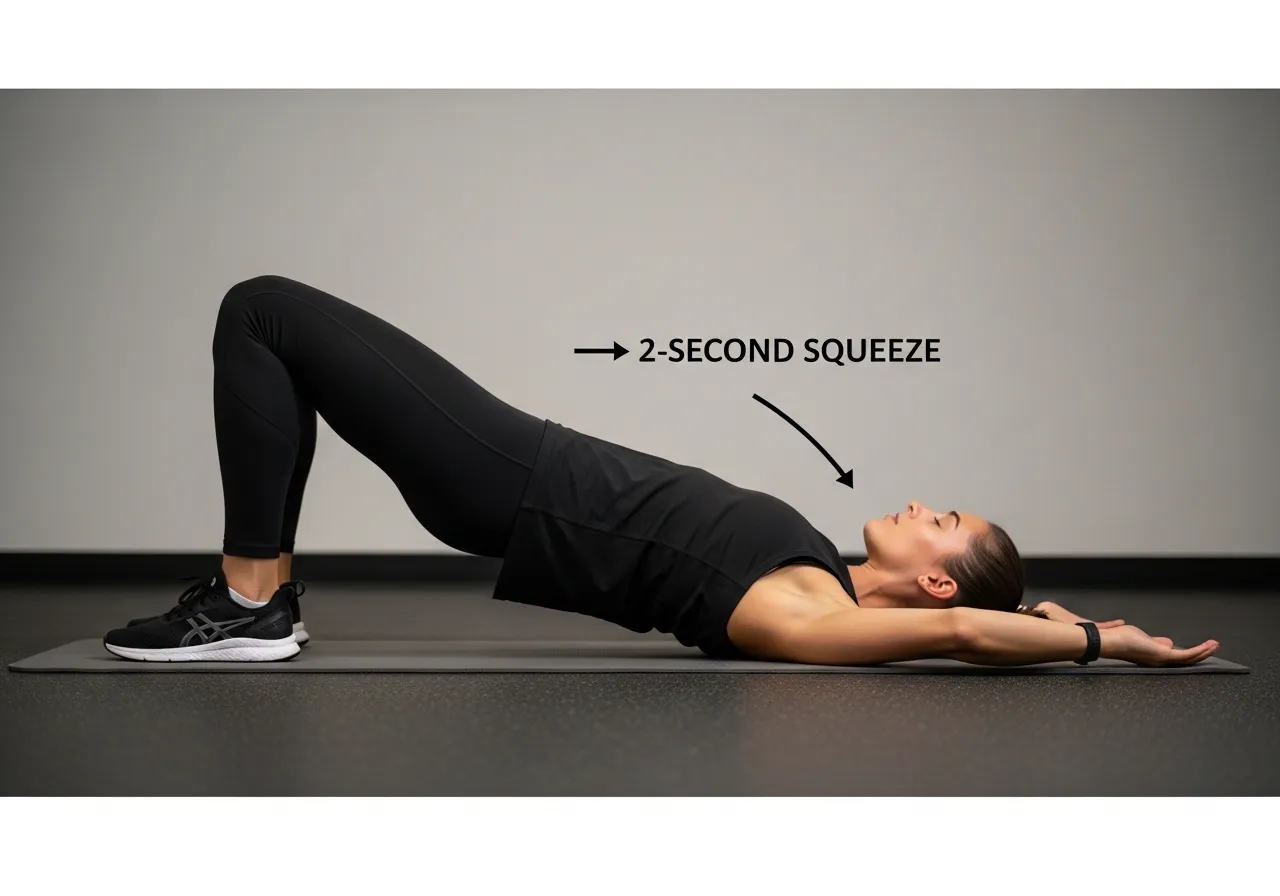
How: Lie on your back with knees bent at 90 degrees and feet flat on the floor. Drive through the heels to lift the hips until the body forms a straight line from knee to shoulder. Squeeze the glutes hard at the top and hold for 2 seconds. Lower under control.
Key point: The glute squeeze at the top is the entire point of the exercise. A glute bridge performed without a deliberate, hard contraction at the top is just a hip hinge. The squeeze initiates the neural activation pathway that compound exercises then load under resistance.
🟢 2. Clamshell
Target: Gluteus medius, hip external rotators
How: Lie on your side with hips and knees bent at 45 degrees, feet stacked. Keeping the feet together, rotate the top knee upward as far as range allows without the pelvis rolling backward. Hold 1 to 2 seconds at the top. Lower under control.
Key point: The pelvis must not roll backward during the clamshell. Pelvic roll is the compensation pattern when the hip external rotators are too weak to produce the range of motion requested. Start with a smaller range and maintain pelvis position rather than rotating further with compensation.
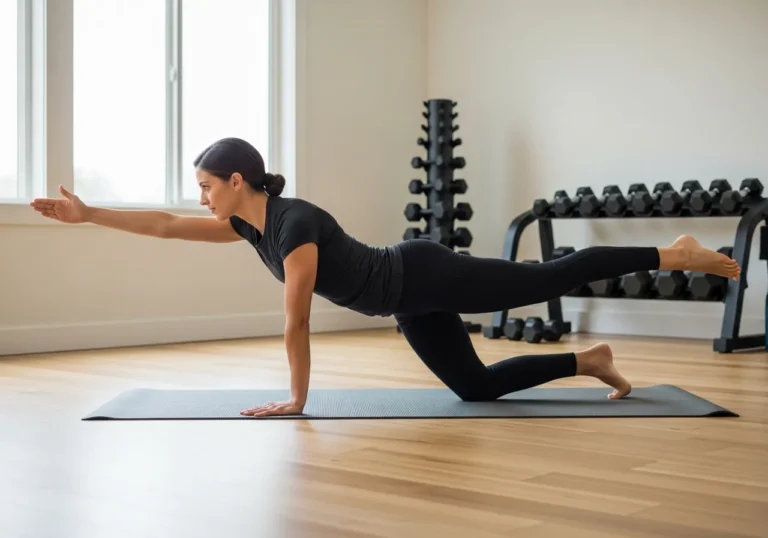
🟢 3. Fire Hydrant
Target: Gluteus medius, gluteus minimus, hip external rotators
How: Start on hands and knees with neutral spine. Keeping the knee bent at 90 degrees, lift one knee outward and upward to hip height while keeping the pelvis stable. Hold 1 second at the top. Lower under control.
Key point: The lumbar spine and pelvis must not rotate during this exercise. Spinal or pelvic rotation is the body’s way of creating apparent range of motion when the gluteus medius cannot produce the actual range. Prioritise pelvis stability over height of knee lift.
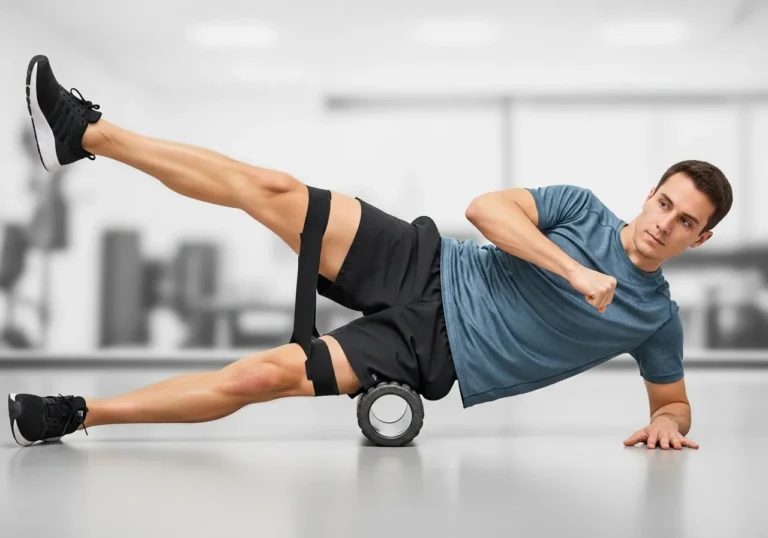
🟢 4. Banded Lateral Walk
Target: Gluteus medius, hip abductors, dynamic stability
How: Place a resistance band around the ankles or just above the knees. Stand with feet hip-width and slight knee bend. Step sideways maintaining band tension throughout. Keep the torso upright and avoid leaning toward the stepping leg. Perform 10 to 15 steps each direction.
Key point: The step should be wide enough to maintain band tension throughout the movement. If the band goes slack at any point in the step, the distance is too small and the gluteus medius is not working against resistance throughout the range.
🟢 5. Single-Leg Glute Bridge
Target: Gluteus maximus unilateral, core anti-rotation, hamstring stability
How: From the standard glute bridge position, extend one leg straight. Drive through the grounded heel to lift the hips. The extended leg should remain at the same height as the grounded leg’s thigh at the top. Squeeze the working glute hard at the top and hold 2 seconds.
Key point: The hip of the non-working side will drop if the gluteus medius is weak on the working side. Do not correct this by tilting the pelvis. Instead, reduce range of motion and maintain level hips throughout. The pelvic drop is a diagnostic finding, not just a technique error.
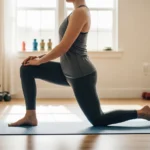
🟢 6. Half-Kneeling Glute Squeeze
Target: Gluteus maximus, hip extension neuromuscular pattern, hip flexor reciprocal inhibition
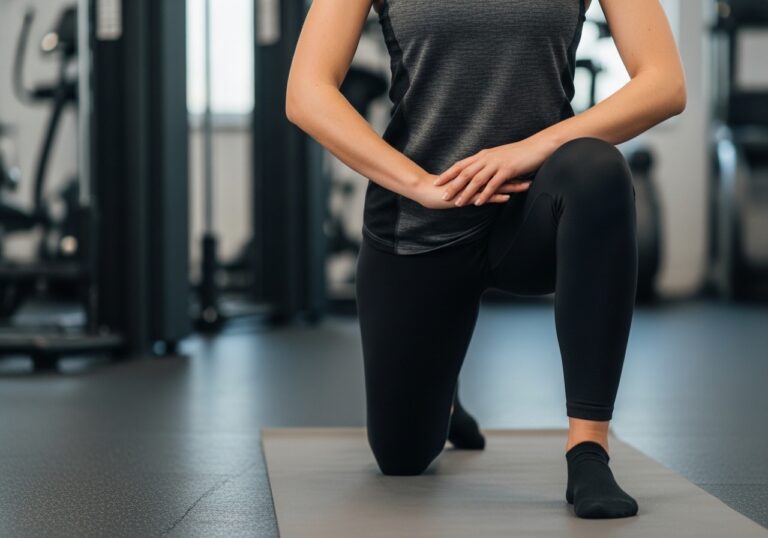
How: Kneel on one knee with the opposite foot forward. From this position, tuck the pelvis under and squeeze the glute of the kneeling leg as hard as possible. Hold 3 seconds. Release and repeat. The kneeling position places the hip flexor of the kneeling leg on stretch, reducing reciprocal inhibition of the same-side glute.
Key point: This exercise directly addresses the inhibition mechanism: it stretches the hip flexor of the kneeling leg while simultaneously activating the gluteus maximus. It is the single most targeted pre-activation exercise for trainees with hip flexor facilitation and glute inhibition.
The Daily Glute Warm-Up Protocol: 8 Minutes Before Every Session
Why 8 Minutes is Enough
Glute pre-activation requires enough volume to shift the neuromuscular activation pattern but not so much that the glutes are fatigued before the primary training begins. Research on activation warm-ups consistently shows that 2 to 3 sets of 10 to 15 reps at bodyweight or light band resistance achieves the activation effect without meaningful fatigue accumulation.
Eight minutes before training is sufficient to complete the full protocol below. Sessions shorter than this risk insufficient activation. Sessions longer than this risk muscular fatigue in the glutes before compound loading begins, which defeats the purpose of the protocol.
The Protocol
Minutes 3 to 4: Glute bridge with 2-second hold at top. 2 sets of 10 reps. Focus on the squeeze rather than the range.
Minutes 5 to 6: Clamshell or fire hydrant. 2 sets of 12 reps per side with light band if available. Address the gluteus medius before compound work.
Minutes 7 to 8: Banded lateral walk. 2 sets of 12 steps each direction. Dynamic activation that bridges static holds and compound movement patterns.
Progression: When to Add Load
Begin the protocol at bodyweight for the first two to three weeks. Once the glute squeeze at the top of bridges and single-leg bridges feels genuinely strong and the connection between intention and muscle contraction is reliable, add a light resistance band to the glute bridges and clamshells.
The goal of the warm-up protocol is never to fatigue the glutes. It is to activate them reliably before every session.
When the protocol feels too easy, the activation effect is working. Resist the urge to make the warm-up a secondary glute session. Progression in compound movements is the measure of warm-up success, not progression in the warm-up exercises themselves.
Why You Still Don’t Feel Your Glutes Working During Compound Exercises
The Mind-Muscle Connection and Its Limits
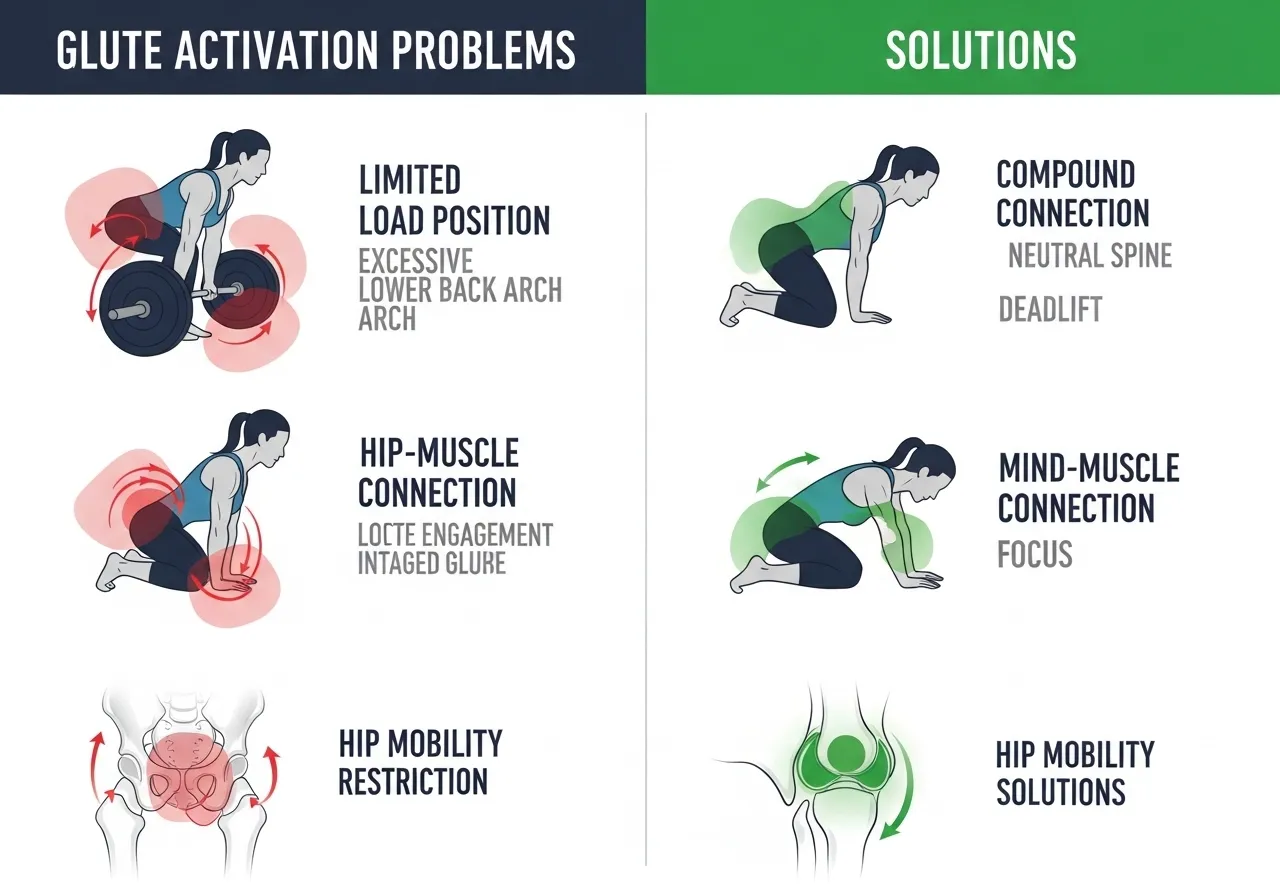
Trainees who cannot feel their glutes working during squats, deadlifts, or hip thrusts often believe the solution is better mind-muscle connection: focusing more intensely on the glutes during the movement. This helps, but only if the neural pathway is already functional.
The mind-muscle connection is a conscious override of the default motor programme. It works well when the underlying activation pathway is intact but underused. It does not work well when the pathway is genuinely inhibited by facilitated antagonists. Thinking harder about glute activation while hip flexors are chronically tight is like trying to drive a car with the handbrake engaged.
The Load and Position Interaction
The hip extension range of motion at which the glute produces maximum force changes with load and speed. In a bodyweight squat, the glutes work primarily in the deep range near the bottom. In a barbell squat at heavy load, the glute produces maximum force in the mid-range. In a sprint, peak glute activation occurs at toe-off, when the hip is in full extension.
Trainees who train primarily with bilateral squats and deadlifts may have well-developed glutes in the sagittal plane while having underdeveloped lateral and rotational gluteal function. Adding unilateral work, banded work, and multi-plane movements addresses these deficits and contributes to the overall glute function that bilateral work alone cannot provide.
Why Unilateral Exercises Reveal What Bilateral Work Hides
Bilateral squats and deadlifts allow the dominant leg to compensate for the weaker one. The stronger glute produces more force. The weaker one produces less. The total movement completes successfully. The imbalance is invisible.
Single-leg exercises expose this asymmetry immediately. A single-leg glute bridge that produces a hard glute contraction on the right side and almost no sensation on the left identifies a real asymmetry that bilateral work was masking. This asymmetry, if untreated, accumulates into injury risk as training loads increase.
Adding single-leg glute bridges, single-leg hip thrusts, and Bulgarian split squats to training alongside bilateral compound work reveals and addresses glute activation asymmetries that bilateral-only programmes never identify. The diagnostic value of unilateral work is as important as its training stimulus.
The Hip Mobility Component
Restricted hip mobility limits the range of motion over which the glutes can produce force. A hip that cannot fully flex without posterior pelvic tilt prevents the glute from working through its full range during squatting movements. A hip that cannot fully extend without lumbar hyperextension prevents full glute activation at the top of hip thrust movements.
Hip mobility work and glute activation work are two parts of the same solution. Activation alone does not resolve the range of motion limitation. Mobility alone does not resolve the neuromuscular inhibition. Both are required simultaneously for trainees with both restrictions. The hip mobility exercises and joint range of motion work that complement the activation protocol are covered in the hip mobility guide.
Frequently Asked Questions About Glute Activation
How do I know if my glutes are actually activating during squats?
The most reliable self-assessment during squats is where you feel the most muscular fatigue after a working set. If the quads and lower back fatigue before the glutes, compensation is occurring. If the glutes fatigue along with or before the quads, activation is adequate.
A more direct test: after a set of 10 heavy squats, immediately palpate the gluteus maximus. A well-activated glute will have a firm, pumped quality. An underactivated glute will feel soft relative to the quadriceps. This comparison is not scientific but provides useful real-time feedback that mirrors what EMG studies measure.
Does glute activation work before running or sport?
Yes. Glute activation before running is particularly well-supported because the gluteus maximus and medius are the primary hip stabilisers during the single-leg stance phase of running. Underactivated glutes during running increase knee valgus stress, IT band loading, and hamstring strain risk by forcing compensatory movement patterns across adjacent joints.
The clamshell, fire hydrant, and banded lateral walk are the most relevant pre-run activation exercises because they target the gluteus medius and external rotators that stabilise the pelvis during single-leg loading. The glute bridge addresses the gluteus maximus hip extension power that drives running propulsion.
How long does it take to fix glute inhibition?
Trainees with mild inhibition, typically those who sit for 6 to 8 hours daily but maintain some regular exercise, usually notice improved glute sensation within two to three weeks of consistent daily activation work combined with hip flexor mobility. The neural pathway responds quickly once the inhibitory mechanism is addressed.
Trainees with significant inhibition from years of sedentary habits, prior lower back injury, or previous hip surgery may take six to twelve weeks before glute activation during compound movements becomes reliable. Patience with the warm-up protocol and consistency of hip flexor mobility work are the primary variables in recovery timeline.
Are resistance bands necessary for glute activation?
No. Bodyweight activation exercises produce the neural activation effect without bands. Bands add resistance that can be useful for trainees who have established the basic activation pattern and want to increase the proprioceptive demand of the exercises.
The half-kneeling glute squeeze, glute bridge with hold, and clamshell all produce meaningful gluteal activation at bodyweight. Adding a light band to the clamshell and lateral walk after two to three weeks of bodyweight practice is a natural progression but is not a prerequisite for the protocol to work.
Should I do glute activation every day or only on training days?
Daily glute activation is beneficial for trainees with significant inhibition from sedentary work habits. The short protocol of 8 minutes does not create recovery demands that interfere with daily repetition. For these trainees, daily activation work re-establishes the neural pattern that prolonged sitting repeatedly disrupts throughout the day.
For trainees without significant inhibition who exercise consistently, activation work before training sessions is sufficient. The warm-up activates the glutes before compound loading on training days, and the compound loading itself maintains the activation pattern on a training frequency of three to five sessions per week.
The most practical approach: perform the full 8-minute protocol before every training session regardless of inhibition status, and add a shorter 3 to 4 minute version (half-kneeling squeeze and glute bridge) on non-training days if glute inhibition during daily activities, such as difficulty feeling glute work when climbing stairs or standing from a chair, remains a concern.
Does glute activation help with lower back pain?
In many cases yes, but the mechanism is indirect. When the gluteus maximus is inhibited, the lumbar erector spinae and hamstrings compensate for the loss of hip extension force. The lumbar erectors work continuously in a role they are not designed to sustain across long training sessions and daily activities. The accumulated erector fatigue and spinal loading often manifests as lower back pain after squatting, deadlifting, or extended standing.
Improving gluteal activation reduces the compensatory demand on the lumbar erectors. When the glutes assume their correct proportion of hip extension load, the erectors are relieved of the excess demand. Many trainees with persistent lower back pain that has not responded to conventional treatment find that systematic glute activation work produces meaningful improvement over four to eight weeks. This is not a medical recommendation. Persistent lower back pain with a mechanical cause requires assessment before assuming glute inhibition is the primary issue.
- Hip flexor co-contraction causes reciprocal inhibition of the gluteus maximus. Addressing hip flexor tightness is the prerequisite for glute activation work to produce its intended effect.
- Step-up variations produce the highest gluteus maximus activation of all exercises in systematic review evidence, ranging from 79 to 113% MVIC. Unilateral and multi-plane exercises consistently outperform bilateral sagittal-plane movements for peak glute activation.
- The half-kneeling glute squeeze addresses the inhibition mechanism directly by placing the hip flexor on stretch while activating the same-side gluteus maximus. It is the highest-priority exercise for trainees with confirmed glute inhibition.
- The 8-minute daily protocol produces the activation effect without fatigue: half-kneeling squeeze, glute bridge with hold, clamshell or fire hydrant, banded lateral walk.
- Glute activation and hip mobility work are two parts of the same solution. Activation alone does not resolve range of motion restrictions. Both must be addressed simultaneously.