Power is not the same as strength. A trainee can deadlift 200 kg but be unable to jump 50 cm if they have never trained for explosive force production. The gap between strength capacity and power expression is where box jump training operates.
The box jump trains the stretch-shortening cycle: the rapid eccentric loading and immediate concentric reversal that produces explosive force output far exceeding what slow maximal effort can generate. This mechanism is responsible for the jumping, sprinting, and change-of-direction performance that distinguishes explosive athletes from strong but slow ones.
This guide covers the stretch-shortening cycle science behind box jump performance, what the research shows about box height and training outcomes, correct technique and landing mechanics, four key box jump variations, and a progressive 8-week programme for developing lower body power.
The Stretch-Shortening Cycle: Why Box Jumps Develop Power That Squats Cannot
The Elastic Energy Mechanism
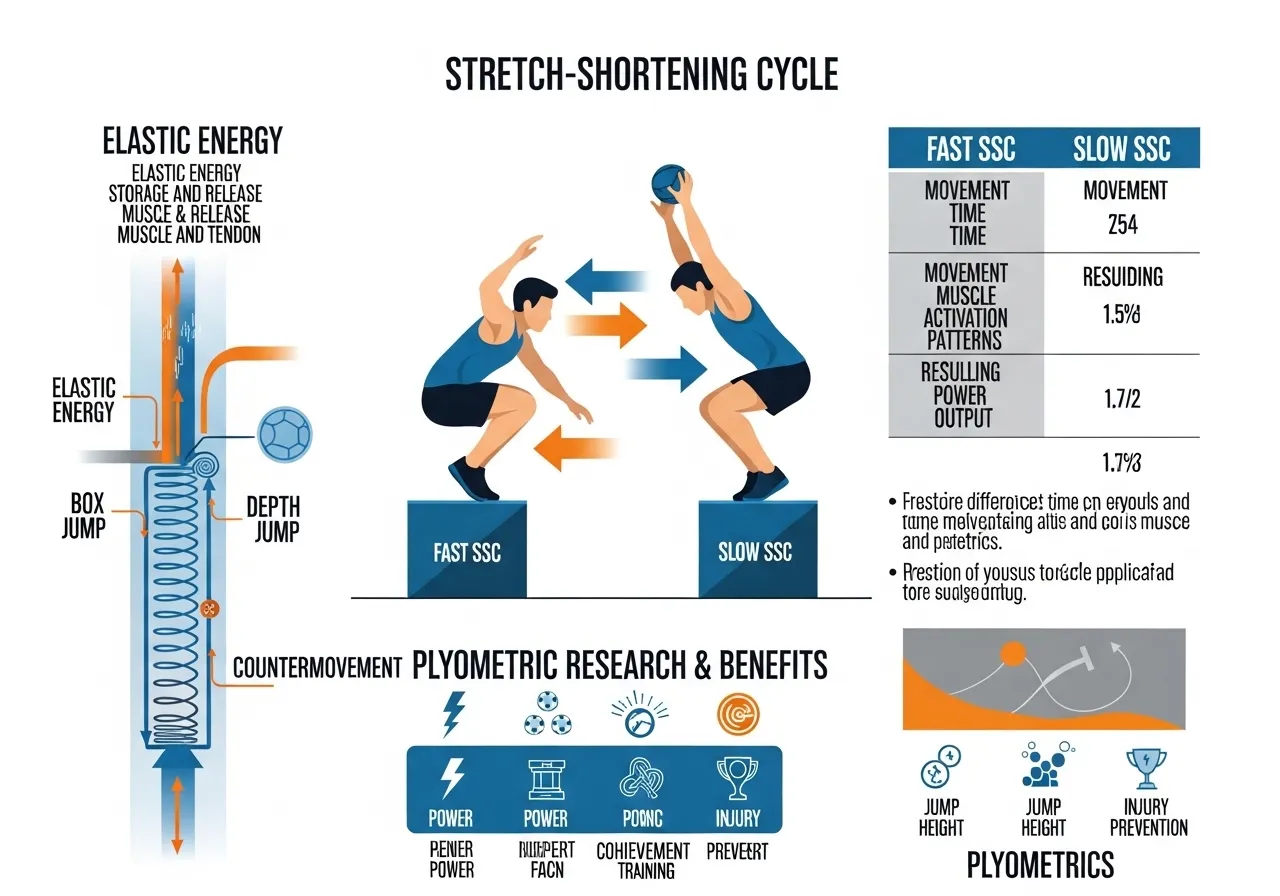
The stretch-shortening cycle (SSC) is the physiological mechanism that enables explosive movements. When a muscle-tendon unit is rapidly stretched (the eccentric phase), it stores elastic energy in the tendon and connective tissue. When the stretch is immediately followed by a concentric contraction, this stored elastic energy is released alongside the active muscular contraction, producing a total force output greater than either component alone.
The key word is “immediately.” If there is a pause between the eccentric stretch and the concentric contraction, the stored elastic energy dissipates as heat rather than contributing to movement. The stretch-shortening cycle is time-dependent.
Fast SSC operates in under 250 milliseconds. Slow SSC operates in 250 to 500 milliseconds. Box jumps with a rapid countermovement train fast SSC. Box jumps with a deliberate pause at the bottom train slow SSC and pure concentric force production.
📌 Key Finding
Plyometric jump training including box jumps produces improvements in jump height, sprint speed, and reactive strength that traditional resistance training does not match. The SSC-specific stimulus of explosive jump training develops rate of force development qualities distinct from those produced by slow strength training.
Why Box Jumps Specifically Train Power Expression
Strength training, specifically squats and deadlifts at heavy loads and slow speeds, develops force production capacity. The nervous system adapts to produce high force over a longer time window. This is essential for lifting heavy things but does not automatically transfer to fast movements.
Box jump training specifically develops the rate of force development: how quickly that force can be produced from zero. A trainee may have the strength to jump high but lack the neural efficiency to express that strength in the 200 to 300 milliseconds available during a jump takeoff. Box jump training closes this gap by repeatedly practising maximal force expression at high velocity, training the nervous system to recruit motor units faster and more completely than slow strength training requires.
This is why the combination of heavy strength training and explosive plyometric training consistently produces greater power development than either training type alone. Strength training builds the force ceiling. Box jump training develops the ability to reach that ceiling at speed.
Box Jump vs Depth Jump vs Countermovement Jump
These three jump variations train different aspects of explosive performance through different SSC demands:
Jump Type
SSC Type
Primary Quality
Best For
Box jump
Slow to fast SSC
Power expression, concentric force
Beginners, general power development
Depth jump
Fast SSC
Reactive strength, SSC efficiency
Advanced athletes, reactive power
Countermovement jump
Slow SSC
Peak power output, elastic contribution
Assessment, comparison baseline
What the Research Shows About Box Height and Performance
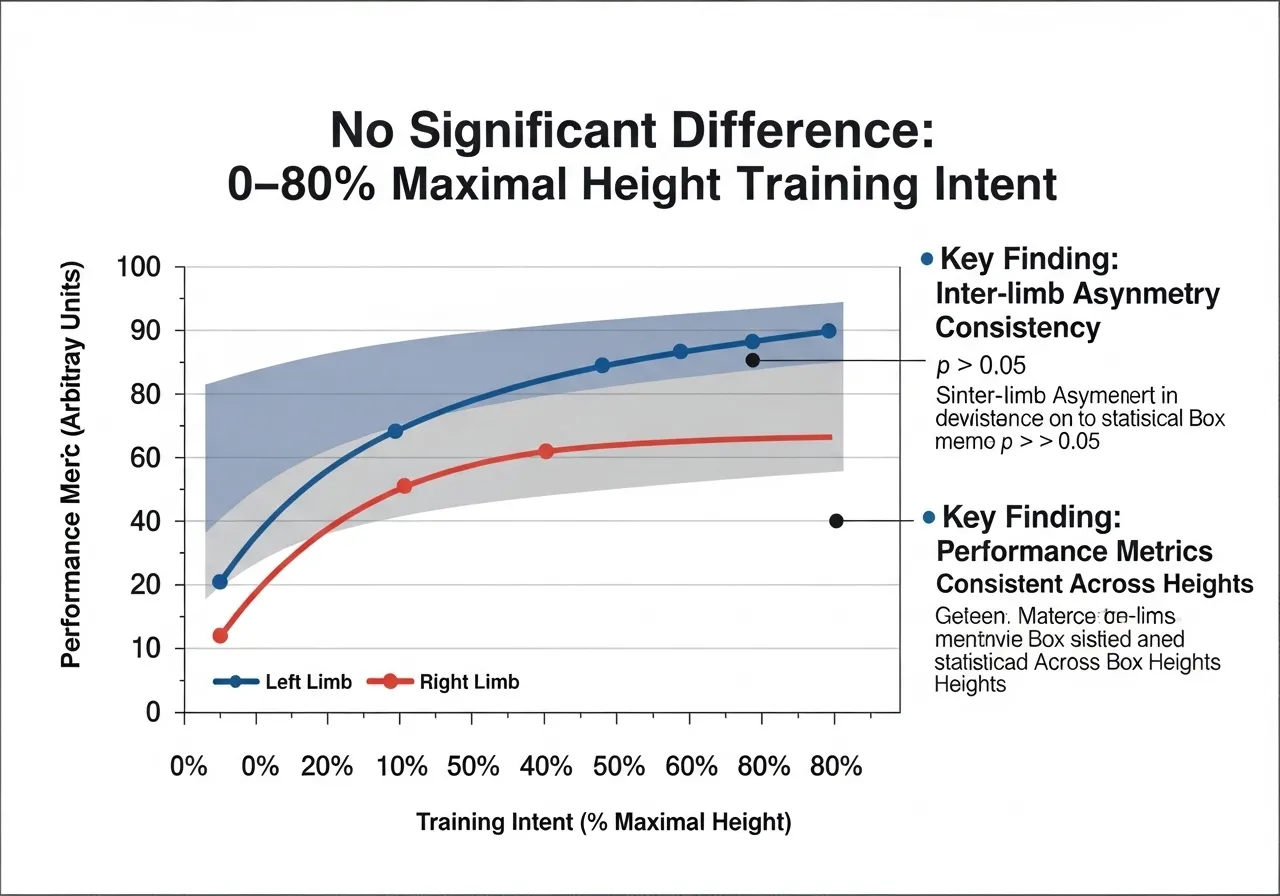
📌 Key Finding Training intent outweighs box height for recreational athletes. Jumping with maximum explosive intent onto a moderate-height box produces similar power outputs to jumping onto a higher box. The effort, not the height, drives the adaptation.
📌 Key Finding
Box height does not significantly alter inter-limb force symmetry during box jumps. Asymmetries identified during box jump testing reflect the trainee’s actual neuromuscular patterns, not artefacts of the box height used, making box jumps valid screening tools for identifying limb dominance imbalances.
Practical Box Height Selection Guidelines
The research evidence supports a pragmatic approach to box height selection that contradicts the common emphasis on maximising box height as the primary measure of training progress.
For power development, the optimal box height is one that allows maximum jump intent to be expressed safely across all sets and reps. For most trainees, this is 40 to 60 cm. A box that is too high forces a pulled-up landing position that reduces jump height expression and introduces compensatory mechanics. A box height that allows a clean, fully extended landing with both feet landing simultaneously is more productive than a higher box that requires the knees to be driven upward to clear the edge.
The primary purpose of the box is to reduce landing impact forces and allow faster set turnaround, not to define the maximum height the trainee can achieve. Using a box height comfortably within the trainee’s capability and focusing entirely on maximum jump effort, minimal ground contact time, and soft landing mechanics produces greater power adaptations than struggling to land on a box at or near maximal height.
Box Jump Technique: Approach, Takeoff, and Landing
⚠️ Ankle, Knee, and Lower Back Safety Note Box jumps place significant impact forces on the ankles, knees, and hips during the landing phase. Individuals with active ankle sprains, patellar tendinopathy, meniscal injuries, or acute lower back pain should obtain assessment before performing box jumps. Begin at low box heights with full attention to soft landing mechanics before progressing height or volume. Any knee pain during landing or takeoff requires immediate assessment before continuing.
The Approach and Arm Swing
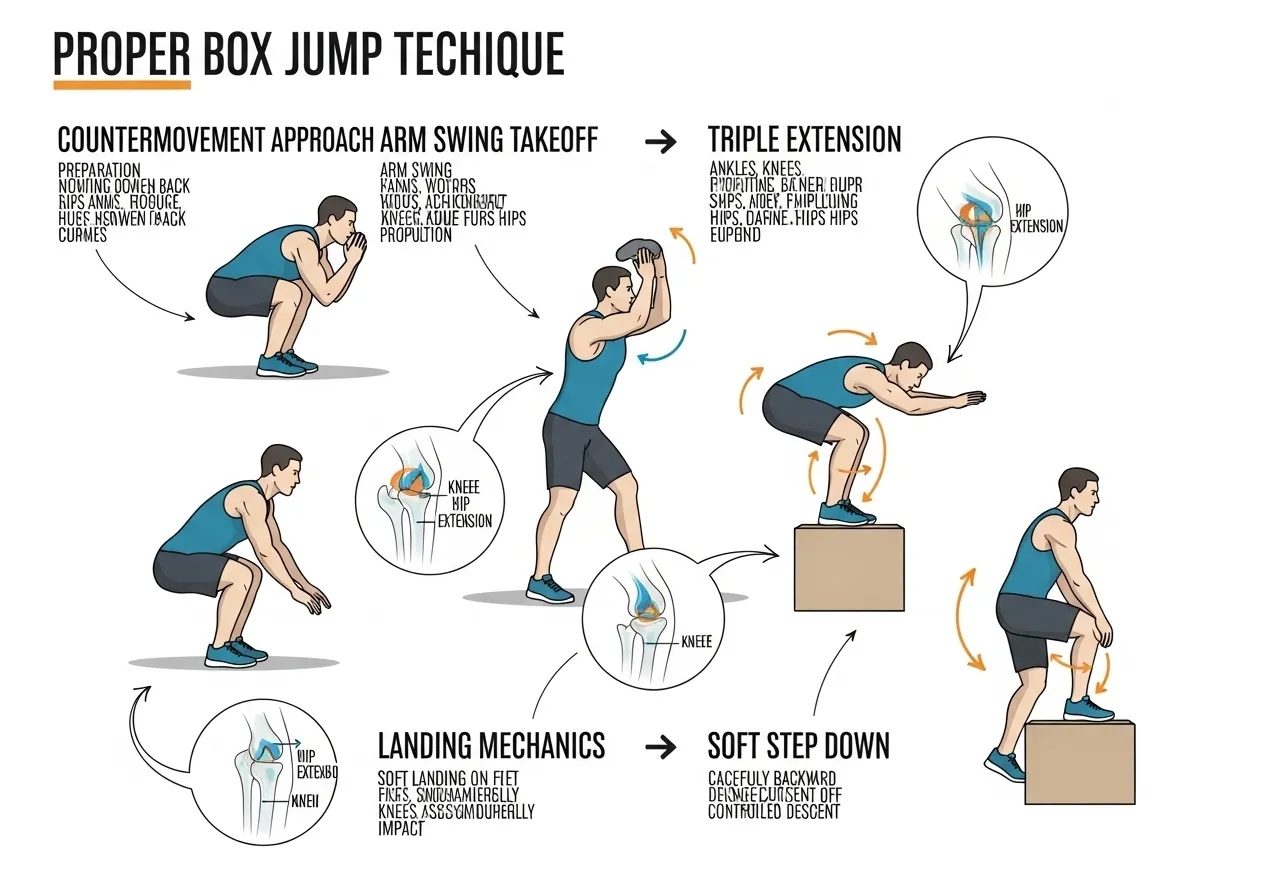
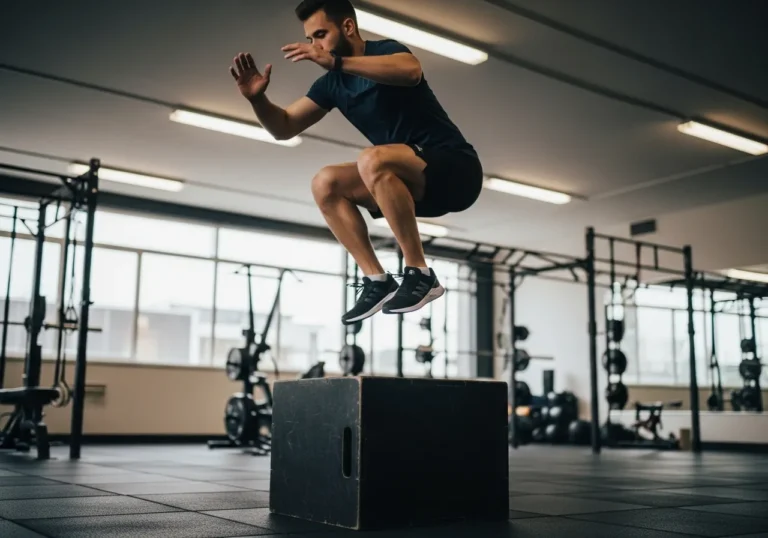
Box jumps can be performed from a standing start or with a brief approach. The standing countermovement box jump is the most common training variation. From a standing position approximately one body length from the box, the trainee performs a rapid countermovement: hips back and down, arms swinging backward, followed immediately by a forceful triple extension of ankle, knee, and hip.
The arm swing is not optional. Research on countermovement jumps consistently shows that a coordinated arm swing increases jump height by 10 to 15% compared to a hands-on-hips jump. The arms generate upward momentum that adds to the leg-driven jump height. The arms should swing forcefully forward and upward during the jump, driving the body vertically.
The Takeoff: Triple Extension
The takeoff requires full triple extension: the ankle plantar-flexes to full range, the knee extends to near lockout, and the hip extends to full range simultaneously. Incomplete triple extension at any joint reduces the power transferred to the jump.
The most common takeoff error is insufficient ankle plantar-flexion: the heels do not fully leave the ground before the jump terminates. This limits the contribution of the gastrocnemius and soleus to the jump and reduces total power output. A practical cue: aim to be on the toes at peak extension before leaving the floor.
Landing Mechanics: The Most Important Part of Box Jump Training
Box jump training is often programmed without sufficient attention to landing mechanics. Landing quality determines both injury risk and the quality of the training stimulus for subsequent reps.
A correct box jump landing: both feet land simultaneously, the knees track over the second toe, the hips hinge to absorb impact, the torso remains upright, and the landing is soft and controlled rather than loud and rigid. Landing with straight knees or allowing the knees to collapse inward represents a neuromuscular control problem that accumulates injury risk with each repetition.
The step-down from the box after each repetition is equally important. Jumping down from the box converts the box jump into a depth jump and creates a landing impact that is appropriate only for more advanced training protocols. Step down one foot at a time after each box jump rep to separate the box jump stimulus from depth jump loading.
Warm-Up Before Box Jumps
Box jumps at maximum effort require a specific warm-up sequence that prepares the nervous system for explosive output, not just the muscles for movement. A 5 to 8 minute warm-up consisting of light jogging, leg swings, bodyweight squats, and 3 to 4 submaximal practice jumps at approximately 50 to 60% of training box height activates the SSC pathways before full-effort jumps begin.
The submaximal practice jumps are particularly important. They re-establish the landing mechanics pattern, activate the relevant neuromuscular pathways, and allow the trainee to confirm that ankle, knee, and hip mechanics are all functioning normally before maximum effort is applied. Skipping this step and jumping directly to maximum effort increases injury risk and reduces the quality of the first working set.
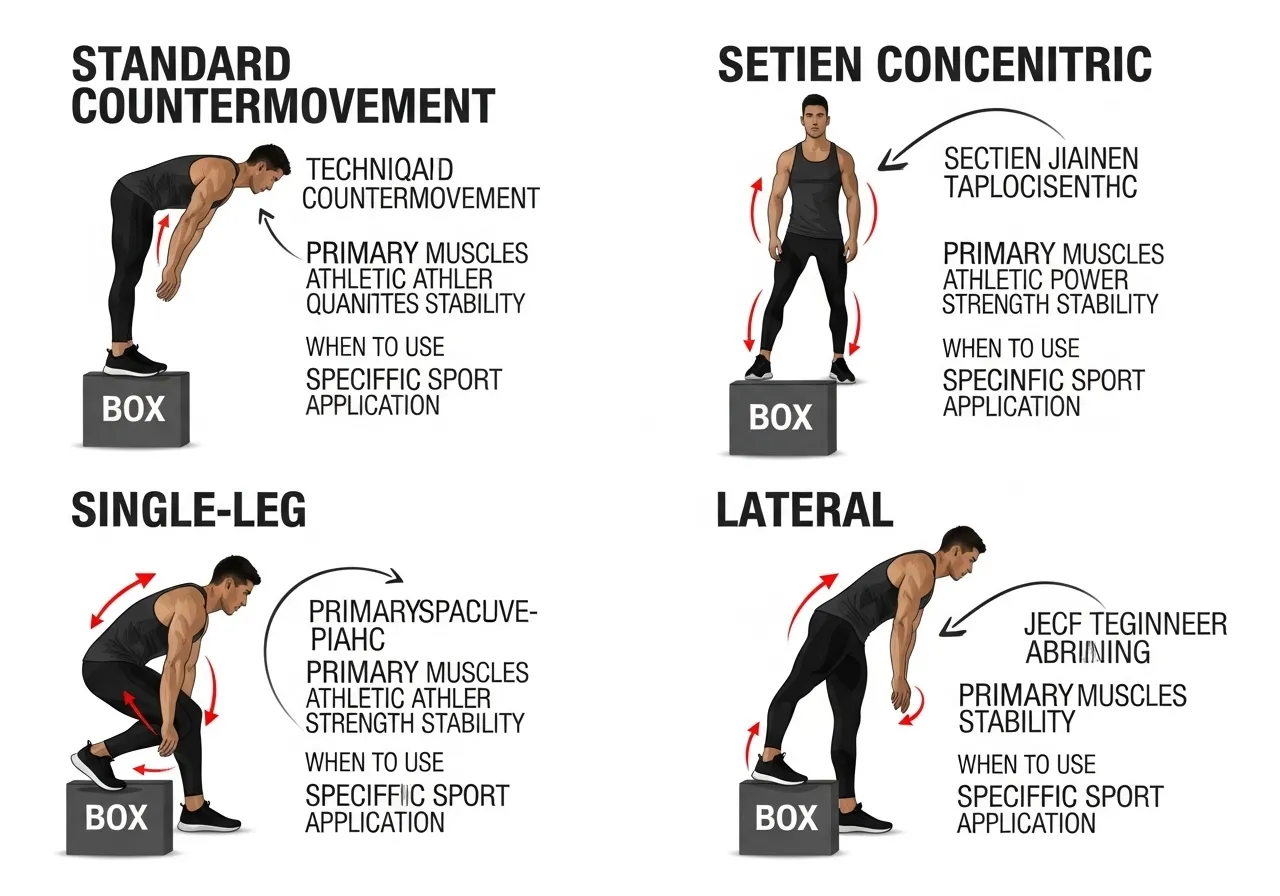
4 Box Jump Variations and When to Use Each
💥 1. Standard Box Jump (Countermovement)
Target: General lower body power, SSC development, jump height
How: Stand facing the box. Perform a rapid countermovement (hips back and down), then jump explosively onto the box. Land softly with both feet simultaneously. Step down. Reset fully before the next rep.
Best for: Primary box jump training for beginners and intermediates. The foundational variation before progressing to more demanding alternatives. For a complete plyometric programme covering all jump variations and SSC progressions, the plyometric training guide covers the full programming framework.
💥 2. Seated Box Jump (Concentric Only)
Target: Pure concentric force production, minimal SSC contribution
How: Sit on a bench or box with hips at 90 degrees. From the seated position, jump onto the box without a countermovement. No arm swing is permitted. The jump is generated entirely from a dead-stop concentric contraction.
Best for: Isolating concentric force production without elastic energy contribution. Useful for identifying the SSC contribution to jump performance: the difference between countermovement and seated box jump height represents the elastic energy contribution to the standard variation.
How: Stand on one leg facing the box. Perform a single-leg countermovement and jump onto the box, landing on the same single leg. The landing requires significant single-leg stability in the hip and ankle. Step down and reset.
Best for: Identifying and addressing limb asymmetries that bilateral box jumps mask, training the unilateral landing mechanics relevant to running and change of direction, and developing hip stabiliser strength under dynamic load.
💥 4. Lateral Box Jump
Target: Lateral power, hip abductor loading, frontal plane mechanics
How: Stand beside the box. Jump laterally onto the box from the side, landing with both feet. Step down to the opposite side. The jump requires lateral force production rather than vertical-only mechanics.
Best for: Athletes in sports requiring lateral movement (basketball, soccer, tennis), addressing the frontal plane power that vertical box jumps do not develop, and complementing the sagittal-plane training that most plyometric programmes emphasise exclusively.
How to Programme Box Jumps: Volume, Intensity, and Session Placement
Volume Guidelines: Less Is More for Power Development
Box jumps are a neural quality exercise. They develop rate of force development and SSC efficiency, qualities that respond to fresh neuromuscular state and high quality of effort rather than high repetition fatigue.
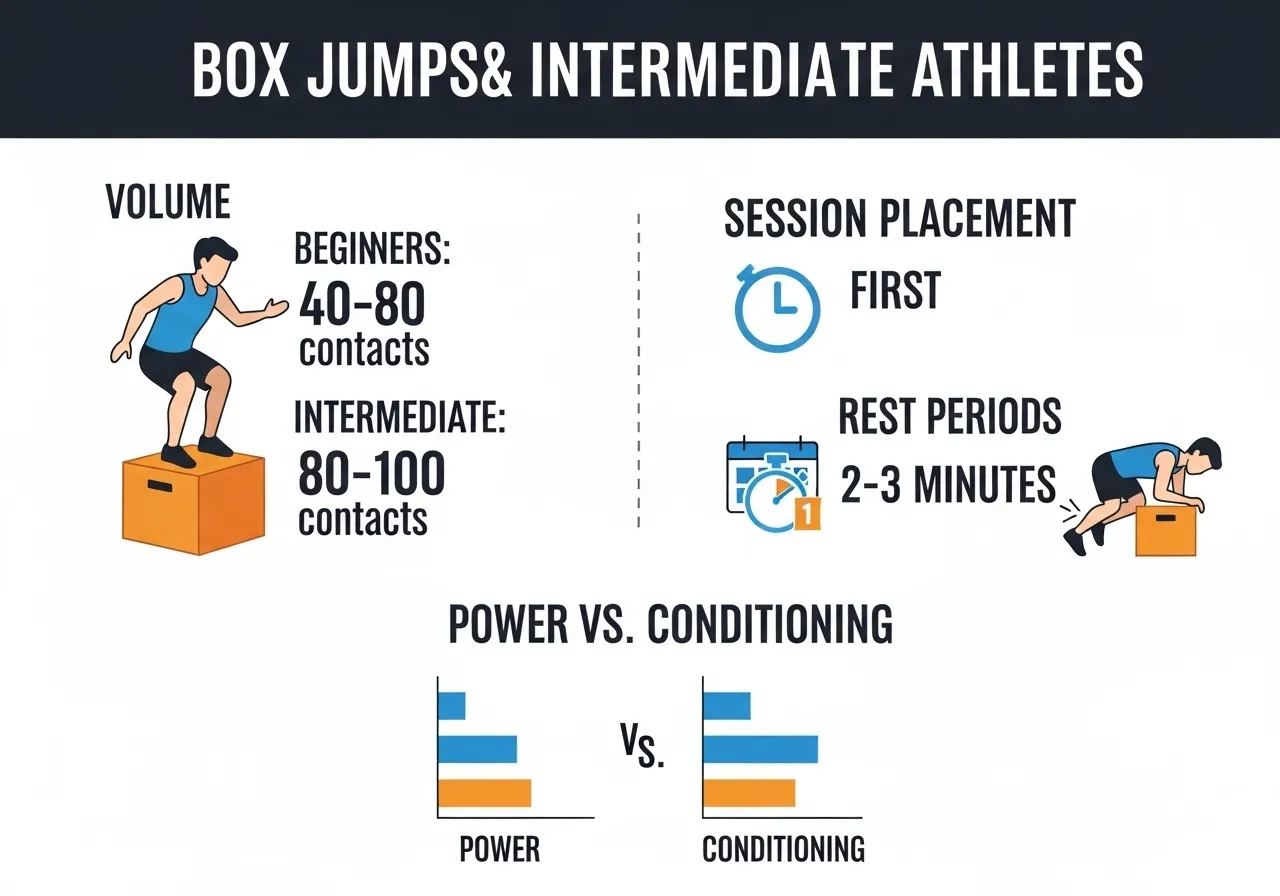
Volume guidelines from plyometric training research: beginners start with 40 to 80 total ground contacts per session, intermediates 80 to 100, advanced 100 to 120. Each box jump rep counts as one ground contact. A session of 4 sets of 5 reps produces 20 ground contacts. A session of 8 sets of 8 reps produces 64 ground contacts. Both are within appropriate beginning ranges.
Session Placement: First in the Session, Every Time
Box jumps must be placed at the beginning of the training session, before any fatiguing strength work. Power qualities are disproportionately sensitive to fatigue. A box jump performed after heavy squats, leg presses, and Romanian deadlifts produces a fraction of the power output that the same jump produces when performed fresh.
This is not a guideline that can be compromised for convenience. Placing box jumps after strength work and expecting power adaptation is a fundamental programming error. The sequence must be: box jumps first, heavy strength work second. The box jumps are shorter than the strength work, typically 10 to 15 minutes including setup, and do not interfere with subsequent strength performance at appropriate volumes.
8-Week Box Jump Progression
📅 Weeks 1 to 2: Technique Foundation
Standard box jump: 4 sets of 4 reps at 40 to 45 cm box height
Focus: soft landing, both feet simultaneous, step down every rep
Rest: 3 minutes between sets
📅 Weeks 3 to 4: Volume Build
Standard box jump: 5 sets of 4 reps
Add single-leg box jump: 3 sets of 3 reps per side
Rest: 2 to 3 minutes between sets
📅 Weeks 5 to 6: Height Progression
Standard box jump: 5 sets of 4 reps at 50 to 55 cm
Lateral box jump: 3 sets of 4 reps each side
Seated box jump: 2 sets of 4 reps to isolate concentric power
📅 Weeks 7 to 8: Peak Volume and Benchmark
Standard box jump: 5 sets of 5 reps at working height
Single-leg box jump: 3 sets of 4 per side
Week 8: test maximum box jump height and compare to Week 1 baseline
Rest Periods: Longer Than You Think
Power development requires near-full recovery between sets. Rest periods of 2 to 3 minutes between box jump sets allow the phosphocreatine system to recover sufficiently to produce maximum effort on the next set. Shorter rest periods convert box jump training into conditioning rather than power development, which may be the intended goal for metabolic conditioning sessions but is not appropriate when power adaptation is the objective.
A practical guide to rest period adequacy: if the second and third sets produce clearly lower jump quality or different landing mechanics than the first set, rest is insufficient.
Increase rest between sets until performance remains consistent across all rounds. Most trainees find that 2 minutes is the minimum; 3 minutes is often more appropriate at higher training intensities.
Frequently Asked Questions About Box Jump Training
How high should a box be for training?
The research evidence reviewed above shows that 40 to 60 cm (16 to 24 inches) is an appropriate training box height for most recreational athletes, regardless of their maximum achievable height. The box height should allow a soft, controlled landing with full hip and knee bend without requiring the knees to be pulled aggressively upward to clear the edge.
A box that requires significant knee tuck to land on represents a height beyond the trainee’s current jump capability. Training at this height forces compensation mechanics that reduce the quality of the power stimulus and increase injury risk. Using a slightly lower box with full explosive intent produces better power adaptations than struggling onto a higher box with compromised mechanics.
Can box jumps replace squats for lower body development?
No. Box jumps and squats develop different qualities through different mechanisms. Squats develop maximum strength and muscle hypertrophy through high load progressive overload. Box jumps develop rate of force development and SSC efficiency through high velocity explosive loading. Neither produces the full set of adaptations that the other does.
The most complete lower body programme includes both: heavy strength work (squats, deadlifts) for strength and hypertrophy, and explosive plyometric work (box jumps, broad jumps) for power development. The strength base built through squatting provides the force production capacity that plyometric training then expresses at speed. The bodyweight strength foundations that complement explosive training are covered in the bodyweight training guide.
How often should I train box jumps per week?
Two sessions per week is the standard recommendation for power development through box jump training, with at least 48 hours between sessions to allow neuromuscular recovery. One session per week maintains power qualities but produces slower adaptation than two sessions. Three or more sessions per week at moderate-to-high volume produces accumulated neuromuscular fatigue that impairs rather than develops power.
For athletes combining box jumps with heavy strength training, placing the two box jump sessions on the same days as lower body strength training (box jumps first) minimises the number of days requiring lower body recovery and allows true rest days between demanding sessions. For trainees who want to combine explosive power work with sled-based conditioning in the same block, the sled training guide covers how sprint-specific conditioning complements box jump power development.
Why do my knees cave inward when I land?
Knee valgus on landing is the most common box jump technique problem and represents a neuromuscular control issue, not simply a strength deficit. The gluteus medius and hip external rotators are insufficient to maintain knee alignment under the dynamic load of landing impact.
Strengthening these muscles through glute activation exercises and single-leg work directly addresses the landing valgus pattern. Practising the landing position specifically, stepping off a box and landing with knee alignment before adding jump height, builds the movement pattern before the full speed of jumping is added.
How does box jump training differ from sprint training for power development?
Box jumps and sprint training both develop lower body power through explosive force production but through different mechanical contexts. Box jumps train vertical force production in a bilateral stance. Sprint training trains horizontal force production in a unilateral alternating pattern at high velocities.
The two training types are complementary rather than interchangeable. Athletes who require both vertical (basketball, volleyball) and horizontal (soccer, American football) explosive power benefit from including both in their programme. For trainees whose primary goal is general athletic power development, both forms of training produce results that neither achieves alone.
Box jumps are more accessible for gym-based training and allow more controlled progression than sprint training. Sprint training develops the horizontal power and stride mechanics that box jumps cannot replicate. Including both within an 8 to 12 week mesocycle addresses the full spectrum of lower body explosive performance.
Key Takeaways
Plyometric jump training including box jumps produces significant improvements in jump height, sprint speed, and reactive strength that traditional resistance training alone does not match
Training intent outweighs box height for recreational athletes. Maximum explosive effort onto a moderate-height box produces similar power outputs to jumping onto a higher box
Box height does not significantly alter inter-limb asymmetry patterns, making box jumps valid screening tools for identifying limb dominance imbalances
Box jumps must be placed first in the training session. Power qualities are disproportionately sensitive to fatigue and cannot be developed effectively after heavy strength work
Step down from the box after every rep. Jumping down converts the exercise into a depth jump with significantly higher landing impact that is appropriate only for advanced programming
Rucking is walking with a weighted pack. That description makes it sound simple. The physiological demand it creates is not. Carrying 15 to 20% of your bodyweight on your back while walking at a brisk pace elevates heart rate to Zone 2 to Zone 3 intensity, loads the posterior chain continuously, compresses the spine under…
⚠️ Fitness Disclaimer: The information in this article is for general educational purposes only and does not constitute professional fitness or medical advice. Always consult a qualified healthcare professional before starting any new exercise program, especially if you have existing injuries or medical conditions. Resistance Bands: The $30 Training Tool That Belongs in Every Serious…
The premise sounds implausible. Apply a cuff to your arms or legs, restrict blood flow partially, then train with weights 20 to 30% of your one-rep maximum, and produce muscle growth equivalent to heavy training at 70 to 80% of your maximum. It sounds like the kind of shortcut that fitness products promise and peer-reviewed…
There is no neat way to flip a tire. It does not fit into a defined movement category. It is not a deadlift. It is not a push press. It is all of them simultaneously, in a sequence, against an implement that shifts weight as it moves. This awkwardness is the point. Every clean movement…
⚠️ Health & Fitness DisclaimerThis article is for general educational purposes only and does not replace professional medical advice. If you have any lower limb, knee, or ankle conditions, please consult a qualified healthcare professional before beginning plyometric training overview training. Plyometric training — exercise that uses the stretch-shortening cycle (the rapid lengthening of a…
⚠️ Health & Fitness DisclaimerThis article is for general educational purposes only and does not replace professional medical advice. If you have any shoulder, wrist, or lower back conditions, please consult a qualified healthcare professional before beginning suspension training. Suspension training — using adjustable straps anchored overhead to leverage bodyweight as resistance — offers a…