Bent-over rows are one of the best back exercises in existence. They are also one of the most commonly cheated exercises in existence.
Watch the average trainee perform a set of heavy bent-over rows. The torso rises with each rep. The legs drive at the bottom. The lower back extends to swing the weight through the sticking point. By the final rep, the movement is more of a reverse hip hinge than a row. The back receives a fraction of the intended stimulus.
The chest-supported row fixes this with a single mechanical change: it removes the possibility of using anything other than the back to move the weight. With the chest braced against a bench, the torso cannot rise. The legs cannot drive. The lower back cannot extend. The back muscles do the work or the weight does not move.
This guide covers what the research shows about rowing exercise muscle activation, why chest support changes the training stimulus, five chest-supported row variations and when to use each, complete technique, and how to programme it alongside conventional rowing movements.
The Research Behind Rowing Muscle Activation
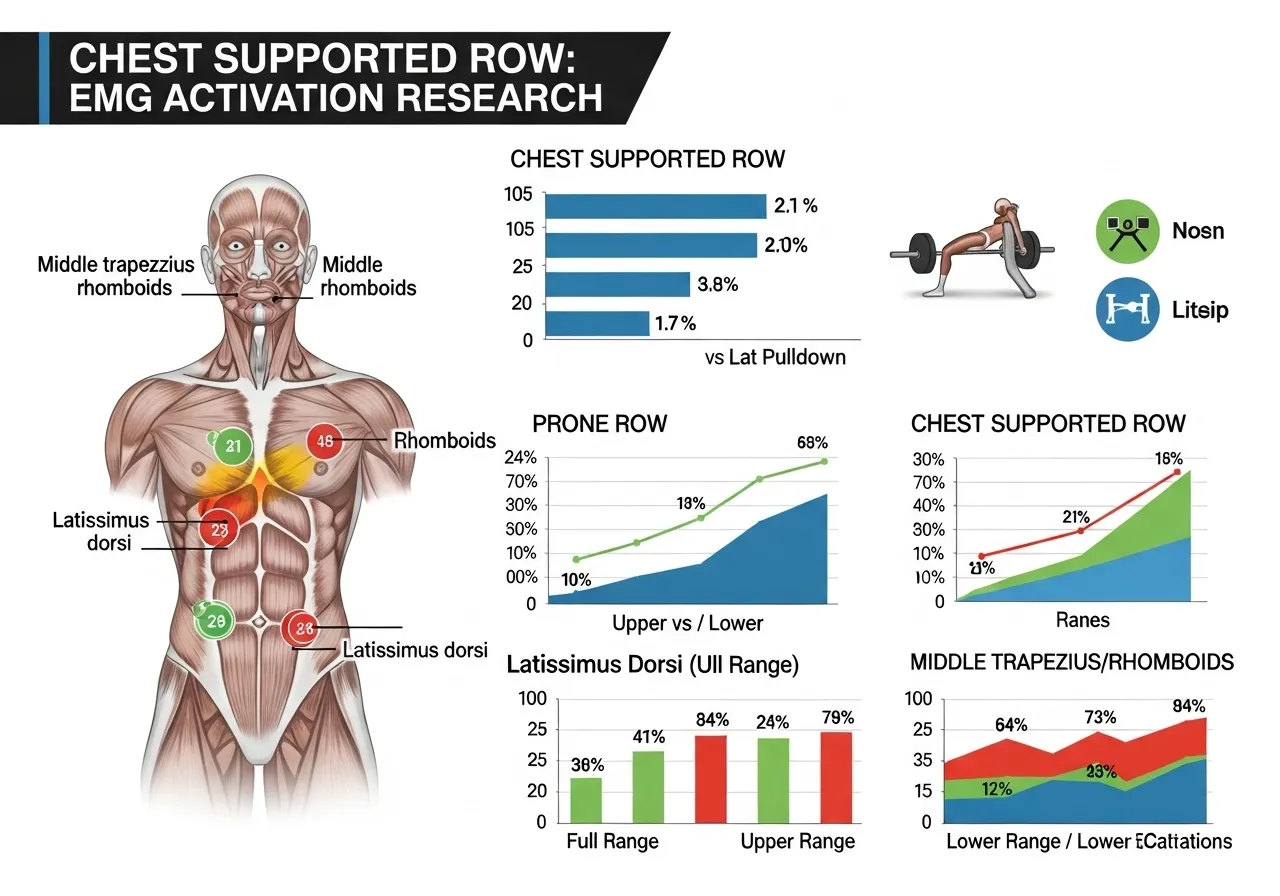
Middle Trapezius and Rhomboid Activation: What the EMG Shows
📌 Key Finding
Rowing movements produce higher middle trapezius and rhomboid activation than pulldown variations. The horizontal pulling plane of rows specifically targets the mid-back retractors that vertical pulling cannot adequately stimulate.
📌 Key Finding
The upper half of the rowing range of motion produces greater lat activation, while the lower half produces greater trapezius activation. Full-range chest-supported rows address both muscle groups. Partial range adjustments allow specific targeting when needed.
📌 Key Finding
The prone neutral-grip row is used as the maximal voluntary contraction reference in back muscle EMG research precisely because it produces near-maximal lat, trapezius, and rhomboid activation with minimal compensation. This is the same position that chest-supported rows replicate.
Is the Chest-Supported Row Better Than the Barbell Row?
The Different Stimulus of Each Movement
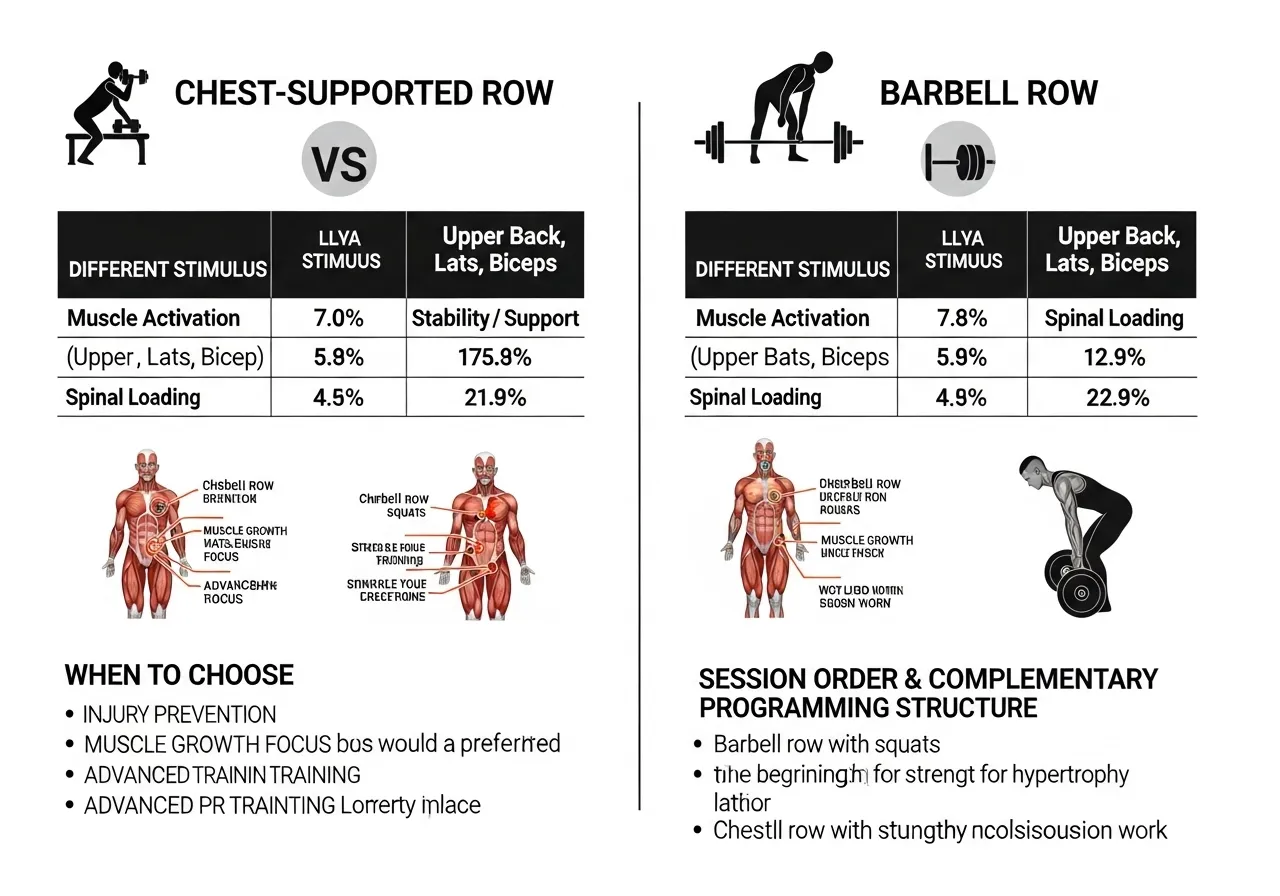
The barbell row and the chest-supported row are not competing for the same training effect. They produce different stimuli through different mechanisms and are most effective when used together rather than treated as interchangeable alternatives.
The barbell row is a total posterior chain exercise. The lower back erectors, glutes, and hamstrings all work isometrically to maintain the hip-hinged position. The traps work to stabilise the thoracic spine. The lats and rhomboids produce the rowing force. A heavy barbell row session is significantly more systemically demanding than a chest-supported row session because of this total body involvement.
The chest-supported row is a back isolation exercise. The lower back, glutes, and hamstrings are removed from the movement. All force production comes from the lats, rhomboids, and mid-back. The training stimulus per back muscle contraction is higher at matched loads because no energy is diverted to lower body stabilisation. For a complete comparison of barbell row grip variations and activation profiles, the barbell row guide covers the full mechanical and EMG analysis.
When to Choose Each
Situation
Choose Barbell Row
Choose Chest-Supported Row
Primary goal
Total posterior chain strength
Back isolation and hypertrophy
Lower back status
Healthy, no active pain
Fatigued, sensitive, or injured
Session position
Primary compound movement
Secondary or finisher movement
Training level
All levels
All levels, especially beginners needing feedback
Technique focus
Overall back strength pattern
Mind-muscle connection, retraction
The Complementary Programming Approach
The most effective back programme uses both movements in a complementary structure. Heavy barbell rows early in the session develop maximum back strength and total posterior chain integration. Chest-supported rows later in the session, when the lower back is too fatigued for heavy bent-over work, allow continued back volume accumulation without spinal compromise.
This sequencing means the back receives higher total weekly volume than either exercise alone can provide, because the chest-supported row extends the back training beyond the point where lower back fatigue would otherwise terminate the session. The scapular stability and mid-back retraction exercises that complement both rowing variations are covered in the scapular stability guide.
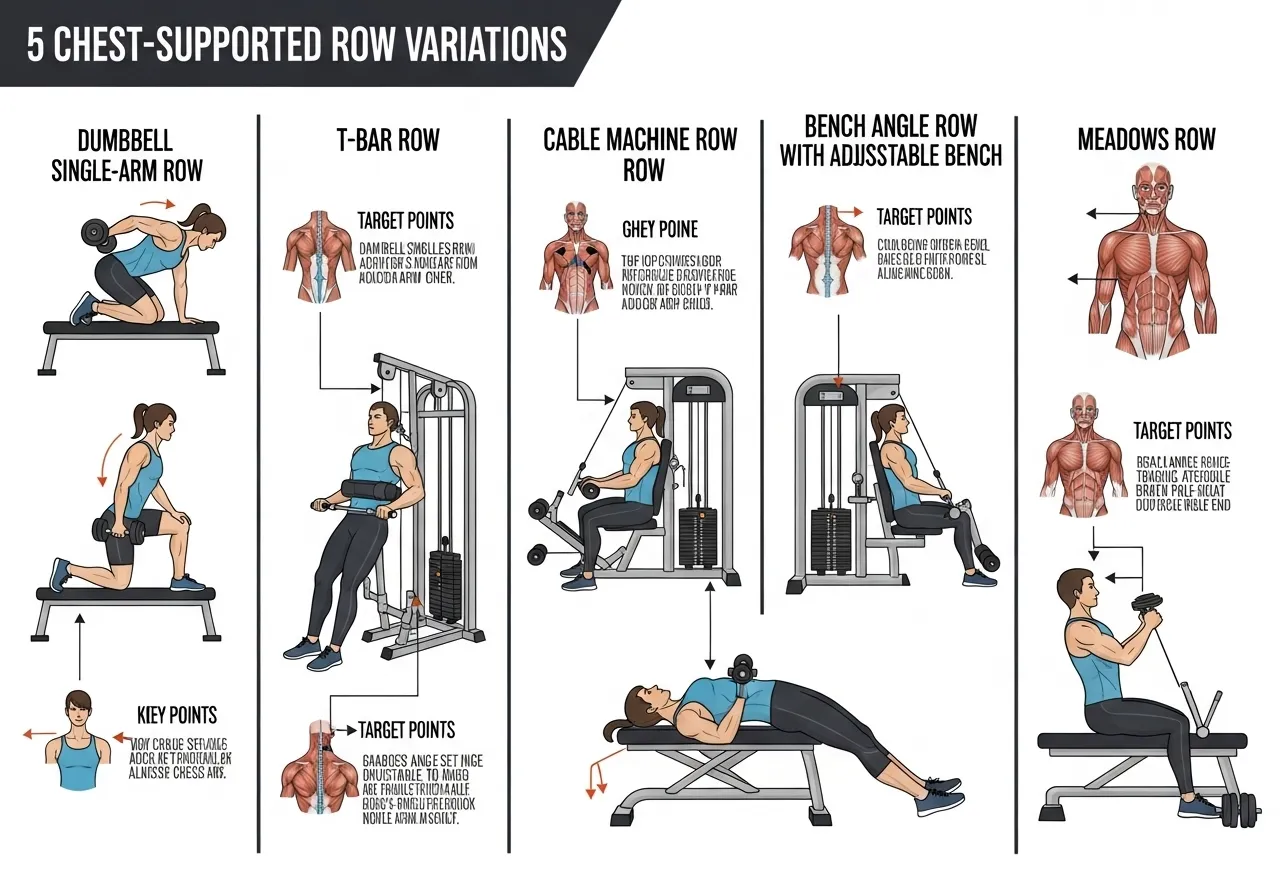
5 Chest-Supported Row Variations: Targets, Setup, and When to Use Each
⚠️ Shoulder and Neck Safety Note Chest-supported row variations place the shoulder joint in horizontal extension under load. Individuals with active anterior shoulder impingement, SLAP labral tears, or AC joint pathology should obtain assessment before loading chest-supported row movements through full range. The head position during prone bench rows should remain neutral with the face pointing down, not cranked back or forward, to avoid cervical compression under load.
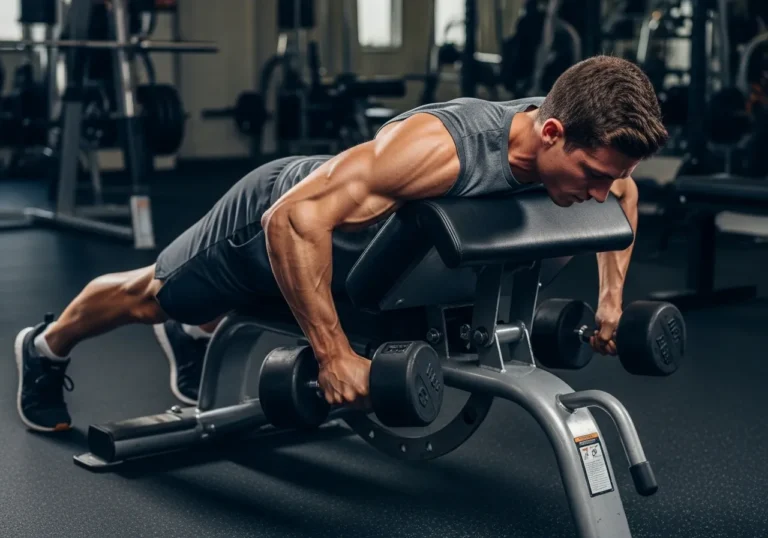
How: Set an incline bench to 30 to 45 degrees. Lie prone with chest against the pad, feet on the floor, dumbbells hanging at arm’s length. Row both dumbbells simultaneously, driving elbows back and squeezing shoulder blades at the top. Lower under control over 2 to 3 seconds.
Key point: The bench angle determines the primary muscle emphasis. A higher incline angle (45+ degrees) shifts emphasis toward upper traps and rhomboids. A lower angle (30 degrees or less) emphasises lower lat and mid-back. Start at 45 degrees and adjust based on where the greatest stimulus is felt.
🏋️ 2. Single-Arm Dumbbell Chest-Supported Row
Target: Unilateral lat, rhomboid, trap; asymmetry identification
How: Same prone bench setup as bilateral variation. Row one arm at a time while the opposite arm hangs at rest. Performing one side allows greater range of motion and stronger mind-muscle connection on each side. Complete all reps on one side before switching.
Key point: If one side noticeably fatigues faster or requires greater effort at matched loads, this reveals a genuine lat/trap asymmetry that bilateral rowing masks. Address with additional single-arm sets on the weaker side across training blocks.
🏋️ 3. Chest-Supported T-Bar Row
Target: Lat and mid-back with heavier loading than dumbbell variations
How: Use a dedicated T-bar row machine with chest support, or set a landmine attachment to allow a neutral-grip pull. The T-bar allows heavier loading than dumbbells while maintaining the chest support that eliminates momentum. Row the handle to the lower chest and squeeze the shoulder blades at the top.
Key point: The T-bar chest-supported row bridges the gap between dumbbell isolation work and heavy barbell rowing. It allows progressive overload beyond dumbbell capacity while maintaining strict back isolation. This is the preferred variation for trainees who have outgrown dumbbell loads.
🏋️ 4. Chest-Supported Cable Row
Target: Lat and rhomboids with constant tension throughout range
How: Set an incline bench in front of a low cable pulley. Lie prone on the bench and attach a handle to the cable. Row the cable to the lower chest. The cable provides tension at the bottom of the range where gravity-based dumbbell resistance is minimal.
Key point: The cable version specifically addresses the bottom-of-range loading deficit that dumbbell chest-supported rows have. The constant cable tension means the lat is under load even at full arm extension, providing a loaded stretch that dumbbell variations cannot replicate.
🏋️ 5. Chest-Supported Machine Row
Target: General back development with fixed movement path
How: Use a dedicated chest-supported row machine with the torso pad adjusted to allow comfortable arm extension at the start. Adjust seat height so the handles align with the lower chest at full contraction. Row to the chest, squeeze at the top, and return under control.
Best for: Beginners learning the rowing pattern without balance or coordination demands, high-rep back volume at the end of a session, and as a deload option during periods of lower back sensitivity. The machine’s fixed path removes the technique demand that allows focus entirely on the contraction.
Chest-Supported Row Technique: The Details That Determine Whether the Back or the Arms Do the Work
The Elbow Path: The Single Most Important Technical Detail
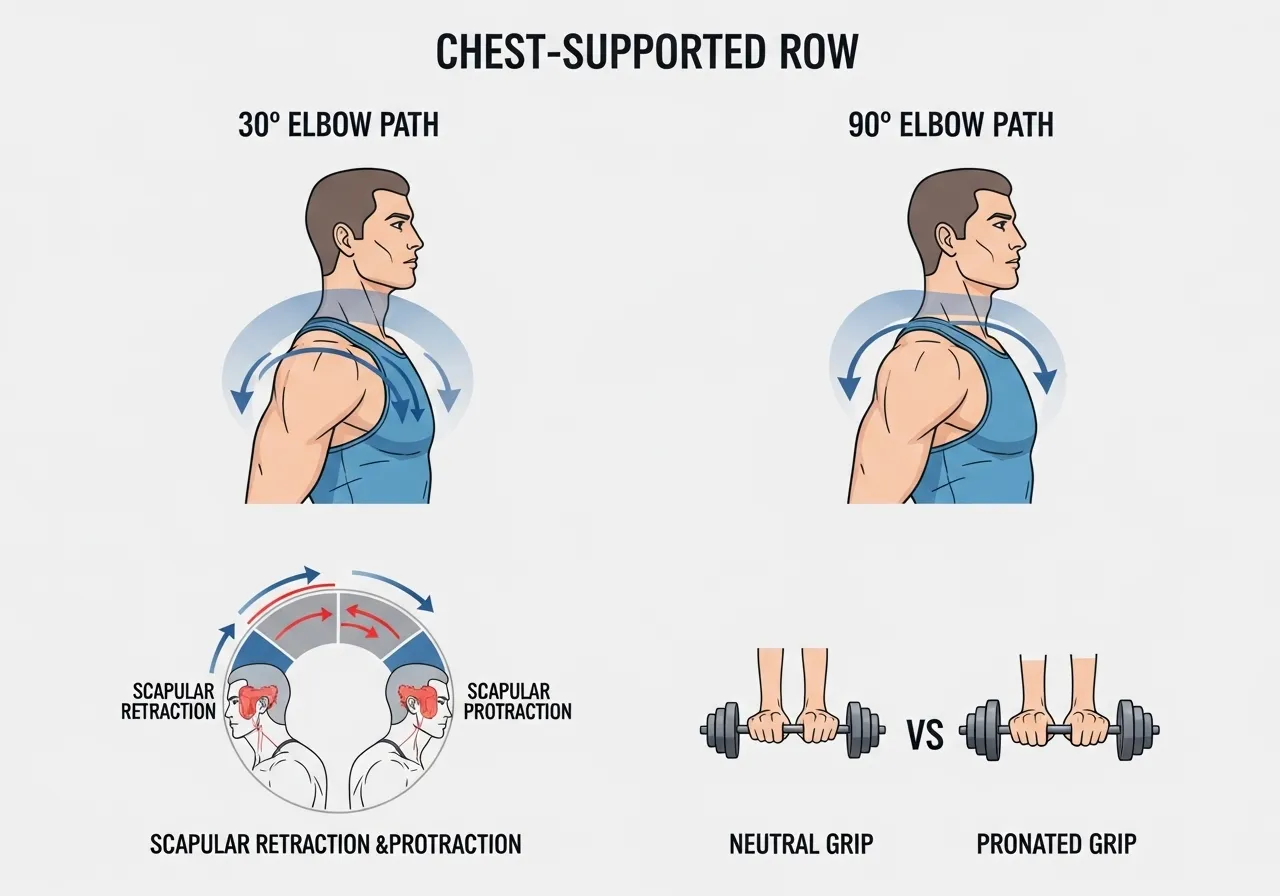
The path the elbows travel during the row determines which muscles do the work. Two elbow paths produce dramatically different results:
Elbows flared wide (90 degrees from torso): The rear deltoid is the primary mover. The lats contribute minimally. The movement becomes a rear delt exercise with back assistance.
Elbows tucked (30 to 45 degrees from torso): The latissimus dorsi is the primary mover. The rhomboids and mid-traps assist in scapular retraction. The rear deltoid assists but does not dominate.
Most trainees flare their elbows during chest-supported rows because the flared position feels stronger and allows more weight. It does not train the target muscles more effectively. Reducing load and keeping the elbows closer to the torso produces greater lat activation per set.
Scapular Movement: Retraction at the Top, Protraction at the Bottom
The chest-supported row should begin with a deliberate scapular retraction cue: pull the shoulder blades back and together before the elbows begin to drive back. This scapular initiation ensures the rhomboids and middle trapezius engage from the start of the movement rather than only at the end range.
At the bottom, allow the shoulder blades to protract forward fully. This full protraction at the bottom places the rhomboids and middle trapezius in their lengthened position, creating the stretch-mediated stimulus that incomplete range chest-supported rows miss. Many trainees keep the shoulder blades retracted throughout the set, eliminating the protraction phase that makes the full range of motion productive for mid-back development.
Grip Width and Neutral vs Pronated Grip
Grip width and orientation affect the relative contribution of different back muscles. Neutral grip (palms facing each other) produces greater brachialis and brachioradialis activation than pronated grip and allows a more comfortable shoulder position for most trainees. Pronated grip (palms facing down) increases rhomboid and middle trapezius activation and reduces bicep involvement. Wide grip shifts more load to the rear deltoid and upper trapezius. Shoulder-width or slightly narrower neutral grip is the most effective general back development choice for chest-supported rows.
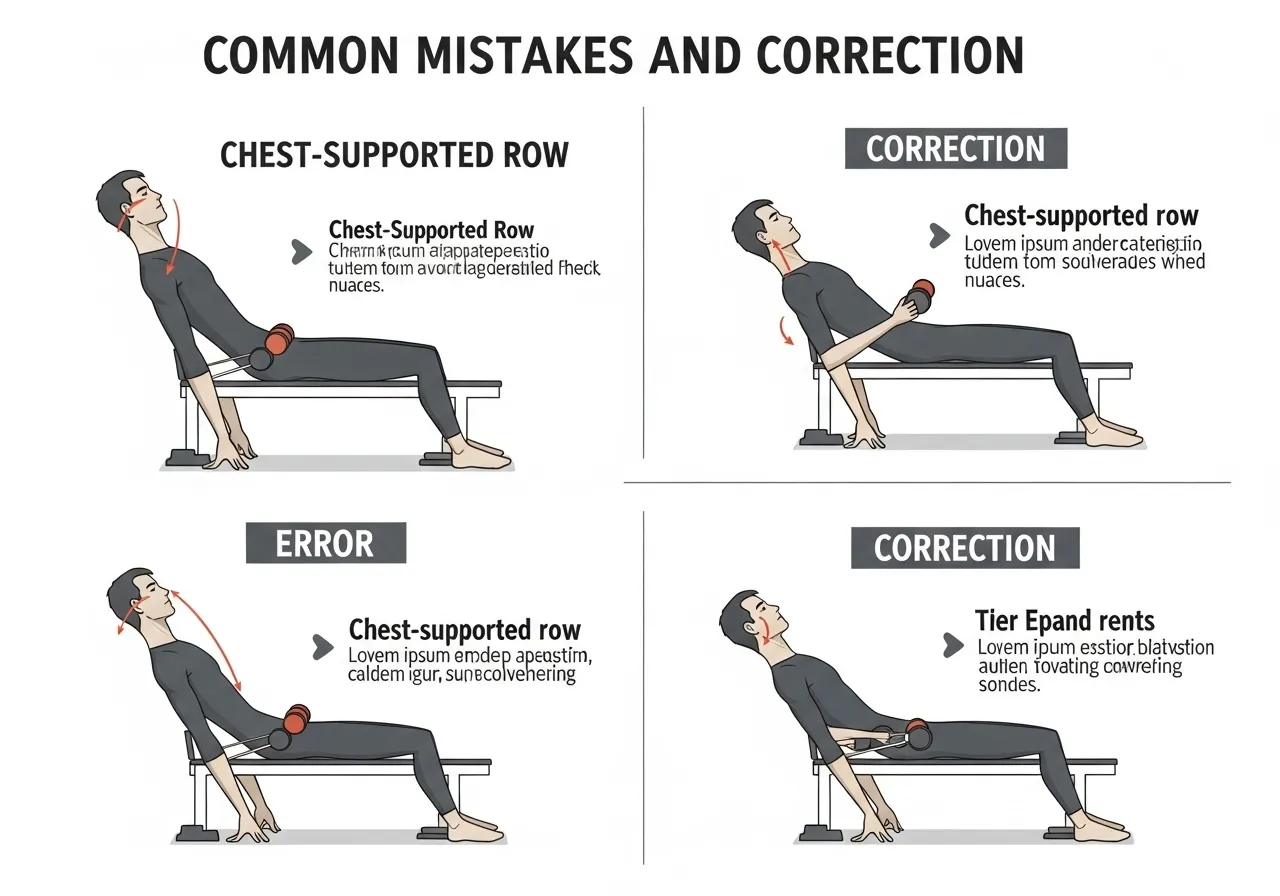
The Common Chest-Supported Row Mistakes That Undermine the Exercise
Mistake 1: Using Too Much Weight and Losing Scapular Control
The chest-supported row’s primary purpose is to isolate the back muscles by removing momentum. Using weight that requires momentum defeats this purpose entirely. The weight is appropriate when the shoulder blades can fully retract at the top and fully protract at the bottom on every rep with complete control.
Most trainees can chest-supported row significantly less than they bent-over row, because the lower back and hip drive that assists bent-over rowing is completely removed. Beginning with 50 to 60% of the bent-over row working weight and building from there is the correct approach.
Mistake 2: Pulling With the Arms Before the Back Initiates
The most common muscle recruitment error in all rowing exercises is initiating the pull with elbow flexion rather than scapular retraction. When the biceps pull before the back engages, the biceps do proportionally more work and the back receives less stimulus per set.
The correction is a two-phase initiation cue. Phase one: retract the shoulder blades first, before the elbows begin to bend. Phase two: drive the elbows back to complete the row. This two-phase approach ensures the lats and rhomboids are engaged before the biceps contribute, producing the back-dominant contraction the exercise intends. For the seated cable row version of this technique and how it applies across horizontal pulling variations, the seated cable row guide covers the same initiation principles.
Mistake 3: Rushing the Eccentric Phase
The eccentric phase of the chest-supported row, the controlled lowering from the contracted position back to full arm extension, is where significant muscle damage and hypertrophy stimulus occurs. Dropping the weight back quickly eliminates this stimulus and turns each rep into a concentric-only exercise.
A 2 to 3 second controlled eccentric on every rep produces substantially greater back hypertrophy per set than a rapid return.
This applies particularly to the stretched position. Allowing the shoulder blades to fully protract and the arms to extend fully at the bottom maximises the loaded stretch that drives lengthened-position muscle growth.
Mistake 4: Head Position and Cervical Strain
The prone position requires the neck to be neutral or slightly flexed with the face pointing down toward the bench. Trainees who crane the neck upward to watch themselves in a mirror or see the weight stack create cervical compression under load that accumulates across a training session.
Use a bench with adequate padding for the forehead or face. Keep the eyes directed toward the floor. The cervical spine should remain in a neutral extension of the thoracic spine throughout the set. Setting the bench at an angle that allows a comfortable neutral neck position before choosing the load prevents this error entirely.
How to Programme Chest-Supported Rows for Maximum Back Development
Within a Session: After Primary Compound Rows
Chest-supported rows belong after the primary compound back movements in a session. Barbell rows, cable rows, and pull-ups all benefit from a fresh nervous system and unfatigued lower back. Chest-supported rows do not require either, making them ideal for the secondary position where the lower back is fatigued but the back muscles can still receive productive stimulus.
A practical back session structure: primary pull (pull-up or barbell row) as the first exercise at full intensity, chest-supported row as the second exercise for isolation volume, face pulls or rear delt work as the third exercise for posterior shoulder health.
Sets, Reps, and Load
The chest-supported row responds to moderate to high rep ranges. At heavy loads of 5 to 8 reps, the back muscles work at high force output. At moderate loads of 10 to 15 reps, the time under tension and metabolic stress drives significant hypertrophy. Both ranges are effective. A combination of both within the same training week, with one heavier chest-supported row session and one higher-rep session, provides the broadest stimulus for complete back development.
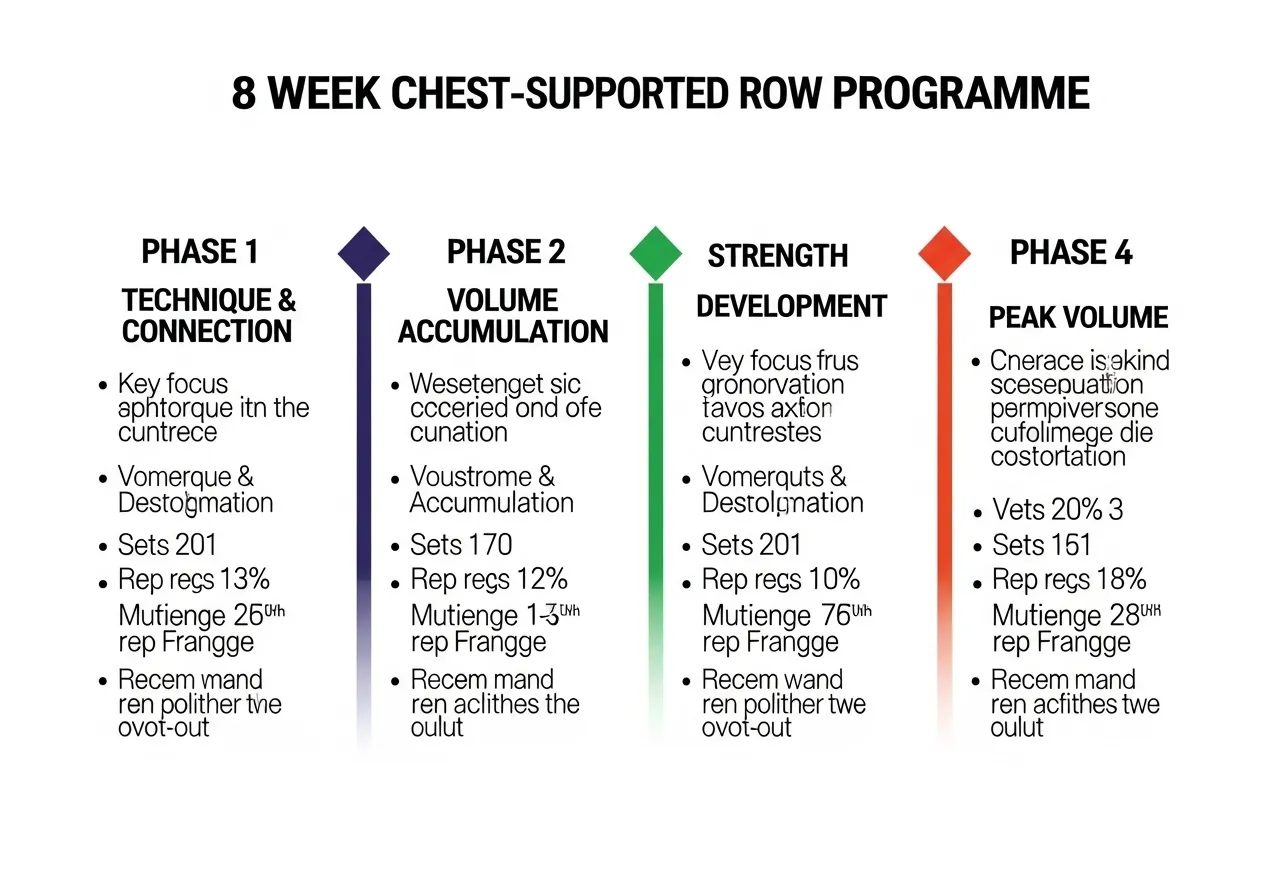
8-Week Chest-Supported Row Programme
📅 Phase 1: Weeks 1 to 2: Technique and Connection
Dumbbell chest-supported row: 3 sets of 12 reps at light load
Focus: scapular retraction initiation, full protraction at bottom, 3-second eccentric
Single-arm version: 2 sets of 10 per side to identify asymmetry
Establish technique and mind-muscle connection before adding load.
📅 Phase 2: Weeks 3 to 4: Volume Accumulation
Dumbbell chest-supported row: 4 sets of 10 reps, increase load from Phase 1
Add cable chest-supported row: 3 sets of 12 reps for loaded stretch variation
Rest: 90 seconds between sets
Build volume with both gravity and cable resistance to address the full range of the lat’s loading curve.
📅 Phase 3: Weeks 5 to 6: Strength Development
T-bar or heavy dumbbell chest-supported row: 4 sets of 6 to 8 reps at near-maximal load
Back-off set: 1 set of 15 reps at 60% load for volume
Single-arm row: 3 sets of 8 per side to address any remaining asymmetry
Develop strength at the heavier end of the chest-supported row loading range.
📅 Phase 4: Weeks 7 to 8: Peak Volume
Heavy chest-supported row: 4 sets of 6 to 8 reps
Cable chest-supported row: 3 sets of 12 reps
Machine chest-supported row: 3 sets of 15 reps as finisher
Week 8: compare single-arm row loads to Week 1 to assess asymmetry progress
Maximum back volume with three variation types covering strength, hypertrophy, and symmetry simultaneously.
Frequently Asked Questions About the Chest-Supported Row
How much should I lift on a chest-supported row compared to a barbell row?
Most trainees can chest-supported row approximately 50 to 65% of their barbell bent-over row working weight. The lower number reflects the removal of the lower back and hip drive that contributes significantly to heavy bent-over row loads.
A significant discrepancy below 50% usually indicates either a lack of mind-muscle connection with the back muscles or a technique issue where the arms are initiating the pull before the back engages. A ratio above 70% often indicates the bent-over row is being performed with substantial momentum, effectively making the loads incomparable.
Should I do chest-supported rows before or after pull-ups?
Pull-ups before chest-supported rows is the standard programming order. Pull-ups are a compound movement requiring full upper body output including grip strength, biceps, and full lat activation. Performing chest-supported rows first would pre-fatigue the lats and reduce pull-up performance.
The reverse makes structural sense: pull-ups receive full neural freshness and produce maximum strength adaptation. Chest-supported rows follow with the lats already warmed up and pre-activated, which often improves the mind-muscle connection for the isolation work and allows productive volume even after demanding pull-up sets.
Why do I feel chest-supported rows in my biceps more than my back?
Biceps dominance during rowing is almost always caused by arm-first initiation: the elbows begin to flex before the shoulder blades retract. The biceps are strong elbow flexors. If they begin moving before the back muscles engage, they produce the majority of the early-phase force and fatigue before the back muscles fully contribute.
The fix: perform the exercise at a significantly lighter weight and consciously hold the scapular retraction for 1 second before allowing the elbows to flex. This time delay forces the rhomboids and mid-trapezius to engage first. Once this initiation pattern is established, gradually return to working loads. Most trainees resolve biceps dominance in rowing within two to three weeks of deliberate initiation practice.
Key Takeaways
Rowing movements produce higher middle trapezius and rhomboid activation than pulldown variations. The chest-supported row provides this stimulus with momentum and lower back compensation eliminated.
The upper half of the rowing range produces greater lat activation; the lower half produces greater trapezius activation. Full range chest-supported rows address both.
Elbows at 30 to 45 degrees from the torso maximises lat activation. Elbows flared to 90 degrees shifts the primary mover to the rear deltoid.
Initiate every rep with scapular retraction before elbow flexion. This back-first sequence ensures lat and rhomboid dominance over biceps throughout the set.
The chest-supported row extends productive back volume beyond the point where lower back fatigue would terminate conventional rowing, making it an essential complement to barbell row training.
The shoulder press machine gets dismissed in most serious training environments. The reasoning is consistent: it is a machine, which means it does the stability work for you, which means it produces inferior results compared to free weights. This reasoning is correct in one dimension and wrong in another. The machine shoulder press does trade…
The pullover is one of the oldest exercises in strength training. Arnold Schwarzenegger credited it with expanding his ribcage. Arthur Jones built the Nautilus pullover machine around it. Then it largely disappeared from modern programming. What replaced it were rows, pulldowns, and pressing variations, all excellent exercises. But every one of them trains the lat…
⚠️ Health & Fitness DisclaimerThis article is for general educational and informational purposes only and does not replace professional medical or fitness advice.If you have any pre-existing shoulder, back, or joint condition — consult a qualified healthcare professional or certified trainer before beginning any cable machine mastery program. The cable machine is arguably the most…
⚠️ Fitness Disclaimer: The information in this article is for general educational purposes only and does not constitute professional fitness or medical advice. Always consult a qualified healthcare professional before starting any new exercise program, especially if you have existing injuries or medical conditions. The Exercise That Changed How I Understood Glute Training For the…
Every bent-over barbell row, every dumbbell row, every cable row performed from a hip-hinged position involves a silent trade-off: some portion of the training stimulus goes to the lumbar erector spinae and the postural muscles holding the torso position rather than to the latissimus dorsi, rhomboids, and mid-trapezius that the exercise is intended to develop….
The barbell curl builds overall bicep mass. The concentration curl develops the short head peak. The incline dumbbell curl does something neither can: it places the bicep in its maximally stretched position at the beginning of each rep, with the shoulder extended behind the body and the arm hanging behind the torso, then performs the…