Every bent-over barbell row, every dumbbell row, every cable row performed from a hip-hinged position involves a silent trade-off: some portion of the training stimulus goes to the lumbar erector spinae and the postural muscles holding the torso position rather than to the latissimus dorsi, rhomboids, and mid-trapezius that the exercise is intended to develop. This is not a flaw — it is the nature of compound free-weight rowing. The lower back co-activation is a real training stimulus that produces real adaptation.
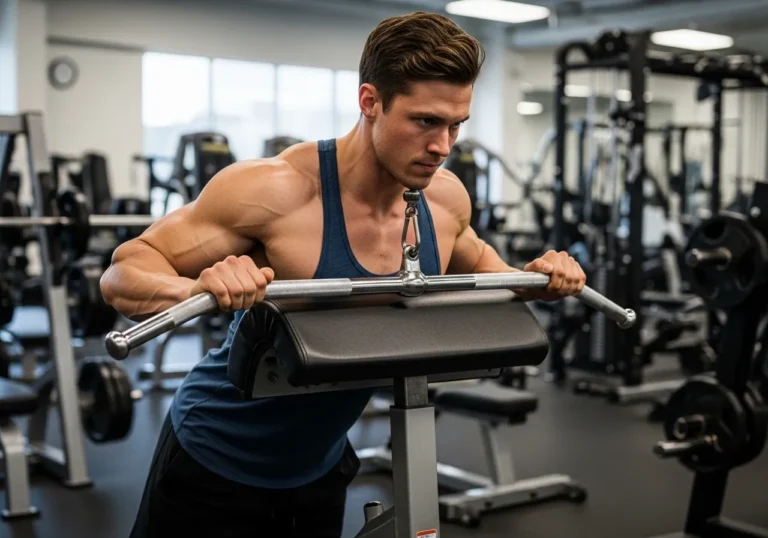
The chest-supported row removes this trade-off by supporting the torso against a pad or bench that takes over the postural stabilisation function. With the chest against a fixed surface, the erector spinae and postural musculature have no significant stabilisation demand. All of the available muscular effort goes to the horizontal pulling motion — and specifically to the muscles responsible for that motion. The result is an exercise that produces comparable latissimus dorsi and rhomboid activation to free-weight rows while significantly reducing erector spinae involvement and eliminating momentum and body english as mechanisms for moving the load.
This guide covers the research on supported versus unsupported rowing, what the chest-supported position changes mechanically, technique for the three main chest-supported row variations, common errors, programming for beginners through advanced trainees, and when the chest-supported row should be the primary rowing movement and when it should be supplementary.
Why Does the Chest-Supported Position Change Everything About How the Back Is Trained?
The Problem With Unsupported Rowing: What You Are Actually Training
An unsupported bent-over row at heavy loads is approximately equal parts back pulling exercise and lower back isometric endurance challenge. At 80 to 85% of maximum rowing strength, the lumbar erector spinae must sustain near-maximum isometric contraction to maintain the hip-hinged position throughout the set. As the set progresses and postural muscles fatigue, the torso begins to rise — reducing the hip flexion angle, shortening the moment arm at the lower back, and making the remaining reps easier not because the back pulling muscles have become stronger but because the postural demand reduces.
This postural fatigue-driven form breakdown means the later reps of a heavy bent-over row set are training a different mechanical stimulus than the earlier reps. Early reps are performed in the correct hip-hinged position with full horizontal pulling range. Late reps are performed in a progressively more upright position that is mechanically closer to a shrug than a row. The effective training range for the primary target muscles may be only the first several reps of each set, with the remainder representing a lower-back fatigue management effort rather than a back development stimulus.
How Chest Support Changes the Training Equation
The chest pad or bench in a supported row provides the same structural support that the erector spinae provides in an unsupported row — without fatiguing. The torso position is maintained mechanically through the external support, and this mechanical support does not fatigue across the set. Every rep of a chest-supported set is performed in the same torso position as the first rep. The set ends when the pulling muscles (lat, rhomboid, rear deltoid) are fatigued, not when the postural muscles can no longer maintain the hip-hinged position.
This consistent torso position across the full set means every rep provides the same horizontal pulling stimulus to the same muscles at the same joint angles. The training stimulus is cleaner, more consistent, and more directly targeted than the unsupported row’s degrading form trajectory. For hypertrophy purposes, more consistent mechanical stimulus across a full set produces more reliable and specific adaptation than a set where the primary challenge changes from back pulling to lower back endurance as the set progresses.
The Lumbar-Sensitive Training Argument
For trainees with lumbar disc pathology, sacroiliac joint dysfunction, or any lumbar-sensitive presentation that limits sustained hip-hinged loading, the chest-supported row provides a mechanism for maintaining back rowing volume without the sustained lumbar flexion and erector spinae loading that unsupported rowing demands. This is not a weakness-accommodating compromise but a rational exercise selection decision: developing back thickness through chest-supported rows while the lumbar tissue heals or manages its sensitivity.
📌 Key Finding
Scapular retraction, external rotation, and posterior tilt during rowing optimise glenohumeral alignment and force transmission. Consistent scapular position across all reps determines consistent muscle activation — a condition the chest-supported position enables by removing postural fatigue as a confounding variable.
Trunk Muscle Activity and Lower Back Pain in Rowing
📌 Key Finding
Erector spinae is a primary contributor to rowing at maximal effort. In chest-supported rowing, this erector spinae demand is eliminated by the external support — redirecting the available effort to the horizontal pulling muscles rather than the postural stabilisers.
Research: What the EMG Evidence Shows About Supported vs Unsupported Rowing
Comparing Rowing Variations: Trunk Activation and Lumbar Spine Load
📌 Key Finding
Supported rowing produces lower erector spinae activation than free-weight rowing. The support shifts effort from lumbar stabilisers to the pulling muscles — confirming that the chest-supported row’s primary advantage is exactly what its mechanical logic predicts: reduced lumbar demand, more pulling muscle stimulus per unit of effort.
Lat Activation: Does Support Compromise the Target Muscle?
The critical question for the chest-supported row’s usefulness is whether the removal of erector spinae demand comes at the cost of reduced latissimus dorsi activation. The available evidence suggests it does not. Research on rowing variations consistently finds comparable or higher latissimus dorsi EMG in supported conditions compared to free-weight rows at matched relative loads, because the elimination of postural fatigue allows the pulling muscles to perform more consistent work across the full set rather than having their effort partially diverted to resisting the torso’s collapse under postural fatigue.
The mechanism is effort conservation: in an unsupported row, the total available muscular effort is divided between postural stabilisation and horizontal pulling. When postural support is provided externally, the full effort is directed to horizontal pulling. At matched loads, the lat activation per rep is not reduced and may be increased in supported conditions, particularly in the later reps of a set where unsupported conditions produce progressive technique breakdown.
The Mind-Muscle Connection Advantage
A practical advantage of chest-supported rowing that the research on muscle activation corroborates is the improved mind-muscle connection that many trainees report. The chest-supported position eliminates the competing attentional demands of maintaining torso position and controlling momentum — demands that consume significant cognitive and neural resources during heavy bent-over rowing. With these demands removed by the external support, more neural attention is available for the intentional contraction and squeeze of the target muscles at the peak position, which research on resistance exercise suggests enhances motor unit recruitment specifically in the intended target muscles.
Volume Sustainability: Why Supported Rows Allow More Back-Specific Volume
Because chest-supported rows do not accumulate lumbar erector spinae fatigue during the set, back rowing volume can be extended through more sets, more reps, or both without the lower back fatigue limiting the total back development stimulus. An unsupported rowing programme that produces lower back fatigue after 4 sets of bent-over rows limits total back volume at that point regardless of whether the lat and rhomboid are adequately stimulated. A chest-supported rowing programme does not hit the same lower back fatigue ceiling, allowing the programme to continue accumulating back-specific stimulus until the pulling muscles themselves are the limiting factor.
The Seal Row: The Strictest Chest-Supported Variation
The seal row — performed lying completely prone on an elevated bench with both arms hanging freely below — represents the most strictly supported chest-supported row available. The entire body except the arms is supported, including the chest, abdomen, and legs. This support completely eliminates every postural variable from the rowing motion. The exercise is extremely isolating and produces a very different subjective experience from any standing or sitting row variation. Research comparing the seal row to bent-over barbell rows consistently finds lower erector spinae activity in the seal row at matched loads, confirming that the degree of external support directly determines the degree of lumbar demand reduction.
Beginner Level: Learning the Pulling Pattern Without Postural Confusion
Why Beginners Benefit Most From Chest Support
Beginners attempting bent-over barbell or dumbbell rows face two simultaneous learning challenges: establishing correct scapular retraction and horizontal pulling mechanics, and maintaining correct hip-hinged torso position under load. These two challenges compete for attention, and beginners typically sacrifice one for the other — usually sacrificing the pulling mechanics to maintain posture, or losing posture while trying to establish pulling mechanics. The chest-supported row removes the posture maintenance challenge entirely, allowing the beginner to focus all attention on establishing the elbow-driving, scapular-retracting pulling pattern that produces effective back development.
Setup: Set an adjustable bench to 30 to 45 degrees. Lie face-down with the chest against the pad and feet on the floor. Hold a dumbbell in each hand, arms hanging below the bench.
Execution: Row both dumbbells simultaneously by driving the elbows backward and upward, squeezing the shoulder blades together at the top. Lower under control. 3 sets of 12 to 15 reps at a load where the elbow-drive and scapular retraction can be felt clearly.
Why it works for beginners: The incline position provides complete torso support, the bilateral motion allows symmetrical development, and the free dumbbell grip allows natural wrist rotation that reduces elbow and wrist discomfort. The absence of posture maintenance demand allows 100% attention on the pulling mechanics.
Beginner Technique Cues
Three cues produce the correct chest-supported row mechanics for beginners. First, drive the elbows toward the ceiling rather than pulling the hands toward the shoulders — this elbow-drive cue engages the lat and posterior deltoid rather than the bicep as the primary mover. Second, squeeze the shoulder blades together at the top of each rep — this scapular retraction cue ensures the rhomboids and mid-trapezius complete their full contraction rather than stopping when the elbows reach a comfortable height. Third, allow the arms to fully extend at the bottom, reaching the dumbbells as far toward the floor as the shoulder flexibility allows — this full extension at the bottom provides the lat stretch that maximises the range of motion and the subsequent contraction range.
Common Beginner Errors on the Chest-Supported Row
Three errors are consistently observed in beginners using chest-supported rows. The first is using the arms rather than the back to pull, characterised by the elbows flaring wide rather than driving backward. The fix is to imagine pinching a pencil between the shoulder blades at the top of each rep. The second is incomplete range at the bottom — stopping the descent before the arms are fully extended because the hanging position feels uncomfortable. The fix is to deliberately allow the arms to hang fully extended between each rep, feeling the lat stretch before initiating the next pull. The third is a too-steep bench angle (over 60 degrees) that reduces the effective range of the pull by allowing the elbows to travel upward past the torso line. The fix is to keep the bench at 30 to 45 degrees.
Beginner Programming
Beginners should use chest-supported rows as the primary back rowing movement for their first 8 to 12 weeks of training, before introducing unsupported bent-over rows. This sequencing establishes the pulling mechanics, scapular control, and back awareness that unsupported rows then develop under the additional challenge of postural stability. Three to four sets of 12 to 15 reps, twice weekly, provides adequate stimulus for the learning phase. The barbell row technique and how it builds on the pulling mechanics developed in chest-supported rows is covered in the barbell row guide.
Intermediate Level: Load Progression and Variation Introduction
The Intermediate Challenge: Overloading Without Postural Cheating
Intermediate trainees have established pulling mechanics but may be using unsupported rows in a way that limits the back-specific stimulus by allowing progressive postural compromise as loads increase. The chest-supported row at the intermediate level serves two functions: as a heavier-loaded isolation movement that can be progressed beyond the beginner dumbbell version, and as a technique reset that periodically reinforces clean pulling mechanics that heavier unsupported work may be compromising.
Progressing to Heavier Supported Options
As beginner incline bench dumbbell rows become too light for the target rep ranges, several progressions provide greater loading without introducing unsupported instability. The chest-supported T-bar row allows significantly heavier loading than dumbbell versions while maintaining full chest support. The machine-supported row provides precise load selection in small increments that dumbbell jumps cannot replicate. The barbell incline row (barbell held under the incline bench in the seal row position) allows barbell loading in the fully supported prone position. Each of these progressions maintains the isolation advantage of the supported position while extending the load range available for progressive overload.
Adding Grip and Elbow Variations
Intermediate trainees benefit from varying grip orientation across chest-supported row sessions to develop different aspects of the upper back musculature. Pronated grip (palms down) emphasises the posterior deltoid and upper trapezius. Supinated grip (palms up) emphasises the lower lat. Neutral grip (palms facing each other) provides a balanced stimulus across the lat, rhomboid, and mid-trapezius. Elbow path also matters: elbows close to the body (adducted) targets the lower lat and teres major; elbows flared at 60 to 90 degrees from the torso targets the posterior deltoid and rhomboids.
Secondary row: Chest-supported T-bar or incline dumbbell 3 × 10 to 12 (isolation, volume)
Supplementary: Single-arm dumbbell row 3 × 12 per side (unilateral)
Optional: Chest-supported rear delt fly 3 × 15 (posterior deltoid)
This structure uses unsupported rowing for strength and progressive overload and chest-supported rowing for isolation volume, addressing both the strength and the specific upper back hypertrophy goals that each variation serves most effectively.
The Supported Row as a Technique Reset Tool
Every 4 to 6 weeks, replacing one unsupported rowing session with a chest-supported session at the same relative load recalibrates the pulling mechanics that heavy unsupported work tends to gradually compromise. The clean, momentum-free reps of the chest-supported session remind the neuromuscular system of the correct elbow path, scapular retraction completion, and full range extension that should characterise all rowing, supported and unsupported. Many intermediate trainees find their unsupported row quality improves after a supported reset session, producing better back activation in subsequent weeks of primary rowing work.
Progressive Overload for Supported Rows
Chest-supported rows respond to the same progressive overload principles as any other resistance exercise: increase load when the target rep range is achievable across all sets with maintained technique. Because postural fatigue does not limit sets, the load progression for chest-supported rows is more predictable and linear than for unsupported rows, where form breakdown creates a moving ceiling that makes load progression assessment ambiguous. Increase load by 2.5 to 5 kg (or the next available dumbbell increment) when all planned sets are completed with clean elbow drive and full scapular retraction. The T-bar row and how its supported positioning compares to chest-supported dumbbell rows for upper back development is covered in the T-bar row guide.
Advanced Level: Maximising Back Isolation and Volume
The Advanced Role of Chest-Supported Rows
Advanced trainees who have developed significant back strength through years of progressive rowing find chest-supported rows valuable as high-volume isolation movements that accumulate back-specific training stimulus without the systemic fatigue cost of equivalent unsupported rowing volume. A set of 15 to 20 reps on a chest-supported row machine produces significant lat and rhomboid hypertrophy stimulus with minimal erector spinae, hip, and postural fatigue. This fatigue economy allows advanced trainees to accumulate more total back volume within a training week than would be recoverable through unsupported rowing alone.
Advanced Intensity Techniques With Chest Support
The isolated, consistent mechanics of chest-supported rows make them particularly suited to advanced intensity techniques that would be unsafe or technically compromised in unsupported variations. Drop sets — reducing load immediately upon reaching failure and continuing — work effectively because the chest support ensures that form is maintained even as fatigue mounts and the trainee approaches true muscular failure in the lat and rhomboid rather than postural failure that unsupported rows produce first. Rest-pause sets — brief rest pauses of 15 to 20 seconds within a set to extend duration beyond initial failure — similarly produce clean mechanical stimulus in each pause-separated burst because the bench support maintains the consistent torso position throughout the extended set.
The Seal Row for Maximum Isolation
The seal row provides the highest degree of isolation available in standard gym equipment. Performed lying completely prone on an elevated bench with both dumbbells or a barbell hanging freely below, it removes every postural variable including chest contact pressure, foot position, and any residual hip or knee stabilisation demand. This total isolation produces a subjectively different experience from any other row variation — trainees who have performed heavy bent-over rows for years often report feeling the mid-back in completely new ways during their first seal row sessions, because muscles that were previously contributing primarily to posture maintenance are now exclusively contributing to the pulling motion.
Paused Reps at Peak Contraction
Adding a 2-second pause at the peak scapular retraction position of each rep transforms chest-supported rows from a movement exercise to a contraction-focused exercise with isometric overload at the most shortened position of the target muscles. The pause eliminates any momentum contribution to the peak contraction and forces the rhomboids and mid-trapezius to sustain maximum shortening under load for the pause duration. This technique is most productive in chest-supported rows rather than free-weight rows because the paused peak position can be held consistently without the torso rising or the moment arm changing between reps.
Combining Chest-Supported and Unsupported in Advanced Programming
Advanced trainees achieve their best back development by using unsupported rows for the strength-and-posterior-chain-endurance qualities that only unsupported loading provides and chest-supported rows for the isolation-and-hypertrophy qualities that only supported loading enables. The two variation types are complementary in a complete programme rather than alternatives. Unsupported rows build the overall posterior chain capacity; chest-supported rows develop the specific upper back thickness that posterior chain work alone leaves partially undertaxed. The single-arm dumbbell row and how its unilateral isolation compares to the chest-supported bilateral approach for upper back development is covered in the single-arm dumbbell row guide.
The 5 Chest-Supported Row Variations and What Each Develops
Choosing Based on Equipment and Goal
The five variations below cover the full range of chest-supported rowing from beginner-accessible to advanced-specific, each with distinct advantages in load capacity, muscle emphasis, and availability in standard gym settings. Rotating through these variations across training blocks prevents the accommodation that single-variation programming produces and develops the upper back from different angles and loading positions.
🏋️ 1. Incline Bench Dumbbell Row (Bilateral)
Target: Lat, rhomboid, mid-trapezius, rear deltoid; beginner to intermediate
How: Bench at 30 to 45 degrees, lying face-down, bilateral dumbbell row with neutral or pronated grip.
Best for: Universal starting point. Available in any gym. Allows natural wrist rotation and grip width adjustment for comfort.
🏋️ 2. Chest-Supported T-Bar Row
Target: Lat and mid-back with heavy barbell loading; intermediate to advanced
How: Use a chest-supported T-bar row machine. Chest against the angled pad, handles gripped at neutral or pronated position. Drive elbows back to full retraction.
Best for: Heaviest loading in the supported row category. The chest support and fixed movement plane allow significantly more weight than dumbbell versions. Best for primary strength development in the supported category.
🏋️ 3. Seal Row (Barbell or Dumbbell)
Target: Maximum mid-back isolation; intermediate to advanced
How: Lie completely prone on an elevated bench. Arms hang freely below. Row barbell or dumbbells from full extension to maximum scapular retraction.
Best for: Complete elimination of all postural demand. Best mind-muscle connection of any row variation for most trainees. Requires elevated bench setup.
🏋️ 4. Machine Chest-Supported Row
Target: Lat and mid-back with precise load increments; all levels
How: Standard machine row with chest pad. Adjust seat height so arms pull horizontally. Drive elbows back to full retraction.
Best for: Volume and hypertrophy work with easy load selection. The machine’s fixed movement path is less demand for learning than free-weight variations. Ideal for high-rep drop sets and extended techniques.
🏋️ 5. Chest-Supported Cable Row
Target: Lat and mid-back with constant cable tension; intermediate to advanced
How: Position an incline bench beside a low cable pulley. Lie face-down on the bench and row the cable handle with both hands, maintaining chest contact throughout.
Best for: Cable’s constant tension through full range combined with chest support isolation. The loaded stretch at bottom and peak contraction at top that cable loading provides, combined with the isolation of chest support, addresses range limitations of both gravity-dependent dumbbell rows and machine rows simultaneously.
Common Errors and How to Fix Them
Why Supported Rows Still Have Technique Problems
The chest-supported row eliminates the postural variables of unsupported rowing but introduces its own set of technique errors that reduce its isolation effectiveness. These errors are different from unsupported row errors: they involve using the support incorrectly, substituting other movement patterns for the intended pulling mechanics, or misusing the exercise’s isolation advantage by not achieving the full range of motion that the support enables.
❌ Error 1: Pulling Away From the Bench at the Top
What happens: As the elbows reach their highest point, the upper body lifts away from the bench, turning the chest-supported row into a brief unsupported row at the top of each rep.
Fix: Keep the chest in contact with the pad or bench throughout the entire rep, including at peak contraction. The chest-pad contact is the defining feature of the exercise. Losing it at the top converts the last portion of each rep into an unsupported movement.
❌ Error 2: Not Completing Full Scapular Retraction at the Top
What happens: The elbows pull back to approximately the level of the torso but the shoulder blades do not complete full retraction. The rhomboids and mid-trapezius reach only partial shortening rather than maximum contraction.
Fix: After driving the elbows back, add a deliberate squeeze of the shoulder blades at the top of each rep, holding 1 second. The shoulder blades should feel like they are trying to touch each other. This intentional retraction completion is the specific target that makes the chest-supported row effective for mid-back thickness.
❌ Error 3: Stopping Short of Full Extension at the Bottom
What happens: The weights are lowered only to 90 degrees of elbow flexion rather than full arm extension. The lat and rhomboid do not receive the full stretched position loading that the chest-supported position enables by allowing the arms to extend further below the torso than in a standing or seated row.
Fix: Lower until the arms are fully extended and the shoulder protracts forward against the chest pad. This is the full range that the chest-supported position enables and that standing rows cannot achieve. The stretch at the bottom is the unique range of motion advantage of the prone position.
❌ Error 4: Using Momentum by Swinging the Arms
What happens: Despite the chest support removing lower back momentum, some trainees introduce arm swing by using the arm extensors to push the weight down before curling it back up, creating momentum that reduces the pulling demand on the back.
Fix: Pause at the bottom of each rep for 1 second, ensuring the arms and weights are at rest before initiating the next concentric pull. This dead-stop technique eliminates arm swing momentum and forces each rep to begin from a static starting position that purely demands back pulling to initiate.
Setting Up the Bench Angle Correctly
The bench angle in incline chest-supported dumbbell rows determines the effective pulling direction and the extent of lat versus posterior deltoid emphasis. A bench angle of 30 to 45 degrees produces an approximately horizontal pull at the shoulder, emphasising the lat and mid-trapezius. A steeper angle of 60 degrees shifts the pull to a more vertical direction, emphasising the posterior deltoid and rhomboids at the expense of lat involvement. Most trainees benefit most from the 30 to 45 degree range that produces the horizontal pull closest to the lat’s primary movement function.
Frequently Asked Questions About the Chest-Supported Row
Is the chest-supported row better than the bent-over barbell row for building a thick back?
Neither is universally better. They develop different qualities that a complete back programme needs both to address. The bent-over barbell row develops posterior chain strength, lower back endurance, and hip hinge stability alongside horizontal pulling strength. The chest-supported row develops pure horizontal pulling hypertrophy without the lumbar and postural co-activation that limits how specifically the back pulling muscles can be targeted in unsupported variations.
The complete back development programme uses both: unsupported rows for strength, posterior chain development, and functional carryover; chest-supported rows for isolation volume, specific upper back hypertrophy, and the ability to accumulate back-specific stimulus without lower back fatigue limiting total volume. Trainees who want maximum back thickness over years of training need both the general strength that unsupported rows build and the specific isolation that supported rows provide.
Can I use the chest-supported row as my only rowing exercise?
Yes, and there are specific circumstances where this is the appropriate choice. Trainees with lumbar sensitivity that limits unsupported rowing volume, beginners learning pulling mechanics before adding postural challenge, and trainees whose lower back is already adequately developed through deadlift and squat work can use chest-supported rows as their primary back rowing movement without meaningful compromise to back development goals.
The trade-off is the loss of the lumbar endurance and hip hinge strength development that unsupported rows provide. For trainees whose primary goal is pure upper back thickness rather than overall posterior chain strength, this trade-off is acceptable. For trainees whose sport or training goals include lumbar strength and hip hinge performance, the unsupported row’s contribution should be maintained alongside supported work.
How much weight should I use for chest-supported rows?
Most trainees find their chest-supported row working weight is 15 to 25% lower than their unsupported bent-over dumbbell row at the same rep range, because the elimination of momentum and postural assistance means the pulling muscles must produce all the force independently. This is not a limitation but an accurate indicator: if the chest-supported row feels easy at the unsupported row weight, either the technique contains one of the errors described above or the unsupported row relies more on momentum and postural assistance than realised.
Is the seal row actually worth setting up if I have a regular incline bench?
The seal row requires elevating the bench on stable blocks or using a purpose-built elevated surface so the arms can hang fully extended below the bench without reaching the floor. This setup effort is worth it for advanced trainees who have plateaued with incline bench supported rows, because the complete prone support produces noticeably different mid-back activation that most trainees describe as their first genuine rhomboid and mid-trapezius training sensation rather than the predominantly lat and posterior deltoid experience of angled variations. The setup investment of 2 to 3 minutes is justified once or twice per week for the isolation quality it provides.
Should I use straps for chest-supported rows?
Straps are appropriate for chest-supported rows when the goal is maximum back isolation and grip is the limiting factor. In the supported position, the back muscles can typically sustain more total volume than the grip can maintain at the same weight. Using straps removes grip as the limiting variable, allowing the lat and rhomboid to be taken to genuine muscular fatigue rather than stopping when grip fails. For trainees who are specifically developing grip strength alongside back strength, avoiding straps maintains the grip training stimulus. For trainees using chest-supported rows primarily for back hypertrophy, straps are a practical tool that extends effective set duration.
Key Takeaways
Supported rowing produces lower erector spinae activation than free-weight rowing while maintaining comparable or higher latissimus dorsi activation. The chest support redirects effort from postural stabilisation to horizontal pulling.
Consistent scapular retraction across all repetitions is the primary mechanical determinant of upper back muscle activation in rowing. The chest-supported position enables this consistency by removing postural fatigue as a confounding variable.
Chest-supported rows allow more back-specific training volume than unsupported rows because they do not accumulate lower back fatigue that limits total set count before the primary target muscles are adequately stimulated.
The five variations (incline bench dumbbell, chest-supported T-bar, seal row, machine, cable) cover all training levels and equipment contexts. The bench angle (30 to 45 degrees) determines the primary muscle emphasis from lat-dominant to posterior deltoid-dominant.
Chest-supported rows complement rather than replace unsupported rows in a complete back programme. Unsupported rows for posterior chain strength and functional carryover; supported rows for isolation volume and specific upper back hypertrophy.
⚠️ Health & Fitness DisclaimerThis article is for general educational purposes only. It does not replace professional medical advice. If you have shoulder, elbow, or wrist conditions, consult a qualified healthcare professional before starting any pressing programme. The flat dumbbell vs barbell bench builds the chest. Everyone knows this. (see also: bench press fixes) (see…
⚠️ Fitness Disclaimer: The information in this article is for general educational purposes only and does not constitute professional fitness or medical advice. Always consult a qualified healthcare professional before starting any new exercise program, especially if you have existing injuries or medical conditions. The Exercise That Changed How I Understood Glute Training For the…
The barbell row is the standard back thickness exercise. It allows heavy loading, trains the entire posterior chain, and has decades of proven effectiveness. Most serious lifters include it and most serious lifters plateau with it eventually. The plateau often has a simple mechanical explanation: the pronated (overhand) grip and horizontal torso position of the…
The straight barbell curl is the classic bicep exercise. Most programmes include it, most beginners start with it, and most experienced trainees return to it as their primary loaded curl movement. It also produces wrist and forearm discomfort in a significant proportion of trainees, particularly those who have had wrist injuries, naturally have limited forearm…
The shoulder press machine gets dismissed in most serious training environments. The reasoning is consistent: it is a machine, which means it does the stability work for you, which means it produces inferior results compared to free weights. This reasoning is correct in one dimension and wrong in another. The machine shoulder press does trade…
⚠️ Fitness Disclaimer: The information in this article is for general educational purposes only and does not constitute professional fitness or medical advice. Always consult a qualified healthcare professional before starting any new exercise program, especially if you have existing injuries or medical conditions. The Lat Pulldown: The Most Underestimated Back Builder in the Gym…