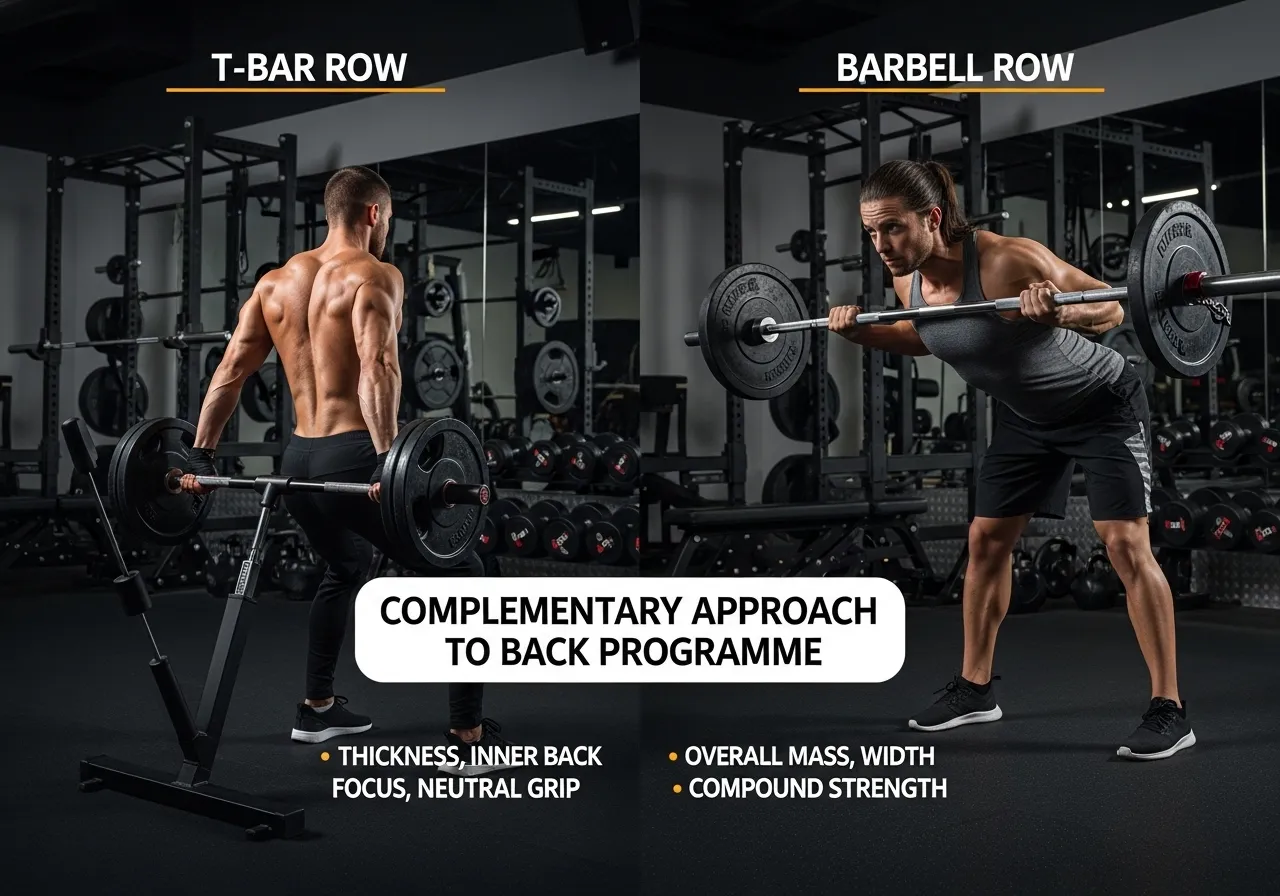
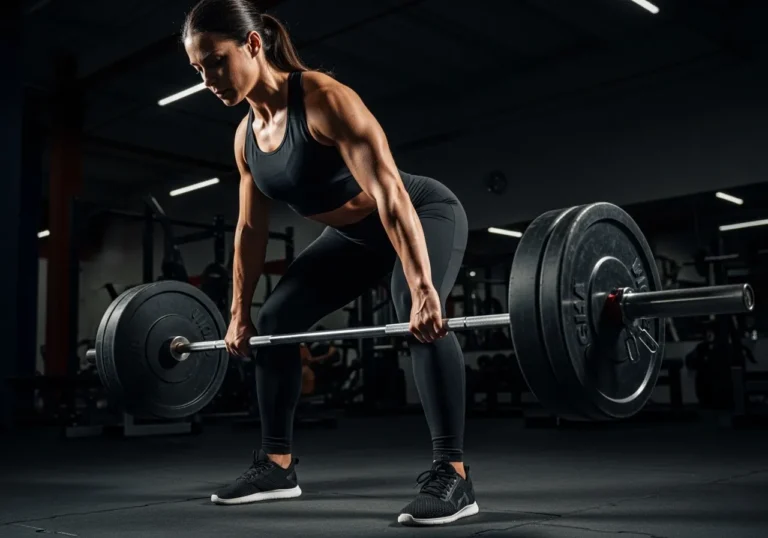
The barbell row is the standard back thickness exercise. It allows heavy loading, trains the entire posterior chain, and has decades of proven effectiveness. Most serious lifters include it and most serious lifters plateau with it eventually.
The plateau often has a simple mechanical explanation: the pronated (overhand) grip and horizontal torso position of the barbell row consistently limits range of motion at the elbow and shoulder in a way that prevents full scapular retraction at the peak contraction. The bar reaches the torso but the elbows and shoulder blades stop short of the position where the mid-back musculature achieves maximum shortening.
The T-bar row addresses this through its neutral grip and the slight torso angle that allows the elbows to travel further back and the scapulae to retract more completely. The result is a rowing variation that reaches a different end-range position than the barbell row, producing a stimulus that complements rather than duplicates what barbell rowing already provides. This guide covers the EMG research on grip position and rowing muscle activation, the specific mechanical advantages of the T-bar setup, technique for four variations, and how to programme the T-bar row within a complete back development block.
The Neutral Grip Advantage: What the Research Shows About Grip Position and Back Activation
How Grip Orientation Changes Which Muscles Dominate
📌 Key Finding
Grip orientation does not significantly change latissimus dorsi recruitment but meaningfully changes posterior deltoid activation. The neutral grip’s primary advantage in T-bar rowing is mechanical, allowing greater elbow travel and scapular retraction range rather than producing categorically different muscle activation at the same joint positions.
Rowing Variation Effects on Trunk Muscle Activation and Spinal Loading
📌 Key Finding
Different rowing exercises produce distinct trunk activation and spinal loading profiles. Row variation selection is not biomechanically interchangeable, which means using multiple rowing variations within a programme produces genuinely different stimuli rather than simply adding redundant volume to the same movement pattern.
Grip Position Effects on Seated Row Force Production
📌 Key Finding
Grip position in rowing exercises changes both force production and muscle activation emphasis across the lat, biceps, posterior deltoid, and trapezius. The neutral grip typically allows greater peak force than pronated grip in rowing movements because the forearm is in its mechanically strongest position for elbow flexion.
Why the T-Bar Row Develops Thickness That Barbell Rows Struggle to Match
The Elbow Travel Advantage
Back thickness, the depth of musculature visible from the side and from behind, depends primarily on mid-back development: the rhomboids, middle and lower trapezius, and the thick central portion of the latissimus dorsi. These muscles achieve their greatest contraction when the scapulae are fully retracted, which requires the elbows to travel maximally behind the torso plane.
In a barbell row with a pronated grip, the bar’s contact with the torso terminates the range of motion before the elbows reach their maximum possible travel. The bar physically prevents further movement. The T-bar row’s neutral grip handles extend through the torso gap rather than contacting the chest or abdomen, allowing the elbows to travel 5 to 10 centimetres further back than the barbell row permits. This additional elbow travel corresponds to deeper scapular retraction and greater shortening of the rhomboids and mid-trapezius at the peak contraction.
The Torso Angle and Its Effect on Load Distribution
Standard T-bar rows are performed with the torso at approximately 45 degrees from horizontal, compared to the 30 to 35 degrees typical of the barbell bent-over row. This steeper angle shifts the load vector slightly more vertically, reducing the shear force on the lumbar spine relative to the more horizontal barbell row position. For trainees managing lower back fatigue from heavy conventional deadlifting and squatting, the T-bar row’s less demanding spinal position allows more total rowing volume without accumulating lower back fatigue that compromises subsequent training sessions.
The chest-supported T-bar row, performed lying face-down on an angled pad, eliminates the lumbar demand entirely by taking the spine out of the loading equation. This completely isolates the mid-back musculature without any erector spinae endurance requirement, making it particularly valuable for trainees whose lower back fatigue limits their rowing volume before their back musculature is fully trained. The chest-supported rowing mechanics and how they compare to free-standing row variations is covered in the chest-supported row guide.
The Bilateral Load and Its Practical Advantage
The T-bar row’s bilateral handle setup allows higher absolute loads than single-arm dumbbell rows or unilateral cable rows because both arms work simultaneously and the supported torso position does not require single-arm stabilisation. This bilateral loading means the T-bar row can be progressively overloaded at rates similar to the barbell row, producing the mechanical tension through consistent progressive overload that drives hypertrophy across training blocks. For trainees whose single-arm dumbbell rows have plateaued because the working weight has exceeded what can be safely stabilised in the bent-over position, the T-bar row provides a bilaterally stable alternative that continues the loading progression.
T-Bar Row Technique: Setup and the Details That Determine Whether the Mid-Back or Biceps Dominate
⚠️ Lower Back and Shoulder Safety Note The free-standing T-bar row places the lumbar spine under significant compressive and shear load in the bent-over position, especially as weight increases. Individuals with active lumbar disc pathology, acute lower back pain, or recent lumbar surgery should use the chest-supported variation exclusively until cleared for free-standing loading. The torso must maintain a neutral spine throughout every rep. Any rounding of the thoracic or lumbar spine under load converts the exercise into a spinal flexion exercise rather than a back rowing exercise.
Setup: Foot Position, Bar Loading, and Grip Selection
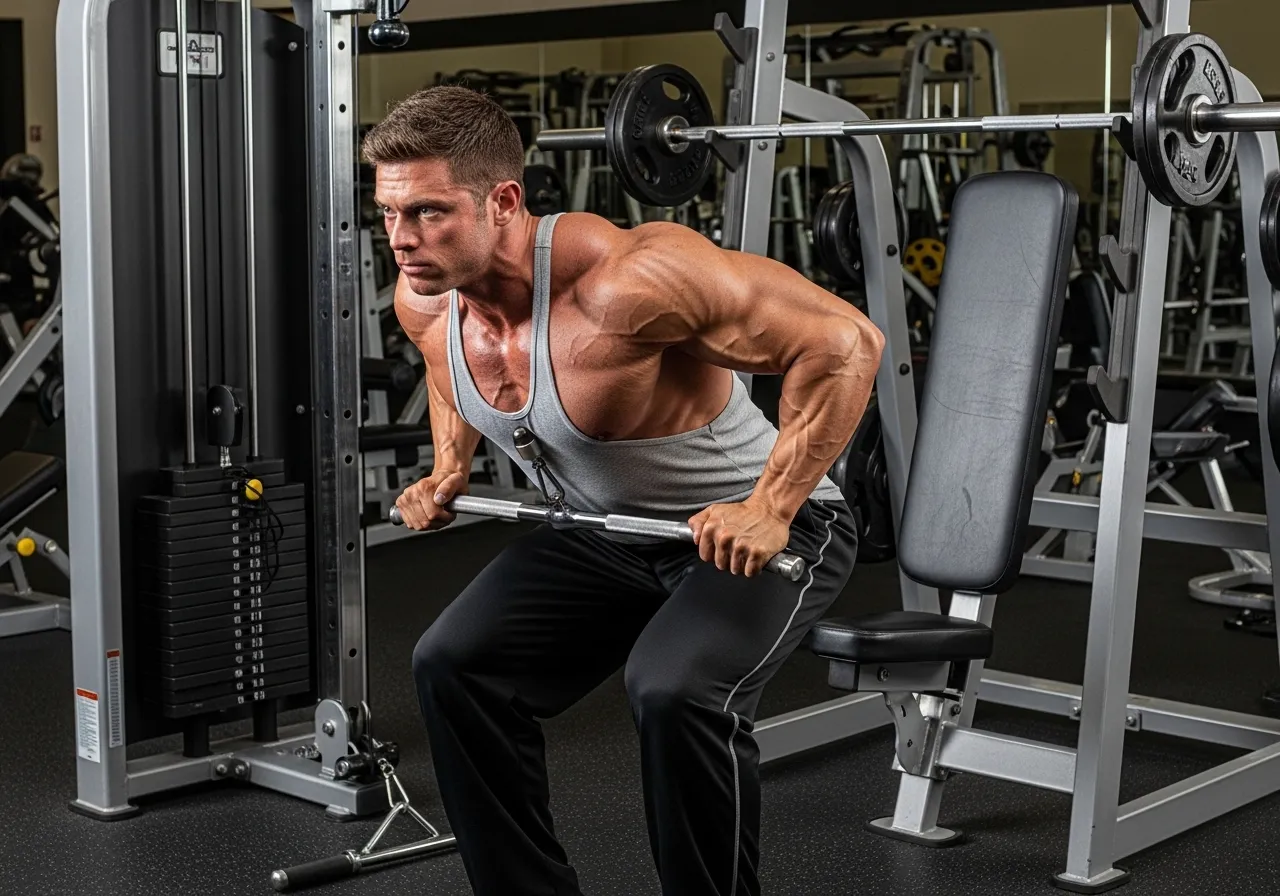
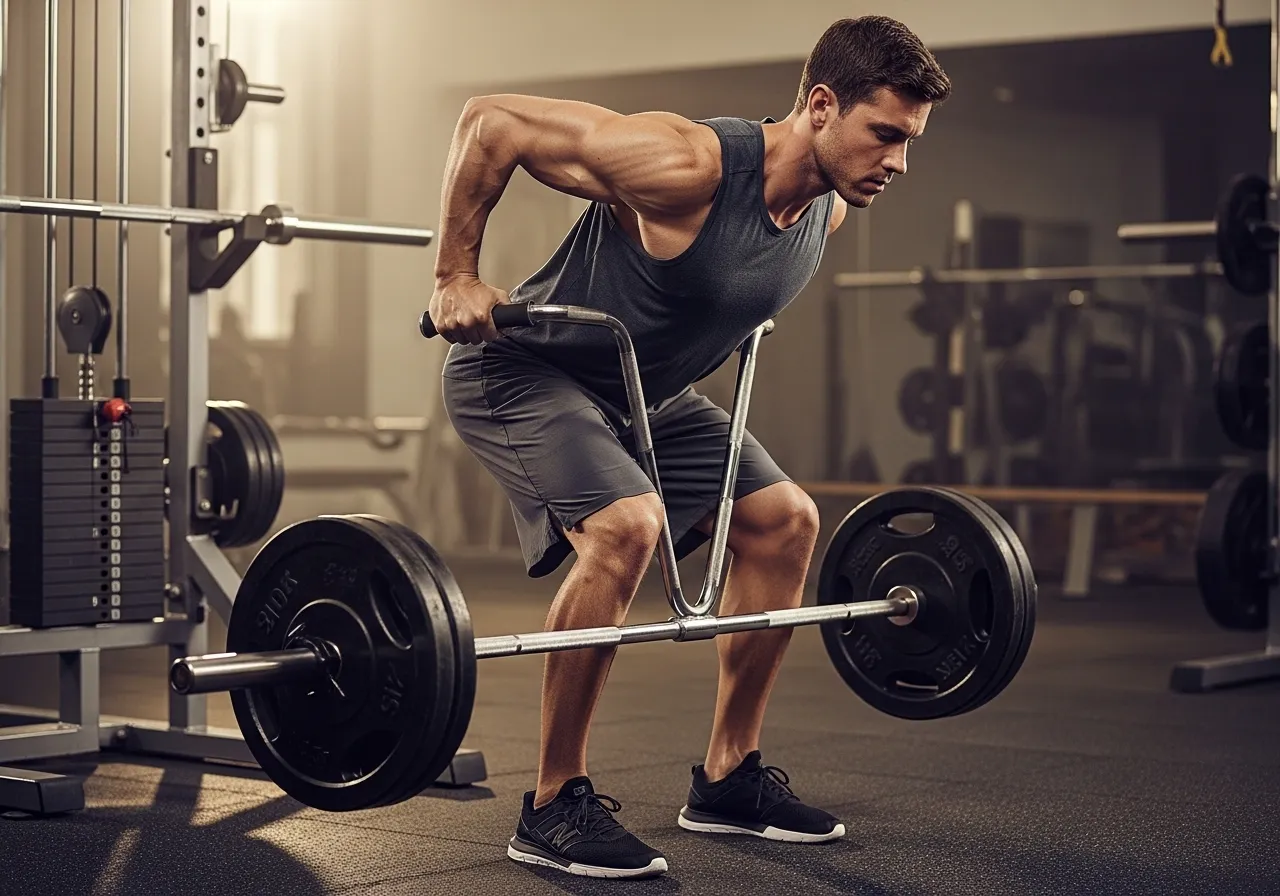
Straddle the T-bar with feet slightly wider than shoulder width on either side of the bar. Stand close enough to the handle that the arms hang vertically when holding it, not reaching forward. The loaded end of the bar should be directly below the chest at the bottom position of the row, not in front of the feet. Grip the neutral handles with both hands, pulling the shoulder blades back and down before initiating any pull. This scapular pre-set prevents the row from beginning as a shrug and ensures the initial drive comes from the mid-back rather than the upper trapezius.
Most commercial T-bar row stations use a V-handle (close neutral grip) or a wider neutral handle. The V-handle produces a narrower elbow path that emphasises the lower lat and rhomboids through a more vertical elbow travel. The wider neutral handle allows greater elbow flare, shifting emphasis slightly toward the posterior deltoid and mid-trapezius. Both are effective. The choice depends on whether the trainee’s priority is lower lat thickness or mid-back width development.
The Pull: Initiating With the Elbows, Not the Biceps
The most common T-bar row error is initiating the pull with elbow flexion rather than scapular retraction. When the biceps lead the movement, the shoulder blades remain relatively stationary while the elbows bend, producing a strong bicep stimulus and a weak mid-back stimulus. The target muscles, the rhomboids and mid-trapezius, barely shorten before the biceps reach their range limitation and terminate the rep.
The correct initiation sequence: begin with a deliberate scapular retraction, driving the elbows back and the shoulder blades toward each other before the elbows significantly flex. The elbows flex as a consequence of the scapular retraction rather than as the primary driver. This sequence is the same cue that applies to all rowing movements and is most easily learned by thinking of the hands as hooks that transfer the pulling force from the back to the bar, not as the primary source of the pulling force.
The End Position: Full Scapular Retraction
At the top of the T-bar row, the elbows should be behind the torso with the scapulae fully retracted and slightly depressed. A 1-second hold at this position forces the mid-back to maintain maximal contraction and prevents the habit of bouncing at the top that allows the weight to control the rep rather than the other way around. The chest should be as close to the T-bar station pad as possible. If the chest is far from the pad at the top, the scapulae are not fully retracting and the range of motion is incomplete.
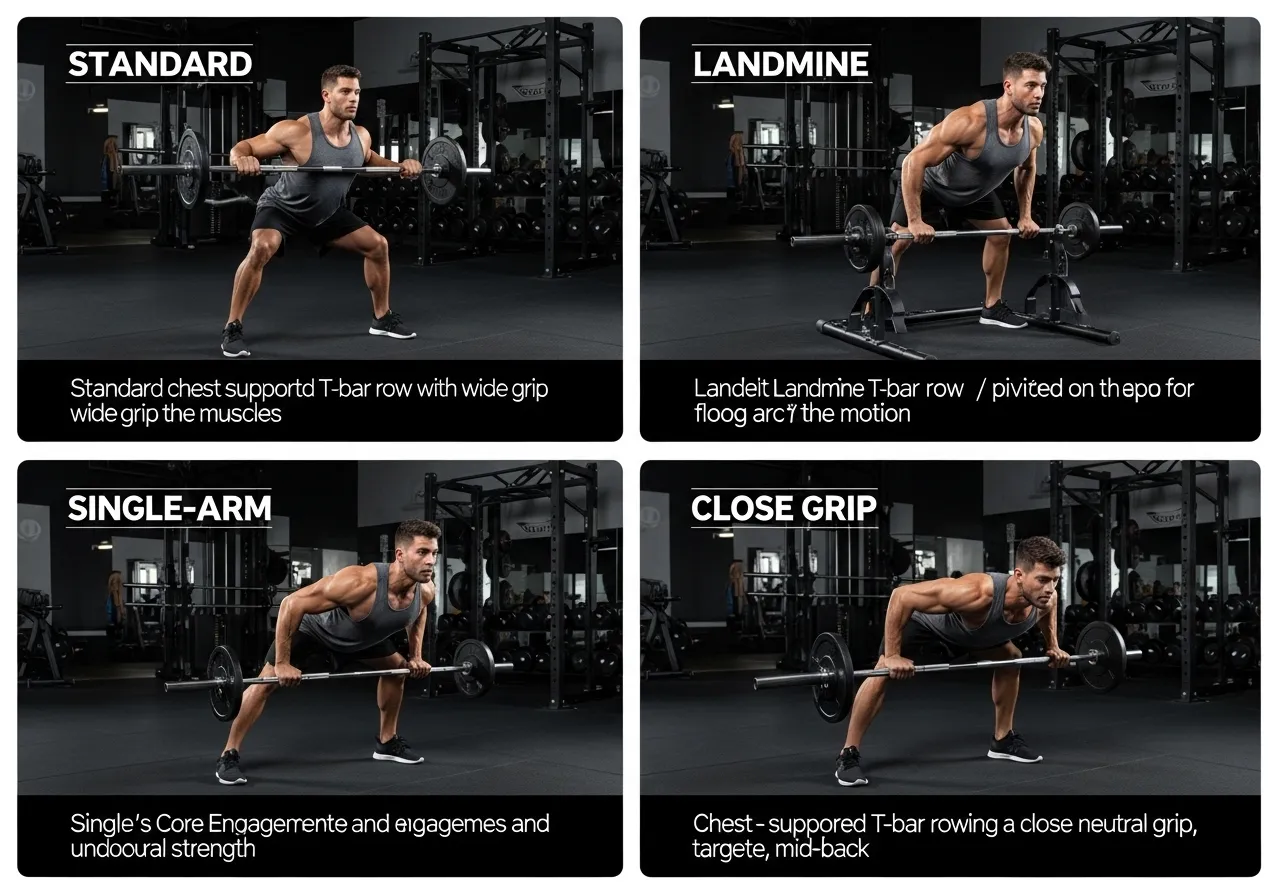
4 T-Bar Row Variations and When to Use Each
🏋️ 1. Standard T-Bar Row (Standing, Plate-Loaded)
Target: Rhomboids, mid-trapezius, lower lat, erector spinae endurance
How: Straddle the bar, neutral grip handles, torso at 45 degrees. Pull to lower chest with full scapular retraction. 1-second hold at top. Lower under control to full arm extension.
Best for: Primary heavy T-bar rowing for back thickness development. Use as the main rowing movement in a training block or as a secondary rowing movement after barbell rows.
🏋️ 2. Chest-Supported T-Bar Row
Target: Rhomboids, mid-trapezius, lower lat with pure mid-back isolation and no spinal load
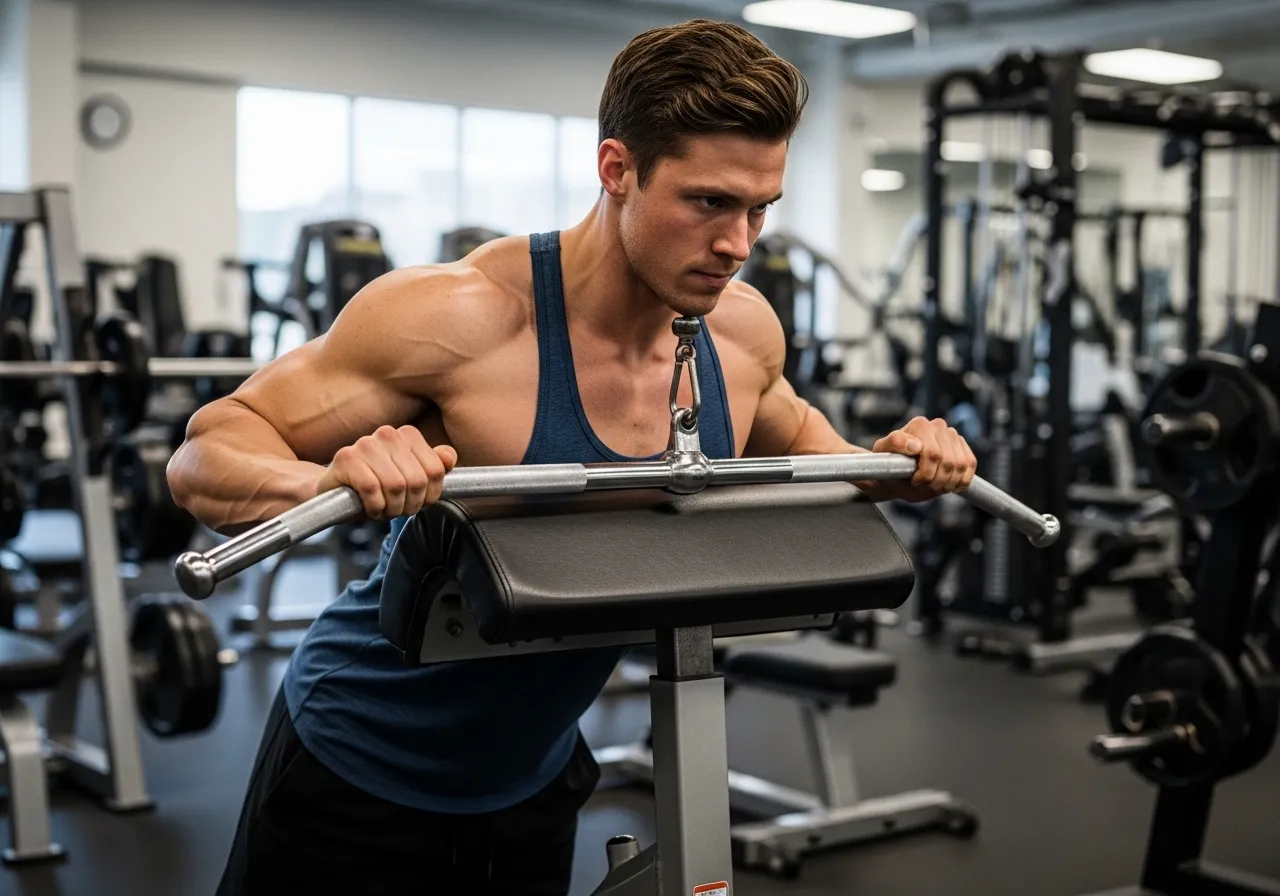
How: Lie face-down on the T-bar station’s angled chest pad. Grip the handles with the chest resting on the pad throughout. Row with full scapular retraction. The back has no stabilisation role. Only the rowing muscles work.
Best for: Trainees with lower back sensitivity, as a volume accumulation exercise after heavier free-standing rowing, and for any trainee who needs to separate back thickness stimulus from erector spinae fatigue.
🏋️ 3. Landmine T-Bar Row (Barbell in Corner)
Target: Same mid-back muscles plus greater freedom in torso position
How: Wedge one end of a barbell in a corner or landmine attachment. Load the opposite end. Straddle and row with a V-handle attachment around the bar or both hands clasped around the bar. This is the original T-bar row used before dedicated T-bar stations existed.
Best for: Trainees without a dedicated T-bar row station, home gym training, and situations where the barbell row needs a variation with more grip options.
🏋️ 4. Single-Arm T-Bar Row
Target: Unilateral mid-back with rotation, asymmetry identification
How: Use one hand on the T-bar handle with the opposite hand on the station frame for balance. Row with the working arm only. The single-arm position allows slight thoracic rotation at the top, increasing scapular retraction range on the working side. Perform all reps on one side before switching.
Best for: Identifying and addressing strength asymmetries between sides, adding thoracic rotation to the row pattern, and providing a unilateral stimulus that bilateral T-bar rowing cannot deliver. The lat pulldown grip variations and how they compare to rowing for complete back development is covered in the lat pulldown guide.
How Does the T-Bar Row Compare to the Barbell Row, and Do You Need Both?
What the Barbell Row Provides That T-Bar Rowing Does Not
The barbell row with a pronated grip produces greater posterior deltoid activation than the neutral grip T-bar row, and the more horizontal torso angle of the standard barbell row places greater demand on the erector spinae as a stabiliser. For trainees who want to develop both mid-back thickness and spinal erector endurance simultaneously, the barbell row achieves both goals in a single exercise. The barbell row is also the most directly specific rowing movement for powerlifting and strength sport preparation, where the barbell-specific grip and torso position has direct carry-over to competition movements.
The barbell row also allows slightly heavier absolute loading than the T-bar row for most trainees because the barbell can be loaded without the handle and station constraints of a T-bar setup, and the familiar barbell grip is typically stronger for most lifters than the neutral handle of the T-bar station. The complete barbell row technique, EMG research, and programming is covered in the barbell row guide.
What T-Bar Rowing Provides That Barbell Rowing Does Not
The T-bar row provides greater end-range scapular retraction through its neutral grip and the elbow travel that the handle design permits. It also reduces lower back spinal shear force relative to the barbell row, allowing higher rowing volume for trainees whose lower back fatigue limits their barbell row frequency. The chest-supported variation completely eliminates the spinal loading variable, providing a pure mid-back hypertrophy stimulus without any erector spinae fatigue cost.
For trainees whose back thickness development has plateaued with barbell rowing, adding T-bar rows as a secondary rowing movement introduces a genuinely different stimulus rather than simply adding more of the same movement. The scapular retraction advantage at end range produces a distinct hypertrophy stimulus in the rhomboids and mid-trapezius that barbell rowing’s range limitation consistently undertaxes.
The Practical Answer: Complementary, Not Competing
The most effective back development programmes for intermediate and advanced trainees include both barbell rowing and T-bar rowing rather than choosing between them. Barbell rows as the primary heavy rowing movement, followed by chest-supported T-bar rows for back-specific volume accumulation without additional spinal fatigue, provides both the heavy bilateral rowing stimulus and the end-range mid-back contraction that produces back thickness. This combination addresses what neither exercise alone can provide as completely.
T-Bar Row Programming: Load, Volume, and Session Placement
Where T-Bar Rows Fit in a Back Session
T-bar rows occupy the same programming position as barbell rows: a primary or secondary heavy rowing movement early in the session when the back musculature is fresh. If both barbell rows and T-bar rows appear in the same session, perform the barbell row first because it requires greater total body tension and spinal stabilisation effort. The T-bar row, particularly the chest-supported variation, can then follow as a higher-volume secondary movement without the progressive fatigue concern that attending to spinal position in the free-standing barbell row creates.
Load Selection and Rep Ranges
T-bar rows respond to both strength-focused rep ranges (4 to 6 reps, heavier loads) and hypertrophy-focused ranges (8 to 12 reps, moderate loads). The chest-supported variation is best used in hypertrophy rep ranges (10 to 15 reps) where the sustained mid-back contraction and the 1-second peak hold produce sufficient metabolic and mechanical tension without the spinal load concerns that make very heavy loads inappropriate on a pad-supported setup.
A practical starting load: most trainees T-bar row approximately 60 to 75% of their barbell row working weight on the first session, with the load increasing across weeks as the neutral grip and elbow travel pattern become familiar. The load disparity reflects the different mechanical efficiency of the two setups rather than a weakness difference.
8-Week T-Bar Row Programme
📅 Phase 1: Weeks 1 to 3: Pattern and Scapular Control
Chest-supported T-bar row: 3 sets of 12 reps, moderate load, 1-second peak hold
Focus: scapular retraction initiation, elbow travel behind torso plane, chest contact with pad at top
Superset option: pair with lat pulldowns to develop both thickness and width simultaneously
Starting with the chest-supported variation removes lower back variables and allows full attention to scapular mechanics. The pattern established here transfers directly to the free-standing variation in Phase 2.
📅 Phase 2: Weeks 4 to 6: Load Development
Standard T-bar row: 4 sets of 8 reps, increase load weekly by 5 kg
Chest-supported T-bar row: 3 sets of 12 reps as volume finisher
Identify any asymmetry with 1 session of single-arm T-bar row at moderate weight
Progressive load on the free-standing variation. The chest-supported work as a finisher adds back-specific volume without additional spinal fatigue from the primary sets.
📅 Phase 3: Weeks 7 to 8: Peak and Assessment
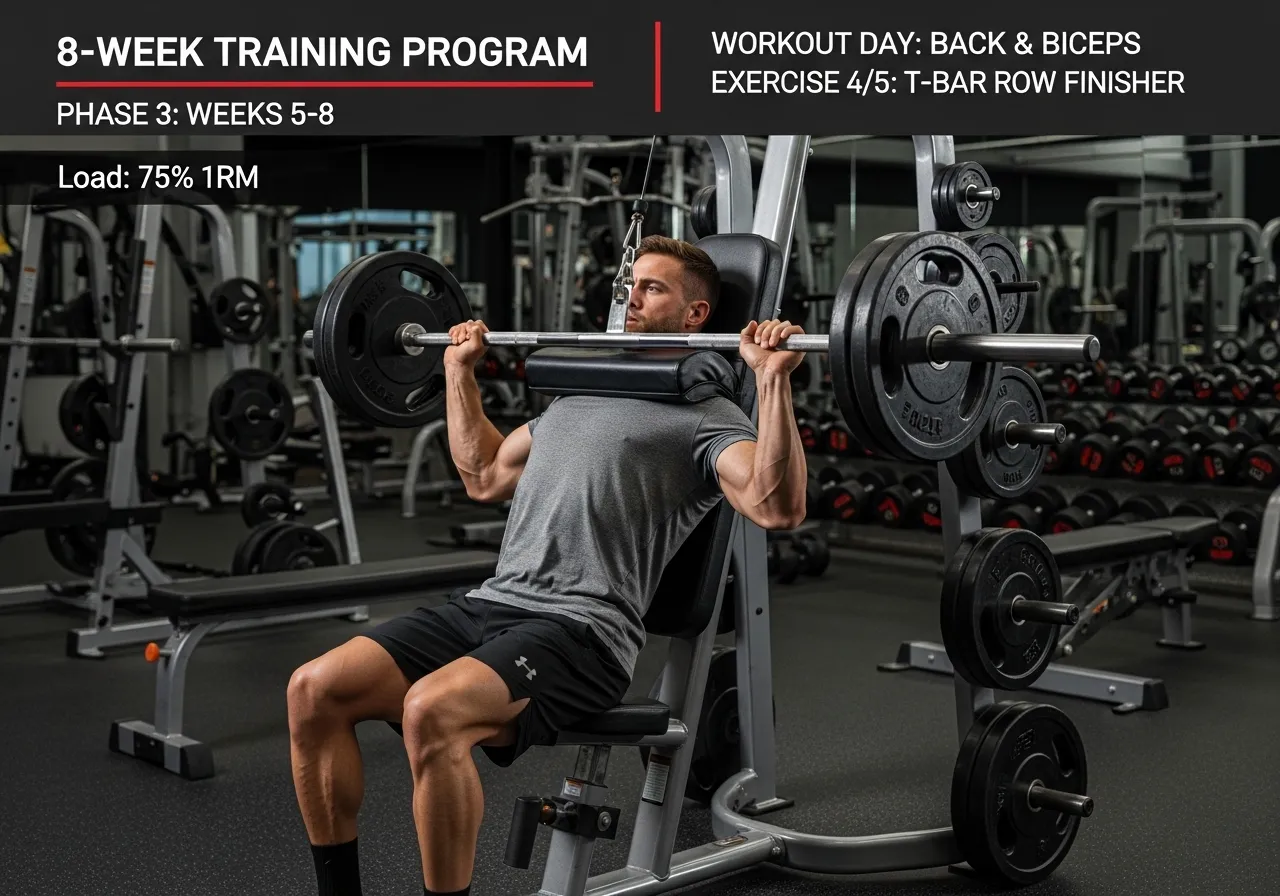
Standard T-bar row: 4 sets of 6 reps, near-maximal load for the variation
Chest-supported: 3 sets of 15 reps as metabolic back finisher
Compare working loads to Phase 1 starting weights as progression benchmark
Expected: 15 to 25% load increase from Phase 1 starting load across 8 weeks
The lower rep, higher load Phase 3 tests the strength development from the preceding hypertrophy-focused phases and establishes a new baseline for the next training block.
Frequently Asked Questions About the T-Bar Row
Is the T-bar row hard on the lower back?
The free-standing T-bar row at the 45-degree torso angle places moderate lumbar compressive and shear load, less than the more horizontal barbell row but more than the chest-supported variation. For trainees without lower back pathology who maintain a neutral lumbar spine throughout, the spinal loading of the T-bar row is within the normal range for loaded rowing exercises and does not present injury risk beyond general rowing exercise safety considerations.
For trainees with active lumbar disc pathology, acute lower back pain, or significant spinal sensitivity, the chest-supported T-bar row is the appropriate starting point. The chest pad eliminates all spinal loading by removing the need for the erector spinae to resist the moment arm created by the weighted bar at 45 degrees. The chest-supported version produces an equivalent mid-back training stimulus without any of the lower back loading concern.
Should I use straps for T-bar rows?
Wrist straps are appropriate for T-bar rows when grip fatigue limits the number of reps or the weight used before the back musculature is fully trained. In T-bar rowing, unlike exercises where grip strength is part of the specific training goal, the grip is a transmission for force rather than a target of the exercise. When grip fails before the back is adequately trained, the back receives less stimulus than the session intended to provide.
Use straps once the T-bar row working weight exceeds the load that grip can maintain for the full planned reps without fatigue-induced form changes. This threshold varies considerably between trainees based on grip strength and hand size. Some trainees need straps at moderate loads; others can manage heavy T-bar rowing without them throughout an entire training career.
How is the T-bar row different from the seated cable row?
The seated cable row provides constant tension throughout the range of motion through the cable’s consistent resistance profile, while the T-bar row’s plate-loaded resistance follows a gravity-dependent curve with lower resistance at the starting stretched position and higher resistance at the contracted position. This means the T-bar row provides greater mechanical tension at the peak contraction where the scapulae are fully retracted, while the cable row provides more stimulus at the lengthened position where the muscle is pre-stretched.
For complete back thickness development, the T-bar row’s peak contraction emphasis and the cable row’s stretched position emphasis are genuinely complementary. Including both within a back training programme addresses the full range of motion loading that neither exercise provides alone. The seated cable row variations and how to maximise its mid-back stimulus through grip and angle adjustments is covered in the seated cable row guide.
Key Takeaways
Grip position in rowing exercises changes peak force production and muscle activation emphasis across the lat, biceps, posterior deltoid, and trapezius. The neutral grip typically allows greater peak force than the pronated grip in rowing due to the forearm’s mechanically stronger flexion position.
Different row variations produce distinct trunk activation and spinal loading profiles. Row variation selection is not biomechanically interchangeable, making multiple rowing variations genuinely complementary rather than redundant volume.
The T-bar row’s neutral grip allows greater elbow travel and deeper scapular retraction than the barbell row, targeting the rhomboids and mid-trapezius at a more complete end-range contraction.
The chest-supported T-bar row isolates mid-back stimulus without any spinal loading contribution, making it ideal for volume accumulation after heavy primary rowing and for trainees with lower back sensitivity.
Start T-bar rows at 60 to 75% of barbell row working weight. The lower initial load reflects mechanical efficiency differences, not strength deficits. Load increases rapidly as the neutral grip pattern becomes familiar.
The barbell curl builds overall bicep mass. The concentration curl develops the short head peak. The incline dumbbell curl does something neither can: it places the bicep in its maximally stretched position at the beginning of each rep, with the shoulder extended behind the body and the arm hanging behind the torso, then performs the…
⚠️ Fitness Disclaimer: The information in this article is for general educational purposes only and does not constitute professional fitness or medical advice. Exercise carries inherent risks. Always consult a qualified healthcare professional or certified personal trainer before starting or modifying any exercise program, especially if you have a pre-existing medical condition, injury, or health…
The pullover is one of the oldest exercises in strength training. Arnold Schwarzenegger credited it with expanding his ribcage. Arthur Jones built the Nautilus pullover machine around it. Then it largely disappeared from modern programming. What replaced it were rows, pulldowns, and pressing variations, all excellent exercises. But every one of them trains the lat…
Most lower body training is quad-dominant. Squats, leg presses, and lunges all drive the knee into flexion under load, challenging the quadriceps as the primary mover. The hamstrings assist but rarely lead. The Romanian deadlift reverses this. The movement is a hip hinge under load, not a knee hinge. The hamstrings must eccentrically control the…
⚠️ Fitness Disclaimer: The information in this article is for general educational purposes only and does not constitute professional fitness or medical advice. Always consult a qualified healthcare professional before starting any new exercise program, especially if you have existing injuries or medical conditions. The Lat Pulldown: The Most Underestimated Back Builder in the Gym…
The dumbbell lateral raise is the standard side deltoid exercise for generations. It is available in any gym, requires no special equipment, and has a clear movement pattern that most trainees learn quickly. It also has a fundamental mechanical limitation: the resistance is zero at the bottom of the movement and maximum at the point…