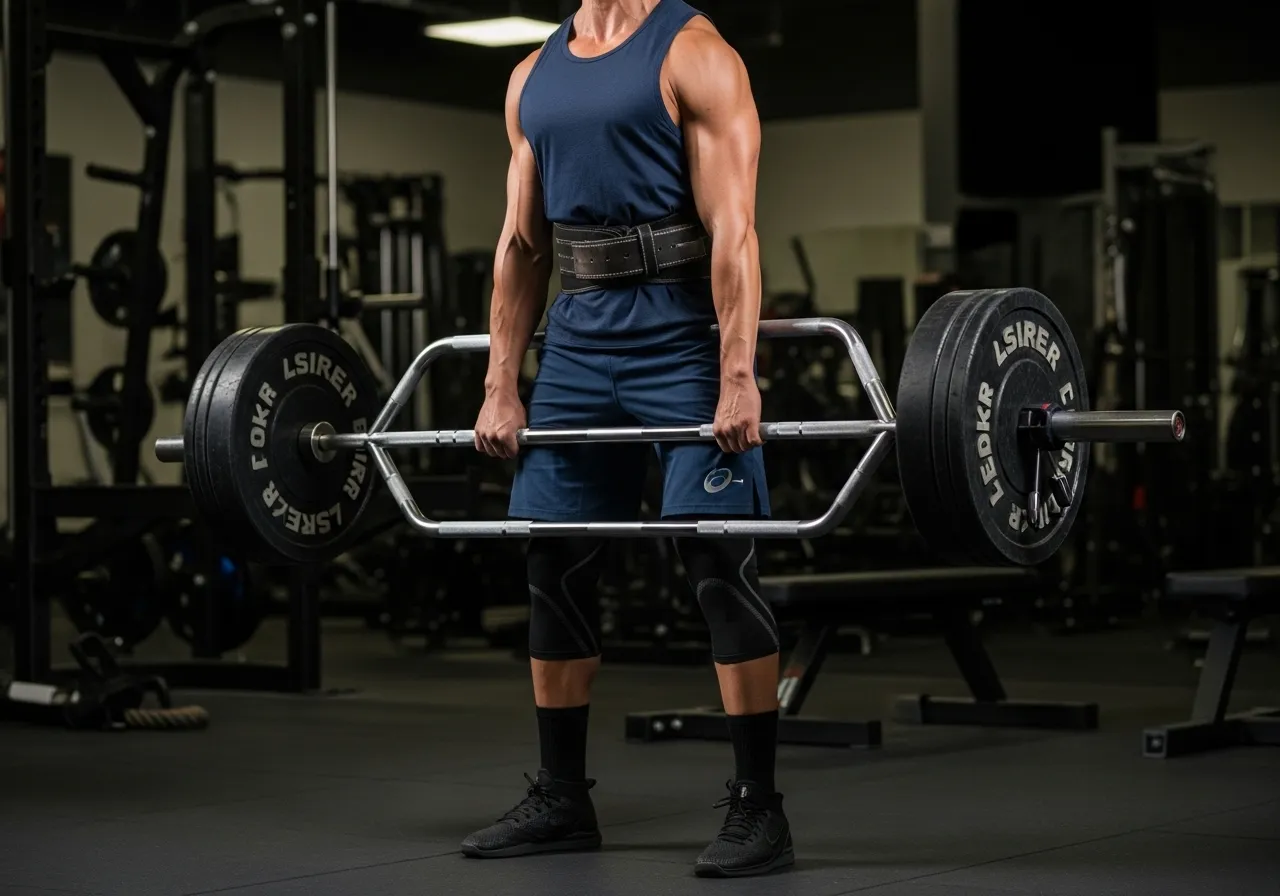
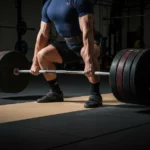
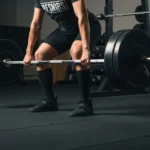
The trap bar deadlift carries a stigma in serious strength training communities. It is described as the easier deadlift, the beginner deadlift, the deadlift for people who cannot do a real deadlift. The perception is that its reduced range of motion and more upright torso represent a shortcut around the technical and physical demands of the conventional barbell deadlift. The research does not support this characterisation.
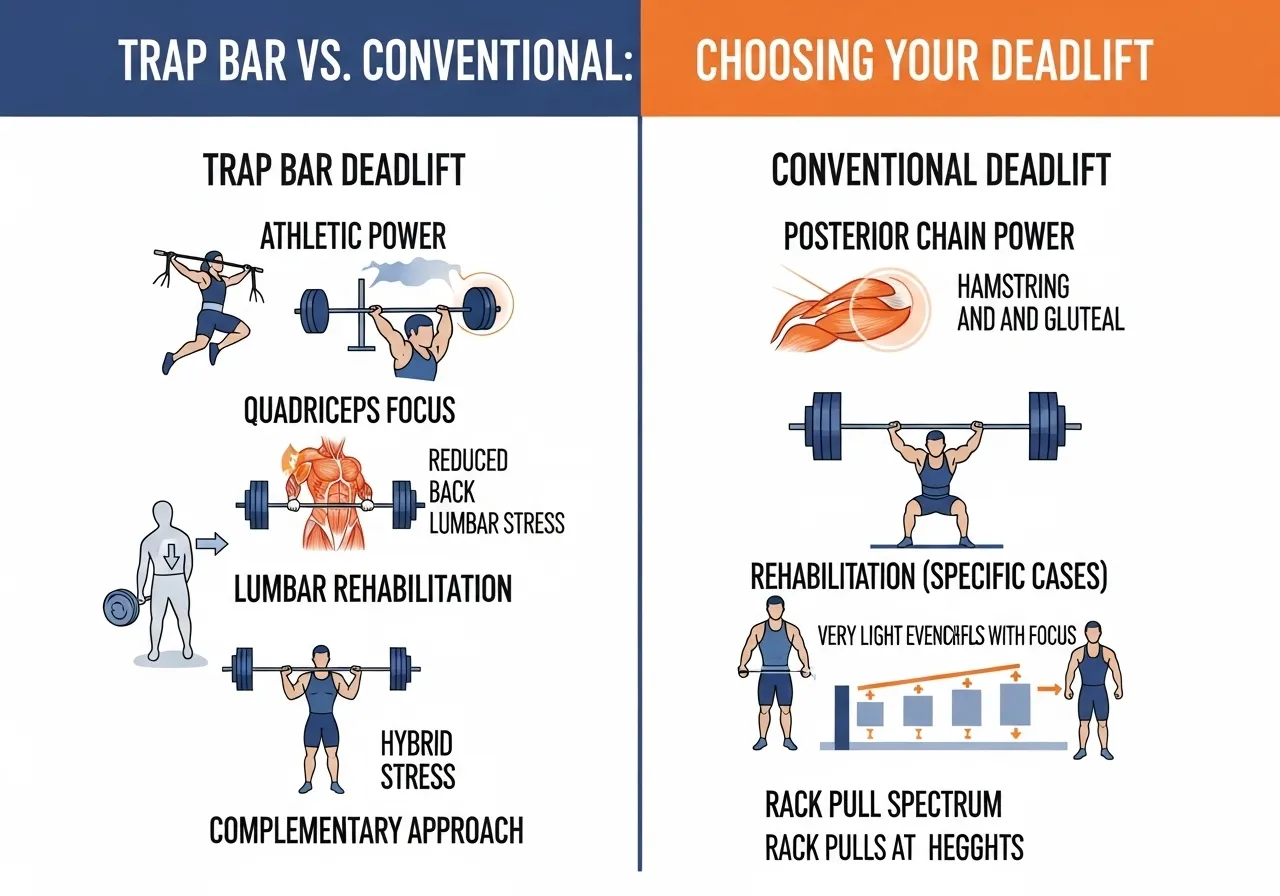
The trap bar deadlift is a different exercise from the conventional deadlift — not a simplified version of it. Its handles position the load bilaterally beside the hips rather than in front of the body, changing the moment arm at the lumbar spine, the relative contribution of knee versus hip extension, and the bar velocity and power output achievable at matched absolute loads. These differences make the trap bar deadlift better suited than the conventional deadlift for specific goals, populations, and training contexts, and less suited for others. The choice between them should be based on this specificity, not on a hierarchy of difficulty.
This guide covers what the research reveals about trap bar versus conventional deadlift differences in biomechanics, muscle activation, and performance, what the trap bar does better and worse than the conventional deadlift, complete technique, common errors, and programming for each context where the trap bar is the appropriate tool.
Is the Trap Bar Deadlift Just an Easier Conventional Deadlift, or Is That the Wrong Question?
Where the Misconception Comes From
The trap bar deadlift’s reputation as an easier alternative stems from two observable features: most trainees can lift more weight with the trap bar than with the conventional barbell, and the trap bar’s more upright torso position looks less technically demanding than the forward lean of a heavy conventional pull. Both observations are accurate but are misinterpreted as evidence of lesser challenge rather than evidence of different mechanics.
The ability to lift more weight with the trap bar is a product of the reduced lumbar moment arm and more mechanically favourable starting position — not because the exercise requires less total muscular effort. Research measuring peak force, power, and velocity during trap bar deadlifts consistently finds values equal to or higher than conventional deadlifts at matched absolute loads. The trap bar allows more of the available muscular force to be expressed as barbell velocity rather than being consumed managing lumbar shear forces, which is an advantage for power development, not evidence of inferior demand.
The Mechanical Basis for the Difference
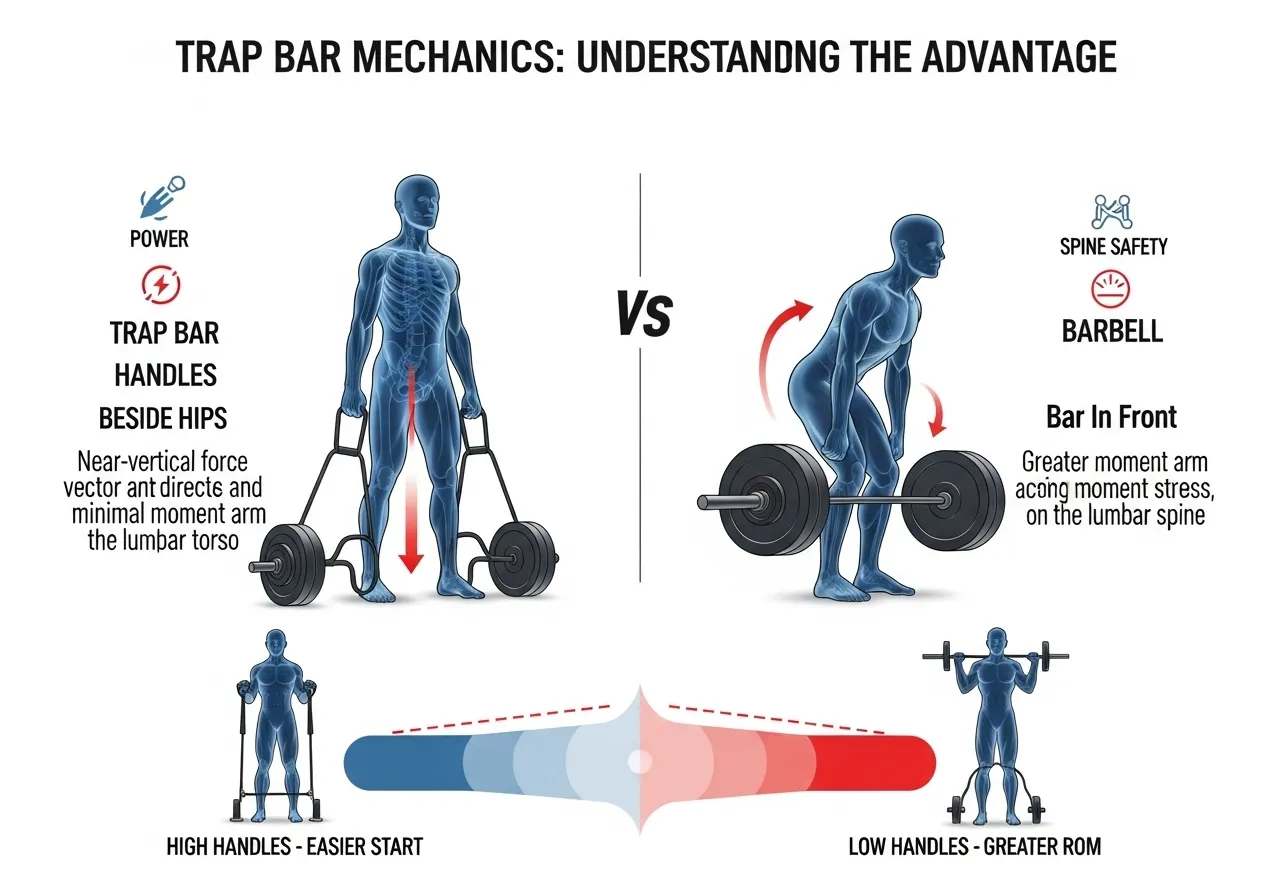
The conventional barbell deadlift places the bar approximately 15 to 25 cm in front of the body’s centre of mass at the starting position. This horizontal distance creates a significant lumbar moment arm — the perpendicular distance between the barbell and the lumbar spine — that the erector spinae must overcome with every pull. At heavy loads, this moment arm produces the largest lumbar extensor demand of any common exercise.
The trap bar places the load bilaterally beside the hips, reducing the horizontal distance between the load and the body’s centre of mass to near zero. The lumbar moment arm is dramatically shorter, the erector spinae demand is reduced, and the centre of mass of the barbell-plus-lifter system is more directly above the base of support. This reduced lumbar demand allows the quads and glutes to contribute more of the available force to vertical bar acceleration rather than to lumbar stability, producing the higher bar velocity and power output that research consistently documents for the trap bar at matched loads.
What the Trap Bar Demands That Conventional Does Not
The trap bar’s reduced lumbar demand does not mean the exercise is easier — it means the demand is distributed differently. The trap bar’s more upright torso and greater knee flexion at the starting position places substantially more demand on the quadriceps than the conventional deadlift’s hip-dominant, knee-extended starting position. It also requires greater hip abductor and knee stabilisation in the frontal plane because the bilateral handles constrain the arm position differently from the conventional barbell’s fixed-width grip.
For trainees whose quad strength and knee extensor power are the training targets — as opposed to hamstring and erector spinae development — the trap bar’s demand profile is not inferior to conventional; it is more specific to the training goal. Dismissing the trap bar as easier misunderstands the exercise’s specificity as weakness rather than as deliberate targeting of different qualities.
The Power Output Advantage: Why Athletes Use the Trap Bar
Research comparing power output characteristics between conventional and trap bar deadlifts consistently finds higher peak power, peak velocity, and force-velocity profile characteristics with the trap bar at matched loads and percentages of 1RM. These power output advantages make the trap bar the more appropriate tool for developing the explosive power that transfers to sprint acceleration, jump performance, and change of direction — despite the common assumption that the conventional deadlift’s greater technical complexity makes it superior for athletic development. The trap bar deadlift’s power development applications for athletes are the primary reason it has become standard equipment in high-performance strength and conditioning facilities, not because it is easier but because it is more appropriate for the specific power quality those facilities develop.
The Starting Position Spectrum: High Handles vs Low Handles
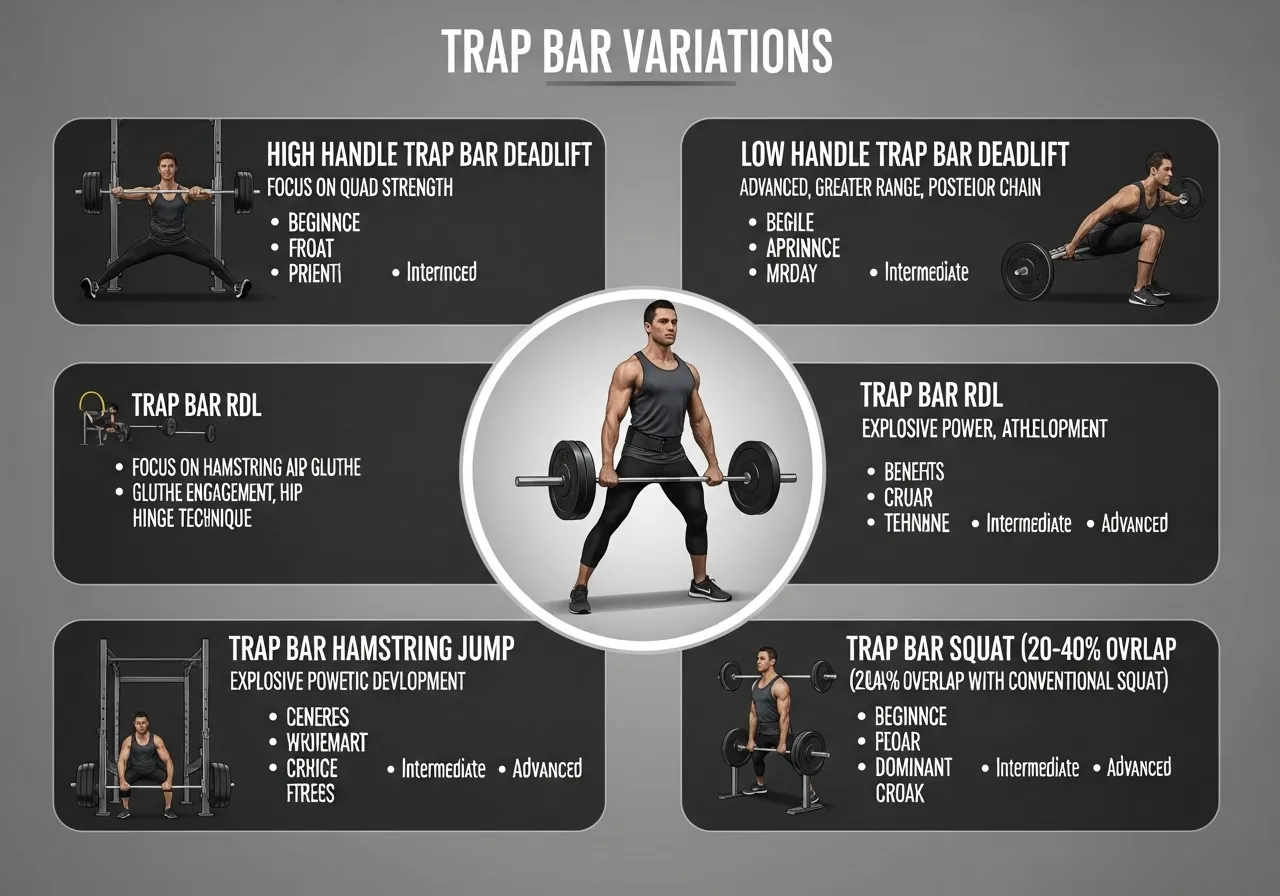
Most trap bars offer both high and low handle positions. High handles reduce the range of motion and further reduce the starting lumbar demand. Low handles increase the range of motion to match or exceed the conventional deadlift’s range and produce greater hamstring and erector spinae demands that approach the conventional deadlift’s posterior chain emphasis. The high-handle trap bar is the appropriate choice for power development, beginners, and lumbar-sensitive trainees. The low-handle trap bar is the appropriate choice for posterior chain development and for trainees who want trap bar mechanics with a range of motion closer to the conventional deadlift.
Research 1: EMG, Kinematics, and Power Output Differences
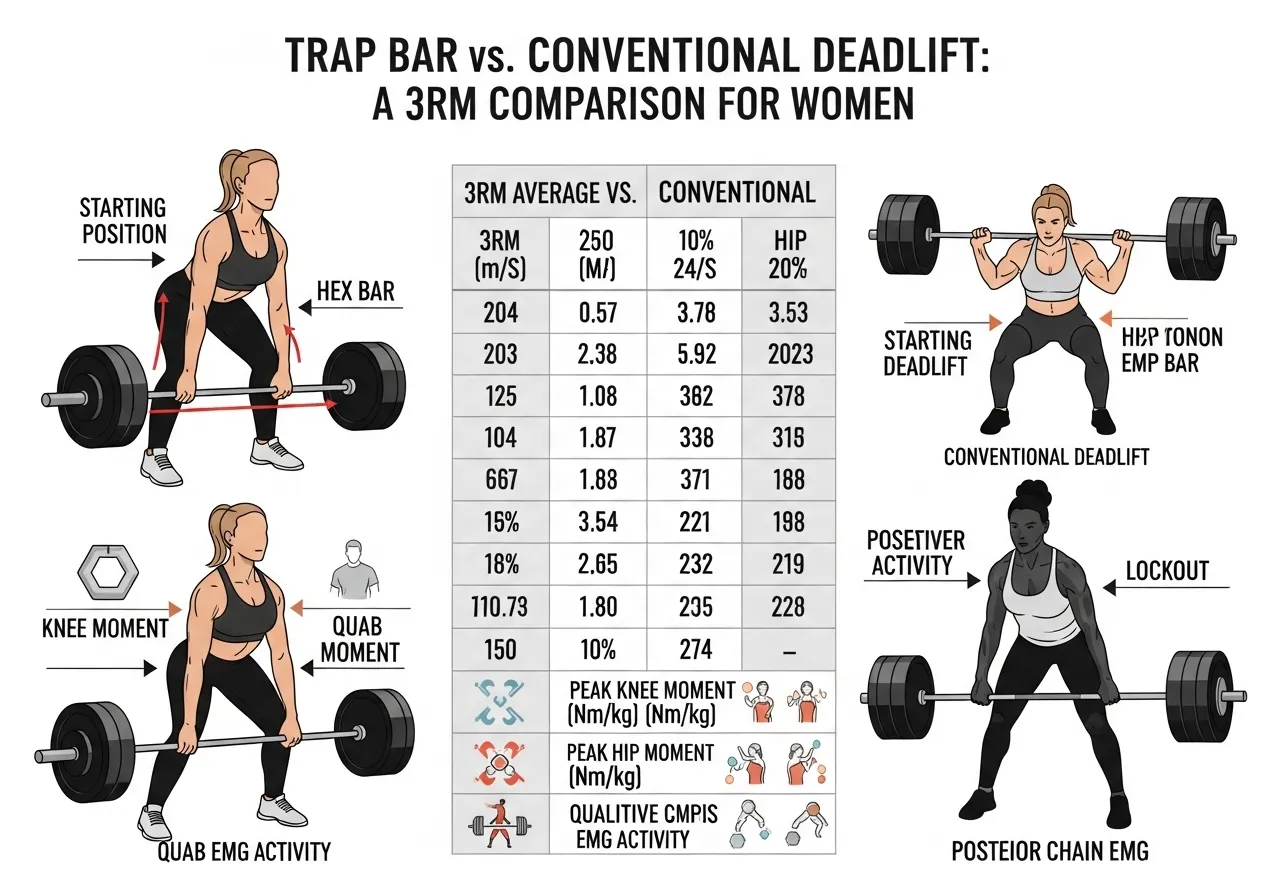
Conventional vs Sumo vs Hex Bar: The Three-Way Women’s Comparison
📌 Key Finding
Hex bar deadlifts produce greater barbell velocity and knee extensor loading. Conventional and sumo produce greater hip extensor loading at lockout. These are not superior and inferior variations but tools targeting different primary muscle groups with different mechanical profiles.
Hex Bar Deadlift Starting Position: How Knee and Torso Angle Change Muscle Activation
📌 Key Finding
Starting knee and torso angle significantly changes hex bar deadlift muscle activation. More upright reduces erector spinae; more flexed knee increases quads. The hex bar can be configured for either posterior chain or anterior chain emphasis — making it more versatile than its simplified reputation suggests.
📌 Key Finding
Hex bar deadlift uses a more upright posture that reduces posterior chain stress and increases peak force, velocity, and power at submaximal loads compared to conventional. The power output advantage is mechanically consistent with the reduced lumbar moment arm, not simply a function of allowing more weight on the bar.
The Lumbar Spine Load Reduction: What the Evidence Shows
Multiple studies comparing lumbar spine forces during conventional versus trap bar deadlifts consistently show lower peak lumbar shear and compressive forces during trap bar deadlifting at matched loads. The mechanism is the reduced moment arm described above — when the barbell is beside the hips rather than in front of them, the erector spinae must produce less force to maintain lumbar extension, and the net lumbar shear force is correspondingly reduced. This does not make the trap bar deadlift spine-safe and the conventional deadlift spine-dangerous at any load. Both require appropriate bracing and technique. But the trap bar’s reduced lumbar demand makes it the more appropriate primary loaded hip hinge movement for individuals with lumbar disc sensitivity who need to maintain progressive strength loading while managing lumbar stress.
Comparing the Research: What Each Variation Does Better
Quality
Conventional
Trap Bar
Posterior chain (hamstrings, glutes)
Higher hip extensor moment
Moderate, position-dependent
Quad activation
Lower
Higher (greater knee moment)
Peak bar velocity and power
Lower at matched load
Higher
Lumbar shear force
Higher
Lower
Technical learning curve
Higher
Lower
Competition relevance
Powerlifting standard
Not competition-legal
Trap Bar Deadlift Technique: Setup, Execution, and Handle Selection
⚠️ Loading and Lumbar Safety Note The trap bar deadlift’s reduced lumbar moment arm allows many trainees to lift significantly more absolute weight than their conventional deadlift. Loading the trap bar beyond what can be controlled through the full range with maintained lumbar neutral position removes the safety advantage the exercise provides. The lumbar must remain neutral throughout — the trap bar does not make heavy deadlifting risk-free; it reduces the lumbar stress at equivalent levels of mechanical competence.
Handle Selection: High vs Low and Neutral vs Pronated
Set up with feet hip-width inside the trap bar frame, over the mid-point of the bar’s length. Select high handles for maximum power output, reduced lumbar demand, and beginner-appropriate range of motion. Select low handles for greater range of motion, increased posterior chain demand, and a movement profile closer to conventional deadlift mechanics. The grip is neutral (palms facing the body) in most trap bar designs, which eliminates the alternating grip rotation that creates slight torso asymmetry in conventional barbell deadlifts.
The Starting Position: Hip Height Determines Muscle Emphasis
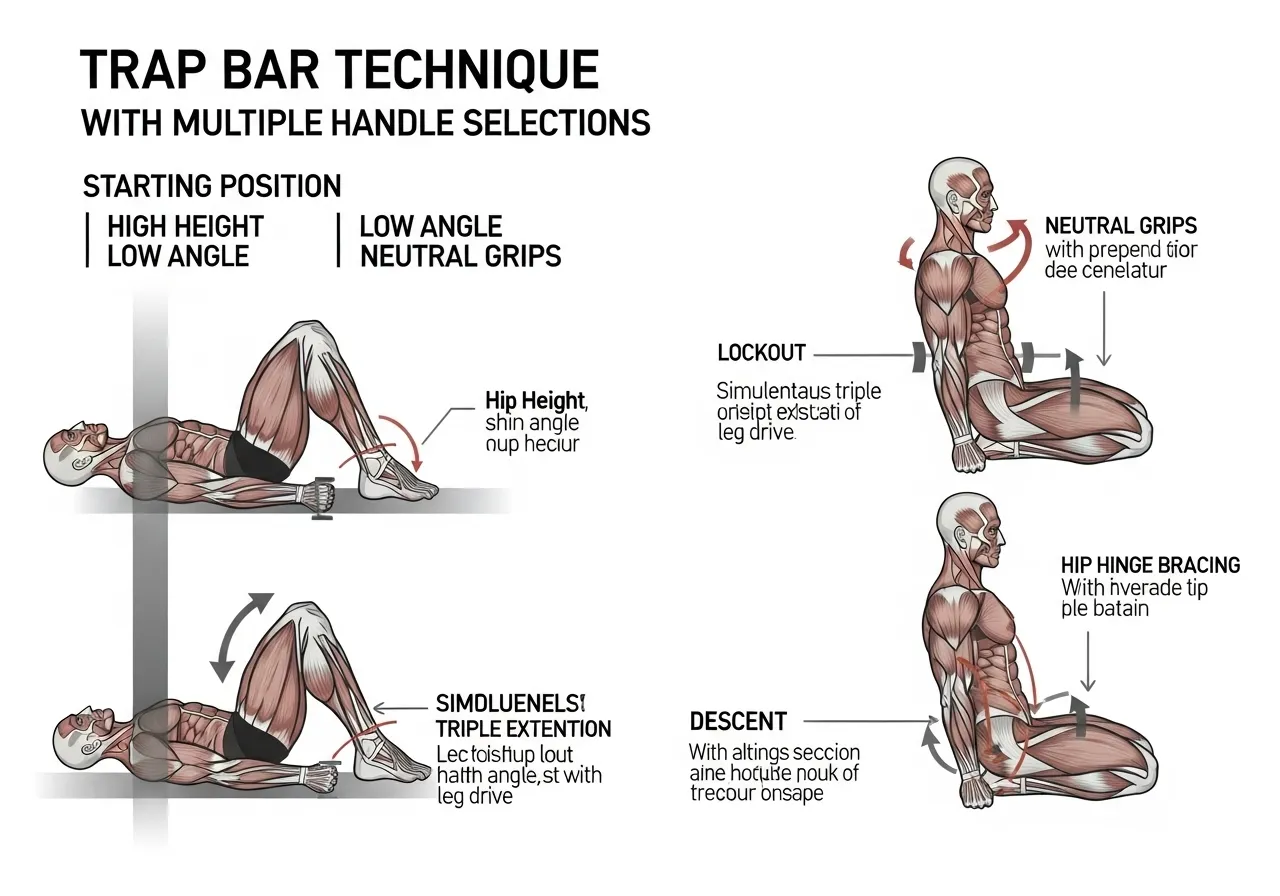
The trap bar starting position is more variable than the conventional deadlift because the handle height and the starting hip angle can be independently adjusted within a range. Setting the hips high (minimal knee bend at start, similar to a conventional deadlift hip angle) emphasises the posterior chain and erector spinae in a profile approaching the conventional deadlift. Setting the hips lower (greater knee bend, more squat-like starting position) emphasises the quads and reduces the posterior chain demand — the configuration that produces the higher bar velocity the research documents.
For most trainees, a starting hip height that places the shins at approximately 15 to 20 degrees from vertical (slightly more upright than conventional deadlift shin angle) provides a balanced starting position that develops both knee extension and hip extension through the pull. This moderate starting position allows the exercise to serve as both a hip hinge and a knee extension trainer simultaneously, which is the trap bar’s primary advantage over the conventional deadlift’s more exclusive hip hinge pattern.
The Pull: Leg Drive, Hip Drive, and Lockout
Initiate the trap bar pull with a simultaneous leg drive and hip drive rather than the hip-dominant drive sequence of the conventional deadlift. Both the knee extensors and hip extensors should activate simultaneously from the start position, producing the triple extension pattern (ankle, knee, hip) that characterises athletic power expression in jumping and sprinting. This simultaneous triple extension is why the trap bar transfers more directly to athletic power than the sequential hip-dominant pattern of the conventional deadlift.
At lockout, achieve full hip extension with glutes contracted and torso upright. The trap bar’s neutral handle position reduces the temptation for the torso to laterally flex toward one side that alternating grip conventional deadlifts sometimes create, making symmetrical lockout more natural. The sumo deadlift and its lockout mechanics, which share some characteristics with the trap bar’s upright lockout position, are covered in the sumo deadlift guide.
Eccentric Control and the Descent
The trap bar descent requires deliberate hip hinge initiation to prevent the bar from drifting forward as it lowers. Because the handles are beside the body rather than in front, the natural tendency is to allow the hips to rise faster than the bar during the descent, shifting the bar forward and converting the exercise into a forward lean that makes subsequent reps more difficult and less safe. Hinge at the hip and lower the bar with maintained neutral spine, keeping the handles beside the hips throughout the descent.
Breathing and Bracing for the Trap Bar Deadlift
The same Valsalva brace that protects the lumbar spine during conventional deadlifts applies to the trap bar. Despite the reduced lumbar moment arm, the trap bar deadlift at heavy loads still produces significant lumbar compressive force from the axial loading of the bilateral weights at the sides. Bracing the core before each rep and maintaining intra-abdominal pressure through the full concentric and eccentric phase is as important for heavy trap bar pulling as for any other heavy loaded spinal movement.
When to Use the Trap Bar vs Conventional Deadlift: A Decision Framework
Use the Trap Bar as Primary When
The trap bar is the appropriate primary pulling movement in five specific contexts. First, when athletic power development is the primary goal — the higher bar velocity and power output characteristics make it more specific to sprint acceleration, jump performance, and change of direction than the conventional deadlift’s slower, more posterior chain-dominant pull. Second, when lumbar sensitivity limits conventional deadlift loading — the reduced lumbar moment arm allows continued progressive loaded hip hinge training that lumbar-sensitive trainees cannot achieve with conventional mechanics. Third, when beginners are learning hip hinge mechanics — the trap bar’s forgiving starting position allows learners to develop the hip hinge pattern without the technical complexity of conventional deadlift bar path management. Fourth, when bilateral symmetry is a training priority — the neutral grip eliminates the asymmetric muscular demands that alternating grip conventional deadlifts create. Fifth, when quad development alongside hip hinge training is the goal — no other hip hinge movement loads the quads as substantially as the trap bar at the quad-emphasising starting position.
Use Conventional Deadlift as Primary When
The conventional deadlift is the appropriate primary choice when maximum posterior chain development is the goal, because its higher hip extensor moment at lockout and greater hamstring involvement produce a posterior chain stimulus the trap bar cannot replicate at the same magnitude. It is also the appropriate choice for powerlifters, for whom competition specificity requires conventional (or sumo) mechanics regardless of the trap bar’s mechanical advantages, and for trainees whose sport-specific needs require the sagittal-plane hip hinge strength that the conventional deadlift develops most directly.
The conventional deadlift’s technical demands — bar path management, lumbar position maintenance under heavy load, and the hip hinge pattern development from a forward-loaded starting position — also provide specific training adaptations that trap bar training does not replicate, including the spinal anti-flexion endurance that heavy conventional pulling develops over years of progressive loading. The full conventional deadlift research and programming framework is covered in the conventional deadlift guide.
The Complementary Approach: Both in the Same Programme
Many intermediate and advanced trainees use conventional deadlifts as the primary strength and posterior chain development movement and trap bar deadlifts as the primary power and athletic development movement within the same programme. The conventional deadlift provides the specific lumbar and hamstring loading that posterior chain development requires. The trap bar provides the velocity and power expression that athletic transfer requires. Alternating the two across training blocks or including both within the same week — conventional for strength, trap bar for power — addresses both training qualities that single-variation deadlift programming leaves partially unaddressed.
The Trap Bar as a Regression Tool for Lumbar Rehabilitation
For trainees returning to loaded hip hinge training after lumbar disc pathology, the trap bar serves as the appropriate regression that allows progressive strength loading while the lumbar tissue heals. Beginning with high-handle trap bar deadlifts at conservative loads and progressing to lower handles as lumbar tolerance allows provides a spectrum of loaded hip hinge training that manages lumbar stress progressively rather than treating the lumbar-sensitive trainee as unable to deadlift until fully recovered. The rack pull’s role in partial-range loaded spinal training during rehabilitation is covered in the rack pull guide.
Programming the Trap Bar for Athletic Power
For athletic power development, the trap bar deadlift is most effective when loaded at 60 to 80% of 1RM and performed with maximum velocity intent rather than the controlled grinding tempo appropriate for maximum strength development. Research on velocity-based training consistently shows that explosive intent during trap bar deadlifts produces greater power output and superior transfer to athletic performance than controlled-tempo lifting at the same loads. Programming: 3 to 5 sets of 3 to 5 reps with maximum velocity intent, with full recovery between sets to preserve power output quality. This structure is distinct from the higher-rep, controlled-tempo programming appropriate for strength and hypertrophy goals.
Trap Bar Deadlift Variations for Different Goals
Why Variations Extend the Trap Bar’s Versatility
The standard trap bar deadlift from the floor with high or low handles covers the primary use cases for most trainees. The variations below address specific contexts where the standard version’s mechanics are not the most appropriate: trainees who need loaded hip hinge at reduced range, those who need greater hamstring emphasis within trap bar mechanics, and those training for maximum power expression with accommodating resistance.
🏋️ 1. High-Handle Trap Bar Deadlift
Target: Power development, lumbar-sensitive populations, beginners
How: Use the elevated handles (approximately 10 cm higher than low handles). The increased starting position reduces the lumbar demand and range of motion while maintaining the bilateral neutral grip mechanics.
Best for: Athletes requiring maximum velocity training, trainees returning from lumbar injury, and beginners learning the hip hinge pattern before advancing to lower handle positions.
🏋️ 2. Low-Handle Trap Bar Deadlift
Target: Posterior chain development, greater range of motion, conventional deadlift approximation
How: Use the lower handles. The starting position is similar to a conventional deadlift in range of motion, with the trap bar’s bilateral neutral grip and reduced lumbar moment arm maintained.
Best for: Trainees who want trap bar mechanics with greater posterior chain emphasis. The combination of conventional-like range with trap bar lumbar mechanics provides a middle ground between the two variations’ respective muscle profiles.
🏋️ 3. Trap Bar Romanian Deadlift
Target: Hamstring and glute loading with trap bar mechanics, hip hinge endurance
How: Pick up the trap bar to standing. Hinge at the hip, lowering the bar toward the floor by pushing the hips back with minimal knee bend. Lower to the range that hamstring flexibility allows while maintaining neutral lumbar. Return to standing through hip extension.
Best for: Trainees who want the trap bar’s neutral grip and bilateral loading with the hamstring-dominant hip hinge mechanics of the RDL pattern. The trap bar’s handles allow comfortable grip throughout the hip hinge range that some trainees find awkward with a conventional barbell RDL.
🏋️ 4. Trap Bar Jump (Loaded Jump with Trap Bar)
Target: Maximum power output, jump performance, athletic power transfer
How: Load the trap bar at 20 to 40% of deadlift 1RM. Perform a countermovement (slight dip) and then jump for maximum height, allowing the feet to leave the floor. Land softly and reset between repetitions. Performed only with high handles.
Best for: Athletes in jumping and sprinting sports who need the highest power output expression available with external loading. The research on trap bar jumps confirms higher peak power and velocity than weighted jump squats or conventional deadlift jumps at matched loads.
The Trap Bar Back Squat Comparison
Recent research comparing the trap bar deadlift with the back squat found significant biomechanical overlap between the two exercises. At similar starting positions, the trap bar deadlift’s knee and hip angle patterns resemble the back squat more than the conventional deadlift, explaining why the trap bar is sometimes described as a hybrid between a deadlift and a squat. For trainees whose squat mechanics are limited by ankle mobility, shoulder mobility for bar placement, or technical complexity, the trap bar deadlift at the quad-emphasising starting position provides comparable quad and glute stimulus with substantially reduced technical demands.
Programming the Trap Bar Deadlift: Beginner to Advanced
Beginner: Learning the Hip Hinge With a Forgiving Tool
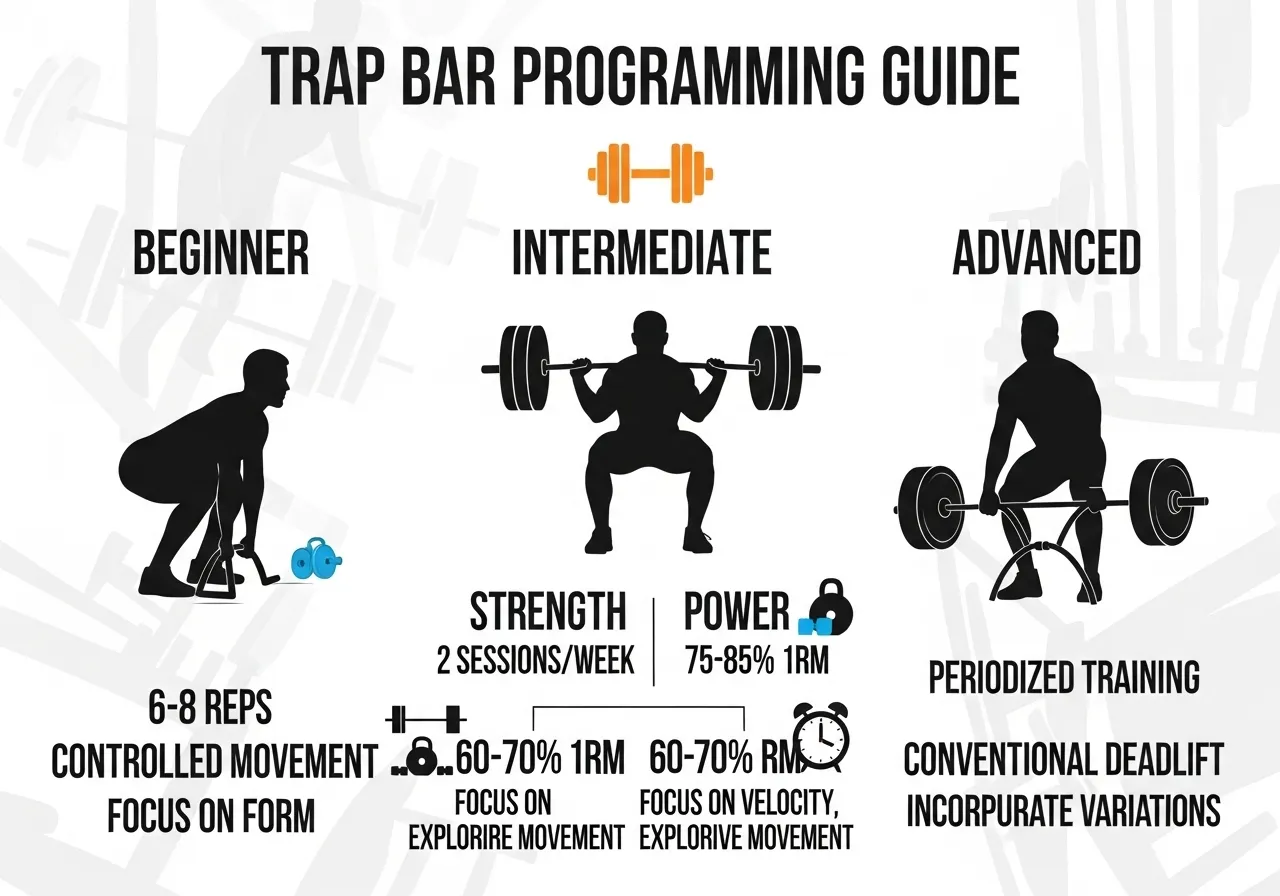
The trap bar is an excellent entry point for hip hinge learning because the neutral handle position provides natural grip alignment, the bilateral loading prevents the bar path confusion of conventional deadlift setup, and the high handles reduce the range of motion to a starting depth that most untrained individuals can achieve with maintained neutral lumbar. Beginners should start with high handles, moderate loads (50 to 60% of estimated 1RM), and prioritise learning the simultaneous leg and hip drive pattern before advancing to heavier loads.
Beginner programme: 3 to 4 sets of 6 to 8 reps at controlled tempo (2 seconds down, 1 second pause at bottom, 2 seconds up), twice weekly. Increase load by 5 to 10 kg when all sets are completed with maintained technique across two consecutive sessions at the same load.
Intermediate: Strength and Power Development in Parallel
Intermediate trainees benefit from using the trap bar for both strength and power development within the same training week by using different loading for each quality.
📅 Intermediate Weekly Structure
Session 1: 4 × 5 at 75 to 85% 1RM, controlled tempo, strength focus
Session 2: 5 × 3 at 60 to 70% 1RM, maximum velocity intent, power focus
Optional: Trap bar RDL 3 × 8 on either session for hamstring supplementation
The two-session structure develops both maximum strength and power output in parallel, which the trap bar’s mechanics support more naturally than the conventional deadlift’s strength-dominant profile.
Advanced: Trap Bar as Power Tool in Periodised Programme
Advanced trainees typically use the conventional or sumo deadlift as the primary strength expression movement and the trap bar as the primary loaded power expression movement. During power phases of annual periodisation, trap bar deadlifts at 50 to 70% of conventional 1RM with maximum velocity intent replace conventional deadlift volume, developing the athletic power transfer that strength phases build the foundation for. During strength phases, trap bar volume reduces to maintenance while conventional deadlift loading increases.
Loading the Trap Bar Relative to Conventional Deadlift
Most trainees lift 5 to 15% more on the trap bar than their conventional deadlift 1RM. This difference reflects the more mechanically favourable load distribution rather than the exercise being easier. When programming trap bar work as a percentage of conventional deadlift 1RM, use 105 to 115% of conventional 1RM as the approximate trap bar 1RM estimate for load prescription, adjusting based on individual testing.
Common Trap Bar Deadlift Errors and Fixes
Why Trap Bar Errors Are Different From Conventional Deadlift Errors
The trap bar’s unique mechanics create specific error patterns that differ from conventional deadlift problems. Most conventional deadlift errors involve bar path management and lumbar position under the forward-loaded starting position. Trap bar errors typically involve misuse of the bilateral neutral position and failure to use the leg drive component that the trap bar’s starting position enables.
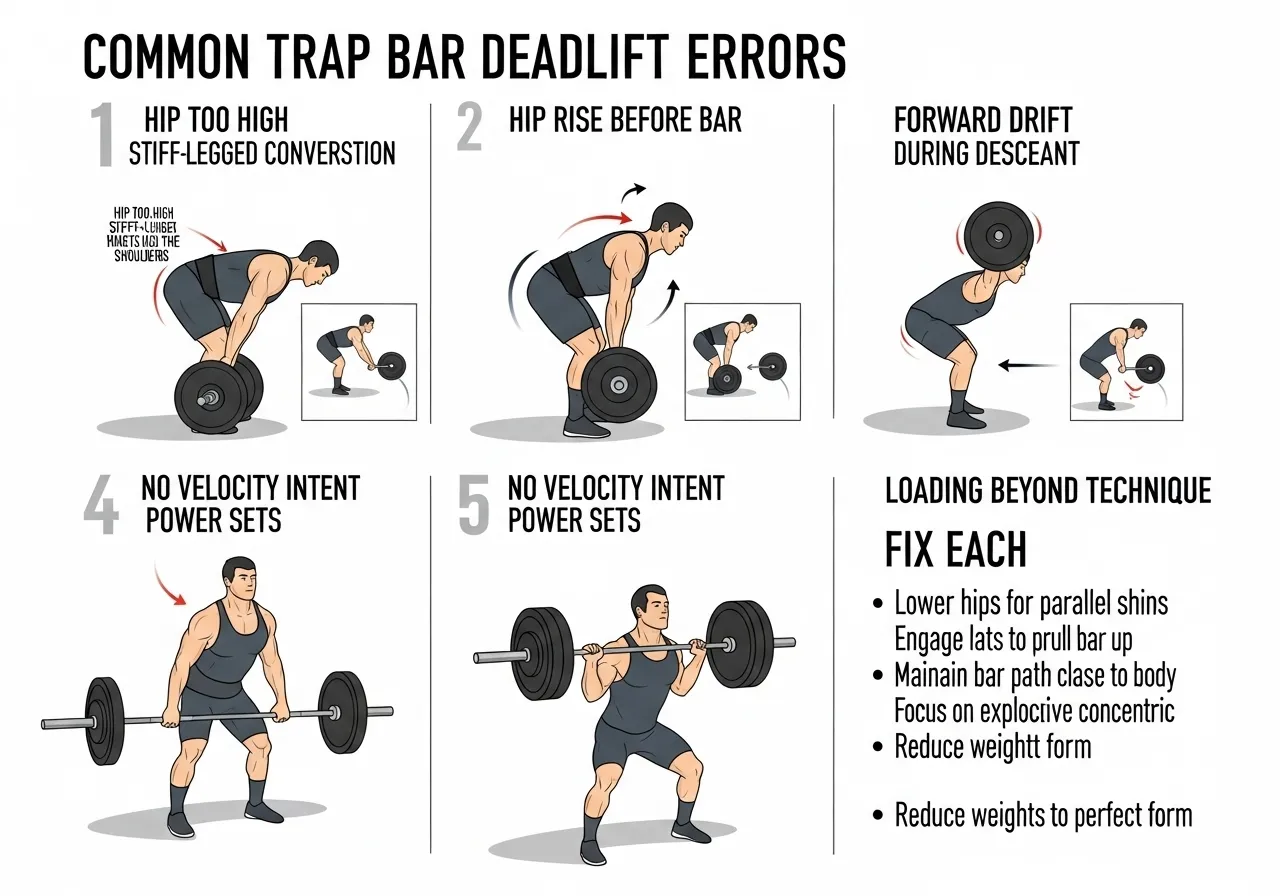
❌ Error 1: Setting Hips Too High (Treating It Like a Conventional Deadlift)
What happens: Starting with the hips too high and knees barely bent eliminates the quad contribution and converts the trap bar deadlift into a stiff-legged deadlift pattern that loses the knee extensor demand that makes the trap bar distinct from conventional mechanics.
Fix: Start with greater knee bend than feels natural from conventional deadlift experience. The shins should be at approximately 15 to 20 degrees from vertical, not the more vertical shin position of a conventional deadlift. The exercise should feel like a combination of a squat and a deadlift, not like a deadlift with different equipment.
❌ Error 2: Allowing the Hips to Rise Faster Than the Bar
What happens: The hips shoot upward at the start of the pull before the bar has moved significantly, converting the initial phase into a Romanian deadlift pattern rather than the simultaneous leg and hip drive the trap bar requires.
Fix: Think “push the floor away” rather than “pull the bar up” at the initiation. The leg drive cue produces simultaneous knee and hip extension from the bottom position, preventing the hip-first rise that reduces the quad contribution.
❌ Error 3: Allowing the Bar to Drift Forward During Descent
What happens: As the bar lowers, the hips rise ahead of it, pushing the handles forward and creating an anterior load position that the trap bar’s design is intended to prevent.
Fix: Initiate the descent with a deliberate hip hinge — push the hips back first, then allow the knees to bend as the bar lowers. The handles should remain beside the hips throughout the descent, not drift forward as the hips rise.
❌ Error 4: Not Using Maximum Velocity Intent for Power Sets
What happens: Trap bar power sets at 60 to 70% 1RM are performed at the same controlled tempo as strength sets, eliminating the bar velocity and power output advantages that justify using the trap bar for athletic development.
Fix: Explicitly contrast tempo between strength and power sessions. Power sets should look and feel like an attempt to throw the bar through the ceiling. The concentric phase should be as fast as possible. Controlled descent follows — the explosive intent applies only to the concentric phase.
Avoiding Over-Loading the Trap Bar Relative to Technique
The trap bar’s reduced lumbar demand tempts trainees to load it more aggressively than their technique supports. A trainee whose conventional deadlift is 100 kg may find the trap bar feels effortless at 120 kg, tempting them to immediately attempt 140 kg. The mechanical advantage that allows more weight does not mean technique has developed to the point where that weight is safe and productive. Progress trap bar loading at the same rate as any other primary movement — based on technique quality across the target rep range rather than based on what feels possible with maximum effort.
Frequently Asked Questions About the Trap Bar Deadlift
Does the trap bar deadlift count as a real deadlift?
The trap bar deadlift is a real deadlift in the sense that it requires picking a load up from the floor through hip and knee extension to a standing position — the defining mechanical elements of a deadlift. It is not competition-legal in powerlifting federations that require a straight barbell, and it produces a different muscle activation profile from the conventional barbell deadlift. Whether it “counts” depends entirely on the training goal. For athletic development, posterior chain training, and general strength, it counts. For powerlifting competition preparation, it does not serve as competition-specific practice regardless of how much weight is moved.
Can the trap bar replace squats?
The trap bar deadlift at the quad-emphasising starting position produces significant quad activation and overlapping kinematics with the back squat. Research comparing the two exercises confirms meaningful biomechanical similarity. For trainees who cannot back squat due to shoulder mobility, thoracic mobility, or equipment limitations, the trap bar deadlift provides substantial quad and glute development alongside the hip hinge loading. It does not fully replace the squat pattern’s specific demands — the front-loaded spine position of the back squat and the pure knee flexion at the bottom of the squat have no direct trap bar equivalent — but it provides meaningful overlap that makes it a practical squat alternative in specific circumstances.
Is the trap bar better for building muscle than the conventional deadlift?
Neither is universally better for building muscle. They target different muscle groups with different emphases: the conventional deadlift builds posterior chain mass more specifically, while the trap bar builds quad mass alongside glute and hamstring development. A complete lower body hypertrophy programme that includes both exercises develops the full spectrum of lower body muscle groups more completely than either exercise alone. For trainees limited to one primary hip hinge movement, the choice should reflect which muscle group is the development priority, not which exercise is generically superior for hypertrophy.
Is the trap bar deadlift safe for people with knee problems?
The trap bar deadlift’s greater knee flexion at the starting position and higher knee extensor demand compared to conventional deadlifts means it places more compressive load at the patellofemoral joint during the initial pulling phase. For trainees with active patellofemoral pain, patellar tendinopathy, or post-surgical knee rehabilitation, the conventional deadlift’s lower knee demand may be more appropriate until the knee pathology is resolved or managed.
For trainees with knee osteoarthritis or general anterior knee discomfort from squatting, the trap bar’s starting position can be adjusted to reduce knee flexion demand by starting with higher hip position — effectively reducing the quad demand and bringing the movement profile closer to a conventional deadlift. The high-handle position also reduces starting knee flexion compared to the low-handle version. Adjusting starting position and handle height allows the trap bar to be configured at any point along the spectrum between maximum knee demand and minimum knee demand, making it more adaptable to knee-sensitive presentations than either a fixed squat or a conventional deadlift pattern.
How do I know whether I should prioritise conventional or trap bar deadlift?
Three questions determine the priority. First, what is the primary training goal — posterior chain strength and development (conventional), or power output and quad development alongside hip hinge training (trap bar)? Second, does lumbar sensitivity limit conventional deadlift loading — if yes, trap bar as primary allows continued progressive loading that lumbar sensitivity prevents with conventional mechanics. Third, is competition in a barbell strength sport the goal — if yes, conventional (or sumo) is necessary regardless of the trap bar’s mechanical advantages.
Trainees who cannot identify a clear reason to choose one over the other benefit from alternating: several weeks of conventional deadlift as primary with trap bar as accessory, then several weeks of trap bar as primary with conventional as accessory. The alternating approach prevents the technical stagnation of permanent single-variation training and develops both movement patterns and their respective muscular adaptations across training cycles.
Key Takeaways
The trap bar deadlift is not an easier conventional deadlift. It is a different exercise with different primary targets: greater quad activation and bar velocity versus the conventional’s greater posterior chain and lumbar demand.
Research confirms that hex bar deadlifts produce greater bar velocity and knee extensor loading, while conventional and sumo produce greater hip extensor loading at lockout. Each is better for different training goals, not better overall.
The trap bar’s reduced lumbar moment arm decreases lumbar shear force at matched loads, making it the appropriate primary loaded hip hinge for lumbar-sensitive trainees and the preferred power development tool for athletes.
Starting position determines muscle emphasis: more upright trunk reduces erector spinae; more flexed knee increases quads. The trap bar can be configured for either emphasis through deliberate setup adjustment.
Use conventional deadlift as primary when posterior chain development and competition specificity are the goals. Use trap bar as primary for athletic power development, lumbar-sensitive training, and quad-inclusive hip hinge work. Both in the same programme addresses all lower body strength qualities.
Why the Close-Grip dumbbell vs barbell bench Is the Most Underrated Upper Body Exercise Ask most gym-goers how they train their triceps and you will hear a familiar list: cable pushdowns, overhead extensions, skull crushers. Ask them about the close-grip bench press stall fixes and you will typically get a blank stare or a vague…
⚠️ Shoulder and Rotator Cuff Safety NoteThe lateral raise elevates the arm through shoulder abduction — a movement that narrows the subacromial space and can provoke impingement in individuals with existing rotator cuff pathology or AC joint irritation. Those with diagnosed supraspinatus tears, active shoulder impingement syndrome, or a history of shoulder surgery should obtain…
⚠️ Fitness Disclaimer: The information in this article is for general educational purposes only and does not constitute professional fitness or medical advice. Always consult a qualified healthcare professional before starting any new exercise program, especially if you have existing injuries or medical conditions. Why the Overhead Press Is the Most Neglected Compound Lift in…
The barbell squat is the king of lower body exercises. Nobody argues this. But the squat trains both legs simultaneously, allows the stronger leg to compensate for the weaker, and does not replicate the single-leg mechanics of every sport, every staircase, and every walking stride. The barbell lunge addresses what squatting leaves untrained. It loads…
⚠️ Fitness Disclaimer: The information in this article is for general educational purposes only and does not constitute professional fitness or medical advice. Always consult a qualified healthcare professional before starting any new exercise program. Why One Leg at a Time Builds More Muscle Than Two For the first three years of serious training, I…
Most trainees learn to squat wrong and never unlearn it. They lean forward. They cave the knees. They sit shallow. They add weight to these compensations until injury forces a reset. The goblet squat eliminates almost every common squat error through a single mechanical change: moving the load to the front of the body. The…