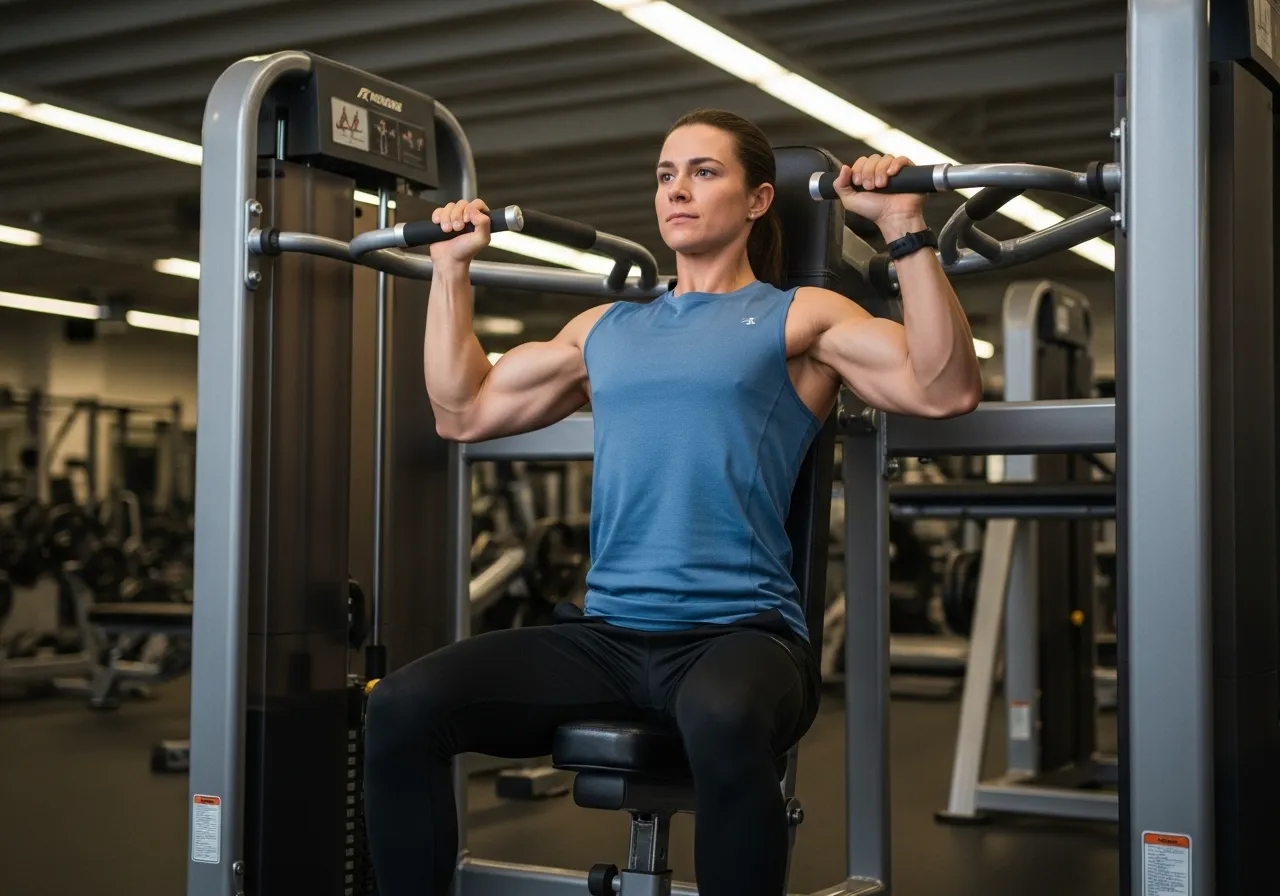
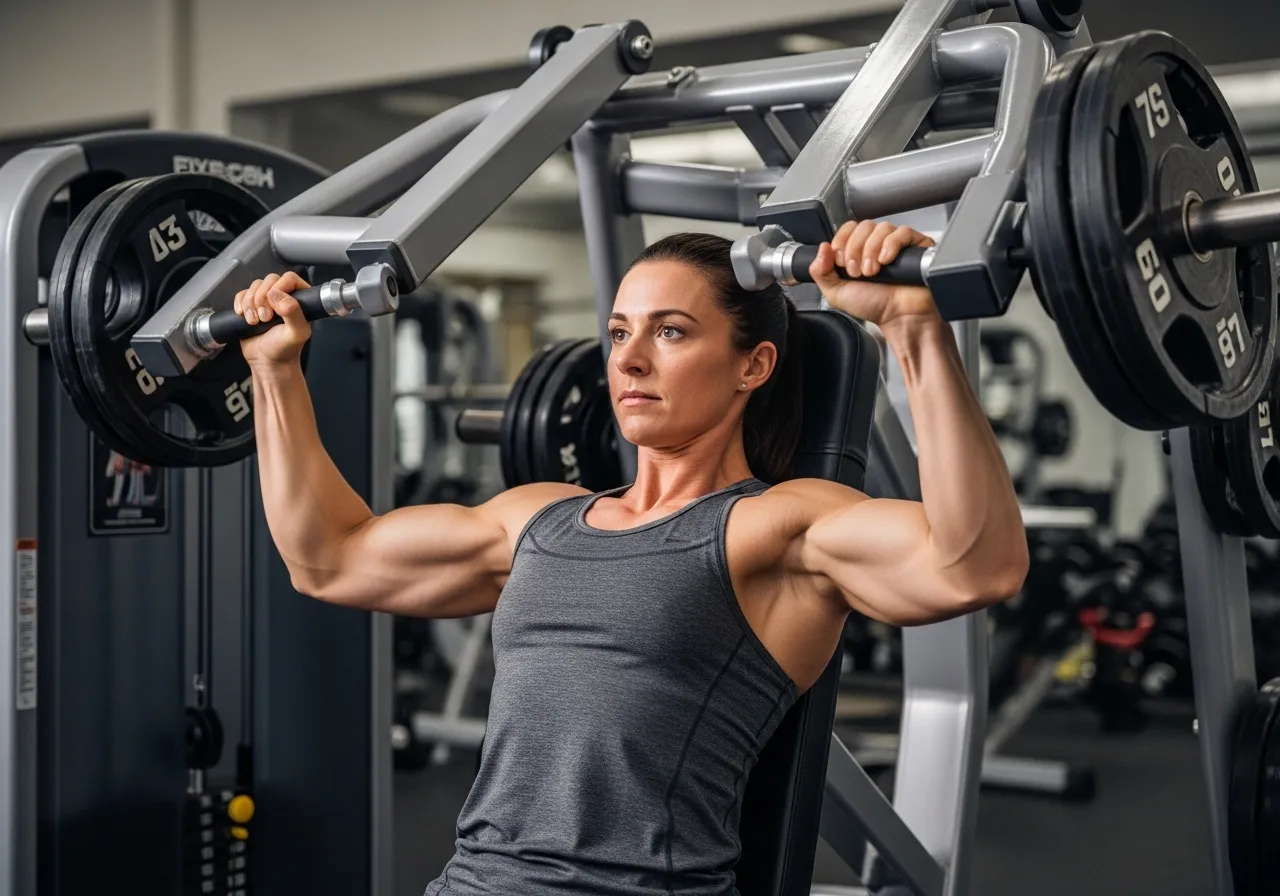
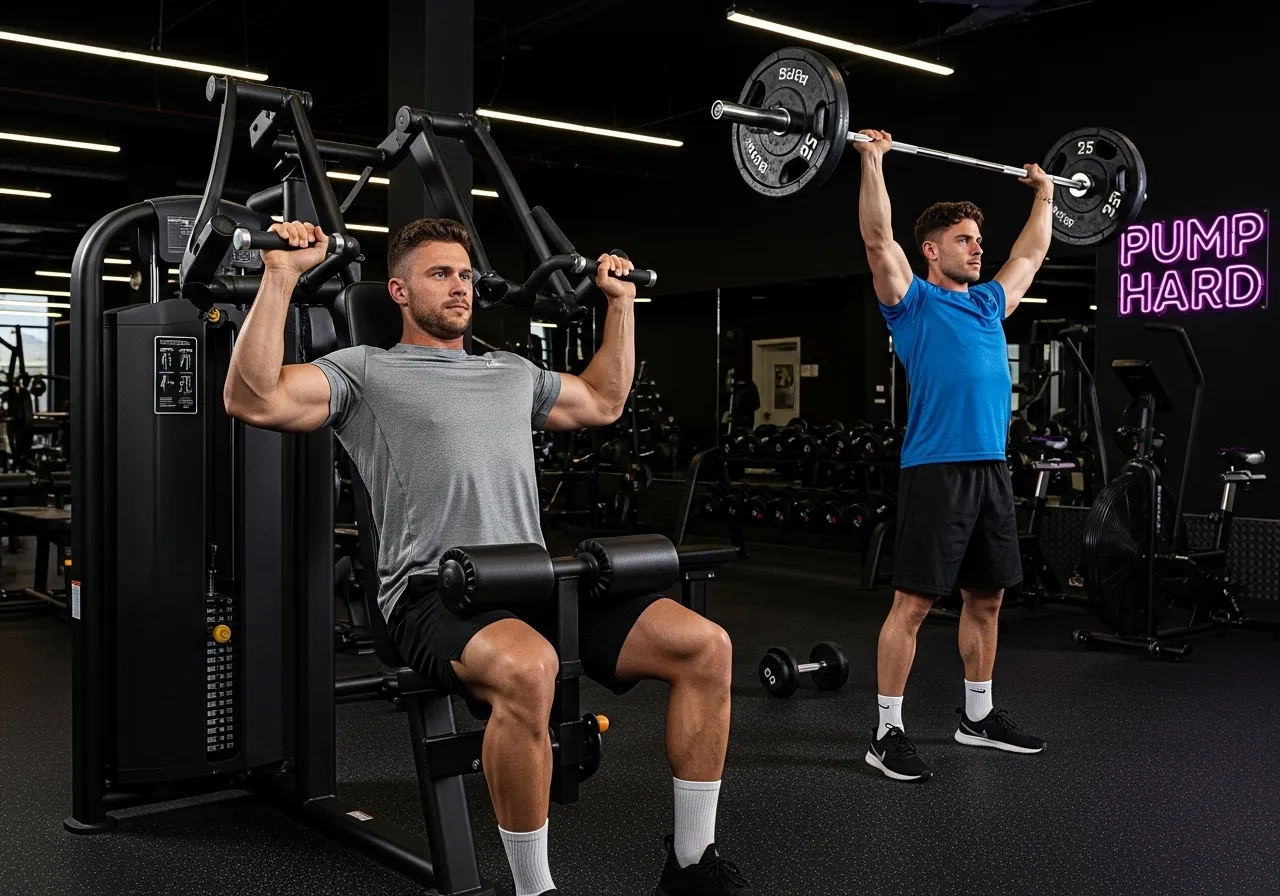
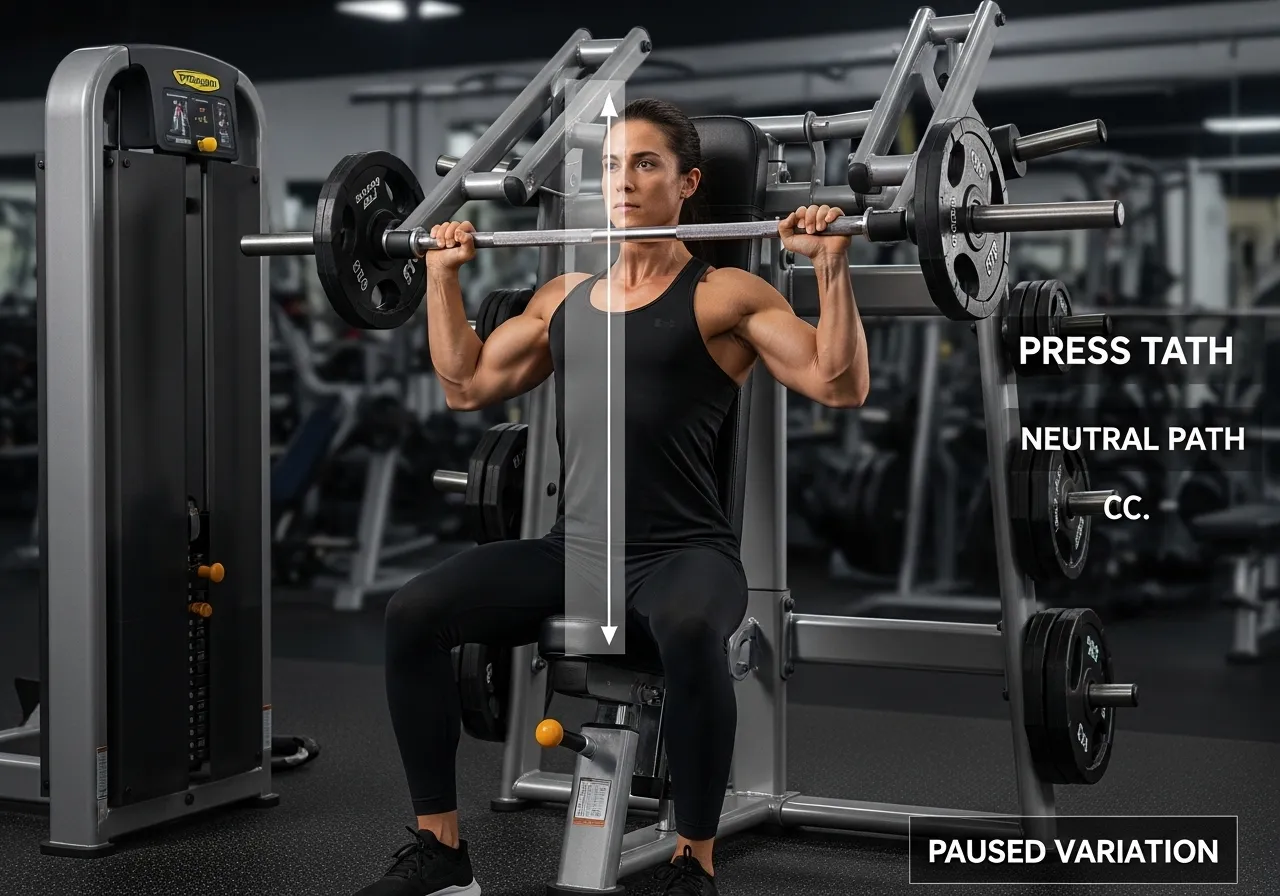
The shoulder press machine gets dismissed in most serious training environments. The reasoning is consistent: it is a machine, which means it does the stability work for you, which means it produces inferior results compared to free weights. This reasoning is correct in one dimension and wrong in another.
The machine shoulder press does trade stabiliser demand for primary muscle isolation. This is simultaneously its limitation and its advantage, depending on the trainee’s goal and context. A healthy experienced lifter maximising total shoulder development benefits from the bilateral coordination challenge and greater stabiliser stimulus of barbell pressing. A trainee managing a shoulder injury, an older adult building deltoid strength without rotator cuff stress, or an intermediate lifter adding volume beyond what free weight fatigue can sustain. Each of these trainees benefits specifically from what the machine provides.
This guide covers the EMG research on machine versus barbell and dumbbell shoulder press, what the fixed path advantage actually means mechanically, technique, variations, and how to programme the machine shoulder press within a complete shoulder development plan.
What the EMG Research Shows: Machine vs Barbell vs Dumbbell Overhead Press
📌 Key Finding
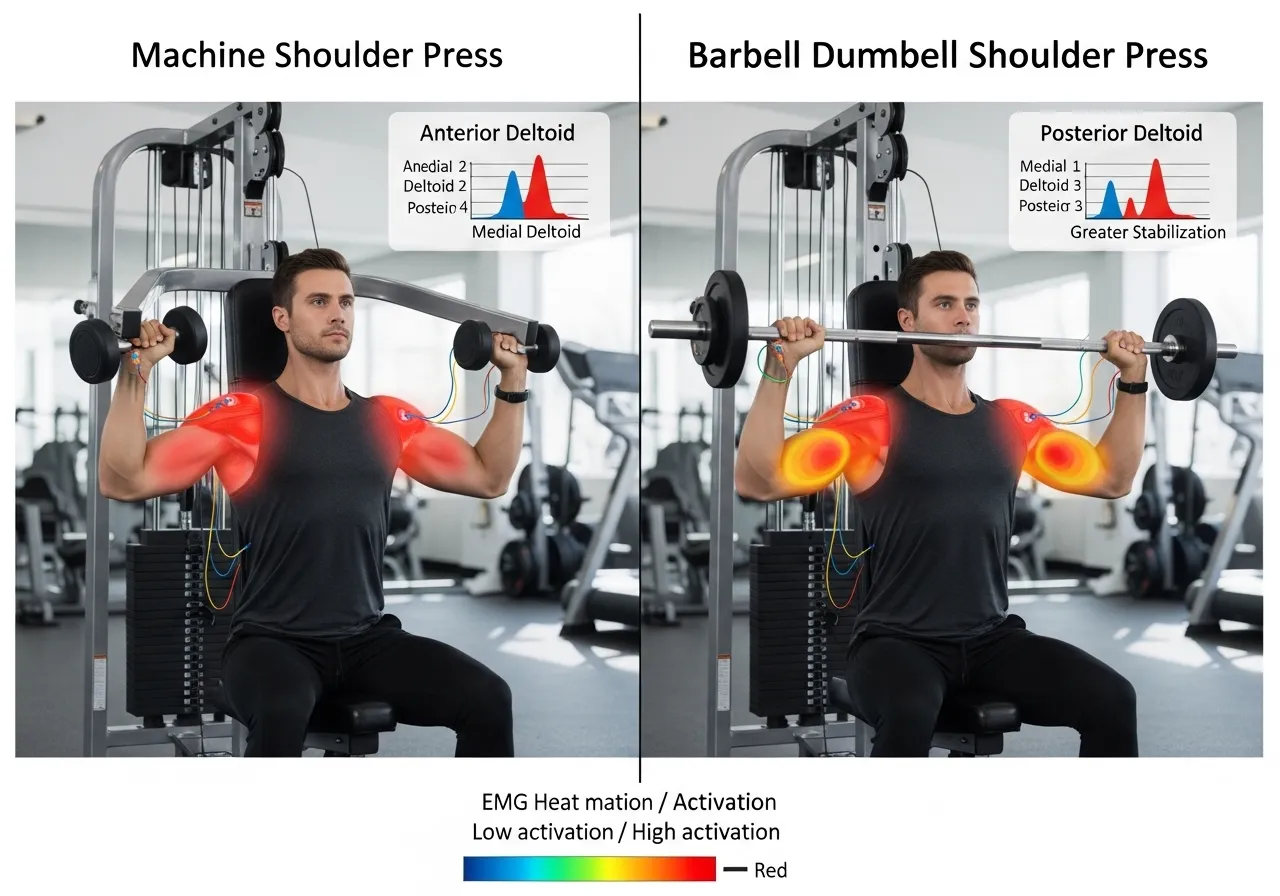
Barbell overhead press excites the posterior and medial deltoid more than machine press due to stabilisation demand. Anterior deltoid activation is similar across barbell and machine variations. For trainees whose primary goal is anterior deltoid hypertrophy, machine and barbell presses produce equivalent stimulus.
Barbell vs Dumbbell: The EMG Differences That Guide Programming
📌 Key Finding
Dumbbell press produces 11 to 15% greater anterior deltoid activation than barbell press at equivalent loads. The machine shoulder press, like the seated barbell, produces lower anterior deltoid activation than standing or seated dumbbell pressing because the fixed path removes the unilateral coordination demand that increases primary muscle recruitment.
Equipment Effects on Shoulder and Back Muscle Activation
📌 Key Finding
Machine pressing provides a distinct muscle activation profile rather than a uniformly inferior one. At heavier loads, the differences between machine and free weight activation diminish. Machines at high effort levels produce comparable primary muscle stimulus to free weights at the same effort level.
The Fixed Path Advantage: What the Machine Actually Does That Barbells Cannot
Fatigue Accumulation and Volume Capacity
The single most underappreciated advantage of the machine shoulder press is that it allows higher total volume in a training session than free weight pressing because it removes the stabiliser fatigue that limits free weight sets. A trainee who has performed 4 sets of barbell overhead press may have sufficient deltoid strength remaining for additional volume but insufficient rotator cuff and scapular stabiliser endurance to maintain safe free weight form. Performing 2 to 3 additional sets of machine shoulder press in this state produces genuine deltoid stimulus without the injury risk of continuing with a barbell on fatiguing stabilisers.
This fatigue separation is the primary programming application of the machine shoulder press in high-level training: it extends shoulder volume beyond what free weight pressing can safely provide. The anterior and medial deltoid continue to receive mechanical stimulus while the stabilisers exhausted by primary free weight work are protected by the machine’s fixed path.
Injury-Modified Training
Many shoulder pathologies, specifically rotator cuff irritation, acromioclavicular joint sensitivity, and early-stage impingement, are aggravated by the uncontrolled path variation that free weight pressing involves. The rotator cuff muscles work continuously during barbell and dumbbell pressing to stabilise the humeral head within the glenoid against the unpredictable micro-variations in bar path that the trainee’s fatigue, grip asymmetry, and scapular position create. These small perturbations are the training stimulus for the stabilisers. They are also the mechanism that irritates already-sensitised shoulder structures.
The machine shoulder press eliminates this variable path and allows the primary deltoid muscles to train through a full pressing range without demanding the rotator cuff stability that free weights require. For trainees managing minor shoulder pathology who need to maintain deltoid strength and volume during a period of free weight pressing avoidance, the machine shoulder press is the most appropriate pressing substitute. The scapular stability requirements for healthy pressing mechanics and how to develop them alongside machine pressing are covered in the scapular stability guide.
Bilateral Force Matching
The machine shoulder press with a bilateral mechanism forces both arms to move through identical ranges of motion simultaneously. This eliminates the bilateral asymmetry in pressing path that barbell pressing masks. A trainee with subtly different shoulder mobility between sides will show different machine ROM or loading capacity when each side is tested independently on a unilateral machine. This makes the machine an effective diagnostic tool for shoulder asymmetry identification alongside its training application.
Is the Machine Shoulder Press Worth Including if You Can Already Barbell Press?
The Case Against (and Why It Is Only Partially Correct)
The argument against machine shoulder pressing for trainees who can barbell press is straightforward: the barbell provides more total stimulus per set through greater stabiliser recruitment and higher absolute load capacity. Every set of barbell pressing develops more motor units, more rotator cuff endurance, and more total neural drive than the machine equivalent at matched effort. If time is limited and one pressing variation must be chosen, the barbell produces the more complete shoulder development stimulus.
This argument is correct for low-volume programmes where each exercise selection must maximise total stimulus. It does not apply to higher-volume programmes where the stabiliser fatigue from primary barbell work peaks and additional volume must come from an alternative source, or to trainees who specifically need to separate deltoid loading from rotator cuff loading.
The Complementary Case
The machine shoulder press and barbell overhead press are most effective when used together within a programme. The barbell press develops total shoulder strength, motor unit coordination, and stabiliser endurance. The machine press extends deltoid-specific volume beyond what barbell work alone can sustain and provides a lower-stress pressing option for recovery and deload periods. The complete barbell overhead press technique, EMG research, and how to programme it as the primary shoulder movement is covered in the overhead press guide.
A practical example: a trainee performing 4 sets of barbell overhead press at the start of a shoulder session may have sufficient deltoid capacity for 2 to 3 additional sets but insufficient rotator cuff endurance to maintain safe form under the barbell. Moving to the machine for these additional sets preserves the deltoid training stimulus while removing the risk of continued free weight pressing on fatiguing stabilisers. Over weeks, this approach accumulates meaningfully more total deltoid volume than barbell-only pressing would allow within the same session structure.
The volume extension argument is most compelling for intermediate and advanced trainees who have reached the point where their stabiliser capacity limits total pressing volume before their primary muscles are fully taxed. Beginners, whose limiting factor is usually primary strength rather than stabiliser endurance, benefit less from this approach and should focus on building free weight pressing competency before adding machine volume.
Who Should Prioritise the Machine Over the Barbell
Trainees with active shoulder impingement or rotator cuff sensitivity: Machine pressing removes the stability demand that irritates sensitised structures while maintaining deltoid loading.
Older adults: The controlled path reduces fall and injury risk from heavy free weight overhead pressing while maintaining the deltoid strength that contributes to functional overhead reach capacity.
Beginners learning overhead pressing: The machine teaches the pressing pattern, builds initial deltoid strength, and develops neuromuscular familiarity before the balance and coordination demands of free weight pressing are added.
Intermediate to advanced trainees needing pressing volume: When primary free weight pressing volume is maxed out by stabiliser fatigue, machine pressing extends total deltoid volume within the same session.
Machine Shoulder Press Technique: Setup, Execution, and the Variables That Matter
⚠️ Shoulder Safety Note The machine shoulder press handles should position the elbows at or slightly below shoulder height at the start position. Handles positioned below the elbow level with the elbows forced below shoulder height creates inferior shoulder mechanics regardless of machine design. Adjust the seat height before loading the machine. Pressing with an incorrect seat height that places the elbows too high or too low at the start position increases anterior capsule stress, reduces deltoid activation efficiency, and prevents the full pressing range from being safely completed.
Seat Height: The Setup Variable That Determines Everything
Adjust the seat so the handles align with the upper ears at the starting position. This places the elbows at approximately 90 degrees of shoulder abduction and 90 degrees of elbow flexion, the mechanically optimal position for deltoid pressing force production. If the handles align with the shoulders or lower, the seat is too high. If the handles are level with the top of the head, the seat is too low.
The correct seat height feels like a natural pressing position. Many trainees set the seat too low, placing the starting handle position below the shoulders, which converts the movement toward a decline press pattern. Setting it too high places excessive stress on the inferior joint capsule at the bottom of each rep. Take one to two minutes to carefully adjust the seat height before every machine shoulder press session, particularly when using a shared gym machine that the previous user may have adjusted specifically for their own dimensions.
Grip Width and Path Options
Most machine shoulder presses offer two grip options: a wider grip with hands facing forward (pronated) and a narrower grip with palms facing each other (neutral). The neutral grip reduces the demand on the internal shoulder rotators and places the glenohumeral joint in a more mechanically advantageous position for many trainees. Trainees with anterior shoulder discomfort should try the neutral grip before dismissing the exercise, as many shoulder pain presentations during machine pressing are eliminated by the neutral grip position.
Pressing Tempo and Range
Press to full extension at the top without locking out aggressively. The deltoid does not require full elbow lockout for maximal activation and the joint stress of slamming to lockout on a heavy machine set is unnecessary. Lower under 2 to 3 seconds of controlled eccentric to the starting position where the elbows reach 90 degrees. Do not lower past the point of mild shoulder stretch. The shoulder joint’s inferior capsule is under greatest stress at the extreme bottom position, and excessively deep positioning on the machine produces anterior shoulder capsule stress that the machine’s fixed path concentrates rather than distributes.
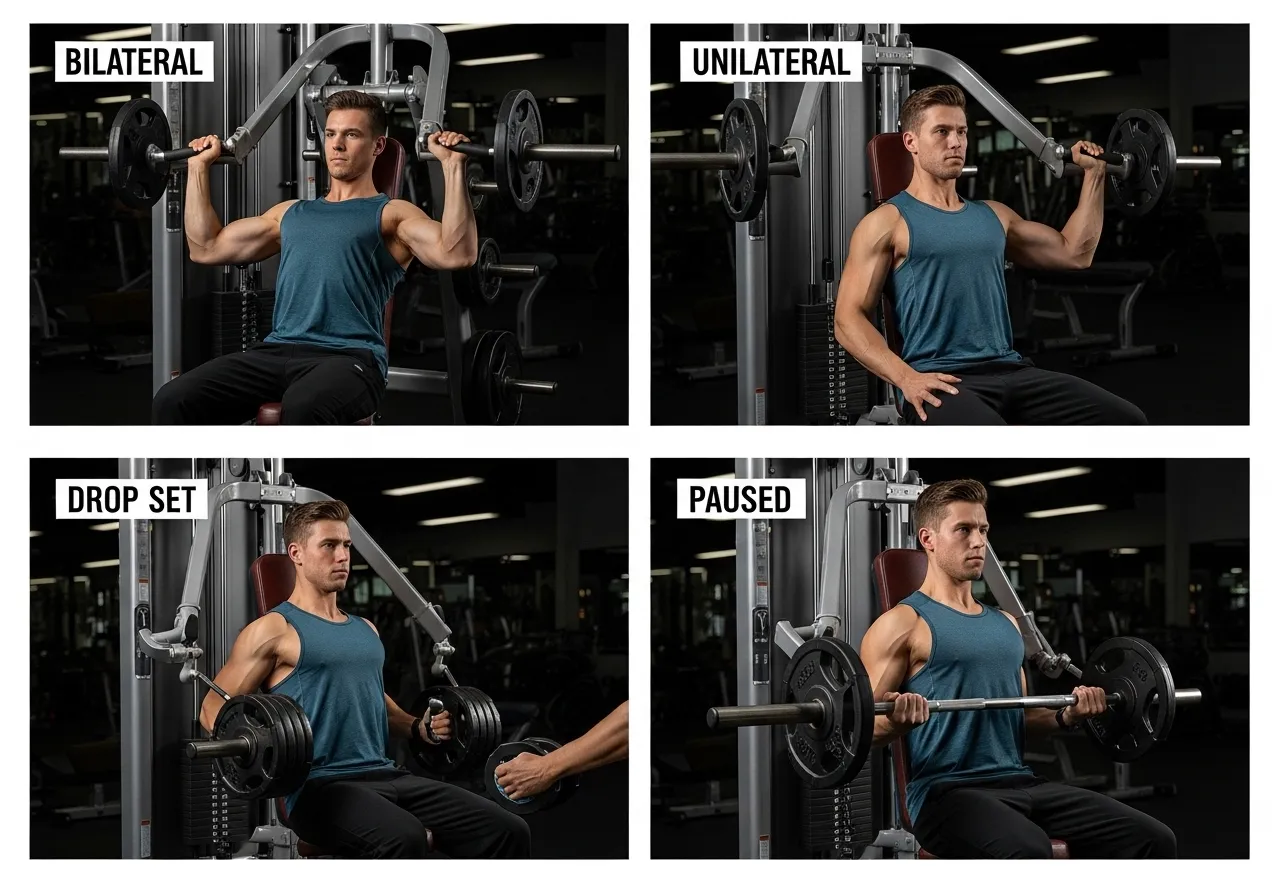
4 Machine Shoulder Press Variations and When to Use Each
🏋️ 1. Standard Bilateral Machine Press
Target: Anterior and medial deltoid, triceps, upper pec contribution
How: Standard seated bilateral press. Both arms press simultaneously through the machine’s arc. Primary variation for most trainees.
Best for: Primary machine pressing stimulus, volume accumulation after free weight pressing, trainees with bilateral shoulder mobility limitations that make barbell pressing uncomfortable.
🏋️ 2. Unilateral Machine Press (One Arm at a Time)
Target: Unilateral deltoid, shoulder asymmetry detection and correction
How: Use the machine with one arm while the other arm rests or holds the machine frame for stability. Perform all reps on one side before switching.
Best for: Identifying strength differences between shoulders, addressing shoulder asymmetries identified during rehabilitation, trainees who cannot perform bilateral pressing due to unilateral injury.
🏋️ 3. Machine Press Drop Set
Target: Maximum deltoid metabolic stress and hypertrophy through extended set volume
How: Perform a full set to near-failure, immediately reduce the weight by 20 to 25% without rest, continue to the next near-failure point. Repeat two to three times.
Best for: Advanced trainees seeking additional hypertrophy stimulus at the end of a shoulder session. The machine allows rapid weight adjustment that barbells cannot, making drop sets more practical and safer on machine exercises than on free weight pressing.
🏋️ 4. Paused Machine Press
Target: Deltoid strength at bottom position, elimination of bounce and momentum
How: Lower to the starting position and pause completely for 1 to 2 seconds before pressing. This removes any elastic energy contribution from the shoulder structures and forces the deltoid to produce force from a dead stop.
Best for: Trainees who find they use momentum or bounce at the bottom of their machine press reps. The pause variation also builds strength specifically at the stretched bottom position, which transfers well to free weight pressing recovery from the bottom of the range.
Programming the Machine Shoulder Press Within a Complete Shoulder Programme
As Primary Shoulder Movement (Injury-Modified or Beginner Context)
When the machine shoulder press serves as the primary pressing movement, programme it first in the shoulder session before fatigue from other exercises reduces performance quality. Three to four sets of 8 to 12 reps with progressive load across weeks is the standard approach. Pair it with lateral raises and rear delt work to develop the complete three-head shoulder stimulus that pressing alone cannot provide.
As Secondary Pressing Volume (Standard Context)
When the machine shoulder press supplements primary barbell or dumbbell pressing, place it after the primary free weight work. Two to three sets of 10 to 15 reps at moderate load extend deltoid volume without adding to the stabiliser fatigue from the primary movements. The higher rep range in this position takes advantage of the machine’s efficiency at metabolic hypertrophy stimulus while the primary compound work has already addressed strength development.
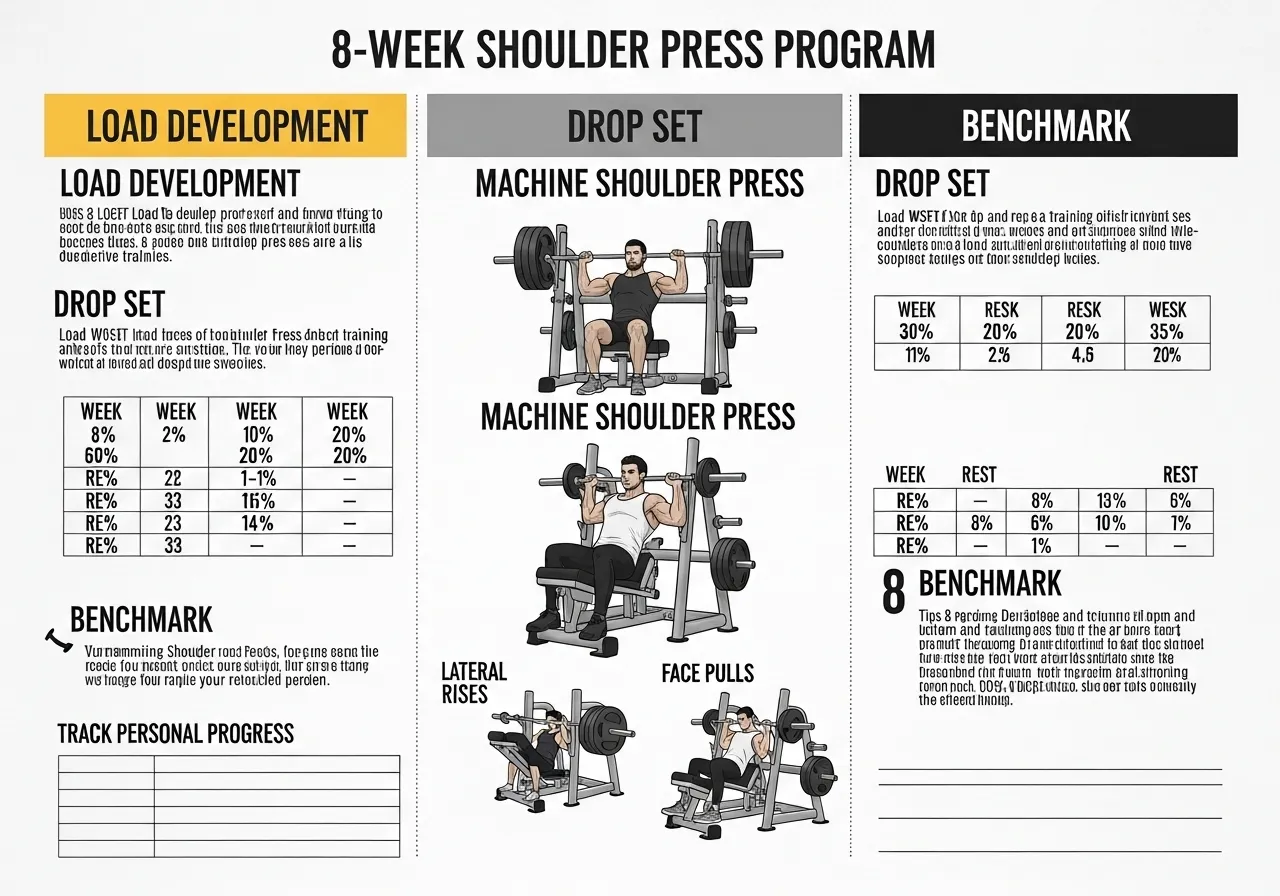
8-Week Machine Shoulder Press Programme
📅 Phase 1: Weeks 1 to 3: Position and Technique
Machine shoulder press: 3 sets of 12 reps, moderate load
Focus: seat height calibration, neutral grip trial, full range
Unilateral test: assess load difference between sides
Establish the machine setup and identify any side-to-side load differences before progressing.
📅 Phase 2: Weeks 4 to 6: Load Development
Machine shoulder press: 4 sets of 8 to 10 reps, increase load weekly
Add paused variation: 2 sets of 8 reps at 80% of working load
If asymmetry found in Phase 1: add one extra set on weaker side
Build load progressively. The paused variation develops bottom-position strength that transfers to free weight pressing.
📅 Phase 3: Weeks 7 to 8: Peak Volume
Machine shoulder press: 4 sets of 6 to 8 reps at near-maximal load
Add 1 drop set on the final set for hypertrophy stimulus
Compare working loads to Phase 1 starting weights as benchmark
Begin transitioning load toward free weight pressing if goal is barbell development
Peak load phase. The drop set on the final set of the session extends deltoid stimulus without adding full-effort sets. The dumbbell shoulder press and how it compares to machine and barbell pressing is covered in the dumbbell shoulder press guide.
Frequently Asked Questions About the Machine Shoulder Press
Does the machine shoulder press build as much muscle as the barbell overhead press?
For anterior deltoid development specifically, the research suggests comparable stimulus at equivalent effort levels. The barbell press excites the posterior deltoid and medial deltoid more due to the stabilisation demand, but anterior deltoid activation is approximately equal between the two variations. Total shoulder development favours the barbell because it trains more total shoulder muscle through higher stabiliser demand. For trainees specifically targeting anterior deltoid hypertrophy, the machine provides adequate stimulus at lower injury risk.
The practical answer for most trainees: using both produces more complete shoulder development than either alone. The barbell overhead press develops total shoulder strength, coordination, and stabiliser endurance. The machine press extends deltoid-specific volume beyond what barbell fatigue limits. The combination outperforms either in isolation for complete shoulder development at higher training volumes.
At what point in a session should I use the machine press?
The machine shoulder press belongs after primary free weight pressing movements when used as supplementary volume. Performing it before barbell pressing pre-fatigues the deltoids and reduces the quality of the primary strength movement. When the machine is the only or primary pressing movement, session placement is flexible and it can be performed first when the deltoids are fresh.
The exception: the paused machine press variation as a warm-up set before heavy barbell pressing. Two light sets of paused machine press activate the deltoids and establish shoulder mechanics before loading the barbell. This warm-up function uses the machine’s controlled path to prepare the shoulder for the stabilisation demands of subsequent free weight work.
How much can I expect to lift on a machine shoulder press compared to a barbell?
Most trainees find their machine shoulder press working load is 5 to 15% lower than their barbell overhead press working load at equivalent sets and reps. This lower load reflects the biomechanical difference between the exercises rather than a weakness. The machine’s fixed arc removes the need to control the bar path, which allows some trainees to feel stronger initially, but the absence of stabiliser contribution means the primary muscles are working with less total system contribution at any given load.
A useful comparison: if you barbell overhead press 60 kg for 3 sets of 8, a starting machine shoulder press working weight of 52 to 55 kg for the same rep scheme is a reasonable initial load. Adjust from there based on the feel of the movement and the specific point during each set where the deltoid, not the stabilisers or balance, becomes the genuine limiting factor for continued reps. When the machine working weight approaches or closely matches the barbell overhead press working weight, the trainee has developed sufficient stabiliser strength that free weight pressing is no longer limited by stabiliser capacity. At that point, the primary development tool should transition toward greater free weight pressing volume.
How does the machine shoulder press compare to the Smith machine shoulder press?
The Smith machine shoulder press provides a fixed vertical path, which reduces the lateral stabilisation demand compared to a free barbell but does not provide the full biomechanical support of a dedicated shoulder press machine. The shoulder press machine typically uses a lever arm that follows a natural shoulder pressing arc rather than a straight vertical path, which better matches the biomechanical arc of the glenohumeral joint during overhead pressing.
The shoulder press machine is therefore biomechanically superior to the Smith machine for shoulder pressing in most cases. The Smith machine’s vertical fixed path forces the glenohumeral joint through a straight-line movement that the joint does not naturally produce, potentially increasing anterior capsule stress compared to both free weight pressing and dedicated shoulder press machine use.
Key Takeaways
Barbell overhead press excites the posterior and medial deltoid more than machine pressing due to stabilisation demand. Anterior deltoid activation is approximately equal between variations at matched effort.
Dumbbell press produces 11 to 15% greater anterior deltoid activation than barbell press. Machine press, like seated barbell, produces lower anterior deltoid activation than standing or seated dumbbell pressing.
The machine shoulder press’s primary advantage is volume extension beyond free weight stabiliser fatigue limits, not superior primary muscle stimulus. This makes it most valuable as a secondary movement after primary free weight pressing.
Correct seat height positions the handles at upper ear level at the start. Too low converts pressing toward a decline pattern. Too high overstresses the inferior shoulder capsule at the bottom position.
For injury-modified training, the machine shoulder press maintains deltoid loading while removing the rotator cuff stabilisation demand that irritates sensitised shoulder structures during free weight pressing.
Warning Fitness Disclaimer: The information in this article is for general educational purposes only and does not constitute professional fitness or medical advice. Always consult a qualified healthcare professional before starting any new exercise program, especially if you have existing injuries or medical conditions. The Most Versatile Piece of Equipment in the Gym That Most…
⚠️ Health & Fitness DisclaimerThis article is for general educational and informational purposes only and does not replace professional medical or fitness advice.If you have any pre-existing shoulder, back, or joint condition — consult a qualified healthcare professional or certified trainer before beginning any cable machine mastery program. The cable machine is arguably the most…
⚠️ Fitness Disclaimer: The information in this article is for general educational purposes only and does not constitute professional fitness or medical advice. Exercise carries inherent risks. Always consult a qualified healthcare professional or certified personal trainer before starting or modifying any exercise program, especially if you have a pre-existing medical condition, injury, or health…
⚠️ Fitness Disclaimer: The information in this article is for general educational purposes only and does not constitute professional fitness or medical advice. Always consult a qualified healthcare professional before starting any new exercise program. The Exercise That Serious Lifters Do But Never Talk About Watch a serious, experienced lifter’s training session and you will…
The barbell row is the standard back thickness exercise. It allows heavy loading, trains the entire posterior chain, and has decades of proven effectiveness. Most serious lifters include it and most serious lifters plateau with it eventually. The plateau often has a simple mechanical explanation: the pronated (overhand) grip and horizontal torso position of the…
⚠️ Fitness Disclaimer: The information in this article is for general educational purposes only and does not constitute professional fitness or medical advice. Always consult a qualified healthcare professional before starting any new exercise program. Why You Feel the Seated Row Everywhere Except Your Back The seated cable machine guide row is one of the…