Indoor Cycling Guide: Cardiovascular Research, Bike Types, Training Zones, and 8-Week Program
This article is for general educational purposes only and does not replace professional medical advice. If you have any cardiovascular, joint, or metabolic conditions, consult a qualified healthcare professional before beginning any cycling for fitness guide program.
Indoor cycling is among the most versatile and research-supported cardiovascular training tools available — offering low-impact, high-intensity conditioning that is accessible to beginners, rehabilitating adults, competitive athletes, and everyone between. (Related: VO2 max guide)
A systematic review of indoor cycling health benefits found that indoor cycling may be effective for enhancing VO2max (the maximum rate at which the body can consume oxygen during exercise — the gold standard measure of cardiovascular fitness), HDL cholesterol (high-density lipoprotein — the protective form of cholesterol), and lean body mass while reducing body fat mass, systolic blood pressure, diastolic blood pressure, LDL cholesterol, and triglycerides (blood fats associated with cardiovascular disease risk).
This guide covers the physiological research behind indoor cycling’s benefits, explains the different bike types and their distinct applications, details cadence and resistance programming, and provides a complete 8-week program for all levels.
Indoor Cycling Physiology: How It Develops Cardiovascular Fitness
The Cardiovascular Stimulus
Indoor cycling generates a cardiovascular training stimulus through the sustained engagement of the large lower body muscle groups — quadriceps (the four-headed muscle at the front of the thigh), hamstrings, gluteus maximus, and gastrocnemius/soleus (the calf muscle complex) — whose combined metabolic demand requires the heart and lungs to sustain elevated output continuously throughout the session.
A PMC study comparing energy expenditure, oxygen consumption, and heart rate across seven indoor cardio machines found that upright and spin bikes produced significantly higher energy expenditure, VO2, and heart rate values than recumbent bikes at matched effort levels — while all cycling modalities produced meaningful cardiovascular stimulus — confirming that bike type and body position significantly influence the training response even at the same perceived exertion.
VO2max Development: Intensity Matters
An overview of systematic reviews examining exercise training intensity and VO2max found that exercise training robustly increases VO2max at all intensities, with high-intensity training producing small to moderate additional benefits over lower-intensity training — confirming that both steady-state moderate cycling and high-intensity interval cycling produce genuine cardiovascular adaptations, with intensity determining the magnitude and timeline of improvement.
The practical implication: both moderate-paced steady cycling and high-intensity intervals are effective tools for developing cardiovascular fitness — the appropriate choice depends on the trainee’s current fitness level, recovery capacity, and specific goals.
Low Impact, High Reward: The Joint-Sparing Advantage
Unlike running — which produces ground reaction forces of 2–3 times bodyweight at each foot strike — cycling is a non-impact activity. The circular pedalling motion distributes load around the entire pedal stroke arc rather than concentrating it at a single impact point.
Practical consequences of this low-impact profile:
- Individuals with running-related knee, hip, or ankle injuries can typically maintain cardiovascular training continuity on a bike while the impacted structures recover
- Higher training volumes are tolerable on a bike than on foot — the cumulative joint loading that limits running mileage does not accumulate equivalently in cycling
- Older adults and those with osteoarthritis (degeneration of joint cartilage — a condition for which weight-bearing impact may be contraindicated) may perform vigorous cardiovascular training on a bike that would not be feasible on their joints through running
Muscle Development From Cycling
While cycling is primarily a cardiovascular modality, meaningful lower body muscular adaptations occur alongside cardiovascular improvements — particularly in beginners and those returning from inactivity:
- Quadriceps and gluteus maximus hypertrophy (increase in muscle cross-sectional area) has been documented in untrained individuals beginning cycling programs, particularly at higher resistance levels
- Cycling at moderate-to-high resistance specifically develops the slow-twitch muscle fibres (type I muscle fibres — specialised for sustained, low-power contractions and highly fatigue-resistant) that support endurance performance and metabolic health
- Core musculature — particularly the erector spinae (the muscles running alongside the vertebral column) and hip flexors — is actively engaged throughout cycling to maintain torso position and generate hip drive
Cycling and Mental Health: The Psychological Benefits
Beyond the metabolic and cardiovascular adaptations, indoor cycling produces meaningful psychological benefits that are sometimes overlooked in clinical discussions of the modality:
- Mood elevation: The endorphin and endocannabinoid release during vigorous cycling produces acute mood improvements that are well-documented across cardiovascular exercise research and are consistently reported by regular cyclists
- Stress reduction: The rhythmic, repetitive nature of cycling provides a cognitive engagement that many individuals find meditative — the focus required to maintain cadence, adjust resistance, and monitor effort displaces ruminative thought patterns that contribute to anxiety and stress
- Self-efficacy development: Measurable performance improvements — completing longer sessions, sustaining higher heart rate zones, or improving on timed benchmarks — build the exercise self-efficacy (the belief in one’s ability to exercise effectively) that predicts long-term exercise adherence
Group Cycling Classes: The Social Dimension
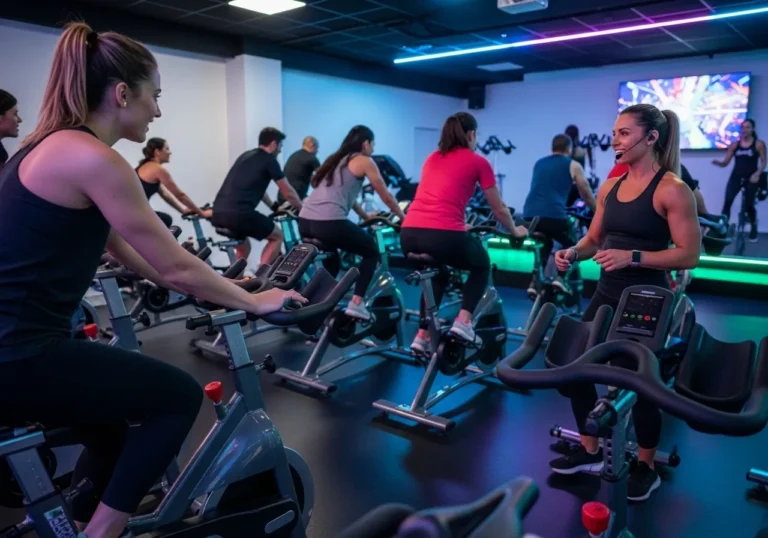
Instructor-led group cycling classes (spin classes, virtual cycling platforms, and cycling studios) add a social and motivational dimension to indoor cycling that solo training cannot replicate:
- Social accountability and group energy frequently produce higher effort levels than solo training at comparable perceived exertion — the “group effect” is well-documented in exercise psychology research
- Instructor cueing provides technique correction and motivation that novice cyclists training alone may lack
- Structured class programming removes the need for individual session design — particularly valuable for beginners who may not yet have the knowledge to self-program effective training sessions
The primary limitation of group classes for performance-oriented cyclists is the absence of individualised intensity prescription — class intensity is set for a group, and may not align precisely with the individual training zones most appropriate for a specific trainee’s current fitness level and goals.
Bike Types: Which Machine Matches Your Goal?
Upright Stationary Bike
The upright bike replicates the riding position of a conventional road bicycle — torso slightly forward, weight distributed between the seat and handlebars. It is the most common gym cardio bike and the most versatile for general fitness applications.
- Training stimulus: Moderate-to-high cardiovascular and leg muscle activation — higher than recumbent bikes due to the more demanding body position requiring core stabilisation
- Advantages: Accessible for all fitness levels; adjustable resistance allows steady-state and interval training; widely available in gyms and as home equipment
- Limitations: Can produce saddle discomfort during long sessions without appropriate seat adjustment; less comfortable than recumbent for people with lower back sensitivity in the upright torso position
Spin Bike (Indoor Cycling Bike)
The spin bike uses a heavier flywheel (the weighted wheel whose momentum simulates road cycling inertia) and a more aggressive forward-leaning riding position than standard upright bikes. It most closely replicates road cycling biomechanics.
- Training stimulus: The highest of any cycling modality — the aggressive position, heavier resistance range, and standing sprint capability produce cardiovascular and muscular demands comparable to outdoor cycling
- Advantages: Allows out-of-saddle sprinting that engages upper body and core more than seated cycling; heavy flywheel teaches smooth pedal stroke; highest caloric expenditure potential among bike types
- Limitations: More technical setup required (saddle height, handlebar height, and fore-aft position all affect biomechanics and injury risk); not recommended without an introductory fit and technique session
Recumbent Bike
The recumbent bike places the rider in a reclined position with the pedals in front rather than below — significantly reducing the upper body loading and shifting the cardiovascular demand almost entirely to the legs.
- Training stimulus: Lower cardiovascular intensity than upright or spin bikes at matched resistance settings — the reclined position facilitates more efficient venous return (blood flow back to the heart through the veins) and reduces the circulatory demand of lifting the torso
- Advantages: Significantly more comfortable for prolonged sessions; safest option for individuals with lower back pain, poor balance, or cardiac conditions requiring conservative intensity management
- Best use cases: Rehabilitation, older adults, individuals with lower back sensitivity, or extended-duration low-intensity cardiovascular conditioning
Air Bike (Fan Bike)
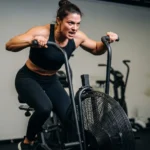
The air bike uses fan resistance — the harder you pedal, the more resistance the fan generates — alongside handlebars that move back and forth to engage the upper body simultaneously with the legs.
- Training stimulus: The highest intensity of any gym bike — the combination of leg and arm work, unlimited resistance scaling, and the aerobic-anaerobic demand of all-out efforts makes the air bike disproportionately demanding relative to its simple appearance
- Best use cases: HIIT training guide training, short maximum-effort intervals, metabolic conditioning circuits
- Limitations: Not suitable for prolonged steady-state riding — the resistance scaling makes even moderate intensities uncomfortable for extended duration
| Bike Type | Intensity Potential | Joint Impact | Best For |
|---|---|---|---|
| Upright | Moderate–high | Very low | General fitness, all levels |
| Spin | High–very high | Very low | Performance training, classes |
| Recumbent | Low–moderate | Lowest | Rehabilitation, back pain, elderly |
| Air bike | Very high | Very low | HIIT, conditioning circuits |
Cycling for Rehabilitation and Special Populations
Indoor cycling’s low-impact profile makes it one of the most broadly applicable cardiovascular training modalities for populations where impact loading is contraindicated:
- Post-surgical rehabilitation: Recumbent cycling is frequently incorporated into cardiac rehabilitation programs following myocardial infarction (heart attack) and cardiac surgery — providing cardiovascular conditioning at conservative, monitored intensities that maintain fitness during medical recovery
- Osteoarthritis management: Cycling provides the joint mobility stimulation and cardiovascular conditioning that support osteoarthritis management without the articular loading that makes weight-bearing exercise painful for many individuals with moderate-to-severe joint disease
- Overweight and obesity: The seated position distributes bodyweight across the saddle rather than concentrating it on the lower limb joints — making cycling accessible at body weights where walking and running produce significant joint discomfort
For individuals in these populations, working with a physiotherapist or exercise physiologist (a specialist in applying exercise science principles to health management) to determine appropriate intensity, duration, and bike setup before beginning an independent cycling program may reduce risk and improve outcomes.
Is Cycling Enough for Full-Body Fitness Development?
What Cycling Develops Comprehensively
Cycling produces substantial adaptations in the domains directly stressed by the activity:
- Cardiovascular fitness: VO2max improvements, reduced resting heart rate, improved stroke volume (the volume of blood pumped per heartbeat), and lower blood pressure are well-documented in cycling interventions
- Lower body muscular endurance: The quadriceps, glutes, and hamstrings develop significant endurance capacity — relevant to extended daily activity, stair climbing, and sport performance
- Metabolic health: Improvements in insulin sensitivity (the efficiency with which cells respond to insulin’s signal to absorb blood glucose), lipid profiles, and body composition have been documented across multiple indoor cycling studies
Where Cycling Has Meaningful Limitations
For comprehensive physical development, cycling has notable gaps that may require supplementary training:
- Upper body development: Standard cycling provides minimal stimulus to the chest, shoulders, back, and arms — these muscle groups require dedicated resistance training if their development is a goal
- Bone density: Unlike running and jumping, cycling is non-weight-bearing — it does not stimulate the osteogenic (bone-building) adaptations associated with impact-loading exercises. Individuals who rely solely on cycling for physical activity may be at greater risk for the bone density reductions associated with aging and inactivity in weight-bearing structures.
- Core strength: While cycling engages the core as a stabiliser, it does not develop the anti-extension and anti-rotation core strength that dedicated core training produces
- Flexibility: Extended cycling in a fixed position can actually shorten the hip flexors and hamstrings over time — regular stretching of these structures is advisable for regular cyclists
The Optimal Complement: Cycling and Resistance Training
Cycling and resistance training complement each other practically and physiologically:
- Cycling provides cardiovascular conditioning that supports the systemic recovery capacity needed for resistance training frequency
- Resistance training provides the bone density stimulus, upper body development, and core strength that cycling cannot address
- On recovery days from heavy strength training, low-intensity cycling provides active recovery (light physical activity promoting blood flow and metabolic byproduct clearance without generating additional muscle damage) that accelerates the recovery process
Placing cycling sessions on non-lifting days or after (not before) heavy lower body strength sessions preserves the training quality of both modalities.
Monitoring Session Quality: RPE and Heart Rate
Two complementary tools for monitoring cycling session quality provide different and complementary information:
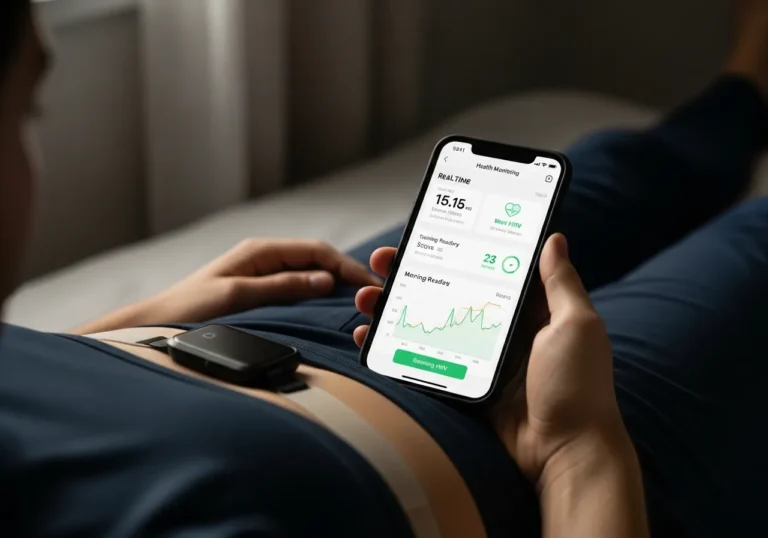
- Heart rate: The most objective measure of cardiovascular intensity — reflects actual physiological demand regardless of how “hard” the effort feels. Heart rate monitors (chest strap or wrist-based optical) allow real-time zone tracking and post-session review of effort distribution. Chest-strap monitors are more accurate during high-cadence cycling where wrist motion can introduce optical sensor noise.
- RPE (rate of perceived exertion — a subjective scale, typically 6–20 or 1–10, that quantifies how hard exercise feels): Captures dimensions of fatigue and effort that heart rate alone misses — the same heart rate on a day with accumulated fatigue feels harder than on a fresh day. RPE tracking alongside heart rate provides a more complete picture of training load and recovery status.
For beginners without heart rate monitors, the talk test (ability to speak in short sentences indicates Zone 2 training guide; inability to speak suggests Zone 4+) provides a reliable free intensity guide that requires no equipment beyond awareness of breathing pattern.
Fuelling and Hydration for Indoor Cycling
Indoor cycling produces significant sweat rates — often higher than equivalent outdoor cycling intensity due to the absence of airflow cooling. Practical hydration guidelines:
- For sessions under 60 minutes at moderate intensity: water before and after the session, with small sips during, is generally sufficient for most individuals
- For sessions over 60 minutes or high-intensity intervals: 400–600 ml of fluid per hour during exercise, with consideration of electrolyte replacement (sodium, potassium) if sweating is heavy
- Pre-session nutrition: a light meal 1–2 hours before cycling or a small easily digestible snack 30–45 minutes before may prevent the low blood glucose (hypoglycaemia — abnormally low blood sugar causing dizziness, weakness, and impaired performance) that some individuals experience when cycling in a fasted state at moderate-to-high intensity
Cadence, Resistance, and Training Zones: The Performance Variables
Cadence: Finding Your Optimal RPM
Cadence (RPM — revolutions per minute — the number of complete pedal rotations per minute) is the primary controllable variable in cycling training alongside resistance. The relationship between cadence and training effect is nuanced:
| Cadence | Resistance | Primary Demand | Training Effect |
|---|---|---|---|
| 60–70 RPM | High | Strength-endurance | Leg strength, muscular endurance |
| 75–90 RPM | Moderate | Aerobic endurance | Cardiovascular base, fat oxidation |
| 90–100+ RPM | Low–moderate | Cardiovascular | VO2max, neuromuscular speed |
| 100–120+ RPM | Low | Speed, technique | Pedal efficiency, spin technique |
Training Zones: Programming by Heart Rate
Heart rate-based training zones provide the most objective intensity guide for cycling sessions — matching the effort to the intended physiological stimulus regardless of fitness level or machine settings:
| Zone | % Max HR | Perceived Effort | Primary Use |
|---|---|---|---|
| Zone 1 (Recovery) | <65% | Very easy — full conversation | Warm-up, cool-down, active recovery |
| Zone 2 (Aerobic) | 65–75% | Easy — short sentences | Aerobic base, fat oxidation |
| Zone 3 (Tempo) | 76–82% | Moderate — 1–2 words | Cardiovascular development |
| Zone 4 (Threshold) | 83–89% | Hard — cannot speak | VO2max improvement, performance |
| Zone 5 (Maximum) | 90–100% | Maximum — unsustainable | Peak power, sprint intervals |
Maximum heart rate estimate: 220 minus age provides a rough population average — individual variation is substantial and this formula becomes progressively less accurate for conditioned athletes. A fitness test-derived maximum (the highest heart rate achieved during a genuine all-out effort) is more accurate for programming precision.
Resistance: The Training Stimulus Multiplier
Resistance determines the mechanical load on the pedalling muscles — the primary driver of the strength and muscular endurance adaptations that complement cycling’s cardiovascular effects:
- Too little resistance at high cadence produces cardiovascular stimulus with minimal muscular loading — appropriate for high-cadence technique work and Zone 2 base building
- Appropriate resistance produces the combination of cardiovascular and muscular loading that most training goals require — the “right” resistance feels genuinely challenging while allowing the target cadence to be maintained through the planned interval duration
- Excessive resistance at low cadence converts cycling into a strength exercise with reduced cardiovascular component — useful periodically but not the foundation of most cycling programs
Progressive Overload in Cycling: How to Ensure Continued Improvement
The same progressive overload principle that drives strength training adaptations applies to cycling fitness development — the cardiovascular system adapts to training demands and requires progressive challenge to continue improving.
Cycling-specific overload progressions, applied incrementally over weeks:
- Duration: Extending steady-state sessions by 5 minutes per week at a consistent Zone 2 intensity builds aerobic capacity progressively without requiring intensity increases that many beginners are not yet ready for
- Intensity: Gradually shifting a greater proportion of weekly training time from Zone 2 to Zone 3 and 4 as aerobic base develops — the established aerobic foundation makes higher-intensity work both safer and more productive
- Volume: Adding a fourth weekly session once three sessions are consistently manageable — frequency increases provide a different overload stimulus than duration or intensity increases alone
- Resistance: Periodically including one “strength-endurance” session per week at 60–70 RPM with high resistance — developing the muscular endurance that complements the cardiovascular adaptations from higher-cadence work
8-Week Indoor Cycling Program: Beginner to Intermediate
Program Structure
Three to four cycling sessions per week, progressing from foundational Zone 2 steady-state work in weeks 1–2 to interval training and threshold work in weeks 5–8. Each session begins with a 5-minute Zone 1 warm-up and ends with a 5-minute Zone 1 cool-down — not included in the session durations below.
Session A: 20 min continuous Zone 2 (65–75% max HR, 75–85 RPM, moderate resistance)
Session B: 20 min continuous Zone 2
Session C: 25 min continuous Zone 2
Focus: Establishing pedalling rhythm, saddle comfort, breathing pattern
Session A: 30 min Zone 2
Session B: 4 × 5 min Zone 3 / 3 min Zone 1 recovery
Session C: 35 min Zone 2
Focus: Extending duration at aerobic intensity; first introduction to Zone 3 work
Session A: 35–40 min Zone 2
Session B: 6 × 3 min Zone 4 / 3 min Zone 1 recovery
Session C: 40 min Zone 2
Session D: 10 × 1 min Zone 5 / 2 min Zone 1 recovery (HIIT format)
Focus: Introducing threshold and high-intensity work alongside aerobic base maintenance
Session A: 45 min Zone 2 (longest aerobic session)
Session B: 5 × 5 min Zone 4 / 3 min Zone 1 recovery
Session C: 20-min time trial — sustain highest sustainable effort for full duration (benchmark session)
Session D: 8 × 90 sec Zone 5 / 2 min Zone 1 recovery
Caloric Expenditure Expectations
Indoor cycling caloric expenditure varies substantially with body weight, resistance, cadence, and intensity. General estimates for a 70 kg individual:
- Zone 2, 30 min: Approximately 250–300 kcal
- Zone 3, 30 min: Approximately 300–370 kcal
- Zone 4–5 HIIT, 20 min: Approximately 250–320 kcal during session, plus meaningful EPOC (excess post-exercise oxygen consumption — the elevation in metabolic rate that persists for hours after high-intensity exercise) contribution
These estimates are broad approximations — individual variation is significant, and machine-displayed calorie estimates are unreliable without accurate body weight and metabolic data input. Effort level (heart rate) is a more reliable intensity indicator than displayed calories for session quality assessment.
Tracking Cycling Progress: Meaningful Benchmarks
Meaningful progress tracking in cycling requires measuring the right variables at appropriate intervals:
- 20-minute time trial: Sustaining the highest manageable effort for exactly 20 minutes — the average power output or heart rate achieved provides a reliable fitness benchmark. Repeat monthly under consistent conditions for objective progress measurement.
- Heart rate at a fixed cadence and resistance: If using the same machine settings weekly, heart rate at a given workload decreases as cardiovascular fitness improves — confirming adaptation without requiring maximal testing.
- Duration at Zone 2: The ability to sustain Zone 2 for progressively longer durations at the same heart rate — from 20 minutes to 30 to 45 — directly reflects improving aerobic base capacity.
Progress photographs of body composition and measurements of resting heart rate (taken immediately upon waking, before any activity) complement performance benchmarks — resting heart rate reductions of 5–15 beats per minute over months of consistent cycling training are a reliable indicator of meaningful cardiovascular adaptation.
Bike Setup, Common Errors, and Injury Prevention
Critical Bike Setup: Saddle Height
Saddle height is the single most important bike setup variable — incorrect saddle height is responsible for the majority of cycling-related knee and hip discomfort. Correct saddle height produces a slight bend in the knee (approximately 25–35° of flexion at the bottom of the pedal stroke, or 145–155° knee angle) — not a fully locked leg and not a significantly bent knee.
Handlebar Height and Fore-Aft Position
- Handlebar height: For general fitness and comfort, handlebars at or slightly above saddle height reduce lower back stress. Lower handlebar positions (used in spin bikes and road cycling) increase back muscle engagement but require flexibility to maintain without discomfort.
- Saddle fore-aft: With the pedal at the 3 o’clock position (horizontal to the ground), the knee should be directly above the pedal spindle — not significantly ahead of or behind it. Forward saddle position shifts load to the quadriceps; rearward position engages the hamstrings and glutes more.
Common Cycling Errors and Their Consequences
| Error | Consequence | Correction |
|---|---|---|
| Saddle too low | Patellar tendon strain (knee pain below the kneecap) | Raise saddle until knee has 25–35° bend at bottom of stroke |
| Saddle too high | Hip rocking; IT band and hamstring strain | Lower until hips remain stable throughout pedal stroke |
| Excessive upper body tension | Neck, shoulder, and wrist fatigue | Light grip; elbows soft; relax shoulders periodically |
| Ankling (feet pointing down) | Reduced power transmission; calf and Achilles strain | Keep foot roughly parallel to the floor through the stroke |
| Knees tracking inward | Medial knee stress; patellofemoral pain | Drive knees over second toe throughout stroke; check cleat alignment if using clip-in pedals |
Stretching for Cyclists: The Priority Areas
Regular cycling in a fixed flexed-hip position gradually shortens the hip flexors (iliopsoas — the primary hip flexor connecting the lumbar spine to the femur) and, for many cyclists, the hamstrings. Left unaddressed, these adaptations can contribute to anterior pelvic tilt (forward rotation of the pelvis that increases lumbar lordosis — the inward curve of the lower back) and lower back discomfort during and after cycling sessions.
A minimum post-cycling flexibility routine may include:
- Kneeling hip flexor stretch: 45 seconds each side
- Supine hamstring stretch (lying on back, leg raised): 45 seconds each side
- Piriformis stretch (figure-4 position): 45 seconds each side
- Thoracic extension over a foam roller: 2 minutes
Indoor Cycling FAQ
How long should I cycle to lose weight?
Weight loss from cycling, as with all exercise, depends primarily on the caloric deficit created — not the duration of any single session. The most practical approach is to accumulate 150–300 minutes of moderate-intensity cycling per week (matching general physical activity guidelines) combined with dietary management that creates a sustainable daily caloric deficit.
Session duration matters less than total weekly volume and consistency. Three 30-minute moderate sessions per week produce better long-term results than one 90-minute session followed by days of inactivity — both for caloric expenditure and for the cardiovascular and metabolic adaptations that support sustained weight management.
Is a stationary bike as effective as outdoor cycling?
For cardiovascular fitness development, indoor and outdoor cycling produce comparable adaptations when training intensity and volume are matched. Indoor cycling may have practical advantages for training quality — weather independence, precise intensity control, and the ability to maintain target heart rate zones without the variable resistance of road terrain.
Outdoor cycling provides unique elements that stationary bikes cannot replicate — balance and bike-handling demands, proprioceptive challenge from variable terrain, and the psychological benefits of outdoor exposure. For fitness purposes, the two modalities may be considered largely interchangeable; for cycling sport specifically, outdoor practice develops the bike-handling and pacing skills indoor training cannot address.
Can beginners use a spin bike, or should they start on an upright bike?
Spin bikes are appropriate for beginners who receive proper bike setup and technique instruction before their first session. The aggressive position and higher resistance range of spin bikes require more precise setup than upright bikes — an incorrectly set up spin bike creates a significantly higher injury risk than a poorly set up upright bike.
A 15-minute introductory session with a certified cycling instructor or gym staff member to establish correct saddle height, handlebar position, and basic technique before the first full session may reduce the risk of discomfort and injury that discourages many new spin bike users.
- Indoor cycling may improve VO2max, HDL cholesterol, lean body mass, and blood pressure while reducing body fat and cardiovascular disease risk markers
- Upright and spin bikes produce higher cardiovascular demand than recumbent bikes — bike type selection should match training goals and individual tolerance
- Both steady-state Zone 2 cycling and high-intensity intervals develop cardiovascular fitness — intensity determines the magnitude and timeline of adaptation
- Saddle height is the most critical setup variable — 25–35° knee bend at the bottom of the stroke prevents the majority of cycling-related knee discomfort
- Cycling does not provide bone density stimulus or upper body development — these require supplementary resistance training for comprehensive fitness