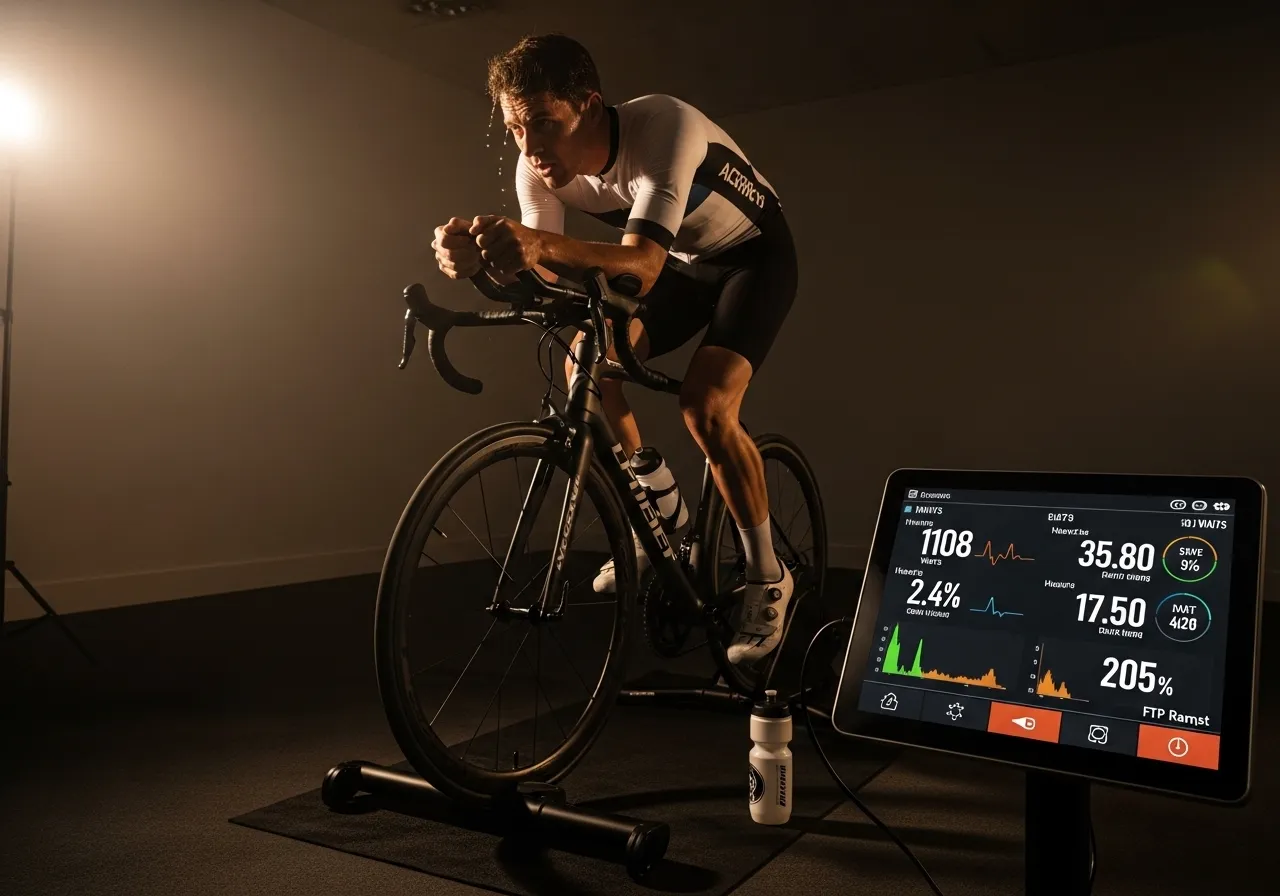
⚠️ Cardiovascular Safety Note High-intensity cycling intervals (Zone 4–5 work) place significant demand on the cardiovascular system — heart rate typically reaches 85–95% of maximum during threshold and VO2max efforts. Individuals with undiagnosed heart conditions, coronary artery disease, or recent cardiac events should obtain medical clearance before starting structured high-intensity cycling training. Any chest pain, dizziness, or unusual shortness of breath during cycling efforts is a stop signal requiring immediate medical assessment.
Most cyclists train by feel. A hard day feels hard; an easy day feels easy. Over time, fitness improves — but plateaus arrive quickly, and training volume accumulates without a clear structure for producing specific physiological adaptations.
Power-based training solves this. By measuring the actual mechanical output of the pedals in watts — rather than relying on perceived effort or even heart rate — cyclists can quantify every training session with precision, target specific physiological adaptations in each ride, and track genuine progress over months and years.
This guide covers what FTP is, why power zones matter, what the research shows about training intensity distribution, and how to structure an 8-week programme that develops every energy system systematically.
FTP: The Number That Defines Every Power Zone
What FTP Actually Measures
Functional Threshold Power (FTP) is the highest average power output a cyclist can sustain for approximately 60 minutes. It represents the upper limit of the predominantly aerobic (lactate steady-state) energy system — the boundary between efforts the body can sustain indefinitely with adequate fuelling and efforts that progressively accumulate fatigue.
FTP is the anchor for all power zone calculations. Every training zone is defined as a percentage of FTP — making it a personalised framework rather than a generic intensity recommendation. A Zone 2 ride for a cyclist with an FTP of 200W looks completely different from Zone 2 for a cyclist with an FTP of 300W, even though both are training the same physiological system.
How to Test FTP
Three common FTP testing protocols:
20-minute test (most common): Perform a 20-minute maximal effort on a stationary trainer or flat road. Multiply average power by 0.95 to estimate FTP. The 0.95 factor accounts for the difference between 20-minute and 60-minute sustainable power.
Ramp test: Increase power by a fixed wattage every minute until failure. Calculate FTP as 75% of the highest one-minute power achieved. Less painful and more reproducible than the 20-minute test — now the preferred method for most structured training applications.
8-minute test (Coggan protocol): Two 8-minute maximal efforts with 10-minute rest between. Average the two efforts and multiply by 0.90 for FTP estimate.
📌 Key Finding
Power output at threshold strongly correlates with cycling performance and provides more reproducible intensity prescription than heart rate. FTP-based zones are not just convenient — they are physiologically meaningful.
The 7 Power Training Zones: What Each One Trains and How It Feels
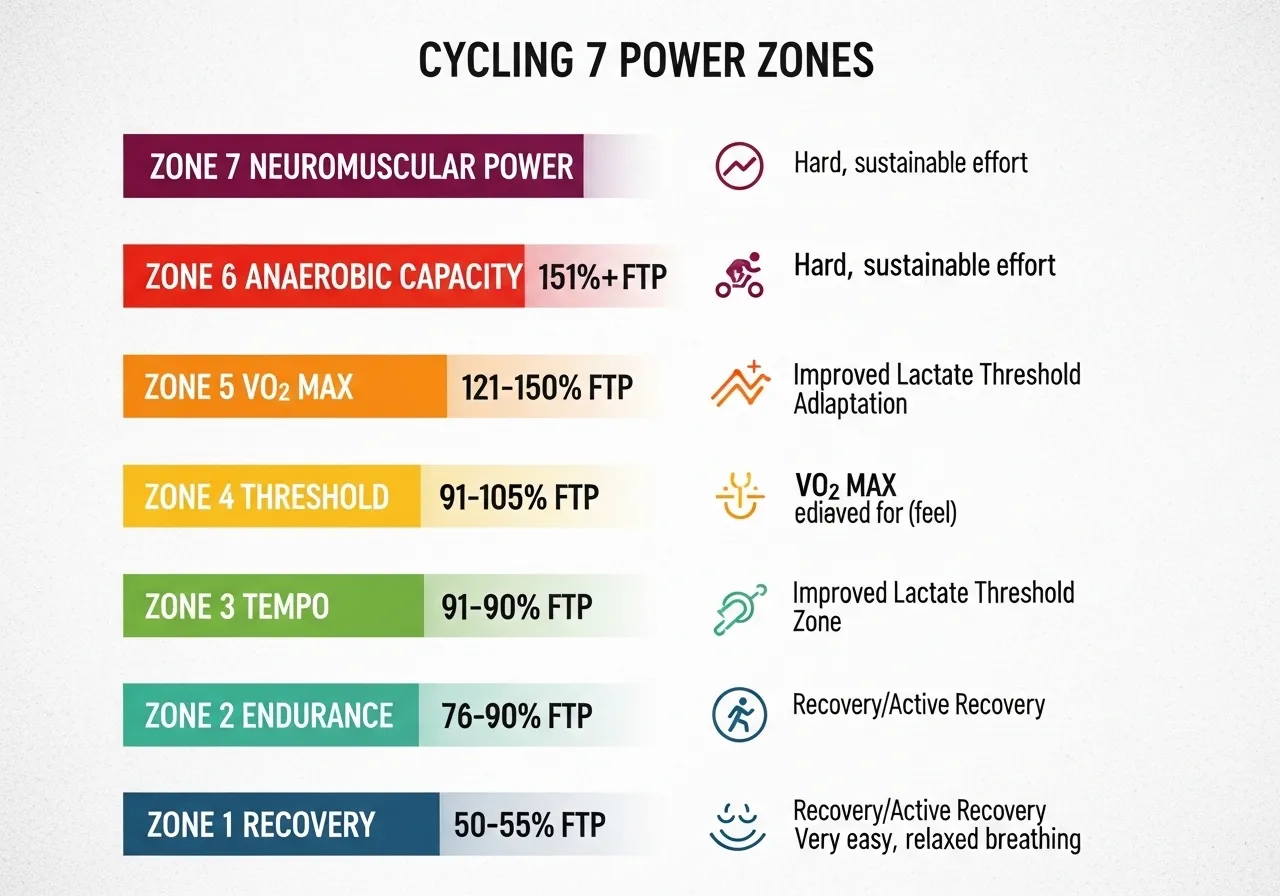
The most widely used power zone model in cycling (Coggan 7-zone model) defines training intensities relative to FTP. Each zone targets a distinct physiological adaptation — and mixing zones indiscriminately produces none of them optimally.
Zone
% FTP
Name
Primary Adaptation
Feel
Z1
<55%
Active Recovery
Blood flow, metabolic waste clearance
Effortless — could hold indefinitely
Z2
56–75%
Endurance
Aerobic base, fat oxidation, mitochondrial density
Comfortable — full conversation possible
Z3
76–90%
Tempo
Lactate threshold, muscular endurance
Comfortably hard — short phrases only
Z4
91–105%
Threshold
FTP improvement, lactate clearance capacity
Hard — single words only
Z5
106–120%
VO2max
Maximal aerobic capacity, cardiac output
Very hard — 3–8 min sustainable
Z6
121–150%
Anaerobic
Anaerobic capacity, lactate tolerance
Severe — 30 sec to 2 min maximum
Z7
>150%
Neuromuscular
Peak power, muscle recruitment, sprint mechanics
Maximal — 5–15 sec only
The Most Important Zone Most Cyclists Neglect: Zone 2
Zone 2 (56–75% FTP) produces the foundational aerobic adaptations that underpin all higher-zone performance — mitochondrial biogenesis, fat oxidation capacity, stroke volume development, and capillarisation. These adaptations take weeks to months to develop and form the base upon which threshold and VO2max work sits.
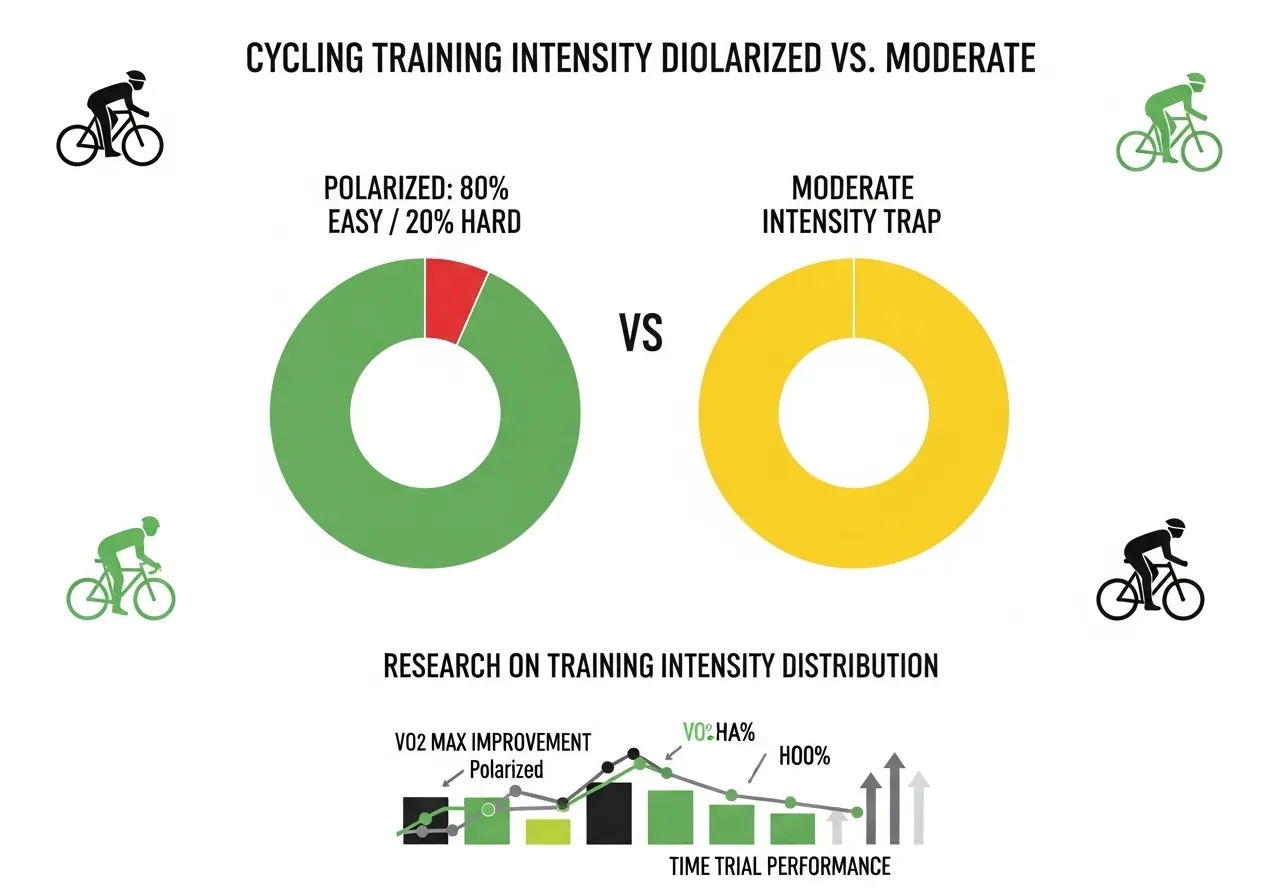
Most recreational cyclists spend the majority of their training time in Zone 3 — an intensity that is too hard to accumulate the volume needed for Zone 2 adaptations, but too easy to drive the threshold and VO2max adaptations of Zone 4–5. This “moderate intensity trap” produces mediocre adaptation from every session without specifically targeting any energy system. See also: Zone 2 training guide for the full science on aerobic base building.
Zone 4 and 5: The High-Value Hard Work
Zone 4 (threshold) efforts directly improve FTP — the number that defines every training zone. Each improvement in FTP shifts all zone boundaries upward, meaning the same absolute power output becomes progressively less demanding. Zone 5 (VO2max) efforts improve maximal aerobic capacity — the ceiling of the aerobic system. Both zones produce significant adaptation but require adequate recovery between sessions. Most cyclists need 48–72 hours between Zone 4–5 sessions.
Is Training By Power Actually Better Than Training By Heart Rate?
The Core Difference
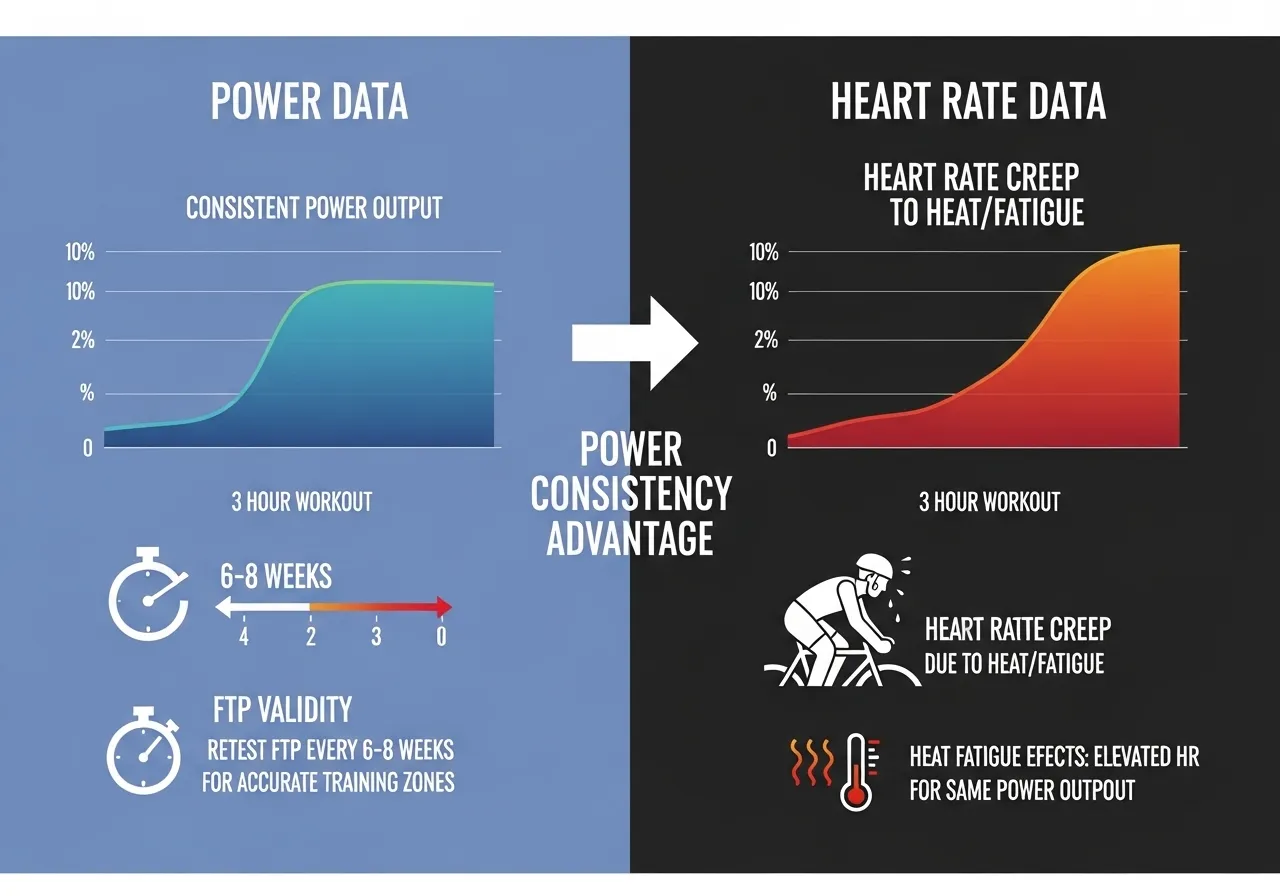
Heart rate measures the cardiovascular system’s response to exercise — an output variable affected by fatigue, heat, hydration, caffeine, sleep, and stress. On a hot day, heart rate at 200W might be 10–15 BPM higher than on a cool day at identical power output. A fatigued cyclist’s heart rate at a given power may be suppressed, masking accumulated training stress.
Power measures the actual mechanical work done by the legs — an input variable directly controlled by the cyclist. 250W is always 250W, regardless of temperature, fatigue, or emotional state. The consistency of power as a measurement makes it a more reliable training anchor than heart rate for structuring specific physiological adaptations.
📌 Key Finding Polarised training (80% easy / 20% hard) outperforms threshold-dominated training for cycling performance. The intensity distribution matters as much as total training volume.
When Heart Rate Remains Valuable Alongside Power
Power and heart rate work best together rather than in opposition. Power sets the target; heart rate monitors the physiological cost of meeting it.
Cardiac drift during Zone 2: If heart rate climbs progressively during a steady-wattage Zone 2 ride, it signals glycogen depletion or rising heat stress — cues to reduce power even if the target zone is maintained by watts
Recovery quality: A resting heart rate elevated 5–10 BPM above normal before a training session signals incomplete recovery — reduce zone targets for that session regardless of power targets
Heart rate at threshold: In Zone 4 intervals, heart rate response confirms whether the power target is genuinely at threshold or below it — important when FTP testing was performed weeks prior and fitness has changed
📌 Key Finding
FTP re-testing every 6–8 weeks is sufficient to keep power zones accurate. More frequent testing is unnecessary and accumulates unnecessary fatigue.
The Practical Case for Starting With a Ramp Test
The 20-minute FTP test requires significant motivation and pacing experience — most cyclists either go out too hard and blow up, or hold back and underestimate their FTP. The ramp test removes this pacing challenge by incrementally increasing power until failure — the test is self-terminating at maximum effort without requiring judgement about sustainable pace.
For trainees new to structured power training, the ramp test provides a reliable FTP estimate on the first attempt. The 20-minute test becomes more useful once the athlete has experience with maximal sustained efforts and can accurately gauge a 60-minute pace from a 20-minute effort. Starting with the ramp test and transitioning to 20-minute testing after 2–3 training blocks is a practical progression.
Equipment Reality: Training Without a Power Meter
Power meters remain the gold standard for zone training but are not the only option. Perceived exertion (RPE) combined with heart rate can approximate power zone targeting reliably in most conditions:
Zone 2: 60–70% max HR + full conversation possible (RPE 4–5/10)
Zone 4: 82–89% max HR + single words only (RPE 7–8/10)
Zone 5: 90–95% max HR + unable to speak (RPE 9/10)
The limitation of heart rate-only training is the cardiac drift and environmental variability described earlier. For general fitness goals, HR-based zone training is effective. For competitive cycling performance optimisation, power measurement produces meaningfully more precise training.
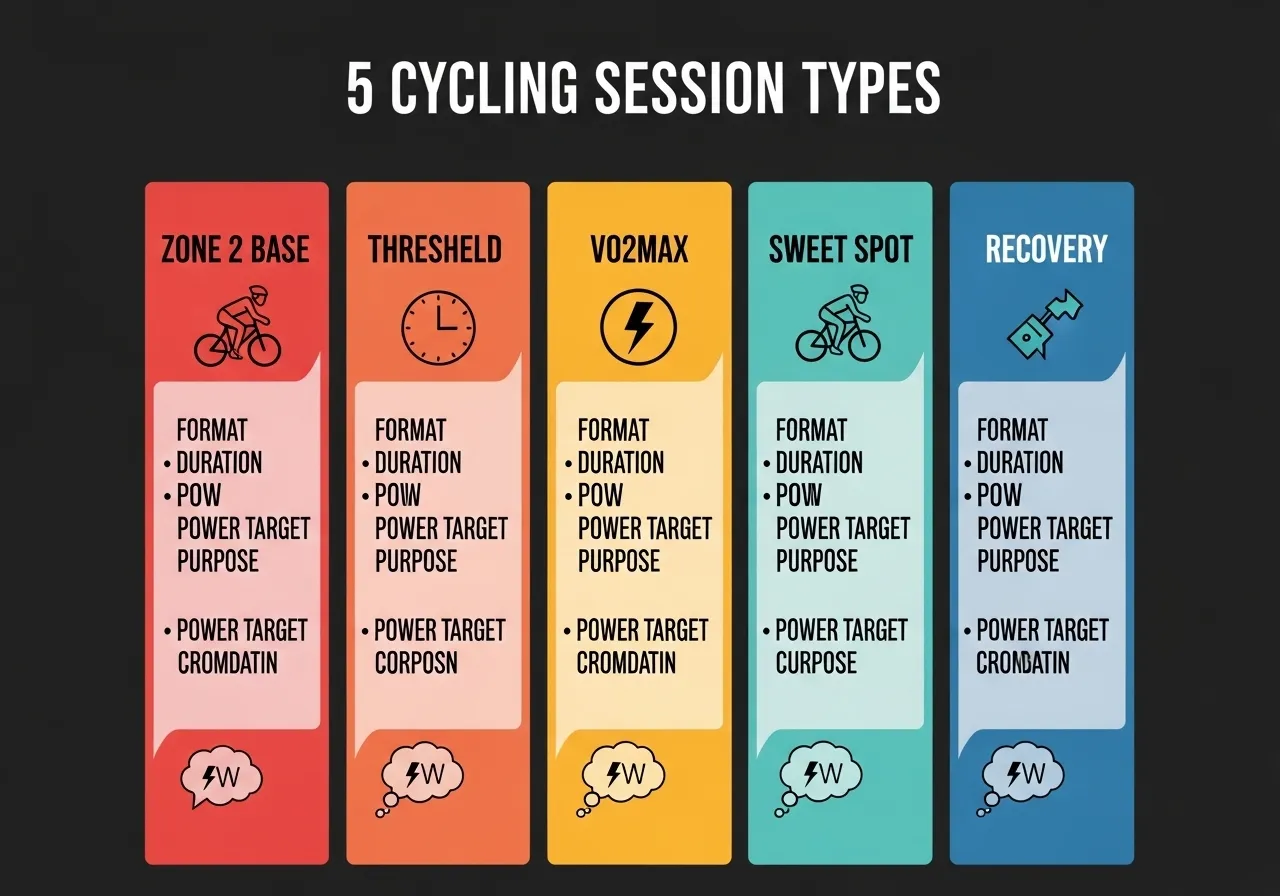
5 Core Cycling Session Types: What Each Produces and How to Execute It
🏋️ 1. Zone 2 Base Ride
Duration: 60–180 minutes | Power: 56–75% FTP
Purpose: Aerobic base building, fat oxidation development, mitochondrial density. The most important session type for long-term performance — underpins all other zone work.
Key point: If you can hold a full conversation throughout, you are in the correct zone. If you cannot, you are drifting into Zone 3 and losing the specific Zone 2 adaptation. Resist the urge to go harder — the adaptation comes from duration, not intensity, in this zone.
🏋️ 2. Threshold Intervals (Zone 4)
Format: 2–4 × 10–20 minutes at 95–105% FTP, with equal rest | Total Zone 4 time: 20–40 min per session
Purpose: Directly improves FTP. The most time-efficient session for raising the threshold ceiling.
Key point: The effort should feel sustainable but genuinely hard — an RPE of 7–8/10. If the first interval feels easy, start at 100% FTP rather than 95%. If the last interval collapses in power, reduce to 2 intervals rather than compromising form on the third and fourth.
🏋️ 3. VO2max Intervals (Zone 5)
Format: 4–8 × 3–5 minutes at 110–120% FTP, with equal or longer rest | Total Zone 5 time: 15–25 min per session
Purpose: Maximal aerobic capacity development. Produces the largest VO2max improvements of any zone.
Key point: Heart rate should reach near-maximum by the final 60–90 seconds of each interval — if it does not, the power may be slightly below Zone 5. These intervals should feel severe by the final 90 seconds. Do not perform more than 2 Zone 5 sessions per week.
🏋️ 4. Sweet Spot Training (Zone 3–4 Border)
Power: 88–93% FTP | Duration: 2–4 × 15–20 minutes
Purpose: Time-efficient FTP development for athletes with limited training hours. Produces threshold-adjacent adaptations with lower recovery cost than full Zone 4 work.
Key point: Sweet spot training is sometimes called “the best bang for your buck” in cycling training. It sits just below true threshold — hard enough to drive significant adaptation, recoverable enough to perform more frequently than pure Zone 4 work. Appropriate for 2–3 sessions per week in a general fitness programme.
🏋️ 5. Recovery Ride (Zone 1)
Duration: 30–60 minutes | Power: <55% FTP
Purpose: Active recovery — increases blood flow to fatigued muscles without adding training stress.
Key point: The most common Zone 1 mistake is going too hard. If power drifts above 55% FTP at any point, the session is no longer recovery — it is adding training stress on a day scheduled for physiological repair. Zone 1 rides feel almost embarrassingly easy. That is correct.
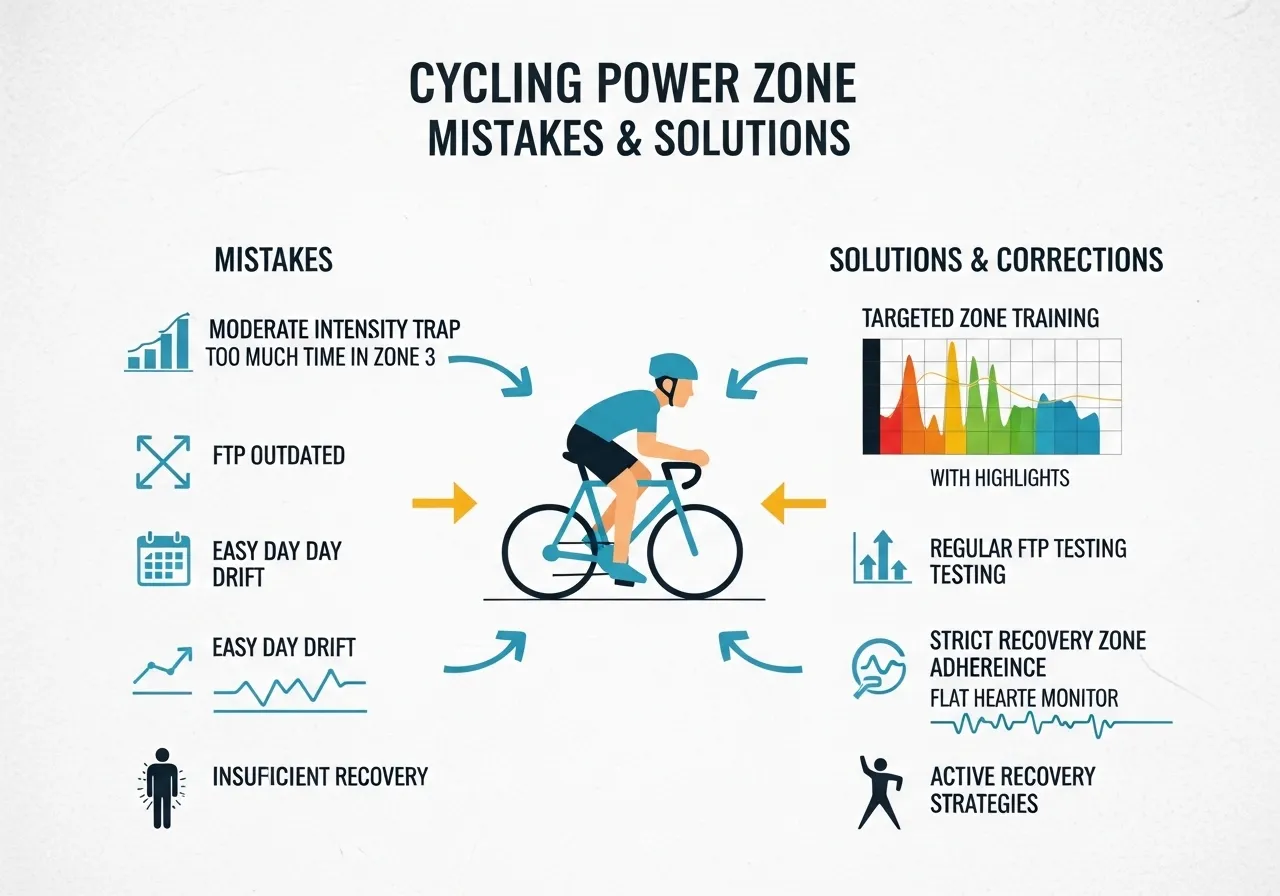
4 Power Zone Training Mistakes That Prevent Progress
Mistake 1: The Moderate Intensity Trap
The most common and consequential cycling training error: spending the majority of training time in Zone 3 — too hard for Zone 2 aerobic base adaptations, not hard enough to drive Zone 4–5 threshold and VO2max development.
Zone 3 feels productive. It is genuinely challenging. But the polarised training meta-analysis is unambiguous: an 80/20 distribution (Zone 1–2 / Zone 4–5) produces superior outcomes to Zone 3-dominated training. Most recreational cyclists have the opposite distribution — minimal easy work and minimal hard work, with most training time in the moderate middle. Restructuring toward polarised distribution typically requires accepting that easy rides feel insufficiently productive — a psychological barrier the research is clear must be overcome.
Mistake 2: Never Re-Testing FTP
An FTP tested in January becomes inaccurate by March if training remains consistent and progressive. All power zones are based on FTP percentage — outdated FTP means every zone is underspecified. Zone 4 intervals at 95% of a 6-month-old FTP may actually be Zone 3 efforts if fitness has improved 10–15%.
Re-test every 6–8 weeks during a training block. Use the same protocol each time — ramp test or 20-minute test — to maintain consistency across measurements. An increasing FTP is the most direct evidence that power zone training is working.
Mistake 3: Exceeding Zone Targets on Easy Days
Recovery rides that drift into Zone 2, Zone 2 rides that drift into Zone 3 — the accumulated effect is insufficient recovery before hard sessions and insufficient volume in the intended easy zone. Power meters make this mistake visible: if average power on an “easy” ride consistently sits above 75% FTP, the ride is not easy.
Mistake 4: Insufficient Recovery Between Hard Sessions
Zone 4 and Zone 5 intervals require 48–72 hours of recovery between sessions. A cyclist who performs threshold intervals Monday, Wednesday, and Friday — with Zone 3 rides Tuesday and Thursday — is accumulating fatigue faster than adaptation can occur. The hard sessions in this structure degrade from Wednesday onward — a pattern also seen in running interval training when easy days are insufficiently easy; by Friday, the threshold interval is more fatigue management than genuine Zone 4 work.
Structure hard days with Zone 1 or complete rest between them. The Friday session is only productive if Wednesday’s session was genuinely recovered from.
How to Actually Implement Polarised Training
The polarised 80/20 distribution sounds straightforward but creates practical challenges for most recreational cyclists. An 80% Zone 1–2 proportion across a typical 6-hour training week means approximately 4.5–5 hours of easy riding and only 1–1.5 hours of high-intensity work.
Most cyclists resist the easy volume because it feels unproductive. The research is unambiguous: the aerobic base adaptations from Zone 2 volume take weeks to months to accumulate and form the physiological substrate that Zone 4–5 work builds upon. Skipping the base accelerates the timeline to hard work but produces inferior results because the aerobic machinery needed to respond to threshold stress is underdeveloped.
A practical weekly structure that approximates polarised distribution: two hard sessions (Zone 4–5) with Zone 1 or rest on the days between, and one long Zone 2 ride on the weekend. The remaining rides are Zone 1 recovery rides or rest days. Total training stress distributes approximately 80/20 with this structure.
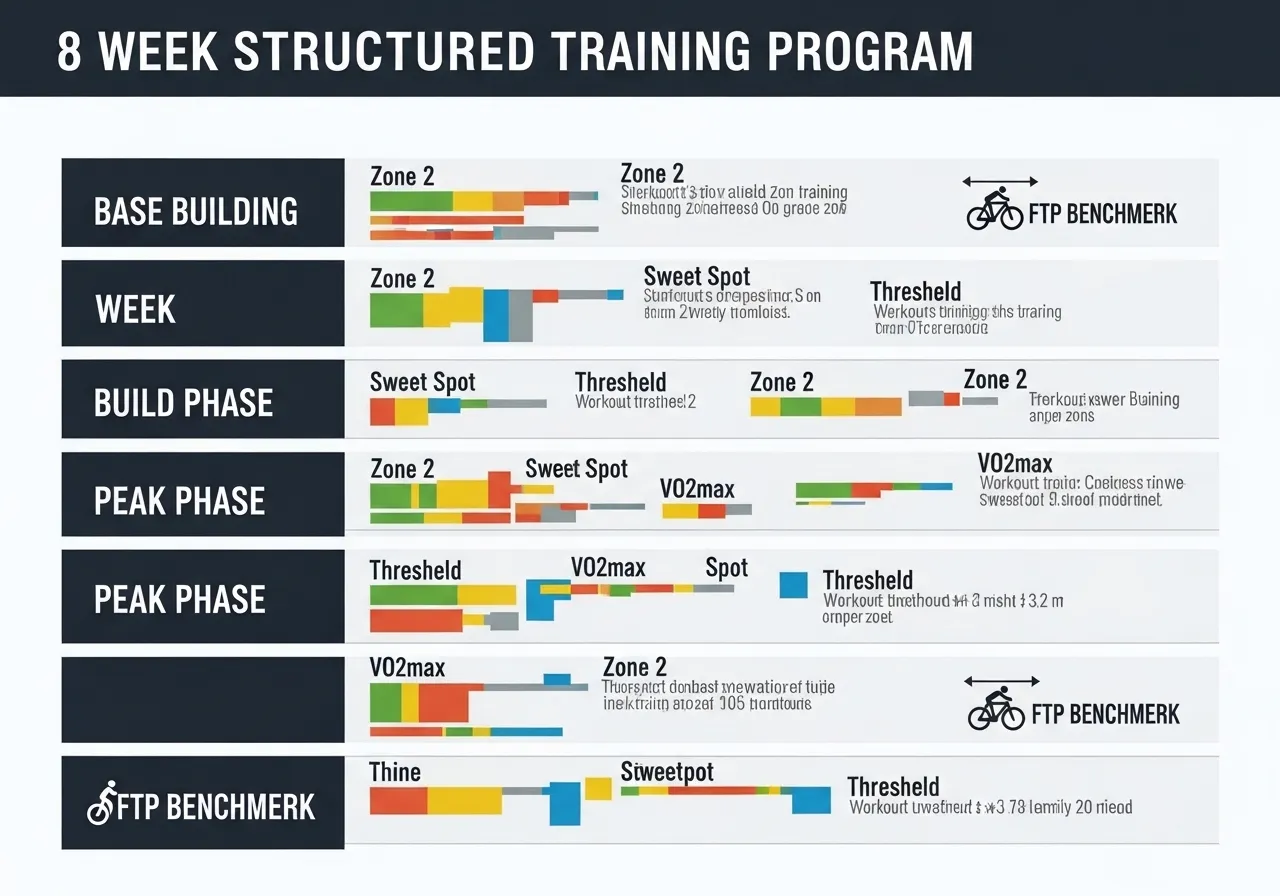
8-Week Cycling Power Zones Programme
This programme requires a power meter (indoor trainer with power measurement or outdoor power meter) and an up-to-date FTP test. Perform the FTP ramp test before Week 1 and again at Week 8.
Structure: 4 rides per week — 2 hard sessions (Zone 4–5) and 2 easy sessions (Zone 2 or Zone 1). Total weekly training time increases progressively from approximately 4 hours in Weeks 1–2 to 6 hours in Weeks 7–8.
📅 Phase 1 — Weeks 1–2: Aerobic Base Establishment
Tue: Zone 2 steady 60 min (56–75% FTP throughout — use power to police the upper limit)
Thu: Sweet spot 2×15 min at 88–93% FTP, 10 min easy between
Sat: Zone 2 long ride 90 min
Sun: Zone 1 recovery 45 min (<55% FTP)
Focus: Calibrate zones on actual rides — confirm Zone 2 power range feels comfortably conversational
📅 Phase 2 — Weeks 3–4: Threshold Introduction
Tue: Threshold intervals 2×15 min at 95–100% FTP, 10 min Zone 1 between
Thu: Zone 2 75 min
Sat: Sweet spot 3×12 min at 90% FTP
Sun: Zone 1 recovery 45 min
Focus: First true Zone 4 session on Tuesday — the effort should feel genuinely hard but sustainable for 15 minutes
Tue: VO2max intervals 5×4 min at 110–115% FTP, 4 min Zone 1 between
Thu: Zone 2 90 min
Sat: Threshold 3×15 min at 95–100% FTP
Sun: Zone 1–2 easy 60 min
Focus: VO2max intervals — power should be genuinely challenging by the final 90 seconds of each effort
📅 Phase 4 — Weeks 7–8: Peak + FTP Retest
Tue: VO2max 6×4 min at 112–118% FTP
Thu: Zone 2 90–120 min
Sat: Threshold 2×20 min at 98–102% FTP (peak threshold session)
Week 8 FTP Retest: Ramp test or 20-min test. A 3–8% FTP increase over 8 weeks of structured power training is a typical outcome. Recalculate all zone boundaries from the new FTP before the next training block. For non-cycling HIIT applications of the same intensity principles, see the HIIT training guide.
Focus: The FTP retest confirms whether zone targeting was correct — if improvement is below 3%, Zone 4 volume may need increasing in the next block
Frequently Asked Questions About Cycling Power Zones
Do I need an expensive power meter to train with power zones?
Indoor smart trainers (direct-drive or wheel-on) with power measurement start at approximately £300–500 and provide accurate power data for all indoor sessions. For outdoor power training, pedal-based or crank-based power meters start at £200–400. The investment is substantial but pays dividends in training precision over years. A less expensive alternative: use the heart rate zone equivalents as a proxy for power zones (Zone 2 = 60–70% max HR; Zone 4 = 82–89% max HR) — the physiological targeting is less precise but the framework remains valid.
Can I use power zones for non-cycling cardio?
Power zones are specific to cycling — the FTP and zone calculations derive from cycling-specific power output. For running, the equivalent framework uses running power meters or pace-based zones. For rowing, stroke rate and split time serve a similar anchoring function. The training principles — polarised distribution, specific zone targeting, periodic threshold testing — transfer across cardio modalities even when the specific metrics change.
How does FTP relate to VO2max?
FTP and VO2max are closely related but distinct. FTP represents approximately 70–80% of VO2max power output in most trained cyclists. As FTP improves through threshold training, VO2max typically also improves — and as VO2max increases through Zone 5 work, the ceiling available for FTP to approach also rises. The two variables reinforce each other: Zone 4 work raises FTP toward the VO2max ceiling; Zone 5 work raises the ceiling itself.
Why does my power drop significantly toward the end of threshold intervals?
Three causes: the FTP estimate is too high (the target power exceeds your actual sustained threshold), insufficient warm-up before the interval (the first 5–10 minutes of a hard effort are the most physiologically demanding), or accumulated fatigue from earlier in the training week. If power drops more than 5–8% in the final quarter of a threshold interval, reduce the target by 3–5% for the next session. Consistency at a slightly lower power produces better adaptation than struggling through intervals at a power that causes dramatic fade.
Is Zone 2 cycling effective for weight loss?
Zone 2 rides maximise fat oxidation rate — the percentage of energy derived from fat rather than carbohydrate. At Zone 2 intensity, the body relies predominantly on fat as fuel rather than glycogen. For total caloric expenditure, however, higher-intensity sessions burn more calories per unit of time. The most effective approach for body composition: Zone 2 rides for longer duration sessions (building total caloric expenditure through duration) and Zone 4–5 for shorter sessions that produce higher per-minute expenditure and post-exercise metabolic elevation.
person running VO2 max interval training track high intensity cardiovascular aerobic development VO2 max interval training meta-analysis 0.51 L/min improvement continuous vs interval cardiac output mechanism Billat vVO2max protocol 5 minute intervals research minimal velocity VO2max oxygen uptake kinetics logic short vs long VO2 max intervals 90 percent time comparison 3 minute vs 5 minute…
⚠️ Fitness Disclaimer: The information in this article is for general educational purposes only and does not constitute professional fitness or medical advice. Always consult a qualified healthcare professional before starting any new exercise program, especially if you have existing injuries or medical conditions. Why Two Straps Changed What I Thought Training Equipment Needed to…
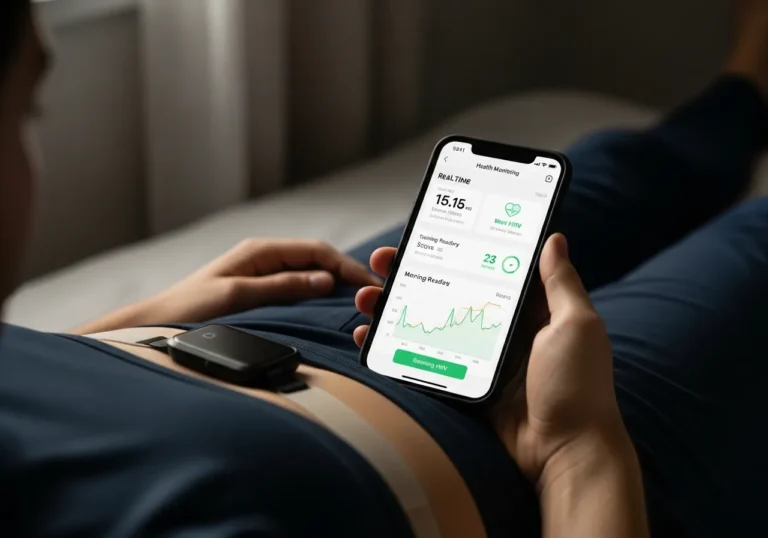
⚠️ Cardiovascular Monitoring Safety NoteHRV monitoring is a wellness and performance tool — not a medical diagnostic device. Consistently low HRV accompanied by symptoms such as chest pain, unexplained breathlessness, palpitations, or severe fatigue may indicate an underlying cardiovascular or systemic condition requiring medical evaluation. Do not use HRV data alone to override symptoms that…
⚠️ Fitness Disclaimer: The information in this article is for general educational purposes only and does not constitute professional fitness or medical advice. Exercise carries inherent risks. Always consult a qualified healthcare professional or certified personal trainer before starting or modifying any exercise program, especially if you have a pre-existing medical condition, injury, or health…
⚠️ Fitness Disclaimer: The information in this article is for general educational purposes only and does not constitute professional fitness or medical advice. Always consult a qualified healthcare professional before starting any new exercise program. ⚠️ Cardiovascular Health Notice: If you have a history of heart disease, high blood pressure, or any cardiovascular condition, obtain…
⚠️ Health & Fitness DisclaimerThis article is for general educational purposes only and does not replace professional medical advice. If you have any cardiovascular, joint, or metabolic conditions, consult a qualified healthcare professional before beginning any cycling for fitness guide program. Indoor cycling is among the most versatile and research-supported cardiovascular training tools available —…