Most people who train the core train the visible core: crunches for the rectus abdominis, planks for surface endurance, side bends for the obliques. These exercises develop the muscles that are visible and the movements that feel like core work. They largely bypass the transversus abdominis, the deepest abdominal muscle, which is invisible, produces no visible movement when it contracts, and does not respond to the exercises that train the superficial abdominal wall.
The transversus abdominis is the primary spinal stabiliser in the deep core system. It activates milliseconds before any limb movement begins, not in response to movement but in anticipation of it, creating the intra-abdominal pressure and thoracolumbar fascial tension that protects the lumbar spine during every functional movement. In individuals with lower back pain, this anticipatory activation is delayed or absent, and the spine is exposed to movement forces before the stabilisation system can protect it.
This guide covers the anatomy and function of the transversus abdominis, what the research shows about drawing-in versus bracing and which produces better TVA activation, how position affects TVA recruitment, the seven most effective deep core exercises, and a 6-week progressive protocol for developing genuine spinal stability rather than surface abdominal strength.
Research 1: Drawing-In vs Bracing, What Actually Activates the TVA More?
The Two Competing Approaches to TVA Activation
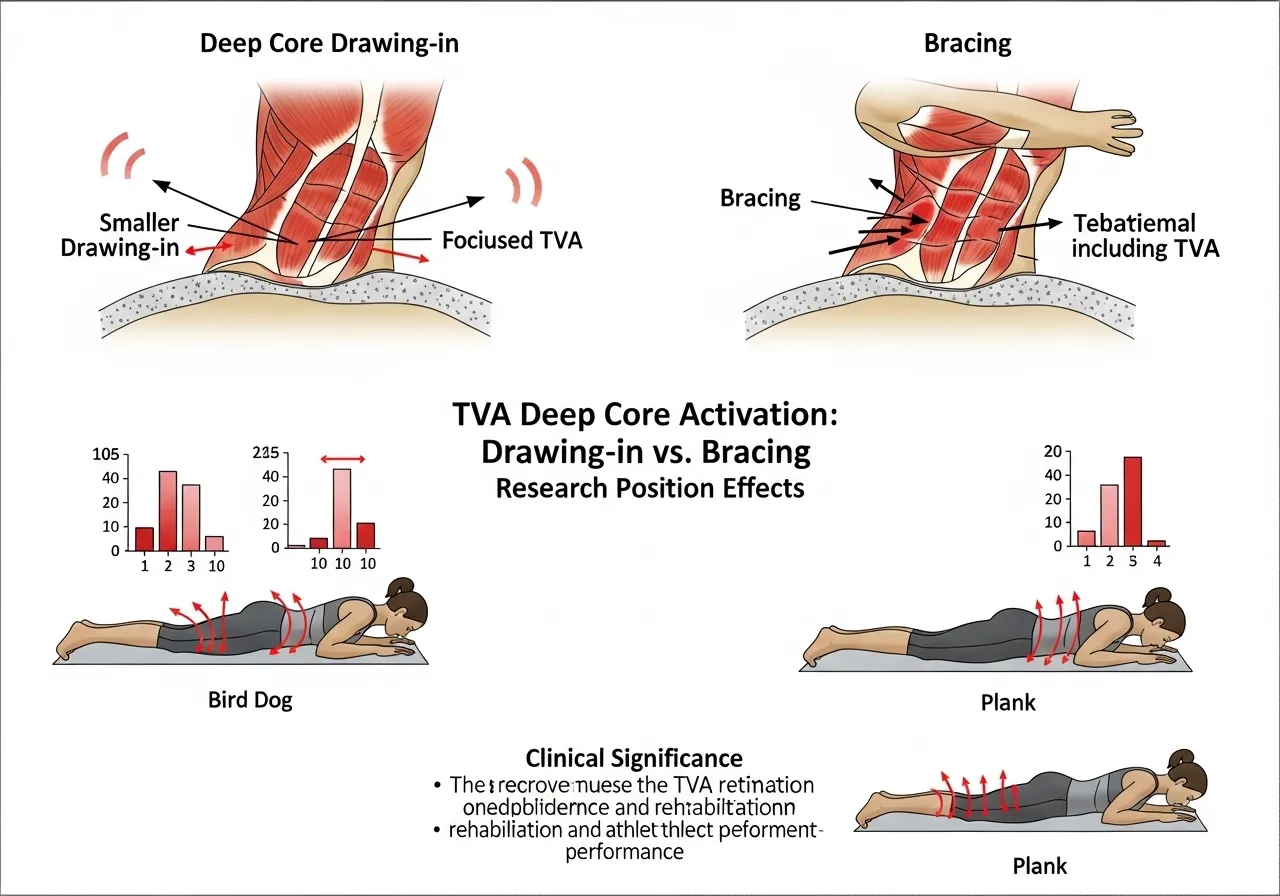
The drawing-in manoeuvre (ADIM) involves pulling the navel toward the spine, selectively contracting the transversus abdominis and internal oblique while keeping the superficial abdominals relaxed. It was historically the primary rehabilitation technique for TVA activation, taught in physical therapy for lower back pain management based on the Hodges and Richardson research showing that TVA activation precedes limb movement in healthy subjects.
Abdominal bracing involves expanding the abdomen outward in all directions simultaneously, contracting both the deep and superficial abdominal musculature to create a rigid cylinder of pressure around the spine. It was popularised by Stuart McGill’s work on spine biomechanics as the superior approach for heavy lifting and functional athletic movements.
What the Position Research Shows About TVA Activation
📌 Key Finding
Body position significantly affects TVA activation during both drawing-in and bracing. The optimal TVA training position depends on the individual’s ability to selectively recruit the deep versus superficial core, confirming that position selection is a critical variable in deep core training programme design.
TVA Activation by Position: Drawing-In vs Bracing Results
📌 Key Finding
TVA activation differs meaningfully across positions during both manoeuvres. Position selection is a primary variable in TVA training effectiveness, not just technique selection. The same drawing-in or bracing effort produces different TVA activation depending on whether the trainee is supine, hook-lying, or upright.
Bracing vs Hollowing: Exercise-Specific Comparison
📌 Key Finding
The bird dog produces significantly greater TVA activation than the plank or bridge. Dynamic exercises requiring anti-rotation stability recruit the TVA more effectively than static holds, changing the conventional hierarchy that places the plank as the primary core exercise.
The Clinical Significance: Why TVA Timing Matters More Than TVA Strength
The Hodges and Richardson research that established TVA’s role in spinal stability demonstrated that the key variable is not TVA strength in isolation but TVA activation timing relative to limb movement. In healthy subjects, the TVA activates 30 to 110 milliseconds before voluntary arm movement and 110 milliseconds before leg movement, creating pre-movement spinal stabilisation. In subjects with chronic lower back pain, this anticipatory activation is delayed or absent, meaning the spine faces movement forces before the protective co-contraction can establish itself.
Deep core training that restores this anticipatory timing pattern provides greater functional spinal protection than core training that simply increases TVA strength without addressing the timing deficit. This is why isolated TVA activation practice in rehabilitation contexts, teaching the drawing-in manoeuvre before progressing to loaded exercises, is more functionally relevant than high-volume sit-up training that strengthens the rectus abdominis without restoring the TVA timing that actually protects the spine during daily movement. The core stability research and how foundational core training precedes deep core work is covered in the thoracic rotation guide.
The Practical Verdict: Drawing-In for Learning, Bracing for Performance
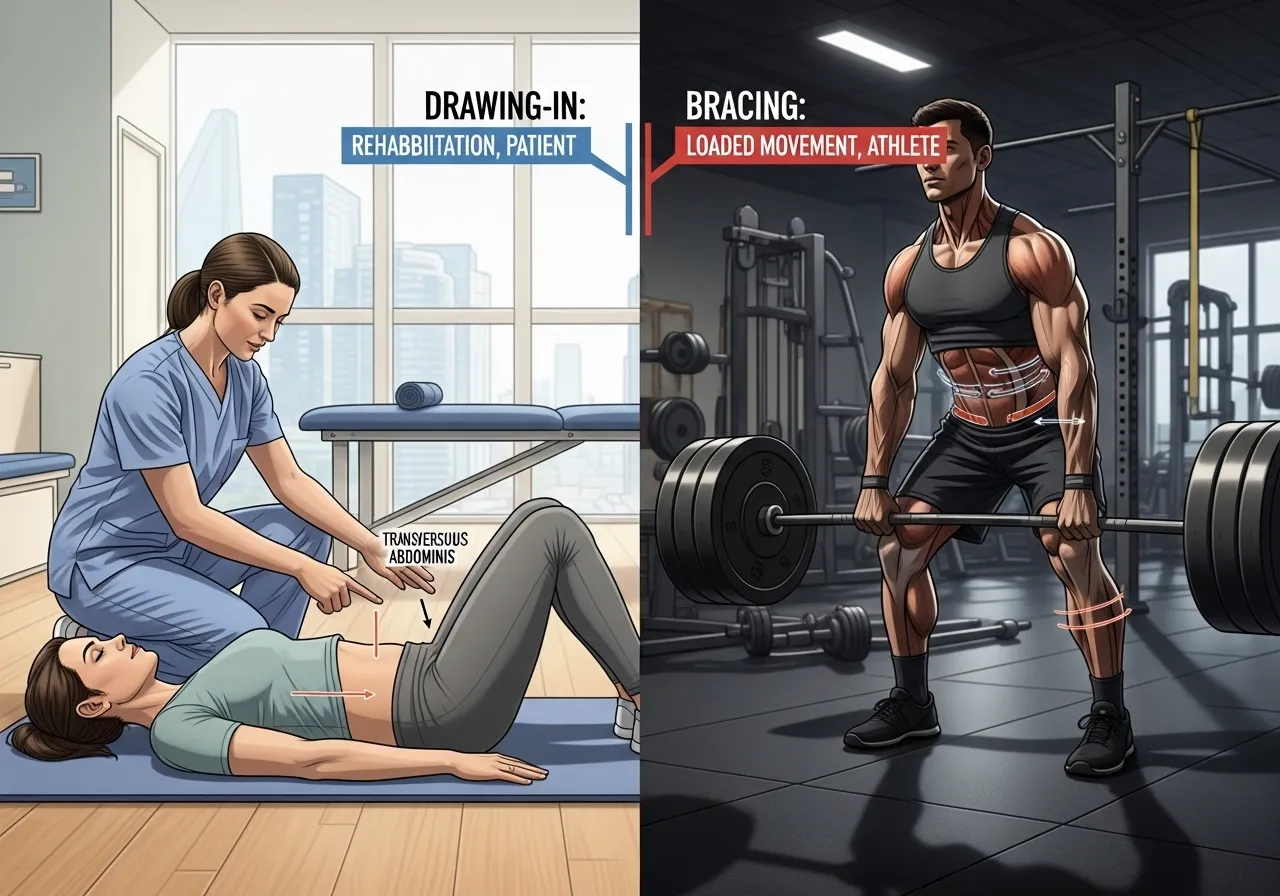
The research does not establish a universal superiority of either technique. Drawing-in provides better TVA isolation for learning the deep muscle contraction pattern in rehabilitation and beginner contexts. Bracing provides better overall spinal stiffness for loaded movements in training and performance contexts. The most complete deep core training programme uses drawing-in to teach TVA awareness and selective activation, then transitions to bracing for the loaded exercises where co-contraction of the entire core cylinder provides the maximum spinal protection during challenging movement.
The Anatomy of the Deep Core System: More Than Just the TVA
The Four-Muscle Deep Core Cylinder
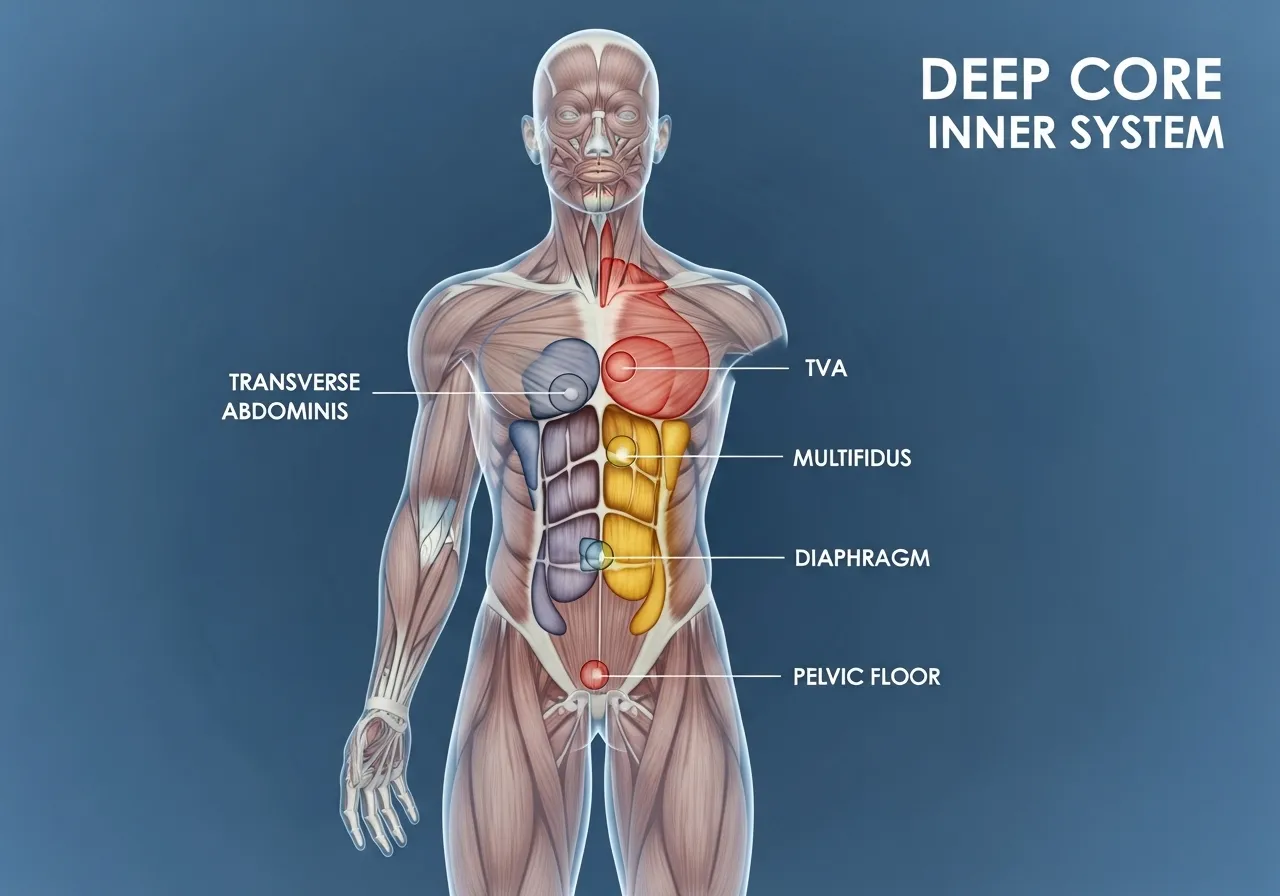
The deep core is not a single muscle but a cylindrical pressure system formed by four structures: the transversus abdominis at the front and sides, the multifidus at the back, the diaphragm at the top, and the pelvic floor at the bottom. This cylinder generates intra-abdominal pressure when all four walls contract simultaneously, creating the hydraulic stiffness that stabilises the lumbar spine against movement forces. Training any single component in isolation without developing the coordinated co-contraction of all four walls produces incomplete spinal stabilisation regardless of the strength of the isolated component.
The transversus abdominis receives the most research attention because it is the most frequently inhibited in lower back pain presentations and because its selective activation through drawing-in is technically distinct from the superficial abdominal training that most trainees already perform. The multifidus receives the next most attention in rehabilitation research because it atrophies specifically on the side of a unilateral herniated disc in a pattern that does not recover spontaneously and requires targeted rehabilitation to restore.
The Transversus Abdominis: Function and Dysfunction
The TVA wraps around the torso like a corset, with horizontal fibres running from the thoracolumbar fascia at the back to the linea alba at the front. When it contracts, it increases intra-abdominal pressure, tensions the thoracolumbar fascia to stiffen the lumbar spine, and contributes to the sacroiliac joint compression that stabilises the pelvis. It does not produce visible trunk movement when it contracts in isolation, which is why its activation cannot be observed externally and must be felt by the trainee.
TVA dysfunction in lower back pain presents as a delayed activation onset, reduced activation magnitude, and reduced ability to maintain activation under repeated loading. These deficits are consistent enough that researchers propose TVA activation timing assessment as a clinical marker for lower back pain risk and a training target for lower back pain rehabilitation. The quadratus lumborum, which works alongside the TVA in lateral spinal stabilisation, and its relationship to lower back pain is covered in the QL guide.
The Multifidus: The Forgotten Partner
The lumbar multifidus is a segmental spinal extensor that runs between individual vertebrae, producing fine inter-segmental control of lumbar spine position. It co-activates with the TVA in the anticipatory stabilisation pattern before limb movement, providing posterior spinal stiffness while the TVA provides anterior and lateral stiffness. Multifidus atrophy on the pain side is one of the most consistent findings in chronic lower back pain research, and targeted exercises that develop multifidus activation alongside TVA training produce better long-term lower back pain outcomes than TVA-only approaches.
The Diaphragm and Breathing Coordination
The diaphragm functions as both the primary breathing muscle and the top of the deep core pressure cylinder. During maximum effort stabilisation (heavy lifting, sudden loading), the diaphragm must hold its position against the rising intra-abdominal pressure rather than descending for breathing. This creates a temporary breath-hold or Valsalva-like state that maximises intra-abdominal pressure and spinal stiffness.
Individuals who cannot coordinate diaphragmatic breathing with TVA activation fail to develop the full-cylinder stabilisation that effective deep core training provides. They either breathe and lose TVA activation, or maintain TVA activation and cannot breathe during the exercise. Teaching diaphragmatic breathing first, then TVA activation during the exhalation phase, then maintaining TVA activation into the inhalation phase, is the progression that develops full breathing-TVA coordination.
The Pelvic Floor Connection
The pelvic floor forms the base of the deep core pressure cylinder and co-activates with the TVA in the same anticipatory stabilisation pattern. Pelvic floor dysfunction, present in postpartum women and men and women with chronic lower back pain, disrupts the four-wall co-contraction that deep core stability requires. Including pelvic floor awareness in deep core training, through gentle pelvic floor contraction (Kegel-like co-contraction) during TVA exercises, develops the coordinated four-wall activation that isolated TVA training cannot achieve without the pelvic floor component.
The 7 Most Effective Deep Core Exercises
Why Exercise Selection Matters More Than Volume
Deep core development does not respond to high repetition volume the way the superficial abdominal wall does. The TVA and multifidus are endurance-oriented stabilisers that respond to sustained low-intensity activation across multiple repetitions with maintained quality rather than high-intensity contraction to failure. Quality of activation with full attention to the drawing-in or bracing technique produces more TVA development than performing the same exercises without the targeted contraction cue.
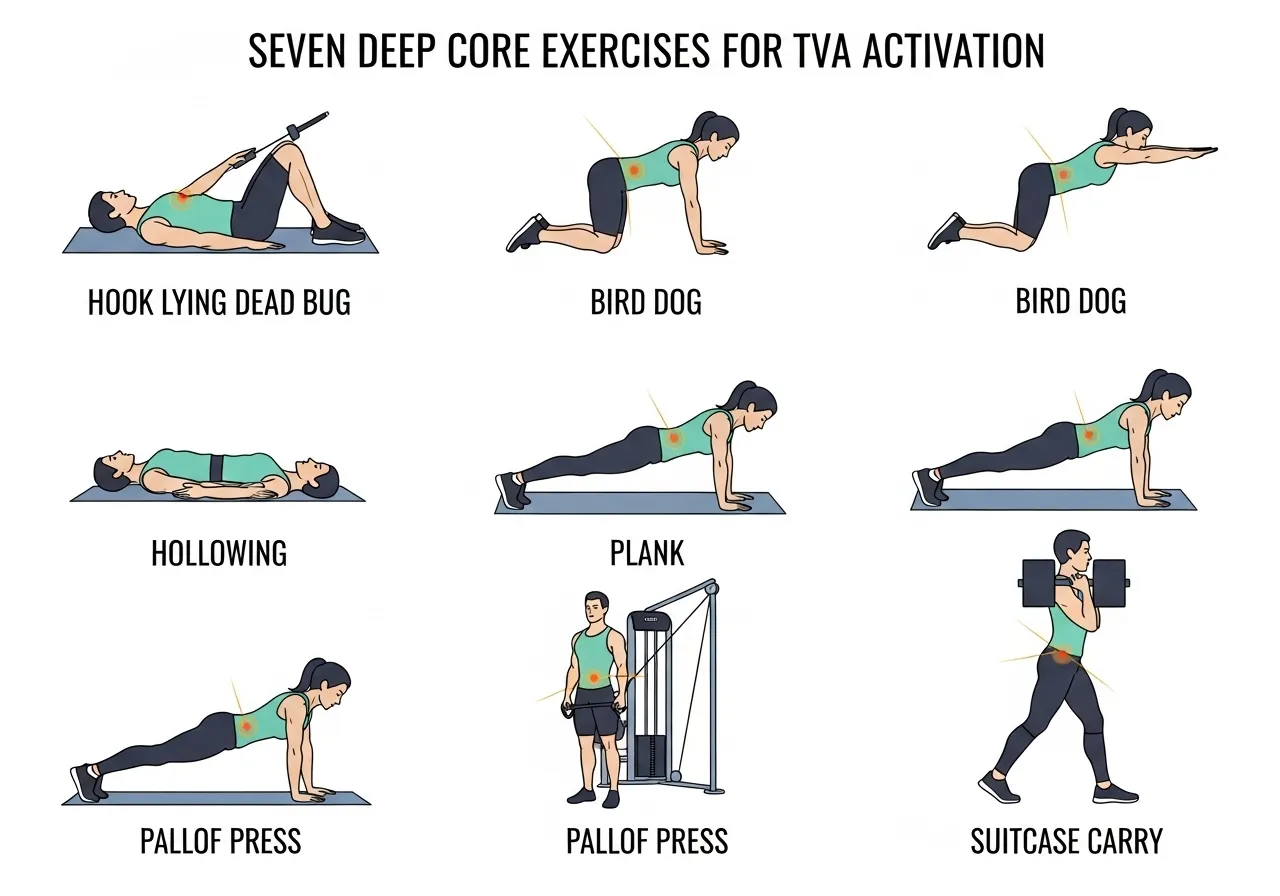
🔄 1. TVA Activation in Hook Lying (Foundation)
Target: Pure TVA isolation, learning the drawing-in sensation
How: Lie on the back with knees bent, feet flat. Place fingertips 2 cm medial to the anterior superior iliac spine (hip bones). Breathe in, then on the exhale, draw the navel gently toward the spine without moving the pelvis or ribcage. Hold 10 seconds while breathing normally. 10 repetitions.
Key point: The fingers should feel the deep abdominal wall tense inward and firm up, not the rectus abdominis which would create a hard ridge. No visible movement of the spine or pelvis should occur.
🔄 2. Dead Bug
Target: TVA anti-extension stability under limb loading
How: Lie on the back, arms pointing to ceiling, hips and knees at 90 degrees. Activate TVA using drawing-in. Slowly lower one arm overhead and the opposite leg toward the floor simultaneously, keeping the lower back pressed against the floor. Return and repeat on the other side. 10 repetitions per side.
Key point: The lower back must remain in contact with the floor throughout. Any lifting of the lower back indicates that the TVA loses its activation and the hip flexors pull the pelvis into anterior tilt.
How: Begin on hands and knees with a neutral spine. Activate TVA via drawing-in. Extend one arm forward and the opposite leg backward simultaneously, maintaining the spine completely still. Hold 3 to 5 seconds. Return without touching the floor and repeat on the other side. 10 repetitions per side.
Key point: The research shows bird dog produces greater TVA activation than the plank. The anti-rotation demand as the opposing arm and leg move creates the TVA challenge. The spine must not rotate toward the raised leg.
🔄 4. Abdominal Hollowing in Four-Point Kneeling
Target: TVA isolation with gravitational challenge in the sagittal plane
How: Begin on hands and knees with a neutral spine, allowing the abdomen to relax toward the floor. Draw the navel up toward the spine without moving the spine itself. Hold 10 seconds. The spine should remain still, neither flexing nor extending, while only the deep abdominal wall contracts upward.
Key point: The gravitational challenge of the hanging abdominal position makes TVA isolation harder than in supine, providing greater activation demand at the same effort level.
🔄 5. Plank with TVA Bracing
Target: Full deep core cylinder endurance, bracing under sustained load
How: Standard plank position on forearms and toes. Before holding, apply full abdominal brace (outward expansion, not drawing-in). Maintain the brace throughout the hold. 3 sets of 20 to 45 second holds.
Key point: A plank without TVA bracing is largely a hip flexor and shoulder girdle isometric. The bracing transforms it into a deep core endurance exercise. The research shows it produces less TVA activation than the bird dog, making it a complement rather than a substitute.
🔄 6. Pallof Press
Target: TVA anti-rotation under cable resistance, functional loaded stability
How: Stand beside a cable machine with the cable at chest height. Hold the handle at the chest with both hands. Brace the entire core cylinder. Press the handle straight forward, resisting the cable’s attempt to rotate the torso toward the machine. Hold 2 seconds. Return. 3 sets of 10 reps per side.
Key point: The Pallof press develops TVA in the anti-rotation function that sport and daily activities demand. It bridges the gap between the floor-based isolation exercises and the demands of standing loaded movements.
How: Hold a moderate-weight dumbbell or kettlebell in one hand. Walk 20 to 30 metres while maintaining perfectly upright posture. The deep core must resist the lateral flexion that the unilateral load creates. Equal distance per side.
Key point: The most functional deep core exercise available without specialist equipment. It develops TVA anti-lateral-flexion capacity in the walking pattern that the deep core stabilises in daily movement.
Drawing-In vs Bracing: When to Use Each in Practice
The Fundamental Difference in Application
Drawing-in and bracing are not competing techniques that require choosing one or the other. They are tools with different appropriate applications that a well-designed deep core programme uses at different stages and in different contexts. Understanding when each is appropriate prevents the common error of using drawing-in for heavy loaded movements (providing insufficient spinal stiffness) or using bracing for the earliest stages of TVA learning (overwhelming the deep system with superficial co-activation before the deep pattern is established).
When Drawing-In Is the Right Technique
Drawing-in is appropriate for rehabilitation and learning contexts where the primary goal is re-establishing the TVA activation pattern that lower back pain has disrupted. It is also appropriate for low-load bodyweight exercises where the protective demand is modest and the training goal is developing TVA awareness and endurance in isolation. The foundation exercise in this guide, TVA activation in hook lying, uses drawing-in specifically because the goal is pure TVA isolation learning.
Drawing-in is less appropriate for heavy loaded exercises, moderate to high-speed athletic movements, and any situation where the spine is under significant external loading. The selective TVA contraction of drawing-in, while excellent for isolated TVA development, provides less total spinal stiffness than full bracing because it does not engage the superficial abdominal wall that contributes significantly to overall spinal protection under high loads.
When Bracing Is the Right Technique
Bracing is appropriate for all loaded exercises: squats, deadlifts, overhead pressing, loaded carries, and any athletic movement where significant external force will be applied to the spine. The full co-contraction of the deep and superficial core provides the maximum intra-abdominal pressure and spinal stiffness that resists the compressive, shear, and bending forces that loaded movements create.
Bracing is also appropriate for the more advanced exercises in this guide: Pallof press, suitcase carry, and loaded plank. As the external loading challenge of core exercises increases, the stabilisation required transitions from TVA-isolated drawing-in to full cylinder bracing that recruits all available spinal stabilisers simultaneously.
The Progression: Drawing-In First, Then Bracing
The logical progression is drawing-in for Weeks 1 to 3 of a deep core programme, establishing TVA awareness and activation pattern through the low-load isolation exercises, then introducing bracing alongside the loaded exercises from Week 4 onward as the exercise complexity increases. Attempting to brace before drawing-in is learned consistently produces bracing that overwhelms the deep system with superficial activation, producing a strong-feeling core contraction that may have minimal TVA component if the deep pattern has not been established first.
The Athlete vs Rehabilitation Patient Distinction
Athletes who have never had lower back pain and who have adequate TVA timing do not need to start with drawing-in isolation. Their TVA timing is already adequate and their primary need is developing bracing capacity under sport-specific loaded movements. For this population, learning to brace consistently across heavy compound exercises produces the spinal stability they require without the drawing-in isolation phase that rehabilitation populations need to restore disrupted TVA timing patterns.
The deep core need that connects both populations is the transfer from isolated core exercise to braced position maintenance during loaded compound movements. An athlete who braces well on deadlifts but loses the brace under fatigue in the final sets, and a rehabilitation patient who draws in effectively in hook lying but cannot maintain TVA activation during standing tasks, both need the progressive loading and position challenges that the 6-week protocol below provides.
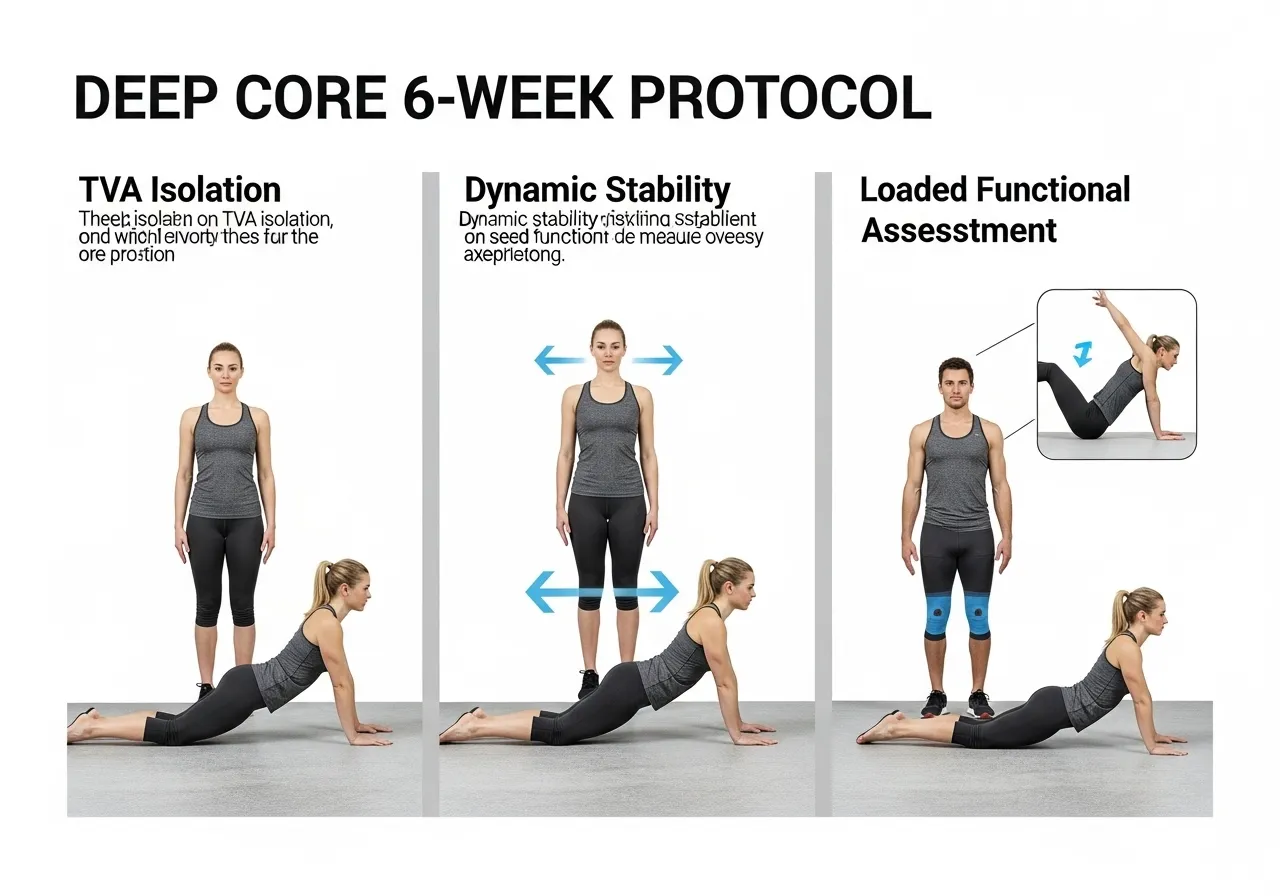
6-Week Deep Core Protocol: From TVA Isolation to Functional Stability
The Progressive Challenge Structure
Deep core development follows a specific progression from isolated TVA activation to dynamic stability under increasing load and complexity. The progression cannot be skipped, trainees who move directly to loaded exercises without establishing the TVA drawing-in pattern either develop surface core strength without deep core timing or use bracing patterns that substitute superficial activation for missing deep activation. The 6-week structure below follows the evidence-based progression from drawing-in learning through dynamic stability to loaded functional applications.
📅 Phase 1: Weeks 1 to 2: TVA Isolation and Awareness
Dead bug: 3 × 8 per side with drawing-in maintained throughout
Focus: feeling TVA contraction independently of rectus abdominis
The first week often produces surprising difficulty in distinguishing TVA from rectus abdominis contraction. The absence of spinal movement during the drawing-in is the key confirmation that TVA is contracting rather than the superficial abdominal wall.
📅 Phase 2: Weeks 3 to 4: Dynamic Stability Introduction
Bird dog: 3 × 10 per side with 3-second holds, 3 times per week
Plank with TVA brace: 3 × 30-second holds, transition to bracing technique
Continue dead bug with longer limb lever (straight leg instead of bent)
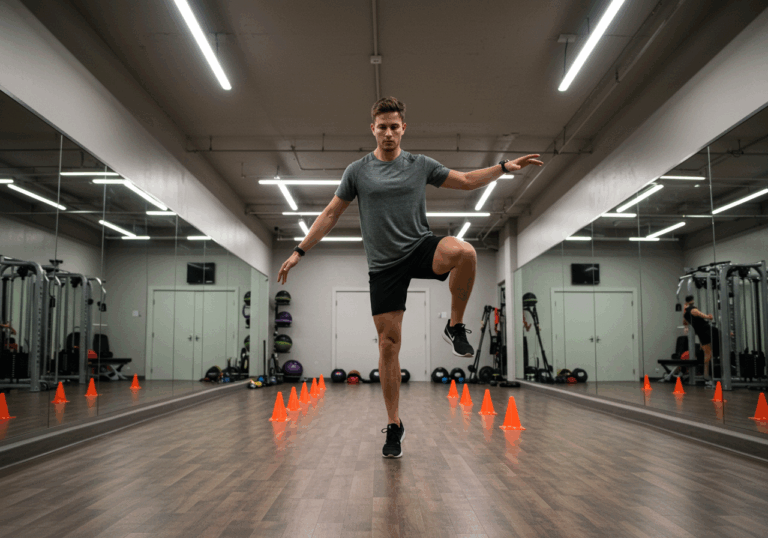
Introduction: maintain drawing-in or bracing during single-leg stance (30 seconds per side)
Phase 2 introduces the anti-rotation and dynamic demands that transfer drawing-in skill to functional movement. The bird dog is the priority exercise in this phase based on the research showing its superior TVA activation.
📅 Phase 3: Weeks 5 to 6: Loaded Functional Stability
Pallof press: 3 × 10 per side with full bracing
Suitcase carry: 3 × 25 metres per side
Apply bracing to primary compound exercises: squats, deadlifts, overhead press
Week 6: assess lower back pain scores and single-leg squat stability versus baseline
Phase 3 transfers deep core training to the functional positions where spinal protection is most needed. The application of bracing to compound exercises is the critical final step, deep core training only produces its injury prevention benefits when the stabilisation patterns transfer to loaded movement.
Assessment: Measuring Deep Core Development
Three practical assessments track deep core progress across the protocol. First, TVA activation quality: can the TVA be selectively contracted (without rectus abdominis co-contraction) for 10 seconds while breathing normally by Week 2? Second, dead bug stability: can the lower back maintain floor contact throughout 10 full reps per side by Week 3? Third, single-leg balance with TVA brace: can 30 seconds per side be maintained with minimal trunk sway by Week 4? The thoracic rotation mobility that supports optimal deep core function in the mid-back is covered in the thoracic rotation guide.
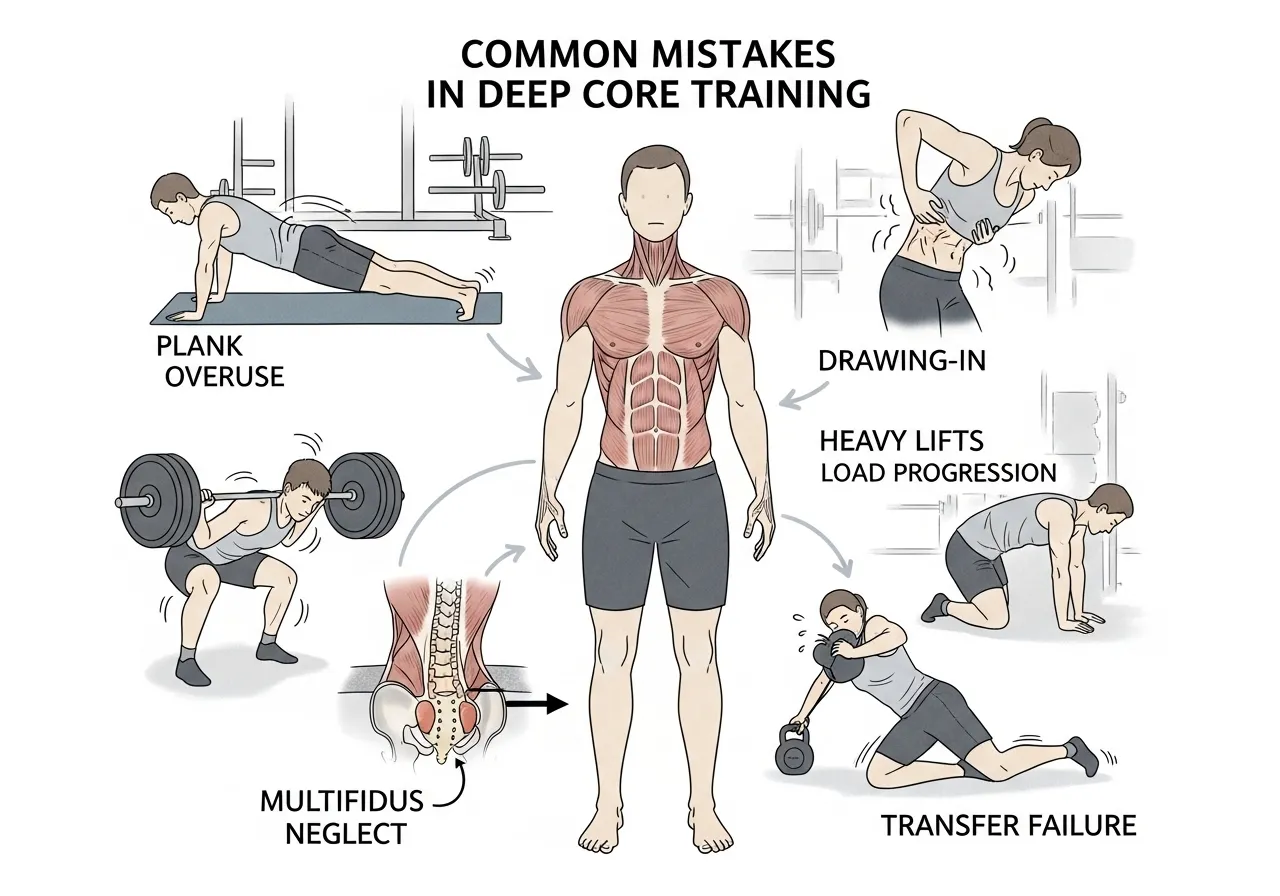
Common Deep Core Training Mistakes and How to Avoid Them
Mistake 1: Treating the Plank as the Primary Deep Core Exercise
The plank is the most commonly prescribed core exercise and the least specific for deep core development among commonly available exercises. Without explicit TVA bracing cues, the plank is primarily a hip flexor and shoulder girdle isometric with modest core co-activation. The research confirms that the bird dog produces significantly greater TVA activation than the plank. Replacing some plank volume with bird dog and dead bug work produces better deep core development from the same training time investment.
Mistake 2: Using Drawing-In for Heavy Loaded Exercises
Drawing-in selectively contracts the TVA while minimising superficial abdominal co-activation. This is ideal for TVA isolation learning but provides insufficient total spinal stiffness for heavy squats, deadlifts, and overhead pressing where the spine must resist significant external loading. Applying drawing-in to heavy compound movements reduces spinal stiffness below the level that prevents injury, because the superficial abdominal wall that bracing engages contributes materially to total spinal stiffness at heavy loads.
Mistake 3: Progressing Load Without Established TVA Activation
Many trainees progress deep core exercise difficulty (heavier Pallof press, longer plank holds, more demanding bird dog variations) before they can reliably activate the TVA during the simpler exercises. The result is performing advanced exercises with superficial core compensation patterns rather than the deep core activation the exercises are intended to develop. Confirming TVA activation quality at each stage before advancing to the next complexity level produces better deep core development than volume progression without activation quality confirmation.
Mistake 4: Neglecting the Multifidus
Deep core training programmes that focus exclusively on TVA develop only the anterior wall of the deep core cylinder. Without multifidus co-activation, the posterior spinal stabilisation that protects the lumbar spine against flexion forces is inadequately developed. Bird dog is the most effective multifidus exercise in standard deep core programmes because the prone extension component specifically recruits the segmental multifidus alongside the TVA anti-rotation component. Including bird dog as a primary Phase 2 exercise addresses both the TVA and multifidus components of the deep core system.
Mistake 5: Not Transferring Deep Core Activation to Compound Movements
The most common failure mode in deep core training is developing excellent TVA activation in isolation exercises and then failing to maintain that activation during compound movements. A trainee who can draw in perfectly in hook lying but abandons core activation when the load gets heavy in a deadlift receives none of the spinal protection benefit that deep core training provides during the most demanding loading situations. The explicit practice of bracing before and throughout every heavy compound set, checking activation quality at the beginning of each set before adding load, transfers the deep core training to the movements where spinal protection is most needed.
Frequently Asked Questions About Deep Core Training
Is deep core training only relevant for people with lower back pain?
Deep core training is relevant for anyone who performs loaded compound movements, athletic activities involving sudden direction changes, or any activity where the spine must resist external forces. Lower back pain is the outcome of inadequate deep core function in many presentations, but it is not a prerequisite for benefiting from deep core training. Athletes who develop deep core training as a preventive measure before lower back symptoms develop avoid the disrupted TVA timing pattern that precedes most lower back pain episodes rather than restoring it after pain has already altered the motor control programme.
Strength athletes who brace consistently and effectively during heavy compound lifts are already performing functional deep core training. Their need for dedicated deep core isolation work is lower than an office worker whose only exercise is moderate-intensity cardio and whose TVA timing may be compromised by prolonged sitting without the loading that maintains spinal stabiliser activation.
How long does it take to see results from deep core training?
Motor control changes from deep core training appear faster than strength changes from superficial core training because the primary adaptation is neuromuscular timing rather than hypertrophy. Trainees who practise TVA drawing-in consistently twice daily typically report improved ability to feel and control the deep contraction within 1 to 2 weeks, and measurable improvements in TVA activation timing via ultrasound are documented in clinical studies within 4 to 6 weeks of structured deep core training.
Lower back pain reduction, in presentations where delayed TVA timing is a primary contributor, typically shows meaningful improvement within 6 to 8 weeks of consistent deep core training. Trainees who have had intermittent lower back pain for years and who address TVA timing through structured deep core training consistently report that the pain pattern changes within this timeframe, with episodes becoming less frequent and less severe as the deep core stabilisation system develops the anticipatory activation pattern that was absent during symptomatic periods.
Can I do deep core exercises every day?
The Phase 1 isolation exercises (TVA activation, four-point kneeling hollowing) can be performed daily because they are low-load motor control practice rather than strength training that requires recovery. Daily practice of the TVA drawing-in pattern accelerates the neurological learning that establishes the deep core activation habit.
The more demanding Phase 2 and 3 exercises should be performed 3 times per week with rest days between sessions to allow adequate recovery from the stability demands of bird dog, plank, and Pallof press work. Performing these exercises daily produces fatigue accumulation that compromises activation quality in later sessions, reducing the deep core benefit relative to the same volume distributed across non-consecutive days.
Does deep core training help with sports performance, not just injury prevention?
Deep core training improves sports performance through two mechanisms beyond injury prevention. First, improved force transfer: the deep core cylinder is the link between the lower body power generation and upper body force expression in throwing, striking, and rotational sports. A stiff, well-activated deep core transfers force from the legs to the arms more efficiently than a soft or poorly activated core. Athletes who strengthen their deep core alongside their limb strength consistently report improved power output in sport-specific movements without any increase in limb strength.
Second, improved single-leg stability: the deep core activates during every single-leg stance phase of running, changing direction, and jumping. Athletes with stronger TVA timing maintain better hip and knee alignment under the high-speed loading of sport movements, which both reduces injury risk and allows more efficient application of ground reaction force. The combination of improved force transfer and single-leg stability makes deep core training a performance enhancement tool that also happens to protect against injury, not a rehabilitation-only intervention. More on the neural component of lower back pain management in the nerve flossing guide.
Should I brace or breathe normally during deep core exercises?
The coordination of deep core activation with normal breathing is the most challenging aspect of deep core training and the most important for functional transfer. The goal is to maintain TVA activation while breathing normally: inhale without losing the deep core brace, exhale without increasing it to the point of forced breath-holding. This breathing-bracing coordination is the final skill that makes deep core activation available during dynamic loaded movements where breath-holding for the entire duration is not possible.
The progression: practise TVA drawing-in on the exhale first. Then practise maintaining the activation into the inhale. Then practise maintaining a gentle brace through multiple breath cycles. This coordination development takes 2 to 4 weeks and is the skill that transfers deep core activation to athletic and daily movement contexts where the loading persists across multiple breaths.
Key Takeaways
The TVA activates before voluntary limb movement in healthy individuals, protecting the spine before movement forces arrive. In lower back pain, this anticipatory activation is delayed or absent. Deep core training restores this timing pattern.
Body position significantly affects TVA activation magnitude during both drawing-in and bracing. The four-point kneeling and hook-lying positions provide greater TVA isolation challenge than the plank for equivalent effort.
The bird dog produces significantly greater TVA activation than the plank or bridge. Dynamic anti-rotation exercises recruit the TVA more effectively than static holds in the research evidence.
Drawing-in is for learning TVA isolation and rehabilitation. Bracing is for loaded exercises and performance. The complete deep core programme uses both at appropriate stages rather than committing to one approach exclusively.
Deep core training produces its injury prevention benefit only when the activation transfers to compound loaded movements. Practising bracing before and throughout every heavy set is the essential final step in a complete deep core programme.
Foundation: morning mobility routine-First System With foam rolling research guide Anchors Build your base with mobility, posture, and foam rolling integration This system starts with tissue care. Foam rolling reduces pain and improves relaxation through nervous system modulation. I tested this across 12 weeks. My calves relaxed faster, and my stride improved within two sessions….
Sciatica is one of the most common causes of persistent lower body pain in active adults, and radiating arm pain from cervical nerve compression is its upper body equivalent. Both conditions share a mechanism: the peripheral nerve is irritated, compressed, or has lost its normal ability to glide freely through the surrounding tissues. Movement that…
Balance is your base: how your body stays upright Balance connects strength, cardio, and mobility into one system Balance begins at your feet and your inner ear. Your eyes then refine the picture. Your brain coordinates all three systems. Good balance training guide lowers injury risk and improves lifting efficiency. It also improves running economy…
Shoulder internal rotation is one of the most commonly restricted ranges of motion in both overhead athletes and office workers, for completely different reasons that produce the same mechanical consequence: the humeral head cannot sit centrally in the glenoid during overhead movements, the supraspinatus tendon gets compressed, and pain or injury follows. In overhead athletes…
⚠️ Fitness Disclaimer: The information in this article is for general educational purposes only and does not constitute professional fitness or medical advice. Always consult a qualified healthcare professional before starting any new exercise program. ⚠️ Medical Disclaimer: This article is for general informational purposes only. If you are experiencing pain or any health condition,…
Hip rotation mobility is one of the most clinically significant and least directly trained movement qualities in recreational athletes. Most trainees address hip flexor tightness, hip mobility drills, and ankle dorsiflexion without ever specifically assessing or training the rotation available at the hip joint itself. Internal and external rotation of the hip are the movements…