Hack Squat Machine Guide: EMG Research, How It Differs From the Barbell Squat, and Technique
The hack squat machine places the spine in a fixed incline that concentrates lower body loading at the knee joint. Individuals with active patellofemoral pain syndrome, patellar tendinopathy, or recent ACL reconstruction should obtain medical clearance before hack squat training — the fixed pad position prevents natural forward trunk lean that would distribute load away from the knee. Individuals with lower back disc herniation benefit from the spinal support the machine provides, but should begin conservatively and monitor symptoms.
The hack squat machine is one of the most underutilised pieces of equipment in most commercial gyms.
It sits between the leg press and the barbell squat in most people’s mental hierarchy — perceived as a safer leg press or a machine-assisted squat. Neither framing captures what makes it distinct.
The hack squat’s fixed incline position forces an upright torso and drives the knee forward over the toe through a full range — producing one of the highest quad activation profiles of any compound exercise. The spine is supported, eliminating the lower back limiting factor that caps many trainees’ barbell squat volume. And the fixed path removes the balance demand that restricts technique quality under fatigue.
This guide covers the research on what the hack squat actually trains, how it compares to barbell squatting, the technique details that determine whether it builds or damages the knee, and an 8-week programme built around its unique advantages.
Research 1: Hack Squat vs Back Squat — Spinal Loading and Quad Emphasis
The Trunk Muscle Study
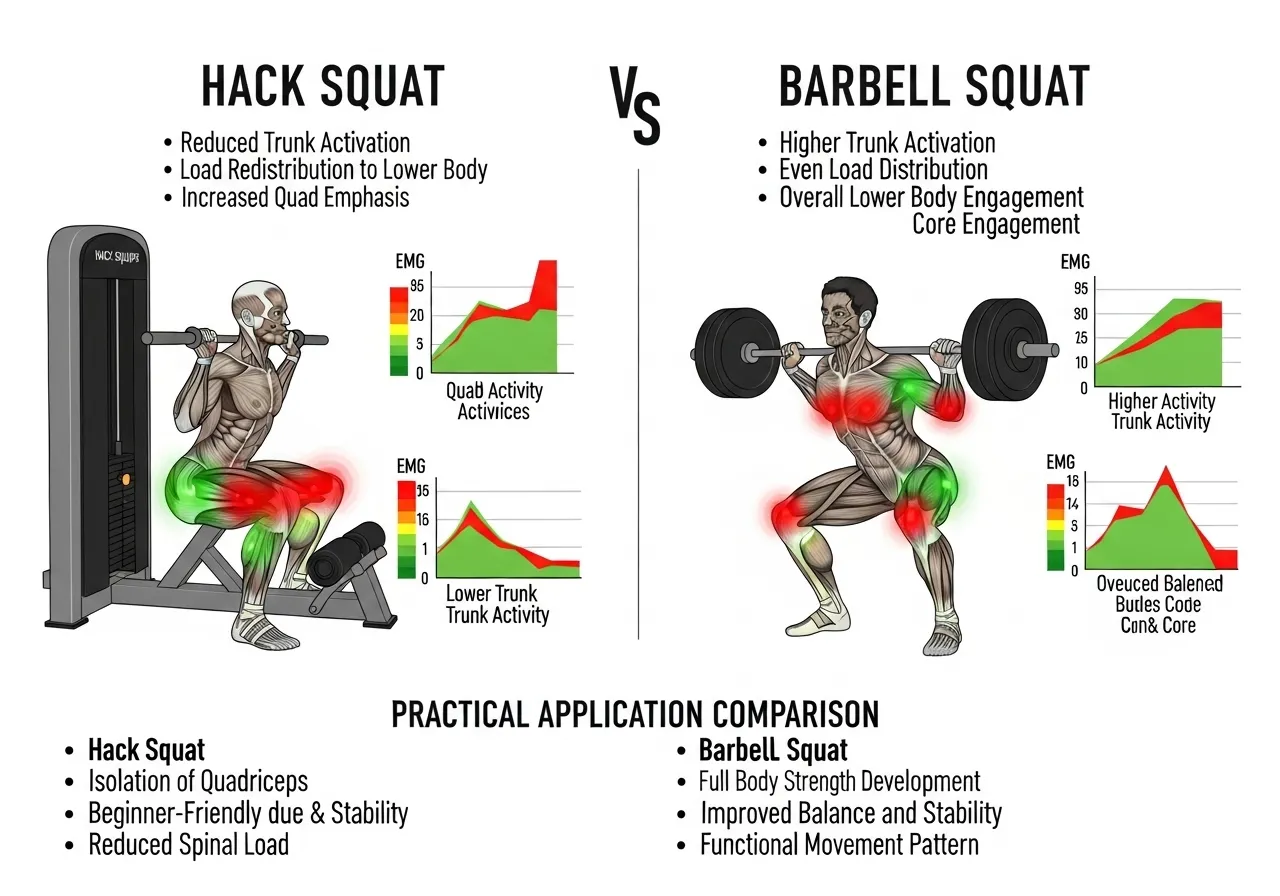
A study comparing trunk muscle activation between the hack squat and barbell back squat at matched relative loads finds that the hack squat produces greater 1RM absolute load capacity compared to the back squat — likely attributed to the machine’s fixed pathway and spinal support removing the trunk stabilisation demand — while trunk muscle activation is significantly lower during hack squats than back squats, confirming that the hack squat redistributes loading from the spinal stabilisers toward the lower body prime movers, making it a mechanically distinct exercise rather than an equivalent alternative to the barbell squat.
Hack squat produces higher absolute loads with lower trunk muscle activation than the barbell back squat. The spine works less; the legs work more. For quad-targeted hypertrophy with reduced lower back demand, this redistribution is the entire point.
Who Benefits Most From This Redistribution
Three training contexts where the hack squat’s reduced spinal demand is specifically valuable:
- High-volume quad training: Trainees who want to accumulate 4–6 sets of quad work per session often find the lower back becomes the limiting factor on sets 4–6 of barbell squats. The hack squat removes this limitation — all 6 sets can reach target quad stimulus.
- Post-heavy deadlift: Combining heavy deadlifts and heavy barbell squats in the same session overloads the erector spinae cumulatively. Pairing deadlifts with hack squats maintains quad volume without compounding spinal fatigue.
- Technique-limited trainees: Trainees whose barbell squat technique deteriorates under load — forward lean increasing, heels rising — benefit from the fixed pathway hack squat until the mobility and strength deficiencies limiting their barbell technique are addressed.
The 1RM Advantage: Load Transfer in Practice
Most trainees can hack squat 20–30% more weight than they back squat at equivalent depth and effort. This load advantage allows greater absolute force on the quadriceps at each working set — a genuine mechanical advantage for quad development that the research on progressive overload and mechanical tension consistently supports as a key hypertrophy driver.
Research 2: Fixed vs Free Barbell Path — What Changes in Muscle Activation
The Textile EMG Study
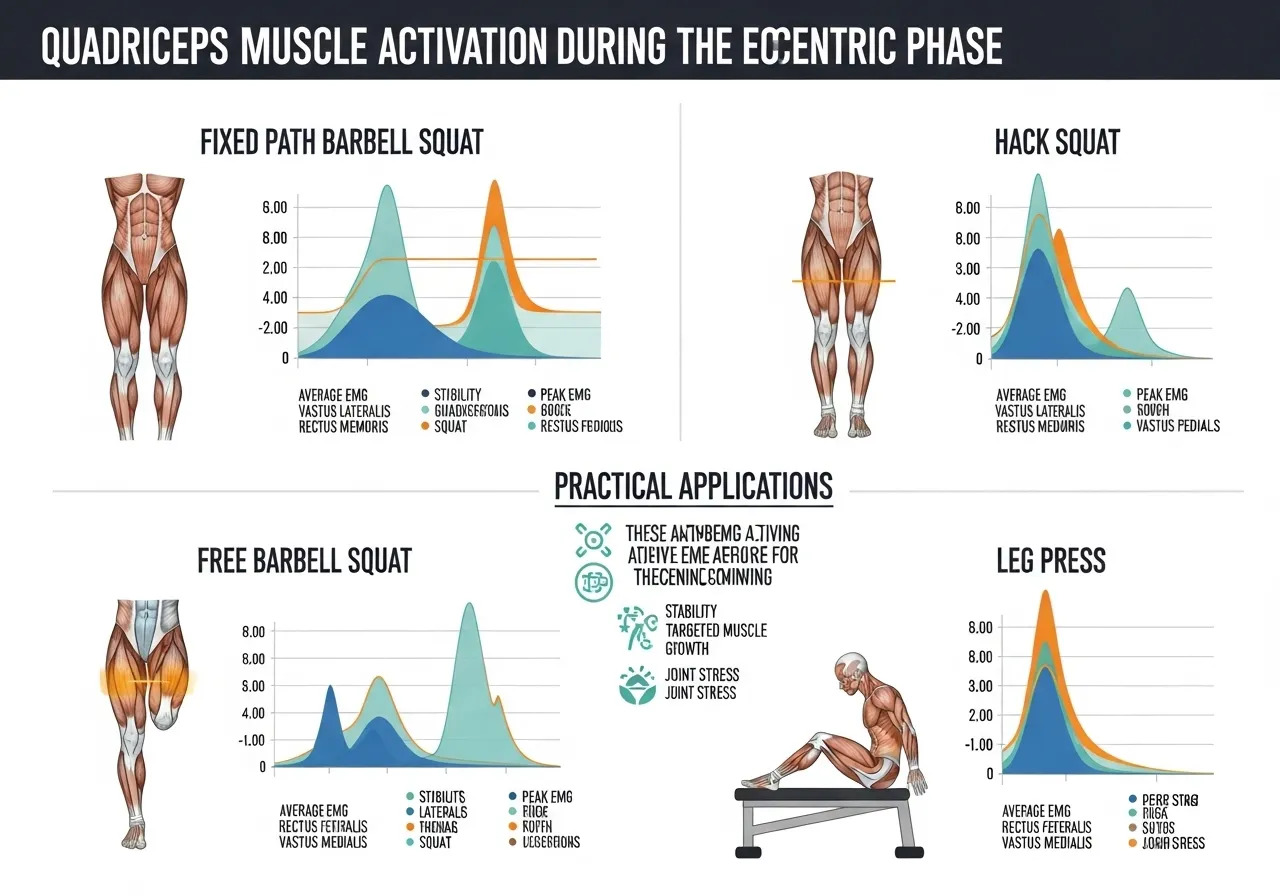
A study comparing muscle activation between free barbell squats and Smith machine (fixed path) squats using novel textile EMG electrode shorts — allowing ecologically valid measurement outside laboratory constraints — finds that mean quadriceps activation was significantly greater for the free barbell path compared to the fixed movement path, with differences most pronounced during the eccentric phase — while gluteus maximus activation showed no significant difference between conditions — confirming that the free barbell path produces greater quad activation through the full squat range, particularly during the lengthening phase where stretch-loaded stimulus is highest.
Free barbell path produces greater quadriceps activation than fixed path — particularly during the eccentric phase. This does not make the hack squat inferior; it means the hack squat achieves high quad stimulus through load advantage, not movement pattern variability.
The Practical Implication: Load vs Activation
The research creates an apparent contradiction: free barbell squats produce higher quad activation per unit of load, but the hack squat allows 20–30% more absolute load. In practice, both factors contribute to hypertrophy stimulus — and the total mechanical tension (load × range × reps) may be comparable or higher on the hack squat at equivalent effort, even if the activation percentage per kilogram is slightly lower.
The take-home: neither exercise is superior in all contexts. The barbell squat produces more total-body stabiliser training alongside the quad stimulus. The hack squat concentrates the quad stimulus with lower spinal demand. Both exercises in rotation provide more complete development than either alone.
Fixed Path and Knee Biomechanics
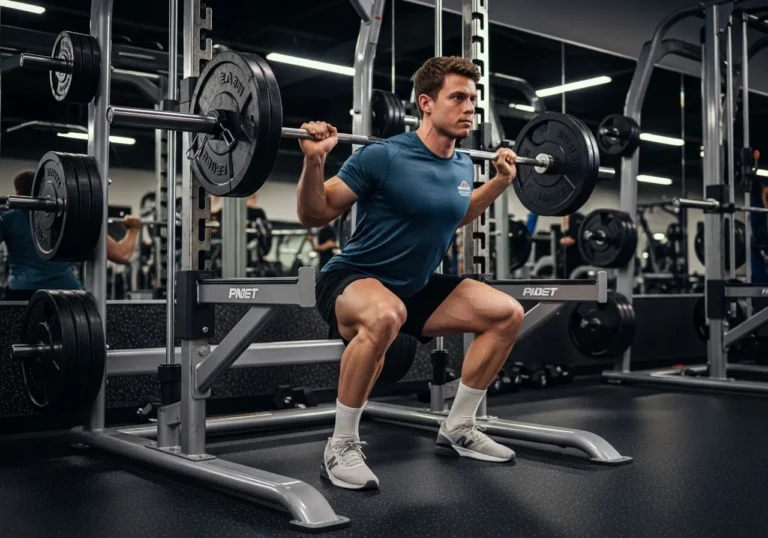
The hack squat’s fixed incline guides the body through a consistent forward-lean position that drives the knee further over the toe than a standard barbell squat. This increases patellofemoral compressive force at the bottom of the movement.
For healthy knees, this is not inherently problematic — the patellofemoral joint tolerates substantial compressive load in healthy tissue. For individuals with existing patellofemoral pain or patellar tendon irritation, the fixed forward knee travel of the hack squat may be provocative in ways that adjusting barbell squat technique (moving the foot forward) cannot resolve due to the fixed machine path.
Spinal Health: When the Fixed Path Is an Advantage
The barbell squat requires the spinal erectors to maintain a safe neutral position under significant compressive load throughout the movement. For trainees with existing lumbar disc sensitivity, this demand can be the primary limiting factor — not quad or glute strength.
The hack squat’s back pad provides direct spinal support throughout the entire range. The spine never bears unsupported compressive load as it does during the descent of a heavy barbell squat. This makes the hack squat uniquely valuable for trainees managing lumbar disc conditions who still want to perform compound knee flexion training at meaningful loads.
The caveat: spinal support removes the stabiliser training benefit that barbell squatting provides. Trainees who train exclusively on machine-supported movements develop well-developed prime movers alongside undertrained spinal stabilisers — a combination that increases injury risk when they eventually return to free weight movements without the machine’s support.
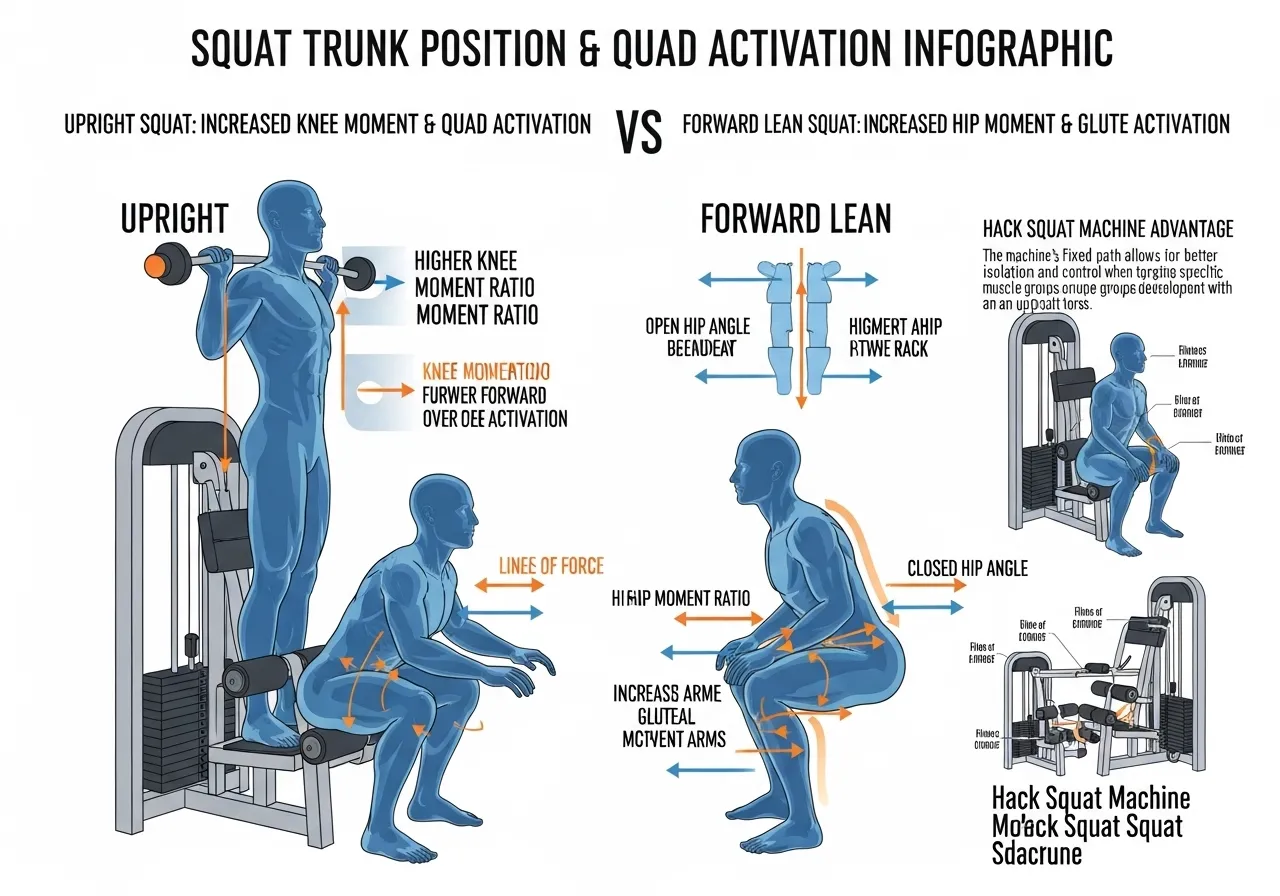
Research 3: Squat Depth, Trunk Position, and Quadriceps Activation
The Biomechanical Review
A clinical biomechanical review of squat exercise examining the relationships between trunk position, foot placement, depth, and muscle activation finds that when the applied load is placed anteriorly (as in a front squat) or the trunk is held upright, higher knee flexion moments result — producing greater quadriceps activation than back squats performed with greater trunk forward lean at matched loads — confirming that the upright trunk position the hack squat machine enforces directly increases quadriceps demand by shifting mechanical advantage toward the knee extensors over the hip extensors.
Upright trunk = greater knee flexion moment = greater quad activation. The hack squat machine enforces the upright trunk position automatically — removing the technical requirement that makes front squats challenging for many trainees, while delivering the same knee-dominant loading pattern.
Depth and the Quad-Glute Trade-Off
Research on squat depth and gluteus maximus activation reveals an important depth-dependent pattern:
- At parallel depth (90° knee flexion): Quad activation is near-maximal; glute activation is moderate
- At shallow depth (above parallel): Both quad and glute activation reduce significantly; this depth range provides limited training stimulus for either muscle group
- At deep squat depth (below parallel): Glute maximus activation increases further; quad activation remains high but may plateau
For the hack squat specifically, reaching parallel depth or below is both mechanically possible and mechanically required to achieve meaningful quad and glute stimulus. Performing partial-range hack squats — which is common when trainees load too heavily — produces neither the quad nor the glute development that the exercise is capable of delivering.
Foot Placement on the Hack Squat Platform
Unlike the leg press where foot position changes are well-researched, hack squat foot placement research is limited. Based on available biomechanical reasoning:
- Higher foot placement: Reduces forward knee travel, decreases patellofemoral stress, shifts emphasis toward glutes and hamstrings — similar to a narrower stance squat on the machine
- Lower foot placement: Increases forward knee travel and quadriceps demand — emphasises the VMO and rectus femoris. More joint stress at the patellofemoral complex.
- Wider stance: Increases hip adductor and glute medius involvement; reduces the pure quad stimulus of the narrow stance hack squat
The VMO: The Hack Squat’s Most Targeted Benefit
The vastus medialis oblique (VMO) — the teardrop-shaped muscle visible on the inside of the knee — receives maximal activation at terminal knee extension (the final 15–30° of straightening the leg). The hack squat’s full range motion through to complete leg extension activates the VMO specifically at its peak demand range.
For trainees with patellar tracking problems or ACL rehabilitation goals where VMO strengthening is specifically prescribed, the hack squat combined with lower foot placement produces greater VMO-targeted terminal extension loading than most other compound exercises. The machine’s fixed pathway ensures consistent terminal extension without the balance compensation that free weight exercises introduce.
A practical VMO-focused protocol: perform the final 5 reps of each hack squat set with a deliberate 2-second pause at the bottom before driving to full extension — maximising the concentric VMO activation through the full knee extension range on every rep.
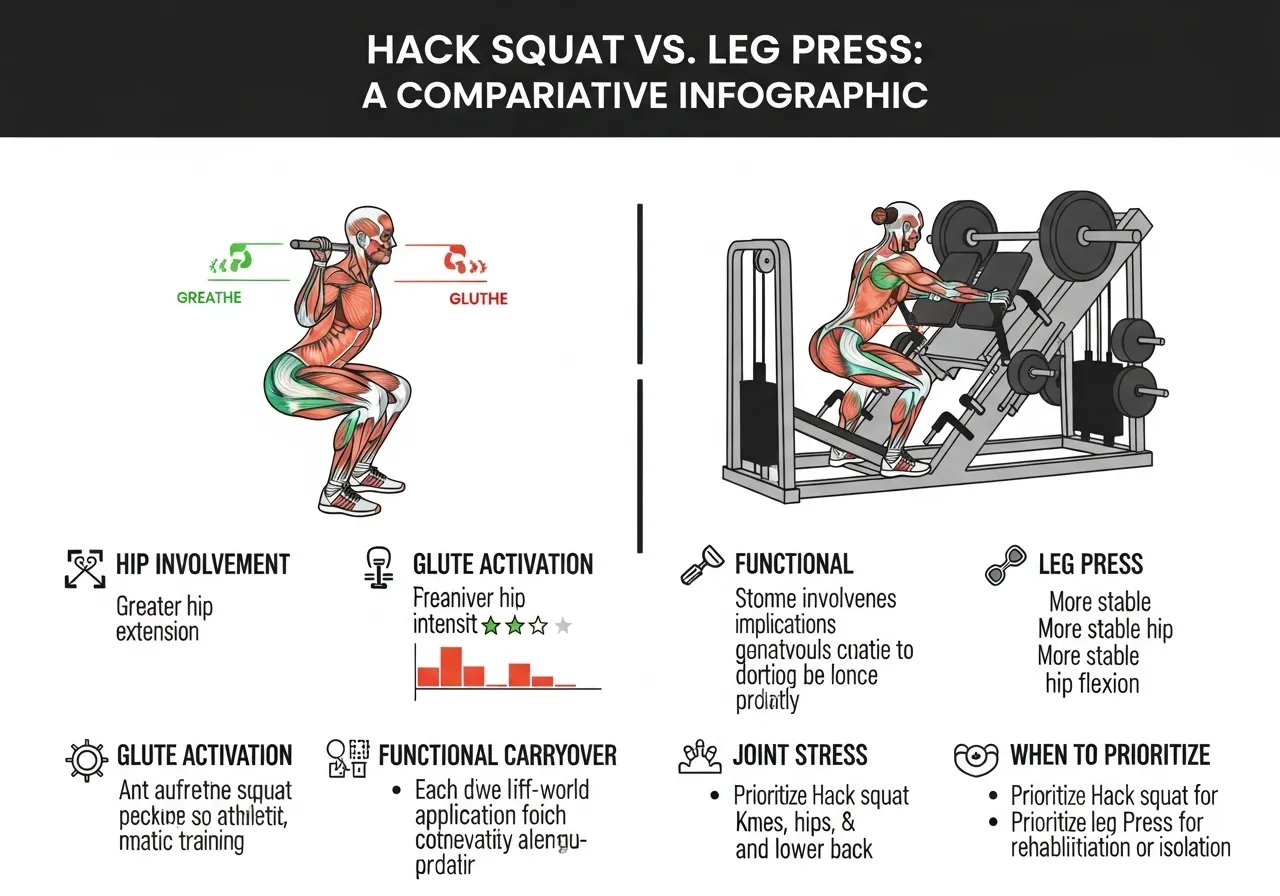
Is the Hack Squat Better Than the Leg Press for Quad Development?
The Mechanical Difference
The hack squat and leg press both load the quadriceps through a knee extension pattern with spinal support. Their mechanical difference lies in the direction of loading.
In the leg press, the body reclines and pushes a platform away horizontally or at an angle. The knee extends but the hip does not fully extend through the movement range — the glutes remain in a shortened position throughout most of the press. The leg press is primarily a quad exercise with limited hip extension component.
In the hack squat, the body is inclined upright and descends vertically. Both the knee and hip extend simultaneously against gravity. The hip extensor muscles (glutes, hamstrings) work alongside the quadriceps through the full movement range — making the hack squat a more complete lower body compound exercise than the leg press.
The Verdict: Different Exercises for Different Goals
| Factor | Hack Squat | Leg Press |
|---|---|---|
| Hip involvement | High — simultaneous knee + hip extension | Low — hip stays shortened |
| Quad activation | High | High |
| Glute activation | Moderate-High | Low-Moderate |
| Functional carryover | Higher — more squat-like movement | Lower |
| Joint stress | Higher knee stress (forward lean) | Lower knee stress (controllable) |
| Best use | Primary compound leg movement, squat substitute | High-volume accessory, knee-sensitive populations |
When to Prioritise the Hack Squat Over the Leg Press
- When the goal is developing squatting strength without barbell technique demands
- When the trainee needs both quad and glute development simultaneously from a single machine exercise
- When the training programme already includes leg press and needs a more complete lower body compound movement to complement it
- When the barbell squat is temporarily unavailable (injury, equipment, technique development period) and a squat-pattern alternative is needed
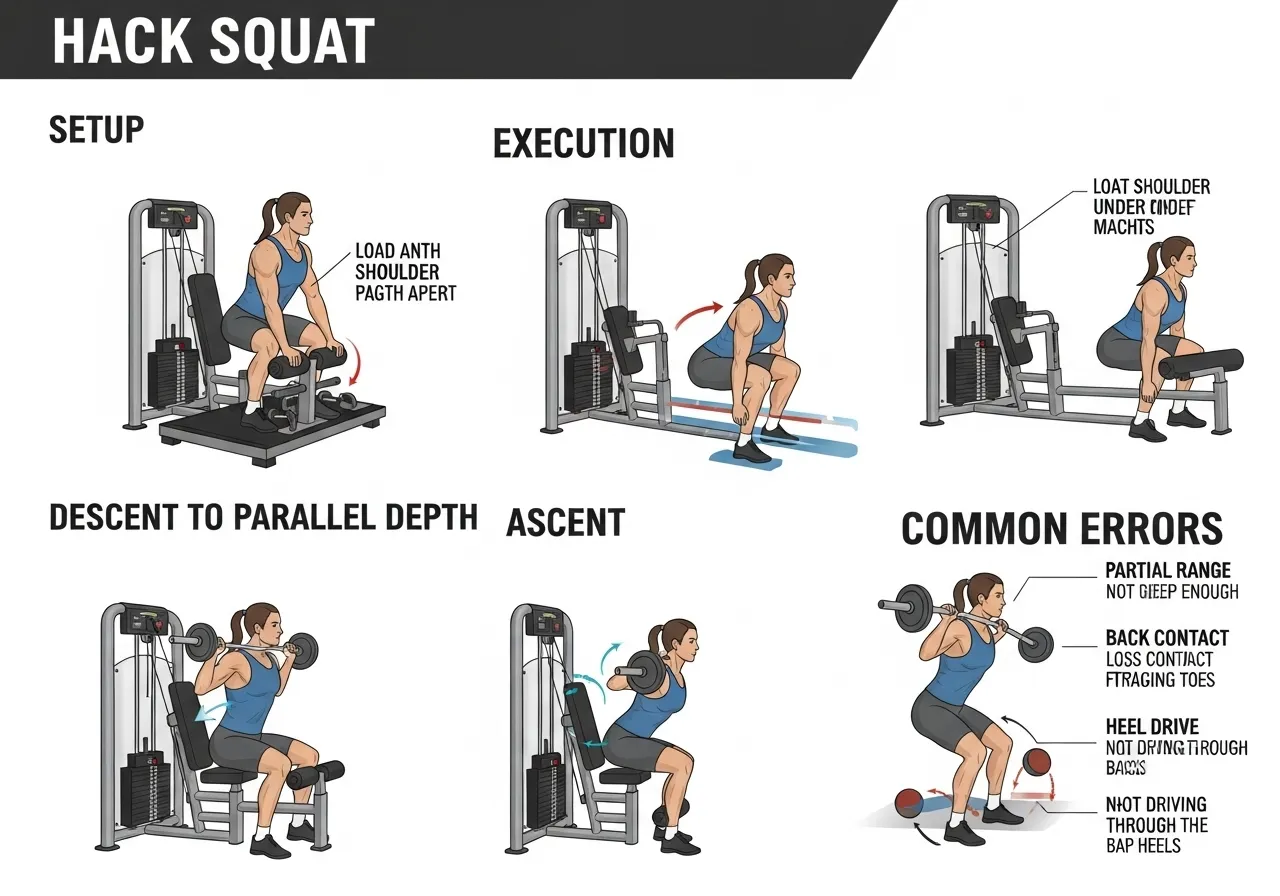
Hack Squat Technique: Every Detail That Determines Whether It Works
Setup: The Non-Negotiables
- Back pad position: The upper back and entire back should contact the pad from the start of each set. Losing contact mid-set indicates the load is too heavy or depth is too great for current mobility — reduce load or depth.
- Shoulder pad position: Shoulder pads should rest on the trapezius (upper shoulder), not the neck. Pads resting on the neck create cervical compression under load — adjust the machine height before loading.
- Foot position: Start with feet shoulder-width on the platform, toes angled outward 15–30°. This allows the knees to track over the toes throughout the descent without internal rotation.
- Safety stops: Set the safety stops at or slightly below the bottom position before loading. The stops should engage before the back pad loses contact.
Execution: Descent
Lower at a controlled pace — approximately 2–3 seconds. Allow the knees to travel over the toes consistently — do not attempt to restrict forward knee travel on the hack squat as you would on a barbell squat. The machine’s fixed path determines knee travel.
Target parallel depth at minimum — where the thigh is parallel to the platform base and knee angle is approximately 90°. Below parallel is appropriate for healthy knees and produces greater glute stimulus. Above parallel is mechanically insufficient for optimal quad development.
Execution: Ascent
Drive through the heels and mid-foot — not the toes. A toe-dominant push shifts load forward in the foot and reduces glute and hamstring contribution to the ascent. Press to full knee extension at the top, but avoid locking the knee aggressively — a soft lockout (95% extension) is appropriate for high-rep sets.
The Most Common Errors
| Error | Consequence | Fix |
|---|---|---|
| Partial range reps | Quad and glute stimulus severely reduced | Reduce load; reach parallel or below every rep |
| Back losing contact | Spinal compression; support lost | Reduce load or depth |
| Knee valgus (inward collapse) | Patellofemoral and medial knee stress | Widen foot stance; reduce load |
| Heel rise | Ankle mobility limiting depth; quad emphasis shifts | Raise heel position on platform or address ankle mobility |
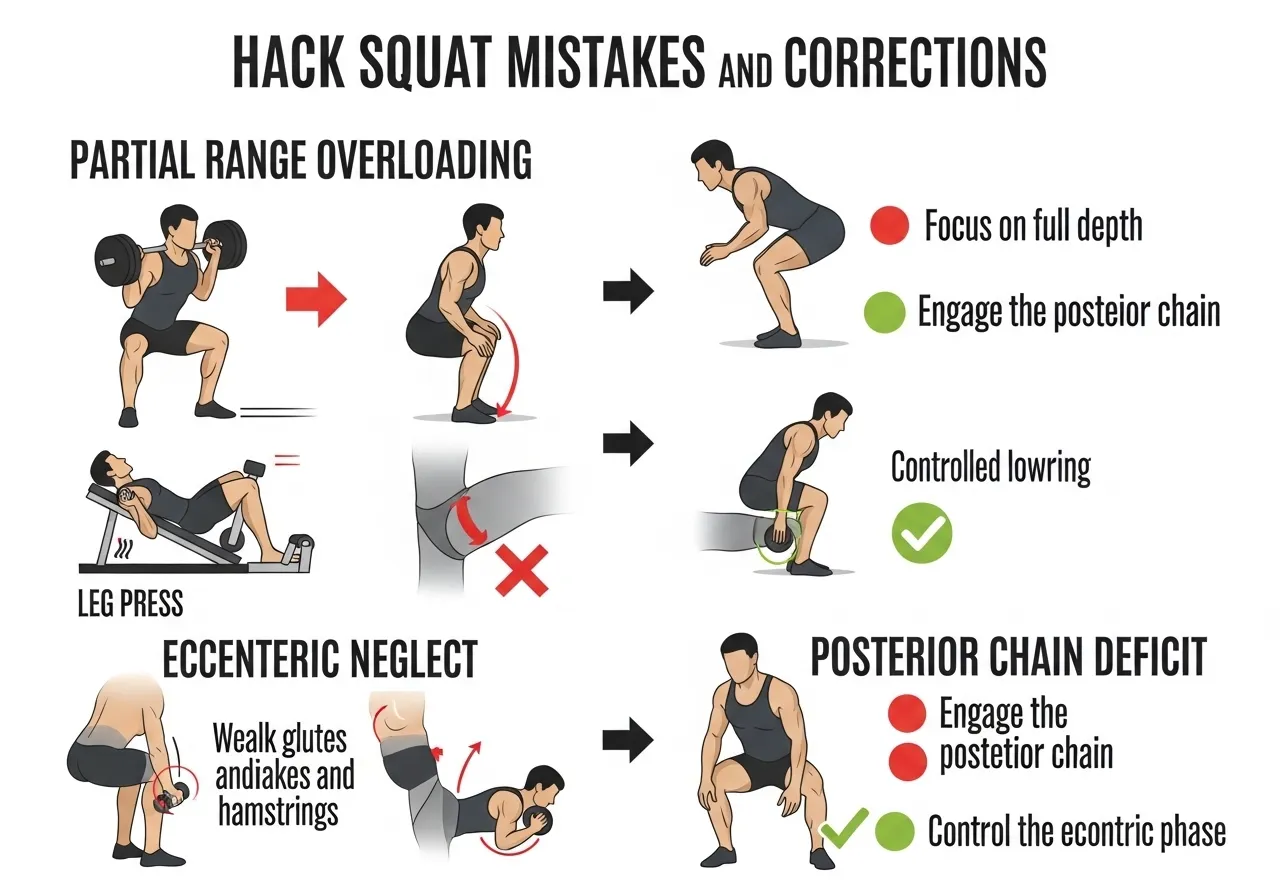
Why Most Trainees Get Less Than Half the Benefit From the Hack Squat
Overloading at the Expense of Range
The hack squat allows heavy loads — and most trainees load it as heavily as possible. At excessive loads, depth becomes the first casualty: reps stop above parallel, the back pad loses contact, and the movement becomes a partial press rather than a squat.
Partial-range hack squats produce high mechanical load at the top of the range where the muscles are shortest — the least productive portion of the movement for hypertrophy. The bottom 30–40° of the hack squat, where muscles are longest and most stretched, produces the greatest hypertrophic stimulus per rep. Stopping above parallel consistently skips this range.
Using It as a Leg Press Substitute
Trainees who use the hack squat exactly as they use the leg press — high foot placement, limited depth, toe push — convert it into an inferior leg press. They receive the knee stress of the hack squat’s forward path without the quad and glute stimulus that makes it valuable.
The hack squat’s value comes from its squat-pattern mechanics. Using it with leg press mechanics removes this value. Lower foot placement, full depth, and a heel-driven ascent are non-negotiable for the exercise to deliver on its potential.
Neglecting Eccentric Control
The hack squat’s guided pathway makes it easy to let the machine “catch” the descent at the bottom — essentially dropping into the lower position rather than lowering under control. This removes the eccentric loading that is the primary driver of muscle damage and hypertrophic stimulus in the descent phase.
A 2–3 second controlled descent on every rep costs nothing in additional time but produces substantially more hypertrophic stimulus per set. The eccentric phase on a hack squat — where the quads lengthen under significant load against the fixed incline — is one of the most productive ranges of the exercise.
Not Pairing It With Hip-Dominant Exercises
The hack squat’s reduced hamstring and erector spinae activation compared to barbell squats means that a hack-squat-centred lower body programme systematically undertains the posterior chain. Sessions built around hack squats should include direct hamstring work — Romanian deadlifts, Nordic curls, or leg curls — to compensate for the posterior chain deficit that the machine’s quad emphasis creates. See also: Romanian deadlift guide for the complementary posterior chain exercise that balances hack squat training.
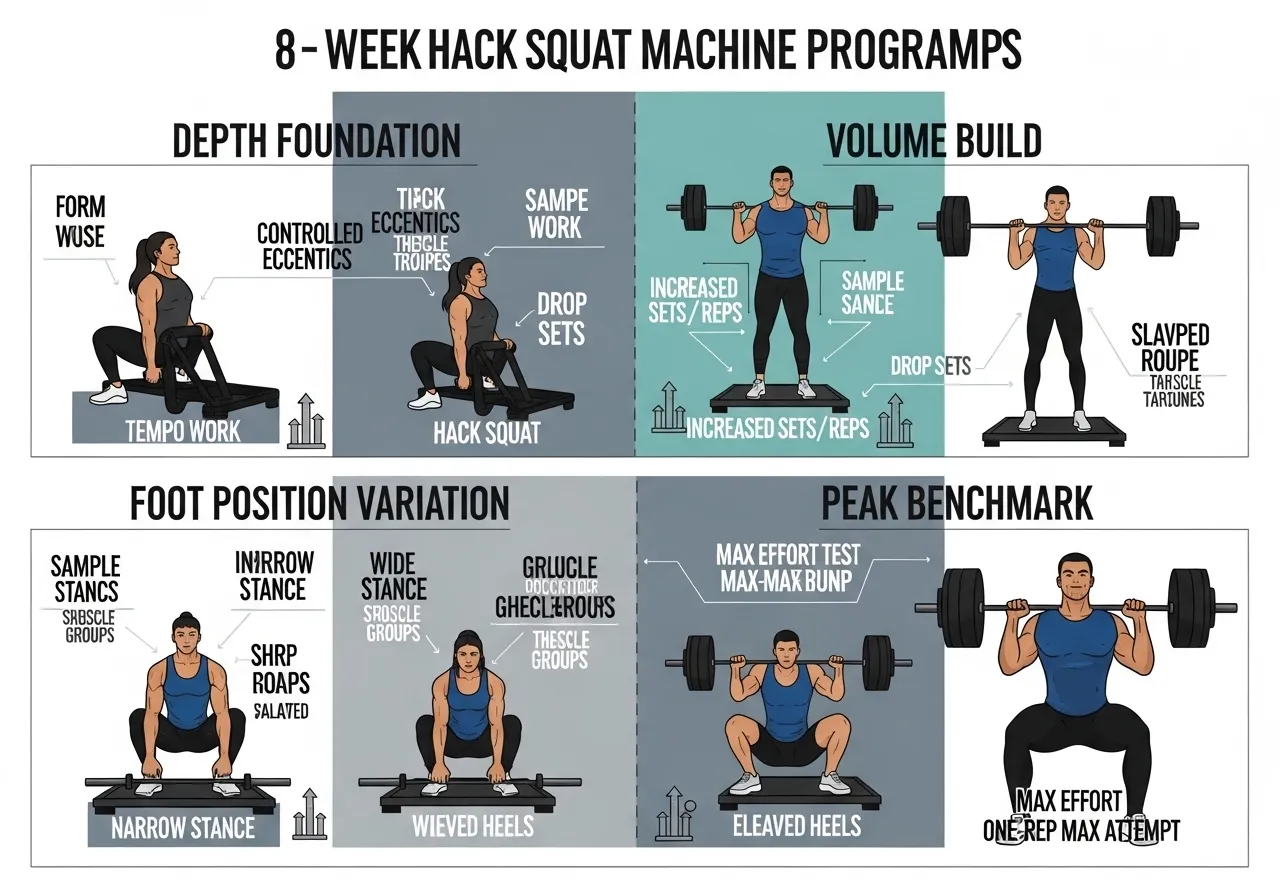
8-Week Hack Squat Programme
This programme runs two lower body sessions per week. Session A uses the hack squat as the primary compound movement. Session B uses the barbell back squat or trap bar deadlift as the primary movement, with hack squat as an accessory. Both sessions include direct posterior chain work to compensate for the hack squat’s reduced hamstring and glute activation relative to barbell squatting.
📅 Phase 1 — Weeks 1–2: Depth and Technique Foundation
- Session A: Hack squat 4×10 (moderate load — prioritise parallel depth every rep) | Romanian deadlift 3×12 | Leg curl 3×12
- Session B: Barbell back squat 4×6 | Hack squat accessory 2×12 (lighter, full depth focus) | Hip thrust 3×12
Focus: Establish full depth standard and controlled eccentric before adding load
📅 Phase 2 — Weeks 3–4: Volume Build
- Session A: Hack squat 4×8 (heavier load) | Romanian deadlift 4×10 | Walking lunge 3×10 each
- Session B: Barbell back squat 4×5 | Hack squat 3×10 | Nordic curl 3×6
Focus: Increase load on primary hack squat sets; maintain depth standard as weight increases
📅 Phase 3 — Weeks 5–6: Intensity (Foot Position Variation)
- Session A: Hack squat low foot position 4×6 (VMO emphasis, heavier) | Hack squat high foot position 2×12 (glute emphasis) | RDL 4×8
- Session B: Barbell squat 4×4 (strength focus) | Hack squat 3×8 | Leg curl 4×10
Focus: Introduce foot position variation — note the different fatigue patterns between low and high foot positions
📅 Phase 4 — Weeks 7–8: Peak + Benchmark
- Session A: Hack squat 4×5 (near-maximal load with depth maintained) | RDL 3×8 | Nordic curl 3×6
- Session B: Barbell squat peak 4×3 | Hack squat 3×8 | Hip thrust 4×10
- Benchmark (Week 8): Retest hack squat 5RM vs Phase 1 working weight. A 15–25% load increase at full depth is a typical 8-week outcome. Compare quad muscle soreness location between Sessions A and B — Session A should produce more distal quad (VMO) soreness; Session B more posterior chain soreness, confirming the complementary training stimulus is working.
Focus: Establish new 5RM at maintained depth standard; continue hack squat as permanent Session A primary movement going forward
Frequently Asked Questions About the Hack Squat Machine
Is the hack squat safe for people with bad knees?
It depends on the knee condition. The hack squat’s fixed forward-knee-travel path increases patellofemoral compressive load — making it potentially provocative for active patellar tendinopathy or patellofemoral pain syndrome. For these populations, a higher foot placement reduces forward knee travel and may allow the exercise to be tolerated. For post-surgical knee rehabilitation, physiotherapy guidance determines appropriateness. For healthy knees with no pathology, the hack squat is as safe as any compound knee flexion exercise when loaded appropriately and performed with full range of motion.
Can the hack squat replace barbell squats?
For muscle development goals — largely yes. The hack squat produces comparable quad and glute hypertrophy when volume and intensity are matched. What it cannot replace: the stabiliser training (erector spinae, obliques, mid-foot balance) that barbell squatting develops, and the sport-specific strength patterns that barbell squatting trains for athletic performance. For general fitness and aesthetics goals, the hack squat is a viable primary leg exercise. For athletic development, it complements rather than replaces barbell squatting. See also: barbell back squat guide for the exercises that complement hack squat training.
Should I go below parallel on the hack squat?
Yes — for healthy knees and adequate ankle and hip mobility. Below-parallel depth increases gluteus maximus activation and lengthens the quadriceps further, increasing the stretch-loaded stimulus. The safety mechanisms on most hack squat machines allow setting the bottom stop at below-parallel — use it. Partial-range hack squats (stopping above 90°) significantly reduce both quad and glute training stimulus for minimal reduction in joint stress.
What is the difference between the hack squat and the landmine squat?
The landmine squat (holding one end of a barbell anchored at the floor) creates a similar upright-torso, forward-knee squat pattern to the hack squat but without machine support. The landmine version trains balance, requires more core stability, and allows natural body movement rather than a fixed path. The hack squat allows heavier loads and full spinal support. Both produce similar quad emphasis — the landmine is the free-weight equivalent of the hack squat’s machine pattern.
How often should I hack squat per week?
Two sessions per week is appropriate for most training goals. The hack squat produces significant eccentric quad loading that requires 48–72 hours of recovery between sessions. Three sessions per week is feasible for advanced trainees at moderate volumes. See also: leg extension and curl guide for isolated VMO work that pairs well with hack squats. The limiting factor is typically knee joint recovery rather than muscular recovery — the patellofemoral joint may develop irritation with three high-volume hack squat sessions per week, particularly if running or other knee-demanding activities are also in the programme.