Isometric Training Guide: Muscle Adaptation Science, 8 Key Exercises, and Isometric Strength Plan
This article is for general educational purposes only and does not replace professional medical advice. If you have any joint, tendon, or cardiovascular condition, please consult a qualified healthcare professional before beginning any isometric training programme.
Isometric training — contracting a muscle without any change in joint angle or muscle length — is the most misunderstood training modality in mainstream fitness.
Most trainees encounter isometrics only in two contexts: the wall sit in a group fitness class, or a physiotherapist’s rehabilitation protocol after injury. Both encounters reinforce the same impression: isometrics are low-intensity, rehabilitation-appropriate, but fundamentally limited compared to “real” lifting.
The research tells a more interesting story. This guide covers what isometric training actually produces in terms of strength and hypertrophy, why muscle length during isometric training matters more than most coaches know, the 8 best isometric exercises across all major muscle groups, and an 8-week programme that uses isometrics strategically within a complete training approach.
The Rehabilitation Myth: Isometrics Are More Than Just Injury Recovery
Where the Reputation Came From
Isometric training gained its rehabilitation reputation legitimately — it is genuinely excellent for loading tendons and maintaining muscle activity when joint movement is contraindicated by injury or surgery. In that specific context, isometrics is the right tool.
What happened over decades of this framing is that isometric training became associated exclusively with reduced capacity, pain management, and the temporary limitations of injured people — rather than with its actual potential as a standalone training modality for healthy individuals.
If you have ever dismissed isometrics because “you can only hold a static position,” you have been sold a partial picture of what this training method actually produces.
What a 9-Week Isometric Programme Does to Muscle Size
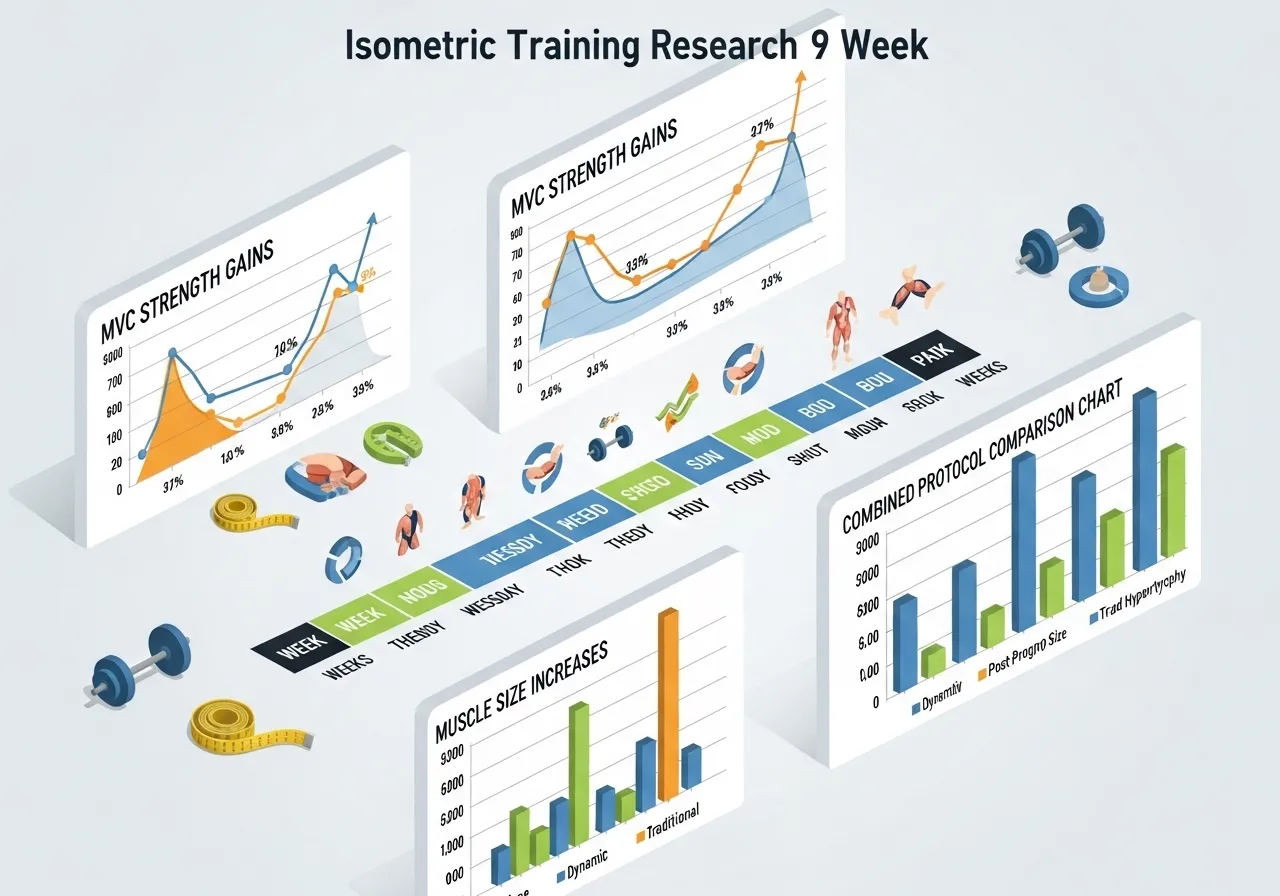
A study published in the International Journal of Environmental Research and Public Health examining the effects of isometric training programmes on muscle size and function in the elbow flexors found that a 9-week combined isometric training regimen including both high- and low-intensity phases increased maximal voluntary isometric contraction (MVC) alongside measurable increases in muscle cross-sectional area — with the training-induced change in MVC being similar between a hypertrophy-focused combined regimen and a strength-only protocol — confirming that appropriately dosed isometric training can simultaneously develop both muscle size and maximal voluntary strength in healthy individuals.
Isometric training can produce both hypertrophy and strength gains simultaneously when appropriately programmed — not just the joint-angle-specific strength improvements commonly cited as its only benefit.
The Joint-Angle Specificity Problem — and Its Solution
The most frequently cited limitation of isometric training is joint-angle specificity: strength gains from isometric training tend to be greatest at and near the joint angle where training occurs, with smaller transfer to other positions in the range of motion.
This is real — but it is a programming problem, not a fundamental flaw. It is addressed by:
- Training at multiple joint angles: Performing isometric holds at the mid-range, shortened, and lengthened positions of a movement distributes strength gains across the full range
- Combining with dynamic training: Isometrics paired with conventional dynamic lifting fills the joint-angle-specific gaps — the isometric provides dense tension at targeted positions, the dynamic work trains across the full range
- Selecting the right position: Training at the “sticking point” (the weakest position in a dynamic movement) using isometrics directly targets the angle where dynamic strength most often fails
Blood Pressure Considerations: The Real Safety Note
Isometric contractions — particularly at high intensities with breath-holding — can produce acute spikes in blood pressure due to the Valsalva manoeuvre (the involuntary closing of the airway during straining). This is the one genuinely relevant safety consideration for isometric training.
For individuals with hypertension (high blood pressure) or cardiovascular disease, high-intensity isometrics require medical clearance. For healthy individuals, maintaining continuous breathing throughout holds (rather than holding the breath) substantially reduces this effect.
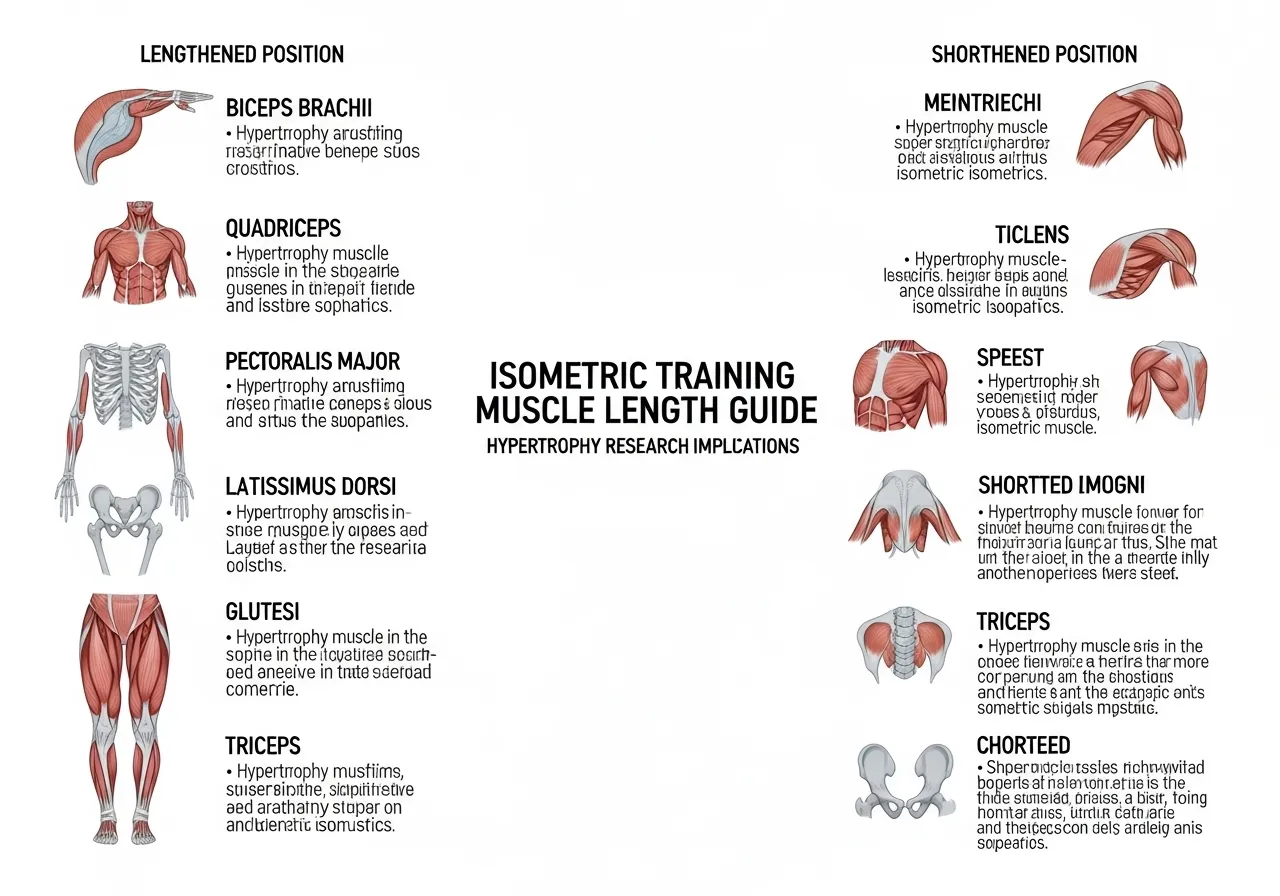
Does Muscle Length During Isometric Training Change What You Get?
The Emerging Research on Long vs Short Muscle Lengths
One of the most practically important findings in recent isometric training research concerns where in the range of motion the hold is performed — specifically, whether training at a longer (more stretched) or shorter (more contracted) muscle length changes the adaptation outcome.
A randomised controlled study examining the effects of low-intensity isometric training at long and short muscle lengths of the hamstrings found that 8 weeks of isometric hamstring training at long muscle lengths (30° knee flexion) produced greater increases in hamstring cross-sectional area than the same training performed at short muscle lengths (90° knee flexion) — with both conditions improving maximal voluntary isometric contraction — suggesting that the muscle length during isometric training significantly influences the hypertrophic outcome even when training load and volume are matched.
Isometric training at long muscle lengths produces greater hypertrophy than equivalent training at short muscle lengths. For muscle-building goals, performing holds in the stretched position (e.g., deep squat for quads, fully extended position for biceps) is meaningfully superior to holds in the contracted position.
Why Lengthened Isometrics May Be More Effective for Hypertrophy
The proposed mechanism involves the relationship between mechanical tension and muscle fibre length. At longer muscle lengths, the overlap between actin and myosin filaments (the contractile proteins within muscle fibres) is reduced — meaning individual cross-bridges (the molecular connections that generate force) must produce greater force per unit to maintain the same total tension.
This increased per-unit mechanical stress at the sarcomere level (the smallest functional unit of a muscle fibre) may produce a stronger hypertrophic signalling response — particularly stimulating the addition of sarcomeres in series, a type of adaptation associated with both lengthened hypertrophy and fascicle length increases.
Practical Implications: How to Apply Muscle Length Findings
For each isometric exercise, the “lengthened” position corresponds to the most stretched point of that muscle:
| Muscle Group | Shortened Position (less effective for hypertrophy) | Lengthened Position (more effective for hypertrophy) |
|---|---|---|
| Quadriceps | Leg near fully extended (standing) | Deep knee bend (90°+ flexion, e.g., wall sit deep) |
| Hamstrings | Knee bent to 90° (shortened) | Leg near fully extended (lengthened hamstring) |
| Biceps | Elbow fully flexed (top of curl) | Elbow near full extension (arm almost straight) |
| Glutes | Hip fully extended (top of hip thrust guide) | Hip at 90° flexion (deep hip hinge position) |
| Chest | Hands together at midline | Arms wide and lowered (stretched fly position) |
Isometric Training and Strength Transfer to Dynamic Movements
A systematic review and meta-analysis examining the relationship between isometric and dynamic strength following resistance training found that isometric resistance training resulted in greater isometric strength gains compared to dynamic resistance training and control conditions, while isokinetic (dynamic) strength gains were similar between isometric and dynamic training modalities — indicating meaningful transfer from isometric training to dynamic performance that varies depending on the joint angle trained and the specificity of the dynamic test used.
Isometric training transfers meaningfully to dynamic strength — the transfer is not limited to the trained angle alone. Dynamic strength gains from isometric training were comparable to those from dynamic training itself when matched for volume.
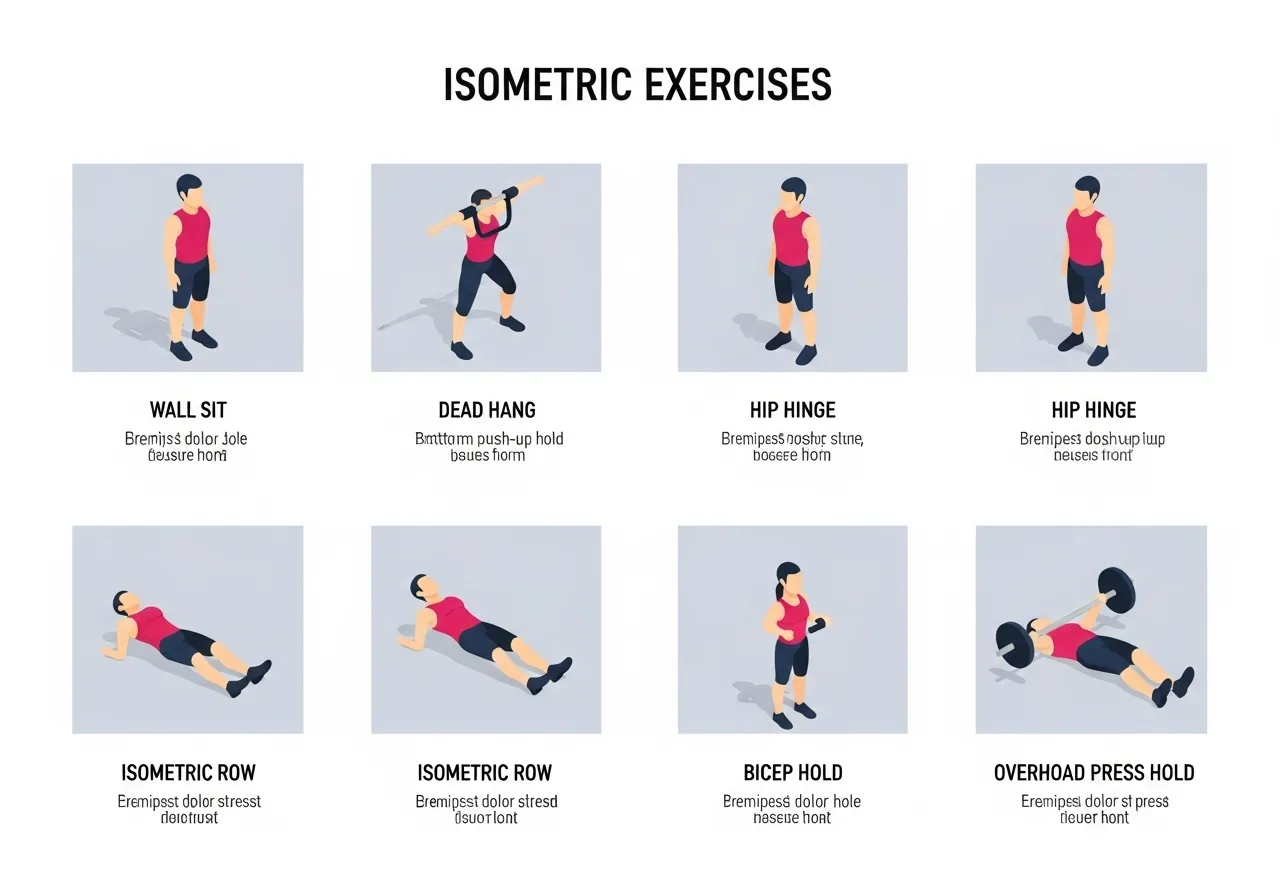
8 Key Isometric Exercises: Technique and Programming Notes
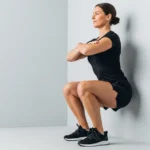
🏋️ 1. Wall Sit (Deep) (see also: core stability guide) (see also: balance training guide) (see also: stretching guide)
Target: Quadriceps, gluteus maximus, hamstrings
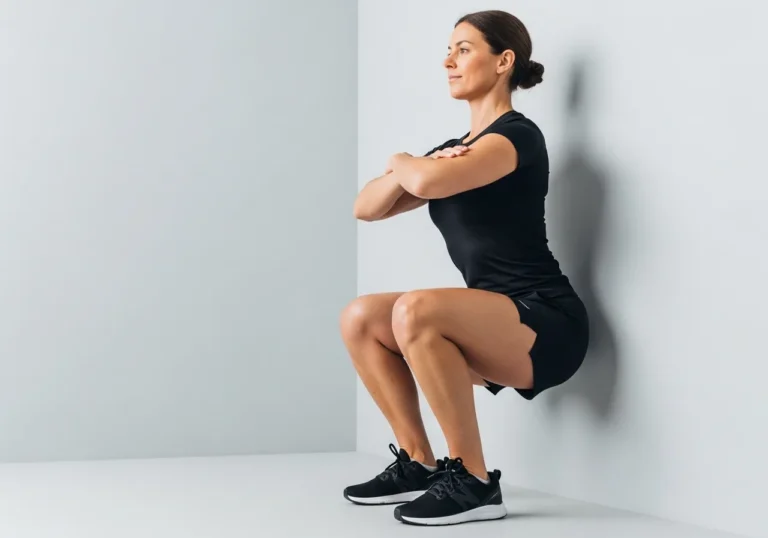
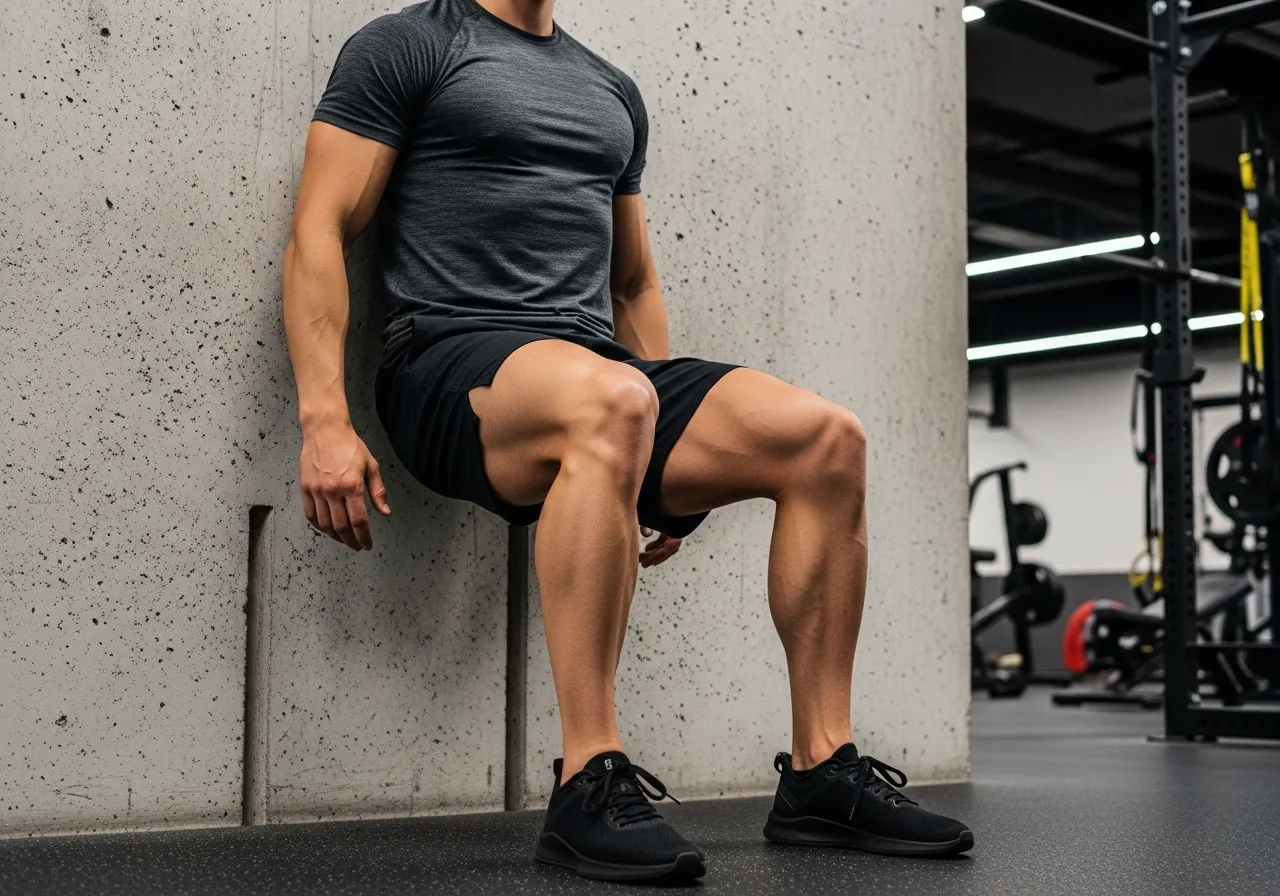
How: Stand with back flat against a wall. Slide down until thighs are parallel to the floor or below (the deeper the position, the greater the lengthened quadriceps stimulus). Feet hip-width apart, shins vertical. Hold for the target duration while breathing continuously.
Key point: Most people perform wall sits at too shallow a depth — the quad-parallel position (90° knee angle) provides significantly more hypertrophic stimulus than a shallower sit
🏋️ 2. Isometric Push-Up Hold (Bottom Position)
Target: Pectoralis major (lengthened), triceps, anterior deltoid
How: Lower to the bottom of a push-up (chest 2–3 cm from the floor) and hold. Elbows at 45° from the torso, core braced, body rigid. The bottom position places the pectoral in its lengthened state — maximising the hypertrophic stimulus.
Key point: This is more demanding than it appears — most people can hold the top push-up position indefinitely but find the bottom position extremely challenging after 20–30 seconds
🏋️ 3. Dead Hang
Target: Latissimus dorsi (lengthened), forearm flexors, shoulder stabilisers
How: Grip a pull-up bar with fully extended arms. Allow the shoulders to elevate passively (scapular elevation — the natural rise of the shoulder blades when hanging). Hold for the target duration. Progress to active hang (shoulders depressed, scapulae engaged downward) for greater lat activation.
Key point: The dead hang is one of the most underutilised exercises for shoulder health — passive shoulder elevation under load gently stretches the capsule and strengthens the rotator cuff in a decompressed position
🏋️ 4. Isometric Hip Hinge Hold
Target: Hamstrings (lengthened), glutes, erector spinae
How: Hinge at the hips to a Romanian deadlift bottom position (torso near parallel to the floor, slight knee bend). Hold with the hamstrings under maximum stretch. Can be performed bodyweight or holding light dumbbells for progressive loading.
Key point: This position places the hamstrings at long muscle length — consistent with the research showing superior hypertrophy from lengthened isometric training; hold duration of 30–45 seconds produces substantial stimulus
🏋️ 5. Plank (Standard and Variations)
Target: Transversus abdominis, rectus abdominis, obliques, erector spinae
How: Forearm or straight-arm plank with body in a straight line from head to heels. Actively brace the abdominals as if anticipating a punch, squeeze the glutes, and maintain neutral spine. Variations: side plank (oblique emphasis), RKC plank (maximal full-body tension).
Key point: A 10-second RKC plank (maximal full-body tension — squeeze everything simultaneously) may produce greater core activation than a 60-second passive plank where effort gradually reduces
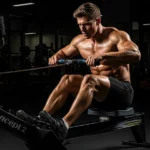
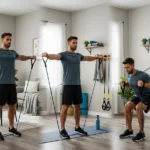
🏋️ 6. Isometric Row Hold (Cable or Band)
Target: Latissimus dorsi, rhomboids, middle trapezius, biceps brachii
How: Pull a cable or band to the mid-row position (elbows at 90°, scapulae retracted) and hold. Maintain the pulled position with deliberate scapular retraction throughout the hold — the mid-position loads the back musculature isometrically at a moderate muscle length.
Key point: For the greatest lat hypertrophic stimulus, hold at the beginning of the row pull (arms extended, lats stretched) rather than the completed position — consistent with the lengthened-position advantage from the research
🏋️ 7. Isometric Bicep Curl Hold
Target: Biceps brachii, brachialis
How: Hold a dumbbell or cable handle with the arm near full extension (the lengthened biceps position). Maintain tension against the weight without allowing the arm to move. This is markedly more demanding per unit of time than holds at 90° elbow flexion.
Key point: The full-extension hold is uncomfortable and unfamiliar — most trainees underestimate the stimulus; 20–30 seconds at the lengthened position with a light-to-moderate load produces significant biceps activation
🏋️ 8. Isometric Overhead Press Hold
Target: Deltoids, upper trapezius, triceps brachii, rotator cuff stabilisers
How: Press dumbbells to just below full lockout (elbows slightly bent, shoulders loaded) and hold. Alternatively, hold at the sticking point of the press (typically 90–120° of shoulder flexion) — the position where dynamic pressing most commonly fails.
Key point: Isometric holds at the specific sticking point of a press directly address the angle where strength is weakest — a targeted application that general dynamic pressing cannot replicate with the same specificity
Isometrics vs Dynamic Training: When Should You Prioritise Which?
The False Choice Most Programmes Force
Most training programmes are either entirely dynamic (barbells, dumbbells, machines, cables with full range of motion) or use isometrics only in the rehabilitation context. Very few programmes deliberately combine both modalities for complementary benefits in healthy trainees.
Here is what the research and practical application support when deciding how to use each:
| Situation | Isometric Advantage | Dynamic Advantage | Best Choice |
|---|---|---|---|
| Sticking point weakness in a lift | Direct, angle-specific loading at the weak position | — | Isometric at sticking point |
| Maximum strength development | — | Full ROM loading; progressive overload precision | Dynamic primary + isometric accessory |
| Tendon rehabilitation / patellar tendinopathy | Load tendon without joint movement; pain reduction effect | — | Isometric |
| Hypertrophy (muscle size) | Lengthened isometrics strong hypertrophic signal | Full ROM with eccentric emphasis; higher volume capacity | Both combined |
| Joint injury (cannot move through range) | Maintains muscle activity without joint stress | — | Isometric |
| Limited training time (under 20 min) | High stimulus per unit of time; no equipment needed | — | Isometric circuit |
| Athletic power development | — | Rate of force development requires dynamic contraction | Dynamic (plyometric/explosive) |
Isometric Training for Tendon Health: A Specific and Well-Evidenced Use
One of the most clinically validated applications of isometric training is tendon loading for patellar tendinopathy (pain and dysfunction of the patellar tendon — the tendon connecting the kneecap to the shin bone). Research has consistently shown that isometric quadriceps contractions at moderate-to-high intensity produce an immediate analgesic (pain-reducing) effect in tendon pain — an effect that does not occur with equivalent dynamic loading.
The proposed mechanism involves the neurological inhibition of cortical excitability (a reduction in the brain’s sensitivity to pain signals from the tendon) following sustained isometric muscle activation. This pain-relief effect typically lasts 30–45 minutes after a set of isometric holds — making isometric loading a practical in-session pain management strategy for athletes training through tendinopathy under professional guidance.
The Fatigue Advantage of Isometric Training
A practical advantage rarely discussed in fitness media: isometric training produces significantly less systemic fatigue than equivalent-stimulus dynamic training. The absence of eccentric loading (which produces the majority of delayed onset muscle soreness and structural muscle damage) means isometric sessions can be performed more frequently without the recovery cost of conventional lifting.
For trainees who are already training 4–5 days per week with dynamic work, adding isometric sessions on recovery days provides additional stimulus without adding significant recovery demand — a meaningful advantage for those whose primary goal is increasing total weekly training volume.
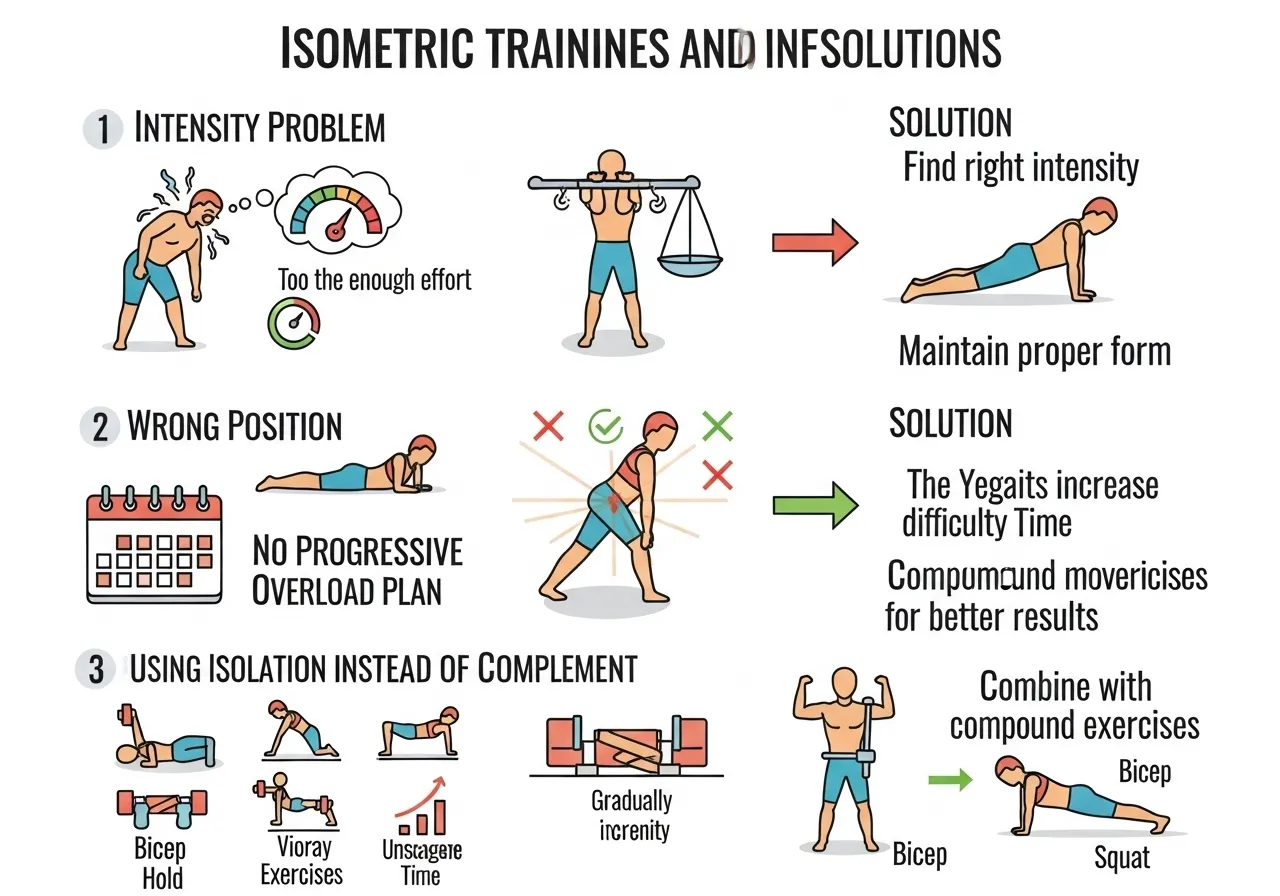
Why Isometric Training Fails to Produce Results for Most People
The Intensity Problem: Too Easy, Too Long
The most common isometric training error is not training at insufficient intensity — it is training at low intensity for long durations rather than high intensity for shorter durations.
A 2-minute wall sit at a shallow depth with breathing effortless throughout is a different training stimulus than a 45-second wall sit at deep depth where the final 15 seconds require genuine effort to maintain. The second is a training stimulus; the first is barely above resting metabolic rate for the muscles involved.
For strength and hypertrophy goals, isometric contractions at 70–75% of maximum voluntary contraction for 3–30 seconds per repetition have the best evidence support. Lower intensities (under 50% MVC) may develop muscular endurance but are insufficient to maximally stimulate hypertrophic signalling pathways.
The Wrong Position: Short Muscle Length by Default
Most people default to the easiest position in a movement — which is almost always the shortened position. The shortened quadriceps in a shallow wall sit. The contracted biceps at 90° during a curl hold. The standing position during a calf raise hold.
As the lengthened-position research makes clear, these are the positions that produce the least hypertrophic stimulus from isometric training. Defaulting to them is comfortable and manageable, but it is also the reason isometric training feels like a cool-down rather than a training method.
No Progressive Overload Plan
Dynamic training has obvious progressive overload markers — you add weight to the bar or increase reps. Isometric training feels ambiguous: what does “more” look like when you are just holding a position?
Without a clear progression scheme, most isometric training stagnates within 2–3 weeks. Practical isometric progression methods:
- Duration progression: Increase hold time by 5 seconds per session or per week (e.g., 20s → 25s → 30s per set)
- Load progression: Hold the same position with progressively heavier dumbbells or higher cable resistance
- Angle progression: Move toward a longer muscle length as strength improves at the initial position
- Set addition: Increase from 3 to 5 sets of the same hold before increasing duration or load
Using Isometrics in Isolation Rather Than as a Complement
Isometric-only training programmes can produce results, but they consistently underperform programmes that combine isometric and dynamic loading.
The most effective approach treats isometrics as a targeted supplement to dynamic training — used to address specific weaknesses (sticking points, injured angles, lengthened-position hypertrophy targets) rather than as a wholesale replacement for compound dynamic work.
Trainees who abandon isometrics entirely after a few weeks of underwhelming results are usually either training at insufficient intensity, defaulting to shortened positions, or trying to use isometrics as the primary driver of a programme rather than the targeted tool it is most effective as.
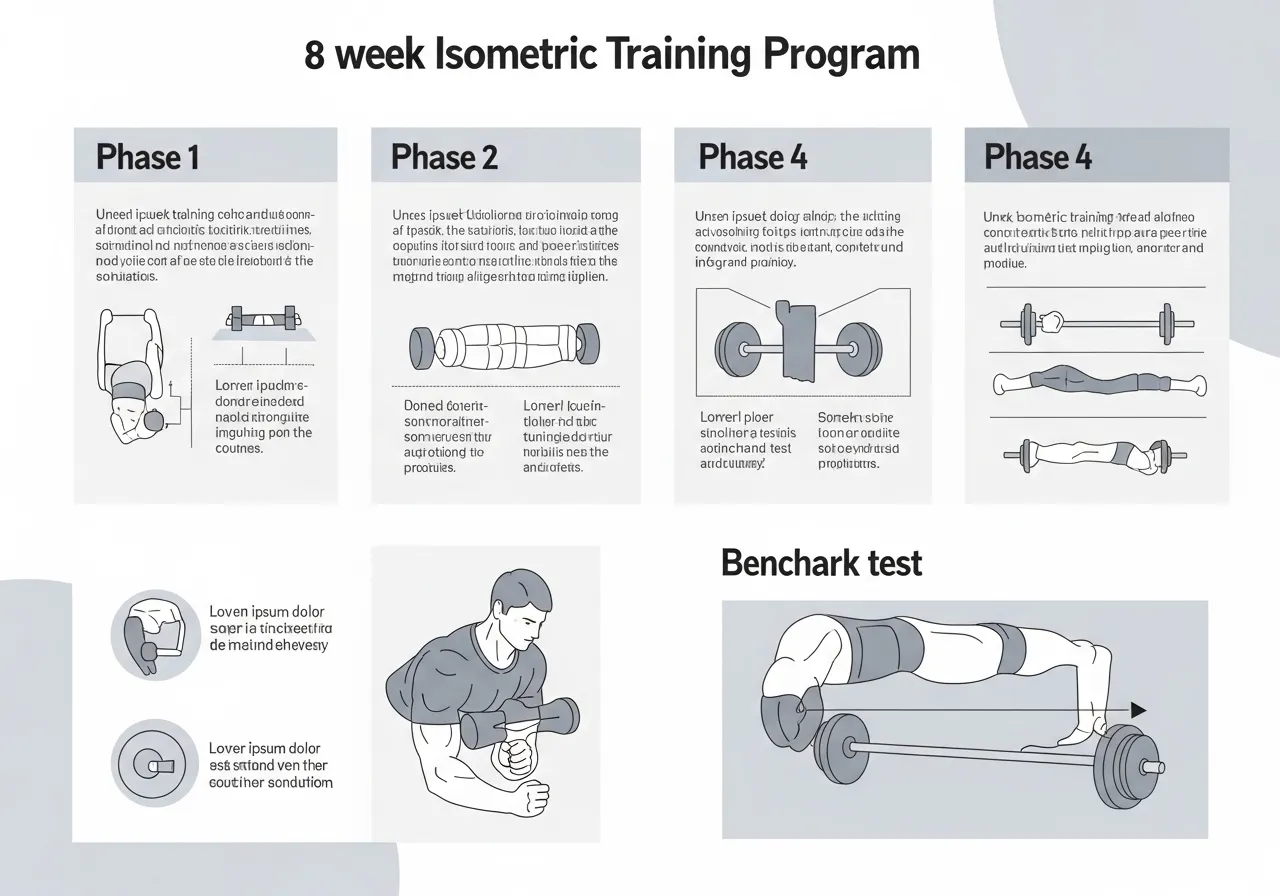
8-Wee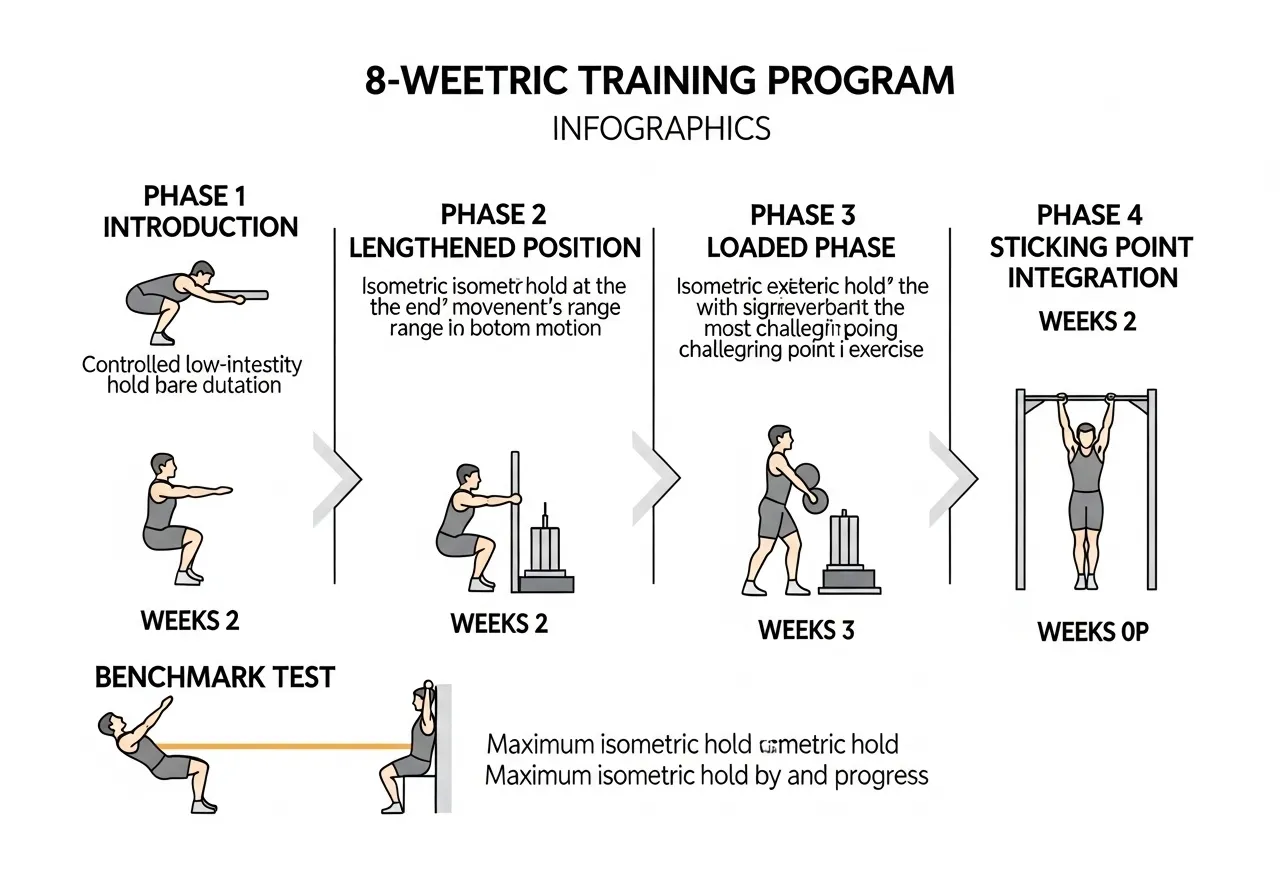 k Isometric Integration Programme
This programme integrates isometric training as a targeted complement to dynamic resistance work — not a replacement for it. Each session includes both dynamic compound movements and targeted isometric holds that address the specific weaknesses or lengthened-position hypertrophy targets that dynamic training alone underserves.
Equipment: a pull-up bar for dead hangs, dumbbells or a cable machine for isometric holds, and a wall for wall sits. Most sessions can be completed with minimal equipment.
📅 Phase 1 — Weeks 1–2: Introduction (Technique and Intensity Calibration)
- Wall sit (deep): 3×30 s — find the depth where the final 10 seconds are genuinely challenging
- Dead hang: 3×20 s — progress to active hang (shoulders depressed) by Week 2
- Isometric push-up hold (bottom): 3×15 s — most trainees find this harder than expected; reduce to 10 s if needed
- Plank (RKC style): 3×20 s maximum tension
Focus: Learn correct positions; identify which exercises challenge you most — those are your priority targets
📅 Phase 2 — Weeks 3–4: Lengthened Position Focus
- Wall sit (deep, 90° or below): 4×35 s
- Isometric hip hinge hold (bodyweight): 3×30 s — hamstrings at full stretch
- Isometric bicep hold (arm near extended): 3×20 s per arm with light dumbbell
- Dead hang to active hang: 3×25 s active position
- Bottom push-up hold: 3×20 s
Focus: Consistently train at lengthened positions; note which muscle groups feel the most fatigue — these are receiving the hypertrophic stimulus the research supports
📅 Phase 3 — Weeks 5–6: Loaded Isometrics
- Wall sit (holding dumbbells on thighs): 4×35 s — add 5–10 kg total load
- Isometric hip hinge (holding light dumbbells): 4×30 s
- Isometric cable row hold (arms extended, lat stretched): 3×20 s per side
- Isometric overhead press hold (sticking point): 3×20 s
- Side plank: 3×30 s each side
Focus: Add external load to previously mastered positions; track the dumbbell weight used for reproducibility
📅 Phase 4 — Weeks 7–8: Sticking Point Integration
- Identify your sticking point: Which dynamic lift stalls at a specific point in the range? Select that angle for isometric holds this phase.
- Sticking point holds: 4×20 s at the precise sticking point angle of your primary lift (squat, press, or deadlift equivalent)
- Wall sit (maximum load): 4×40 s with highest comfortable dumbbell load
- Lengthened isometric circuit: Hip hinge + bicep hold + bottom push-up hold — 3 rounds, 25 s each exercise, 30 s between exercises
- Benchmark: Retest Week 1 wall sit (same depth) — ability to hold for 45–60 s where 30 s was challenging in Week 1 is a clear adaptation marker
Focus: Apply isometric training directly to your specific dynamic training weaknesses; establish this as a permanent part of your programme, not a temporary experiment
Frequently Asked Questions About Isometric Training
How long should I hold each isometric contraction?
For strength and hypertrophy goals, hold durations of 3–30 seconds at 70–75% of maximum voluntary contraction have the strongest evidence. For endurance and joint stability goals, longer holds (30–60 seconds) at lower intensity (50–60% MVC) are more appropriate. Avoid holds longer than 60 seconds at high intensity — the cardiovascular stress outweighs the additional training benefit.
Can isometric training help with tendon pain?
Yes — isometric loading is among the most evidence-supported interventions for reactive tendinopathy (inflamed tendons). The immediate analgesic effect of sustained isometric contractions has been documented for patellar, Achilles, and rotator cuff tendons. However, tendon pain management requires professional assessment to rule out structural tendon tears before loading. Always consult a physiotherapist or sports medicine physician before using isometrics for tendon-related pain.
Is isometric training effective for beginners?
Yes — and in some ways more immediately accessible than dynamic training. Isometric exercises require no equipment for many variations, involve no technique complexity compared to barbell lifting, and can be scaled instantly by adjusting hold duration and depth. Beginners may find isometrics an excellent introduction to resistance training before progressing to more complex dynamic movements.
Does isometric training increase blood pressure dangerously?
High-intensity isometric contractions with breath-holding can produce acute blood pressure increases. For healthy individuals who breathe continuously throughout holds (avoiding the Valsalva manoeuvre), this effect is significantly reduced. For individuals with diagnosed hypertension or cardiovascular disease, isometric training intensity should be kept moderate (below 50–60% MVC) and medical clearance should be obtained before beginning a programme.
How does isometric training fit alongside regular gym training?
Most effectively as an accessory tool added to 2–3 dynamic training days per week — either as a session finisher (2–3 isometric exercises after dynamic work) or as a standalone recovery-day activity. A complete 15–20 minute isometric session on a rest day provides additional training stimulus without the recovery demand of a full dynamic session.