⚠️ Health & Fitness Disclaimer This article is for general educational and informational purposes only and does not replace professional medical or fitness advice. Kettlebell training involves ballistic movements that require proper technique. If you have any pre-existing back, shoulder, or joint condition — please consult a qualified healthcare professional or certified instructor before beginning.
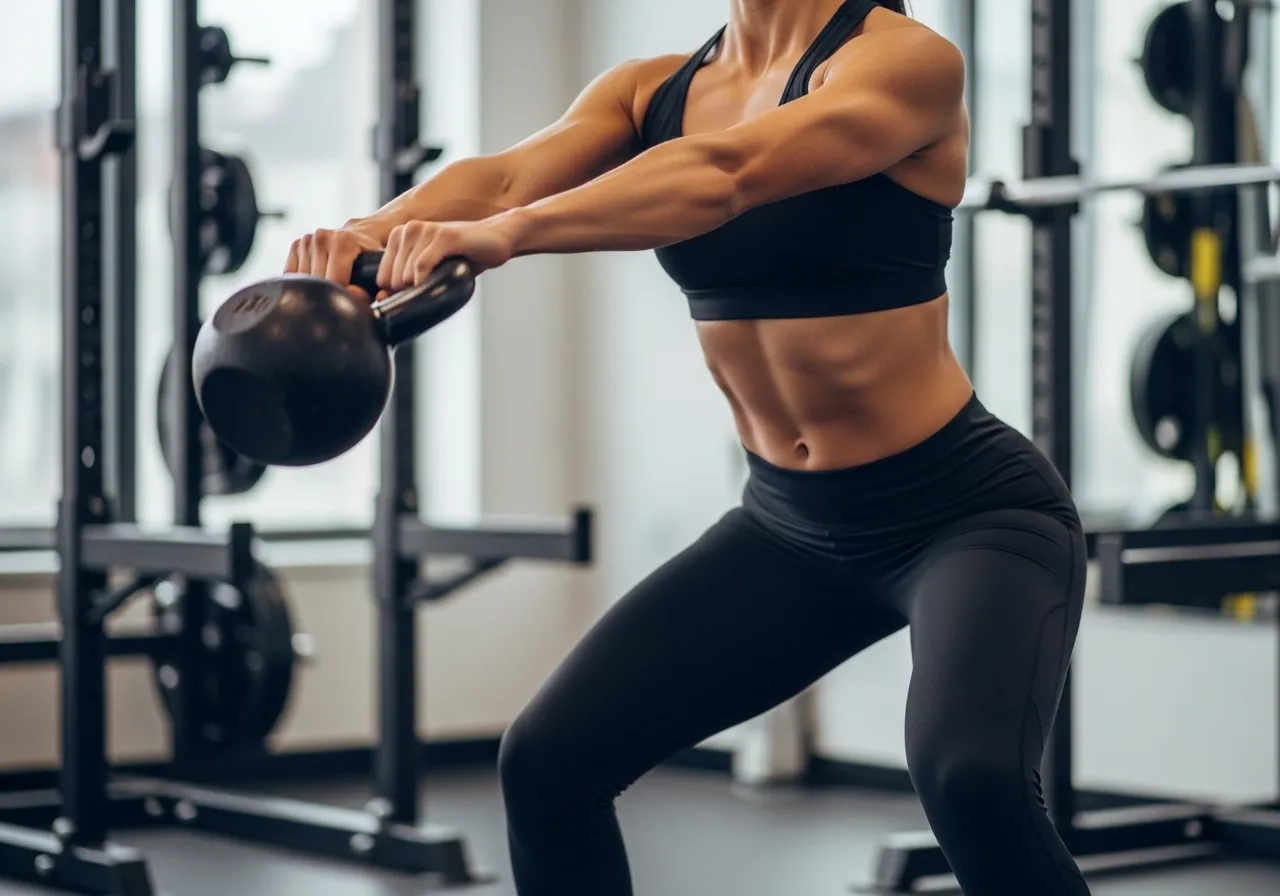
The kettlebell complete guide is one of the most efficient training tools available — a single implement that simultaneously develops strength, power, cardiovascular capacity, and mobility in a way that neither barbells, dumbbells, nor cardio machines can replicate alone.
Its effectiveness stems from the unique offset center of gravity — the weight hangs below the handle rather than being centered in it — which creates rotational forces that demand active stabilization throughout every exercise.
This guide covers the research on kettlebell training, explains the five foundational movements, provides technique breakdowns for each, and gives a progressive program from beginner to intermediate.
The Science Behind Kettlebell Training: What the Research Shows
These broad performance gains reflect the multi-joint, multi-plane nature of kettlebell exercises — unlike isolated machine training, which develops strength only in the specific plane of the machine’s movement path.
Musculoskeletal Health and Pain Reduction
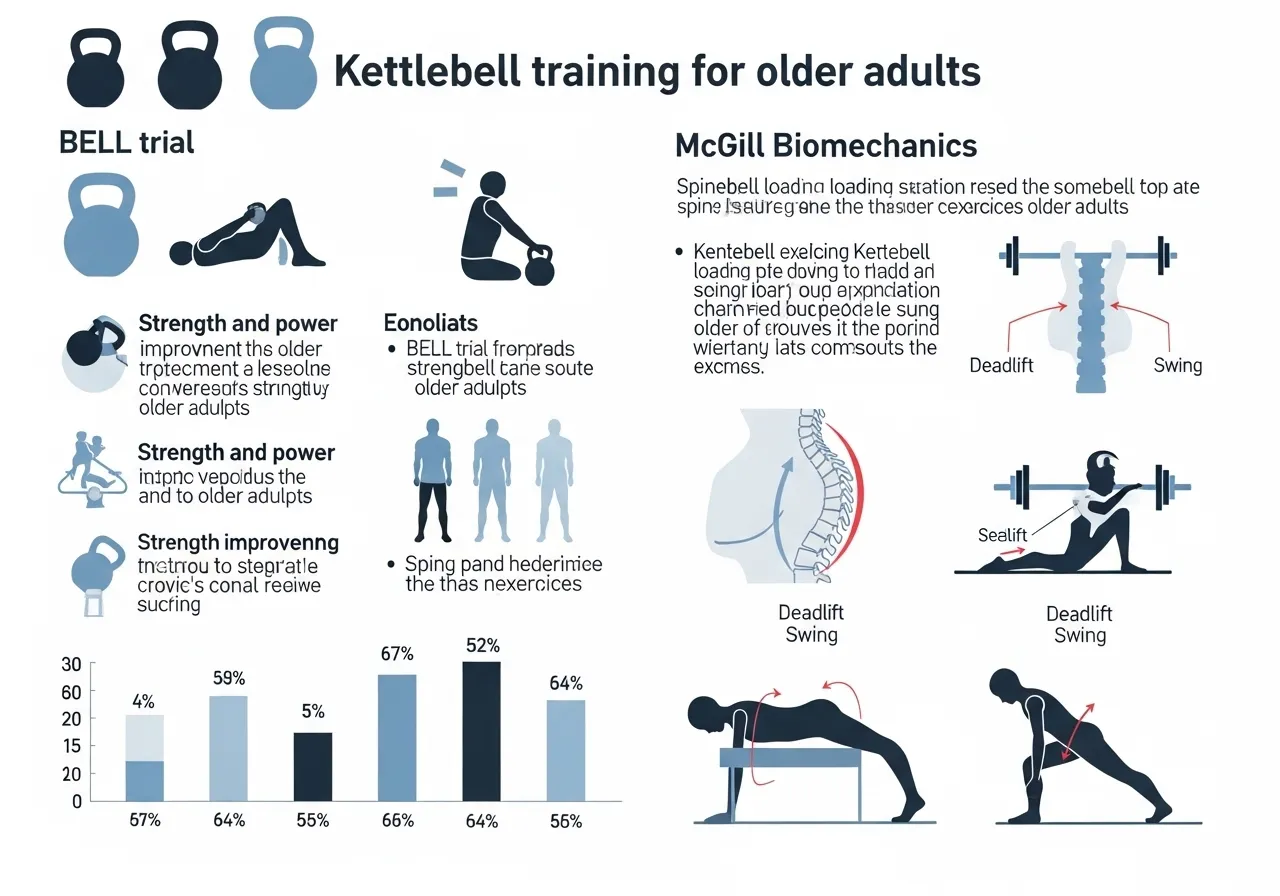
A randomized controlled trial found that 8 weeks of kettlebell training in office workers with chronic neck, shoulder, and lower back pain significantly reduced pain in both the neck/shoulders (by 2.1 points on a 10-point scale) and lower back (by 1.4 points), while increasing trunk extensor strength — supporting kettlebell training as a practical workplace health intervention.
The study noted that all participants showed a positive adaptive response to training — supporting kettlebell training as an accessible and effective intervention for older adults seeking comprehensive fitness improvements.
Biomechanics: The Kettlebell Swing Under the Microscope
The study identified that kettlebell swings produce a posterior shear pattern at L4–L5 (the fourth and fifth lumbar vertebrae) — the opposite direction of traditional deadlift loading — which may explain their therapeutic application in some back pain contexts.
The Dual Cardiovascular-Strength Stimulus
Kettlebell training occupies a unique space between traditional strength training and cardiovascular exercise:
Heart rate during continuous kettlebell swing protocols reaches 65–85% of maximum — sufficient to produce cardiovascular adaptation
The explosive hip-hinge pattern of the swing develops posterior chain power in ways that steady-state cardio cannot
The combination of strength and cardiovascular stimulus in a single session makes kettlebells time-efficient for general fitness goals
How Kettlebells Differ from Dumbbells: The Offset Center of Gravity
The fundamental mechanical difference between kettlebells and dumbbells is the position of the center of mass relative to the hand:
Dumbbell: The weight is centered at the grip — the center of mass is directly in line with the handle
Kettlebell: The ball hangs below the handle — the center of mass is displaced below the grip, creating a constant rotational moment that the wrist, elbow, and shoulder must actively manage
This offset creates constant proprioceptive demand (sensory input about position and movement) during every exercise — the forearm and shoulder stabilizers must continuously adjust throughout the range of motion in ways that dumbbell exercises do not require.
This is why exercises like the Turkish Get-Up, performed with a dumbbell first and then a kettlebell, feel fundamentally different — the kettlebell’s tendency to rotate at the wrist forces much greater shoulder and wrist stabilizer activation.
The combination of strength and cardiovascular demands within a single exercise session makes kettlebell training highly efficient for metabolic conditioning — the improvement of the body’s ability to produce and sustain energy output during intense exercise.
This efficiency is particularly relevant for time-constrained individuals:
A 20-minute kettlebell session performed at appropriate intensity can produce cardiovascular stimulus comparable to a 30–40 minute moderate-intensity run
The posterior chain strength development from swings occurs simultaneously with the cardiovascular conditioning — not sequentially as in separate strength and cardio sessions
The technical demands of kettlebell exercises engage the central nervous system more deeply than simple cardio — producing neurological adaptations alongside metabolic ones
Breathing Patterns in Kettlebell Training
Kettlebell exercises require specific breathing coordination that differs from most resistance training:
During the swing hike (before the drive): Inhale sharply as the bell hikes back — filling the lungs and building intra-abdominal pressure for the upcoming hip snap
At the top of the drive: A sharp exhale — the “hiss” or “punch” breath associated with hardstyle kettlebell technique — coincides with the hip lock and glute squeeze at the swing’s apex
During high-rep work: A “two swings per breath” rhythm — inhale on the downswing, exhale on the upswing — becomes necessary as the stroke rate increases
Correct breathing pattern is not merely aesthetic — the increased intra-abdominal pressure from the synchronized inhale-brace provides meaningful spinal stability during the loaded hip-hinge pattern.
Choosing Between Ballistic and Grinding Kettlebell Work
Kettlebell exercises fall into two broad categories with distinct training effects:
Ballistic exercises (swing, clean, snatch): Fast, explosive movements that develop power and cardiovascular capacity — the hip snap is the power source, and momentum carries the bell through the trajectory
Grinding exercises (press, TGU, goblet squat, carry): Slow, controlled movements that develop strength, stability, and mobility — muscular effort throughout the full range with no momentum contribution
Effective kettlebell programming combines both categories — ballistic work provides the conditioning and power development that grind-only programs lack, while grinding exercises develop the structural strength and stability needed for safe ballistic loading.
The Turkish Get-Up is the single best representative of the grinding category — its seven-stage, shoulder-overhead structure demands and develops the complete mobility-stability foundation that allows heavier ballistic work to be performed safely.
This dual nature positions kettlebell training as uniquely efficient for time-constrained individuals.
The 5 Foundational Kettlebell Movements
Movement 1 — The Kettlebell Swing
The swing is the cornerstone of all kettlebell training — mastering it is prerequisite to every other foundational movement.
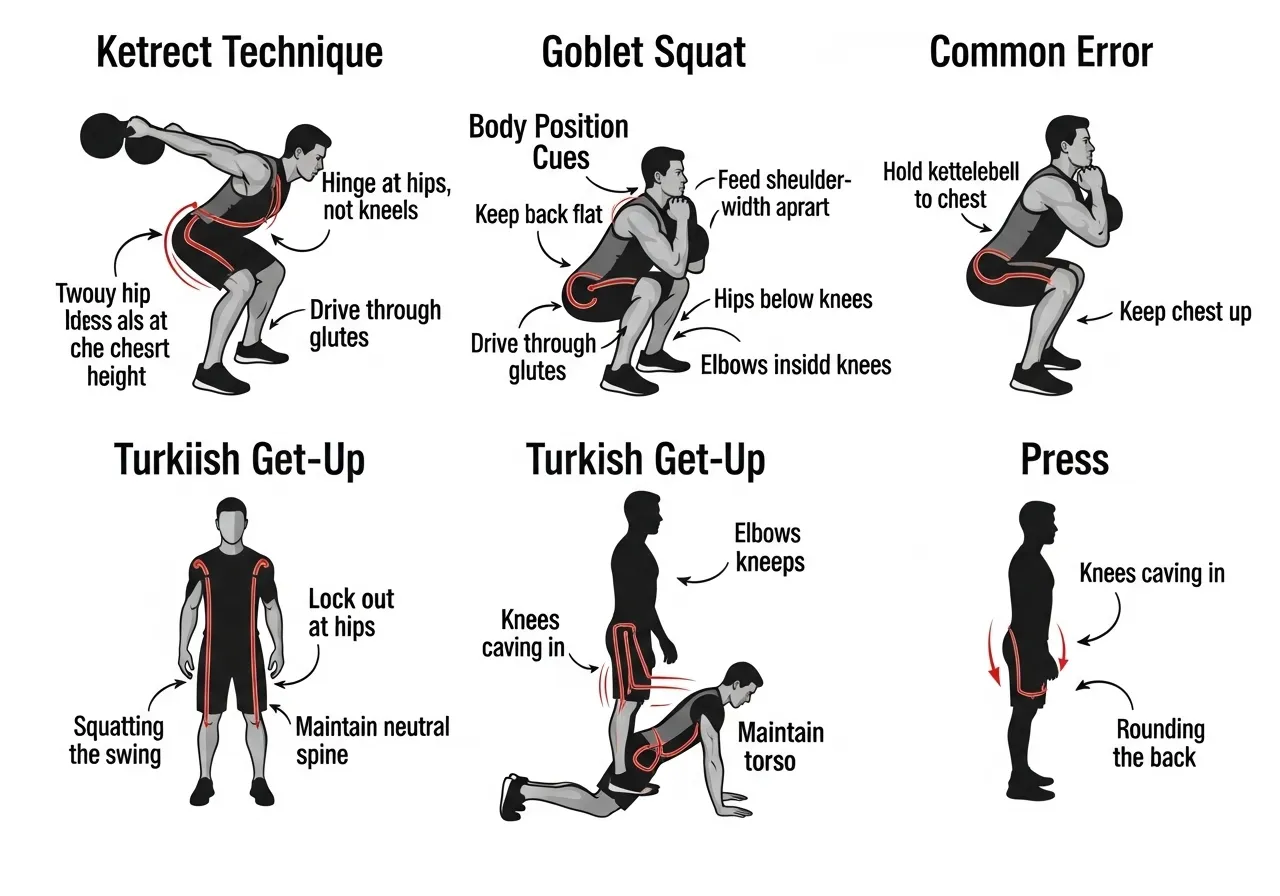
Setup: Feet shoulder-width apart, kettlebell on the floor approximately 30 cm in front of the feet Hike: Hinge at the hips, grip the handle, “hike” the bell back between the legs — like a hiking trail snap Drive: Drive the hips forward explosively (not a squat, not a back extension — a hip snap) Float: The bell floats to approximately chest height on momentum — not muscular effort Return: Hinge again as the bell descends — the bell “hikes” back between the legs for the next rep
Critical cues:
“Hips, not back”: The power comes from the hip snap — not from pulling up with the lower back or arms
“Squeeze the floor with your feet”: Activates the glutes and prevents excessive forward lean
“Pack the shoulders”: Keep the shoulder blades pulled down and back — avoid letting them shrug at the top
Movement 2 — The Goblet Squat
The goblet squat is the ideal squat teaching tool — holding the kettlebell at chest height counterbalances the body, naturally promoting an upright torso and deep squat position.
Setup: Hold the kettlebell by the “horns” (the sides of the handle) at chest height, elbows tucked Descent: Sit between the feet — not down and forward. The knees track over the toes, the torso stays upright Bottom position: Elbows press against the inside of the knees to open the hips — hold 1–2 seconds Ascent: Drive the floor away with the feet; squeeze the glutes at the top
Movement 3 — The Turkish Get-Up (TGU)
The Turkish Get-Up is a seven-stage movement from lying to standing while holding a kettlebell overhead — often described as “a complete fitness assessment in a single movement.”
Research confirms that the TGU demands significant shoulder muscle activation throughout — with the greatest muscular demand occurring during the press-to-elbow and leg-sweep stages.
The seven stages of the TGU:
Stage
Movement
Key Focus
1
Roll to press (supine to elbow support)
Arm stays vertical throughout
2
Press to hand (elbow to hand support)
Shoulder packed, arm straight
3
Hip bridge
Hips high, spine neutral
4
Leg sweep (bring knee under hip)
Most demanding stage for shoulder
5
Kneel to lunge
Upright torso throughout
6
Stand up
Drive through front heel
7
Reverse (standing to supine)
Control at every stage on the way down
Begin learning the TGU without any weight — perform the movement with a shoe balanced on the fist to train the “arm stays vertical” cue before adding load.
Movement 4 — The Kettlebell Clean
The clean brings the kettlebell from the swing position to the “rack” (the resting position at shoulder height with the bell resting on the forearm).
Movement: Hike the bell back as in a swing, then instead of allowing it to float, redirect it in a tight arc close to the body — like “zipping up a jacket.” Finish with the bell in the rack: forearm vertical, elbow in front of the body, wrist straight. Common error: Allowing the bell to swing wide and crash onto the forearm — the arc should be tight, not circular Practice drill: One-hand swing → clean, repeating the last rep as a clean to feel the difference in arc path
Movement 5 — The Kettlebell Press
Performed from the rack position — the kettlebell is pressed overhead while maintaining a stable base and packed shoulder.
Press technique: From rack, press the bell overhead — finish with the arm vertical, bicep by the ear, shoulder “packed” (not shrugged). The wrist stays straight. Key cue: “Push the floor away with the feet” — activates the entire kinetic chain during the press Return: Bring the bell back to rack with control — do not drop it down
The Hardstyle vs. Sport-Style Swing: Understanding the Difference
Two distinct schools of kettlebell technique exist — and understanding the difference clarifies conflicting advice often encountered:
Style
Hip Snap
Bell Path
Primary Goal
Hardstyle (StrongFirst/RKC)
Explosive — maximum power at the top
Bell stops at chest height; hip fully locked
Strength, power, posterior chain
Sport-style (Girevoy Sport)
Smooth — conserves energy for reps
Bell arcs higher; more arm involvement
Endurance, rep count, competition
For general fitness beginners, the hardstyle approach is recommended — its emphasis on maximum hip power production and full glute engagement produces the strongest posterior chain development per rep, and the clean mechanical endpoint makes technique assessment straightforward.
The Farmer’s Carry: The Most Underestimated Kettlebell Exercise
The farmer’s carry — simply walking while holding a kettlebell (or two) at the sides — is one of the most effective exercises for developing the grip, core, and postural endurance that transfers to almost all other physical activities.
Technique: Stand upright, core braced, shoulders packed. Walk with deliberate steps — resist the tendency to lean to either side or let the torso rotate. Keep the bell from touching the leg. Target muscles: Forearms and hands (grip), upper traps, obliques (anti-lateral flexion), calves (balance), quadratus lumborum (the deep lateral back muscle) Sets/Distance: 3–5 × 20–40 meters | Progress by increasing load, distance, or both
The suitcase carry variation — holding one bell in one hand only — increases the anti-lateral flexion demand considerably and may be the single most effective core stability exercise available in a kettlebell program.
Kettlebell Size Selection and Weight Recommendations
Starting Weight Guidelines
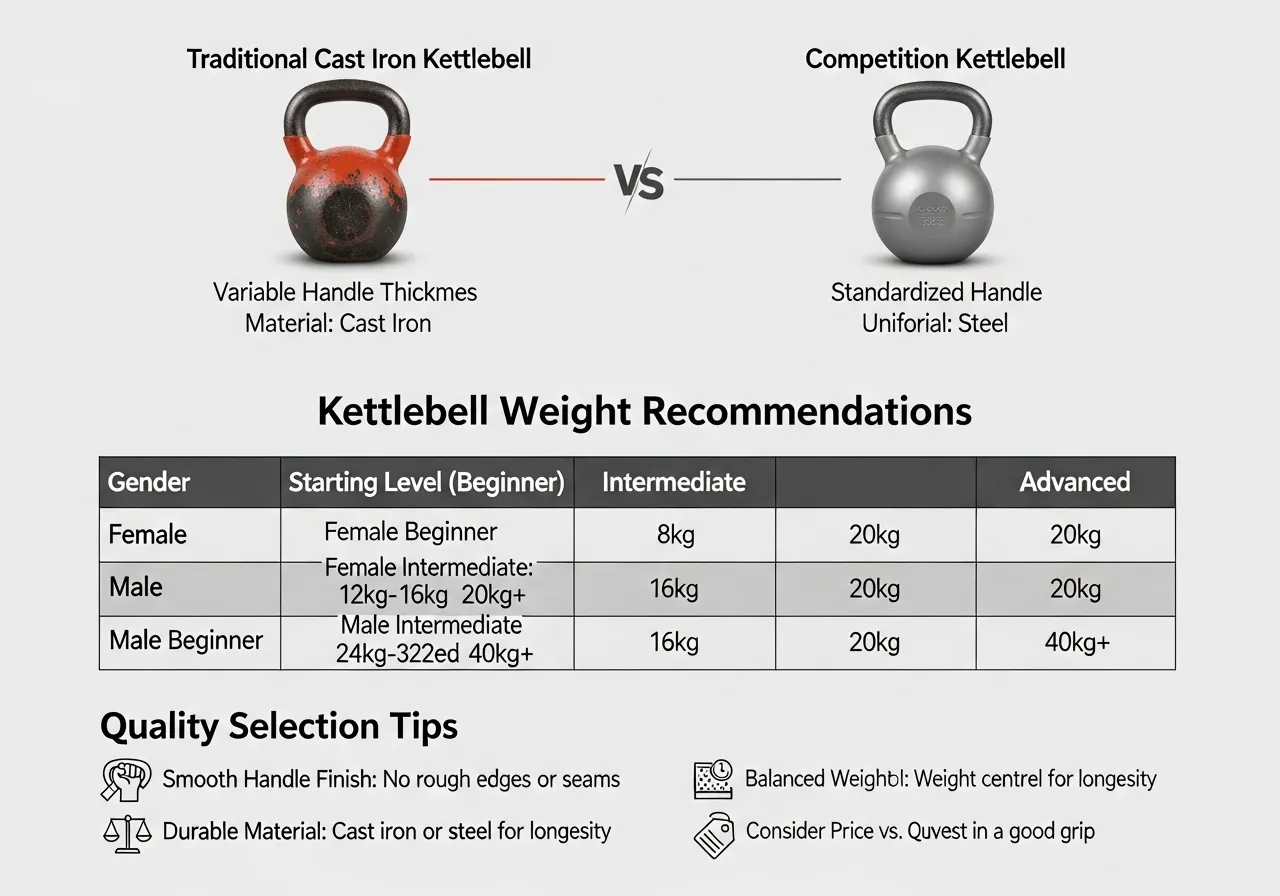
Kettlebells are measured in kilograms (the traditional Russian system using “poods” — 1 pood = 16 kg — is sometimes referenced in kettlebell training contexts).
Population
Recommended Starting Weight (Swing/Goblet)
Recommended Starting Weight (Press/TGU)
Women (beginner)
8–12 kg
4–8 kg
Men (beginner)
12–16 kg
8–12 kg
Women (intermediate)
16–20 kg
12–16 kg
Men (intermediate)
20–24 kg
16–20 kg
These are starting recommendations — actual appropriate weight depends significantly on prior training history, movement quality, and body weight.
The weight should be light enough to maintain perfect technique for all planned reps while feeling genuinely challenging in the final few reps of each set.
Starting with One Kettlebell vs. Multiple
A single kettlebell in the appropriate weight range covers all five foundational movements — making the investment requirement for kettlebell training very low.
A practical starting purchase for most adults:
✅ Women: One 12 kg + one 8 kg (for TGU and press until the 12 kg becomes appropriate)
✅ Men: One 16 kg + one 12 kg (for TGU and press until the 16 kg becomes appropriate)
As pressing and TGU strength develops, the heavier bell is used for more exercises and a new heavier bell is added.
Choosing Kettlebell Quality
Handle finish: A slightly rough or powder-coated handle provides better grip during swings without tearing the skin as aggressively as completely unfinished cast iron
Competition (uniform) vs. traditional style: Competition kettlebells have a uniform size regardless of weight — useful for consistent technique. Traditional kettlebells grow in size with weight.
Handle width: The handle should comfortably fit both hands for double-handed exercises — handles too narrow or too wide affect technique
Avoid: Vinyl-coated kettlebells with seams along the handle — these create friction points that damage the palms during swinging movements
Caring for the Hands During Kettlebell Training
A practical concern for consistent kettlebell training is hand callus management — the swing and snatch place significant friction on the palmar calluses (thickened skin areas that build up at the base of the fingers).
Strategies for maintaining hands during intensive kettlebell practice:
Allow calluses to build gradually — they are protective; attempting to prevent them entirely leaves the hands vulnerable
File calluses to a smooth, even height rather than allowing them to build into thick ridges — raised ridges tear during high-rep swings and snatches
Chalk (magnesium carbonate) reduces friction by absorbing moisture — many serious kettlebell practitioners use chalk during high-rep swing and snatch sessions
Gloves are not typically recommended by experienced practitioners — they add thickness that changes the grip mechanics and prevent the callus development that eventually makes ungloved training comfortable
Flooring and Space Requirements for Kettlebell Training
Unlike most gym equipment, kettlebell training requires specific environmental considerations:
Floor surface: Rubber gym flooring is ideal — it provides grip, absorbs dropped bell impact, and protects both the bell and the floor. Hard tile and hardwood floors are vulnerable to damage from an accidentally dropped kettlebell.
Clearance space: A minimum of 2 meters in front and behind the trainee is recommended for swings — the bell travels in an arc and requires clear space in the direction of travel
Ceiling height: Overhead pressing and TGU movements require adequate ceiling clearance — at minimum, the height of the trainee plus the length of the arm plus the bell diameter
For home training: A 3×3 meter clear area with rubber matting provides a safe and functional kettlebell training space
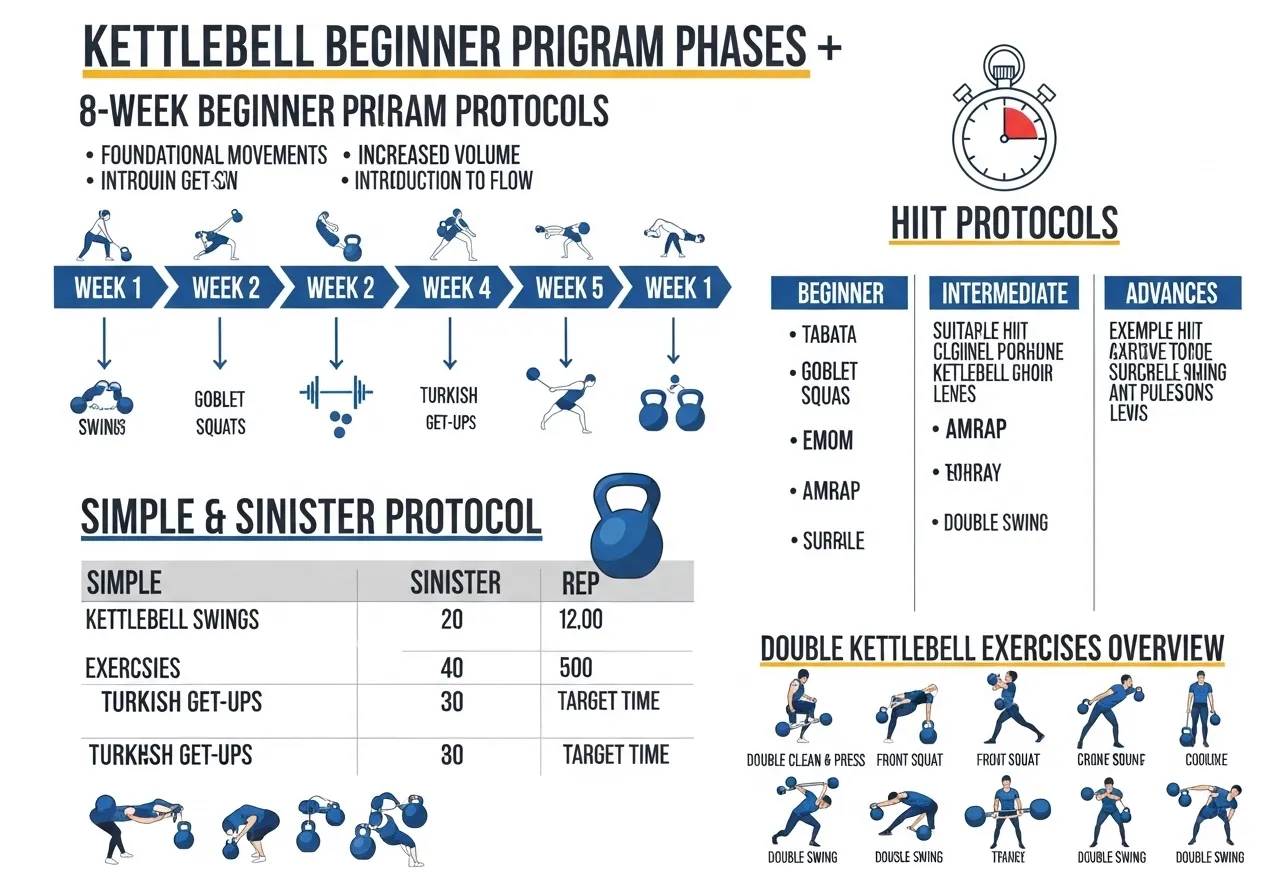
Kettlebell Programming: 8-Week Foundation Plan
Phase 1: Weeks 1–4 — Foundation Building
Session A (Mon/Thu):
Goblet Squat: 3 × 8 — focus on upright torso and full depth
Two-Hand Swing: 5 × 10 with 60 sec rest — hip snap quality
TGU (unloaded or 4 kg): 3 each side — slow, deliberate stages
Session B (Wed/Sat):
Single-Arm Swing: 3 × 8 each side
Clean practice: 3 × 5 each side (light weight, technique focus)
Goblet Squat hold (paused at bottom): 3 × 5 with 3-second hold
Phase 2: Weeks 5–8 — Volume and Skill Development
Session A (Mon/Thu):
TGU: 5 × 1 each side (with appropriate weight)
Two-Hand Swing: 10 × 10 with 30 sec rest (high-volume swing protocol)
Goblet Squat: 3 × 10
Session B (Wed/Sat):
Clean + Press: 3 × 5 each side
Single-Arm Swing: 5 × 10 each side
Clean + Front Squat: 3 × 5 each side
The Simple & Sinister Protocol
One of the most widely used kettlebell programs is the “Simple & Sinister” protocol — a minimalist daily practice with clear progression targets:
Component
Volume
“Simple” Goal
One-Hand Swing
10 × 10 (5 each side)
Men: 32 kg / Women: 24 kg in 5 min
Turkish Get-Up
5 each side
Men: 32 kg / Women: 24 kg in 10 min
This program is practiced daily (or near-daily) — the low volume per session allows recovery while building consistent practice and motor learning over months.
Kettlebell HIIT Protocols
Once swing technique is solid, kettlebell HIIT provides exceptional cardiovascular and metabolic conditioning:
The kettlebell swing, when performed with correct hip-hinge technique, is not inherently dangerous for the lower back — and research suggests it may be therapeutic for some back pain presentations through posterior chain strengthening.
The key distinction: the swing is a hip-hinge movement driven by glutes and hamstrings, not a lower back extension exercise. Any sensation of the lower back “pulling” during swings indicates a technique error — typically initiating with the back rather than the hips.
Individuals with disc herniations, spondylolisthesis, or acute back pain should obtain clearance from a physiotherapist before incorporating kettlebell swings, as the spinal loading characteristics of the exercise require professional assessment in these contexts.
Can kettlebells replace a full gym program?
Yes — for general fitness and functional strength goals, a kettlebell program covering the five foundational movements provides sufficient stimulus for strength, power, and conditioning development.
For sport-specific strength goals (powerlifting, bodybuilding), kettlebells alone may be insufficient due to load limits and specificity — but as a primary tool for general fitness, the evidence strongly supports their effectiveness.
✅ Key Takeaways
Research supports kettlebell training for strength, power, cardiovascular capacity, pain reduction, and functional improvements across populations
The swing is the foundational movement — all other exercises build on its hip-hinge pattern
The Turkish Get-Up is a complete mobility and stability assessment in one exercise
Starting weight should allow perfect technique for all planned reps — technique precedes load
Kettlebell training is appropriate for older adults under supervision — with documented improvements across multiple fitness and health markers
Monitoring Intensity in Kettlebell Training
Unlike barbell or machine training where load is precisely quantified, kettlebell training requires a slightly different approach to intensity monitoring:
Heart rate: Wrist or chest heart rate monitoring provides objective intensity data during swing-based sessions — targeting Zone 3–4 (70–85% max HR) for cardiovascular benefit
Rate of Perceived Exertion (RPE): A 6–8/10 RPE during swing protocols indicates appropriate intensity for conditioning work
Technique quality as intensity indicator: When form begins to deteriorate — hip snap weakens, spine rounds, handle path becomes inconsistent — this signals appropriate rest, not more reps
Grip fatigue: For high-rep snatch work, grip fatigue often limits before cardiovascular or muscular exhaustion — this is normal, and grip capacity develops with consistent practice
Kettlebell Training and Bone Density
Kettlebell exercises are predominantly weight-bearing and impact-involving — the foot strike on hip-lock and the ground reaction forces during swing training provide osteogenic (bone-building) stimuli.
This bone density benefit is particularly relevant for women approaching or in perimenopause — a period when estrogen decline accelerates bone mineral density loss, and weight-bearing exercise becomes increasingly important for long-term skeletal health.
The grip development from kettlebell training also strengthens the small bones and tendons of the hands and forearms — areas that benefit less from barbell and machine training.
Individuals with diagnosed osteoporosis or low bone density should consult their healthcare provider and a qualified exercise physiologist before beginning kettlebell training — ballistic loading requires sufficient bone integrity, and specific modifications may be needed.
Advanced Kettlebell Techniques, Sport Applications, and Long-Term Development
The Kettlebell Snatch
The snatch — taking the kettlebell from the floor to overhead in a single movement — is considered the most technically demanding foundational kettlebell exercise and the benchmark of advanced kettlebell competency.
It differs from the clean in that the bell bypasses the rack position entirely, travelling in a tight arc from the back-swing directly to overhead lockout.
Prerequisites for the snatch:
Proficient one-hand swing with consistent technique at the target weight
Proficient clean — the early portion of the snatch path is identical to the clean
Comfortable overhead lockout position — demonstrated through Turkish Get-Up competency
Sufficient hip hinge power to drive the bell overhead without muscular arm effort
The “high pull” — an intermediate step where the bell is driven to shoulder height and held momentarily before the overhead lockout — is a useful teaching progression between the clean and the full snatch.
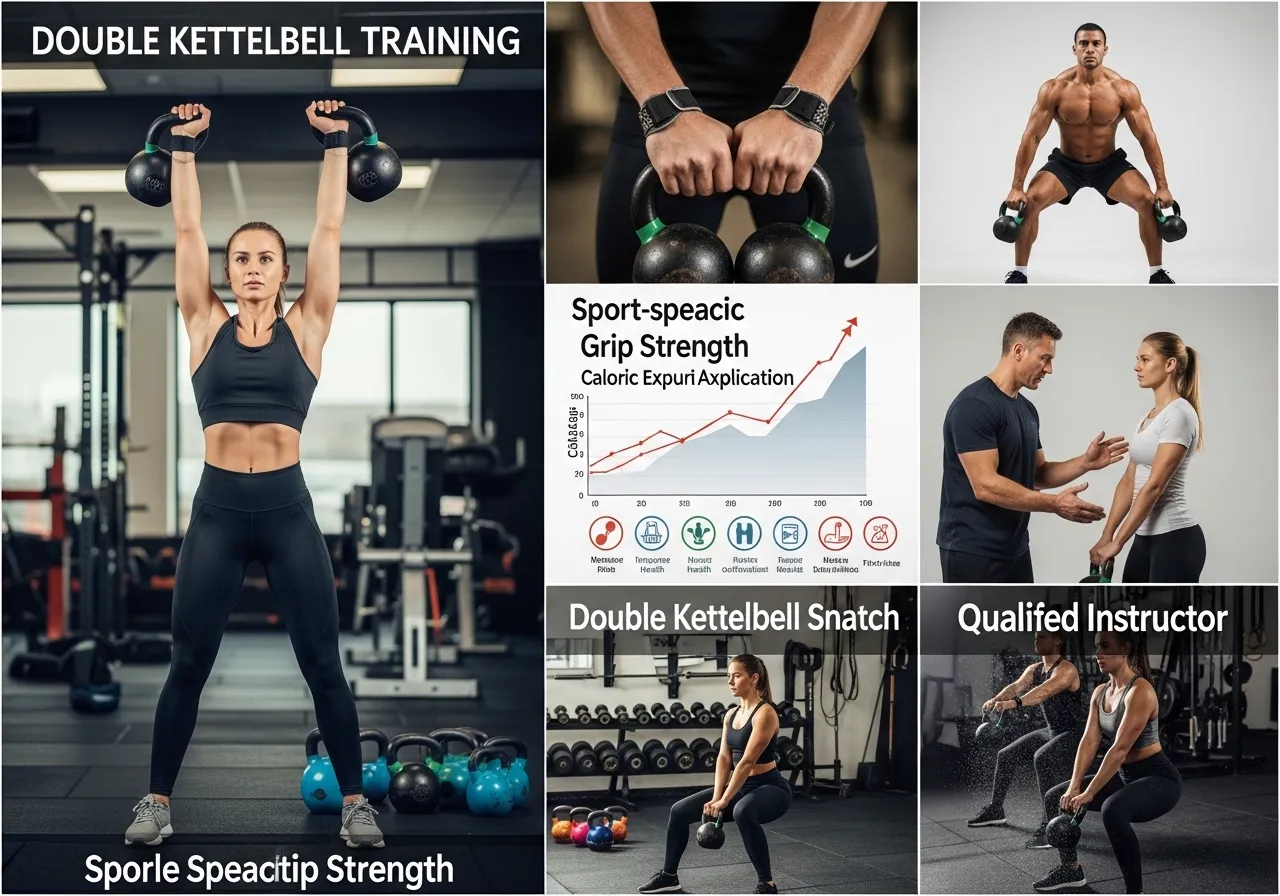
Double Kettlebell Training
Using two kettlebells simultaneously increases the training complexity and load:
Double swing: Both bells hiked simultaneously — doubles the posterior chain demand
Double clean + press: The bilateral press with two bells loaded simultaneously — significantly heavier than single-bell pressing
Double front squat: Both bells in the rack position for the squat — greater anterior load than goblet squat; excellent for quadriceps development
Farmer’s carry (double): Walking with a heavy bell in each hand — a foundational grip and core exercise
Double kettlebell work requires higher technical proficiency than single-bell work — the asymmetrical correction mechanisms available with one bell are unavailable when both hands are loaded.
Kettlebell Training for Athletes
The transfer of kettlebell training to athletic performance is well-documented across multiple sports:
Sport
Key Transfer
Primary Exercises
Combat sports
Hip power, grip endurance, cardiovascular capacity
Swing, snatch, carry
Track and field
Explosive hip extension, acceleration
Swing, clean, snatch
Team sports
Agility, hip power, shoulder stability
TGU, swing, clean + press
Endurance sports
Posterior chain endurance, core stability
High-rep swings, goblet squat
Grip Training: An Underappreciated Kettlebell Benefit
The thick handle of most kettlebells and the dynamic grip demands of swinging and snatching develop forearm and grip strength significantly more than most dumbbell or barbell exercises.
Grip strength is independently associated with overall health outcomes in research — stronger grip strength predicts better functional independence, lower cardiovascular disease risk, and reduced all-cause mortality in population studies.
The grip development from consistent kettlebell training is a practical health benefit that extends beyond the direct muscular training effect.
Kettlebell Training and Caloric Expenditure
Continuous kettlebell swing protocols at vigorous intensity produce caloric expenditure comparable to running at a moderate pace:
A 12-minute continuous swing protocol can elicit approximately 65% of VO2 max — sufficient for cardiovascular adaptation
The combination of muscular and cardiovascular demand during swings produces EPOC (excess post-exercise oxygen consumption) effects that extend caloric burn beyond the session itself
A 30-minute kettlebell circuit may burn 300–400+ calories for a 70 kg individual, depending on exercise selection and intensity
Finding a Qualified Kettlebell Instructor
The technical demands of ballistic kettlebell movements — particularly the swing, clean, and snatch — make working with a qualified instructor genuinely valuable:
StrongFirst Certified Instructors (SFG) and Russian Kettlebell Challenge (RKC) certified instructors follow standardized, evidence-informed kettlebell technique systems
A qualified instructor can identify technique errors not visible to the trainee (particularly in the hip-hinge pattern) that cause long-term problems if uncorrected
2–4 sessions with a qualified instructor at the start of kettlebell training typically produces better long-term results than months of self-directed practice with suboptimal technique
Any individual with pre-existing musculoskeletal conditions — particularly lower back, shoulder, or hip issues — should receive specific assessment from a physiotherapist before beginning kettlebell training, as the loading demands of ballistic exercises require professional evaluation in these contexts.
The Long-Term Progression Path in Kettlebell Training
Kettlebell progression follows a specific trajectory that differs from traditional weight-room programming:
Weeks 1–4: Technique acquisition — the hip-hinge pattern, rack position, and TGU stages are established with light weight
Months 2–3: Volume building — increasing swing sets and reps while maintaining technique; introducing the clean and light pressing
Months 4–6: Load progression — same movements at the next heavier bell size; introducing the press seriously
Year 2+: Advanced protocols — sport-style work, competition preparation, or barbell program integration
The patient, technique-first approach characteristic of serious kettlebell practitioners is not just a stylistic choice — it reflects the reality that the hip hinge, overhead lockout, and rotational stabilization demands of advanced kettlebell work require genuine movement competency foundations before heavy loading produces results rather than injury.
Integrating Kettlebells With Barbell Training
Many strength athletes integrate kettlebell work alongside their primary barbell programming:
Kettlebell swings on non-barbell days provide posterior chain conditioning without competing with barbell squat and deadlift recovery
Turkish Get-Ups before heavy overhead pressing sessions warm up the shoulder complex in a functionally comprehensive way that conventional shoulder warm-ups do not replicate
Farmer’s carries at the end of a session accumulate grip, core, and trap volume without additional barbell sets
⚠️ Health & Fitness DisclaimerThis article is for general educational purposes only and does not replace professional medical advice. If you have any cardiovascular, metabolic, or respiratory condition, please consult a qualified healthcare professional before beginning any new exercise programme. Zone 2 training has gone from an elite endurance secret to a mainstream fitness obsession…
⚠️ Health & Fitness DisclaimerThis article is for general educational purposes only and does not replace professional medical advice. If you have cardiovascular, respiratory, or musculoskeletal conditions, please consult a qualified healthcare professional before beginning a swimming program. Swimming is one of the most physiologically complete forms of exercise available — simultaneously developing cardiovascular fitness,…
Most cardio equipment trains the legs while the upper body assists at best. The assault bike is different. The arms drive the handlebars forward and back while the legs pedal. Both contribute to power output simultaneously. This total-body demand creates a cardiovascular and metabolic challenge that leg-only cardio equipment cannot replicate at the same effort…
⚠️ Fitness Disclaimer: The information in this article is for general educational purposes only and does not constitute professional fitness or medical advice. Always consult a qualified healthcare professional before starting any new exercise program. ⚠️ Cardiovascular Health Notice: If you have a history of heart disease, high blood pressure, or any cardiovascular condition, obtain…
Most recreational endurance athletes train in the middle. They run or cycle at a pace that feels like a meaningful workout: harder than a casual stroll, not so hard that it becomes a genuine interval session. This moderate intensity zone, roughly 75 to 85% of maximum heart rate, feels productive. It creates obvious cardiovascular stress….
⚠️ Health & Fitness DisclaimerThis article is for general educational and informational purposes only and does not replace professional medical or fitness advice.If you have any pre-existing lower back, hip, or knee condition — consult a qualified healthcare professional before starting any deadlift program. The conventional deadlift is one of the most effective strength exercises…