Pec Deck Machine Guide: EMG Research, Chest Isolation Science, Technique, and Complete Chest Programming
The pec deck places the shoulder in horizontal abduction with the arm at 90° — a position that loads the anterior glenohumeral capsule and the long head of the bicep tendon. Individuals with anterior shoulder instability, SLAP lesions, or a history of shoulder dislocation should obtain medical clearance before pec deck training. The key safety parameter is the rear stop position: never allow the arms to travel further back than the point where the shoulder feels a deep anterior stretch — excessive range creates disproportionate anterior capsule stress without meaningful additional pectoral stretch.
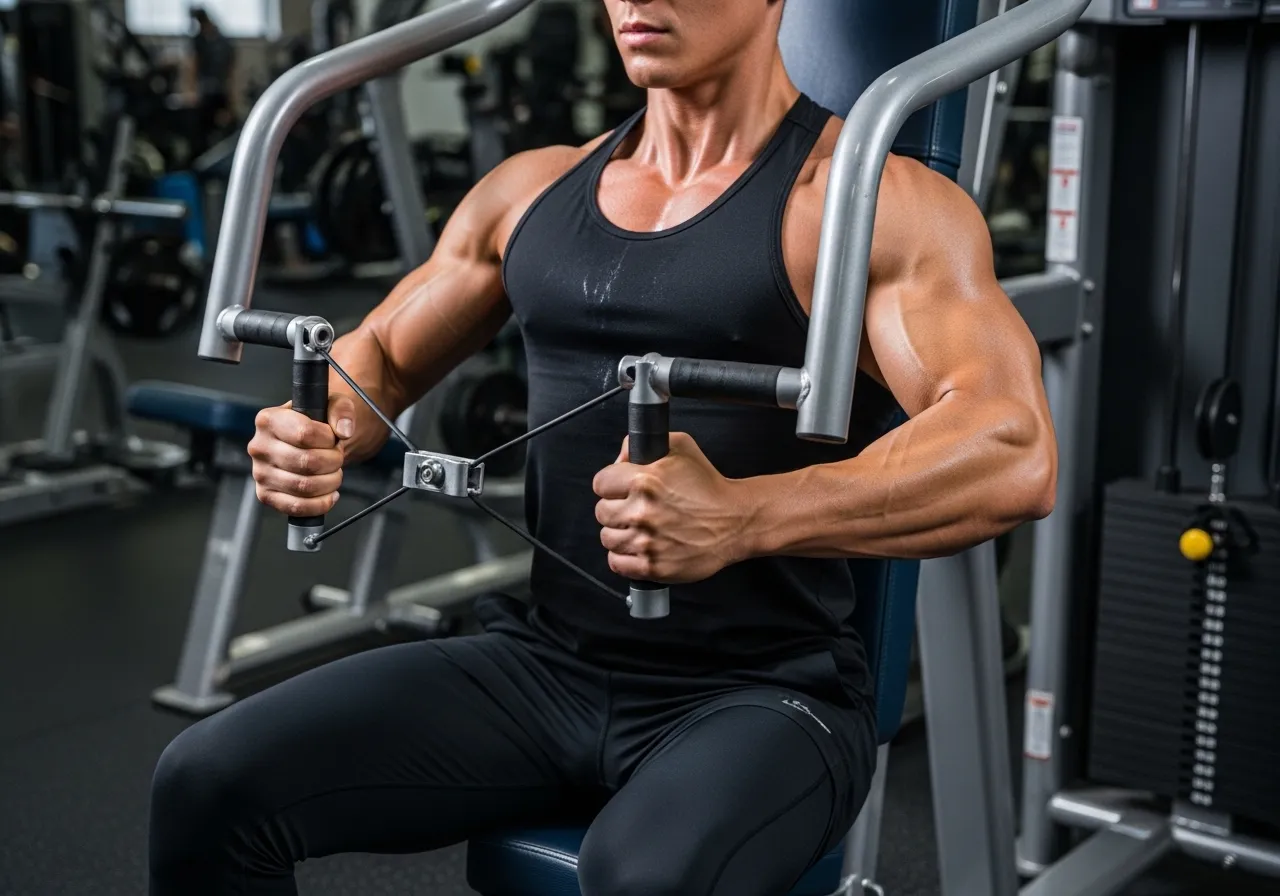
The pec deck machine sits in most gyms as an afterthought — used at the end of chest sessions when the barbell is occupied or as a light pump exercise to finish the workout.
The EMG research tells a different story. The pec deck produces some of the highest pectoralis major activation of any chest exercise — higher than the dumbbell fly, higher than the cable crossover at many angles, and comparable to the barbell bench press for the sternal fibres. The difference is that it achieves this activation in a way that no free weight or cable exercise can: through the full horizontal adduction range, with constant tension, and without any tricep or anterior deltoid contribution.
This guide covers what the research actually shows about pec deck activation, how it compares to pressing and cable fly alternatives, what technique determines whether it trains the chest or the shoulder, and how to build it into a complete chest programme.
Pec Deck vs Cable Fly vs Barbell Bench Press: The EMG Evidence
The Three-Exercise Comparison Study
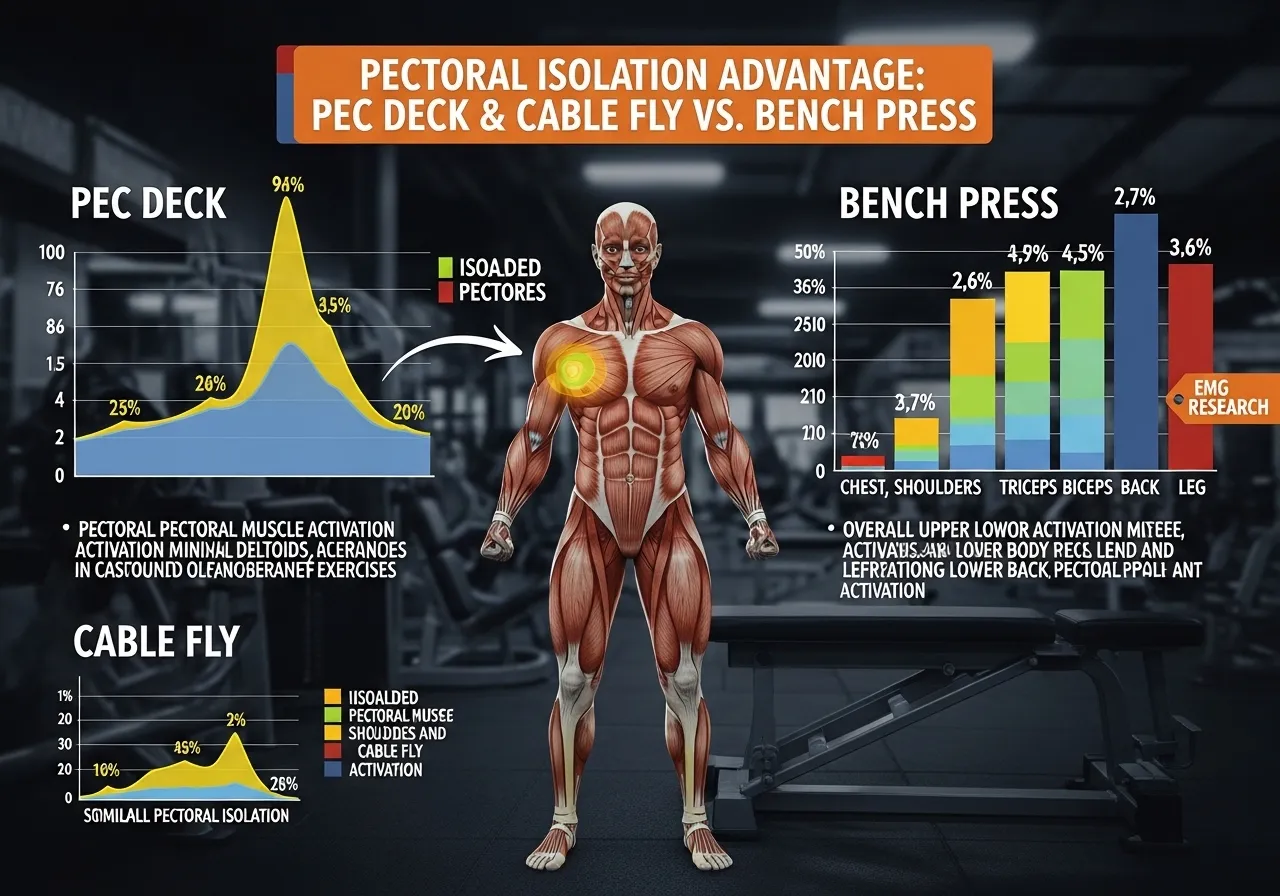
A study comparing pectoral muscle activation across the pec deck, cable crossover, and barbell bench press in resistance-trained men using surface EMG finds that the pec deck produced significantly higher pectoralis major activation than the cable crossover at matched relative loads — while the barbell bench press produced comparable overall pectoral activation to the pec deck but with significantly greater anterior deltoid and triceps brachii co-activation — confirming that the pec deck provides a more isolated pectoral stimulus than either compound pressing or cable fly alternatives, making it mechanically superior for pure chest hypertrophy when tricep and deltoid contributions are not desired.
Pec deck produces greater pectoral isolation than bench press or cable fly — the same prime mover activation with significantly less deltoid and tricep contribution. For trainees who want their chest to be the limiting factor, the pec deck is the most direct tool available.
The Upper vs Lower Chest Emphasis
A study comparing pectoralis major activation across multiple chest exercises finds that the pec deck fly produced high activation in both the upper (clavicular) and lower (sternal) portions of the pectoralis major — with the sternal fibres showing particularly high activation due to the horizontal adduction arc that the pec deck follows — confirming that the pec deck provides comprehensive pectoralis major coverage across the muscle’s full fibre distribution, rather than selectively targeting the upper or lower chest as is sometimes claimed in training literature.
The pec deck activates both upper and lower pectoral fibres comprehensively. The common claim that it targets only the inner chest is not supported by EMG data — it trains the full pectoral across the horizontal adduction movement.
The Isolation Advantage: What Pressing Cannot Provide
A study examining isolation versus compound chest exercises finds that isolation exercises for the chest — including machine fly variants — produced higher pectoralis major activation per unit of fatigue to secondary muscles compared to compound pressing movements, confirming the value of isolation exercises in chest programming specifically for trainees whose pectoral development lags behind their pressing strength due to tricep or anterior deltoid domination during pressing movements.
Isolation chest exercises produce higher pec activation per unit of secondary muscle fatigue than pressing. For trainees whose chest development lags pressing strength, isolation work is not optional — it is the primary solution.
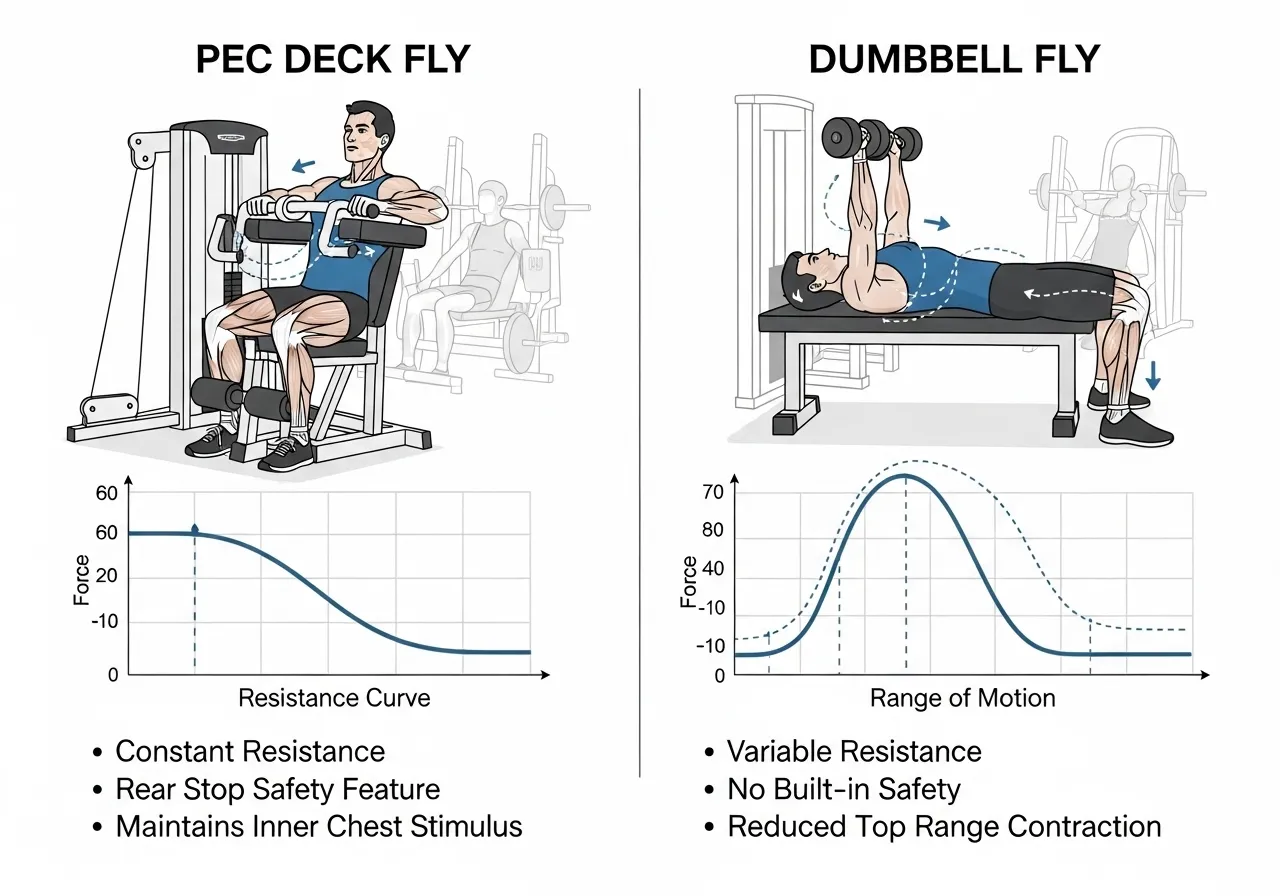
Is the Pec Deck Just a Safer Version of the Dumbbell Fly — or Something Different?
The Resistance Curve Difference
The dumbbell fly and pec deck follow the same horizontal adduction movement pattern. But their resistance curves are fundamentally different in ways that produce meaningfully different training stimuli.
The dumbbell fly’s resistance comes from gravity acting downward on the dumbbells. At the bottom of the fly (arms extended to the sides), gravity creates maximum torque — the dumbbells are furthest from the movement axis. At the top (arms above the chest), gravity acts almost parallel to the arm’s lever — minimal resistance. The dumbbell fly provides enormous stretch stimulus at the bottom and near-zero stimulus at peak contraction.
The pec deck’s resistance comes from the machine’s resistance mechanism acting horizontally throughout the arc. Resistance remains more constant across the range — particularly maintaining challenge as the arms come together, where the dumbbell fly provides almost no stimulus.
The Injury Risk Difference
The dumbbell fly’s maximum resistance at full stretch — when the shoulder is most vulnerable — creates the highest injury risk of any common chest exercise. The combination of a maximally stretched pectoralis major and anterior deltoid under maximum gravitational load at the transition point between lowering and reversing direction produces a significant anterior pectoral and shoulder strain risk.
The pec deck eliminates this risk through the pad support: the arms rest against pads throughout the movement, preventing the uncontrolled descent that causes most dumbbell fly injuries. The pad limits range at the rear, defining a safe endpoint that is mechanically set rather than relying on individual strength or attentiveness.
The Inner Chest Stimulus: Pec Deck’s Unique Advantage
The pec deck allows the arms to travel past the neutral midline — past the point where both pads meet — in machines designed for this range. This short-position overload at the inner chest (medial pec fibres near the sternum) is something neither the dumbbell fly nor the barbell bench press can provide.
Trainees who want to develop the medial sternal fibres that create the defined inner chest line benefit specifically from this extended top-range contraction. Pressing movements cannot load the pec in its shortened position — the pec deck’s top-range squeeze fills this gap. See also: cable fly guide for how the cable crossover compares to the pec deck for chest development across the full range.
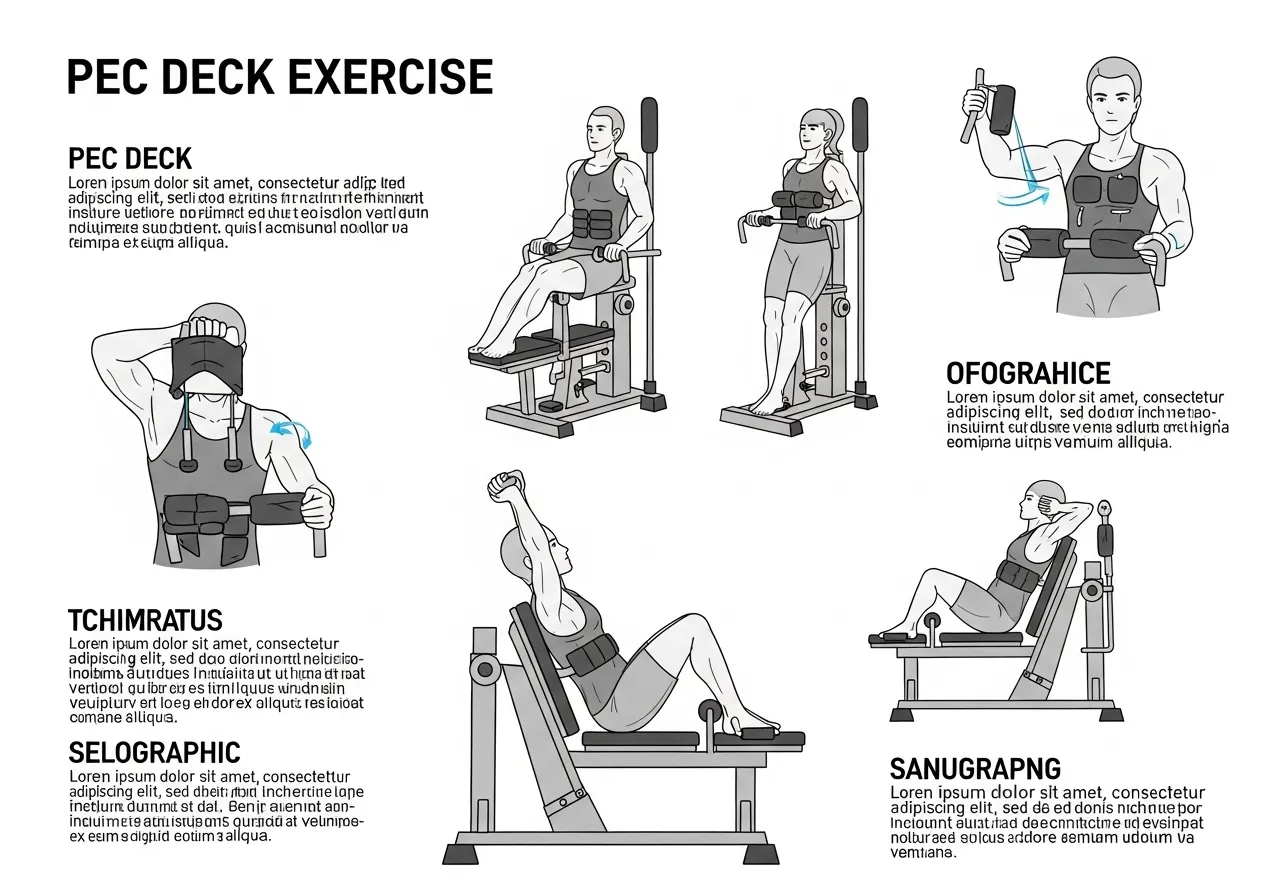
Pec Deck Technique: Every Detail That Shifts Stimulus From Shoulder to Chest
Seat Height: The Most Important Setup Variable
Seat height determines the angle of horizontal adduction during the movement — and therefore which portion of the pectoralis major receives the primary stimulus.
- Arms parallel to the floor (standard position): Even activation across the sternal and clavicular heads. The most commonly recommended starting position.
- Arms slightly below shoulder height (lower seat): Greater lower/sternal pectoral activation. Matches the direction of the lower chest fibre orientation.
- Arms slightly above shoulder height (higher seat): Greater clavicular (upper chest) activation. Useful for trainees with underdeveloped upper chest relative to lower.
Rear Stop Position: The Safety Setting That Most People Ignore
Most pec deck machines have a rear stop that limits how far back the arms travel. This stop is not just a comfort feature — it is a safety parameter. The rear stop should be set so the elbows are at or slightly behind the torso plane. Arms allowed to travel significantly behind the body creates anterior shoulder stress that the exercise’s chest benefit does not justify.
Beginners: set the rear stop conservatively — elbows no further than directly beside the shoulder. Intermediate: elbows can travel slightly behind the torso plane as shoulder mobility and control improve. Advanced: use judgment based on shoulder comfort rather than seeking maximum stretch as a goal in itself.
Arm Position: Forearms on Pads vs Handles
Most pec deck machines offer two grip options:
- Forearms on vertical pads: Distributes force across the forearm and upper arm. Reduces bicep tendon stress. More comfortable for longer sets at moderate load. Standard recommendation for most trainees.
- Hands on handles: Allows greater wrist control but concentrates force at the hand. Slightly different pectoral activation angle. More appropriate for trainees with forearm pad discomfort.
Execution: The Squeeze That Makes the Difference
The pec deck’s value comes from its top-range contraction — the point where the pads meet and the pectoral reaches its shortest, most contracted position. Most trainees rush through this point without pausing.
A deliberate 1–2 second squeeze at peak contraction produces significantly more medial pectoral stimulus per rep than touching the pads and immediately reversing. The squeeze forces the pec to hold an isometric contraction at its peak activation point — the precise mechanism that builds the inner chest definition that pressing work never achieves.
The Eccentric: Three Seconds Back
Lower the pads back to the rear stop over a controlled 3 seconds. The pectoral is under load throughout this lengthening phase — the eccentric stimulus that drives muscle damage and repair-based hypertrophy. Letting the weight stack fall rapidly removes this stimulus entirely.
Machine Path vs Free Weight Path: What It Means for Shoulder Safety
The pec deck’s fixed arc follows a path determined by the machine’s mechanical design — the trainee cannot deviate from it. This removes the ability to self-adjust the path to accommodate individual shoulder anatomy, which is simultaneously a safety advantage and a limitation.
Advantage: the fixed path prevents the uncontrolled downward drift that causes dumbbell fly injuries, and the rear stop prevents excessive range regardless of fatigue or inattention. For trainees with previous anterior shoulder injuries, the predictable fixed path reduces injury recurrence risk compared to free-weight fly alternatives.
Limitation: trainees with atypical shoulder anatomy or significant bilateral asymmetry may find the machine’s fixed path uncomfortable on one side. In this case, unilateral cable fly allows independent path adjustment for each arm — more appropriate than forcing an asymmetric shoulder into a bilaterally fixed machine arc.
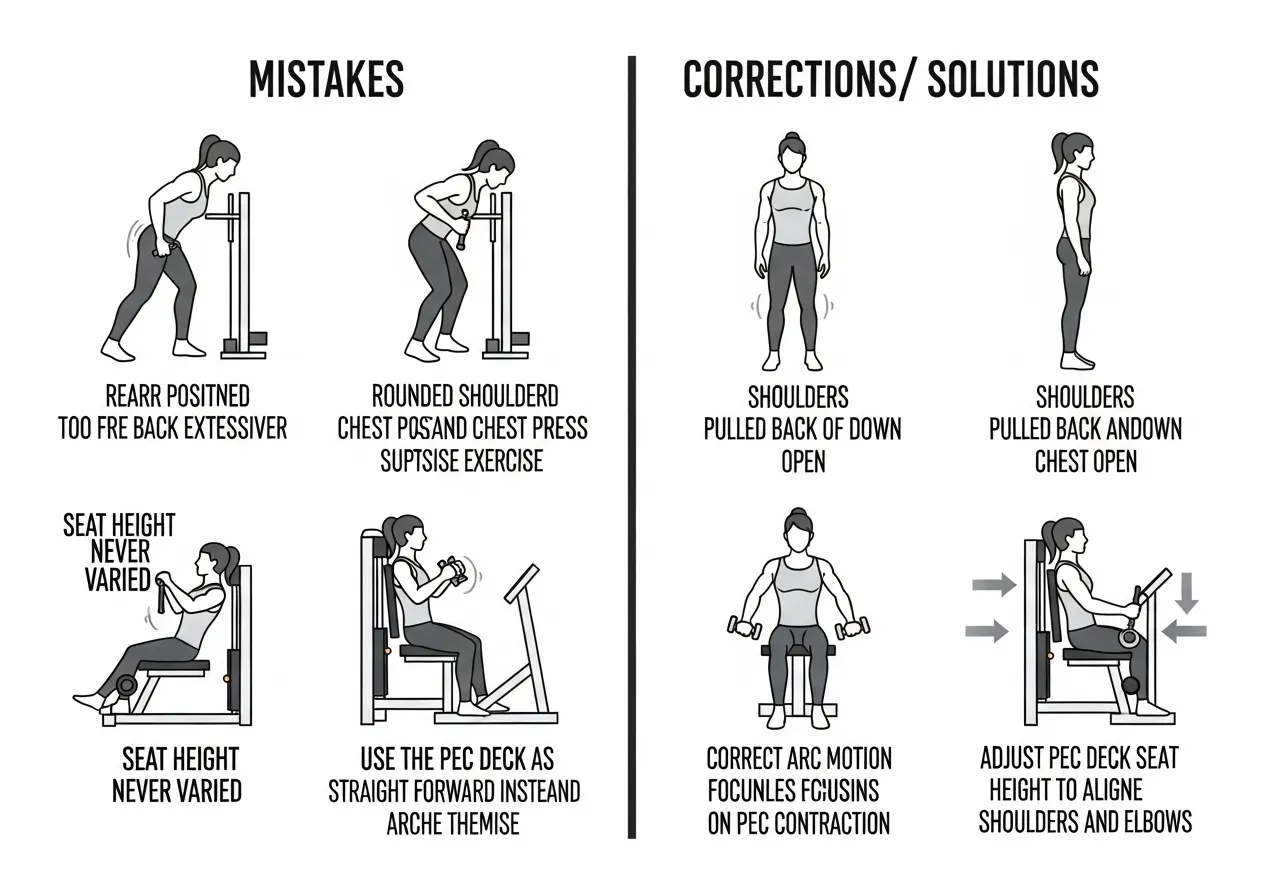
4 Pec Deck Mistakes That Train the Shoulder Instead of the Chest
Mistake 1: Rear Arms Too Far Back
The most damaging pec deck error: allowing the arms to travel far behind the body in search of maximum stretch. At extreme rear positions, the anterior deltoid and bicep tendon absorb the majority of the stress — not the pectoral. The pec begins to generate its horizontal adduction force when the arms are at or slightly behind the shoulder plane, not at extreme rear extension.
Diagnostic test: during the movement, do you feel the stress primarily in the front of the shoulder at the rearmost position? If yes, reduce the rear range. The pec should be the first muscle that feels loaded when the movement begins from the rear position — not the shoulder.
Mistake 2: Rounding the Shoulders Forward
Trainees who allow the shoulders to round forward during the movement shift the load from the chest to the anterior deltoid and serratus anterior. The back should maintain light contact with the backrest throughout — not pressed hard against it (which restricts chest expansion) but not leaving it either.
The cue: keep the shoulder blades lightly pulled together and down (retracted and depressed) before each rep. This pre-sets the chest in a position where it, not the shoulder, drives the movement.
Mistake 3: Using the Pec Deck as the Only Chest Exercise
The pec deck provides excellent pectoral isolation but does not develop the pressing strength, the tricep coordination with the chest, or the stability demand that barbell and dumbbell pressing provides. Trainees who build chest programmes exclusively around the pec deck develop pectoral size without the structural foundation and compound pressing strength that supports healthy shoulder function over years of training.
The pec deck belongs as a complement to pressing, not a replacement. Three sets of pec deck after the main pressing work produces the isolation stimulus that pressing cannot provide — while the pressing maintains the compound strength and muscle coordination that the pec deck alone cannot develop.
Mistake 4: Never Varying the Seat Height
Using the same seat height for every pec deck session consistently emphasises one region of the pectoral over others. Rotating between lower seat (sternal/lower emphasis), standard seat (balanced), and higher seat (clavicular/upper emphasis) across training blocks provides more complete pectoral development than a fixed height.
For trainees with a specific underdevelopment — lower chest visually flat, upper chest dominant — adjusting the seat height toward the underdeveloped region for the majority of pec deck work over 8–12 weeks produces visible regional improvement. See also: incline bench press guide for the pressing complement that specifically develops the upper clavicular pectoral fibres the pec deck addresses from the seat-high position.
The Pre-Exhaustion Debate: Pec Deck Before or After Pressing?
Pre-exhaustion — performing the pec deck before bench pressing to fatigue the chest before the compound movement — is a technique occasionally recommended for trainees whose triceps or shoulders dominate the pressing movement rather than the chest.
The logic: by fatiguing the pec first, the bench press that follows forces the already-fatigued chest to work harder relative to the still-fresh secondary muscles. The research on pre-exhaustion is mixed — some studies show increased pectoral activation during the subsequent press; others show reduced overall performance without clear hypertrophy benefit.
The practical recommendation: post-pressing pec deck produces more consistent results for most trainees than pre-exhaustion. The exception is the trainee who genuinely cannot feel the chest working during pressing regardless of technique adjustments — for this specific population, 2–3 sets of pec deck immediately before pressing can establish the mind-muscle connection that carries into the press.
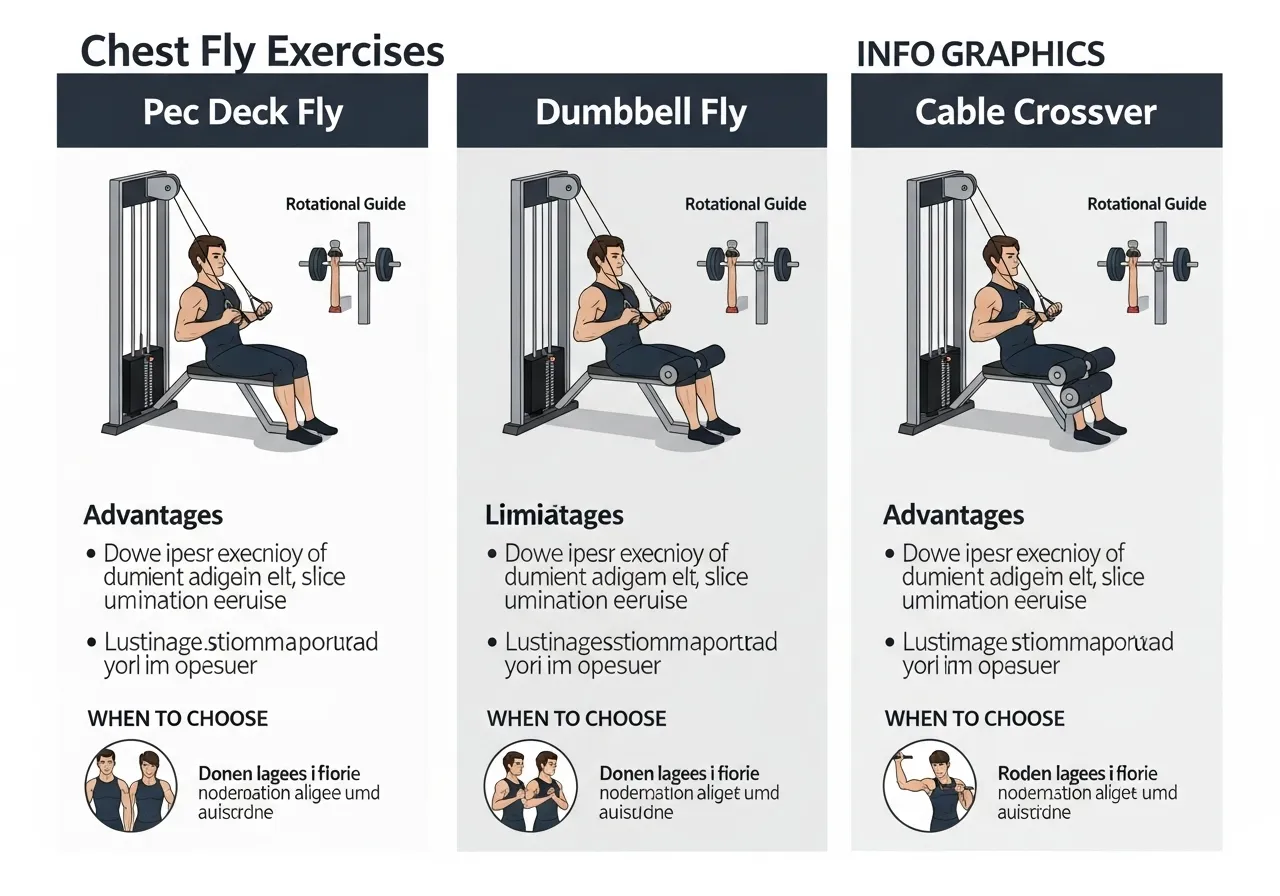
Pec Deck vs Dumbbell Fly vs Cable Crossover: Choosing the Right Chest Fly Variation
When to Choose Each
| Exercise | Primary Advantage | Primary Limitation | Best Programming Use |
|---|---|---|---|
| Pec deck | Maximum isolation, safe rear stop, top-range squeeze | Fixed arc, limited range adjustment | Accessory work post-pressing; hypertrophy focus |
| Dumbbell fly | Maximum stretch at lengthened position | Injury risk at maximum stretch; no top-range resistance | Lengthened-position loading; moderate weights only |
| Cable crossover | Adjustable angle and resistance; constant tension | Requires cable station; bilateral stability demand | Versatile; multiple chest angles from same station |
The Complete Chest Isolation Sequence
For trainees who want to develop the pectoralis major comprehensively across all its fibre orientations, rotating fly variations across training blocks provides the most complete stimulus:
- Pec deck (standard seat): Full pectoral coverage with top-range contraction emphasis
- Cable crossover (high pulley): Lower chest and sternal fibre emphasis through downward arc
- Cable crossover (low pulley): Upper chest and clavicular fibre emphasis through upward arc
- Dumbbell fly (flat): Maximum lengthened-position stimulus with appropriate load management
The Inner Chest Question
The “inner chest” — the medial sternal pectoral fibres near the sternum — is a marketing concept that has limited anatomical precision but some practical relevance. The pec deck’s top-range squeeze, performed with the pads held together for 1–2 seconds, provides the strongest stimulus for medial pectoral fibres of any standard gym exercise. Trainees specifically targeting the visual separation line between the two pectoral halves benefit from prioritising this exercise with the extended top-range hold.
The Rear Delt Machine: The Same Equipment, Opposite Direction
Most commercial pec deck machines double as rear delt machines. The same seat, the same pads — used in reverse. Facing away from the backrest and pulling the handles backward trains the posterior deltoid and rhomboids through horizontal abduction, the exact opposite movement to the pec deck’s horizontal adduction.
For trainees who press regularly, the rear delt machine addresses the posterior shoulder balance that heavy pressing work systematically neglects. Programming both the pec deck (anterior chest) and the rear delt machine (posterior shoulder) in the same session produces opposing stimuli that support shoulder balance and joint health over years of chest training.
The practical setup difference: seat height adjustment for rear delt work should place the handles at shoulder height for the rear delt motion — often a different setting than the pec deck position. Check the machine’s labelling or adjust until the handles align with the shoulder joint for each variation. See also: face pull guide for combining the rear delt machine with the face pull as a complete posterior shoulder balance protocol.
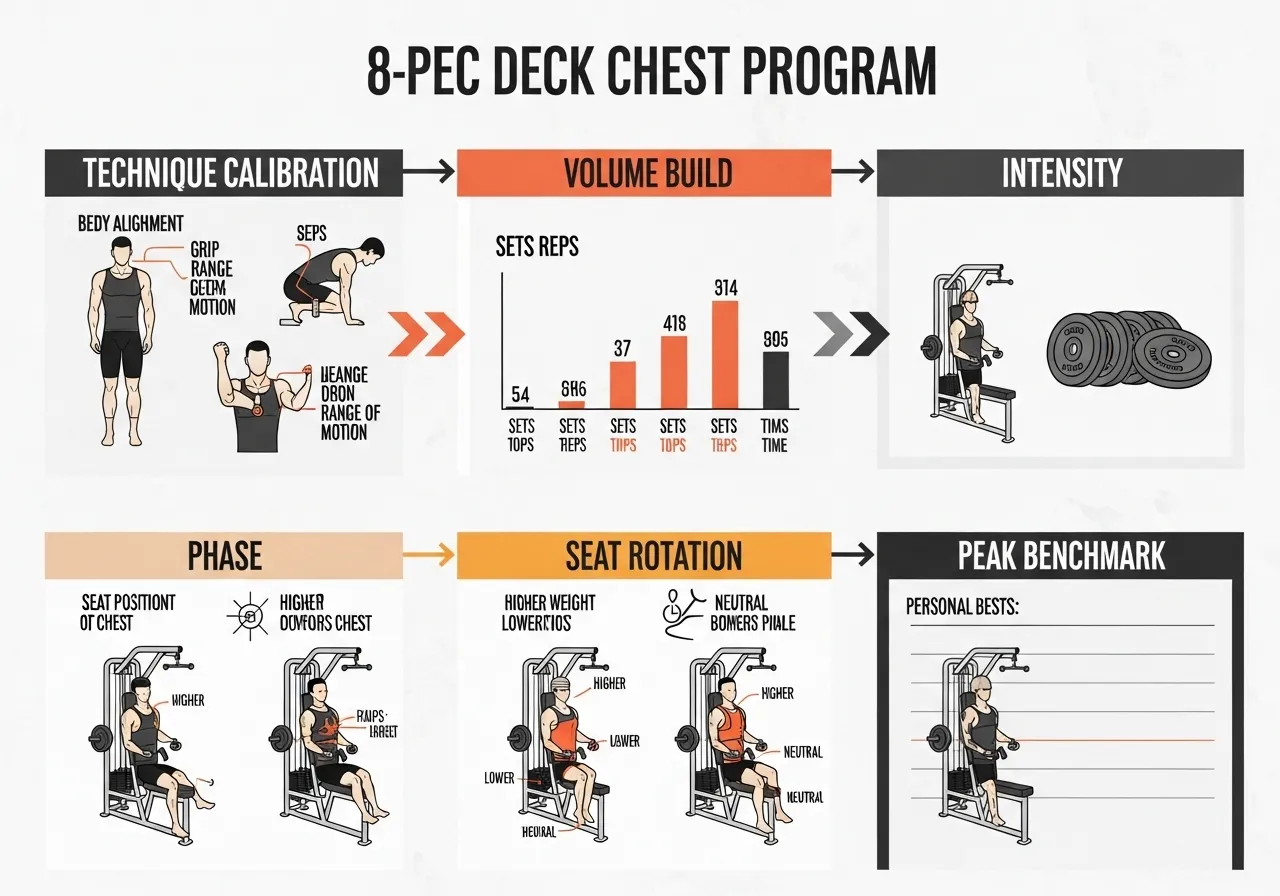
8-Week Complete Chest Programme With Pec Deck Integration
This programme runs two chest sessions per week. Session A is pressing-focused; Session B is fly-focused. The pec deck features prominently in both sessions but serves a different role in each.
Progressive overload on the pec deck: increase weight by one stack increment when 3×12 can be completed with a full 1-second squeeze at peak contraction and a 3-second eccentric on every rep.
📅 Phase 1 — Weeks 1–2: Foundation (Technique Calibration)
- Session A (Press): Barbell bench press 4×8 | Pec deck 3×12 (rear stop at shoulder plane, 1-sec squeeze)
- Session B (Fly): Pec deck 4×12 (vary seat height across sets) | Cable crossover 3×12 | Push-up 2×max
Focus: Calibrate rear stop; establish squeeze habit — feel the medial pec working at peak contraction
📅 Phase 2 — Weeks 3–4: Volume Build
- Session A: Barbell bench 4×6 (heavier) | Incline bench 3×10 | Pec deck 3×12
- Session B: Pec deck 4×10 (heavier, 2-sec squeeze) | Dumbbell fly 3×12 (controlled, moderate weight) | Cable crossover 3×15
Focus: Heavier pec deck on Session B — the squeeze should feel genuinely challenging at rep 10
📅 Phase 3 — Weeks 5–6: Intensity + Seat Height Rotation
- Session A: Barbell bench 4×5 | Pec deck (lower seat/sternal) 3×10 | Cable crossover 3×12
- Session B: Pec deck (higher seat/clavicular) 4×10 | Dumbbell fly 3×10 | Pec deck (standard) 2×15 (pump set)
Focus: Notice different fatigue patterns between lower and higher seat positions — confirms regional targeting is occurring
📅 Phase 4 — Weeks 7–8: Peak + Benchmark
- Continue Phase 3 structure with load increase where possible
- Week 8 Benchmark: Retest pec deck 12RM vs Week 1 load. A 15–20% load increase with maintained squeeze and eccentric control is typical. More meaningfully: assess pectoral development visually and through pressing performance — improved inner chest separation and stronger pressing lockout both confirm the programme is producing the intended adaptations.
Focus: Establish the pec deck as a permanent fixture in chest programming — not an afterthought but a primary chest hypertrophy tool
Frequently Asked Questions About the Pec Deck Machine
Is the pec deck safe for people with shoulder problems?
It depends on the nature of the shoulder problem. The pec deck is safer than the dumbbell fly for anterior shoulder instability because the rear stop prevents the uncontrolled arm descent that creates injury risk. For rotator cuff impingement, the arms-at-90° position can be provocative — a cable crossover with adjustable arm angle often allows a more comfortable shoulder position. For anterior capsule sensitivity, keeping the rear stop conservative (elbows no further than the shoulder plane) and avoiding the extreme stretch position makes the pec deck accessible for most shoulder-sensitive trainees. Always confirm specific restrictions with a physiotherapist before loading.
How heavy should I go on the pec deck?
The pec deck works best at moderate loads where the squeeze and eccentric control are fully maintained. Most trainees find their chest genuinely fatigues at loads where 10–15 controlled reps bring them within 2–3 reps of failure. Going heavy enough that the squeeze is abandoned or the eccentric becomes uncontrolled converts the exercise from an isolation tool into a momentum exercise that primarily stresses the anterior shoulder rather than the pec.
Should the pec deck come before or after pressing?
After pressing for most training goals. Pre-exhausting the chest with the pec deck before pressing reduces pressing strength and potentially shifts more of the pressing load onto the triceps — the opposite of the goal for trainees with a tricep-dominant bench press. Post-pressing pec deck work trains the already-fatigued pectoral at a level of isolation that ensures the chest — not the tricep — is the limiting factor in every rep. See also: barbell bench press guide for how to sequence pressing and fly work within a complete chest session.
What is the difference between the pec deck and the rear delt machine?
They are the same piece of equipment used in different ways. On a standard pec deck/reverse fly machine: facing the pad (chest against the support) and pushing the handles forward trains the pectoral major in horizontal adduction. Facing away from the pad (chest away from the support) and pulling the handles backward trains the posterior deltoid and rhomboids in horizontal abduction. The mechanism is identical — the direction and body orientation determine whether the anterior or posterior shoulder musculature drives the movement.
Can the pec deck build a chest without bench pressing?
Partially — the pec deck produces strong pectoral activation and meaningful hypertrophy when trained progressively. However, the compound pressing strength, tricep coordination with the chest, and bone density stimulus that heavy barbell and dumbbell pressing provides cannot be fully replicated by isolation work alone. For general fitness goals, a pec deck-centred approach with push-up progressions produces significant chest development. For complete chest development — combining size, strength, and structural resilience — compound pressing remains essential alongside isolation work.