Landmine Training Guide: Why a Barbell in a Corner Outperforms Most Gym Machines – 8 Exercises Explained
Landmine exercises involve rotational and asymmetric loading that stresses the shoulder in an oblique pressing pattern and the lumbar spine in lateral and rotational planes. Individuals with active shoulder impingement, rotator cuff tears, lumbar disc herniation, or diagnosed spinal instability should obtain medical clearance before landmine training. During rotation-based landmine exercises, core bracing must precede every rep — spinal extension or lateral collapse under load is a stop signal, not a cue to push through.
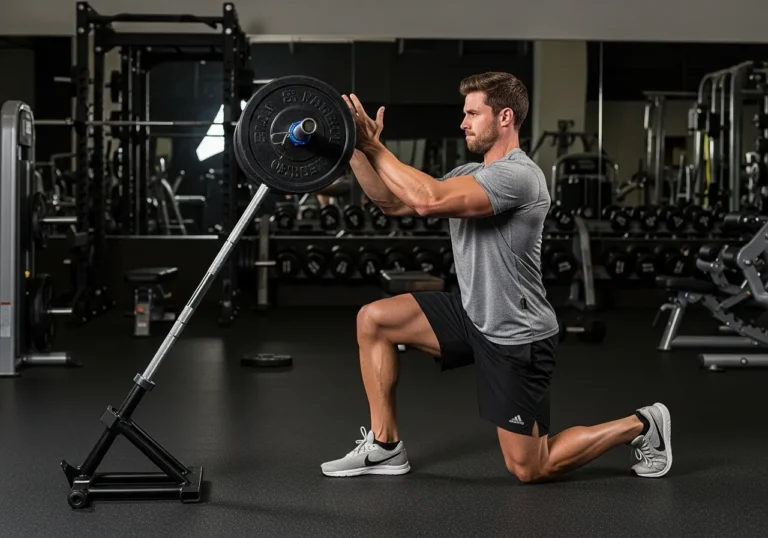
A barbell anchored at one end in a corner. That is all a landmine is.
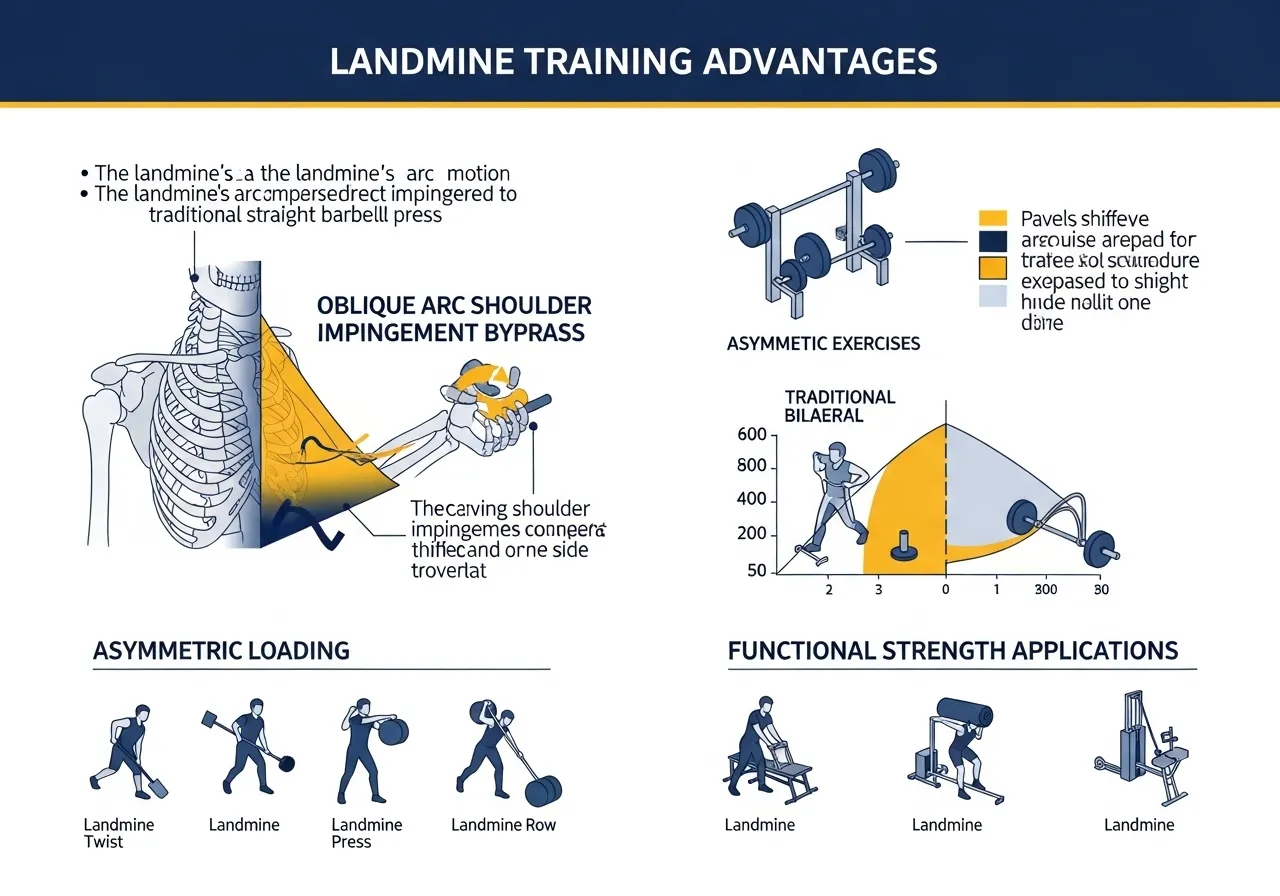
No handles, no cables, no adjustable weight stacks — just a fixed pivot point that creates an arc of resistance unlike anything a machine or free weight can replicate. The landmine press travels in a diagonal arc that bypasses the shoulder impingement zone that stops many trainees from pressing overhead. The landmine squat positions the load anteriorly without the wrist and rack demands of the front squat. The landmine rotation loads the obliques through a three-dimensional pattern that no cable or machine rotation exercise matches.
This guide argues that the landmine is one of the most underutilised tools in functional strength training — and explains exactly why its oblique loading angle produces advantages that conventional pressing and pulling cannot.
Stop Dismissing Landmine Training as a Rehab Tool — The Research Says Otherwise
The Shoulder Impingement Bypass
Standard overhead pressing requires the shoulder to pass through the subacromial space — the gap between the humeral head and the acromion — as the arm elevates above shoulder height. In individuals with shoulder impingement, this passage produces pain and reduces pressing capacity.
The landmine press arc takes the arm from approximately 45° in front of the torso to a forward-diagonal overhead position — bypassing the most provocative 60–120° of pure shoulder abduction where impingement typically occurs. Many trainees who cannot perform barbell overhead press due to shoulder limitations can perform landmine press pain-free immediately.
This is not merely a workaround. The oblique pressing arc produces meaningful anterior and medial deltoid stimulus — making the landmine press a genuine shoulder development tool, not just a rehabilitation substitute.
The EMG Evidence for Landmine Press
A study examining muscle activation during landmine pressing movements finds that the landmine press produces significant anterior deltoid, upper trapezius, and triceps brachii activation — with the oblique pressing path generating a different muscle activation pattern than standard vertical overhead pressing — confirming that the landmine press develops the pressing musculature through a movement arc that specifically reduces shoulder joint stress while maintaining meaningful training stimulus for the prime movers.
Landmine press activates the anterior deltoid, upper trapezius, and triceps through an oblique arc that reduces shoulder joint stress compared to vertical overhead pressing — without reducing the training stimulus for the prime movers.
The Asymmetric Loading Advantage
Every landmine exercise loads one side of the body differently from the other — even bilateral exercises like the landmine squat create asymmetric forces as the barbell end anchors the resistance diagonally. This asymmetry activates the lateral core stabilisers, hip abductors, and thoracic rotators as compensatory anti-rotation muscles throughout every set.
This constant asymmetric demand develops the functional core stability that heavy bilateral barbell training — perfectly symmetric by design — never trains. Trainees who add landmine work to a barbell-dominated programme typically notice improved performance in sport and daily movement tasks that bilateral lifting does not replicate.
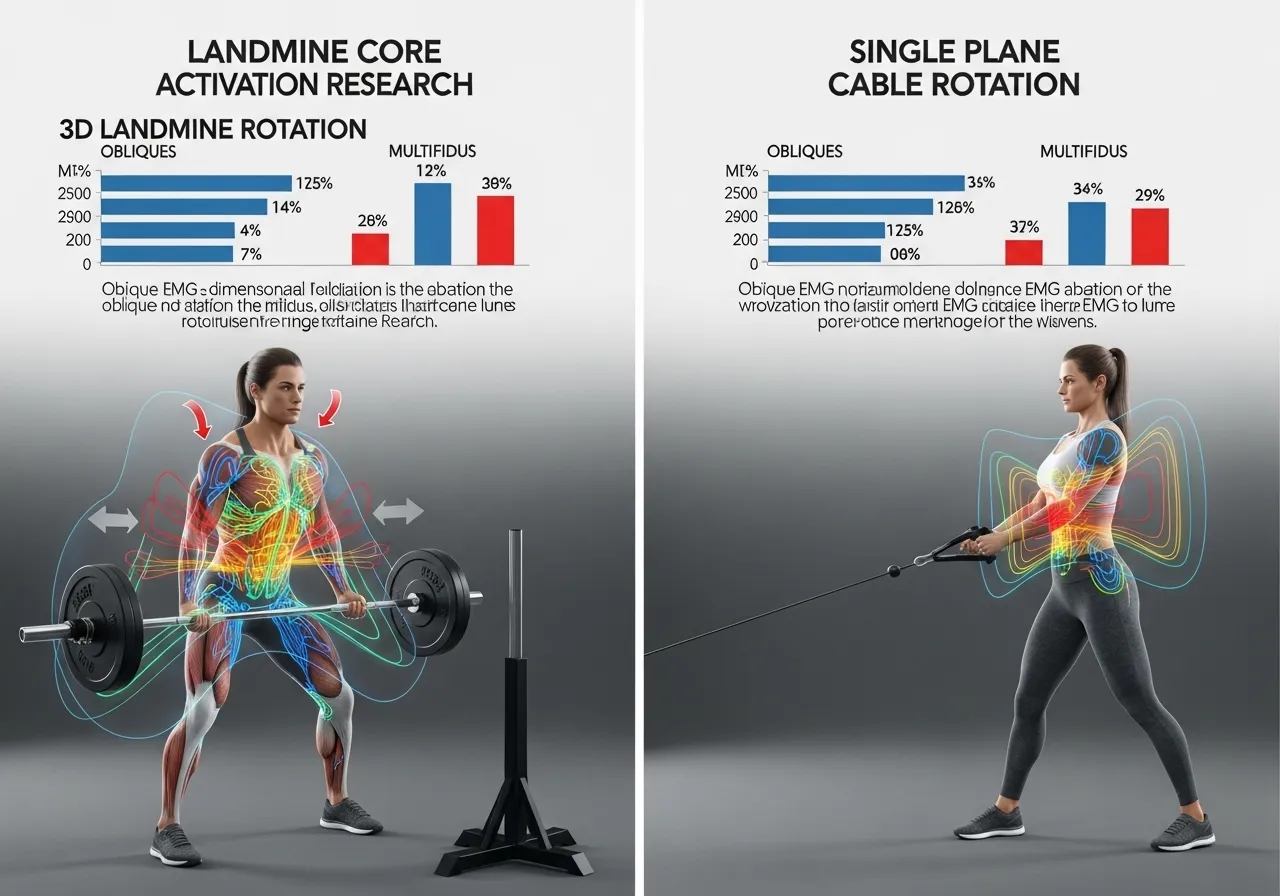
What the Research Shows: Core Activation and Rotational Power From Landmine Training
The Rotation EMG Study
A study examining core muscle activation during the landmine rotation exercise compared to traditional rotational cable exercises finds that the landmine rotation produces significant activation of the external obliques, internal obliques, rectus abdominis, and multifidus — with the three-dimensional nature of the movement engaging core stabilisers through a combination of rotation, lateral flexion, and anti-extension patterns that single-plane cable rotation exercises do not replicate — confirming that landmine rotation provides more comprehensive core development than standard rotation-based exercises when training rotational power and spinal stability simultaneously.
Landmine rotation engages core stabilisers in three planes simultaneously — rotation, lateral flexion, and anti-extension. Single-plane cable rotations cannot replicate this multi-dimensional demand.
Landmine vs Barbell Press: The Biomechanical Comparison
A study comparing the landmine press with traditional barbell overhead press in terms of shoulder biomechanics and muscle activation finds that the landmine press produces a significantly lower peak shoulder joint reaction force compared to the barbell overhead press at matched loads — while producing comparable anterior deltoid and triceps brachii activation — confirming that the landmine press achieves equivalent prime mover stimulus with reduced glenohumeral compressive and shear forces, making it a mechanically superior option for trainees managing shoulder joint sensitivity while maintaining upper body pressing development.
Landmine press produces equivalent anterior deltoid and triceps activation to barbell overhead press — with significantly lower shoulder joint reaction force. Same stimulus, less joint stress.
Practical Implications Across Training Goals
| Goal | Landmine Exercise | Advantage Over Convention |
|---|---|---|
| Shoulder pressing | Landmine press | Lower impingement risk, same prime mover stimulus |
| Core rotation | Landmine rotation | 3-plane core activation vs single-plane cable |
| Anterior-loaded squat | Landmine squat | No wrist/rack demand vs front squat |
| Deadlift with back sensitivity | Landmine deadlift | More upright torso, reduced lumbar shear |
| Back/hip thrusting | Landmine hip thrust | Natural diagonal load path, comfortable positioning |
Do You Actually Need a Landmine Attachment — or Can You Just Jam a Barbell in a Corner?
The Corner Method: Does It Work?
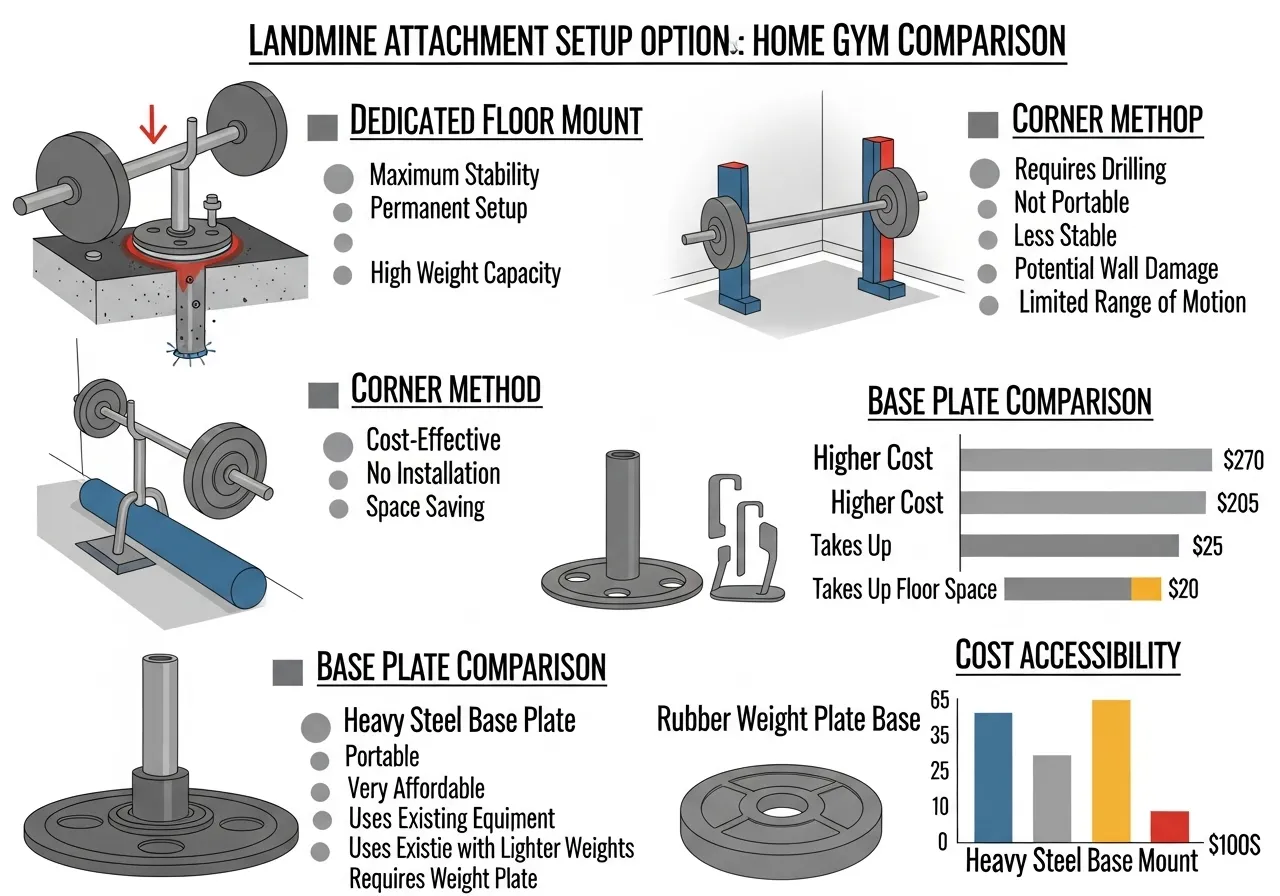
Landmine training requires one end of a barbell to be anchored at a fixed pivot point. The dedicated landmine attachment — a floor-mounted sleeve that holds the barbell end — provides a consistent, floor-level pivot. Most commercial gyms stock them.
The improvised corner method — wedging one end of the barbell into the corner junction of two walls — works functionally, with caveats. The barbell end must be protected from wall damage (a folded towel over the end suffices). The wall corner creates a slightly higher pivot point than a floor-level attachment, changing the arc of the movement minimally. For most exercises, the difference is not functionally significant.
A third option: a landmine base plate attachment that holds the barbell end on the floor without requiring a wall — available for under £30 and appropriate for home training setups. This is the most versatile and damage-free option for non-commercial settings.
Barbell Weight Considerations
Landmine exercises use significantly less weight than their barbell equivalents. The mechanical advantage of the arc means that a 20 kg barbell plus 20 kg of plate creates less absolute resistance at the working end than the same load would in a bilateral pressing position.
A practical starting guideline: begin with the barbell alone (15–20 kg) for most landmine exercises, regardless of conventional pressing strength. The unfamiliar arc and stability demand make landmine exercises more challenging than their load suggests. Most trainees are surprised how demanding correct landmine press or squat feels with a bare barbell the first session.
Equipment Compatibility: Not Every Barbell Works Equally Well
Standard 20 kg Olympic barbells work with commercial landmine attachments. For home setups using smaller barbells (15 kg or less) or fixed-end dumbbells, improvised arrangements become less reliable. The barbell end must fit snugly in the anchor to prevent slipping during rotational and asymmetric exercises — a loose pivot creates both an ineffective exercise and a safety risk.
For home training, a dedicated landmine base plate with a full-size Olympic barbell is the most reliable setup. The barbell investment doubles as a conventional lifting tool, making the landmine capability an accessory feature of a versatile piece of equipment. See also: loaded carries guide — the trap bar and barbell used for carries work identically with a landmine attachment for a space-efficient home setup.
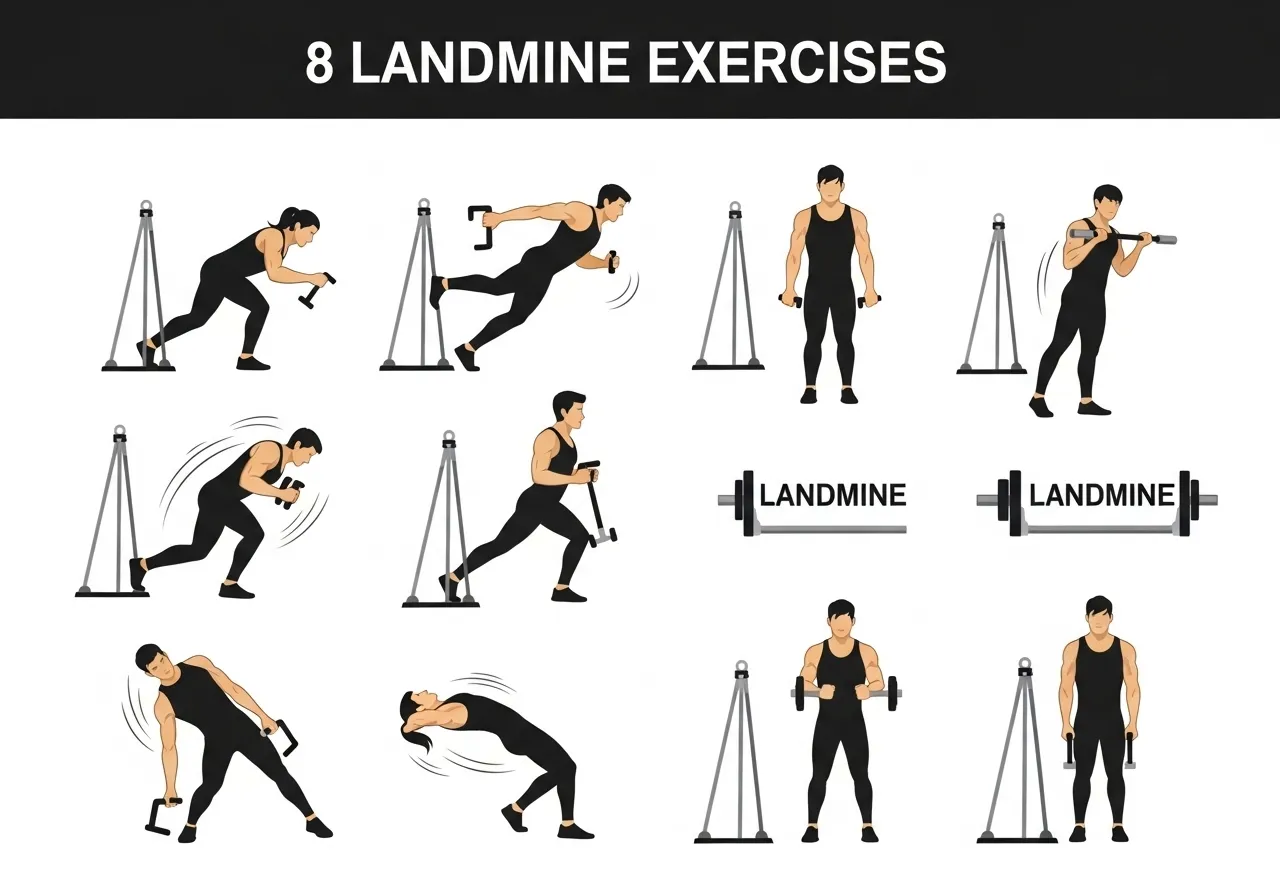
8 Landmine Exercises: The Complete Exercise Library
🏋️ 1. Landmine Press (Single-Arm)
Target: Anterior deltoid, upper pectoralis, triceps
How: Stand in a staggered stance, same-side foot forward as the pressing arm. Hold the barbell end at shoulder height with one hand. Press forward and slightly upward along the barbell’s natural arc until the arm is fully extended. Lower under control. Keep the core braced and avoid rotating the torso.
Key point: The oblique arc bypasses the impingement zone — the shoulder should feel stable and comfortable throughout. If there is pinching at the top, reduce load and ensure the elbow is not drifting outward.
🏋️ 2. Landmine Squat (Goblet Position)
Target: Quadriceps, glutes, anterior core
How: Hold the barbell end with both hands at chest height in a goblet position. Feet shoulder-width, toes out 15–20°. Squat to parallel or below, maintaining an upright torso — the barbell’s anterior loading assists torso position naturally. Drive through the heels to stand.
Key point: The barbell end rises as you squat — the loading arc actively cues an upright torso, making this one of the most technique-friendly anterior squat variations available. No wrist or rack position required.
🏋️ 3. Landmine Romanian Deadlift (Single-Leg)
Target: Hamstrings, glutes, hip stabilisers, spinal erectors
How: Hold the barbell end with the opposite hand to the standing leg. Hinge at the hip, extending the free leg behind as the torso lowers — the barbell follows the natural hip hinge arc. Maintain a neutral spine throughout. Drive the hip forward to return.
Key point: The cross-body loading (opposite hand to standing leg) creates anti-rotation demand that trains the lateral core and hip stabilisers beyond what bilateral RDL achieves. Essential for trainees with bilateral hip or lower back asymmetry.
🏋️ 4. Landmine Row (Single-Arm)
Target: Latissimus dorsi, posterior deltoid, middle trapezius
How: Hinge forward to approximately 45°, supporting the non-working hand on a bench or the knee. Grip the barbell end with one hand and row it toward the hip, leading with the elbow. Full scapular retraction at the top. Lower under control.
Key point: The angled barbell path creates a diagonal row that feels different from cable and dumbbell rows — the arc loads the lat through a more horizontal abduction than straight rows, increasing posterior deltoid involvement.
🏋️ 5. Landmine Rotation
Target: External obliques, internal obliques, rotational core, thoracic spine
How: Stand perpendicular to the anchor, holding the barbell end with both hands at arm’s length. Rotate the barbell arc from hip height on one side to hip height on the other in a controlled arc, pivoting the feet. Engage the core before each rotation — the power comes from hip rotation, not arm swinging.
Key point: This is the definitive landmine exercise for rotational athletes — golfers, tennis players, hockey players, and throwers. The arc replicates the mechanics of rotational sport movement better than any cable or machine rotation exercise.
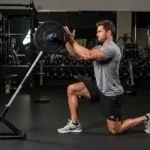
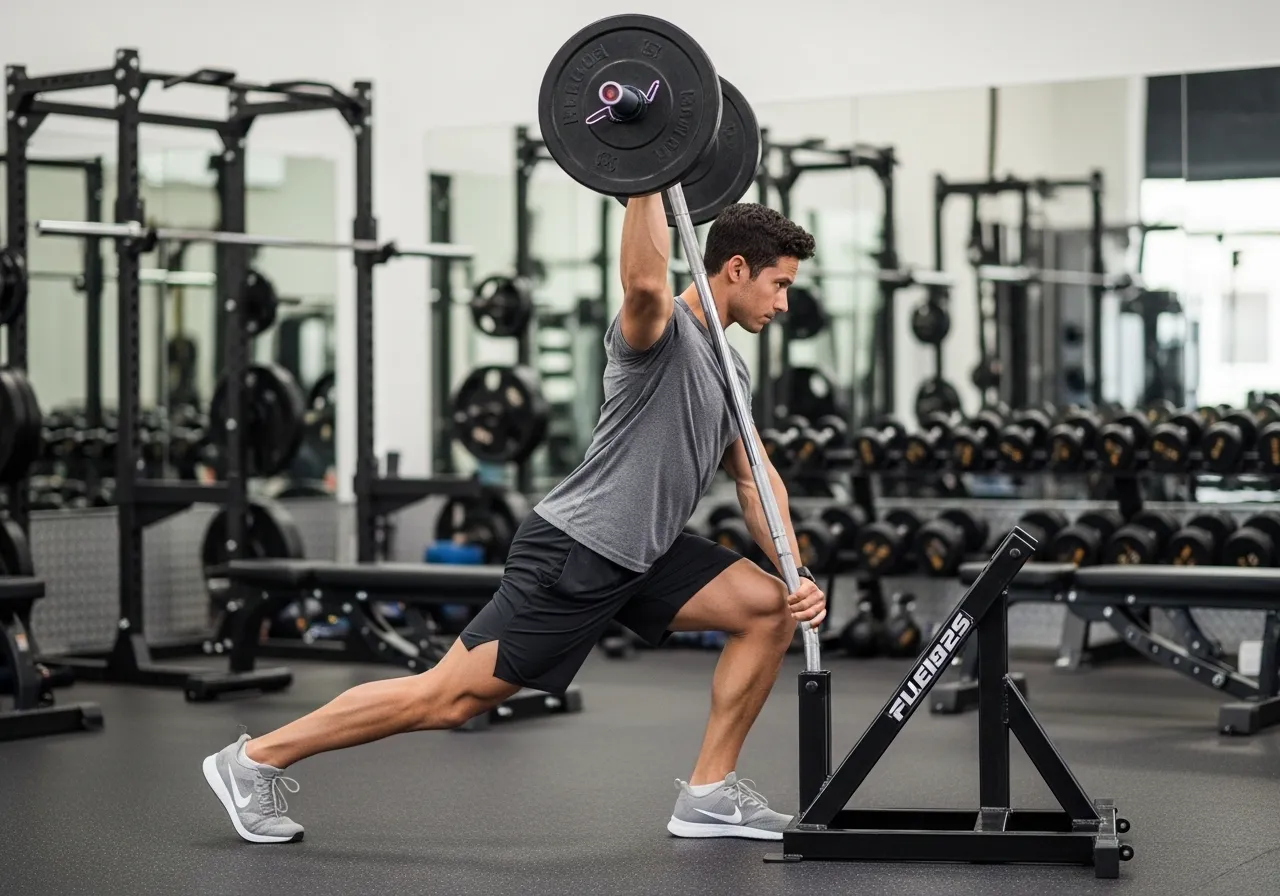
🏋️ 6. Landmine Lunge with Press
Target: Quadriceps, glutes, anterior deltoid, core (complex movement)
How: Hold the barbell end at shoulder height with the arm corresponding to the lunging leg. Step forward into a lunge as the arm presses along the barbell arc simultaneously. Return to standing and lower the arm together. The synchronised lunge-press trains coordination and core stability under combined movement demand.
Key point: One of the most functionally demanding landmine exercises — the combined lunge and press requires the core to simultaneously stabilise the lower body loading while producing force through the upper body press. Appropriate after mastering the isolated press and squat separately.
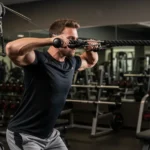
🏋️ 7. Landmine Anti-Rotation Press (Pallof Arc)
Target: Anti-rotation core, obliques, anterior deltoid, shoulder stability
How: Stand sideways to the anchor, holding the barbell end with both hands at chest level. Press the barbell away from the body along its natural arc while resisting the rotational pull that the arc creates — the body must stay square throughout. Return to chest. This creates constant anti-rotation demand throughout the arc.
Key point: The landmine’s arc creates a unique rotational force that the Pallof press cable cannot fully replicate — the barbell’s arc pulls diagonally rather than directly laterally, training the obliques in a combination of rotation and flexion resistance simultaneously.
🏋️ 8. Landmine Hip Thrust
Target: Gluteus maximus, hamstrings, anterior core
How: Sit with the upper back against a bench, barbell end resting in the hip crease. Drive the hips up to full extension, pressing the barbell end upward along its natural arc. The landmine arc automatically adjusts the resistance direction through the hip thrust range — maintaining resistance at the fully extended position where a barbell hip thrust would create near-zero moment arm.
Key point: The landmine’s arc maintains meaningful resistance at full hip extension — the position where glute activation peaks — addressing the resistance curve limitation of plate-loaded hip thrusts.

Can Landmine Training Replace Barbell Training — or Is It Just a Supplement?
The Honest Assessment
Landmine training cannot fully replace barbell training for absolute strength development. The arc limits the maximum load that can be meaningfully applied — particularly for squat and pressing patterns where the barbell’s mechanical disadvantage at certain arc positions caps the load well below what a standard barbell allows.
For powerlifting-specific strength, Olympic weightlifting, or any sport where maximal force in a specific pattern is the goal, the barbell in its conventional configuration remains irreplaceable. The landmine supplements these goals, it does not replace them.
Where Landmine Training Is Superior
Four specific contexts where landmine training outperforms conventional barbell training:
- Shoulder-limited pressing: Trainees who cannot press overhead without pain can often landmine press pain-free from day one. The pressing adaptation continues; the shoulder heals in parallel.
- Rotational power development: No conventional barbell exercise trains rotation as specifically as the landmine rotation. For rotational athletes, landmine rotation is not a supplement — it is the primary tool.
- Anti-rotation core training: The landmine’s diagonal arc creates multi-plane anti-rotation demand that cable machines and standard barbell exercises cannot replicate.
- Anterior squat loading without rack demands: The landmine goblet squat produces front-squat-equivalent muscle activation without requiring wrist mobility, rack position, or a barbell rack — making anterior loading accessible for a wide range of trainees.
The Integration Model
The most effective approach combines barbell training for primary strength development with landmine training for rotational power, shoulder-safe pressing, and anti-rotation core work. This combination develops the complete athletic spectrum — maximal force, rotational power, multi-plane stability — that neither tool alone can cover. See also: sled training guide for another functional conditioning tool that pairs effectively with landmine work in the same training session.
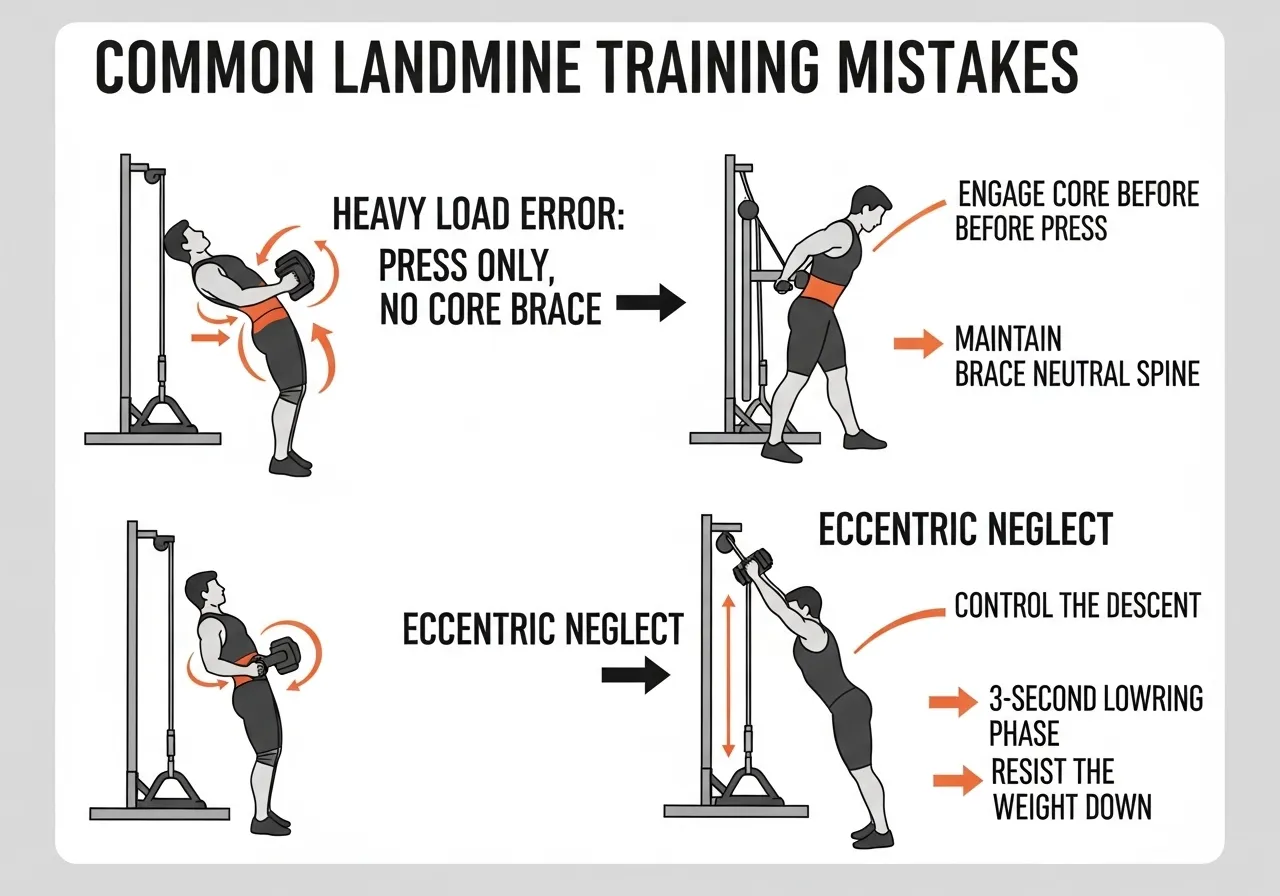
4 Landmine Mistakes That Undermine the Exercise’s Advantages
Mistake 1: Treating It Like a Conventional Barbell Exercise
Trainees who approach landmine training by loading the bar as heavily as possible and performing the movement mechanically are missing the tool’s purpose. The landmine’s value lies in its arc, its asymmetric loading, and its oblique force vector — not in how much weight can be shifted through the movement.
Using strict form, controlling the arc throughout the range, and maintaining anti-rotation tension throughout each rep produces far more functional benefit than heavy, sloppy landmine pressing or squatting. Treat the landmine as a skill-based exercise — technique and control first, load progression second.
Mistake 2: Only Using the Press
Many trainees discover the landmine as a shoulder-friendly pressing alternative and never explore the rest of the exercise library. The rotation, anti-rotation press, single-leg RDL, and hip thrust are each more unique in their stimulus than the press — and collectively provide the multi-plane, asymmetric training that makes landmine work genuinely irreplaceable in a complete programme.
Mistake 3: Not Bracing the Core Before Each Rep
Landmine exercises involve asymmetric and rotational forces that the spine must resist throughout every rep. Trainees who begin each rep without a deliberate core brace allow the lower back to laterally flex or rotate under the asymmetric load — particularly during single-arm pressing, rotation, and the lunge-press.
The cue: full diaphragmatic breath in, brace the core as if about to absorb a punch, then initiate the movement. Exhale on the exertion phase. This Valsalva-style bracing maintains spinal stiffness through the full movement.
Mistake 4: Neglecting the Eccentric Phase
The landmine’s arc means the barbell end wants to return to its resting position at the bottom of each press — gravity assists the descent. Most trainees allow this gravity-assisted drop rather than controlling the eccentric under muscle tension. A deliberate 2–3 second eccentric on every landmine press and row rep doubles the time under tension per set at no additional load cost. See also: isometric training guide for combining landmine paused reps with isometric holds at the end range of the press and rotation exercises.
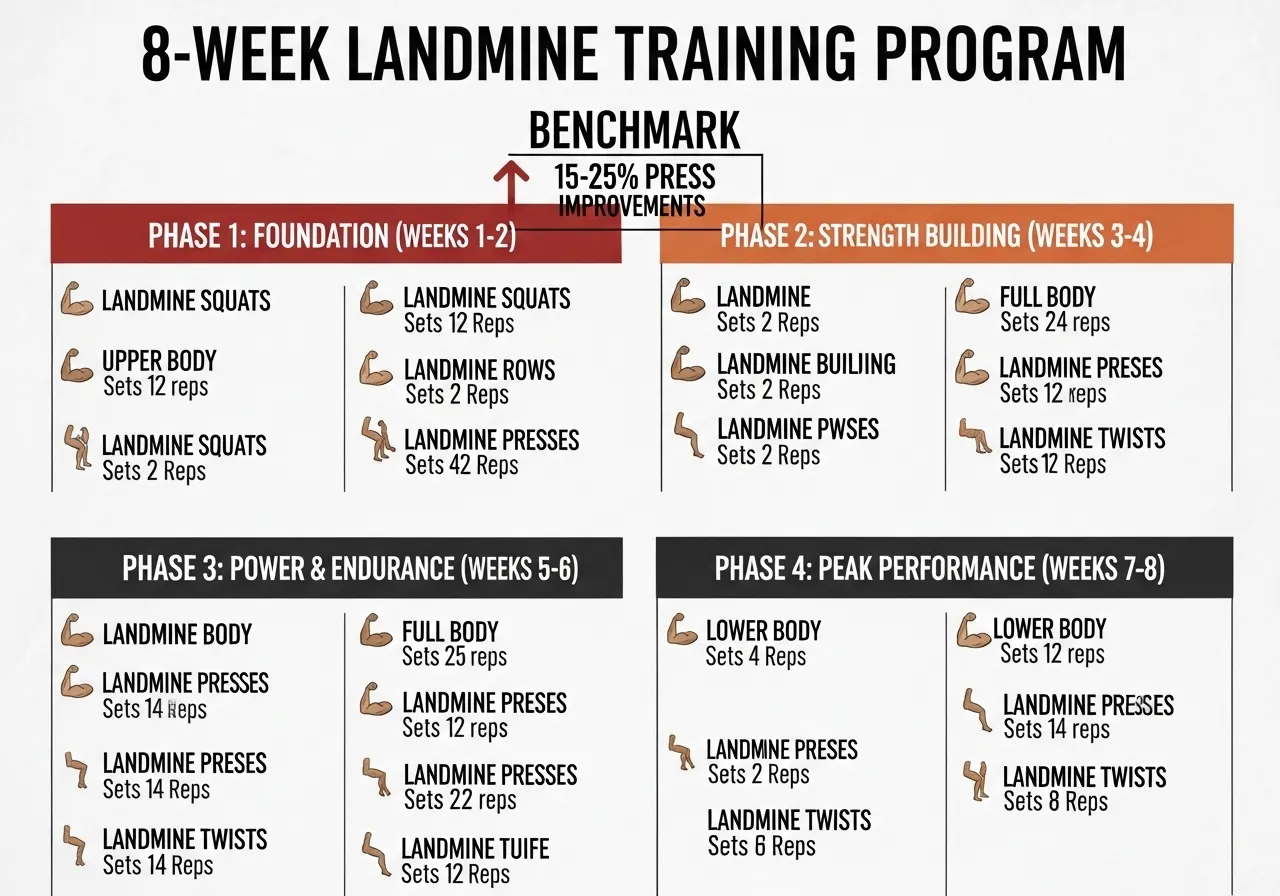
8-Week Landmine Programme: Full-Body Functional Strength
This programme runs three sessions per week — one upper body emphasis, one lower body emphasis, and one full-body conditioning session. Each session takes 30–45 minutes. Equipment needed: a barbell and a landmine attachment or wall corner setup.
Load the barbell with 10 kg total in Week 1 and increase by 5 kg every 2 weeks. Reset to lower load when introducing new exercises.
📅 Phase 1 — Weeks 1–2: Foundation Movements
- Session A (Upper): Landmine press 4×8 each arm | Landmine row 3×10 each | Anti-rotation press 3×8 each side
- Session B (Lower): Landmine squat 4×10 | Single-leg RDL 3×8 each | Landmine hip thrust 3×12
- Session C (Full-body): Landmine rotation 4×8 each direction | Lunge with press 3×6 each | Landmine row 2×12 each
Focus: Establish movement patterns — feel the arc and anti-rotation demand before adding load
📅 Phase 2 — Weeks 3–4: Volume Build
- Session A: Landmine press 4×6 (heavier) | Row 4×8 | Anti-rotation press 3×10
- Session B: Landmine squat 4×8 | Single-leg RDL 4×8 each | Hip thrust 4×10
- Session C: Rotation 4×10 each | Lunge-press 3×8 each | Full sequence circuit ×2 (30 sec each, no rest)
Focus: Increase volume on primary exercises; introduce the circuit for conditioning
📅 Phase 3 — Weeks 5–6: Intensity + Complex Training
- Session A: Landmine press 4×5 (peak load) | Row 3×6 | Anti-rotation 3×10
- Session B: Single-leg RDL 4×6 (heavier) | Landmine squat 3×10 | Hip thrust 4×8
- Session C: Complex — rotation 6 reps + lunge-press 6 reps each side + row 8 reps, 3 rounds, 90 sec rest
Focus: Peak pressing load in Session A; complex session trains conditioning alongside skill
📅 Phase 4 — Weeks 7–8: Peak + Benchmark
- Full programme continuation at peak loads from Phase 3
- Week 8 Benchmark: Retest landmine press single-arm 5RM vs Week 1 load. A 15–25% load increase over 8 weeks is typical. Test rotation for range and smoothness — asymmetry between sides at Week 1 should show visible reduction. Perform a 3-round conditioning complex and compare rest time needed vs Week 5.
Focus: Confirm strength, rotation quality, and conditioning improvements across all three training dimensions the programme addressed
Frequently Asked Questions About Landmine Training
What weight should I start with on landmine exercises?
Start with the barbell alone (15–20 kg) for most landmine exercises — regardless of conventional pressing or squatting strength. The unfamiliar arc, stability demand, and anti-rotation requirement make the exercise significantly more challenging than the absolute load suggests. Most trainees are surprised how demanding strict landmine pressing feels with a bare bar the first session. Progress gradually: add 5 kg every 2 weeks when technique remains clean throughout all working sets.
Can I do landmine training if I have shoulder problems?
Often yes — with professional guidance. The landmine press arc bypasses the subacromial impingement zone that makes standard overhead pressing provocative for many shoulder conditions. Many physiotherapists include landmine pressing as part of shoulder rehabilitation precisely because it allows progressive pressing loading without the specific positional stress that barbell overhead press creates. Always confirm with a physiotherapist that the specific arc angle is appropriate for your particular shoulder condition before loading.
How does landmine training compare to kettlebell training?
Both develop functional strength through asymmetric and multi-plane loading. Kettlebells excel at ballistic conditioning, hip hinge patterns, and single-limb stability. The landmine excels at pressing patterns, rotational power, and anti-rotation core training. For a complete functional training programme, both tools provide complementary stimuli — the kettlebell swing cannot be replicated with a landmine; the landmine rotation cannot be replicated with a kettlebell. See also: kettlebell training guide for the complementary tool that pairs most effectively with landmine work.
Do I need to buy special equipment for landmine training?
The minimum equipment: a standard Olympic barbell and either a commercial landmine attachment (£30–80) or a folded towel in a wall corner. Many commercial gyms have landmine attachments permanently mounted to the floor — check the free weights area. For home training, a landmine base plate is the most practical option — it requires no wall damage, works on any floor surface, and stores in the same space as the barbell itself.
Is landmine training appropriate for beginners?
Yes — particularly the press, squat, and row variations. The landmine’s arc guides movement direction, making technique more self-correcting than standard barbell pressing. The landmine squat in particular is an excellent anterior squat introduction for trainees who cannot yet achieve front squat rack position or barbell back squat depth. Begin with Phase 1 of the 8-week programme using only the barbell weight and focus entirely on pattern quality before adding plates.