Easy running is comfortable. Sprint intervals are brief and brutal. Tempo running sits between them and is, for many recreational runners, the training zone they consistently avoid because it is neither comfortable enough to sustain for long nor short enough to feel manageable.
This avoidance is expensive. Tempo running, performed at or just below the lactate threshold, produces a specific aerobic adaptation that neither easy running nor high-intensity intervals develop as efficiently: it raises the pace at which the body can sustain aerobic energy production without accumulating lactate faster than it can clear it. This adaptation determines how fast a runner can sustain effort for 20 to 60 minutes. It is arguably the single most important quality for middle-distance and road racing performance.
This guide covers the physiology of lactate threshold and why tempo running develops it better than easy running, the research on individual responses to threshold training, how to find your specific tempo pace without laboratory testing, five structured tempo workouts, and how to integrate tempo running within a complete training week.
Tempo Running vs Easy Running: Why Comfortable Pace Does Not Build the Lactate Threshold
The Three Physiological Training Zones and What Each Develops
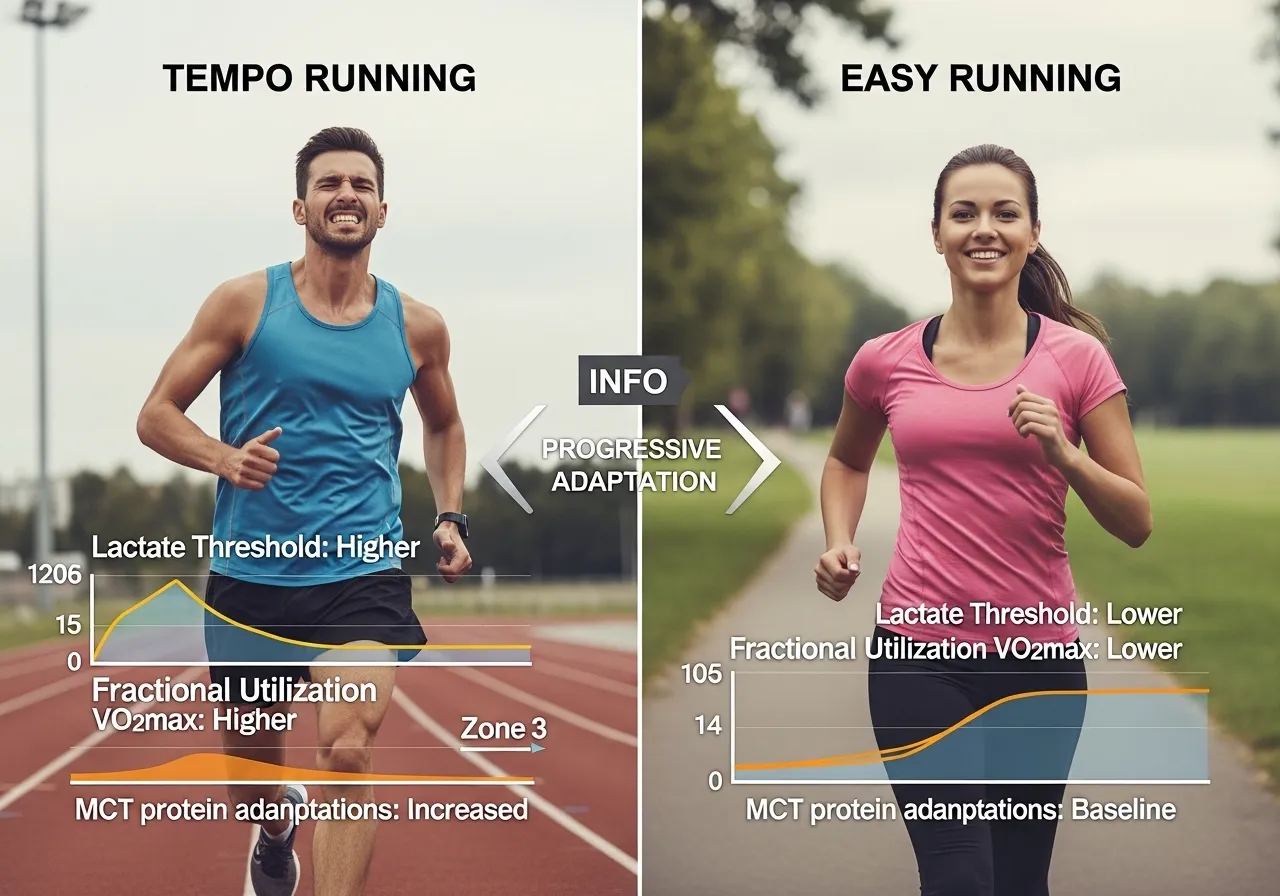
Endurance training produces adaptations in three broad intensity zones. Zone 1 and 2 (easy pace, conversational effort) develops mitochondrial density, fat oxidation efficiency, and cardiac stroke volume through high-volume low-stress work. Zone 4 and 5 (intervals at VO2 max and above) develops maximal oxygen uptake, stroke volume ceiling, and tolerance to high lactate concentrations. Zone 3, the tempo zone at lactate threshold, develops the fractional utilisation of VO2 max: the percentage of maximal oxygen uptake that can be sustained continuously.
Fractional utilisation is the quality that separates runners of similar VO2 max. Two runners with identical VO2 max values of 60 mL/kg/min can have dramatically different 10 km race performance if one can run at 85% of that maximum for the duration and the other can only sustain 75%. The runner at 85% fractional utilisation is running on a higher gear that the lower-threshold runner cannot access. Tempo running shifts the lactate threshold upward, allowing a higher percentage of VO2 max to be sustained before lactate begins accumulating at a race-limiting rate.
Why Easy Running Alone Does Not Raise the Lactate Threshold Effectively
Easy running at 60 to 70% of maximum heart rate stays well below the lactate threshold for most trained runners. At this intensity, lactate production rates are low and clearance easily matches production. The body adapts to sustained aerobic work at this intensity through mitochondrial proliferation and fat oxidation improvements, but the lactate threshold itself, the pace at which lactate begins accumulating, does not shift significantly with easy running alone.
Raising the lactate threshold requires sustained effort at or near the threshold itself. The physiological adaptation driving threshold improvement is increased mitochondrial enzyme activity in the slow-twitch muscle fibres recruited at threshold pace, and increased lactate clearance capacity through upregulation of MCT (monocarboxylate transporter) proteins that remove lactate from muscle cells. Both adaptations occur maximally when training occurs at or near the intensity that challenges these specific systems. Easy running does not sufficiently challenge the lactate clearance and threshold enzyme systems that tempo running specifically targets. The Zone 2 training science and how it provides the aerobic base that makes tempo running effective is covered in the Zone 2 training guide.
What Tempo Running Feels Like: The Comfortably Hard Description
Tempo pace is often described as comfortably hard. More specifically, it is the pace at which speaking requires effort. Single words are possible. Full sentences require pausing the effort. This subjective description translates to approximately 80 to 90% of maximum heart rate or a rating of perceived exertion of 6 to 7 on a 10-point scale. Runners who find that they can maintain a long conversation at their tempo pace are running too slowly. Runners who cannot speak at all are running above tempo pace into high-intensity interval territory.
The Research: Individual Responses to Lactate Threshold Training
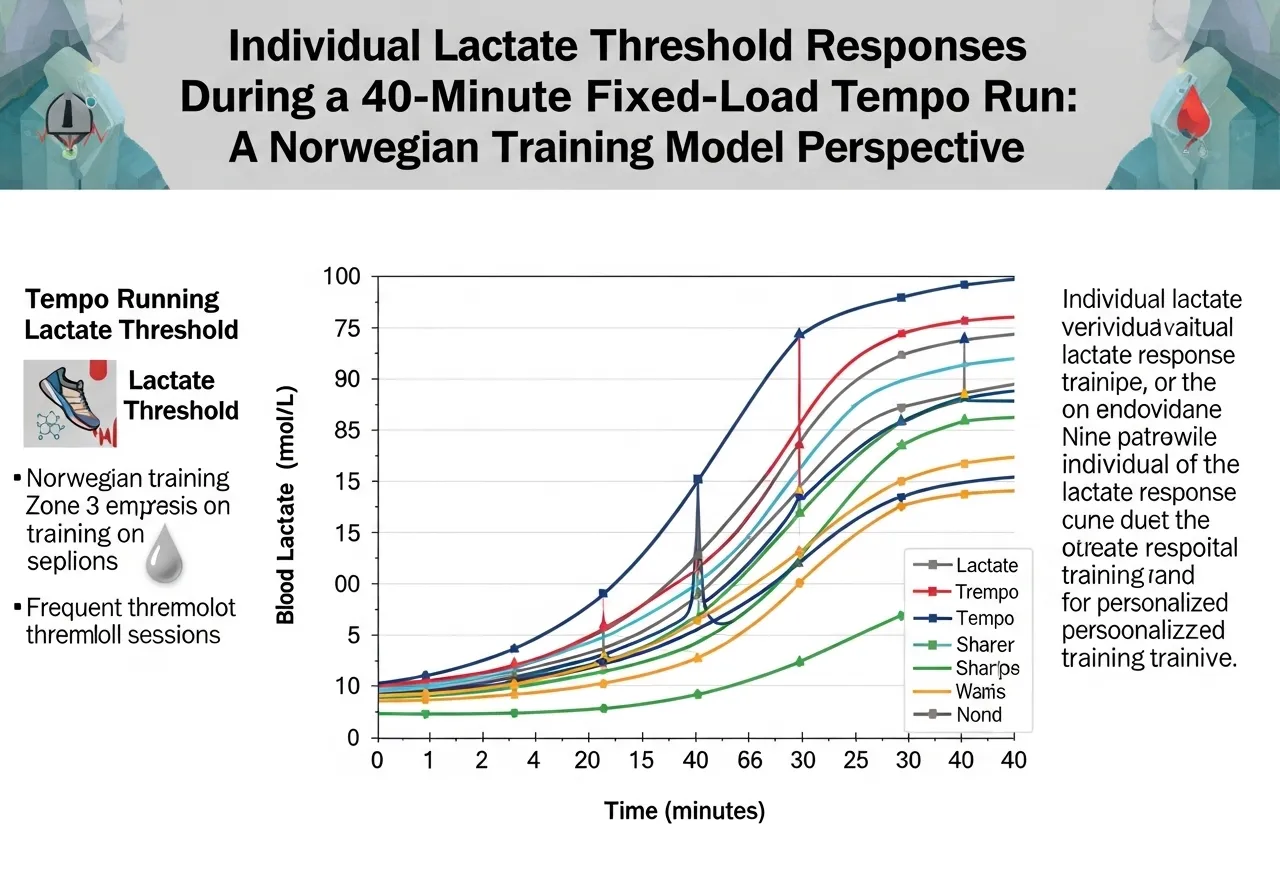
Running Continuously at a Fixed Lactate Threshold Load
📌 Key Finding
Individual physiological responses to a fixed lactate threshold pace vary significantly between trained runners. A single prescribed tempo pace does not produce equivalent training stimulus across individuals, which is why personal threshold identification through field tests produces better training outcomes than group-prescribed tempo paces.
📌 Key Finding
Lactate threshold percentage alone does not predict threshold velocity. Running economy and maximal aerobic speed together determine 90% of threshold pace, meaning tempo training improves threshold performance through both raising the threshold percentage and improving the economy of running at that intensity.
The Norwegian Threshold Training Model
The recent dominance of Norwegian distance runners, including Jakob Ingebrigtsen and others, has renewed research interest in lactate-guided threshold training. The Norwegian model uses twice-daily threshold training sessions calibrated to blood lactate measurements of 2 to 3 mmol/L rather than pace or heart rate. This approach matches the research finding that individual lactate responses to a given pace vary considerably, with lactate testing providing the most accurate prescription of true threshold intensity rather than proxies like pace or heart rate that do not account for individual variation in lactate metabolism.
For recreational runners without access to lactate testing, the practical implication is that prescribed tempo paces based on recent race times provide a reasonable approximation of individual threshold pace, but heart rate monitoring and perceived exertion remain essential ongoing calibration tools. A single race-derived tempo pace that felt appropriate early in training may drift above or below threshold as fitness changes across a training cycle.
How to Find Your Tempo Pace Without a Laboratory
The Race Time Method
The most widely used field method for estimating tempo pace uses recent race performances as the baseline. For most runners, tempo pace falls between 10 km race pace plus 15 to 20 seconds per kilometre and half-marathon race pace plus 10 seconds per kilometre. A runner with a recent 10 km time of 45 minutes (4:30 per km pace) would estimate their tempo pace at approximately 4:45 to 4:50 per kilometre. A runner with a 21.1 km time of 1:45 (4:59 per km pace) would estimate tempo pace at approximately 5:05 to 5:10 per kilometre.
These are starting estimates, not prescriptions. The race time method assumes that recent race performance reflects current fitness, that the race was run at maximal effort, and that the runner’s individual lactate threshold falls at the typical percentage of maximal pace. All three assumptions introduce error. Treat the race-derived estimate as a starting point and adjust based on heart rate and perceived exertion during the first few tempo sessions.
The Talk Test Calibration
During a tempo run, speaking should be possible but uncomfortable. The ability to produce a 3 to 4 word phrase with effort but not a full sentence indicates threshold pace. If speaking is completely comfortable, the pace is too slow. If speaking requires stopping running, the pace is too fast. This subjective calibration is more immediately useful than pace alone because it adjusts automatically for conditions like heat, humidity, altitude, and accumulated fatigue that shift the physiological threshold relative to any fixed pace.
A practical calibration protocol: begin the tempo run at the estimated race-derived pace. After 5 minutes, say a short phrase aloud. If it feels easy, increase pace by 5 to 10 seconds per kilometre and reassess after 3 minutes. If it feels very difficult, reduce pace and reassess. The goal is a pace where the phrase requires deliberate effort but does not interrupt breathing completely.
Heart Rate as an Ongoing Calibration Tool
Tempo pace corresponds to approximately 80 to 90% of maximum heart rate for most trained runners. This range is wide enough to accommodate the individual variation in threshold heart rate that makes a single percentage prescription inaccurate for all runners. Use the talk test to calibrate the initial pace, then record the heart rate that corresponds to the calibrated effort. In subsequent tempo sessions, use that recorded heart rate as the primary target rather than a fixed pace, adjusting pace upward or downward to maintain the target heart rate regardless of conditions.
The Three Most Common Tempo Pace Errors
Three specific errors consistently undermine tempo running effectiveness. First, running too fast: many runners approach tempo pace as a maximum sustainable effort rather than a specific physiological zone, resulting in a pace that sits above the lactate threshold in the VO2 max interval zone. Running above threshold produces greater acute discomfort but less specific threshold adaptation than correctly paced tempo work. The pace should feel hard but sustainable for 20 to 40 minutes, not for 8 to 12 minutes.
Second, inconsistent session structure: starting the tempo run at an easy pace and gradually building to tempo pace across the session means most of the session occurs below the threshold stimulus zone. Tempo running requires reaching threshold intensity within the first 3 to 5 minutes of the tempo segment and maintaining it throughout. A brief warm-up before the tempo section, not a gradual build within it, is the appropriate structure.
Third, neglecting recovery between sessions: tempo running creates central cardiovascular and muscular fatigue that requires 36 to 48 hours before the subsequent session can be performed at full quality. Scheduling tempo runs too close together, or following a hard strength session with a same-day or next-morning tempo run, prevents the quality of work that makes tempo sessions effective. The recovery and fatigue management framework for balancing tempo with other training is covered more fully in the context of complete running programme design.
As tempo fitness improves across weeks of training, the pace required to maintain the target threshold heart rate will increase. This pace progression at matched heart rate is the direct measurement of lactate threshold improvement. If tempo sessions require progressively faster paces to maintain 85% of maximum heart rate at the same perceived exertion, the threshold is rising. The complete lactate threshold science and formal testing methods are covered in the lactate threshold guide.
5 Tempo Running Workouts: Structures, Durations, and When Each Applies
Why Tempo Workout Structure Matters
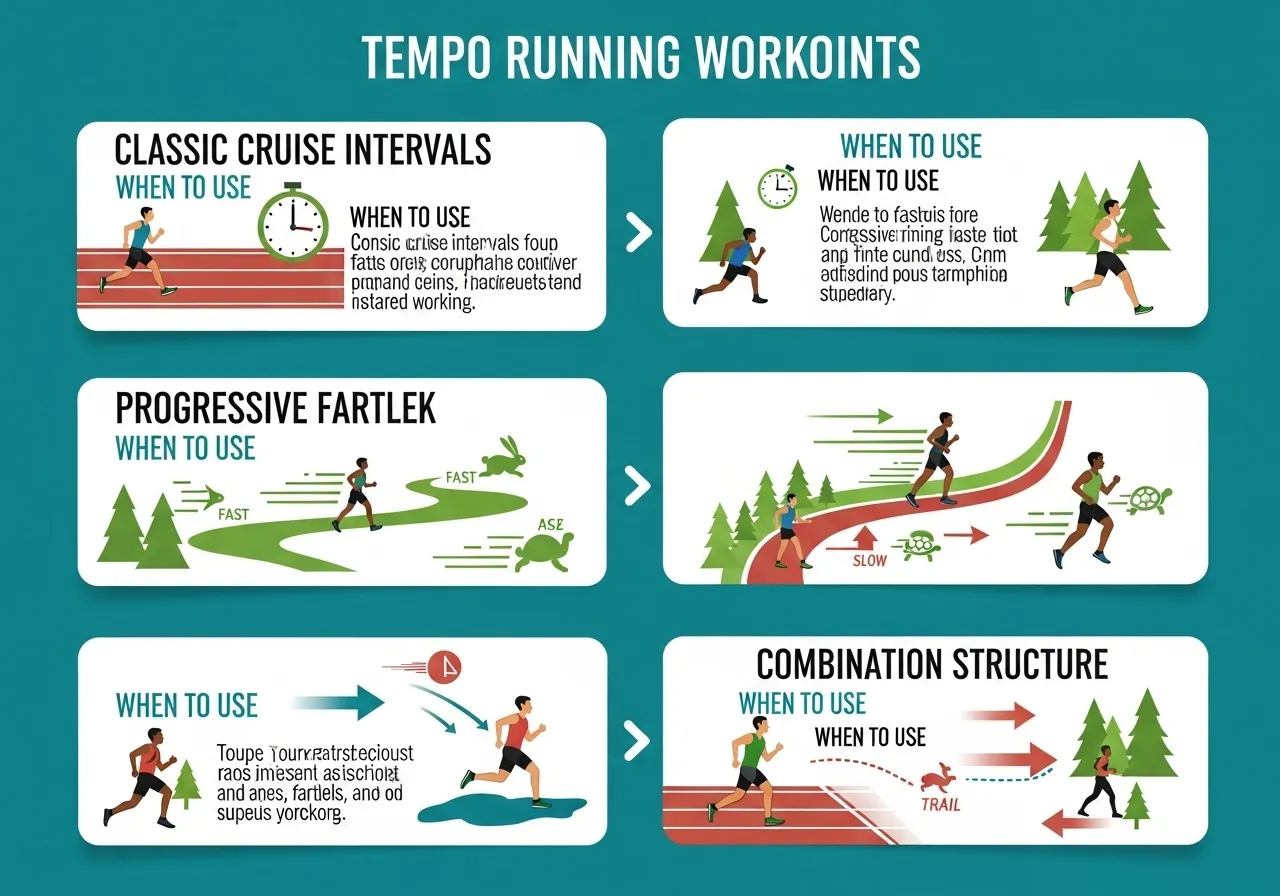
Tempo running is not a single workout type but a family of workouts sharing the threshold intensity zone. The structure of the workout, continuous versus broken, determines the specific stimulus. A 20-minute continuous tempo run and a session of 4 × 5 minutes at tempo pace with 90-second recoveries both target the lactate threshold but produce different physiological emphases. Continuous tempo runs develop the ability to sustain threshold pace for increasing durations. Broken tempo intervals allow more total volume at threshold pace within a session before fatigue compromises pace quality. Both structures are necessary in a complete tempo training programme.
🏃 1. Classic Tempo Run (20 to 40 Minutes Continuous)
Stimulus: Sustained threshold effort, mental durability at discomfort level
How: Warm up 10 to 15 minutes easy. Run continuously at tempo pace for 20 to 40 minutes. Cool down 10 minutes easy. Beginners start at 20 minutes. Progress to 40 minutes over 6 to 8 weeks.
Best for: The foundation tempo workout. Develops the ability to sustain threshold intensity continuously. Use this as the primary tempo structure when starting threshold training and maintain it throughout training.
🏃 2. Cruise Intervals (3 to 5 × 5 to 8 Minutes at Tempo)
Stimulus: Higher total volume at threshold pace, pace accuracy reinforcement
How: Warm up 15 minutes. Perform 3 to 5 repetitions of 5 to 8 minutes at tempo pace with 60 to 90 seconds easy jogging recovery between intervals. Cool down 10 minutes.
Best for: Runners who cannot yet sustain 20+ minutes of continuous tempo. The recoveries allow more total time at tempo pace than continuous running permits at early training stages. Also valuable mid-training cycle when total threshold volume needs to exceed what continuous tempo can provide.
How: Begin the tempo section 10 seconds per km slower than target tempo pace. Increase to target pace at halfway. Finish the final quarter 5 to 10 seconds per km faster than target pace. Total tempo section 20 to 30 minutes.
Best for: Intermediate runners developing race pacing discipline. The progressive structure mirrors the optimal race pacing strategy of even or slightly negative splits and trains the runner to hold back early before finishing strongly.
🏃 4. Tempo-Interval Combination
Stimulus: Both threshold and VO2 max stimulus in one session
How: 20 minutes continuous tempo run, 5 minutes easy jog, then 4 × 1 km at 5 km race pace with 90 seconds recovery. The tempo segment develops threshold; the intervals target VO2 max.
Best for: Advanced runners with a strong aerobic base who need to simultaneously develop both threshold and VO2 max qualities. Not appropriate for beginners or runners early in a training cycle.
🏃 5. Undulating Tempo (Fartlek at Threshold)
Stimulus: Threshold training adapted to terrain, introduces pace variation
How: Run a route with hills. Maintain threshold effort (by heart rate) rather than fixed pace. Pace naturally slows on uphills and increases on downhills while the cardiovascular stimulus remains constant. Duration 20 to 35 minutes at threshold heart rate.
Best for: Trail runners and those training on hilly terrain. Also useful for any runner who finds fixed-pace tempo mentally tedious. The effort-based approach is more forgiving of variable terrain while preserving the threshold stimulus.
How Much Tempo Running Is Enough, and How Does It Compare to HIIT?
The Optimal Tempo Volume: What the Evidence Suggests
For recreational runners, one tempo session per week producing 20 to 40 minutes of threshold-level running provides sufficient lactate threshold stimulus for meaningful improvement. Two tempo sessions per week is appropriate for intermediate and advanced runners with training volumes above 50 km per week. More than two threshold sessions per week without adequate easy running volume creates accumulated fatigue that prevents the adaptation from manifesting, a common error in runners who interpret tempo running’s effectiveness as justification for maximising its frequency.
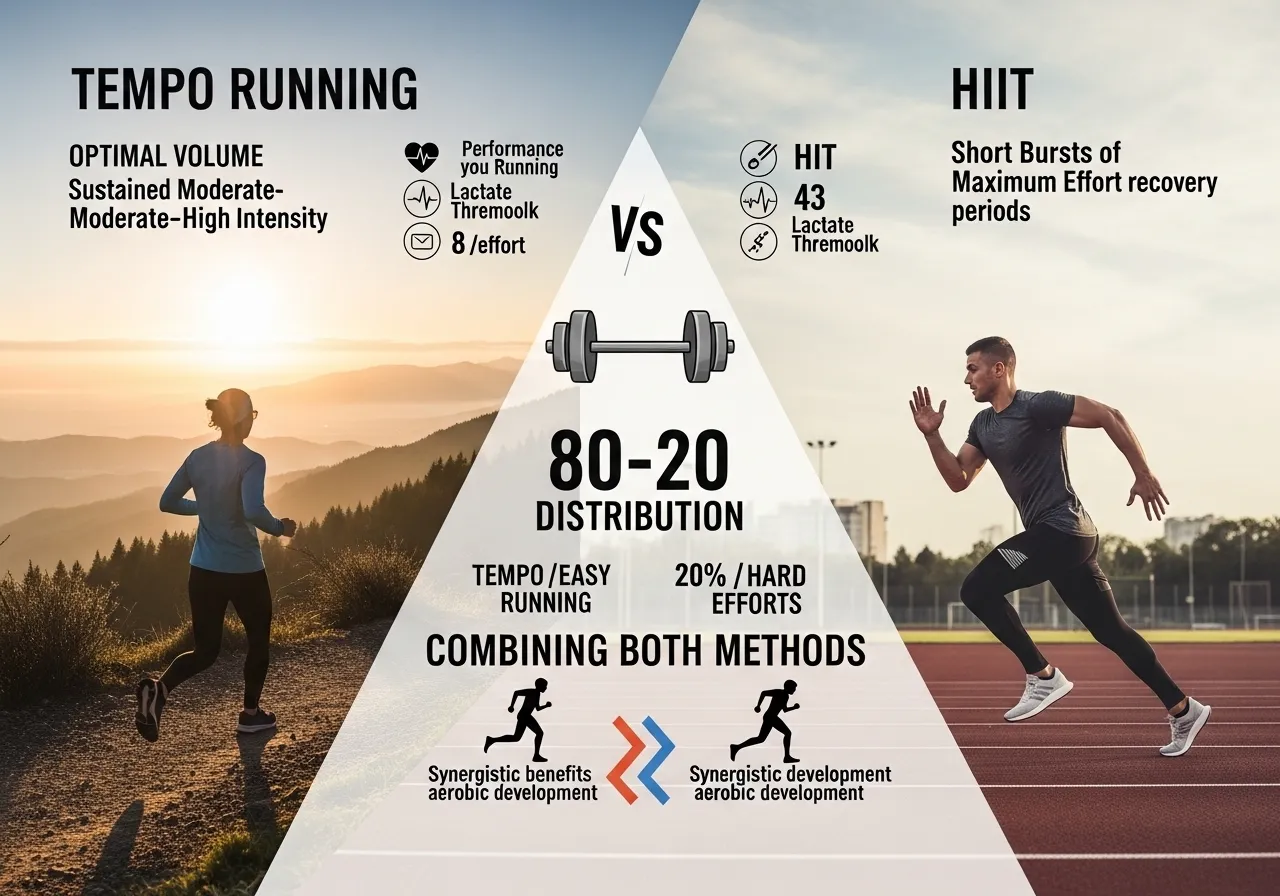
The 80/20 training distribution, where approximately 80% of weekly training volume is performed at easy-to-moderate intensity and 20% at threshold and above, represents the consensus optimal distribution based on studies of elite endurance athletes and recreational runner adaptations. Within this structure, tempo running fills the high-quality 20% alongside, but not instead of, VO2 max interval work.
Tempo Running vs HIIT: Which Produces Greater Aerobic Improvement?
📌 Key Finding
HIIT and moderate-intensity continuous training produce comparable VO2max improvements in trained runners. Tempo running is not inferior to HIIT for aerobic development in trained populations. The choice between them should be based on training context, injury risk, and specific race preparation needs rather than generic effectiveness rankings.
The Case for Combining Both
Elite distance runners do not choose between tempo running and interval training. They use both, typically within a polarised or pyramidal distribution that allocates the majority of training volume to easy running, a meaningful weekly allocation to tempo running, and a smaller allocation to VO2 max intervals. Each intensity serves a distinct adaptation purpose: easy running builds aerobic base volume, tempo running raises the threshold ceiling, and VO2 max intervals develop the peak oxygen uptake that determines the ceiling above which the threshold can rise.
The most common error in recreational runner programming is substituting interval training for tempo running rather than combining them. Sprint intervals and HIIT are time-efficient but do not produce the sustained threshold stimulus that raises lactate threshold pace as effectively as continued threshold-specific work. Using only intervals produces a runner with a high VO2 max and a relatively low threshold, a combination that produces good performance over short distances but degrades over longer efforts. The sprint interval training science and how it complements rather than replaces tempo work is covered in the sprint interval training guide.
Frequently Asked Questions About Tempo Running
How often should I do tempo runs each week?
One tempo run per week is appropriate for most recreational runners training 30 to 50 km per week. This provides sufficient threshold stimulus without accumulating the fatigue that makes subsequent easy runs too taxed to develop aerobic base effectively. The single weekly tempo session should be the priority quality session of the week, not an addition to a week already containing multiple hard efforts.
Two tempo sessions per week is appropriate for experienced runners with weekly volumes above 50 to 60 km who run consistently and accumulate at least 2 years of training history. At this volume and experience level, the aerobic base is robust enough to recover between two threshold sessions while still allowing adequate easy running to fill the aerobic base development role. Adding a second tempo session before building the aerobic base through adequate easy running volume produces diminishing returns because the physiological systems that tempo running is trying to develop are insufficiently primed.
Can I do tempo runs on a treadmill?
Treadmill tempo running is effective and in some respects more precise than outdoor tempo running. The treadmill allows exact pace control, removes wind resistance and terrain variation, and provides objective feedback on whether the prescribed pace is being maintained throughout the session. For runners learning to feel tempo pace for the first time, the treadmill’s pace display provides useful feedback that outdoor running without GPS does not.
The limitation is that treadmill running is biomechanically slightly different from outdoor running, with the moving belt contributing to leg turnover in ways that reduce running economy demands marginally. For training that is race-specific, outdoor tempo running on the actual terrain of upcoming races provides the most direct preparation. For fitness development without race-specific requirements, treadmill tempo running produces equivalent physiological adaptation.
Why do I feel worse at tempo pace in the heat?
Heat significantly reduces the pace at which the lactate threshold occurs because the cardiovascular system must allocate a greater proportion of cardiac output to skin blood flow for thermoregulation, leaving less available for the working muscles at any given pace. At 30 degrees Celsius, the same lactate concentration that occurs at 5:00 per km in cool conditions may occur at 5:20 per km in the heat. This is not a fitness regression. It is a normal physiological response to thermal load.
Training in the heat by pace rather than effort produces overtraining because the runner is working above their threshold pace to maintain the programmed time per kilometre. Training by heart rate or perceived exertion during hot conditions automatically adjusts pace to maintain the appropriate threshold effort regardless of temperature. The natural pace reduction in heat is correct training practice, not an indication that threshold fitness has declined.
How long before I notice tempo running improving my race times?
Measurable lactate threshold improvements typically appear after 4 to 6 weeks of consistent weekly tempo running, with the improvement most visible as the ability to sustain tempo pace for progressively longer durations before perceived exertion increases significantly. Race time improvement follows typically 8 to 12 weeks after beginning a consistent tempo programme, because the physiological adaptation from threshold improvement takes additional weeks to translate into race-pace capability at distances where threshold is the primary performance limiter.
The 10 km to half marathon distance range shows the most pronounced improvement from threshold training because these distances are performed primarily at or near lactate threshold. Shorter distances (5 km and below) respond more to VO2 max and sprint development. Longer distances (marathon and above) respond substantially to easy aerobic volume in addition to threshold work. Tempo running produces its largest relative performance benefit for runners targeting the 10 km to 25 km racing range.
Key Takeaways
Tempo running raises the lactate threshold, the pace at which lactate begins accumulating faster than it clears. Easy running does not sufficiently challenge the MCT protein upregulation and threshold enzyme systems that tempo pace specifically targets.
Individual responses to a fixed threshold pace vary significantly. Use personal pace calibration through the talk test and heart rate monitoring rather than relying on group-prescribed tempo paces or race time calculators alone.
Lactate threshold velocity is determined by 90% from the product of maximal aerobic speed and individual threshold percentage. Tempo training improves threshold performance by raising both the threshold percentage and running economy at threshold intensity.
HIIT and tempo running produce comparable VO2max improvements in trained runners. Combine both rather than substituting one for the other: easy running builds base, tempo raises the threshold ceiling, intervals develop VO2 max peak.
One tempo session per week (20 to 40 minutes) is sufficient for recreational runners training 30 to 50 km per week. Frequency should increase to two sessions only after adequate aerobic base volume supports the recovery demand.
⚠️ Fitness Disclaimer: The information in this article is for general educational purposes only and does not constitute professional fitness or medical advice. Always consult a qualified healthcare professional before starting any new exercise program, especially if you have existing injuries or medical conditions. Why Two Straps Changed What I Thought Training Equipment Needed to…
⚠️ Health & Fitness DisclaimerThis article is for general educational purposes only and does not replace professional medical advice. If you have any lower back, knee, or cardiovascular conditions, please consult a qualified healthcare professional before beginning a rowing machine mastery guide program. The rowing machine training guide machine — or ergometer — produces a…
⚠️ Fitness Disclaimer: The information in this article is for general educational purposes only and does not constitute professional fitness or medical advice. Exercise carries inherent risks. Always consult a qualified healthcare professional or certified personal trainer before starting or modifying any exercise program, especially if you have a pre-existing medical condition, injury, or health…
Breathing through the mouth during exercise is the default for most people. It feels necessary at moderate intensity, instinctive at high intensity, and the idea of restricting breathing to the nose during a training run sounds like an experiment in self-imposed oxygen deprivation. The research tells a more nuanced story. Nasal breathing during exercise activates…
Most recreational athletes choose one form of cardio and repeat it. Runners run. Cyclists cycle. Swimmers swim. This is not a strategic decision. It is the path of least resistance: the familiar equipment, the practised movement, the social group tied to the activity. The repetition accumulates a specific cardiovascular adaptation to one mode of exercise…
person running VO2 max interval training track high intensity cardiovascular aerobic development VO2 max interval training meta-analysis 0.51 L/min improvement continuous vs interval cardiac output mechanism Billat vVO2max protocol 5 minute intervals research minimal velocity VO2max oxygen uptake kinetics logic short vs long VO2 max intervals 90 percent time comparison 3 minute vs 5 minute…