Cross-Training for Cardio: Why Varying Your Aerobic Stimulus Produces Better Fitness Than Repeating One Exercise
Most recreational athletes choose one form of cardio and repeat it. Runners run. Cyclists cycle. Swimmers swim. This is not a strategic decision. It is the path of least resistance: the familiar equipment, the practised movement, the social group tied to the activity.
The repetition accumulates a specific cardiovascular adaptation to one mode of exercise while progressively increasing the risk of the overuse injuries that repetitive loading produces. The runner who logs 50 km per week develops running-specific cardiovascular fitness, running-specific muscular endurance, and running-specific overuse pathology (shin splints, Achilles tendinopathy, plantar fasciitis) at a rate that would not occur if the same cardiovascular volume was distributed across multiple lower-impact activities.
The research evidence on cardiovascular training transfer between modalities is now extensive enough to provide clear guidance: aerobic fitness developed through one mode transfers meaningfully to other modes, the transfer is not perfect but it is sufficient to justify cross-training as a genuine alternative to single-mode volume increases, and the injury protection benefit of distributing load across multiple activities is well-documented across endurance sport populations.
This guide covers the research on cardiovascular transfer between training modalities, the specific benefits cross-training provides at each fitness level, how to structure effective cross-training weeks for different goals, and the most common mistakes that prevent cross-training from producing the fitness outcomes it is capable of delivering.
The Central vs Peripheral Adaptation Distinction
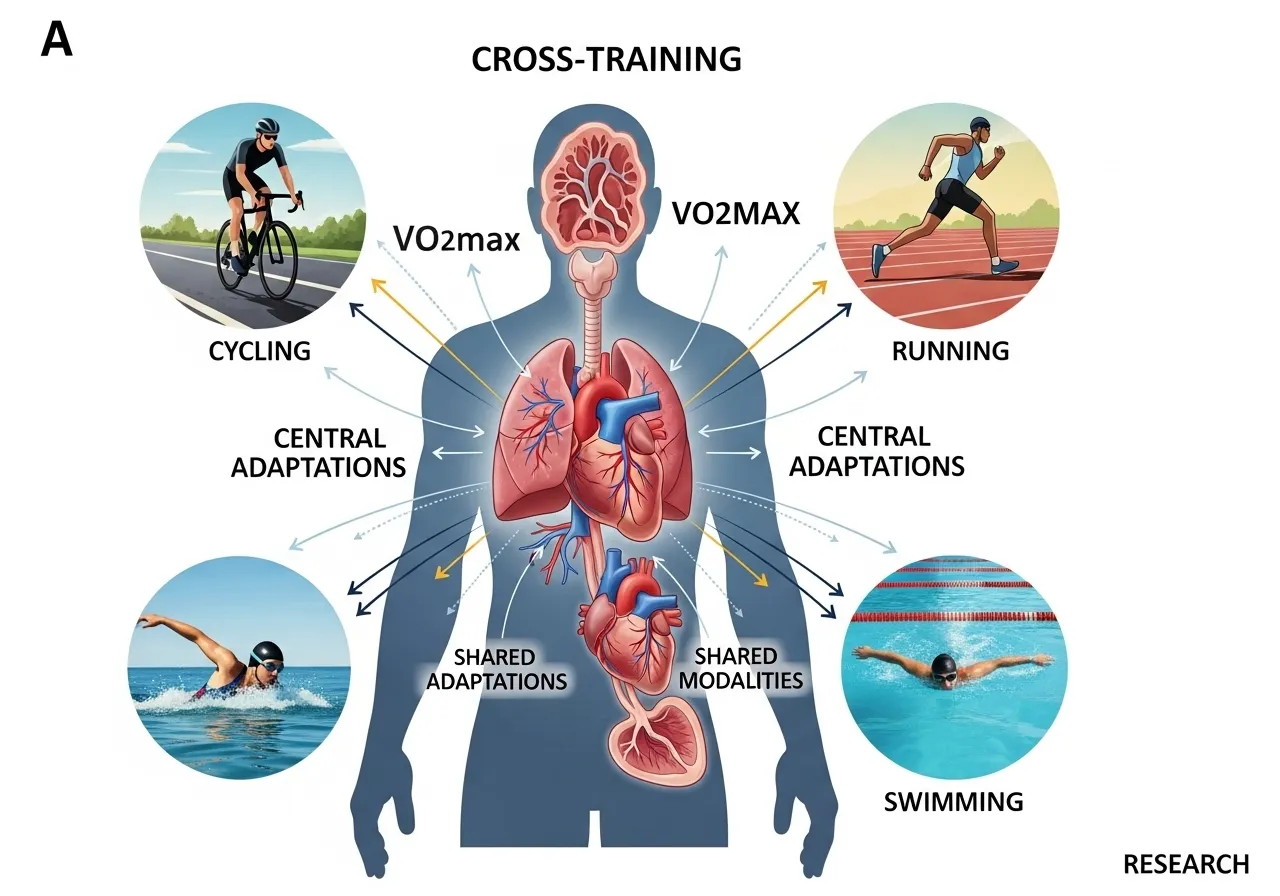
Understanding why cardiovascular fitness transfers between modalities requires distinguishing between central and peripheral adaptations. Central adaptations occur in the heart and blood: increased stroke volume, expanded plasma volume, improved cardiac output at maximal effort. These adaptations benefit all aerobic exercise regardless of the specific movements involved and develop in response to sustained elevated heart rate, not in response to specific movement patterns. A trained heart pumps more blood per beat during cycling, running, and swimming equally.
Peripheral adaptations are more mode-specific: mitochondrial density in specific muscles, capillary density in trained muscle groups, enzyme upregulation in the muscles that perform the primary work of a given activity. A trained runner has more mitochondria and capillaries in the quadriceps and calves than in the upper body. These peripheral adaptations transfer partially but not completely to other modalities. The central adaptations transfer fully. This is why cross-training produces near-complete cardiovascular fitness maintenance despite incomplete mode-specific transfer.
The Research: Does Cardiovascular Fitness Transfer Between Training Modalities?
The Classic Cross-Training Transfer Evidence
A foundational study examining the transfer of VO2max training effects between cycling, running, and swimming found that cross-training is a widely used approach for structuring a training programme to improve competitive performance in a specific sport by training in a variety of sports, with the review finding transfer of training effects on VO2max between cycling, running, and swimming, establishing that aerobic adaptations developed through one cardiovascular modality are not exclusively mode-specific but carry over to other aerobic activities through the shared central cardiovascular adaptations that all aerobic exercise produces.
VO2max improvements transfer between cycling, running, and swimming. Central cardiovascular adaptations, cardiac output, stroke volume, mitochondrial density, are shared across all aerobic modalities and do not need to be developed separately in each exercise mode.
VO2max Response Variability and the Case for Cross-Training
A study investigating cardiovascular and metabolic adaptations among individuals who showed different levels of VO2max responsiveness to exercise training found that healthy sedentary participants who engaged in a six-week exercise training programme showed that responders had greater increases in peak power output, second lactate threshold, and microvascular responsiveness, whereas non-responders had greater increases in cycling efficiency, with no statistical differences observed in body composition, blood pressure, or resting cardiac adaptations between responders and non-responders, confirming that individuals who do not show VO2max improvements to one training stimulus may still achieve meaningful health and performance adaptations through that training.
Non-responders to VO2max improvement still gain efficiency improvements from aerobic training. Varying the training modality changes which aspects of cardiovascular fitness develop, which means cross-training provides adaptive variety that single-modality training cannot match for trainees who plateau in one measure while progressing in others.
Training Intensity and VO2max: What the Evidence Synthesis Shows
An overview of systematic reviews and meta-analyses examining exercise training intensity effects on VO2max in healthy adults found that all eleven reviews examined were of moderate to very strong methodological quality and collectively confirmed that both lower intensity training and high intensity training improve VO2max in healthy adults, with higher intensity training producing greater relative improvements, while the review framework confirmed that the absolute VO2max gains from any training programme depend on initial fitness level, training volume, intensity, and duration rather than on the specific exercise modality used.
VO2max gains depend on intensity, volume, and duration rather than on the specific exercise modality. Cycling intervals, running intervals, and rowing intervals produce equivalent VO2max stimulus at matched intensities, confirming that cross-training at appropriate intensity is interchangeable with single-mode training for aerobic development.
Beginner Level: Why Cross-Training Is the Optimal Starting Framework
The Beginner Overuse Risk
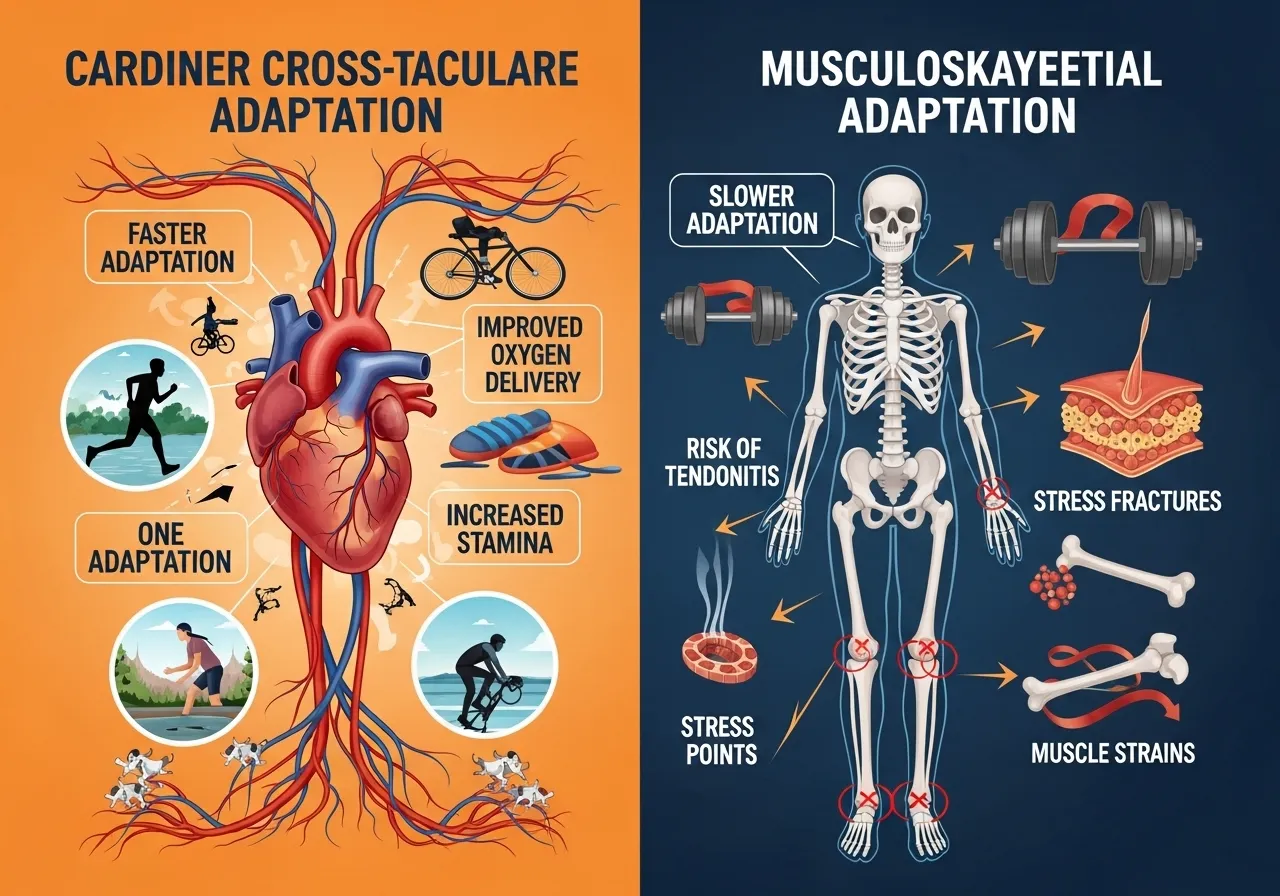
Beginners who start running five days per week to improve cardiovascular fitness are attempting to build aerobic capacity and musculoskeletal tolerance simultaneously on a structure that has neither. The cardiovascular system adapts within two to four weeks. The tendons, bones, and connective tissue that absorb running impact require three to six months of progressive loading before they tolerate high-frequency repetition without injury.
This mismatch is why beginner runners frequently progress to 30 to 40 minutes of continuous running within six weeks and then develop shin splints, Achilles pain, or knee pain at exactly the point where their cardiovascular fitness would support continuing. The cardiovascular system is ready. The musculoskeletal system is not. Cross-training solves this by allowing the cardiovascular system to develop at its preferred faster rate across multiple lower-impact modalities while running-specific tissue loading increases gradually within a smaller weekly running volume.
Why Single-Modality Beginners Plateau Faster
Beginners who train exclusively in one cardiovascular modality also develop a narrow motor pattern adaptation that limits their overall fitness development. Each cardiovascular mode, running, cycling, swimming, and rowing, places distinctly different mechanical demands on the body’s movement systems and develops distinct peripheral muscular adaptations alongside the shared central cardiovascular changes. A runner develops the specific neuromuscular efficiency of running gait but does not develop the paddling mechanics of swimming, the circular pedal stroke of cycling, or the coordinated push-pull of rowing. Each of these mechanical patterns requires its own adaptation period independent of cardiovascular capacity. Training multiple modalities from the beginning builds a broader foundation of movement competency alongside cardiovascular capacity, and this combination produces more resilient and adaptable fitness than a single modality alone. A beginning runner develops running economy, the metabolic efficiency specific to running mechanics, but not the paddle mechanics efficiency of swimming or the circular pedalling efficiency of cycling. Each of these mechanical skills requires its own adaptation period. Training multiple modalities from the beginning builds a broader movement competency base that makes subsequent skill development in any modality faster because the underlying cardiovascular engine is already larger.
The practical evidence for this: triathlon beginners who come from other endurance sports tend to develop triathlon-specific fitness faster than complete novices despite the triple technical demand, because they arrive with cardiovascular capacity that can be applied across three modes simultaneously. The training focus for these athletes is technical skill in the new modalities rather than cardiovascular base building, which is already present from their prior single-sport training. The broader the initial cardiovascular base, the faster the sport-specific technical skill investment converts into actual competitive performance in a new modality, because fitness is not the bottleneck.
The Optimal Beginner Cross-Training Structure
For beginners targeting cardiovascular fitness improvement with injury protection:
- Running: 2 sessions per week, 20 to 30 minutes at conversational pace
- Cycling (stationary or outdoor): 2 sessions per week, 30 to 45 minutes at low-to-moderate intensity
- Swimming or rowing: 1 session per week, 20 to 30 minutes
This structure provides five cardiovascular sessions per week with only two running sessions, developing broad aerobic fitness while limiting the cumulative running impact that produces overuse injury in beginners. The cardiovascular development from the non-running sessions transfers to running fitness through the shared central adaptations that all aerobic training produces. The Zone 2 training framework that underpins this approach for beginners is covered in the Zone 2 training guide.

Intermediate Level: Cross-Training as Deliberate Volume Management
The Plateau and the Volume Ceiling
Intermediate trainees who have trained consistently for 6 to 18 months in a single modality often reach a cardiovascular fitness plateau that does not respond to simply adding more volume. Adding more running sessions when running is already the primary training stimulus produces diminishing returns because the same adaptive pathway is being stimulated repeatedly without novel input.
Cross-training at the intermediate level provides two distinct benefits. First, it introduces a novel stimulus through the slightly different muscle recruitment patterns, respiratory demands, and movement mechanics of a different modality that can restart adaptation through pathways the primary modality does not engage. Second, it allows total cardiovascular training volume to increase beyond what a single modality could safely sustain, because the injury accumulation rate of any single activity is load-dependent and distributing volume across modalities distributes the tissue stress.
Strategic Modality Selection for Intermediates
The most productive cross-training additions for intermediate trainees address the specific gaps in their primary modality:
- Runners: Add cycling for additional aerobic volume without running impact. Add swimming for upper body cardiovascular demand that running completely neglects.
- Cyclists: Add running for weight-bearing bone loading and high-cadence neuromuscular demand. Add rowing for upper body and posterior chain cardiovascular load.
- Strength athletes: Add rowing or cycling to develop aerobic base without leg fatigue that impairs squatting and deadlifting recovery. The HIIT and moderate cardio frameworks for strength athletes are covered in the HIIT training guide.
How to Identify When Single-Modality Training Has Peaked
Three signals indicate a single-modality training plateau that cross-training can address. First, VO2 max measures or time-trial performance has not improved over 6 to 8 weeks despite maintained training volume and intensity. Second, resting heart rate trends upward or sleep quality degrades despite no increase in training load, suggesting accumulated fatigue from repetitive stimulus without adequate recovery. Third, minor overuse symptoms in the primary sport, such as persistent lower leg tightness in runners or chronic knee discomfort in cyclists, suggest the musculoskeletal system is approaching its loading limit even when cardiovascular capacity would support higher volume.
When two or more of these signals appear simultaneously, adding a second cardiovascular modality often produces faster fitness progress than continuing to add volume or intensity to the primary sport. The second modality provides recovery for the overtaxed primary-sport musculoskeletal structures while maintaining cardiovascular stimulus through a different movement pattern.
The Weekly Volume Distribution Principle
For intermediates managing total weekly cardiovascular volume, the distribution principle is straightforward: no single modality should comprise more than 60 to 70% of total weekly cardiovascular training minutes for general fitness trainees. Allowing one modality to dominate progressively recreates the overuse risk and diminishing return pattern that cross-training is meant to prevent. The target is genuine multi-modal training, not a primary sport with a token alternative added.
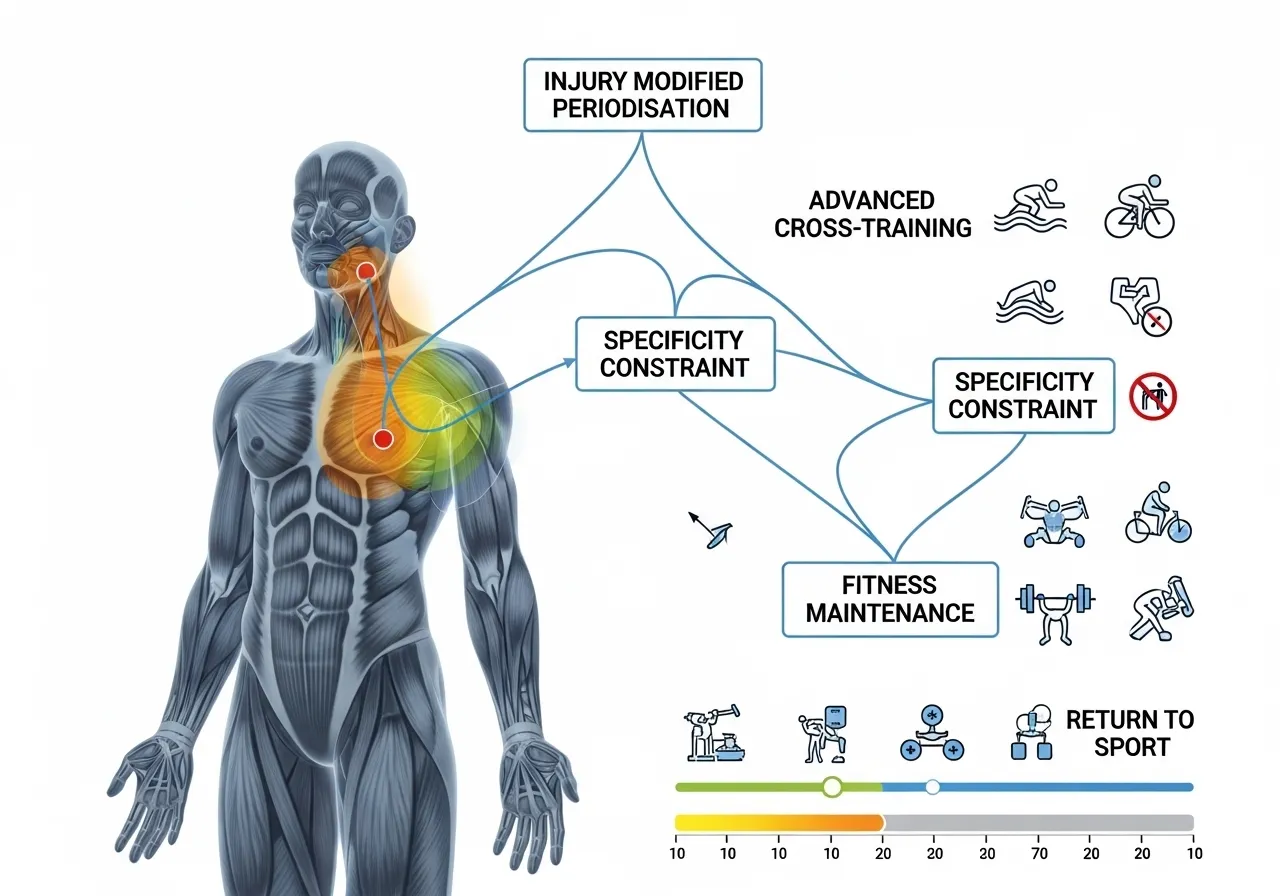
Advanced Level: Cross-Training as Periodisation and Injury Management
Maintaining Fitness Through Injury
For experienced athletes, the most immediately valuable application of cross-training knowledge is injury-modified training. When a running injury prevents weight-bearing cardiovascular training, pool running, cycling, and rowing allow near-complete cardiovascular fitness maintenance at intensities matched to the athlete’s usual training zones. The cardiovascular fitness developed through years of running does not dissipate in two to four weeks of non-running cross-training the way single-modality detraining would suggest, because the central adaptations (cardiac output, stroke volume) are preserved through any sufficiently intense aerobic stimulus regardless of mode.
An experienced runner with four weeks of injury-forced pool running and cycling maintains approximately 90 to 95% of aerobic fitness compared to continued running, enough to return to near-previous performance within two to three weeks of resumed running training once the injury resolves. Trainees who understand this maintain training intensity and structure during injury periods rather than ceasing all cardiovascular work, producing dramatically better return-to-sport outcomes.
Cross-Training for Periodisation Blocks
Advanced endurance athletes use cross-training deliberately within annual periodisation plans to achieve specific adaptations without accumulating the cumulative fatigue of year-round high-volume single-sport training. A competitive runner who replaces 30% of weekly running volume with cycling during a base-building phase accumulates lower total impact loading while maintaining aerobic volume, allowing the running musculoskeletal system to recover from previous competition loading while aerobic fitness continues developing.
This approach is standard in elite triathlon training, where the three-sport structure is treated as a periodisation tool rather than just a race format. Athletes train the sports that provide the most recovery value in each training block, not the sport closest to the next competition event. Recreational athletes can apply the same principle by identifying which cardiovascular modality places least stress on their most fatigued tissue in each training phase.
Cross-Training During Deload and Recovery Weeks
Advanced athletes who use structured periodisation, alternating loading and deload weeks, can use cross-training to maintain cardiovascular stimulus during deload periods without adding to primary-sport tissue fatigue. A runner’s deload week typically involves 30 to 40% reduction in running volume. Replacing part of that reduction with cycling or swimming maintains cardiovascular training stimulus while giving running-specific tissues the reduced load they need to supercompensate from the preceding training block.
This approach produces better fitness outcomes than simply reducing all training during deload periods because it decouples cardiovascular stimulus from tissue loading. The cardiovascular system does not need recovery from the same stressors that the running musculoskeletal system does. A deload that reduces running load while maintaining cardiovascular stimulus through alternative modalities allows the body to recover in the dimension that needs recovery without losing the dimension that does not need recovery.
The Specificity Constraint
Cross-training at the advanced level must account for the specificity principle: performance in a specific sport or event requires training in that specific sport or event as the competition approaches. An advanced runner who has spent 12 weeks building aerobic base primarily through cycling needs four to six weeks of predominantly running-specific training before a running race to convert the aerobic base into running-specific neuromuscular and musculoskeletal performance. Cross-training develops the engine. Specificity training optimises the transmission between that engine and the specific performance.
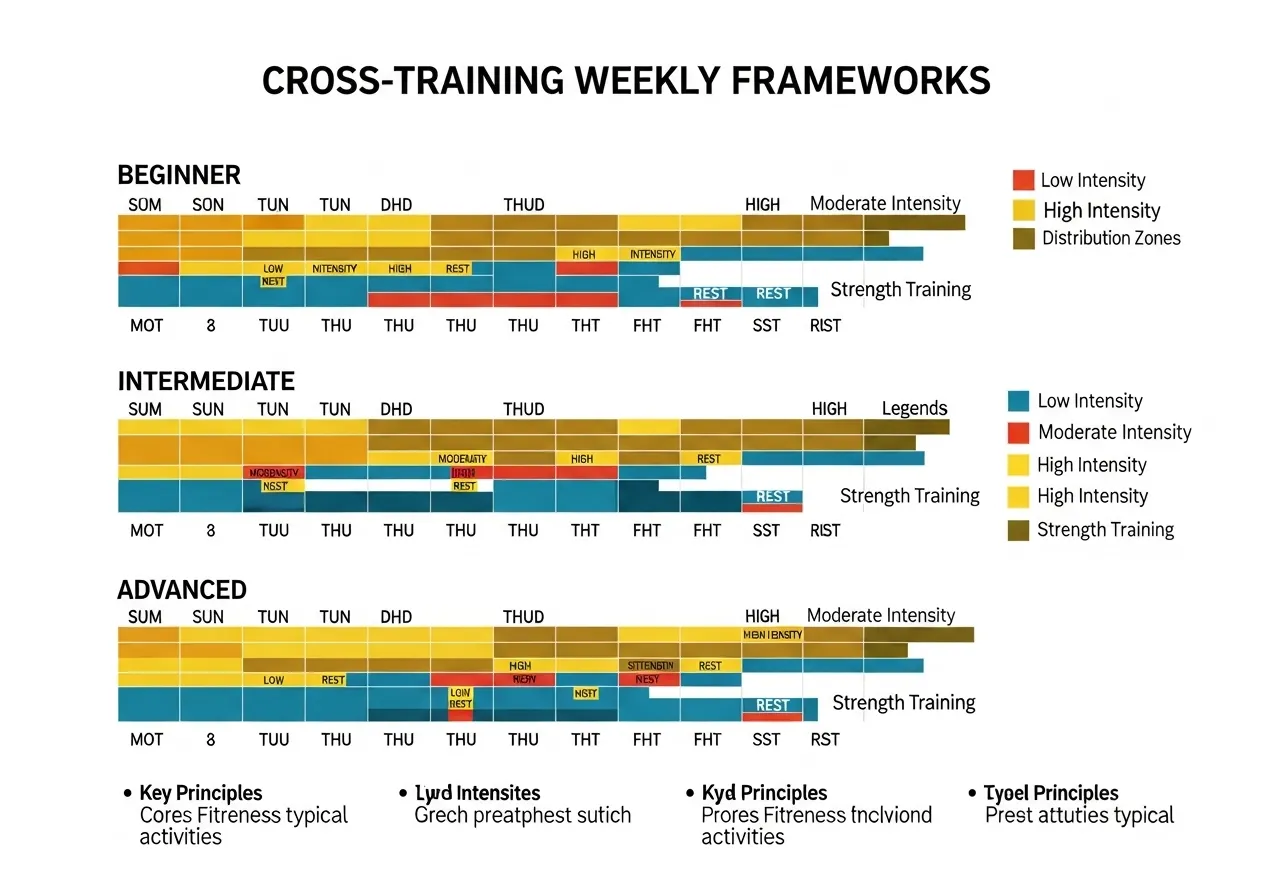
How to Structure a Cross-Training Week: Practical Frameworks by Goal
Framework 1: General Fitness (3 to 4 Sessions per Week)
Wednesday: Running or walking, 30 minutes moderate pace
Friday: Swimming or elliptical, 30 minutes moderate
Saturday: One longer session of any modality, 45 to 60 minutes
Goal: Broad cardiovascular development with minimal single-activity overuse risk
Framework 2: Runner Adding Cross-Training (5 Sessions per Week)
Tuesday: Cycling, 45 minutes Zone 2
Thursday: Quality run session (intervals or tempo), 40 minutes
Friday: Swimming or pool running, 30 minutes
Sunday: Long run, 60 to 90 minutes
Goal: Increased aerobic volume without proportional increase in running load
Framework 3: Strength Athlete Adding Cardio (2 to 3 Sessions per Week)
Thursday: Rowing, 25 to 30 minutes moderate intensity
Saturday: Walking or light cycling, 30 to 45 minutes active recovery
Goal: Aerobic base development without impeding lower body strength training recovery. The walking foundation for this approach is covered in the walking guide.
The Common Cross-Training Error: Too Easy on Alternative Days
The most frequent mistake in cross-training programmes is treating alternative-modality sessions as light recovery work regardless of where they fall in the training week’s intensity structure. A runner who runs at 80% of maximum heart rate for quality sessions but only cycles at 60% on cross-training days is effectively reducing total training quality below what single-modality training would provide at equivalent volume.
The alternative modality sessions should follow the same zone-based intensity prescription as primary-modality sessions. Quality days are quality days across all modalities. Easy days are easy days. Performing Zone 2 cycling on a quality day because the intensity feels manageable on the bike defeats the purpose of the zone structure entirely. The lower perceived exertion of an unfamiliar modality at a given heart rate reflects lower neuromuscular efficiency in that movement, not lower cardiovascular demand. The cardiovascular stimulus is equivalent. The lower perceived exertion of an alternative modality at equivalent heart rate is a benefit of lower mechanical stress, not a reason to reduce cardiovascular intensity below the prescribed zone.
Intensity Distribution Across Modalities
The same intensity principles that apply to single-mode training apply to cross-training programmes. Zone 2 constitutes 70 to 80% of total weekly cardiovascular volume. High-intensity work (Zone 4 to 5) constitutes 10 to 20% of volume. The distribution remains consistent regardless of which modalities fill each zone. A common error is performing cross-training sessions at lower intensities than the primary modality, effectively diluting the training stimulus. The cycling session on recovery days should be Zone 2. The rowing session on quality days should reach Zone 4. The same zone-based structure that applies to running applies directly to all cross-training modalities.
Frequently Asked Questions About Cardiovascular Cross-Training
Does cross-training reduce sport-specific performance compared to single-modality training?
For general fitness trainees, the answer is effectively no. The cardiovascular adaptations that produce fitness improvements transfer broadly enough across modalities that the overall fitness outcome of well-structured cross-training matches or exceeds single-modality training at the same total volume.
For competitive sport athletes, there is a specificity cost at high performance levels. An elite marathon runner who replaces 30% of running volume with cycling will show slightly lower running-specific economy and neuromuscular efficiency than if all volume was running, even if VO2 max is equivalent. This specificity cost is small enough to be outweighed by the injury-prevention benefit for most recreational competitors, but it becomes relevant for athletes pursuing podium-level performance in a specific event.
Is swimming a good substitute for running when injured?
Swimming is one of the most effective cardiovascular cross-training options for injured runners because it provides full upper and lower body aerobic stimulus at zero weight-bearing load. VO2 max maintenance during a running injury is excellent with swimming at matched intensity, and the non-impact nature of the activity prevents exacerbation of most lower limb overuse injuries.
The limitation is that swimming technique requires investment of time and attention that other cross-training modalities do not. A runner who cannot swim efficiently will find pool swimming a frustrating training experience because the technical limitation caps the cardiovascular intensity below what their aerobic fitness would support. Pool running (deep-water running with a flotation belt) is a more accessible alternative for injured runners that provides closer approximation of running mechanics without the technique requirement of competitive swimming strokes.
Which cross-training modality produces the best VO2max transfer to running?
Cycling produces the most effective cardiovascular cross-training stimulus for runners because it loads the same primary muscle groups (quadriceps, hamstrings, glutes) through a non-impact movement pattern. The metabolic demand on the lower body musculature during cycling closely approximates running demand, making the transfer of cardiovascular and muscular endurance adaptations more direct than swimming or upper-body-dominant alternatives.
Pool running is the single most specific alternative for injured runners because it replicates running mechanics in a zero-impact environment. The cardiovascular and neuromuscular patterns are nearly identical to land running, producing the most complete cardiovascular and movement-pattern preservation of any cross-training option. The limitation is accessibility and the technical awkwardness of deep-water running that requires a flotation belt and an appropriately deep pool.
For general cardiovascular fitness development rather than injury-modified running specifically, rowing provides the broadest muscle group involvement of any cardiovascular machine, engaging legs, posterior chain, and upper body simultaneously at intensities that challenge the cardiovascular system at least as effectively as running at matched heart rates.
How quickly does cross-training fitness transfer back to the primary sport?
The return timeline depends on the duration of cross-training and the athlete’s experience level. Experienced athletes who have maintained cardiovascular fitness through cross-training for four to eight weeks typically return to near-previous single-sport performance within two to three weeks of resumed sport-specific training. The aerobic base is preserved. The sport-specific neuromuscular and musculoskeletal patterns require brief reactivation.
Beginners who cross-train for six to eight weeks before beginning their primary sport often experience a better initial sport-specific performance than beginners who started the primary sport directly, because the cross-training aerobic base provides a fitness foundation that reduces early-session fatigue and allows faster technical skill development once sport-specific training begins.
- VO2max improvements transfer between cycling, running, and swimming through the central cardiovascular adaptations shared by all aerobic exercise modalities.
- VO2max gains depend on training intensity, volume, and duration rather than the specific exercise modality. Cycling, running, and rowing intervals at equivalent intensities produce equivalent aerobic stimulus.
- Beginners benefit most from cross-training because it allows the cardiovascular system to develop at its faster adaptation rate while musculoskeletal loading from any single activity increases gradually.
- For injury-modified training, experienced athletes maintain 90 to 95% of aerobic fitness through alternative modality training, enabling near-complete performance recovery within two to three weeks of resumed primary sport training.
- No single modality should comprise more than 60 to 70% of total weekly cardiovascular training volume for general fitness trainees pursuing broad aerobic development. Genuine multi-modal training distributes load and adaptive stimulus across multiple systems.