Polarised Training Guide: The 80/20 Research That Explains Why Moderate-Intensity Cardio Is Holding You Back
Most recreational endurance athletes train in the middle. They run or cycle at a pace that feels like a meaningful workout: harder than a casual stroll, not so hard that it becomes a genuine interval session. This moderate intensity zone, roughly 75 to 85% of maximum heart rate, feels productive. It creates obvious cardiovascular stress. It produces perspiration and elevated breathing that confirm something is happening.
The research on elite endurance athletes consistently shows they do not train in the middle. Studies of world-class runners, cyclists, rowers, and cross-country skiers repeatedly find the same intensity distribution: approximately 75 to 80% of total training volume at low intensity (below the first lactate threshold, conversational pace), 5% or less at moderate intensity (threshold zone), and 15 to 20% at high intensity (above the second ventilatory threshold, interval pace). The middle zone is largely avoided.
This is the polarised training model. It appears counterintuitive: if high-intensity work produces the best cardiovascular adaptations, why do elite athletes spend 80% of their training at genuinely easy pace? This guide explains the physiological basis for polarised training, what the meta-analysis evidence shows about its effectiveness compared to threshold and moderate-intensity approaches, why the moderate zone specifically undermines rather than develops endurance fitness, how to build a polarised training week, and how recreational athletes should adapt the model to their training context.
Why Most People Train in the Wrong Zone: The Moderate Intensity Trap
The Subjective Appeal of Moderate Intensity
Moderate intensity training feels like the appropriate effort for a training session. It is uncomfortable enough to seem like real exercise, fast enough to cover meaningful distance, and produces visible physiological signs that confirm cardiovascular demand. It is also exactly where the bodies of untrained or moderately trained individuals are pushed by any attempt to run or cycle faster than a slow walk. The natural pace for recreational athletes with modest aerobic fitness falls squarely in the moderate intensity zone.
This creates a self-reinforcing pattern: training at the pace that feels like adequate effort produces moderate-intensity training as the default, regardless of the physiological consequences. The consequences, according to the research on intensity distribution, are suboptimal development in both the low-intensity aerobic base and the high-intensity cardiovascular ceiling that polarised training develops in parallel.
The Physiological Problem With the Middle Zone
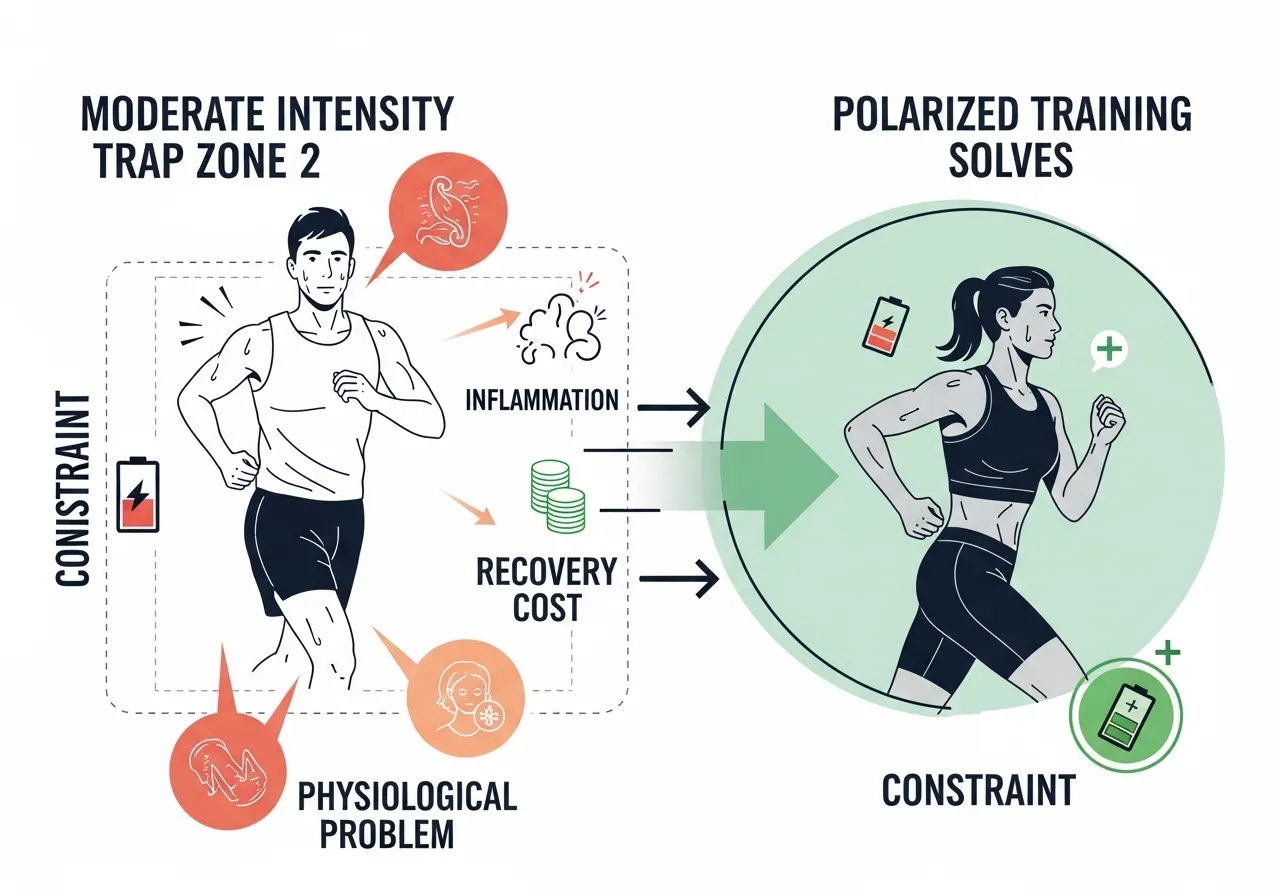
Moderate intensity training, performed at the lactate threshold or slightly above, produces significant lactate accumulation and metabolic stress without the high-intensity stimulus that drives VO2 max improvement, and without the low-intensity volume that drives mitochondrial density and fat oxidation development. It is simultaneously too hard to allow high volume without excessive fatigue accumulation, and not hard enough to provide the cardiovascular ceiling-raising stimulus that genuine high-intensity intervals produce.
The consequence is that athletes who consistently train in the moderate zone develop a training ceiling that prevents progression in either direction. They are too fatigued from the metabolic cost of moderate intensity sessions to increase volume and develop the aerobic base that low-intensity training builds, and they do not include enough genuine high-intensity work to drive VO2 max improvements. The plateau that follows is not a failure of effort but a consequence of training in the physiological zone that produces the worst return on training investment for endurance development.
Why Low Intensity Does Not Feel Like a Real Workout
The primary barrier to implementing polarised training for recreational athletes is the subjective experience of low-intensity exercise. Running or cycling at genuinely low intensity, below the first lactate threshold, feels too easy to constitute productive training. It does not create the cardiovascular stress that feels like exercise is happening. For most recreational athletes, the pace required to stay below the first lactate threshold is slower than they have ever run for fitness purposes, and maintaining it requires restraining natural pace increases that the body moves toward automatically.
The metabolic reality is that low-intensity exercise at sufficient volume drives the mitochondrial density, capillary proliferation, and fat oxidation capacity that underpins all endurance performance regardless of the exercise’s subjective difficulty. The Zone 2 science and how to determine the correct low-intensity training pace is covered in the Zone 2 training guide.
The Threshold Training Alternative and Its Limitations
Threshold training, performing sustained efforts at or near the lactate threshold, is the most common alternative to polarised training in recreational programming. It directly develops lactate threshold pace, which is the primary performance limiter for middle-distance and endurance events. It is physiologically rational and produces measurable improvement.
The limitation is recovery cost. Threshold training is metabolically expensive, requiring 48 to 72 hours of recovery before subsequent high-quality sessions. This recovery demand limits the total high-quality training that can be performed weekly. Elite athletes using threshold training as their primary intensity experience slower progression than those using polarised approaches because the threshold training volume that produces the best direct threshold adaptation simultaneously prevents the high-intensity VO2 max stimulus from being applied at adequate frequency.
How Polarised Training Solves the Recovery Problem
Polarised training solves the recovery constraint through its strict intensity separation. The low-intensity sessions that comprise 80% of volume are genuinely non-stressful metabolically. They drive aerobic base adaptations without accumulating the lactate and neural fatigue that moderate-intensity sessions produce. This means recovery between low-intensity sessions is rapid, allowing high-intensity sessions to be performed frequently on a well-recovered system. The high-intensity 20% delivers the VO2 max stimulus at full quality because the preceding training load is predominantly easy rather than moderately taxing.
Research 1: The Meta-Analysis on Polarised Training vs Other Intensity Distributions
The Systematic Review Evidence
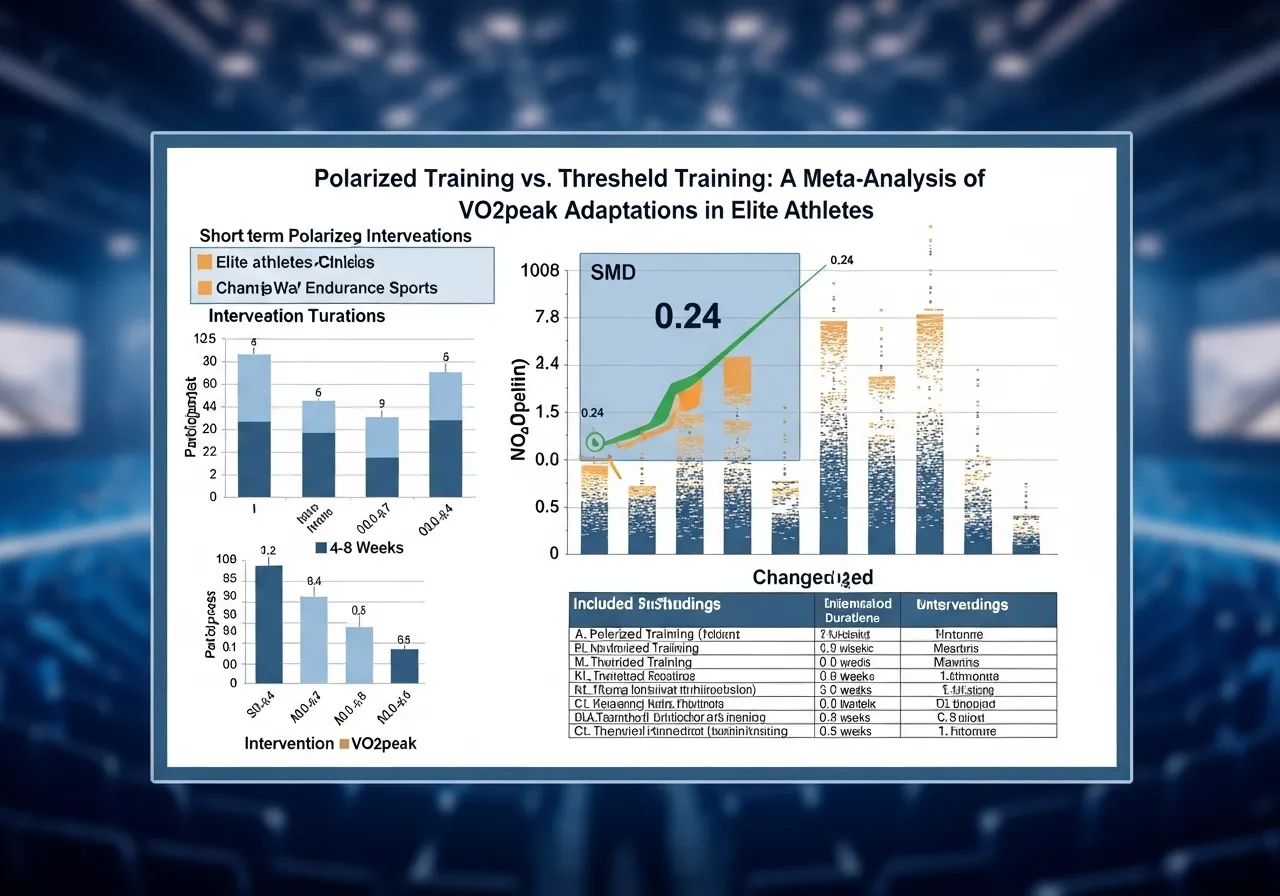
A systematic review and meta-analysis comparing polarised versus other types of endurance training intensity distribution on athletes’ endurance performance found that pooled effect estimates suggest polarised training superiority for improving VO2peak with a standardised mean difference of 0.24 with a 95% confidence interval of 0.01 to 0.48 across 11 studies and 284 subjects with no statistical heterogeneity and high certainty of evidence, and that polarised superiority occurred specifically in shorter interventions of less than 12 weeks with an SMD of 0.40 and for highly trained athletes, while less trained populations showed smaller differences between polarised and other training intensity distributions suggesting that polarised training advantages are most pronounced in individuals whose aerobic base is already developed.
Polarised training produces SMD = 0.24 greater VO2peak improvement than other intensity distributions with high certainty of evidence. The advantage is most pronounced in highly trained athletes over shorter blocks (SMD = 0.40 in under 12-week interventions), confirming polarised training as the superior approach for trained individuals seeking performance gains.
Polarised Training Effects on VO2max and Work Economy
A systematic review examining polarised training effects on VO2max and work economy among endurance athletes found that a training intensity distribution involving a moderate to high volume of high-intensity training at 15 to 20 percent combined with a substantial volume of low-intensity training at 75 to 80 percent appears to be the most beneficial for improvements in VO2max, VO2peak, and work economy over short-term periods, with the review concluding that polarised training could stimulate great performance-related effects after a 10-week intervention period and that a distribution of approximately 73 percent low-intensity and 14 percent high-intensity training significantly improved 10 km running performance among recreational athletes.
The optimal polarised distribution is 75 to 80% low intensity and 15 to 20% high intensity. A 73/14 distribution significantly improved 10 km running performance in recreational athletes over 10 weeks, confirming polarised training applicability beyond elite populations.
The Direct Comparison: Polarised vs Threshold vs High-Volume Low-Intensity
A randomised controlled trial directly comparing polarised, threshold, high-volume low-intensity, and high-intensity training distributions in well-trained endurance athletes found that polarised training produced superior improvements across multiple performance metrics compared to threshold training when training volume and duration were matched, with the polarised approach demonstrating better outcomes for time trial performance, VO2max, and power at the second ventilatory threshold, while high-volume low-intensity training alone produced smaller improvements than both polarised and threshold approaches, confirming that neither pure high volume nor pure threshold training replicates the combined stimulus of the polarised model.
In direct RCT comparison, polarised training outperforms threshold training, high-intensity training, and high-volume low-intensity training when matched for total volume. Neither extreme alone (all-easy or all-hard) matches the combined dual-stimulus of the polarised model.
Polarised vs Pyramidal: The Related Debate
Pyramidal training is a closely related intensity distribution where most volume is low intensity, with decreasing proportions of moderate and high intensity work: approximately 70% low, 20% moderate, 10% high. It differs from polarised training primarily in including a moderate-intensity tier rather than minimising the middle zone. The research comparison between polarised and pyramidal training is less definitive than the polarised versus threshold comparison, with some studies showing equal outcomes and others favouring polarised.
The practical implication is that pyramidal training may be a more accessible first step toward polarised training for recreational athletes who currently train primarily in the moderate zone. Reducing moderate-intensity training to 20% while adding low-intensity volume represents a less dramatic initial restructuring than the full polarised model’s near-elimination of moderate work. For most recreational athletes making the transition from moderate-dominant training, the pyramidal model produces meaningful improvement and provides the experiential foundation for adopting stricter polarised intensity discipline.
Elite Training Observations: What Champions Actually Do
The observational data on elite endurance athletes consistently shows polarised intensity distribution across multiple sports. Cross-country skiers, Olympic rowers, competitive runners, and elite cyclists studied retrospectively and prospectively all show approximately 75 to 80% of training volume at low intensity with 15 to 20% at high intensity and minimal moderate-intensity work. This consistency across sports, coaching systems, and athletic backgrounds provides strong external validity for the experimental evidence from controlled studies.
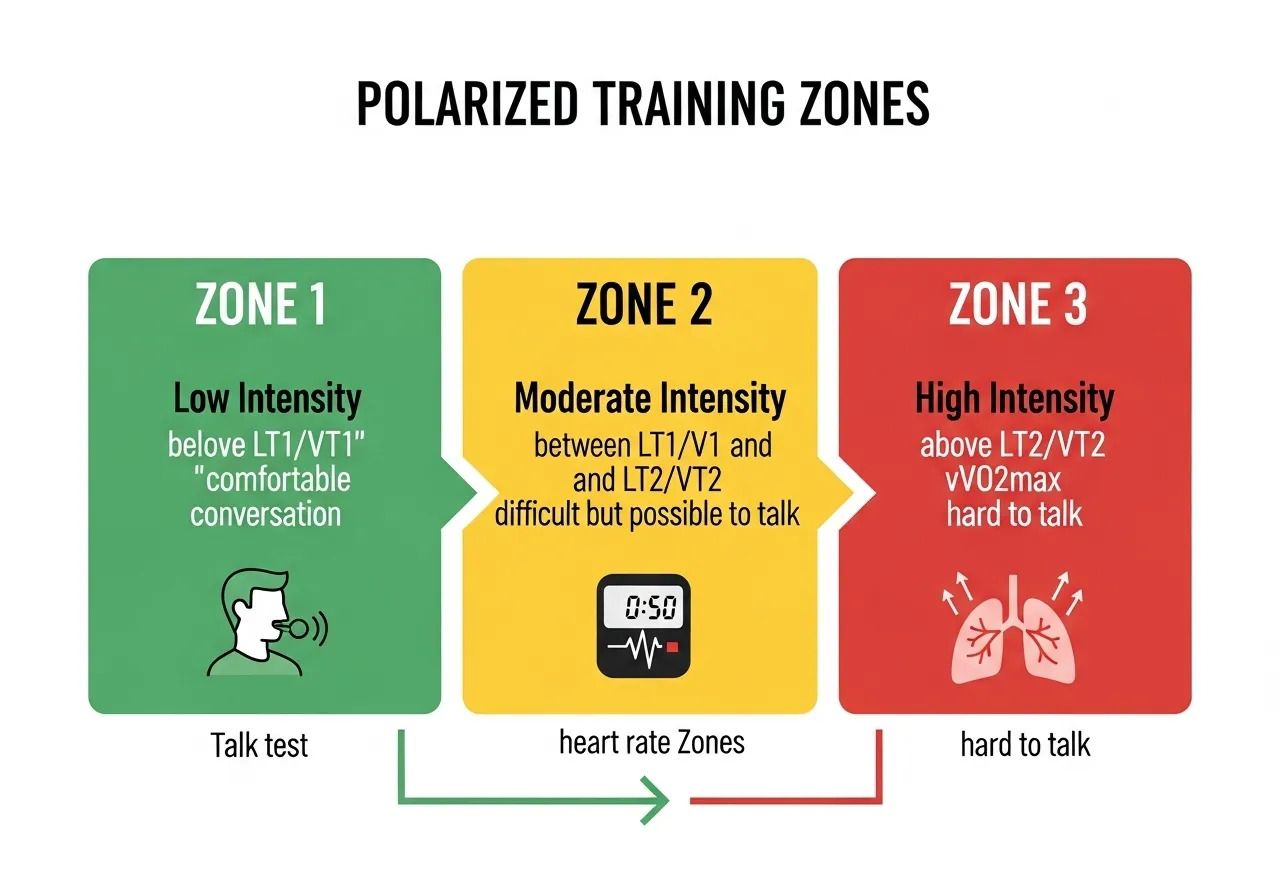
How to Define the Three Zones for Polarised Training
Why Zone Definition Is the Critical First Step
Polarised training depends entirely on accurate zone definition. Training that the athlete believes is low intensity but is actually moderate intensity because the zone boundaries are incorrectly set produces none of the polarised model’s benefits. The most common error in self-directed polarised training is setting the low-intensity zone too high, so that sessions intended as Zone 1 easy runs are actually being performed at threshold intensity. The result is a moderate-intensity dominant programme with a polarised label.
The Three-Zone Model Used in Polarised Training Research
Polarised training research uses a three-zone model based on physiological thresholds rather than simple heart rate percentages. Zone 1 is below the first lactate threshold (LT1) or first ventilatory threshold (VT1): the intensity at which blood lactate begins to rise above resting levels and breathing first becomes noticeably heavier than walking. Zone 2 is between LT1 and the second lactate threshold (LT2) or second ventilatory threshold (VT2): what most runners call threshold or tempo pace. Zone 3 is above LT2: genuinely high intensity, the pace that can be sustained for only minutes at a time at maximal effort.
In polarised training, Zone 1 comprises 75 to 80% of volume. Zone 2 is minimised to 5% or less. Zone 3 comprises 15 to 20%. The key zone is Zone 1, whose upper boundary must be accurately identified to ensure the large-volume low-intensity sessions are genuinely below the first lactate threshold.
The Talk Test for Zone 1 Identification
The most practical field identification for the Zone 1 upper boundary is the talk test. At true Zone 1 intensity, full sentences are comfortable. Breathing is heavier than rest but not laboured. Speaking a full paragraph without pausing to breathe is possible but requires some attention. When breathing becomes rhythmically linked to footstrike and full sentences require interrupting for breath, intensity crosses the first lactate threshold and enters Zone 2.
For most recreational athletes, this is slower than they expect. Running speeds of 9 to 11 km/h are commonly at or above Zone 1 boundary for recreational runners with moderate aerobic development. Cyclists often find their Zone 1 ceiling corresponds to approximately 55 to 65% of maximum heart rate, which is meaningfully below the 70 to 80% they typically assume represents easy riding.
Heart Rate Monitoring for Zone Discipline
Heart rate monitoring is essential for maintaining Zone 1 discipline during low-intensity sessions. Without objective feedback, pace preferences and competitive instincts consistently push intensity above the Zone 1 boundary during what the athlete intends as easy sessions. A target heart rate of 60 to 70% of maximum heart rate corresponds reasonably well to Zone 1 for most trained individuals, though this range is approximate. Determining the talk test boundary for the specific individual and noting the corresponding heart rate provides a more accurate personalised Zone 1 ceiling than population-derived percentage formulas.
The High-Intensity Zone: What Qualifies as Zone 3
Zone 3 in the polarised model is genuinely above the second ventilatory threshold: the intensity at which lactate rises sharply, speech is impossible, and the effort can be sustained for only minutes before performance degrades. VO2 max intervals at vVO2max pace, sprint intervals, and race-pace efforts in competitions all qualify as Zone 3. Threshold runs that feel hard but sustainable for 20 to 40 minutes are Zone 2, not Zone 3, regardless of their perceived intensity. Accurate Zone 3 identification ensures the 15 to 20% of high-intensity volume is producing the VO2 max ceiling-raising stimulus that the polarised model requires. The VO2 max interval protocols that constitute the Zone 3 component of polarised training are covered in the VO2 max interval training guide.

Polarised Training for Recreational Athletes: Is the Elite Model Applicable?
The Training Volume Objection
The most common objection to applying the polarised model to recreational athletes is that the elite training volumes that produce the 80/20 distribution may not scale meaningfully to recreational training volumes of 5 to 10 hours per week. An elite runner training 15 to 20 hours per week at 80% Zone 1 produces 12 to 16 hours of weekly low-intensity volume, which is a substantial aerobic base-building stimulus. A recreational runner applying the same percentage at 6 hours per week produces only 4.8 hours of Zone 1 volume, which provides a much smaller total aerobic stimulus.
The research response to this objection is that the percentage-based distribution is valid across a range of training volumes, with the caveat that the total adaptive stimulus scales with absolute volume rather than percentage. A recreational athlete at 6 hours per week with a polarised distribution will develop faster than the same athlete at 6 hours per week with a moderate-intensity distribution, but not as fast as an elite athlete at 20 hours per week with a polarised distribution. The model is applicable at recreational volumes with realistic outcome expectations.
The Practical Application Challenge
Implementing polarised training requires overcoming the subjective resistance to genuinely easy running. Most recreational athletes who attempt to run in Zone 1 initially report feeling that the pace is too slow to constitute a productive training session. They are correct that the pace is slow. They are incorrect that it is unproductive. The mitochondrial and capillary adaptations driven by Zone 1 volume develop at this pace across sufficient weekly volume, regardless of how unproductively slow it feels.
A practical initial target: if you are currently running 5 sessions per week of mixed moderate intensity, restructure to 4 Zone 1 sessions plus 1 Zone 3 interval session. The Zone 1 sessions should feel genuinely easy throughout. The Zone 3 session should include 3 to 5 quality intervals at vVO2max or race pace. This simple restructuring approximates a polarised distribution and typically produces measurable fitness improvements within 6 to 8 weeks in athletes stuck in moderate-intensity training.
How Polarised Training Changes Over Time
As aerobic base develops through consistent Zone 1 training over months, the pace required to stay below Zone 1 boundary increases. A runner whose Zone 1 boundary is initially 9 km/h may find it rises to 11 km/h after 6 months of consistent low-intensity volume. The intensity distribution percentage stays constant, but the absolute paces within each zone improve as fitness develops. This is the physiological mechanism through which the polarised model produces long-term continuous improvement: the aerobic base built by Zone 1 volume raises the speed at which Zone 1 work occurs, producing faster and faster easy running as a side effect of genuine low-intensity volume accumulation.
When Polarised Training Is Not the Right Approach
Polarised training is most effective for athletes whose primary goal is endurance performance improvement over periods of months to years. It may not be the optimal approach for athletes who are only training 2 to 3 sessions per week total, because the low-intensity volume at this frequency is insufficient to produce the aerobic base adaptations that justify minimising higher-intensity work. With only 2 to 3 weekly sessions, including some threshold training alongside low-intensity work (pyramidal or threshold model) may produce better outcomes than strict polarised distribution. The polarised advantage emerges most clearly at training volumes above 5 to 6 hours per week where adequate Zone 1 volume is achievable within the training schedule.
Combining Polarised Training With Strength Work
Many recreational athletes combine endurance and strength training, which affects how the polarised model is applied. Strength training sessions add recovery demand that reduces the available Zone 1 volume and may limit the frequency of Zone 3 sessions. The concurrent training science suggests that Zone 3 high-intensity endurance sessions create the greatest interference with strength adaptation compared to Zone 1 sessions. Programming Zone 1 endurance sessions on strength training days and reserving Zone 3 sessions for dedicated days separated from heavy strength work minimises both concurrent training interference and recovery competition between the two training modes.
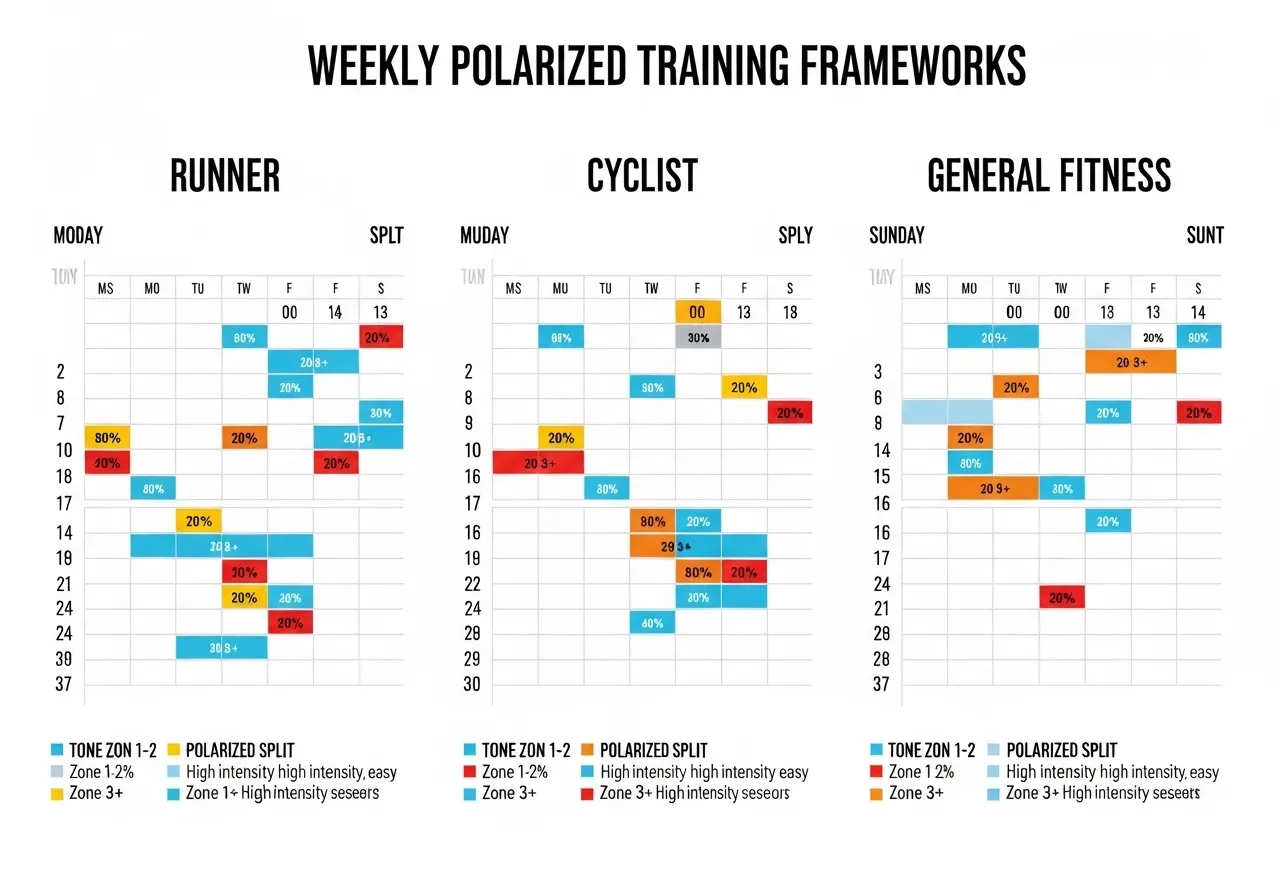
Building a Polarised Training Week: Practical Frameworks
The 80/20 Rule in Practice: What Each Session Looks Like
A polarised training week at 7 to 8 hours total volume contains approximately 6 to 6.5 hours of Zone 1 sessions and 1 to 1.5 hours of Zone 3 work. This translates to 4 to 5 Zone 1 sessions of 70 to 90 minutes each and 1 to 2 Zone 3 sessions per week. Zone 3 sessions are typically shorter in duration (45 to 60 minutes total including warm-up and cool-down) because the high-intensity interval work they contain cannot be sustained for the full session duration.
Monday: 70 min Zone 1 easy run
Tuesday: 5 × 5 min Zone 3 intervals with 5 min recovery (60 min total)
Wednesday: 75 min Zone 1 easy run
Thursday: Rest or 30 min Zone 1 walk/easy cycling
Friday: 75 min Zone 1 easy run
Saturday: 4 × 8 min Zone 3 tempo intervals (65 min total)
Sunday: 90 min Zone 1 long run
Zone distribution: ~80% Zone 1, ~17% Zone 3, ~3% Zone 2 ✅
Monday: 90 min Zone 1 easy ride
Tuesday: 60 min Zone 3 intervals (5 × 5 min at above VT2 power)
Wednesday: 90 min Zone 1 easy ride
Thursday: Rest
Friday: 90 min Zone 1 easy ride
Saturday: 60 min Zone 3 intervals
Sunday: 120 min Zone 1 long ride
Zone distribution: ~81% Zone 1, ~16% Zone 3, ~3% Zone 2 ✅
Monday: 60 min Zone 1 easy cardio (any modality)
Wednesday: 45 min Zone 3 intervals (3 × 5 min hard, rest 5 min)
Friday: 60 min Zone 1 easy cardio
Saturday: 90 min Zone 1 long easy session
Sunday: Optional 45 min Zone 1 easy
Zone distribution: ~79% Zone 1, ~18% Zone 3, ~3% Zone 2 ✅
The Zone 3 Session: What to Do With the 20%
The Zone 3 component of polarised training should be genuinely high intensity, not just uncomfortable. VO2 max intervals (5 × 5 minutes at vVO2max), sprint intervals, hill repetitions at maximum effort, and race-pace segments all qualify. The goal is to spend meaningful time above the second ventilatory threshold where VO2 max stimulus is occurring. Sessions that feel hard but stay below VT2 (sustained threshold runs) are Zone 2 work and do not count toward the polarised model’s Zone 3 target. The tempo running science and how threshold runs fit differently in the polarised versus threshold training models is covered in the tempo running guide.
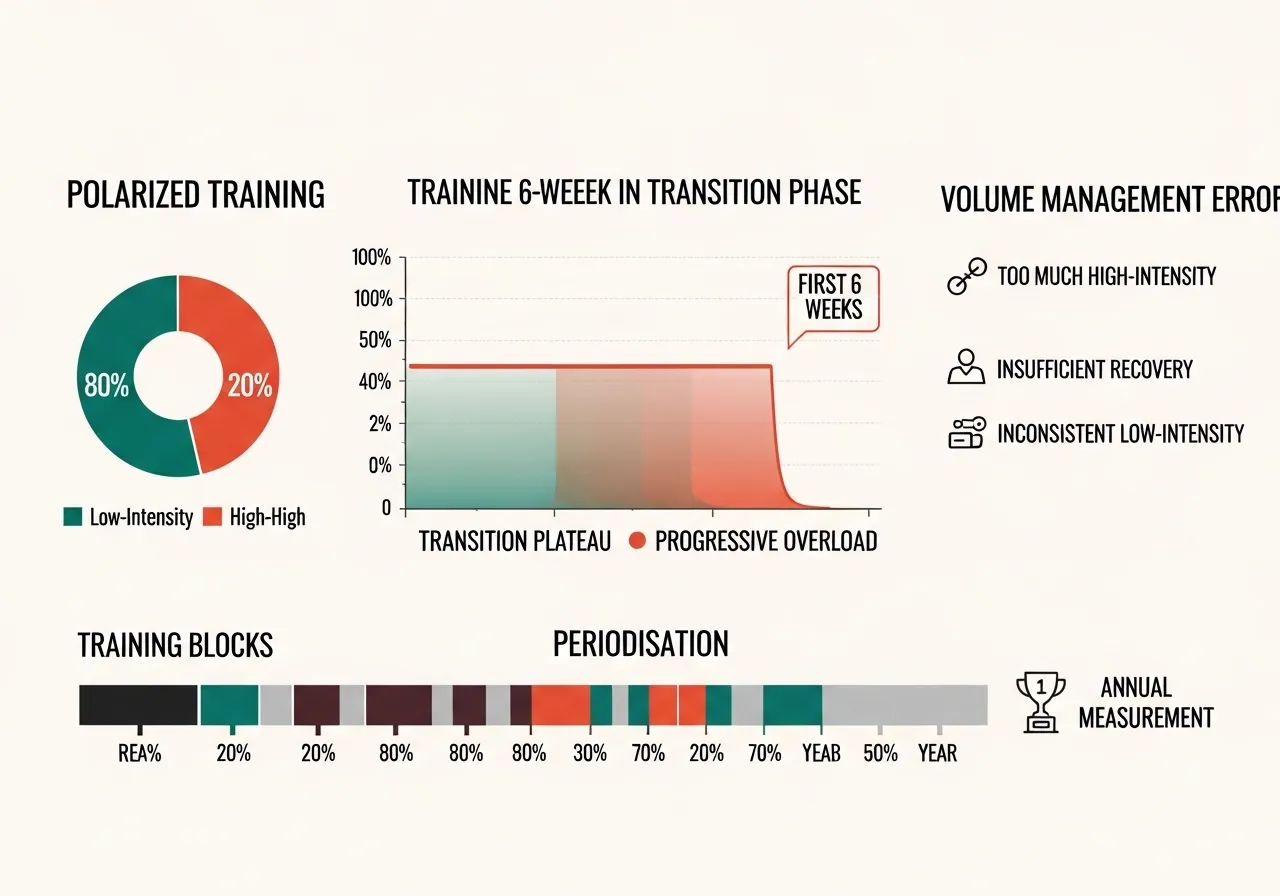
The Transition From Moderate-Intensity to Polarised Training
What to Expect in the First 4 to 6 Weeks
Athletes transitioning from moderate-intensity dominant training to a polarised model typically experience an initial fitness plateau or slight regression during the first 4 to 6 weeks. The moderate-intensity work they previously performed provided direct threshold training stimulus. Replacing most of it with Zone 1 training temporarily reduces the threshold-specific stimulus while the aerobic base adaptations from Zone 1 volume are still developing. This initial plateau is expected and should not prompt a return to the moderate-intensity model that had already produced a training ceiling.
After 6 to 10 weeks of consistent polarised training, most athletes report the following changes: their Zone 3 sessions feel stronger because they are performed on better-recovered systems, their easy pace for the same heart rate increases as aerobic base develops, and their overall endurance performance begins improving at a rate that exceeded what the preceding moderate-intensity training produced.
Managing the Transition in Training Volume
The transition to polarised training does not require increasing total training volume. It requires restructuring the intensity distribution of existing volume. An athlete training 6 hours per week of predominantly moderate intensity should restructure those 6 hours into approximately 4.8 hours of Zone 1 and 1.2 hours of Zone 3, maintaining total volume while changing the distribution. Adding volume simultaneously with intensity restructuring complicates the assessment of which change is producing the outcomes and adds unnecessary total training stress during the adaptation period.
Common Errors in Polarised Training Implementation
Three errors consistently undermine polarised training outcomes. First, Zone 1 drift: sessions that begin as Zone 1 gradually increase in intensity as pace preferences assert themselves or as terrain naturally increases heart rate. Using heart rate monitoring and actively slowing down when the Zone 1 ceiling is exceeded prevents this. Second, Zone 3 undershoot: intervals that are programmed as Zone 3 but performed at threshold intensity because the athlete is reluctant to reach genuine discomfort. Zone 3 must be genuinely above VT2 to provide the VO2 max stimulus that the model requires. Third, inadequate Zone 1 volume: attempting polarised training at only 3 to 4 sessions per week means insufficient Zone 1 accumulation to drive aerobic base adaptations, which produces neither the base nor the performance improvements that the model promises at higher volumes.
Periodising Polarised Training Across an Annual Plan
Polarised training benefits from annual periodisation that adjusts the Zone 3 proportion across training phases. Base phases (off-season and early preparation) emphasise the Zone 1 end of the distribution: 85 to 90% Zone 1, 10 to 15% Zone 3. As competition approaches, Zone 3 volume increases toward 20% and Zone 1 volume decreases proportionally, sharpening the high-intensity stimulus for peak performance. Race-specific preparation in the final 4 to 6 weeks before major competitions includes some Zone 2 threshold work to develop race-pace specificity that pure Zone 1 and Zone 3 training does not provide.
Measuring Progress in Polarised Training
The most direct progress measure in polarised training is the pace or power at the Zone 1 ceiling heart rate. When the same heart rate that corresponded to 9 km/h in month one corresponds to 10.5 km/h in month four, the aerobic base has meaningfully improved. Secondary measures include improved time trial performance, reduced perceived exertion at previous training paces, and improved Zone 3 interval performance as the aerobic base supports higher-quality recovery between high-intensity efforts.
Frequently Asked Questions About Polarised Training
Is polarised training only for elite athletes?
The research shows polarised training advantages are most pronounced in highly trained athletes. Less trained recreational athletes may show similar outcomes from polarised and threshold training in short-term studies. However, the fundamental physiological rationale for polarised training applies to any endurance athlete: Zone 1 builds aerobic base efficiently without recovery cost, and Zone 3 builds VO2 max ceiling efficiently. These mechanisms operate regardless of training history.
The practical difference is that recreational athletes with limited weekly training time may find the threshold model more time-efficient for generating specific race-pace fitness in short training blocks. Polarised training produces its greatest advantage when sufficient Zone 1 volume can be accumulated over extended periods, which requires both adequate weekly hours and sufficient training consistency across months.
How do I know if my easy runs are genuinely Zone 1 or Zone 2?
The talk test is the most accessible field check. At true Zone 1 intensity, a complete sentence of 10 to 15 words can be spoken without stopping to breathe mid-sentence. The effort should feel genuinely easy throughout, not just sustainable. A useful practical test: if you are running with a training partner, can you have a normal conversation without needing to pause mid-sentence? If not, you are in Zone 2.
Heart rate provides a more objective check. If your easy run heart rate consistently exceeds 75% of maximum heart rate, your easy runs are likely in Zone 2 rather than Zone 1. Many recreational athletes are surprised to find that genuine Zone 1 training requires running at 10 to 30 seconds per kilometre slower than their current easy pace.
Can I do polarised training if I only have time for 3 sessions per week?
At 3 sessions per week, a strictly polarised model is difficult to implement effectively because the Zone 1 volume at this frequency is insufficient to drive meaningful aerobic base adaptations. A more practical approach at 3 weekly sessions: one Zone 3 interval session, one Zone 2 threshold run or tempo, and one Zone 1 long easy session. This pyramidal-leaning distribution produces better outcomes at low weekly training volumes than strict polarisation because the threshold session provides direct race-pace stimulus that 3 sessions per week of polarised training cannot replicate through Zone 1 volume alone.
Does polarised training work for beginners?
Beginners who are just beginning cardiovascular training benefit substantially from Zone 1 training simply because any aerobic training represents a novel stimulus that drives rapid adaptation. The polarised versus threshold distinction matters less for untrained beginners than for athletes who have developed moderate-level aerobic fitness through months or years of consistent training. For beginners, the most important practice is establishing consistent training habits and developing the aerobic base that underpins all subsequent endurance development, regardless of the specific intensity distribution used.
What is the difference between polarised and 80/20 training?
The terms are often used interchangeably. Polarised training refers to the intensity distribution model where approximately 80% of volume is at low intensity and 20% at high intensity, with minimal moderate-intensity work. The 80/20 label describes the same distribution numerically. Some coaches and researchers make a distinction: 80/20 describes the percentage split while polarised specifically implies the minimisation of the middle zone (Zone 2) rather than simply a high proportion of easy work. In practice, both terms describe training that emphasises the extremes of the intensity spectrum and avoids the moderate zone that recreational athletes typically overuse.
- Polarised training distributes approximately 75 to 80% of training volume at low intensity (Zone 1), 5% at moderate intensity (Zone 2), and 15 to 20% at high intensity (Zone 3). The moderate zone is deliberately minimised.
- Meta-analysis evidence shows polarised training produces SMD = 0.24 greater VO2peak improvement than other intensity distributions with high certainty of evidence, with advantages most pronounced in shorter blocks and highly trained athletes.
- The moderate-intensity zone that most recreational athletes default to is metabolically expensive without providing either the aerobic base stimulus of Zone 1 or the VO2 max ceiling-raising stimulus of Zone 3, producing the worst return on training investment of the three zones.
- Zone 1 must be genuinely below the first lactate threshold: full sentences possible, heart rate at 60 to 70% maximum. Zone 3 must be genuinely above the second ventilatory threshold: unsustainable beyond minutes, speech impossible.
- The transition from moderate-dominant to polarised training produces an initial 4 to 6 week plateau before improvements emerge. This is expected, not a sign of failure. Consistent Zone 1 volume accumulation across months produces the aerobic base improvement that makes subsequent high-intensity work more effective.