⚠️ Health & Fitness Disclaimer This article is for general educational and informational purposes only. It does not replace professional medical or fitness advice. If you have any pre-existing condition, joint concern, or cardiovascular issue — please consult a qualified healthcare professional before starting or modifying any exercise program.
Jump rope training has been used by boxers, athletes, and school children for decades — yet it remains one of the most underappreciated tools in adult fitness programming.
It costs almost nothing, requires no gym, and delivers a cardiovascular stimulus that rivals treadmill running — in a fraction of the space and time.
This guide covers the physiology behind jump rope research guide training, the research supporting its health benefits, a structured approach to learning the technique, and practical programming for beginners through advanced trainees.
Why Jump Rope Training Deserves More Attention: The Physiology
The Cardiovascular Demand
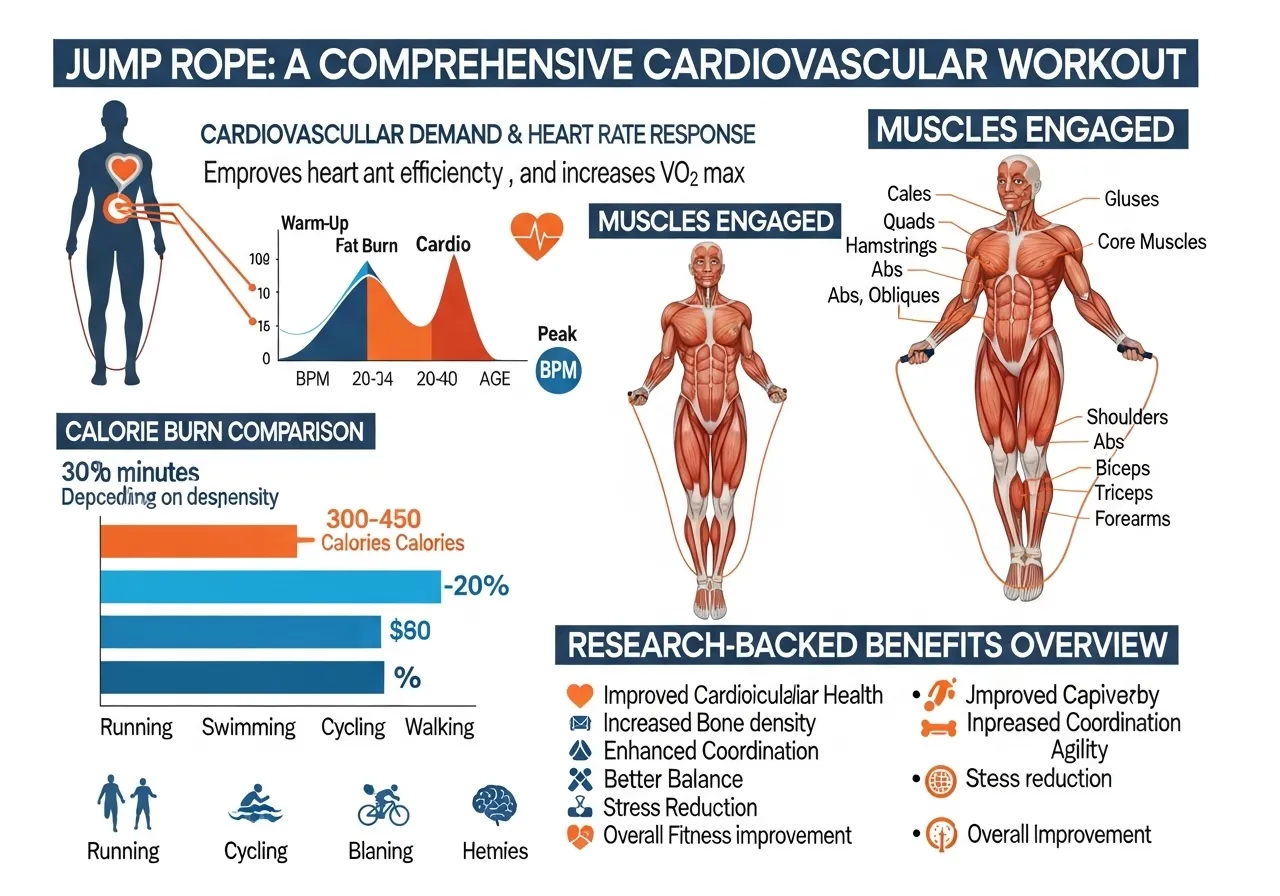
Jump rope training rapidly elevates heart rate — most healthy adults reach Zone 3–4 (70–90% of maximum heart rate) within 60–90 seconds of moderate-paced jumping. (see also: heart rate zones)
This makes it one of the most time-efficient cardiovascular training tools available: a genuine high-intensity cardiovascular stimulus is achievable within the first 2 minutes of a session, without warm-up equipment or a treadmill.
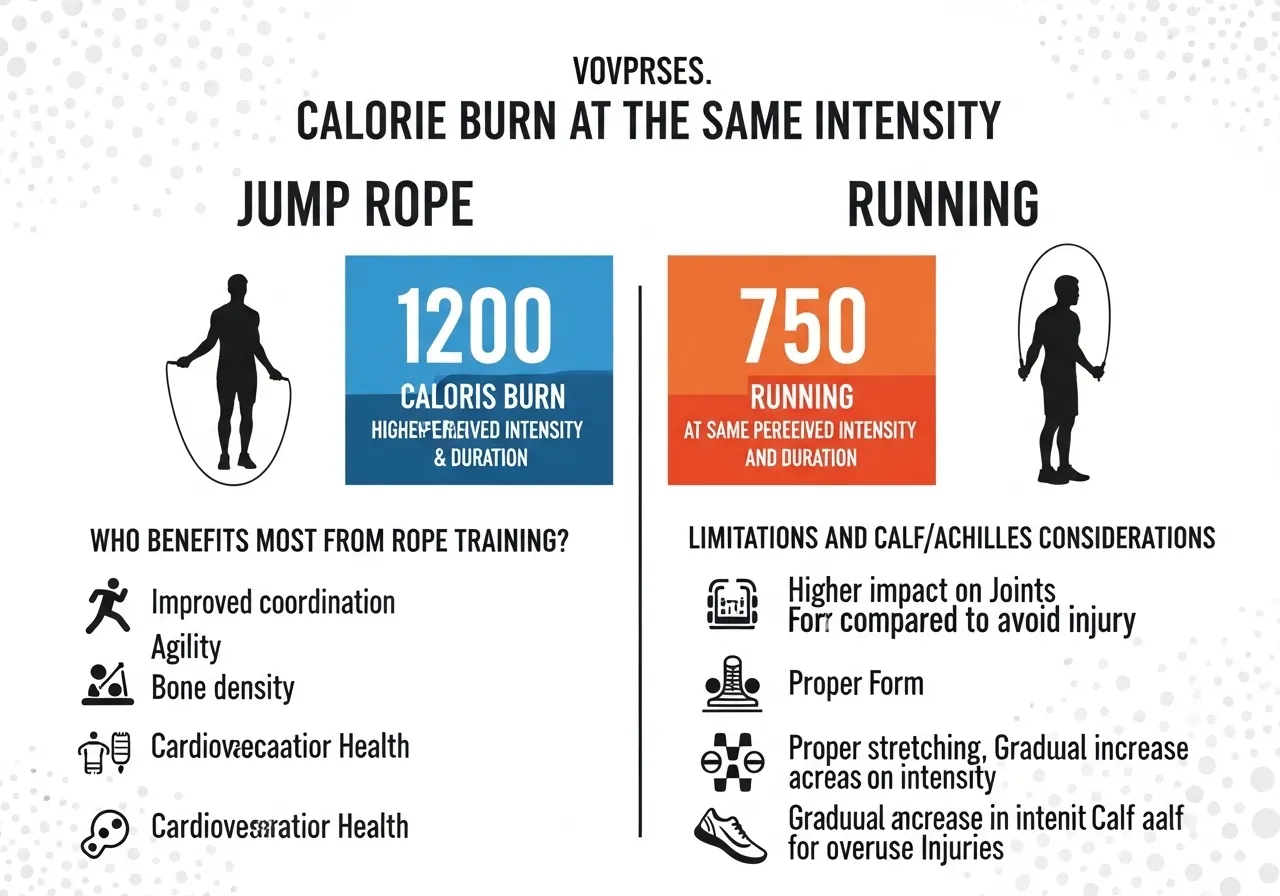
The metabolic demand per minute is comparable to running at a moderate pace — approximately 10–15 calories per minute depending on body weight and jump intensity — making it competitive with most traditional cardio options for energy expenditure in short sessions.
Unlike most cardiovascular modalities that are primarily lower-body focused, jump rope training simultaneously activates:
Lower body: Gastrocnemius and soleus (the two calf muscles) as the primary power generators; quadriceps for landing control; glutes for hip stabilization
Upper body: Wrist extensors and flexors for rope rotation; anterior deltoids for maintaining arm position; core stabilizers throughout
Coordination system: The timing demands of jump rope require precise neuromuscular coordination — improving the timing, rhythm, and proprioception (the body’s sense of its own position and movement) that transfers to athletic movement patterns
Bone Density: An Often-Overlooked Benefit
Jump rope is a weight-bearing, impact exercise — each landing creates ground reaction forces that stimulate bone remodeling and help maintain or increase bone mineral density (the concentration of minerals like calcium in bone tissue).
This makes jump rope particularly relevant for populations at risk of bone density loss — including women in perimenopause and postmenopause, and older adults seeking weight-bearing cardiovascular exercise alternatives to cycling or swimming.
Individuals with osteoporosis or known joint conditions should seek guidance from a healthcare provider before beginning jump rope training, as the impact load may not be appropriate for all joint or bone presentations.
Jump Rope and Mental Health: An Underappreciated Benefit
Rhythmic, repetitive movement — the hallmark of steady-state jump rope — has been associated with mood improvement and stress reduction through similar mechanisms to other aerobic exercise:
Endorphin release during vigorous exercise reduces perceived pain and may improve mood acutely
The focused attention required to maintain rhythm in jump rope creates a brief meditative state — the mind is occupied with counting and timing, reducing mental rumination for the duration of the session
The rhythmic quality of steady-state jumping at a comfortable pace shares characteristics with mindfulness-based movement practices in terms of attentional focus
While jump rope is not a treatment for mental health conditions, regular vigorous aerobic exercise — including jump rope — is consistently associated in research with reductions in anxiety and depression symptoms as a complementary lifestyle factor.
Individuals managing mental health conditions should continue any prescribed treatment and consult their healthcare team about incorporating exercise, including jump rope training, into their overall wellness approach.
Jump Rope Rope Types: What Matters and What Doesn’t
The rope market includes dozens of variations — but the features that actually affect training outcomes are limited:
Rope Type
Material
Best For
Speed rope (PVC/cable)
Thin plastic or cable with swivel bearings
HIIT, double unders, speed work
Beaded rope
Plastic segments on cord
Beginners — provides more feedback on foot contact
Leather rope
Traditional boxing training rope
Durability, tactile feedback, boxing context
Weighted rope (handles)
Heavier handles (0.25–1 kg each)
Upper body conditioning emphasis
For general fitness and jump rope HIIT workout work, a basic speed rope with swivel bearings ($10–25) is all that is needed — expensive “smart” jump ropes with digital counters provide convenience but no training benefit over a standard rope.
Jump Rope for Coordination and Neurological Benefits
The coordination demands of jump rope training produce neurological adaptations that are distinct from the metabolic benefits — and may be particularly valuable for populations seeking to maintain cognitive and motor function:
Research in children has shown that jump rope training improves executive function, working memory, and attentional control — cognitive benefits likely related to the precise timing and rhythmic demands of the activity
The bilateral coordination (left-right synchronization) required for consistent jumping trains the neural pathways connecting the two brain hemispheres
Reaction time and foot speed improvements from consistent jump rope training transfer to sport-specific agility tasks — particularly relevant for sports requiring quick foot repositioning
These neurological benefits suggest jump rope training has value beyond its cardiovascular stimulus — particularly for older adults where maintaining coordination and balance is a health priority, and for athletes where sport-specific agility is a performance determinant.
The Case for Adding Jump Rope to Any Fitness Program
Few exercise tools combine the following properties simultaneously: meaningful cardiovascular stimulus, near-zero equipment cost, minimal space requirements, portability, coordination development, bone density benefit, and scalability from beginner to elite athlete level.
The research supporting jump rope’s cardiovascular and cardiometabolic health benefits — across blood pressure, body composition, vascular function, and aerobic capacity — positions it as a genuinely evidence-supported cardiovascular tool rather than simply a nostalgic childhood activity.
For trainees who have not included jump rope in their programs, the 4-week beginner progression described in this guide provides a structured, low-risk entry point that builds both the conditioning and the coordination needed for more intensive protocols.
The initial 2–4 weeks of calf adaptation are the primary obstacle — and once past them, most trainees find jump rope becomes one of their most efficient and versatile training tools.
Jump Rope Technique: Learning the Fundamentals Before Adding Speed
Equipment Setup: Rope Length
Incorrect rope length is the most common technical barrier for beginners — causing the rope to hit the feet or requiring excessive overhead arc.
Standard rope length fitting:
✅ Stand on the middle of the rope with both feet
✅ Both handles should reach approximately armpit height
✅ For beginners, erring slightly longer is preferable — it allows more time to jump before the rope arrives
✅ Shorter ropes increase speed demand; appropriate for more experienced jumpers
The Basic Two-Foot Jump: Getting the Mechanics Right
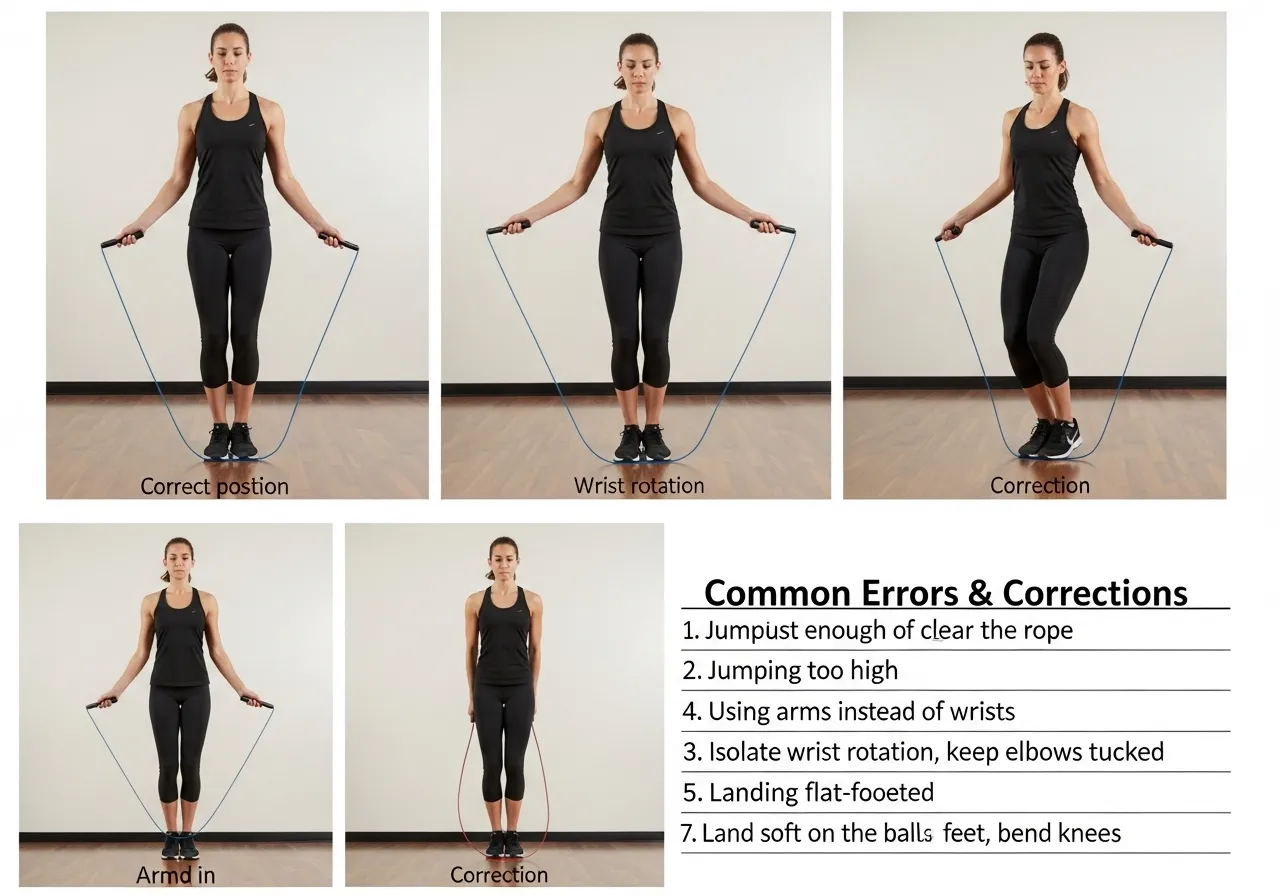
Most technique errors in jump rope come from jumping too high, landing too hard, or using the arms incorrectly — not from lack of fitness.
Arm position: Elbows close to the sides, hands at hip height. The rotation comes from the wrists — not large shoulder or arm movements. Think “small circles at the wrists.”
Jump height: Only 2–3 cm clearance is needed — just enough for the rope to pass under the feet. Jumping 10–15 cm high wastes energy and increases landing impact unnecessarily.
Landing mechanics: Land on the balls of the feet (the padded area below the toes) with knees slightly bent — never flat-footed. The calves act as springs, absorbing and releasing impact each jump.
Body position: Upright torso, relaxed shoulders, eyes forward — not looking down at the rope.
Common Technique Errors and How to Fix Them
Error
What It Looks Like
Correction
Jumping too high
Large vertical hop with thighs lifting
“Hover above the ground” — minimal clearance only
Arms flaring outward
Elbows away from the body; large arm circles
“Elbows to ribs” — rotation from wrists only
Flat-foot landing
Slapping sound with each landing
Land on balls of feet; knees slightly bent
Looking down
Head tilted forward watching the rope
Eyes forward — feel the timing, don’t watch
Skipping on every jump
Alternating feet like running rather than both feet together
Practice two-foot jumps first until consistent
Footwear and Floor Surface Recommendations
Footwear: Cross-training or running shoes with adequate forefoot cushioning — minimalist shoes or flat-soled shoes may increase calf and Achilles tendon stress during high-volume sessions
Floor surface: Rubber gym flooring, sprung wooden floors, or outdoor asphalt/concrete are all appropriate. Carpet increases rope catching and is not recommended. Concrete without cushioned footwear over long sessions increases joint impact.
Avoid: Jumping barefoot for extended sessions — the repetitive forefoot impact without footwear support may increase plantar fascia and calf strain risk
The 5 Key Jump Rope Techniques
Technique
Description
Level
Primary Benefit
Two-foot jump
Both feet together, consistent rhythm
Beginner
Technique foundation, calf conditioning
Alternating foot
Running-style step, one foot at a time
Beginner–Intermediate
Lower impact option, higher speed potential
High knees
Alternating feet with knees driving upward to hip height
Intermediate
Hip flexor and core engagement
Double under
Rope passes under feet twice per jump
Advanced
Power, timing, high caloric demand
Boxer skip
Slight weight shift side-to-side while jumping
Intermediate
Rhythm, footwork, lateral stability
Learning Double Unders: A Step-by-Step Approach
The double under — the rope passing under the feet twice in a single jump — is the most significant skill progression in jump rope training beyond basic jumping.
The most common error when attempting double unders is excessive jump height — trainees instinctively jump higher, but the key is actually faster wrist rotation rather than greater height.
Key cues for double under technique:
→ Jump height: 5–8 cm (slightly higher than single unders, but not dramatically so)
→ Wrist speed: Accelerate the wrists at the peak of the jump — not at the bottom
→ Body position: Avoid “dolphin kick” (hips swinging backward) — the body should remain vertical
→ Landing: Same calf-cushioned landing as single unders
Most trainees achieve their first consistent double unders within 2–4 weeks of dedicated practice (10–15 minutes per session) once single-under technique is solid.
Jump Rope Programming: Beginners Through Advanced
The Beginner Challenge: Building Unbroken Jumping Capacity
Most adults returning to jump rope find that cardiovascular fitness is not the limiting factor — coordination and calf endurance are.
The calves work significantly harder during jump rope than during most other exercises, and significant soreness (DOMS) in the calves is common after the first 2–3 sessions.
A gradual introduction specifically designed to manage this:
Week 4 — Foundation Complete:
3 × 5 min jumping / 2 min rest | Introduce boxer skip variation
HIIT Jump Rope: The Time-Efficient Protocol
Jump rope HIIT research is among the most time-efficient cardiovascular protocols available — reaching near-maximal heart rate effort within seconds and recovering between rounds:
Protocol
Work
Rest
Rounds
Total Time
Beginner HIIT
20 sec
40 sec
8–10
8–10 min
Intermediate HIIT
30 sec
30 sec
10–12
10–12 min
Advanced HIIT
40 sec
20 sec
10–15
10–15 min
Tabata (Advanced)
20 sec all-out
10 sec
8
4 min
Steady-State Jump Rope Sessions
Continuous jumping at a moderate pace — maintaining conversational effort for 10–20 minutes — trains the aerobic base and fat oxidation pathways in the same way as Zone 2 cardio running or cycling, with the added coordination and upper body engagement unique to jump rope.
Building toward 10 minutes of unbroken jumping at a comfortable alternating-foot pace is a meaningful fitness milestone for most adult beginners — achievable within 4–6 weeks of consistent practice.
Jump Rope as a Workout Finisher
Adding 5–10 minutes of jump rope HIIT after a strength training session is one of the most practical integration strategies:
The lower body is already warmed up — reducing the technical barrier to maintaining proper mechanics
A brief HIIT finisher (6–8 rounds × 30 sec on / 30 sec off) adds meaningful cardiovascular volume without adding significant session time
The Achilles and calf stress of rope jumping is reduced when the calves are already warmed up versus jumping cold
Weekly Integration
Strength-focused program: 2–3 × 10-min HIIT jump rope sessions per week (as finishers or standalone) Cardio-focused program: 3–4 × 15–20 min sessions mixing steady-state and intervals General fitness: 3 × 15 min sessions — 5 min warm-up steady state, 10 min HIIT, 5 min cool-down Time-constrained: 2 × 10 min HIIT sessions — even 10 minutes of structured rope intervals produces measurable cardiovascular stimulus
Jump Rope for Weight Management
Jump rope’s high caloric expenditure relative to session duration makes it a practical tool for individuals with weight management goals:
A 20-minute moderate-intensity jump rope session may burn 200–280 calories for a 70 kg person — comparable to a 20-minute run
The HIIT format (alternating all-out effort with rest) produces an EPOC effect (Excess Post-exercise Oxygen Consumption — continued caloric burn after the session ends) that adds additional caloric expenditure over the following hours
The accessibility and low equipment cost of jump rope makes adherence more sustainable than gym-dependent cardiovascular training for many individuals
Weight management through exercise is most effective when combined with appropriate dietary habits — jump rope training supports the exercise component, but cannot independently compensate for significant dietary excess.
A registered dietitian and qualified fitness professional working together can provide the most effective combined approach for sustainable weight management goals.
Adapting Jump Rope Training to Different Fitness Goals
The same fundamental tool can be programmed toward meaningfully different outcomes depending on how it is structured:
Primary Goal
Recommended Approach
Weekly Volume
Cardiovascular fitness
Steady-state 15–20 min + HIIT 2× per week
3–4 sessions
Fat loss / caloric expenditure
HIIT 20–25 min, 3–4× per week
3–4 sessions
Athletic conditioning
Speed work + double unders + footwork drills
2–3 sessions
Warm-up activation
3–5 min easy jumping before other training
Daily or most days
The flexibility to structure jump rope toward any of these goals — at the same minimal equipment cost — is one of its most distinctive practical advantages as a training tool for diverse populations and programming contexts.
Jump Rope vs. Other Cardio: How It Compares and Who It Suits Best
Caloric Expenditure Comparison
Jump rope is among the highest calorie-burning exercises per minute of any common cardiovascular activity:
Activity
Approx. Calories/Min (70 kg person)
Intensity Level
Jump rope (moderate)
10–13 cal/min
Vigorous
Running (8 km/h)
9–12 cal/min
Vigorous
Cycling (moderate)
7–9 cal/min
Moderate–Vigorous
Swimming laps
8–10 cal/min
Vigorous
Walking (brisk)
4–5 cal/min
Moderate
These are estimates — actual caloric expenditure varies significantly with body weight, jumping speed, technique efficiency, and fitness level.
The key practical point: jump rope at vigorous intensity compares favorably to running for caloric expenditure, while requiring no track, treadmill, or weather-dependent conditions.
Who Benefits Most From Jump Rope Training
Home trainees: A jump rope costs $10–30 and requires only 2×2 meters of space — the lowest equipment barrier of any effective cardio tool
Travelers: Fits in any bag, works in any room or outdoor space — consistent cardiovascular training without gym access
Boxers and martial artists: The footwork, coordination, and timing transfer directly to combat sports — jump rope has been a boxing training staple for over a century for good reason
Athletes needing upper body cardio: Like battle ropes, jump rope engages arms and shoulders alongside the lower body — useful for upper body conditioning alongside leg recovery
Individuals with limited space or budget: Jump rope offers gym-quality cardiovascular training at minimal cost
Limitations and Considerations
Achilles and calf sensitivity: The repeated eccentric calf loading of jumping makes Achilles tendinopathy (degeneration and pain of the Achilles tendon) a risk with rapid volume increases — progress duration and frequency gradually, particularly in the first month
Knee considerations: Individuals with patellofemoral pain (pain around or behind the kneecap) should consult a physiotherapist before beginning high-volume jump rope, as the repeated impact may aggravate this condition
Not suitable for all flooring: Jumping on very hard surfaces without appropriate footwear for extended periods increases lower limb stress
Skill barrier: Unlike running or cycling, jump rope requires a period of skill acquisition — frustrating initially but resolved with consistent practice
Practical Questions About Jump Rope Training
How long should a beginner jump rope session be?
For the first 2–3 weeks, sessions of 10–15 minutes of total active jumping time are appropriate — including rest intervals.
The primary limiter for most beginners is calf fatigue and rope catching (losing the rhythm), not cardiovascular capacity.
Starting with short intervals (20–30 sec) and longer rest periods allows the calves to adapt gradually before increasing continuous jumping duration.
Is jump rope bad for knees?
In healthy individuals with proper technique, jump rope is generally a low-risk activity for the knees — landing on the balls of the feet with a slight knee bend absorbs most of the impact through the calves and quads rather than transmitting it directly to the knee joint.
Individuals with pre-existing knee conditions (meniscus issues, patellofemoral pain, ligament injuries) should consult a physiotherapist or sports medicine physician before beginning jump rope training to determine appropriate volume and technique modifications for their specific situation.
Can jump rope replace running?
For general cardiovascular fitness and caloric expenditure goals, jump rope can functionally replace running — it produces equivalent cardiovascular stimulus at similar intensities.
For goal-specific outcomes (marathon training, running economy improvement), jump rope does not train the specific biomechanics of running and should complement rather than replace running for dedicated runners.
For most general fitness trainees, jump rope is an excellent running alternative — particularly for those managing knee or hip conditions that running aggravates, or those who prefer home-based or travel-friendly training options.
✅ Key Takeaways
Jump rope training improves cardiovascular capacity, body composition, blood pressure, and cardiovascular risk markers — supported across multiple research trials
Caloric expenditure is comparable to running at moderate-to-vigorous pace — making it time-efficient for both HIIT and steady-state cardiovascular work
The main beginner barriers are calf conditioning and coordination — both resolved with 3–4 weeks of consistent practice
Land on the balls of the feet with a slight knee bend; keep the elbows close and rotate from the wrists — technique errors account for most beginner frustration
Achilles tendon pain during or after sessions warrants reducing volume and seeking physiotherapy evaluation before continuing
Long-Term Jump Rope Development: Advanced Techniques and Programming
Progressions Beyond the Basics
Once consistent 5–10 minute unbroken sets are achievable with good technique, several progressions extend the training stimulus without requiring new equipment:
Double Unders: The rope passes under the feet twice during a single jump — requiring significantly more jump height (15–20 cm), faster wrist rotation, and precise timing.
The double under is the primary jump rope skill progression in CrossFit and competitive fitness contexts — and for good reason, as it produces a dramatically higher caloric and cardiovascular demand per unit time than single unders at equivalent jump cadence.
Learning pathway for double unders:
Step 1: Master consistent 100+ single-under sets without misses
Step 2: Practice “penguin jumps” — jumping without the rope and clapping hands against thighs twice per jump to simulate the timing
Step 3: Attempt singles-singles-doubles: two single unders followed by one double under attempt
Step 4: Build to consistent 10, then 20, then 50 unbroken double unders
Weighted Jump Rope: Using a rope with weighted handles (typically 0.25–0.5 kg per handle) increases the rotational resistance and upper arm demand — building forearm and shoulder conditioning alongside the cardiovascular stimulus.
Speed Intervals: Alternating between maximum-speed jumping (target 180–200 RPM — rope revolutions per minute) and comfortable-pace recovery jumping within a continuous set, without stopping — a more advanced form of interval training that maintains the skill demand throughout recovery periods.
Jump Rope in Sport-Specific Training
Jump rope has a well-established history in sports training beyond boxing:
Basketball: Footwork drills and conditioning — the quick directional changes in basketball footwork share coordination demands with jump rope variations
Tennis and racket sports: Split-step timing, foot quickness, and forearm conditioning
Soccer: Foot speed, agility, and lower-body conditioning without high impact running load
Gymnastics and dance: Rhythm, coordination, and landing mechanics
Research on jump rope in basketball players found improvements in multiple physical fitness dimensions — aerobic capacity, upper-body power, core endurance, and sport-specific shooting accuracy — supporting its role as a genuinely multi-dimensional training tool for athletes.
Combining Jump Rope With Strength Training
Integration Method
Example
Best For
Session finisher
10 min HIIT rope after strength session
Adding cardio volume without separate session
Superset with strength
Squats → 60 sec jump rope → rest → repeat
Circuit-style conditioning and caloric demand
Standalone session
20–30 min jump rope on non-lifting days
Dedicated cardiovascular training without lower body strength fatigue
Warm-up activation
3–5 min easy jumping before strength training
Cardiovascular warm-up, ankle/calf activation
Recovery and Injury Prevention for Jump Rope Training
The Achilles tendon and plantar fascia are the structures most commonly stressed during high-volume jump rope training:
Calf stretching after every session: Standing calf stretch (both straight-knee for gastrocnemius and bent-knee for soleus) held 30–45 seconds each — a 5-minute post-session calf stretching routine is a practical preventive measure
Progressive volume increase: Increasing jump rope volume by no more than 10–15% per week — the same principle applied to running mileage increases to prevent overuse injury
Rest days: Jump rope places repetitive stress on the same structures — 2–3 sessions per week with at least one day between sessions allows adequate Achilles and calf recovery for most trainees
If heel pain (particularly first-step morning pain, which is characteristic of plantar fasciitis) or Achilles pain develops, reducing session frequency and consulting a physiotherapist for specific load management guidance is strongly recommended before the symptoms progress.
Jump Rope Training Across the Lifespan
Jump rope’s scalability makes it appropriate across a wide age range — from children developing coordination through to older adults maintaining bone density and cardiovascular health.
For older adults (60+), modifications that reduce impact stress while maintaining the cardiovascular benefit include:
Alternating-foot stepping (rather than both feet simultaneously) reduces single-leg impact by approximately 50%
Shorter sessions (5–10 minutes) with longer rest periods allow the same cardiovascular stimulus with lower cumulative calf and joint loading
Cushioned footwear and a rubberized floor surface reduce ground reaction forces
As always, older adults with cardiovascular conditions, joint replacements, or osteoporosis should seek medical clearance from their healthcare provider before beginning jump rope training.
Measuring Progress in Jump Rope Training
Tracking progress provides motivation and guides programming adjustments:
Unbroken set length: Recording the longest unbroken set at each session — improvement from 30 seconds to 5 minutes is clearly visible progress
RPE at standard sessions: A session that felt 8/10 in week 1 should feel 6/10 at the same protocol by week 4 — the subjectivity decrease confirms cardiovascular adaptation
Resting heart rate: Tracking weekly average resting heart rate — gradual decline over 6–12 weeks of consistent cardiovascular training indicates improved aerobic fitness
Jump speed (RPM): Counting rope revolutions per 30 seconds × 2 — higher RPM at the same perceived effort indicates improved efficiency and power
Even modest consistent progress across these markers — measured monthly rather than session-to-session — confirms that the training is producing the intended cardiovascular and coordination adaptations.
Nutrition Around Jump Rope Sessions
Jump rope training’s high energy demand per minute creates specific nutritional considerations:
Before intense HIIT rope sessions: A light carbohydrate-containing snack 30–60 minutes before may support interval quality — jumping fasted for high-intensity intervals may limit the maximum effort achievable in later rounds
Hydration: Jump rope at vigorous intensity generates significant sweat even in short sessions — replacing fluids before and after is important, particularly in warm environments
After sessions: For trainees combining jump rope with strength training, adequate protein in the post-session window (within 1–3 hours) supports muscle protein synthesis in the calves and lower body musculature that jump rope loads
Consistent practice over months — not weeks — is where the most meaningful fitness and coordination improvements from jump rope training fully emerge.
⚠️ Health & Fitness DisclaimerThis article is for general educational purposes only and does not replace professional medical advice. If you have any lower back, knee, or cardiovascular conditions, please consult a qualified healthcare professional before beginning a rowing machine mastery guide program. The rowing machine training guide machine — or ergometer — produces a…
Most recreational endurance athletes train in the middle. They run or cycle at a pace that feels like a meaningful workout: harder than a casual stroll, not so hard that it becomes a genuine interval session. This moderate intensity zone, roughly 75 to 85% of maximum heart rate, feels productive. It creates obvious cardiovascular stress….
Most recreational athletes choose one form of cardio and repeat it. Runners run. Cyclists cycle. Swimmers swim. This is not a strategic decision. It is the path of least resistance: the familiar equipment, the practised movement, the social group tied to the activity. The repetition accumulates a specific cardiovascular adaptation to one mode of exercise…
⚠️ Health & Fitness DisclaimerThis article is for general educational purposes only and does not replace professional medical advice. If you have cardiovascular, respiratory, or musculoskeletal conditions, please consult a qualified healthcare professional before beginning a swimming program. Swimming is one of the most physiologically complete forms of exercise available — simultaneously developing cardiovascular fitness,…
Most recreational endurance athletes train by feel. Some days hard, some days easy. Occasionally very hard. They improve for the first six months, plateau, and then wonder why more miles are not producing better results. The answer is almost always the same: they are training in the middle. Not easy enough to build aerobic base….
⚠️ Fitness Disclaimer: The information in this article is for general educational purposes only and does not constitute professional fitness or medical advice. Always consult a qualified healthcare professional before starting any new exercise program. ⚠️ Cardiovascular Health Notice: If you have a history of heart disease, high blood pressure, or any cardiovascular condition, obtain…