⚠️ Health & Fitness Disclaimer This article is for general educational purposes only and does not replace professional medical advice. If you have any joint conditions, recent injuries, or post-surgical restrictions, please consult a qualified healthcare professional before beginning a mobility training program.
Mobility training — the systematic development of joint range of motion with the active muscular control to use that range purposefully — is one of the most neglected components of comprehensive fitness programming. Where flexibility describes passive range of motion (how far a joint can be moved by external force), mobility describes active range of motion: the range you can control with your own muscles. (Related: morning mobility routine)
This distinction matters enormously for practical fitness outcomes. Passive flexibility without active mobility produces ranges of motion that cannot be used functionally and may increase injury risk by creating unstable end-range positions the muscles cannot control. Active mobility development — training strength through full ranges — produces the controlled movement quality that transfers to every physical activity.
This guide covers the research on mobility training benefits, the key joint areas and their most important movement restrictions, the most effective mobility exercises and sequences, and an 8-week mobility development program.
Mobility Training Research: What the Evidence Shows
These findings have significant practical implications: trainees who perform resistance exercises through full range of motion are simultaneously developing mobility — and conversely, trainees who restrict range of motion in their lifting (partial reps, early sticking-point termination) are missing meaningful flexibility benefits that would otherwise accrue from their training.
The athletic performance transfer from mobility training likely operates through multiple pathways: improved force production at end-range positions, better movement efficiency through reduced compensatory patterns, and the balance and proprioceptive qualities that mobility training develops alongside joint range improvements.
Mobility vs. Flexibility: A Practical Clarification
The distinction between passive flexibility and active mobility has direct implications for exercise selection and programming:
Quality
Definition
Training Method
Transfer to Performance
Passive flexibility
Range achievable with external force
Static stretching, PNF
Limited — range without control
Active mobility
Range achievable under own muscle control
CARs, end-range strengthening, full-ROM lifting
High — range with control
CARs (Controlled Articular Rotations — slow, active circles of a joint through its complete available range under maximal muscle tension) are the foundational mobility exercise for developing active range — taking joints through the maximum range that the surrounding muscles can actively control, progressively expanding this range over time.
The Neural Basis of Mobility Improvements
Early mobility gains — the improved range and reduced discomfort felt within the first 2–3 weeks of consistent practice — are primarily neurological rather than structural. The nervous system maintains protective tension around joints as a safety mechanism, limiting range to what it considers “safe” based on previous experience and the strength available at end ranges.
Mobility training works in two complementary ways:
Increased stretch tolerance: Repeated exposure to end-range positions gradually raises the nervous system’s threshold for the protective contraction reflex, allowing more range before the reflex activates
End-range strength development: Strengthening the muscles at the limit of their range — through CARs, end-range isometric holds, and loaded mobility exercises — convinces the nervous system that the new range is safe because muscular control is available there
This is why passive stretching alone produces slower and less lasting results than combined passive stretching with active end-range strengthening — the passive approach increases tolerance without developing the muscular control that makes the nervous system comfortable maintaining the new range.
Hip Mobility: The Foundation of Lower Body Performance
The hips perform movement in all three planes — flexion/extension, abduction/adduction, and internal/external rotation — making hip mobility restrictions the most athletically consequential of all common mobility limitations.
The most common hip mobility deficits and their consequences:
Limited hip flexion: Restricts squat depth, running stride length, and the functional ability to bend forward without lumbar compensation. Caused primarily by tight posterior hip capsule and hip flexor shortness.
Limited hip internal rotation: Among the most common findings in athletes with lower back pain, groin issues, and knee problems — the hip must internally rotate significantly during walking and running, and insufficient internal rotation range produces compensatory lumbar rotation and knee valgus loading.
Limited hip extension: Shortened hip flexor stretching guide restrict hip extension, causing anterior pelvic tilt and reduced gluteus maximus activation during push-off in walking and running. Directly affects hip thrust and split squat performance.
Key hip mobility exercises:
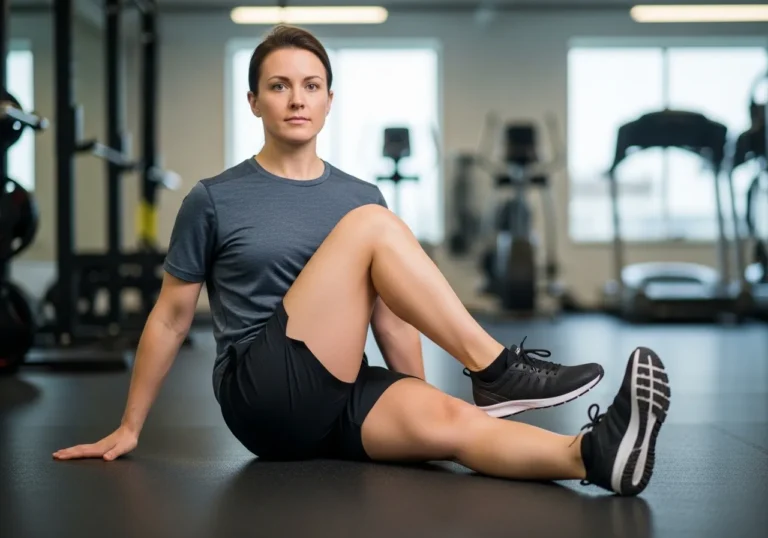
90/90 hip mobility: Seated with both knees at 90° angles — one leg externally rotated, one internally rotated. Switch between forward and back lean to target different aspects of hip rotation range.
Deep squat hold: Maintaining a deep bodyweight squat with the heels on the floor simultaneously stretches the posterior hip capsule, hip flexors, and ankles — addressing multiple hip mobility limitations in one position.
Hip CARs: From standing or quadruped, actively circling the hip through its full available range — the most complete active hip mobility exercise.
Lateral lunge: Dynamic loading of the hip adductor complex through range — developing the hip abduction/adduction control relevant to lateral movement patterns.
Thoracic Spine Mobility: The Most Underappreciated Restriction
Thoracic spine mobility — the ability of the upper and middle back (T1–T12 vertebrae) to flex, extend, and rotate — is one of the most consistently restricted areas in desk-based adults and one of the most consequential for both performance and pain prevention.
The consequences of thoracic stiffness ripple through the entire upper and lower body:
Limited thoracic extension restricts overhead press range, requiring lumbar compensation that loads the lower back under load
Limited thoracic rotation reduces shoulder rotation efficiency in throwing and racket sports — the thoracic spine contributes 30–40% of total trunk rotation, and stiffness here forces the lumbar spine to compensate
Thoracic kyphosis (excessive upper back rounding) alters scapular position, contributing to shoulder impingement in pressing and pulling exercises
Key thoracic mobility exercises:
Thoracic extension over foam roller: Segmental thoracic extension with the roller perpendicular to the spine — working from mid-back to upper back in 3–4 positions
Thread the needle: In quadruped, reaching one arm under the body to maximally rotate the thoracic spine — the rotational range indicator and developer
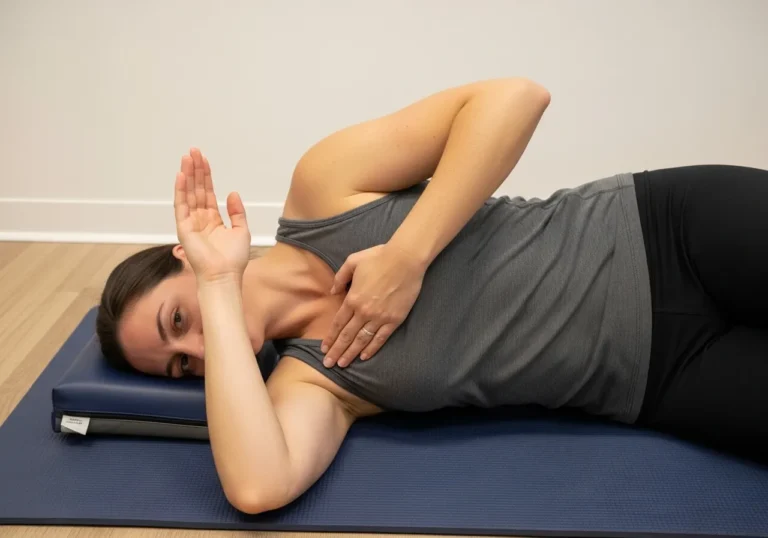
Open book: Lying on the side, rotating the upper body while maintaining hip position — a gentle active thoracic rotation stretch
Thoracic spine CARs: Seated or standing, actively rotating through maximum available thoracic range in both directions
Ankle Dorsiflexion: The Hidden Performance Limiter
Ankle dorsiflexion (the ability to bend the ankle so the shin moves forward toward the toes) is the mobility limitation that most directly affects squat mechanics, running efficiency, and single-leg landing safety.
The standard assessment — the weight-bearing lunge test (WBLT) where the knee is driven forward over the foot with the heel flat — should achieve a minimum of 10 cm distance from the wall to be considered adequate for sport. Many adults, particularly those who wear shoes with heel elevation consistently, fall below this threshold.
Consequences of limited ankle dorsiflexion:
Heel rise during squats — the classic “heels up” error that shifts load forward and compresses the lumbar spine
Reduced single-leg landing depth — the ankle must dorsiflex substantially to absorb jump landing forces, and insufficient range redirects the impact to the knee
Altered running mechanics — reduced ankle dorsiflexion reduces running economy and increases achilles and patellar tendon loading
Shoulder Mobility: The Overhead Performance Complex
Shoulder mobility for overhead activities requires simultaneous adequate range in three distinct elements: glenohumeral (ball-and-socket joint) movement, scapular upward rotation, and thoracic spine extension. Restriction in any of these components impairs overhead performance and may contribute to impingement.
The most useful shoulder mobility assessments:
Apley scratch test: Reaching one arm over the shoulder and the other behind the back — tests combined shoulder external rotation and internal rotation simultaneously
Wall angel: Standing against a wall, attempting to slide the arms from waist to overhead while maintaining back contact — reveals restrictions in shoulder flexion, thoracic extension, and scapular rotation simultaneously
Recognising that most adults in desk-based work have simultaneous deficits in all four areas — hips, thoracic spine, ankles, and shoulders — means that comprehensive mobility programs addressing all four simultaneously are more efficient than single-joint programs, and produce more visible functional changes in daily movement quality within the first 4–6 weeks of consistent practice.
How Should Mobility Training Be Programmed?
The Four Programming Contexts for Mobility Work
Effective mobility programming deploys different exercises in different positions within the training day:
Pre-session activation (5–10 min): Dynamic mobility work — leg swings, arm circles, hip rotations, thoracic rotations. Raises tissue temperature, increases joint fluid distribution, and prepares the movement patterns about to be trained. Never include prolonged static stretching immediately before heavy strength work — research consistently shows that static stretching before maximal strength efforts reduces force production transiently.
Between sets (30–60 sec): Mobility exercises for joints that are not being directly trained in the current exercise — hip mobility between upper body sets, thoracic rotation between lower body sets. Accumulates mobility training volume without adding session time.
Post-session (5–15 min): Static stretching and longer holds target the structures that have been loaded and may benefit from parasympathetic relaxation-facilitated lengthening. Tissue temperature is highest post-exercise, making this the most productive time for passive flexibility development.
Standalone sessions (20–40 min): Dedicated mobility-only sessions — often on rest days from strength training — allow comprehensive work on all priority areas without being constrained by the time available between sets.
CARs: The Daily Joint Health Protocol
A daily CARs (Controlled Articular Rotations) routine — performing full active range-of-motion circles at each joint for 2–3 repetitions — serves as both a mobility assessment and a maintenance practice. The sequence typically takes 8–12 minutes and covers:
Cervical spine CARs: 2 reps each direction
Shoulder CARs: 2 reps each arm
Elbow and wrist CARs: 2 reps each
Thoracic spine CARs: 2 reps each direction
Hip CARs: 2 reps each leg
Knee CARs: 2 reps each leg
Ankle CARs: 2 reps each foot
Daily CARs practice maintains the ranges developed through more intensive mobility work — preventing the regression toward restricted ranges that occurs when joint range is trained occasionally but not maintained through regular active use.
Frequency and Dosing: Evidence-Based Parameters
Research on mobility training dosing indicates:
Frequency: Daily or near-daily practice produces faster range-of-motion improvements than weekly practice — the stretch tolerance improvements that drive early gains reverse partially between sessions if practice is too infrequent
Hold duration for static stretching: 30–60 second holds produce meaningful ROM improvements; shorter holds produce minimal chronic adaptation
Dynamic mobility: 8–10 repetitions through the available range per exercise, performed with control rather than momentum
End-range strengthening: 3–5 second isometric contractions at the end range of a joint position before actively returning — trains the muscles to control and use the available range, converting passive flexibility into active mobility
The Cossack Squat: The Most Complete Lower Body Mobility Exercise
The Cossack squat — a deep lateral squat where one leg is extended straight to the side while the other performs a full single-leg squat — is one of the most comprehensive lower body mobility exercises available, simultaneously addressing:
Hip mobility in the squatting leg: requires full hip flexion, external rotation, and ankle dorsiflexion — the combination that most athletic movements demand
Hip adductor (inner thigh) flexibility in the extended leg: the straight leg position stretches the entire adductor complex through its lengthened range
Single-leg strength: the squatting leg must support full body weight through the deep single-leg squat position
Ankle dorsiflexion in the squatting leg: the deep position demands the most ankle dorsiflexion of any squat variation
Progressing from a supported Cossack squat (hands on floor or holding a support) to a free-standing Cossack squat to a weighted Cossack squat over 8–12 weeks produces dramatic improvements in functional lower body mobility that transfers to athletic performance, squat depth, and single-leg stability simultaneously.
Tracking how far the knee travels in each direction during the CARs rotation provides a practical benchmark for assessing whether mobility work is producing measurable range improvements over the weeks of the program — the available range in a relaxed CAR circle expands perceptibly as genuine mobility develops.
Mobility Exercises for Each Priority Area
Hip Mobility Sequence (10 minutes)
Hip CARs: 2 × 3 each side
90/90 hip mobility: 45 sec in position each side, lean forward and back
Deep squat hold: 3 × 30 seconds (hands can hold door frame initially)
Kneeling hip flexor stretch with rotation: 45 sec each side
Lateral lunge: 3 × 8 each side (dynamic, controlled descent)
Pigeon pose or figure-4: 60 sec each side
Thoracic Spine Sequence (8 minutes)
Foam roller thoracic extension: 3 positions × 30 sec each
Thread the needle: 3 × 5 each side
Open book: 3 × 8 each side
Thoracic CARs: 2 × 3 each direction
Cat-cow with thoracic emphasis: 10 rounds
Ankle Dorsiflexion Sequence (6 minutes)
Ankle CARs: 2 × 5 each foot
Weight-bearing lunge stretch: 3 × 30 sec each side (knee drives forward over foot, heel flat)
Wall ankle stretch (straight leg): 45 sec each side
Wall ankle stretch (bent knee): 45 sec each side (targets deep ankle capsule)
Single-leg calf raise full range: 3 × 12 each side (ankle mobility through loaded dorsiflexion)
Shoulder and Thoracic Combined Sequence (8 minutes)
Shoulder CARs: 2 × 3 each arm
Wall angel: 3 × 8 (slow, controlled back-wall contact maintained)
Doorway pectoral stretch: 45 sec
Prone shoulder extension (Y-W-T raises): 2 × 8 each position
Band pull-apart: 3 × 15
Sleeper stretch (if applicable): 45 sec each side
Full-Body Mobility Flow: The 20-Minute Complete Sequence
Combining all priority areas into a single flow for standalone sessions or comprehensive pre-training preparation:
Daily CARs sequence: 8 min (all joints)
Thoracic foam rolling guide + thread the needle: 4 min
Hip 90/90 + deep squat: 4 min
Ankle wall stretch + weight-bearing lunge: 2 min
Shoulder wall angels + band pull-apart: 2 min
Total: 20 min
Foam Rolling and Tissue Quality: The Evidence Review
Foam rolling — applying self-myofascial release through a foam roller — is among the most commonly practised pre-training routines in gyms globally. The research on its mechanisms and benefits is more nuanced than popular practice might suggest:
Foam rolling acutely increases short-term range of motion — studies consistently show range improvements of 5–10° following foam rolling sessions, likely through combined mechanisms of neural inhibition and local tissue pressure changes
The structural “breaking up of adhesions” narrative that initially justified foam rolling has not been supported by subsequent research — the tissues involved are too stiff to be mechanically altered by foam roller pressure
The acute range benefits of foam rolling do not reduce muscle performance (unlike prolonged static stretching), making it an appropriate pre-training tissue preparation tool
Foam rolling over bony prominences (directly over the IT band at the hip or knee, directly over the spine) should be avoided — the pressure on these structures produces pain without beneficial tissue effect
These nuances make foam rolling most valuable as a pre-training tissue preparation tool rather than as a standalone flexibility or recovery intervention.
8-Week Mobility Development Program
Program Structure
Five sessions per week — three dedicated 20-minute mobility sessions and daily CARs practice on remaining days. The program progressively increases the demand on each joint area over four phases, targeting the four priority regions simultaneously.
Phase 1 — Weeks 1–2 (Assessment and Baseline): 3 sessions/week, 15–20 min each:
Daily CARs sequence (all joints): 8 min
Hip 90/90: 30 sec each position
Deep squat hold: 3 × 20 sec
Foam roller thoracic extension: 3 positions × 20 sec
Wall ankle lunge: 30 sec each side
Wall angel: 2 × 8
Goal: Establish baseline ROM at each joint; identify priority restrictions
Phase 2 — Weeks 3–4 (Volume Build): 3 sessions/week, 20–25 min each:
Daily CARs: 8 min
Hip 90/90 + active rotation: 45 sec each position
Deep squat hold: 3 × 30 sec
Foam roller thoracic + thread the needle: 3 each side
Ankle wall lunge (weighted toe curl): 45 sec each side
Wall angel + band pull-apart: 3 × 10 / 3 × 15
Lateral lunge: 3 × 8 each side
Phase 3 — Weeks 5–6 (End-Range Strengthening): 3 sessions/week, 25 min each:
Hip CARs (loaded with band): 3 each side
90/90 + 5-sec end-range isometric: 3 each side
Cossack squat (deep lateral lunge with forward lean): 3 × 8 each side
Deep squat hold with heel elevated (progressing toward flat): 3 × 30 sec
Thoracic rotation with arm reach: 3 × 5 each side
Overhead squat (light PVC or dowel): 3 × 10
Shoulder CARs loaded: 2 × 5 each arm
Phase 4 — Weeks 7–8 (Integration and Consolidation): 3 sessions/week, 25–30 min each:
Full CARs routine: 10 min
Cossack squat with pause: 3 × 8 each side
Deep squat hold (heels flat target): 3 × 45 sec
Single-leg RDL (hip mobility + hamstring): 3 × 8 each side
Thoracic spine rotation under load (light): 3 × 8 each side
Overhead carry (light dumbbell): 3 × 20 metres each side
Benchmark test: WBLT, 90/90 comfort, deep squat, wall angel
Mobility Training and Longevity: The Long-Term Case
The long-term case for mobility training extends well beyond athletic performance into fundamental quality of life maintenance. Joint range of motion declines progressively with age when not specifically maintained — hip flexion, shoulder overhead reach, and spinal rotation all decrease meaningfully between the ages of 40 and 70 in sedentary adults, reducing functional capacity for daily activities like reaching, bending, and walking efficiently.
Research on aging populations consistently shows that joint mobility is one of the strongest predictors of functional independence — the ability to perform daily tasks without assistance. The activities that require mobility in older adults (reaching overhead, getting up from the floor, bending to pick up objects, turning the head to check blind spots while driving) are not typically the focus of conventional strength training programs but are directly addressed by dedicated mobility work.
Investing 15–20 minutes per day in joint mobility maintenance — particularly during the 40s and 50s when the rate of range-of-motion decline accelerates — may produce a compounding return on investment in functional capacity that conventional strength and cardiovascular training cannot provide alone.
Mobility Training Integration With Strength and Athletic Training
Mobility as the Foundation of Strength Quality
Joint mobility directly determines the ranges within which strength can be expressed. A strong muscle that cannot be used through full range is functionally limited — the strength exists but cannot be applied in the positions that athletic performance and daily activity require.
Specific mobility-to-strength relationships that are practically important:
Hip mobility → squat depth: Without adequate hip mobility (particularly internal rotation and capsular mobility), achieving full squat depth requires compensatory lumbar flexion — which loads the discs rather than the intended lower body muscles
Ankle dorsiflexion → squat mechanics: Every centimetre of additional ankle dorsiflexion range corresponds to increased squat depth achievable before the heels rise — directly affecting the quad and glute stimulus available in the squat
Thoracic extension → overhead press safety: Adequate thoracic extension allows the bar to pass behind the ears to the stacked overhead position without lumbar compensation — protecting the lower back and improving mechanical efficiency simultaneously
Shoulder mobility → bench press health: External rotation range determines whether the shoulder can be maintained in a safe position at the bottom of the bench press — insufficient external rotation produces the “anterior shoulder drift” pattern associated with impingement over years of heavy pressing
Addressing Mobility Asymmetries
Left-right mobility differences are among the most common and practically important findings in mobility assessments — and among the most neglected in standard training programs:
Hip internal rotation is frequently asymmetrical — the non-dominant side often shows greater restriction due to compensatory patterns from dominant-side activity preferences
Thoracic rotation asymmetry (rotating more easily to one side than the other) is common in sport-specific populations like golfers, tennis players, and rotational throwers
Single-sided restrictions should receive additional targeted work (extra sets, longer hold durations) to restore symmetry — bilateral mobility training treats both sides equally and does not address existing asymmetries
When to Prioritise Mobility Training Over Other Training Components
Several scenarios indicate that mobility training may warrant increased programming priority:
Technical breakdown during compound lifts that is attributable to range of motion limitation rather than strength deficit — improving the mobility limitation may improve the lift quality more efficiently than additional strength work
Recurring pain in the same joint or tissue during repeated loading — often reflects the tissue being loaded in a compensatory position due to an upstream mobility restriction
Plateaued performance in movements that depend on range of motion (squat depth, overhead press, sprint stride length) despite maintained or improved absolute strength
Extended periods of reduced physical activity — airline travel, desk-intensive work periods, or injury rehabilitation — during which mobility typically regresses faster than strength
Technology and Mobility Assessment Tools
Several practical tools assist in objectively tracking mobility progress beyond subjective feel:
Weight-bearing lunge test (WBLT) ruler: A measuring tape or dedicated WBLT tool marks the knee-to-wall distance that quantifies ankle dorsiflexion range — the most reproducible single mobility test for athletic assessment
Goniometer: A hinged angle-measuring tool used by physiotherapists to precisely measure joint angles — provides the most accurate ROM measurements but requires a trained assessor for reliable results
Smartphone video: Filming mobility assessments and comparing side-by-side at 4-week intervals provides visual progress documentation that subjective assessment cannot — the changes in range that are too gradual to perceive session-to-session become obvious when compared to baseline video
Mobility Training FAQ
How long does it take to see meaningful mobility improvements?
Initial improvements in how a stretch or mobility position feels — reduced resistance and discomfort at the end range — typically appear within 2–3 weeks of daily or near-daily practice. These early changes reflect neural adaptations (increased stretch tolerance, nervous system “permission” to access the range) rather than structural tissue changes.
Visible improvements in actual joint range of motion — measurable by assessment tools like the WBLT or goniometer — typically become apparent after 4–8 weeks of consistent practice. Structural tissue changes that produce lasting flexibility improvements generally require 8–16 weeks minimum, and the timelines vary considerably based on the joint, the nature of the restriction, and the consistency of practice.
Is it better to stretch before or after training?
The research on pre-training stretching indicates that prolonged static stretching (holds over 60 seconds) immediately before maximal strength or power efforts transiently reduces force production — by approximately 5–8% in the 5–10 minutes following stretching. This effect is small and temporary, but relevant for athletes performing maximal efforts immediately after extended stretching.
Dynamic mobility work — joint rotations, controlled movement through range, bodyweight movements — does not produce this reduction and is the appropriate pre-training preparation. Static stretching is most productively performed post-training or in standalone sessions when the stretch itself is the training objective.
Can I develop mobility without dedicated stretching if I train with full range of motion?
Yes — the meta-analysis evidence confirms that full-range-of-motion resistance training produces ROM improvements equivalent to dedicated stretching programs. Trainees who consistently train compound lifts through complete range (full squat depth, complete overhead lockout, full hip extension in hip thrusts) accumulate meaningful mobility benefits without separate stretching sessions.
The practical implication: prioritising full range of motion in resistance training exercises is simultaneously a strength training and mobility training decision. Restricting range of motion to lift heavier weights sacrifices both the strength benefits of full-range loading and the flexibility benefits of training through complete joint excursion.
✅ Key Takeaways
Resistance training through full range of motion produces ROM improvements equivalent to dedicated stretching — making full-range lifting both a strength and a mobility investment
Mobility (active range of motion with muscular control) is more relevant to performance than passive flexibility — CARs develop this active quality specifically
The four priority mobility areas for most adults are the hips, thoracic spine, ankles, and shoulders — restrictions in these areas produce compensatory patterns throughout the entire kinetic chain
Dynamic mobility before training; static stretching after training — prolonged static stretching before maximal strength efforts may transiently reduce force production
Daily CARs practice for 8–12 minutes maintains the ranges developed through intensive mobility work — preventing regression between dedicated sessions
Shoulder internal rotation is one of the most commonly restricted ranges of motion in both overhead athletes and office workers, for completely different reasons that produce the same mechanical consequence: the humeral head cannot sit centrally in the glenoid during overhead movements, the supraspinatus tendon gets compressed, and pain or injury follows. In overhead athletes…
⚠️ Health & Fitness DisclaimerThis article is for general educational purposes only and does not replace professional medical advice. If you have any hip, lower back, or groin conditions, please consult a qualified healthcare professional before beginning any daily hip mobility routine programme. Hip mobility — the ability of the hip joint to move freely…
⚠️ Fitness Disclaimer: The information in this article is for general educational purposes only and does not constitute professional fitness or medical advice. Always consult a qualified healthcare professional before starting any new exercise program. ⚠️ Medical Disclaimer: This article is for general informational purposes only and does not constitute medical advice. If you are…
Hip rotation mobility is one of the most clinically significant and least directly trained movement qualities in recreational athletes. Most trainees address hip flexor tightness, hip mobility drills, and ankle dorsiflexion without ever specifically assessing or training the rotation available at the hip joint itself. Internal and external rotation of the hip are the movements…
You squat, deadlift, and hip thrust consistently. Your glutes still do not look or feel like they are working. Your quads and lower back fatigue first. The glutes seem to sit out. This is not a motivation or effort problem. It is a neuromuscular activation problem. The glutes are the largest and most powerful muscles…
Most people who have shoulder pain are told their shoulders are the problem. Most people with lower back pain are told their lower back is the problem. Both diagnoses frequently miss the same contributing factor: restricted thoracic rotation at the mid-back. The thoracic spine is designed to rotate. It has 12 vertebrae, each with structural…