⚠️ Health & Fitness Disclaimer This article is for general educational purposes only and does not replace professional medical advice. If you have any pre-existing joint, shoulder, or wrist conditions, please consult a qualified healthcare professional before beginning any dumbbell training programme.
Dumbbells are the most underestimated tool in the gym. Most trainees treat them as a warm-up accessory or a finishing tool — something to use when the barbell is taken or the cable machine training station is occupied. (see also: barbell row guide)
Here is what that approach misses: dumbbells force each limb to work independently, cannot compensate for side-to-side strength imbalances, demand greater stabiliser activation than most machine alternatives, and offer a range of motion that barbells structurally cannot provide at key joints.
This guide covers the EMG research on dumbbell training, explains the free-weight advantage over machines in practical terms, details 10 key exercises across all major movement patterns, and provides an 8-week programme for all levels.
The Free Weight Advantage: What the Research Actually Shows About Dumbbells vs Machines
The Standard Claim — and Why It Is Only Half True
The common argument for machines over free weights is safety and simplicity: machines guide the movement path, reducing injury risk and allowing higher loads more safely. For beginners and rehabilitation contexts, this argument has genuine merit.
What the same argument misses is the stabilisation cost of that guided movement — and why that cost matters more than most gym-goers realise.
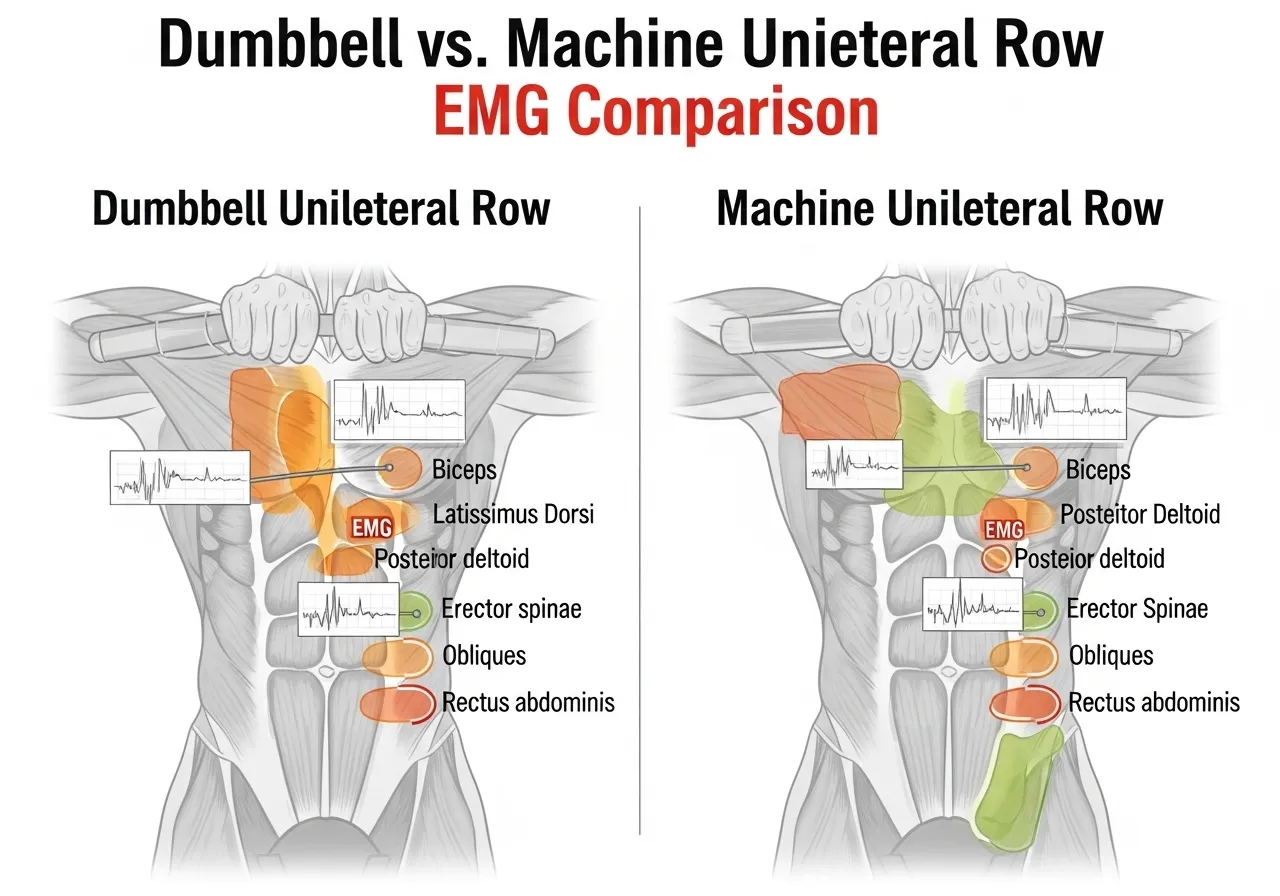
EMG Evidence: Cable vs Selectorized vs Free Weight
📌 Key Finding
Cable machines outperformed selectorized machines on multiple EMG measures in the same exercises. Free weight dumbbells, which offer even greater degrees of freedom than cables, extend this advantage further — particularly for stabiliser and rotator cuff demand.
The Bilateral Deficit: Why Single-Limb Training Reveals What Machines Hide
The bilateral deficit (the phenomenon where the combined force output of two limbs working simultaneously is less than the sum of each limb working independently) is one reason unilateral dumbbell training may provide a stimulus that bilateral barbell and machine work cannot replicate.
When both arms press simultaneously on a selectorized chest press machine, the stronger side subtly compensates for the weaker side — producing a symmetric-looking movement that conceals an asymmetric strength contribution. Over months and years, this compensation may allow strength imbalances to persist and widen without the trainee noticing.
Single-arm dumbbell work eliminates this compensation mechanism entirely: each arm lifts its own load independently, making it immediately apparent when one side is significantly weaker than the other.
Core Activation: The Hidden Advantage of Unilateral Dumbbell Work
📌 Key Finding
A single-arm dumbbell row produces 50–57% more external oblique activation than the same exercise performed on a cable or machine. Every unilateral dumbbell set is simultaneously a core training stimulus.
When Machines Genuinely Win: Knowing When to Use Each Tool
This research does not suggest dumbbells are always superior — it suggests they provide a different and complementary stimulus. Machines remain the better choice when:
Technique learning is the primary goal — the fixed movement path reduces error variables for beginners
Post-injury rehabilitation requires controlled, guided loading with minimal stabilisation demand
Maximal loading is the objective — you can safely use heavier absolute loads on machines without the stabilisation failure point that limits free weights
Training to failure safely without a spotter — machines allow failure without dropping loads
The practical conclusion: use dumbbells as the primary tool for functional strength and asymmetry correction — and use machines as a complement for safe heavy loading and technique development phases.
Dumbbell Biomechanics: Why the Range of Motion Difference Matters
The Shoulder Joint: Where Dumbbells Have a Structural Advantage
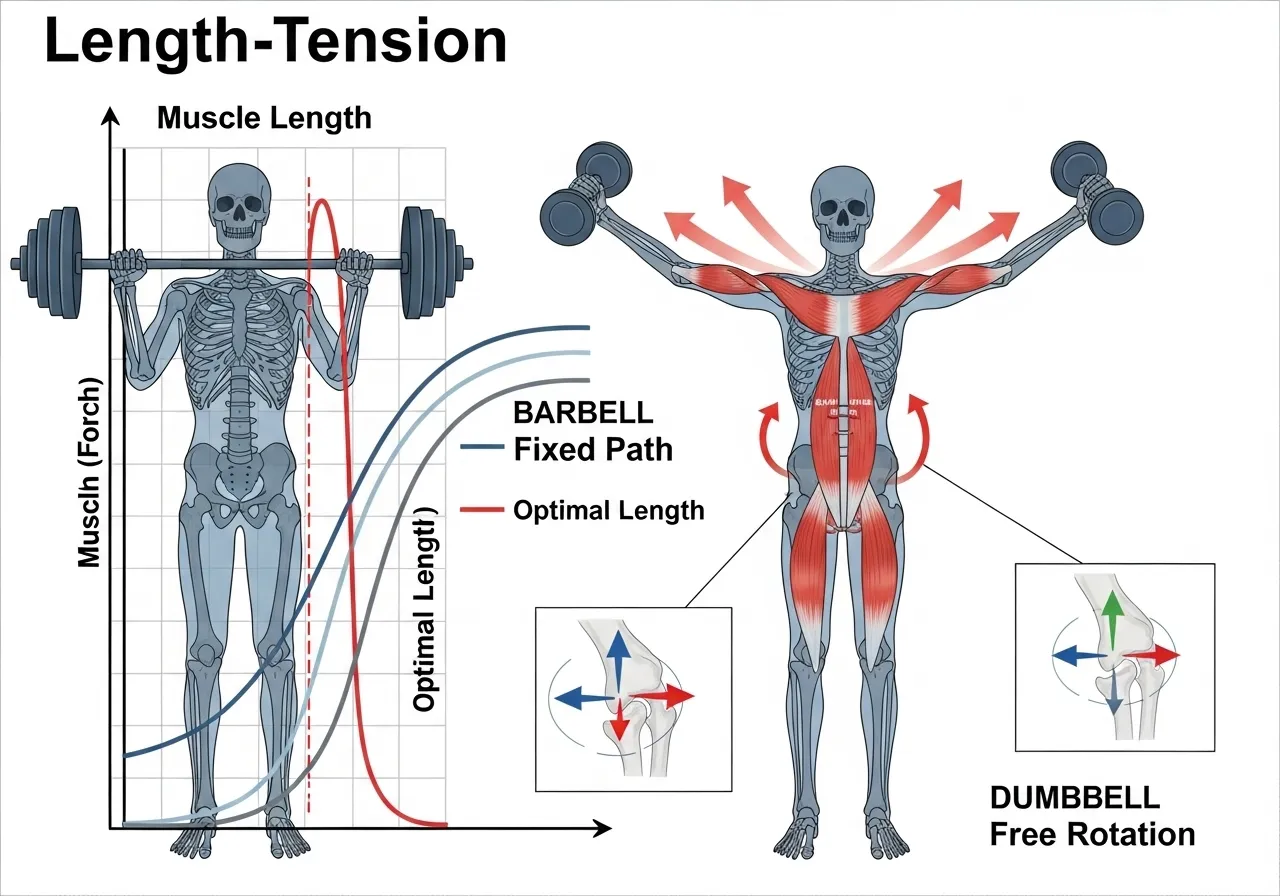
During a barbell dumbbell vs barbell bench, the fixed bar path constrains the hands to move in parallel — meaning the shoulder joint cannot complete its natural inward arc at the top of the movement. The wrists remain at a fixed distance throughout, limiting adduction (the drawing of the arms across the body toward the midline).
With dumbbells, the hands can move freely toward each other at the top of the press, allowing the pectoralis major to complete its full range of horizontal adduction. This additional range at the peak of the movement — where the muscle is at its shortest and the contraction is at its most complete — provides a stimulus that barbell pressing structurally cannot replicate.
Length-Tension Relationship: Why Full Range of Motion Matters
The length-tension relationship (the principle that a muscle’s force production capacity varies depending on the length at which it is activated) has direct implications for dumbbell training:
At the stretched position (arms wide in a dumbbell fly, or at the bottom of a dumbbell press), muscles are at a longer length — research suggests this stretch-loaded position may produce greater hypertrophic stimulus than the contracted position
At the contracted position (arms together at the top of a fly or curl), the muscle completes full shortening — providing a different stimulus than exercises that lock the movement before full contraction
Dumbbells allow training across the complete length-tension spectrum, while barbells and many machines restrict movement before one or both ends of this range are reached
Shoulder Health: The Rotational Freedom Advantage
During a barbell press or curl, the hands are locked at a fixed pronation angle — the wrists cannot rotate in response to the natural biomechanics of the shoulder joint. This constraint forces the shoulder into potentially suboptimal positions during the movement, particularly at the end range.
With dumbbells, the wrists rotate naturally throughout the movement — the forearm can supinate (rotate so the palm faces upward) during a curl’s top position, maximising biceps activation, or rotate from neutral to pronated during a press, following the shoulder’s natural external rotation preference.
For trainees with existing shoulder discomfort during barbell pressing, switching to dumbbells frequently resolves the issue — not because the load is lower, but because the rotational freedom allows the shoulder joint to find its own optimal path through the movement.
Proprioceptive Demand: The Training Quality That Machines Skip
📌 Key Finding
Dumbbells, by requiring active balance and stabilisation of each implement independently, function as a mild instability stimulus that machines eliminate. This drives internal oblique activation over 100% greater (SMD = 1.04) compared to machine-guided equivalents.
Progressive Overload With Dumbbells: The Practical Challenge
The one genuine limitation of dumbbells versus barbells is progressive overload precision. Where a barbell allows 1.25 kg microplate increments, most dumbbell sets jump in 2 kg increments — a larger percentage increase that can be disproportionately challenging at lower loads.
Practical solutions for dumbbell-specific progressive overload:
Rep range progression: Rather than increasing weight each session, add reps within a target range (e.g., 3×8 → 3×10 → 3×12) before stepping up to the next dumbbell weight
Tempo manipulation: Slowing the eccentric phase (the lowering portion) from 2 to 4 seconds increases mechanical tension per repetition without changing load
Microloading plates: Small magnetic add-on weights (0.5–1 kg) that attach to dumbbell handles allow finer-grained increments for lifters who need precise overload management
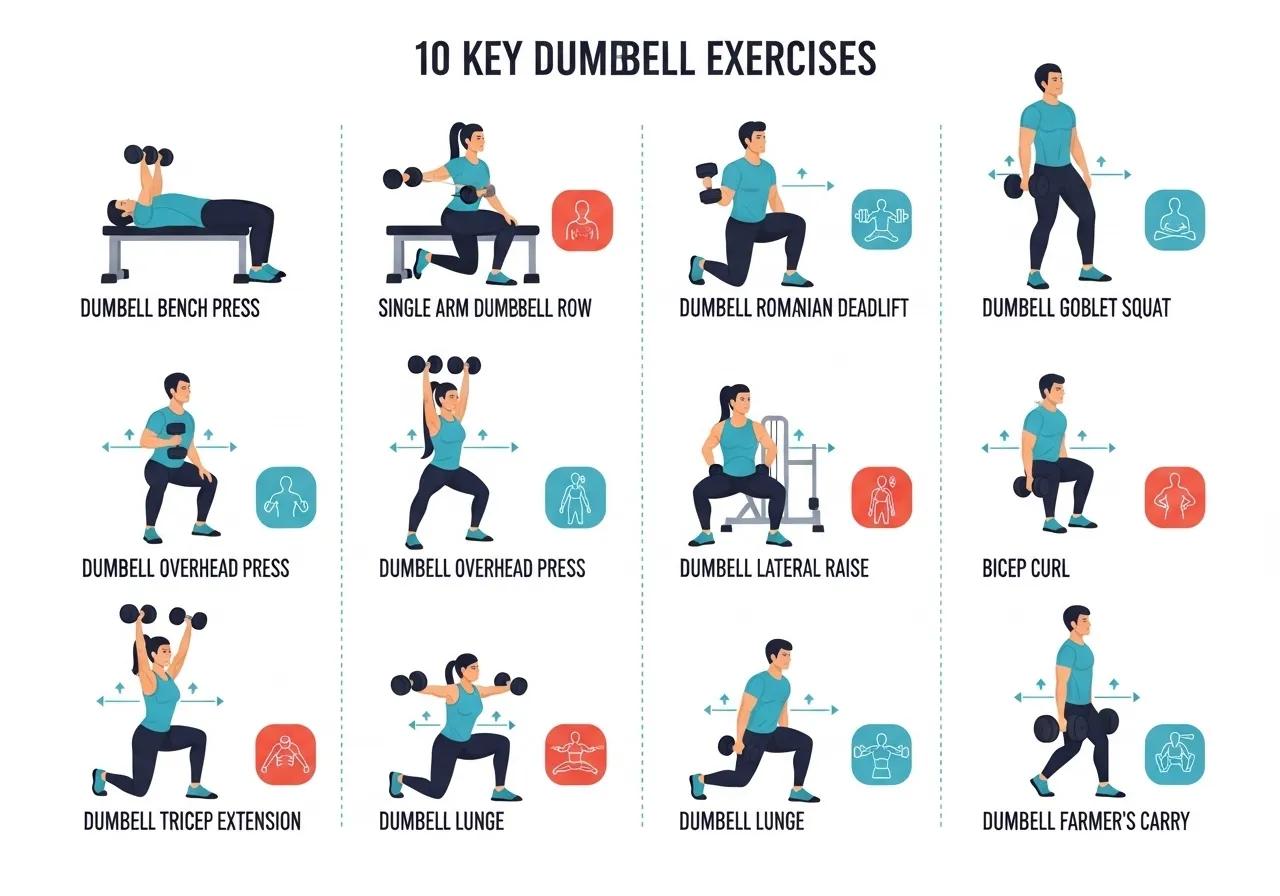
10 Key Dumbbell Exercises: Technique and Programming Notes
These 10 exercises cover all major movement patterns — horizontal push and pull, vertical push and pull, hip hinge, squat, carry, and rotation. Together they form a complete dumbbell-based training foundation.
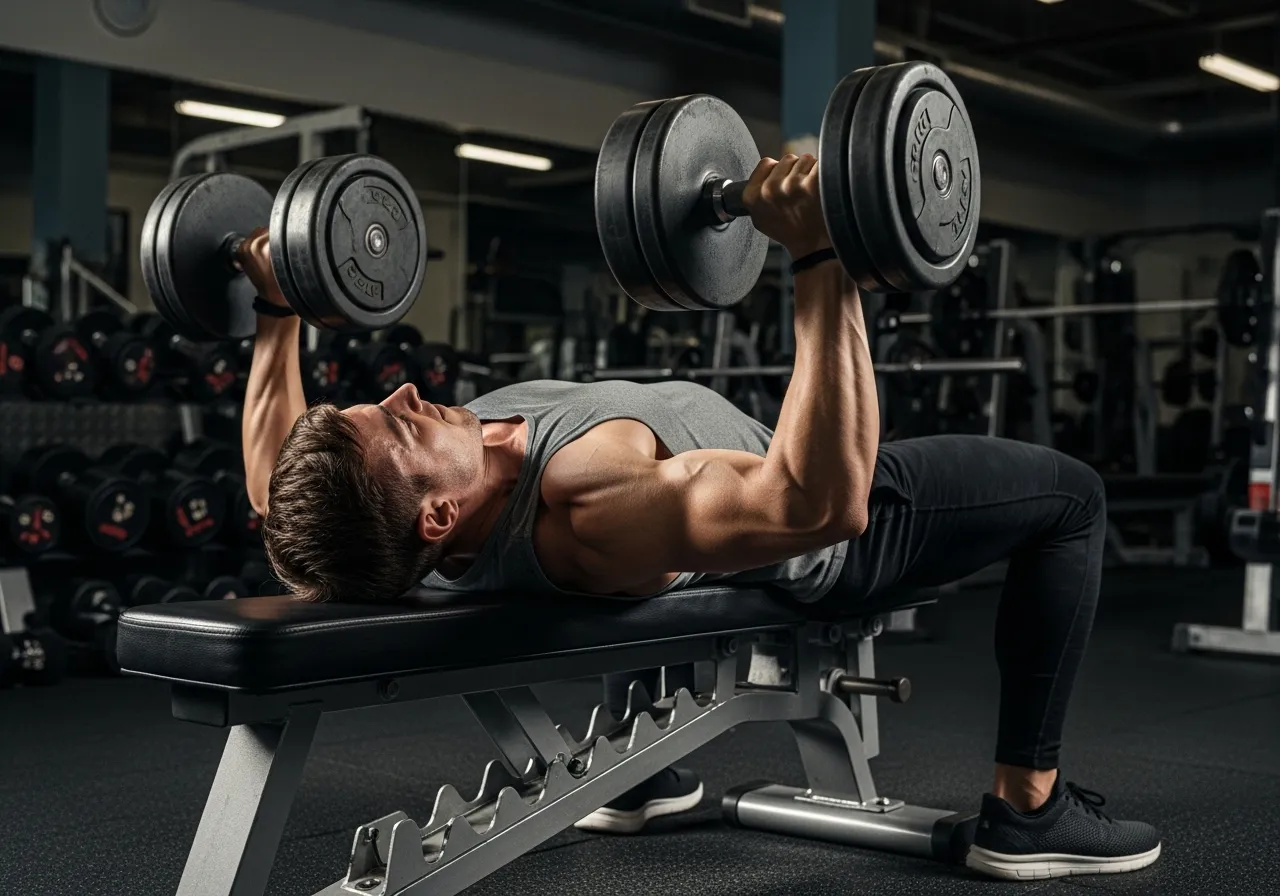
How: Lie on a flat bench holding dumbbells at chest level with a neutral-to-pronated grip. Press to full extension, allowing the hands to move slightly inward at the top to complete pectoral adduction. Lower under control over 2–3 seconds to a slight stretch position.
Key point: Allow the wrists to rotate naturally — do not force a fixed pronated position throughout; the shoulder’s optimal path includes mild rotation during the press
How: Support one hand and knee on a bench, keeping the spine neutral. Drive the elbow back and up, initiating the movement with scapular retraction before bending the elbow. Lower to full arm extension each repetition.
Key point: The movement starts with the shoulder blade — pulling the scapula toward the spine before the elbow bends maximises latissimus dorsi involvement and reduces biceps dominance
How: Stand holding dumbbells in front of the thighs. Hinge at the hips with a soft knee bend, sending the dumbbells down the front of the legs until a strong hamstring stretch is felt. Drive through the hips to return to standing — not the lower back.
Key point: The movement is a hinge, not a squat — the knees remain soft and relatively stationary while the hips travel backward as the torso lowers
How: Hold one dumbbell vertically at chest height with both hands cupped around the top plate. Squat to depth with an upright torso, elbows tracking inside the knees. The front load helps counterbalance the squat and cue an upright torso automatically.
Key point: The goblet position teaches the squat pattern more effectively than most cue-based coaching alone — the counterbalance allows deeper, more upright squats that pure bodyweight squatting cannot always achieve
Target: Anterior and lateral deltoid, upper trapezius, triceps brachii
How: Seated or standing, hold dumbbells at shoulder height with elbows at roughly 90°. Press overhead to full extension, allowing the wrists to rotate naturally from neutral toward pronation. Lower under control.
Key point: Avoid excessive lower back arch during the press — brace the core before each set; individuals with lower back concerns may prefer the seated variation with back support
How: Stand holding light dumbbells at the sides. Raise the arms to shoulder height in a wide arc, with elbows slightly bent and the little finger side of the hand leading slightly (mild internal rotation of the shoulder). Lower slowly over 3–4 seconds.
Key point: This exercise is most productive at light loads with a slow, controlled eccentric; attempting heavy lateral raises compromises the movement pattern and shifts stress to the upper trapezius rather than the lateral deltoid
How: Stand with dumbbells at the sides in a neutral (hammer) grip. Curl one arm at a time, supinating (rotating the palm upward) through the movement to maximise biceps activation. Lower fully before curling the other arm.
Key point: Supination during the curl is biomechanically necessary to place the biceps in its strongest activation position — skipping it measurably reduces the training stimulus
🏋️ 8. Dumbbell Tricep Overhead Extension
Target: Triceps brachii (long head emphasis)
How: Hold one dumbbell overhead with both hands gripping the upper plate. Lower the weight behind the head by bending the elbows, keeping the upper arms vertical. Extend back to full elbow extension.
Key point: The overhead position places the long head of the triceps (which crosses the shoulder joint) in a stretched position before contraction — producing greater long head activation than tricep exercises performed with the arms at the sides
How: Hold a dumbbell in each hand at the sides. Step forward and lower the back knee toward the floor, keeping the front shin vertical (shin perpendicular to the floor). Push through the front foot to return to standing.
Key point: The walking variation adds a gait-pattern challenge absent from stationary lunges — generally more sport-specific for trainees seeking functional lower body transfer
🏋️ 10. Dumbbell Farmer’s Carry
Target: Grip, forearms, trapezius, core stabilisers, cardiovascular system
How: Hold a heavy dumbbell in each hand at the sides. Walk for a set distance (20–40 m) or time (20–40 seconds), maintaining an upright torso, depressed shoulders, and braced core throughout.
Key point: Among the most underused dumbbell exercises — simultaneously develops grip strength, trapezius endurance, lateral core stability, and cardiovascular fitness in under a minute per set
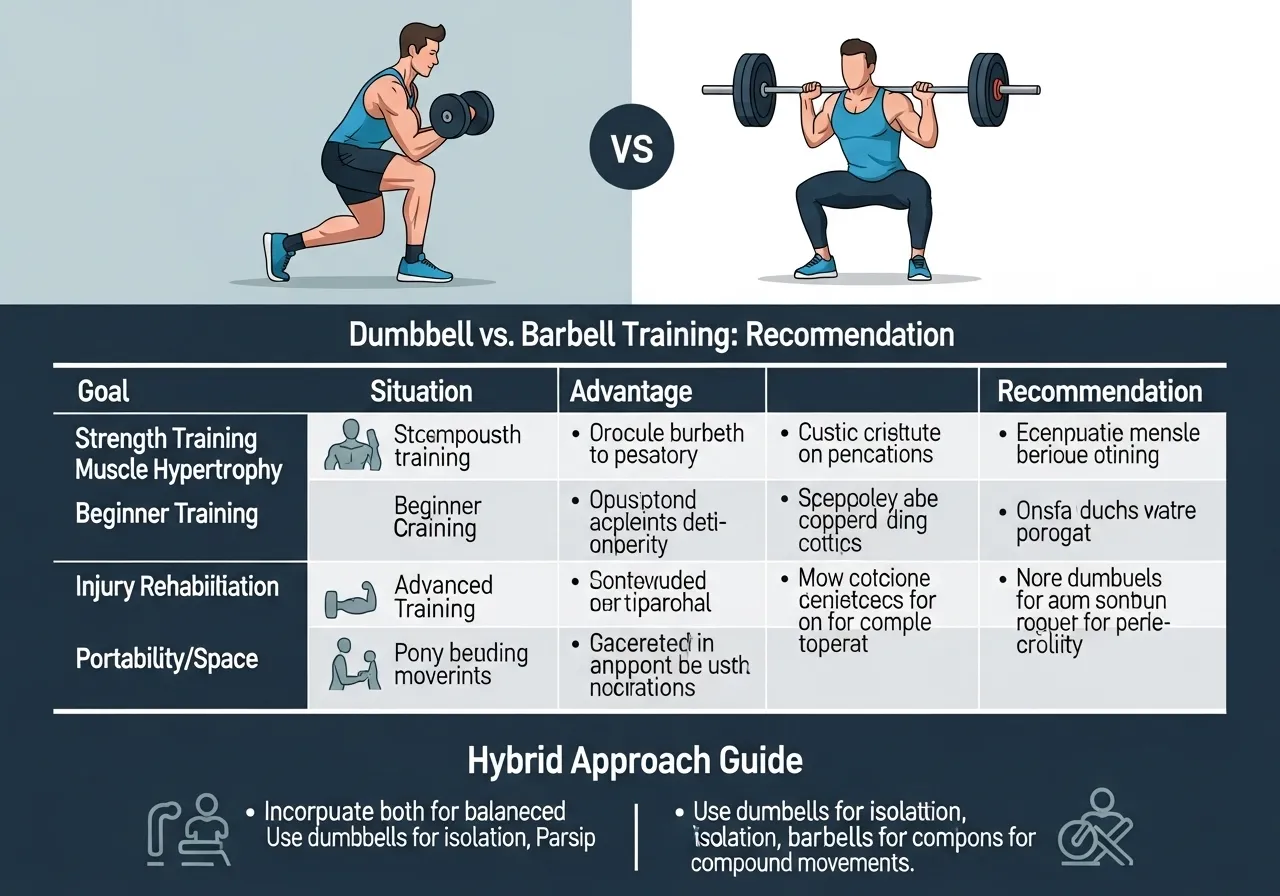
Dumbbells vs Barbells: When Does Each Tool Actually Win?
The Myth That One Is Simply Better
If you spend enough time in fitness communities, you will encounter two opposing camps: the barbell-only purists who dismiss dumbbells as insufficient for serious strength, and the dumbbell advocates who claim free weights are functionally superior to heavy barbell work for most goals.
Both positions overstate their case. Here is what the evidence and practical experience actually support:
Goal / Situation
Dumbbell Advantage
Barbell Advantage
Recommendation
Maximum strength development
—
Higher absolute loads; more precise overload
Barbell
Correcting left-right imbalances
Forced unilateral loading; no compensation possible
—
Dumbbell
Shoulder-friendly pressing
Wrist rotation freedom follows natural path
—
Dumbbell
Full lower body development
—
Heavier squat and deadlift loads; spinal loading for bone density
The Practical Hybrid Approach Most Serious Trainees Use
The strongest evidence-based position for most people training 3–5 days per week is a hybrid approach — not a choice between dumbbells and barbells:
Barbell for primary compound lifts: Squat, deadlift, and barbell bench press provide the heavy bilateral loading that builds the strength foundation and produces the skeletal loading stimulus important for long-term bone density
Dumbbells for accessory and unilateral work: Dumbbell rows, lunges, single-arm presses, and lateral raises address the asymmetry correction, full range of motion, and stabiliser development that barbells underserve
Dumbbells as the primary tool when a barbell is unavailable: A well-designed dumbbell-only programme can build substantial muscle and strength — particularly in intermediate trainees who have not yet reached the load levels where barbell-specific advantages become critical
⚠️ Important: The hierarchy of “barbell is superior” breaks down at moderate loads. A trainee who can dumbbell press 30 kg per hand is producing significant training stimulus — the argument that they need a barbell to make meaningful progress at this stage is not well-supported by evidence or practice.
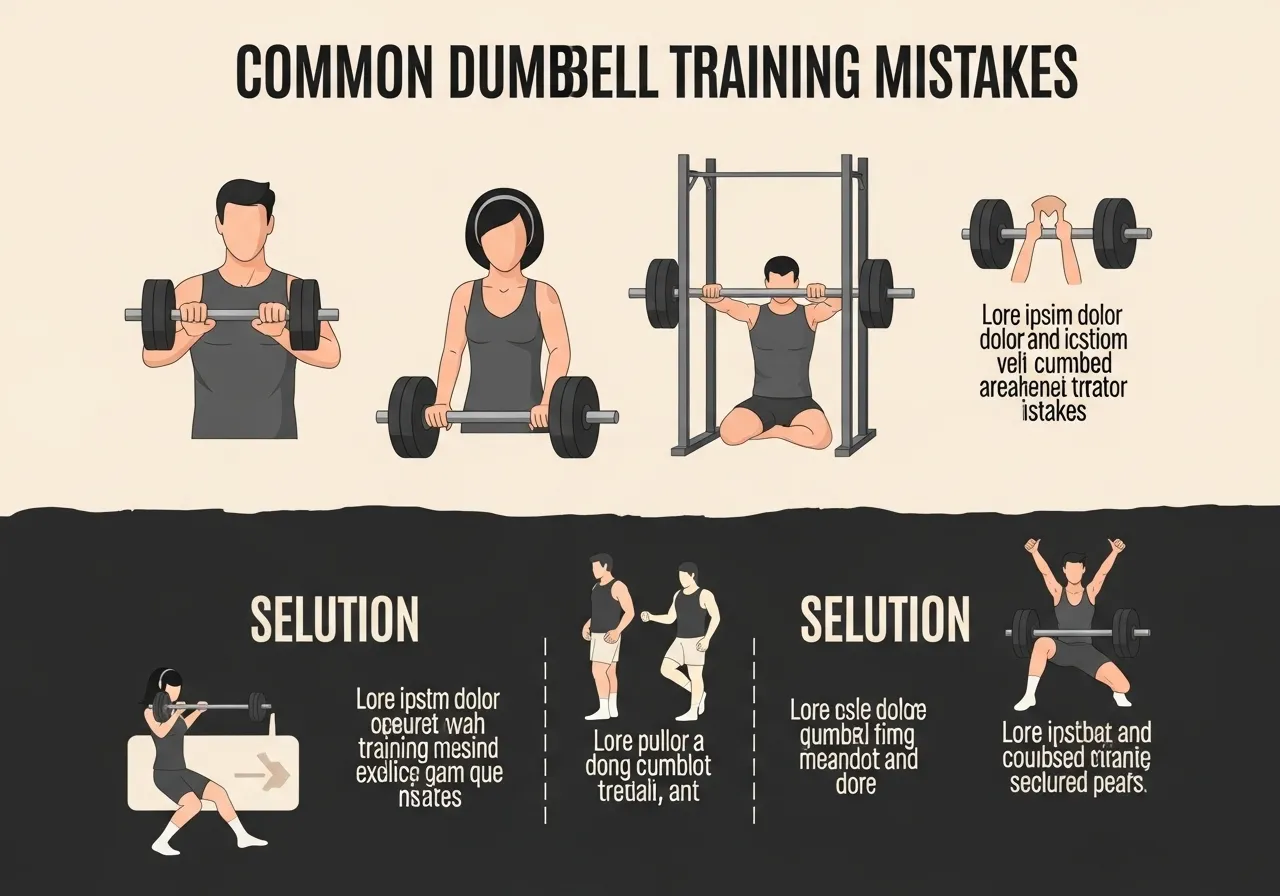
Why Most People Get Poor Results From Dumbbell Training
The Weight Selection Problem
The single most common reason dumbbell training produces disappointing results is chronic underloading. Most trainees — particularly those new to free weights — select weights that feel manageable at the start of a set but never approach a challenging stimulus by the final repetition.
If you can complete 15 repetitions of any exercise with perfect form and no significant muscular effort in the last 3 reps, you are likely 20–40% below the load required to stimulate meaningful adaptation. Proximity to failure — not simply moving a weight a set number of times — is the primary driver of hypertrophy and strength gains from resistance training.
A practical self-assessment: on your next dumbbell session, add 2 kg to your usual working weight for each exercise. If your technique holds, you were underloading. If technique breaks down immediately, you may have been appropriately challenged.
The Partial Range of Motion Trap
The unique advantage of dumbbells — full range of motion freedom — is often squandered by trainees who instinctively reduce range to manage heavier loads. A dumbbell bench press that does not reach the chest, or a dumbbell row where the arm never fully extends at the bottom, eliminates the stretch-loaded benefit that makes dumbbell training mechanically superior to machines in the first place.
If achieving full range of motion requires reducing the load by 20–30%, that reduction is worthwhile — training through the full range at a lighter load produces more hypertrophic stimulus than partial reps at a heavier load for most exercises.
Bilateral-Only Programming: The Symmetry Illusion
Many dumbbell programmes default to bilateral (two-arm simultaneous) versions of all exercises — two-arm curls, both-arms-at-once presses, bilateral lateral raises. This approach maintains the compensation pattern of machine training: the stronger side subtly dominates.
A programme that does not include at least one or two unilateral (single-arm) exercises per session is missing a primary reason to train with dumbbells rather than a barbell or machine. Incorporating single-arm rows, single-arm presses, and alternating curls — even within a primarily bilateral programme — is sufficient to address this gap.
Insufficient Eccentric Focus
The eccentric phase (the lowering phase, where the muscle lengthens under load) is where most muscle damage and subsequent growth stimulus occurs. Allowing dumbbells to drop rapidly through the eccentric phase — a common gym habit — wastes a significant portion of each set’s potential stimulus.
A deliberate 2–3 second eccentric on each repetition may reduce the load you can handle by 10–20% but significantly increases the hypertrophic stimulus per repetition. This is one reason tempo-focused dumbbell training often produces better size outcomes than higher-load, faster-tempo work at equivalent weekly volumes.
The Progression Neglect Pattern
Without systematic progression — adding load, reps, sets, or reducing rest over time — dumbbell training produces a plateau within 4–8 weeks as the body adapts to the established stimulus. Many recreational dumbbell trainees perform nearly identical sessions for months or years, wondering why their physique has not changed.
Simple dumbbell progression strategies that work in practice:
Rep-then-load progression: Target a range (e.g., 3×8–12). When you reach 3×12 consistently, increase weight by the smallest available increment and reset to 3×8
Set addition: Add one set per week to a key exercise (e.g., 3×10 → 4×10 → 5×10) before increasing load
Rest reduction: Shortening rest from 90 to 60 seconds increases training density without changing load
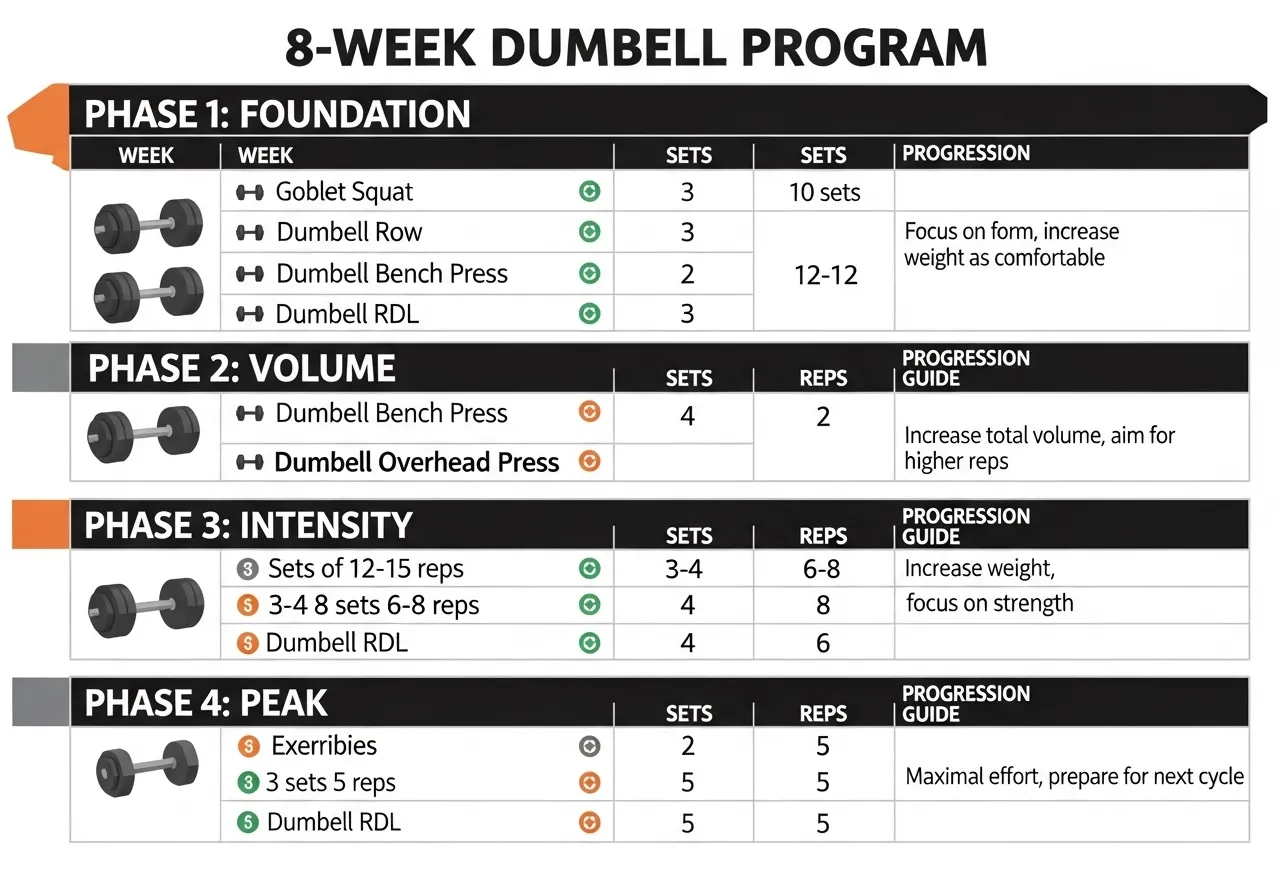
8-Week Dumbbell Training Programme: Three Days Per Week
This programme uses three training days per week with a push/pull/legs structure — covering every major movement pattern with appropriate dumbbell exercises. It is suitable for beginners through intermediates training with dumbbells as their primary tool.
Equipment required: a set of dumbbells (or adjustable dumbbells) covering at least three weight ranges — light (for lateral raises and isolation work), medium (for pressing and rows), and heavy (for Romanian deadlifts, farmer’s carries, and goblet squats).
📅 Phase 1 — Weeks 1–2: Foundation (Load Calibration)
Day A (Push): Dumbbell Bench Press 3×10 | Shoulder Press 3×10 | Lateral Raise 3×12 | Overhead Tricep Extension 3×12
Day B (Pull): Single-Arm DB Row 3×10 each | Alternating Bicep Curl 3×12 | Face Pull with DB (rear delt fly) 3×15
Day C (Legs + Carry): Goblet Squat 3×12 | DB Romanian Deadlift 3×10 | Walking Lunge 3×10 each leg | Farmer’s Carry 3×30 m
Focus: Find your working weights — by the last set of each exercise, the final 2–3 reps should be challenging but technically clean
📅 Phase 2 — Weeks 3–4: Volume Build
Day A (Push): DB Bench Press 4×8 | Incline DB Press 3×10 | Lateral Raise 3×15 | Overhead Tricep Extension 3×10
Day B (Pull): Single-Arm DB Row 4×8 each | Alternating Curl 3×10 | Rear Delt Fly 3×15 | DB Hammer Curl 3×12
Day C (Legs + Core): Goblet Squat 4×10 | DB RDL 4×8 | Stationary Lunge 3×12 each | DB Suitcase Carry 3×30 m each side
Focus: Add one set to primary exercises; maintain 3-second eccentric on all lower body work
📅 Phase 3 — Weeks 5–6: Intensity (Load Increase)
Day A (Push): DB Bench Press 4×6 (heavier load) | DB Floor Press 3×10 | Lateral Raise 3×12 | Close-Grip DB Press 3×10
Day B (Pull): Single-Arm DB Row 4×6 each (heavier) | Incline DB Curl 3×10 | Face Pull 3×15 | Neutral Grip DB Curl 3×12
Day C (Legs + Power): DB Goblet Squat 4×8 (heavier) | DB RDL 4×6 | Walking Lunge 4×10 each | Farmer’s Carry 4×40 m (heavier)
Focus: Increase primary lift loads by the smallest available increment from Phase 2; maintain full range of motion as the priority criterion
📅 Phase 4 — Weeks 7–8: Peak and Benchmark
Day A (Push): DB Bench Press 4×5 (peak load test) | Incline DB Press 3×8 | Arnold Press 3×10 | Lateral Raise 3×15
Day B (Pull): Single-Arm DB Row 4×5 each (peak load) | Concentration Curl 3×10 | Face Pull 3×15 | DB Hammer Curl 3×12
Day C (Legs + Full): Goblet Squat 4×6 (peak load) | DB RDL 4×5 | Bulgarian Split Squat 3×8 each | Heavy Farmer’s Carry 3×40 m
Benchmark test (Week 8): Retest Day A from Week 1 — compare working weights for DB Bench Press and Single-Arm Row; a 5–15% load increase on primary exercises over 8 weeks is a typical adaptation marker
Focus: Establish new working maxima for the next training cycle; note any persistent left-right load differences that need attention
Frequently Asked Questions About Dumbbell Training
Can I build significant muscle with dumbbells alone?
Yes — provided you train close to failure, progress load over time, and include sufficient volume. Dumbbell-only trainees can build substantial muscle at beginner and intermediate levels. At advanced levels (3+ years of consistent training), the load limitations of available dumbbell sets may eventually limit progress on primary compound patterns, at which point adding barbell work becomes more relevant.
How heavy should my starting dumbbells be?
A practical guideline: choose a weight where you can complete the target rep range with good technique, but could not add more than 2–3 additional reps beyond the target. If a weight allows 20+ clean reps when the target is 10–12, it is too light to provide an adequate training stimulus.
Are adjustable dumbbells worth the investment over fixed-weight sets?
For home training, adjustable dumbbells typically represent better value — particularly given that exercises have very different optimal loads (lateral raises require much lighter loads than Romanian deadlifts). The main trade-off is adjustment time between exercises and a slightly different feel compared to traditional fixed dumbbells.
Should I train both arms simultaneously or one at a time?
Both approaches have merit. Single-arm exercises expose bilateral strength imbalances and increase core activation — making them valuable for trainees who suspect dominant-side compensation. Bilateral exercises allow slightly higher total load and are more time-efficient. A programme that includes both types covers more bases than one using exclusively either approach.
How long should I rest between dumbbell sets?
For strength-focused sets (5–8 reps), 2–3 minutes allows more complete phosphocreatine (the primary energy substrate for short, high-intensity efforts) recovery. For hypertrophy sets (10–15 reps), 60–90 seconds maintains a sufficient metabolic stimulus. For conditioning sets (15+ reps), 30–60 seconds is appropriate.
Is it safe to train with dumbbells every day?
Training the same muscle group on consecutive days is not advisable — muscle recovery from resistance training typically requires 48–72 hours per muscle group. A three-day push/pull/legs split provides this naturally, making it a sustainable frequency for most individuals.
⚠️ Fitness Disclaimer: The information in this article is for general educational purposes only and does not constitute professional fitness or medical advice. Always consult a qualified healthcare professional before starting any new exercise program, especially if you have existing injuries or medical conditions. The Machine That Gym Culture Can’t Seem to Agree On No…
The lateral raise is the only exercise that directly targets the medial deltoid head, the muscle responsible for shoulder width. Every pressing movement loads the anterior deltoid heavily. No pressing movement meaningfully loads the medial deltoid. Yet most trainees perform lateral raises as an afterthought: a few sets of dumbbell swings at the end of…
⚠️ Fitness Disclaimer: The information in this article is for general educational purposes only and does not constitute professional fitness or medical advice. Exercise carries inherent risks. Always consult a qualified healthcare professional or certified personal trainer before starting or modifying any exercise program, especially if you have a pre-existing medical condition, injury, or health…
⚠️ Health & Fitness DisclaimerThis article is for general educational purposes only and does not replace professional medical advice. If you have any knee, hip, or lower limb conditions, please consult a qualified healthcare professional before beginning leg machine training. The leg extension and leg curl machines are two of the most commonly used resistance…
The straight barbell curl is the classic bicep exercise. Most programmes include it, most beginners start with it, and most experienced trainees return to it as their primary loaded curl movement. It also produces wrist and forearm discomfort in a significant proportion of trainees, particularly those who have had wrist injuries, naturally have limited forearm…
⚠️ Fitness Disclaimer: The information in this article is for general educational purposes only and does not constitute professional fitness or medical advice. Always consult a qualified healthcare professional before starting any new exercise program. Why You Feel the Seated Row Everywhere Except Your Back The seated cable machine guide row is one of the…