The straight barbell curl is the classic bicep exercise. Most programmes include it, most beginners start with it, and most experienced trainees return to it as their primary loaded curl movement. It also produces wrist and forearm discomfort in a significant proportion of trainees, particularly those who have had wrist injuries, naturally have limited forearm supination range, or who perform high weekly curl volumes that accumulate stress at the fully supinated wrist position.
The EZ bar curl is the most common solution, but it is often adopted without understanding what the angled grip actually changes. The EZ bar’s curved grip puts the forearm in a semi-supinated or semi-pronated position (approximately 30 to 45 degrees from full supination) that reduces the pronation-supination stress at the wrist and elbow compared to the fully supinated position of the straight barbell curl. The question that matters for training decisions is whether this grip change costs meaningful bicep activation in exchange for the reduced wrist stress.
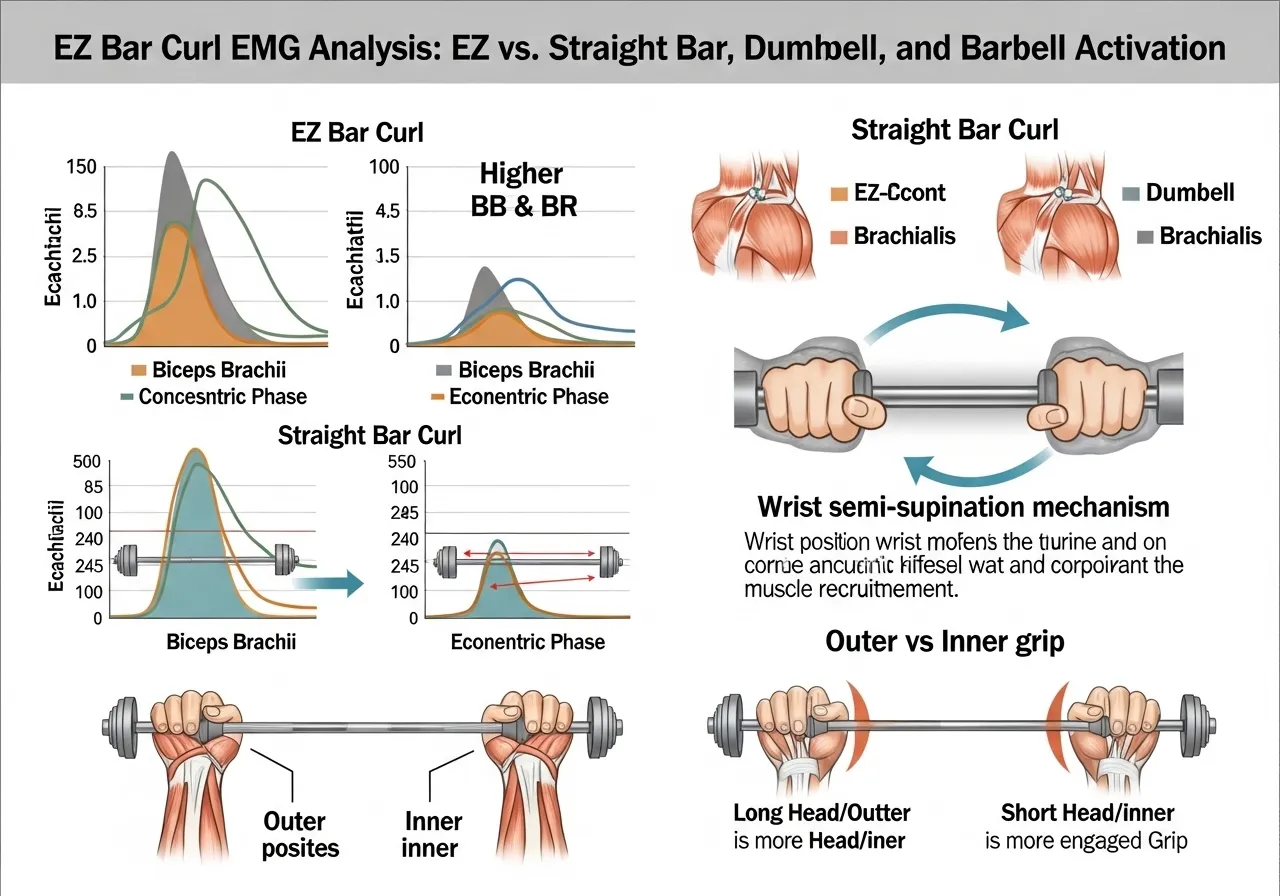
The EMG research on this question is clear enough to guide programming: the EZ bar curl produces similar or higher biceps brachii and brachioradialis activation compared to the dumbbell curl, and marginally different but largely equivalent biceps brachii activation compared to the straight barbell curl. The grip change that reduces wrist stress does not produce a meaningful reduction in the primary training stimulus. This guide covers the EMG evidence, what the angled grip changes biomechanically, technique, how to programme the EZ bar curl alongside other curl variations, and variations for different goals.
Research: EZ Bar vs Straight Bar vs Dumbbell, What the EMG Shows
The Three-Way Curl Comparison: EZ Bar Wins for Brachioradialis
📌 Key Finding
The EZ bar and straight barbell curl produce equivalent biceps brachii and brachioradialis stimulus. The choice between them is a matter of comfort, not activation. The EZ bar produces higher activation than the dumbbell curl in both muscles.
Straight vs EZ Bar: Biceps Brachii and Anterior Deltoid Comparison
📌 Key Finding
Straight and EZ bar curls show distinct biceps brachii and anterior deltoid excitation patterns. The EZ bar’s semi-supinated grip shifts relative contribution between these muscles, with implications for trainees who want to maximise bicep brachii isolation versus those who are satisfied with the combined stimulus the EZ bar provides.
The Wrist Position and Supination Research
The biomechanical basis for the EZ bar’s wrist comfort advantage lies in the anatomy of the radioulnar joint. Full supination of the forearm, required for the straight barbell curl, places the radius and ulna in a crossed position that maximises the mechanical advantage of the biceps brachii as a supinator. This crossed position also places the distal radioulnar joint at the limit of its rotation range, creating stress that accumulates with repeated full-supination loading across high curl volumes.
The EZ bar’s 30 to 45-degree semi-supinated grip moves the forearm away from full-rotation range, reducing the radioulnar joint stress while maintaining sufficient supination for significant biceps brachii activation. The biceps brachii’s peak activation occurs at full supination, but it remains highly activated through the semi-supinated range that the EZ bar uses. The reduction in peak bicep activation from EZ bar versus straight bar is small enough that the research characterises the choice as comfort-based rather than activation-based. Further detailed EMG comparisons of barbell curl variations are covered in the bicep curl guide.
Grip Width on the EZ Bar: Does It Matter?
The EZ bar provides multiple grip positions, with the inner angled grips producing greater semi-pronation and the outer grips producing greater semi-supination. The inner grip position (more pronated) shifts activation further toward the brachioradialis at the expense of some biceps brachii activation. The outer grip position (less pronated, closer to neutral supination) provides greater biceps brachii activation while still reducing the full-supination stress of the straight bar.
📌 Key Finding
EZ bar curls produce higher biceps brachii and brachioradialis activation than dumbbell curls. The EZ bar is not a compromise between straight bar and dumbbell, it is an effective primary curl tool with its own biomechanical advantages at specific grip positions.
Who Benefits Most From the EZ Bar vs Straight Bar
The EZ bar provides meaningful advantages over the straight bar for specific trainee profiles. Trainees with wrist pain specifically during or after straight barbell curls benefit from switching to the EZ bar’s semi-supinated grip, which reduces radioulnar stress without sacrificing the bicep activation that motivated the straight bar preference. Trainees with lateral elbow pain (tennis elbow) often find the EZ bar more comfortable than both the straight bar and dumbbell curl because the semi-supinated position reduces the brachioradialis tension at the lateral epicondyle origin. Trainees seeking higher brachioradialis development alongside biceps training benefit from the EZ bar’s consistently higher brachioradialis activation compared to dumbbell curls. Trainees without wrist discomfort and with a preference for maximum supination-driven bicep activation may prefer the straight bar or supinated dumbbell curl over the EZ bar specifically for short head bicep peak development.
EZ Bar Curl Technique: Setup, Execution, and the Details That Maximise Bicep Activation
Setup and Grip Selection
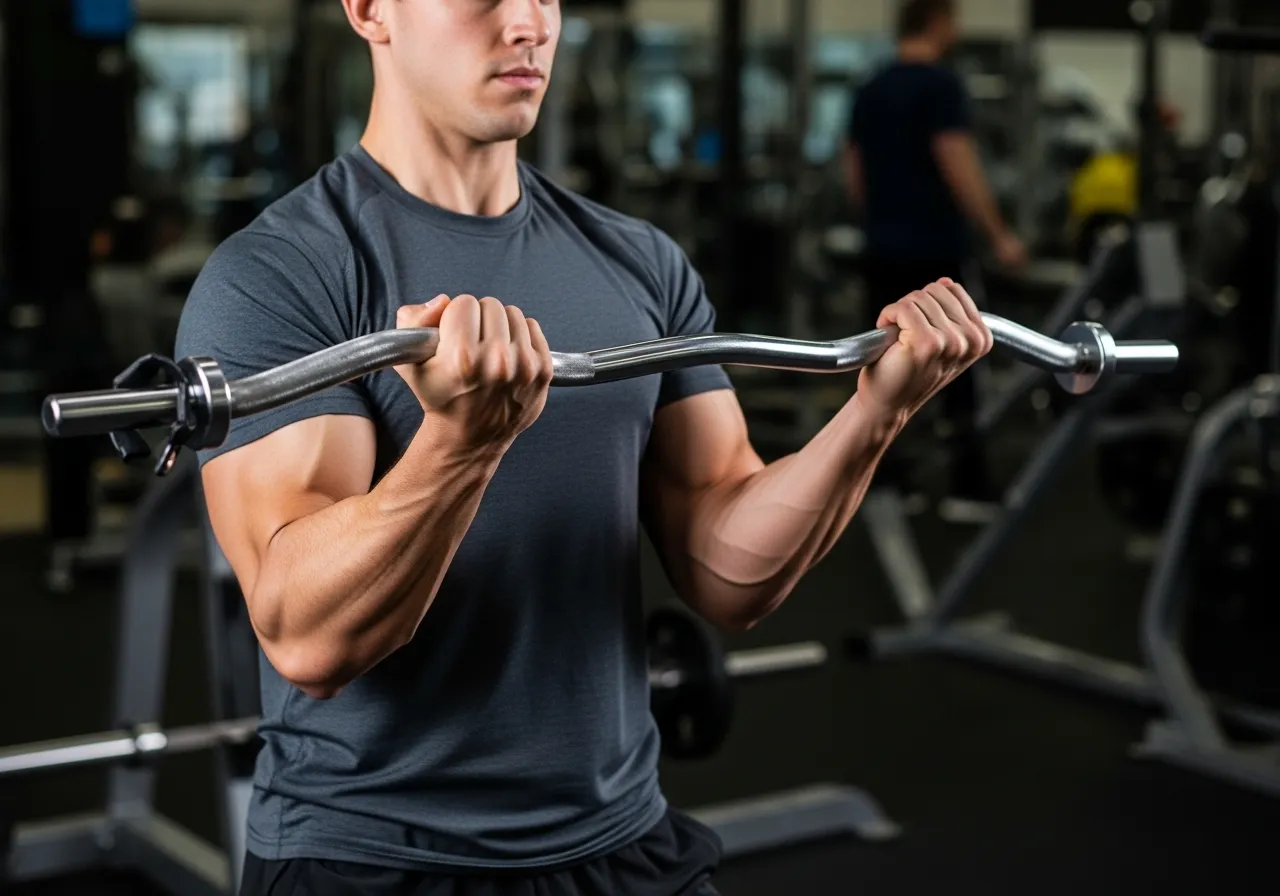
Stand with feet hip-width, knees slightly soft, and a neutral lumbar spine. Select either the inner or outer grip position on the EZ bar based on the goal described above. The outer grip (wider, more supinated) for maximum biceps brachii. The inner grip (narrower, more pronated) for increased brachioradialis contribution. Grip the bar firmly but without excessive wrist flexion or extension, keeping the wrists as neutral as possible within the EZ bar’s natural grip angle.
The most common EZ bar setup error is gripping the straight sections of the bar rather than the angled sections, effectively performing a straight barbell curl with an EZ bar that does not provide the wrist comfort advantage. Ensure the hands rest in the angled valleys of the EZ bar, where the grip naturally settles into the semi-supinated position.
The Curl: Elbows Fixed, No Body Swing
Curl the bar from the fully extended starting position to a peak contraction with the forearms approximately vertical. The elbows must remain fixed at the sides throughout. Allowing the elbows to travel forward during the concentric phase, which happens when the load is heavier than the biceps can manage without assistance, shifts the stimulus toward the anterior deltoid and reduces the biceps activation to below what the EZ bar’s EMG profile promises.
At the peak contraction, squeeze the biceps briefly. The EZ bar’s semi-supinated grip means the peak contraction stimulus is slightly different from a fully supinated curl: the bicep brachii is near but not at its maximum shortening position. This is the trade-off the EZ bar makes for wrist comfort, and it is why adding concentration curls or supinated dumbbell curls to the same programme complements the EZ bar rather than duplicating its stimulus. The short head peak development that the fully supinated concentration curl produces is covered in the concentration curl guide.
Eccentric Control: The Often-Neglected Phase
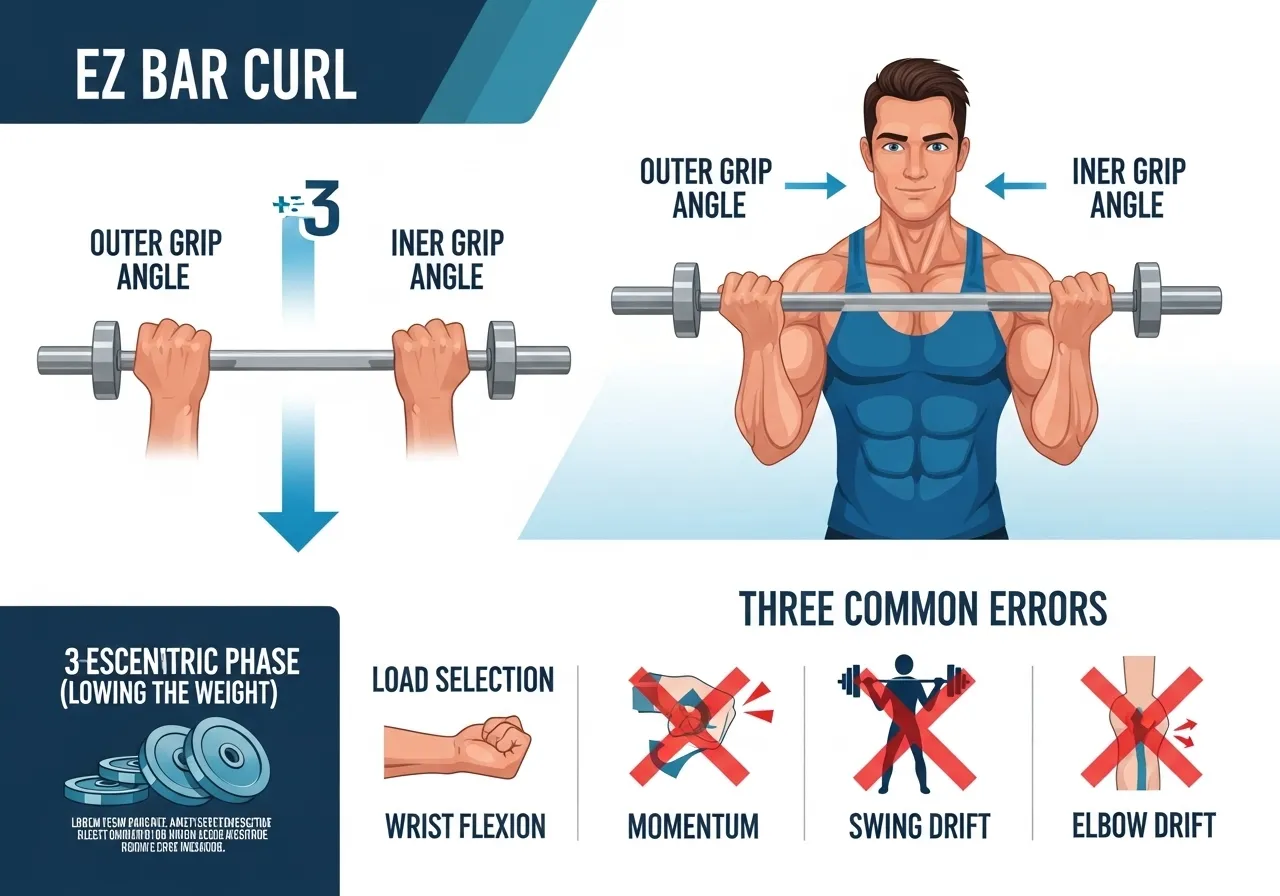
Lower the bar under control over 3 seconds to the fully extended starting position. The EZ bar curl’s eccentric phase provides significant biceps brachii loading as the muscle lengthens under resistance. Research confirms that eccentric phase activation in EZ bar curls is higher than in dumbbell curls, meaning the controlled lowering phase is not a passive return but an active bicep stimulus that a fast uncontrolled descent eliminates.
Load Selection for the EZ Bar
Most trainees can lift slightly more weight on the EZ bar than on the straight barbell curl because the semi-supinated wrist position allows a more mechanically efficient forearm angle for the bicep’s force production. The load should be selected at a weight where the bicep reaches near-failure at the target rep range without the elbows drifting forward or body swing occurring in the final reps. A set where the last 2 to 3 reps require visible body lean is 10 to 15% too heavy regardless of how the preceding reps felt.
Common Errors and Fixes
Three errors most commonly undermine EZ bar curl effectiveness. First, curling the wrists at the top, which substitutes wrist flexion for bicep contraction in the final range. Fix: maintain neutral wrists throughout, not letting them flex toward the ceiling at the peak. Second, using momentum from the lower back to initiate each rep, which reduces the bicep’s demand from the beginning of the range. Fix: brace the core and keep the back completely still, initiating each rep from the hanging position with the bicep alone. Third, choosing a load that allows elbow drift, where the elbows move forward during the curl to shorten the effective moment arm. Fix: reduce load until elbows remain stationary throughout the full set.
How Does the EZ Bar Curl Fit Into a Complete Bicep Programme Alongside Other Curl Variations?
The Four-Exercise Bicep Development Matrix
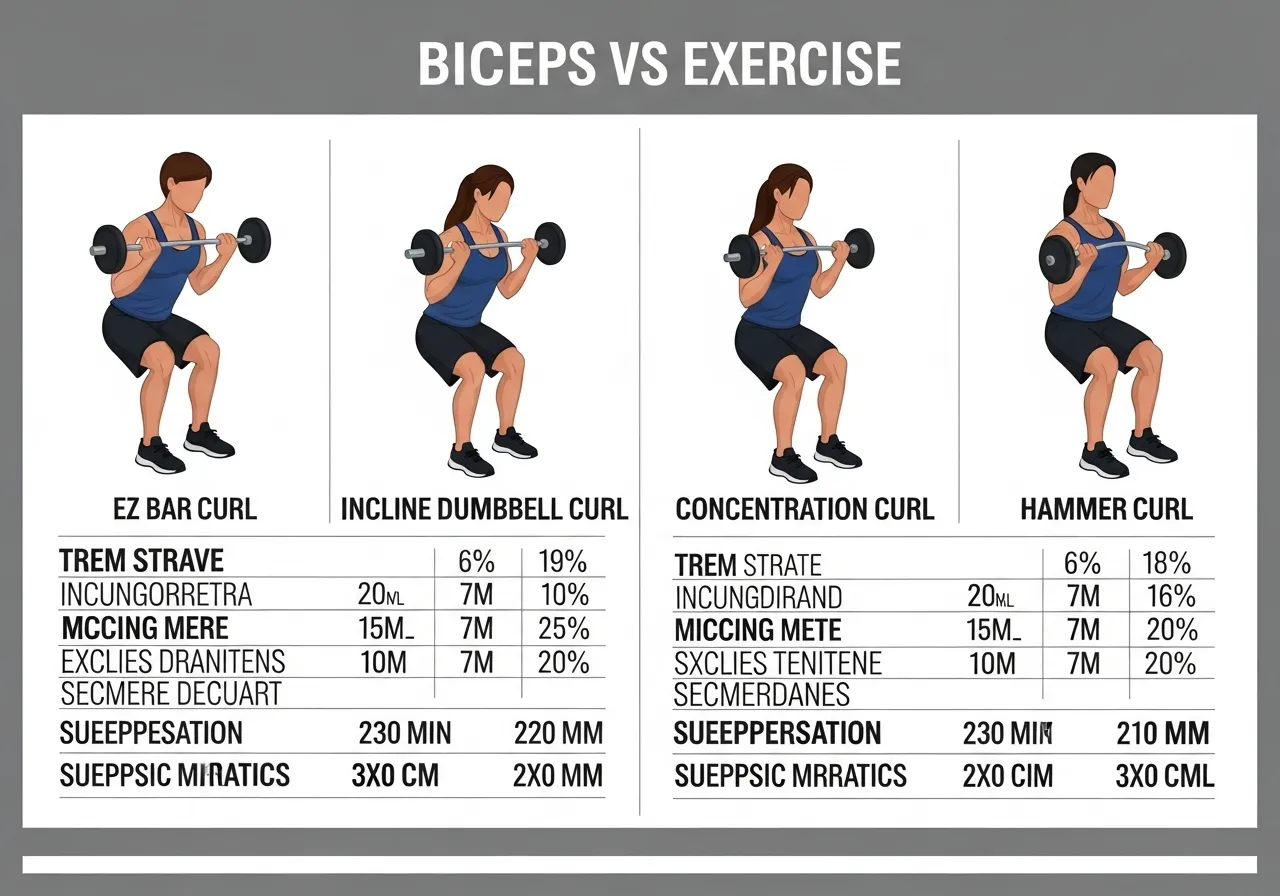
A complete bicep programme addresses four distinct stimuli: overall mass through heavy compound loading, peak development through short head isolation at full supination, width development through long head stretch loading, and brachioradialis thickness through semi-pronated or hammer grip work. No single curl variation provides all four stimuli simultaneously, which is why a complete programme includes multiple curl variations rather than one curl performed at high volume.
The EZ bar curl occupies the overall mass and brachioradialis positions in this matrix. It is the best primary loaded curl for trainees who cannot tolerate the full-supination stress of straight barbell curls, and it provides brachioradialis development that fully supinated dumbbell curls and concentration curls do not prioritise. Its limitation is the peak contraction stimulus, which requires supplementary short head work from concentration curls or preacher curls.
EZ Bar as Primary vs Supplementary Curl
The EZ bar curl is appropriate as the primary loaded curl movement for trainees with wrist or elbow sensitivity, for trainees who find straight barbell curls consistently uncomfortable regardless of technique adjustment, and for trainees who specifically want higher brachioradialis involvement alongside bicep training. As a primary movement, it should follow the same progressive overload principles as straight barbell curls: regular load increases as the target rep range is completable with maintained form across all sets.
As a supplementary movement, the EZ bar curl works well as a secondary option after a primary pulling movement (rows, pull-ups), providing direct bicep stimulus with lower wrist stress than the straight bar for trainees who want to preserve wrist freshness for other exercises in the same session. The long head width development that the incline dumbbell curl provides as a complement to the EZ bar’s mass building role is covered in the incline dumbbell curl guide.
When to Use a Straight Bar Instead
Trainees who experience no wrist or elbow discomfort with straight barbell curls and who are specifically targeting maximum short head peak development should not switch to the EZ bar as the primary curl. The straight bar’s full supination produces the maximum biceps brachii peak contraction stimulus that the EZ bar’s semi-supination slightly reduces. For trainees in this category, the straight bar remains the better primary choice and the EZ bar adds value as an alternative on days when wrist freshness is a concern or as a variation to prevent the accommodation that comes from always using the same implement.
Cable Curl as an EZ Bar Alternative
Cable curls with a straight bar or EZ bar attachment provide constant tension throughout the range of motion, unlike free-weight curls where resistance varies with the angle. The EZ bar cable attachment provides the same wrist comfort advantage as the free-weight EZ bar while adding the constant-tension loading profile of cable training. For trainees who have plateaued with free-weight EZ bar curls, switching to cable EZ bar curls for a 4 to 6-week block provides a different loading curve through the same semi-supinated movement pattern, often producing renewed adaptation without changing the wrist-friendly grip.
Hammer Curl: The Full Pronation Alternative
The hammer curl (neutral grip, thumbs up) goes further than the EZ bar in reducing supination, placing the forearm in a fully neutral position that maximally loads the brachioradialis and brachialis while reducing biceps brachii peak activation. For trainees whose forearm and brachioradialis development lags behind their bicep brachii, the hammer curl provides a more targeted stimulus than the EZ bar. For trainees using the EZ bar specifically to reduce wrist pain, the hammer curl provides even greater wrist comfort if the EZ bar’s semi-supinated position is still uncomfortable.
Programming the EZ Bar Curl at Every Level
Beginner: Learning the Curl Pattern
Beginners benefit from starting with the EZ bar rather than the straight barbell for two reasons. First, the EZ bar’s natural grip angle requires less active supination maintenance throughout the set, reducing the technical complexity of maintaining wrist position while simultaneously learning the bicep curl pattern. Second, the slightly more forgiving wrist position reduces the chance of early wrist discomfort that can cause beginners to abandon the exercise before the strength foundation is developed.
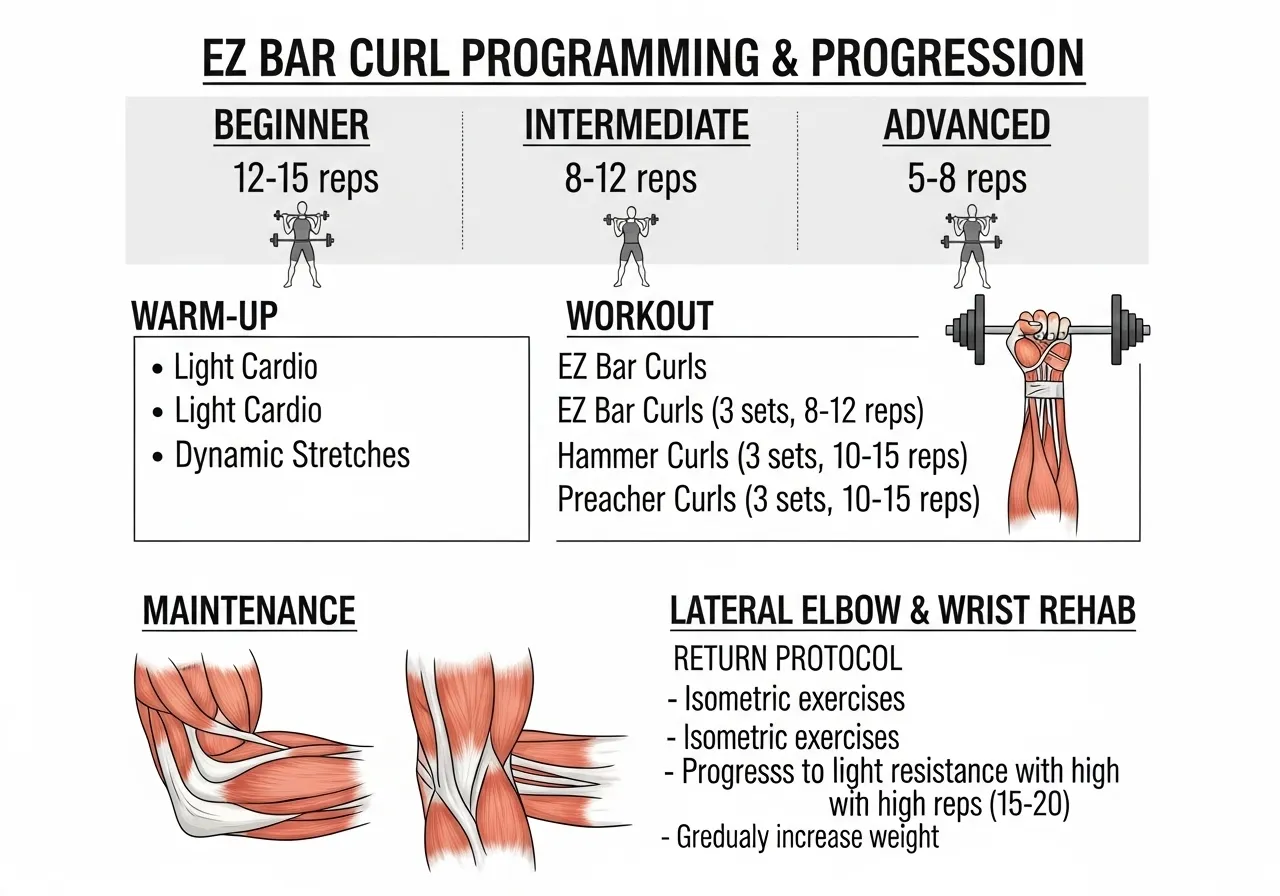
Beginner EZ bar curl programming: 3 sets of 12 to 15 reps at a load where the last 2 to 3 reps of each set are challenging but the elbow-fixed, no-momentum technique can be maintained throughout. Two sessions per week provides sufficient frequency for bicep development without the recovery interference that higher frequency would create alongside compound pulling movements that also stress the biceps.
Intermediate: Progressive Overload and Variation Introduction
At the intermediate level, the EZ bar curl should be progressed weekly or bi-weekly by 2.5 kg increments as the target rep range is consistently completable. Three to four sets of 8 to 12 reps at progressively increasing loads, with a 3-second eccentric phase on every rep, builds the strength and hypertrophy foundation that more advanced programming builds upon. At this level, complementary curl variations (incline dumbbell for long head, concentration curl for short head) can be added alongside the EZ bar as the primary compound curl.
📅 Sample Intermediate Bicep Session
EZ bar curl: 4 × 10 at working load (primary compound curl)
Incline dumbbell curl: 3 × 12 (long head width)
Concentration curl: 3 × 12 per side (short head peak)
Hammer curl: 2 × 15 (brachialis and brachioradialis)
This structure addresses all four bicep development dimensions: EZ bar for overall mass and brachioradialis, incline for width, concentration for peak, hammer for thickness. Each variation provides a distinct stimulus that the others do not replicate.
Advanced: EZ Bar as Maintenance and Volume Tool
Advanced trainees who have developed significant bicep mass often use the EZ bar curl as a higher-volume maintenance tool after primary strength work, where the wrist-friendly position allows high rep volume (15 to 20 reps per set) that would produce wrist fatigue with straight bar loading at equivalent loads. Three to four sets of 15 to 20 reps at moderate load at the end of a back session provides bicep volume accumulation without the fresh-system demand that primary strength movements require.
Managing Lateral Elbow Pain With Curl Selection
Lateral epicondylitis (tennis elbow) is aggravated by brachioradialis loading at the lateral epicondyle origin, which both straight barbell curls and EZ bar curls produce. For trainees with active lateral elbow pain, reducing curl volume and switching to supinated dumbbell curls (which load the bicep brachii more and the brachioradialis less than the semi-pronated EZ bar) provides continued bicep training with reduced lateral epicondyle loading. Return to EZ bar curls as the elbow heals, beginning with reduced loads and monitoring for symptom recurrence with each load increase.
The EZ Bar in a Wrist Rehabilitation Context
For trainees returning to training after wrist injuries including distal radius fractures, scaphoid fractures, or TFCC (triangular fibrocartilage complex) injuries, the EZ bar is typically the first curl variation reintroduced because it requires less rotational stress at the healing structures than the fully supinated straight bar position. The reintroduction protocol: begin at the EZ bar’s inner grip (more pronated, less rotational demand), progress to the outer grip position as wrist tolerance allows, and reintroduce straight barbell curls only after the outer grip EZ bar curl is fully comfortable at the previous working load.
EZ Bar Curl Variations for Different Goals
Choosing Variations Based on the Training Priority
The standard standing EZ bar curl is the foundation. The variations below address specific limitations of the standard movement or provide distinct stimuli for trainees who have developed the base movement and need different loading to continue progressing.
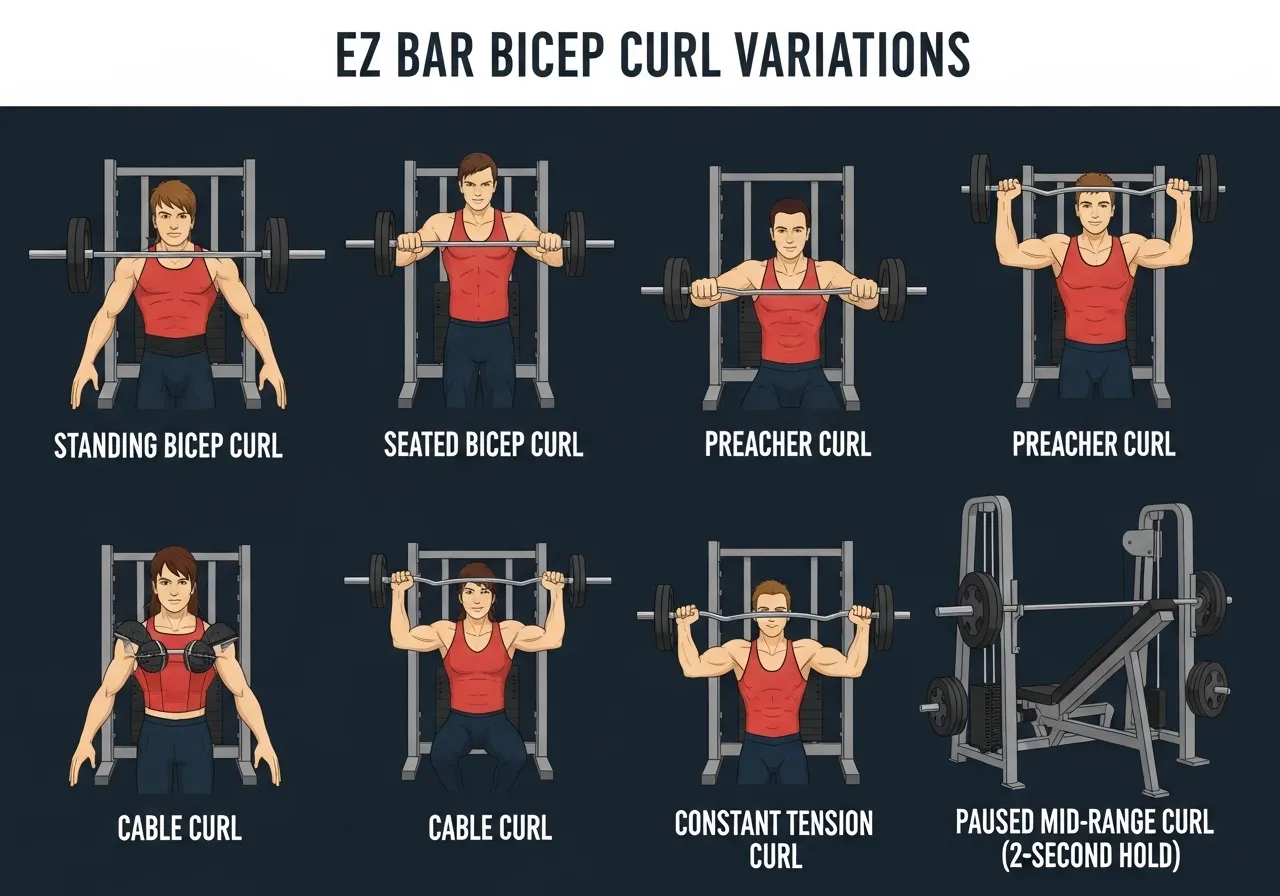
🏋️ 1. Standing EZ Bar Curl (Standard)
Target: Biceps brachii and brachioradialis, overall elbow flexor mass
How: Standing, elbows fixed at sides, semi-supinated grip on EZ bar angled sections, controlled 3-second eccentric, full extension at bottom.
Best for: Primary compound bicep loading for all levels. The benchmark variation for EZ bar strength and hypertrophy development.
🏋️ 2. Seated EZ Bar Curl
Target: Biceps brachii and brachioradialis with eliminated lower body momentum
How: Seated at the edge of a bench, elbows resting on inner thighs for support, curl the EZ bar with the same semi-supinated grip. The seated position eliminates lower back and hip involvement in initiating the curl.
Best for: Trainees who consistently use body swing in standing EZ bar curls. The seated position physically prevents hip and lower back momentum, forcing the biceps to do all the work from the beginning of the range.
🏋️ 3. EZ Bar Preacher Curl
Target: Short head biceps brachii, bottom-range strength with arm supported on pad
How: Use the EZ bar at a preacher curl station. The arm is braced against the pad with the shoulder slightly flexed. Curl from the fully extended position to peak contraction.
Best for: Trainees with wrist discomfort during straight bar preacher curls. The EZ bar’s angled grip provides the same wrist relief advantage on the preacher pad that it provides in standing curls.
🏋️ 4. Cable EZ Bar Curl
Target: Biceps brachii and brachioradialis with constant cable tension
How: Attach an EZ bar handle to a low cable pulley. Stand back from the machine and curl with the same technique as the free-weight standing version.
Best for: Progress beyond free-weight EZ bar. The cable’s constant tension loads the bicep at the bottom stretched position where free-weight resistance is minimal, providing a different loading curve that challenges the bicep throughout a more complete range.
Paused EZ Bar Curl for Sticking Point Development
The paused EZ bar curl holds the position at 90 degrees of elbow flexion (the sticking point where the moment arm is longest and the bicep is most challenged) for 2 seconds on every rep. This technique develops strength specifically at the most mechanically demanding point of the curl, producing sticking point strength that allows heavier loads in the standard curl. Use 15 to 20% less load than standard EZ bar working weight and perform 3 sets of 8 reps with the 2-second mid-range pause.
Frequently Asked Questions About the EZ Bar Curl
Is the EZ bar curl as effective as the straight barbell curl for building biceps?
Yes for most practical purposes. The research characterises the choice between EZ bar and straight barbell as a matter of comfort rather than activation. Both produce high biceps brachii and brachioradialis EMG. The straight bar produces marginally higher peak bicep brachii activation at full supination; the EZ bar produces higher brachioradialis activation and equivalent bicep brachii activation in most comparison studies. For trainees without wrist or elbow discomfort, the difference is too small to influence programming decisions based on activation data alone. For trainees with wrist or elbow discomfort from straight bar curls, the EZ bar produces equivalent results without the discomfort that was limiting their training.
Should I use the inner or outer grip on the EZ bar?
Outer grip (wider, more supinated) for maximum biceps brachii activation and less wrist stress. Inner grip (narrower, more pronated) for more brachioradialis involvement and the most wrist-stress reduction. For the majority of trainees who are switching from straight bar to EZ bar due to wrist discomfort, the outer grip provides adequate wrist relief while maintaining near-maximal bicep brachii activation. The inner grip is appropriate for trainees specifically targeting brachioradialis development or with more severe wrist or elbow sensitivity.
Can the EZ bar replace straight barbell curls entirely?
Yes. For trainees who find the straight barbell consistently uncomfortable and who are not competing in a sport or aesthetic category where maximum short head peak contraction is specifically assessed, replacing straight barbell curls entirely with EZ bar curls produces equivalent long-term bicep development. The small difference in peak supination-driven short head activation can be addressed through concentration curls or fully supinated dumbbell curls in the same programme without requiring straight barbell curls specifically.
Why does the EZ bar feel heavier than the straight bar at the same weight?
The EZ bar itself is typically heavier than a standard barbell (often 10 to 12 kg for the EZ bar versus 20 kg for a standard Olympic barbell), meaning that if the total weight including the bar is matched, the plates loaded on an EZ bar are lighter. The perceived difficulty difference is usually a barbell weight confusion rather than a true difficulty difference in the exercise. When comparing the two at matched plate loads (and accounting for bar weight), most trainees find the EZ bar curl equivalent to or marginally easier than the straight bar curl at the same total weight.
Is the EZ bar good for beginners or only for experienced lifters with wrist problems?
The EZ bar is an excellent choice for beginners regardless of whether they have wrist problems. The semi-supinated grip is more intuitive and requires less active wrist positioning than the straight bar’s full supination, reducing the technical demands of the exercise for trainees who are simultaneously learning bicep curl mechanics, load management, and elbow-fixed technique. Beginning with the EZ bar and progressing to straight bar or dumbbell variations later, once the curl pattern is well established, is a rational beginner approach rather than a compromise reserved for trainees with pre-existing issues.
Key Takeaways
The EZ bar and straight barbell curl produce equivalent biceps brachii activation. The choice is characterised by the research as a matter of comfort, not activation. The EZ bar produces higher brachioradialis activation than the dumbbell curl.
The EZ bar’s 30 to 45-degree semi-supinated grip reduces radioulnar joint stress and lateral epicondyle loading compared to the fully supinated straight bar, eliminating wrist and elbow discomfort without sacrificing the bicep training stimulus.
The outer grip provides more biceps brachii activation and less wrist stress reduction. The inner grip provides more brachioradialis activation and maximum wrist stress reduction. Choose based on training priority and discomfort level.
The EZ bar can replace straight barbell curls entirely for most trainees without meaningful loss of bicep development. Supplement with concentration curls if short head peak development is a specific goal.
The EZ bar is not reserved for trainees with existing injuries. Its semi-supinated grip is technically more intuitive than the straight bar and is an appropriate primary curl for beginners and experienced trainees alike.
Warning Fitness Disclaimer: The information in this article is for general educational purposes only and does not constitute professional fitness or medical advice. Always consult a qualified healthcare professional before starting any new exercise program, especially if you have existing injuries or medical conditions. The Most Versatile Piece of Equipment in the Gym That Most…
⚠️ Health & Fitness DisclaimerThis article is for general educational purposes only and does not replace professional medical advice. If you have any shoulder, back, or joint conditions, please consult a qualified healthcare professional before beginning a Smith machine vs free weights program. The Smith machine — a barbell constrained to a vertical or near-vertical…
⚠️ Health & Fitness DisclaimerThis article is for general educational and informational purposes only.It does not replace professional medical or fitness advice.If you have any pre-existing knee, hip, or lower back condition — please consult a qualified healthcare professional or certified personal trainer before starting or modifying any resistance training program. The leg press guide…
⚠️ Health & Fitness DisclaimerThis article is for general educational and informational purposes only and does not replace professional medical or fitness advice.If you have any pre-existing shoulder, back, or joint condition — consult a qualified healthcare professional or certified trainer before beginning any cable machine mastery program. The cable machine is arguably the most…
The lateral raise is the only exercise that directly targets the medial deltoid head, the muscle responsible for shoulder width. Every pressing movement loads the anterior deltoid heavily. No pressing movement meaningfully loads the medial deltoid. Yet most trainees perform lateral raises as an afterthought: a few sets of dumbbell swings at the end of…
⚠️ Health & Fitness DisclaimerThis article is for general educational and informational purposes only.It does not replace professional medical or fitness advice.If you have any pre-existing condition, injury, or shoulder concern — please consult a qualified healthcare professional or certified personal trainer before starting or modifying any exercise program. The lat pulldown mastery guide is…