Battle Ropes: The High-Intensity Cardio and Upper Body Training Tool That Research Shows Rivals Traditional HIIT
Battle ropes sit in most gyms but get used by a minority of members. The exercise looks unusual — swinging heavy ropes in wave patterns doesn’t resemble any conventional cardiovascular or strength exercise — and its place in a training programme is less obvious than a treadmill interval or a barbell lift. The research tells a different story about their effectiveness.
Battle rope HIIT produces upper body cardiovascular adaptations — including increases in upper body VO2max — that treadmill and cycle ergometer HIIT do not develop, because the demand is placed on the upper body musculature rather than the lower body systems that running and cycling stress. For athletes whose sports require upper body power endurance, for trainees with lower limb injuries that prevent running-based HIIT, and for individuals who want cardiovascular conditioning that simultaneously develops shoulder and arm endurance, battle ropes provide a stimulus that conventional cardio equipment cannot replicate.
This guide covers what the research shows about battle rope HIIT versus traditional HIIT, the primary movement variations and how they differ in muscle activation and cardiovascular demand, technique for the most common patterns, how to structure battle rope sessions for different goals, and how to integrate them within a complete training programme.
Battle Ropes vs Traditional HIIT: What the Research Shows
The 6-Week Battle Rope HIIT Study
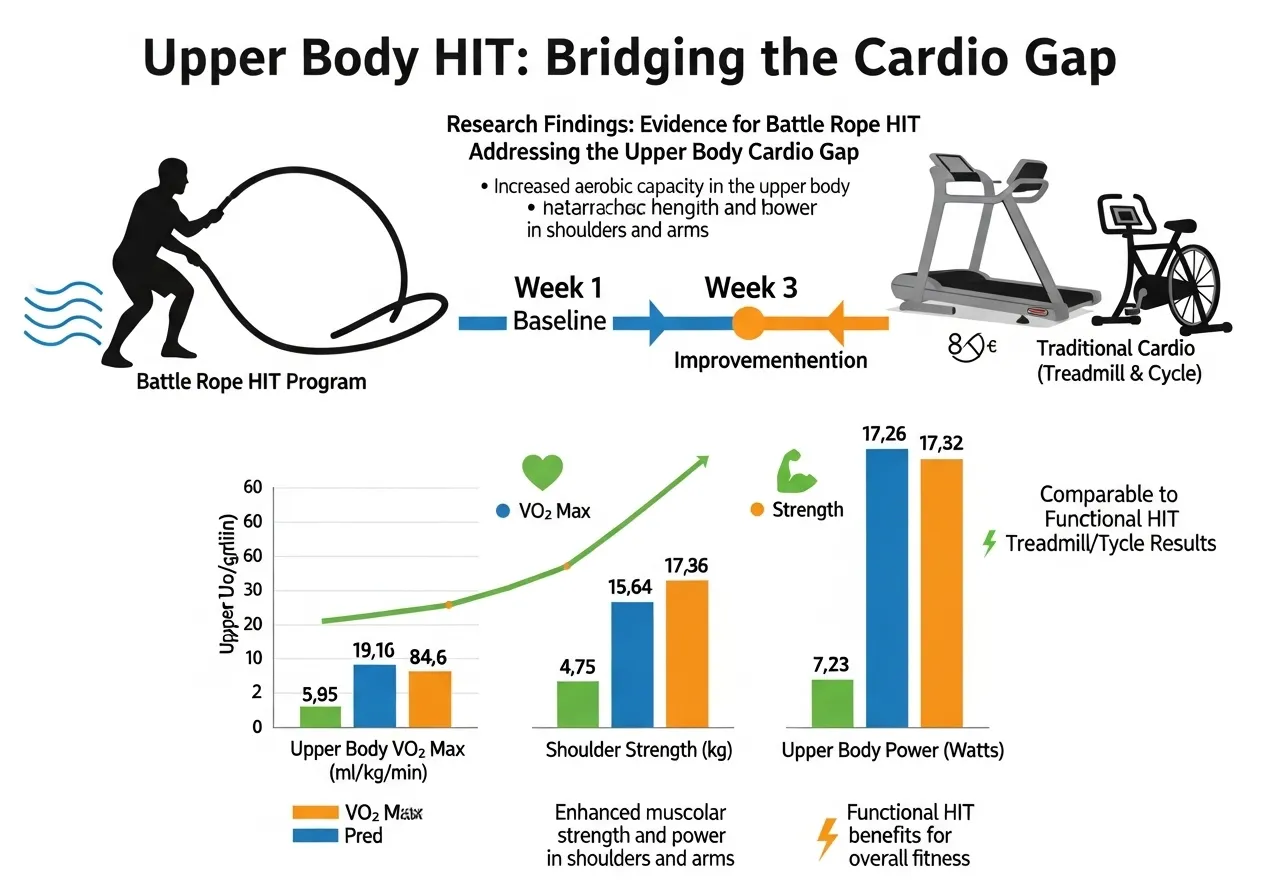
A study examining physiological responses to increasing battling rope weight during two 3-week high-intensity interval training programmes found that after 3 and 6 weeks of battling rope HIIT, men and women increased upper-body maximal oxygen consumption, maximum voluntary contraction isometric shoulder flexion and extension strength, shoulder power output, and push-up and sit-up endurance, and that these increases in aerobic and skeletal muscle measurements are similar to previous HIIT studies involving treadmills and cycle ergometers, with battling rope HIIT producing adaptations in skeletal muscle and aerobic performance in as little as 3 weeks and with increases in battling rope weight displaying further improvements after 6 weeks of battling rope HIIT.
Battle rope HIIT produces upper body VO2max improvements comparable to treadmill and cycle HIIT in as little as 3 weeks. It simultaneously develops upper body aerobic capacity, strength, and power — a combination that traditional cardio equipment cannot provide in a single exercise modality.
Rope-Based HIIT Acute Physiological Responses
A study examining acute physiological responses to rope climbing ergometer high-intensity interval training found that rope-based high-intensity interval training produced significant acute cardiovascular and metabolic responses including elevated heart rate, oxygen consumption, and metabolic stress comparable to established upper body HIIT protocols, confirming that rope-based HIIT represents an effective upper body cardiovascular training stimulus that elicits the central cardiovascular and peripheral muscular adaptations associated with high-intensity interval training in trained individuals.
Rope-based HIIT produces cardiovascular and metabolic stress comparable to established HIIT protocols. The rope modality delivers upper body HIIT stimulus without lower body impact — making it suitable for injured athletes and trainees seeking upper body cardiovascular development.
HIFT and Battle Ropes in Functional Training Research
A systematic review of high-intensity functional training physiological effects found that high-intensity functional training including battle rope exercises and similar modalities produces acute physiological responses and chronic adaptations that overlap with both traditional HIIT and resistance training, with these training methods demonstrating significant improvements in cardiorespiratory fitness, body composition, and muscular performance across multiple studies, confirming that functional HIIT tools including battle ropes can serve as effective primary training modalities rather than supplementary finisher exercises.
Functional HIIT tools including battle ropes improve cardiorespiratory fitness and muscular performance simultaneously. Battle ropes can serve as primary training modalities, not just finisher exercises, when applied with appropriate intensity and volume structure.
The Upper Body HIIT Gap in Most Training Programmes
Most cardiovascular training — running, cycling, rowing, stair climbing — involves primarily lower body musculature. The cardiovascular adaptations these modalities produce are lower body-specific in their peripheral muscle component, though the central cardiac adaptations transfer across modalities. Upper body aerobic capacity and endurance, which determine performance in swimming, combat sports, team sport upper body efforts, and throwing sports, requires specifically upper body HIIT to develop its peripheral component.
Battle ropes fill this gap. They demand continuous upper body power output at near-maximum intensity for 20 to 45-second efforts, developing the upper body aerobic enzyme capacity, capillary density, and local muscle endurance that lower body cardiovascular training does not address. For team sport athletes, swimmers, and combat sport practitioners, adding battle rope HIIT provides the upper body cardiovascular development that running-based conditioning programmes structurally cannot provide.
Energy Expenditure: What the Metabolic Data Shows
Battle rope exercises produce significant metabolic demand. Research measuring oxygen consumption during battle rope protocols consistently finds values of 30 to 45 ml/kg/min during active intervals — equivalent to moderate to vigorous running intensity — despite the upper body-dominant movement pattern. The heart rate response during maximal battle rope efforts reaches 85 to 95% of maximum heart rate within 30 to 45 seconds, confirming that battle ropes create genuine high-intensity cardiovascular stimulus rather than the moderate-intensity demand that their appearance as a non-running exercise might suggest.
The Four Primary Battle Rope Movements: Technique and What Each Develops
Understanding the Movement Categories
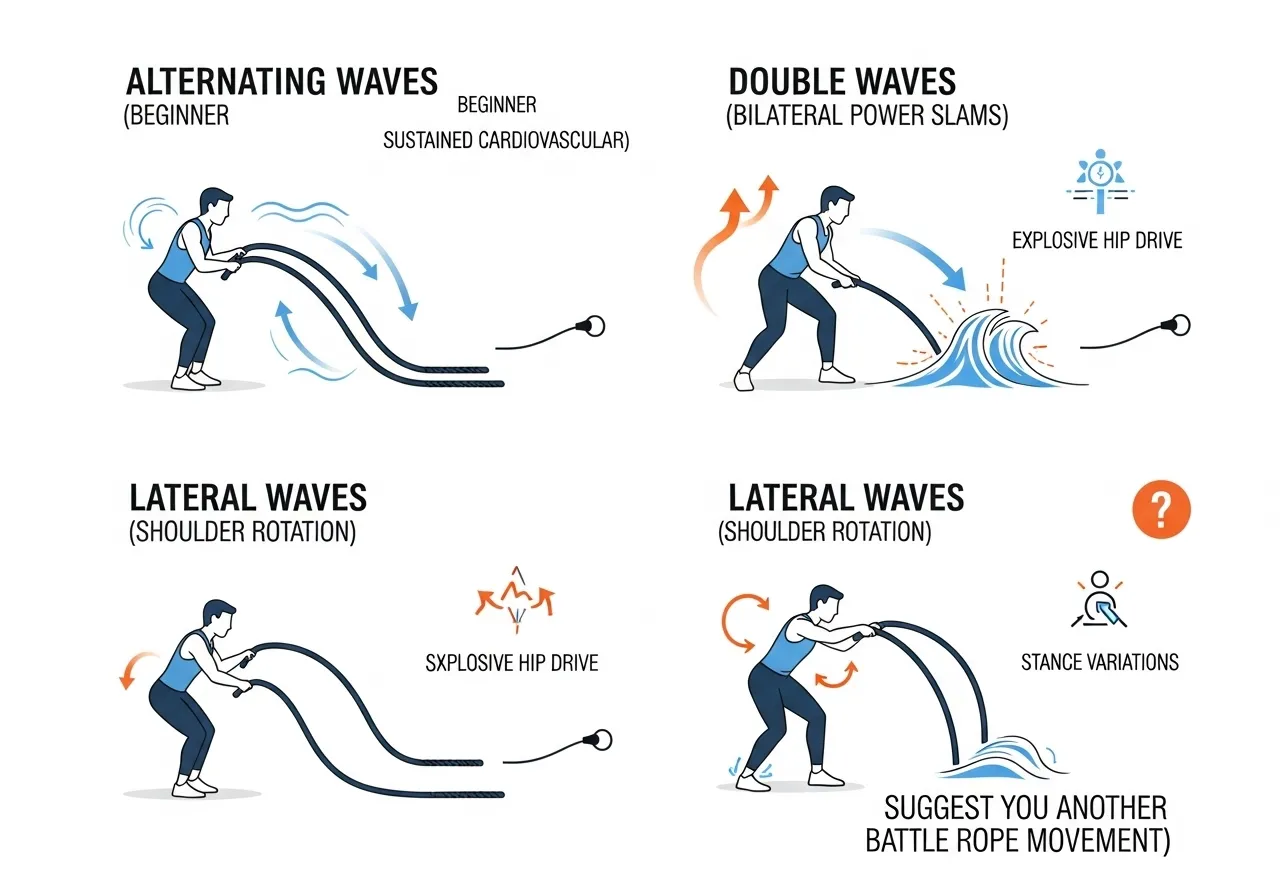
Battle rope exercises divide into two primary mechanical categories: wave movements, where continuous undulating waves are propagated down the rope’s length, and power movements, where the rope or sections of it are explosively displaced. Wave movements provide sustained cardiovascular and upper body muscular endurance stimulus. Power movements provide more explosive power and total body involvement through hip hinge or jumping components.
🔄 1. Alternating Waves
Target: Shoulder endurance, cardiovascular base, bilateral alternating coordination
How: Stand with feet shoulder-width, knees slightly bent, slight hip hinge. Hold one rope end in each hand. Alternately raise and lower each arm in opposition, creating a snaking wave pattern down each rope. Maintain continuous movement for the prescribed interval duration. The core must resist the alternating lateral forces that each arm stroke creates.
Best for: Entry point for battle rope training. The alternating pattern is less demanding than bilateral waves because the load is distributed over time rather than applied simultaneously. Most trainees begin here before progressing to double waves.
🔄 2. Double Waves (Bilateral)
Target: Bilateral shoulder power endurance, greater cardiovascular demand than alternating
How: Same stance as alternating waves. Raise and lower both arms simultaneously to create symmetrical waves down both ropes at the same time. Both arms work in synchrony rather than alternating, doubling the bilateral shoulder load per wave cycle.
Best for: Higher intensity than alternating waves. Heart rate reaches maximum faster. Used for shorter intervals (20 to 30 seconds) where maximum power output is the training target rather than sustained endurance.
🔄 3. Rope Slams
Target: Explosive total body power, hip hinge to overhead push pattern
How: Hold both ropes together in both hands or each rope end in separate hands. Drive both arms overhead using a hip extension-driven triple extension (ankle, knee, hip), then explosively slam the ropes to the floor. The hip drive generates the power; the arms direct it. Reset between each slam, making each rep a discrete power expression rather than a continuous wave.
Best for: Explosive power development and high-intensity brief intervals (15 to 20 seconds at maximum effort). The hip extension component makes slams a total body exercise rather than upper body only, producing higher total energy expenditure per rep than wave variations.
🔄 4. Lateral Waves
Target: Shoulder internal/external rotation endurance, frontal plane core stability
How: Hold both rope ends with palms facing each other. Move both arms simultaneously side to side in the frontal plane (left and right) rather than up and down. This creates lateral waves rather than vertical waves, loading the shoulder rotators and the lateral core differently from the standard wave patterns.
Best for: Shoulder rotator cuff endurance and frontal plane core development. The lateral loading pattern addresses shoulder and core dimensions that vertical wave patterns do not. Particularly useful for overhead athletes (swimmers, throwers, overhead sport practitioners) who need shoulder rotator endurance alongside cardiovascular conditioning.
Stance Variations: How Foot Position Changes the Demand
All four movement patterns can be performed from multiple stance positions that change the core and lower body demand. Split stance (one foot forward) adds anti-rotation demand. Single-leg stance adds balance and hip stability challenge. Squatting stance (continuous squat position) adds quadriceps endurance alongside the upper body work. Rotating stance (pivoting at the hips with each wave) adds thoracic rotation demand and increases total energy expenditure. For trainees seeking both upper body cardiovascular development and functional lower body integration, rotating between these stance variations across sessions prevents accommodation and develops multi-plane coordination alongside the primary cardiovascular and upper body conditioning goals.
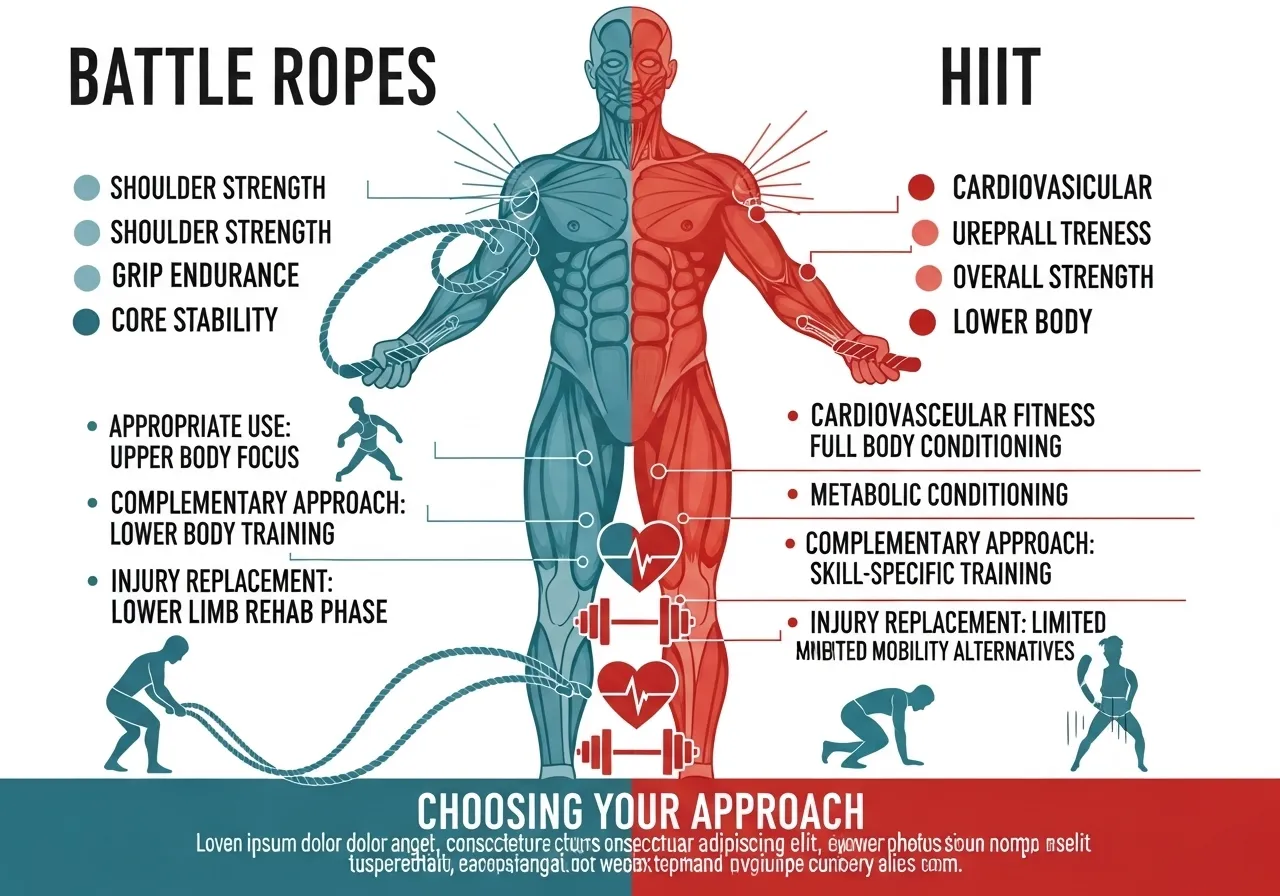
Battle Ropes vs Running HIIT vs Cycling HIIT: Which Should You Use and When?
The Three Modalities Serve Different Primary Purposes
Battle ropes, running HIIT, and cycling HIIT produce overlapping but distinct adaptations that determine which modality is most appropriate for a specific training goal. Understanding the specific advantages and limitations of each prevents the common error of treating all HIIT as interchangeable and selecting exercise mode based on preference or availability rather than physiological priority.
Battle Ropes: The Upper Body Cardiovascular Tool
Battle ropes are the appropriate primary HIIT tool when upper body cardiovascular endurance is the training target, when lower body injuries prevent running or cycling, or when total body conditioning is the goal and lower body cardiovascular training is already adequate. They produce unique simultaneous upper body power and aerobic adaptations that running and cycling cannot provide. Their joint-loading profile is low relative to impact sports, making them suitable for high-frequency use without the cumulative joint stress that high-volume running accumulates.
The limitation of battle ropes as the sole cardiovascular training tool is the reduced contribution to lower body aerobic capacity development. Athletes who need both upper and lower body cardiovascular endurance must include lower body dominant cardio alongside battle rope training rather than replacing one with the other entirely.
Running HIIT: The Lower Body Cardiovascular Standard
Running HIIT develops lower body cardiovascular endurance, running-specific economy, and the weight-bearing impact adaptation that running sports require. It produces the most direct transfer to running performance and is appropriate as the primary HIIT tool for runners, field sport athletes, and any trainee whose primary sport involves running-dominant locomotion. Its limitation is the cumulative joint stress of high-volume running that limits the frequency at which it can be applied, particularly for trainees who also perform high volumes of lower body strength training. The VO2 max interval training that represents the highest intensity running HIIT application is covered in the VO2 max interval training guide.
Cycling HIIT: The Low-Impact Lower Body Option
Cycling HIIT provides lower body cardiovascular development with significantly lower joint impact than running. It is appropriate as the primary cardiovascular tool for trainees with running-related injuries, for individuals with high weekly running volume who need additional cardiovascular stimulus without added impact load, and for cyclists whose primary sport requires cycling-specific cardiovascular development. Its limitation is the non-weight-bearing nature that means the bone density and connective tissue adaptations of running are not developed through cycling, and the cycling-specific peripheral adaptations do not transfer completely to running economy.
The Complementary Approach: Using All Three Strategically
The most complete cardiovascular training programme uses running HIIT for lower body cardiovascular development and sport specificity, cycling for low-impact lower body conditioning on days when running load must be limited, and battle ropes for upper body cardiovascular development and total body conditioning that running and cycling cannot provide. This combination addresses the full spectrum of cardiovascular fitness dimensions — upper body endurance, lower body endurance, and total body power capacity — that single-modality programmes leave partially unaddressed.
When Battle Ropes Are the Only HIIT Option
For trainees with lower body injuries preventing weight-bearing cardiovascular exercise, battle ropes can serve as the primary cardiovascular training tool during the rehabilitation period. The upper body HIIT they provide maintains cardiovascular fitness, preserves upper body muscle mass, and provides the training stimulus that keeps the cardiovascular system from deconditioned during lower limb rehabilitation. The deceleration mechanics and lower limb injury rehabilitation context that commonly precedes a battle rope-primary training phase is covered in the deceleration training guide.
How to Structure Battle Rope Sessions for Different Goals
The Interval Variables: Work Period, Rest Period, and Wave Count
Battle rope session design has four primary variables: work period duration, rest period duration, number of intervals, and movement pattern selection. These four variables interact to determine whether the session primarily develops power output capacity (short, maximal efforts with full recovery), upper body aerobic endurance (moderate length efforts with incomplete recovery), or cardiovascular conditioning (longer efforts at sustainable intensity with moderate recovery).
Session Design for Upper Body Power and Strength
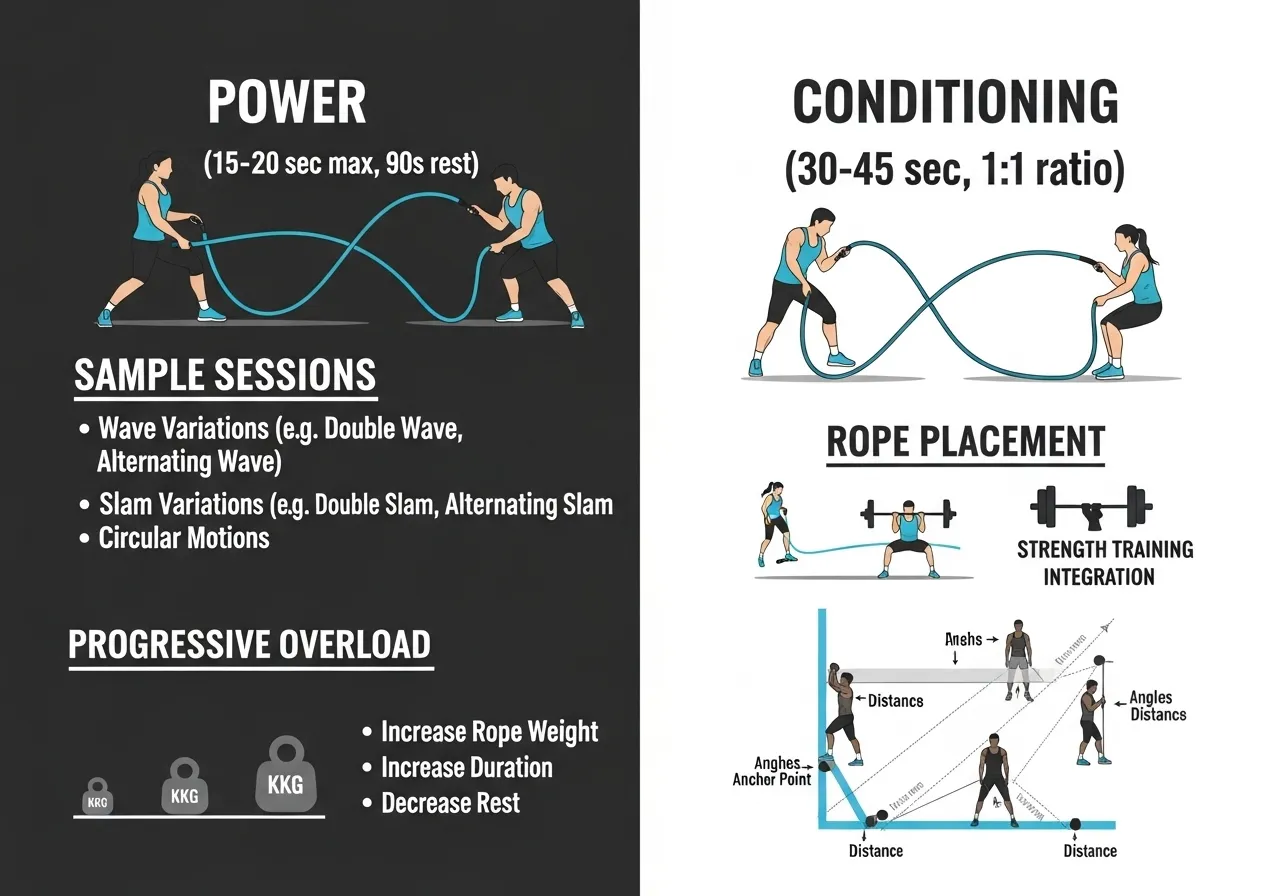
For upper body power development: 8 to 10 intervals of 15 to 20 seconds at maximum effort, with 90 to 120 seconds of rest between intervals. This work-to-rest ratio (approximately 1:6) allows near-complete recovery between efforts, enabling maximum power output in each interval. Rope slams are the primary exercise for this goal because the hip extension drive maximises total body power expression. This structure produces the explosive shoulder and arm power adaptations that the battling rope HIIT study documented in its upper body strength measurements.
Session Design for Cardiovascular Conditioning
For cardiovascular conditioning: 8 to 12 intervals of 30 to 45 seconds at vigorous but sustainable effort, with 30 to 60 seconds of rest (work-to-rest ratio of 1:1 to 1:1.5). Alternating waves are the primary exercise for this goal because the sustained bilateral alternating pattern maintains continuous cardiovascular demand without the complete muscular failure that maximum effort double waves produce quickly. This structure produces the upper body VO2max improvements the research documents at 3 and 6 weeks.
📅 Sample Power Session (20 min total)
- Warm-up: 5 min light alternating waves + dynamic shoulder mobility
- Main: 8 × 15 sec rope slams at maximum effort, 90 sec rest between
- Cool-down: 5 min light alternating waves
Power goal: maximum hip extension and rope displacement per slam. Each set should feel like a sprint, not a jog. If power output drops in sets 5-8, increase rest to 120 seconds.
📅 Sample Conditioning Session (25 min total)
- Warm-up: 5 min progressively intensifying alternating waves
- Main: 10 × 30 sec alternating waves, 30 sec rest
- Add: 2 × 45 sec lateral waves, 45 sec rest (shoulder rotation focus)
- Cool-down: 5 min decreasing intensity waves
Conditioning goal: heart rate reaching 80-90% maximum by interval 3 and staying there. The 1:1 work-rest ratio is the research-validated structure for upper body VO2max development.
Progressive Overload for Battle Rope Training
Battle rope progressive overload operates through four variables: increasing rope weight (heavier rope = greater resistance per wave), increasing interval duration at matched intensity, decreasing rest periods at matched work duration, and adding stance variations that increase total body demand. The battling rope HIIT study showed that increasing rope weight after the initial 3-week adaptation produced further improvement in the subsequent 3 weeks, confirming that rope weight progression is a valid primary overload mechanism rather than just an advanced variation.
Combining Battle Ropes With Strength Training
Battle rope sessions create significant shoulder, forearm, and upper back fatigue. Placing battle rope sessions on the same day as heavy overhead pressing or pulling exercises produces compound upper body fatigue that compromises strength session quality. The most effective placement: battle rope sessions on days separate from heavy upper body strength work, or after primary upper body strength work if the same day is unavoidable, never before heavy pressing or pulling movements where the accumulated shoulder fatigue would reduce the primary strength stimulus.
Battle Rope Technique: Common Errors and Their Fixes
Why Technique Matters More Than It Appears
Battle rope exercises look simple — swing the ropes — but consistent errors prevent the cardiovascular and muscular stimulus the exercise is intended to provide. Most errors either reduce the training stimulus (reducing wave amplitude to a minimal movement that doesn’t create real cardiovascular demand) or redirect the demand away from the intended target muscles toward the lower back and biceps as compensatory structures.
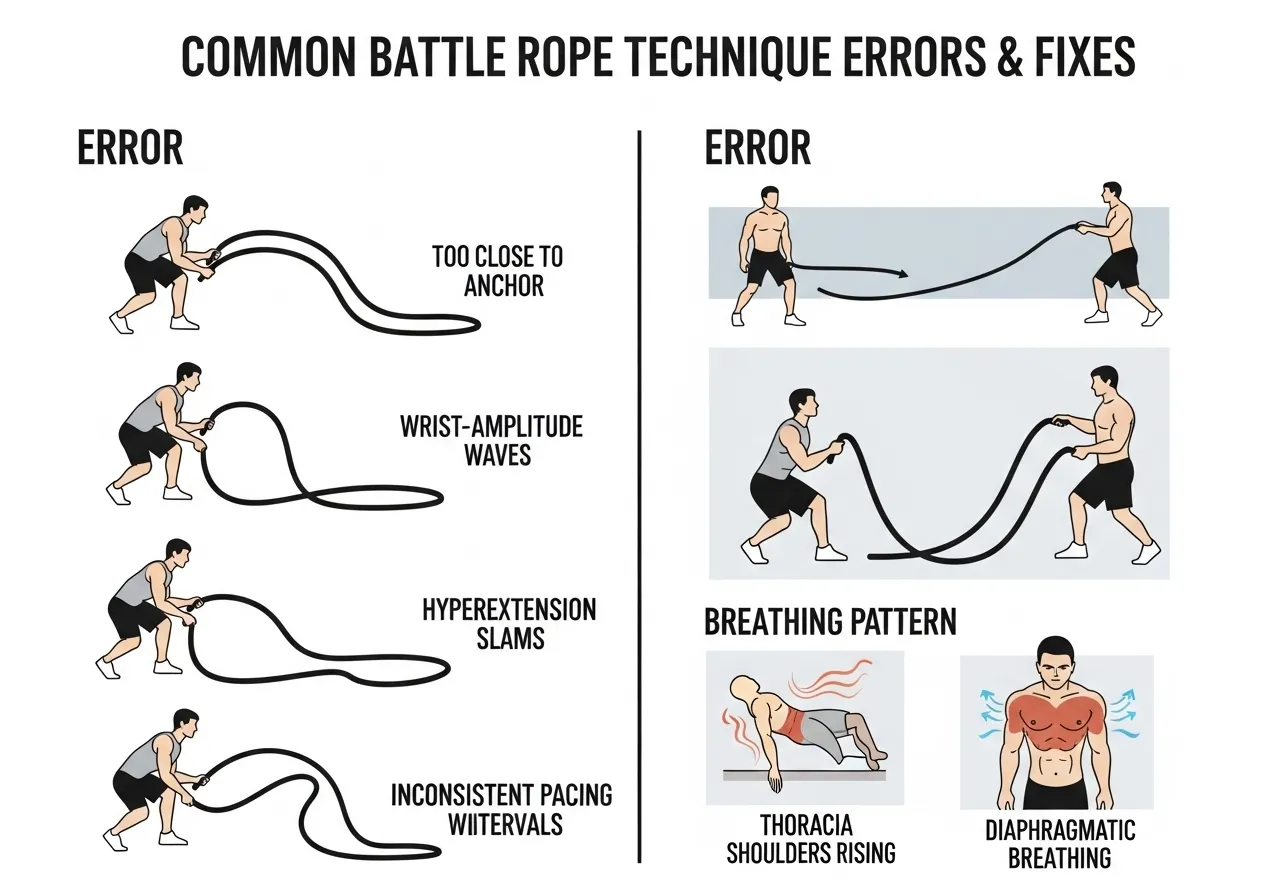
❌ Error 1: Standing Too Close to the Anchor
What happens: The rope has too much slack, reducing the resistance felt with each wave. The waves don’t propagate effectively down the rope’s length because the rope is not taut enough to transmit force efficiently.
Fix: Position far enough from the anchor that a slight tension is felt in the rope even at rest. The rope should have minimal sag. Most trainees should position 2 to 3 metres further from the anchor than feels natural initially.
❌ Error 2: Moving Only the Wrists and Forearms
What happens: Small wrist flicking motion substitutes for full shoulder and arm movement. Wave amplitude is minimal, cardiovascular demand is low, and forearm fatigue limits the session before the intended cardiovascular stimulus is reached.
Fix: Drive the movement from the shoulder and upper arm. Each wave should involve a full range shoulder elevation and depression, not a wrist flick. Larger amplitude waves create greater rope displacement, greater resistance to overcome, and greater cardiovascular and muscular demand.
❌ Error 3: Hyperextending the Lower Back During Slams
What happens: During rope slams, the hip drive extends into excessive lumbar hyperextension rather than stopping at neutral. The lower back absorbs the force of each slam rather than the hip extensors and core.
Fix: Brace the core before each slam. Drive through hip extension, not spinal extension. The spine should be neutral to slightly extended at the top of the slam — not hyperextended. Lower back discomfort after battle rope slams is almost always a bracing and movement pattern issue rather than an inherent risk of the exercise.
❌ Error 4: Slowing Down Too Early in the Interval
What happens: Trainees reduce wave amplitude and frequency in the final 10 to 15 seconds of each interval as fatigue develops, effectively doing 15 to 20 seconds of high-intensity work followed by 10 to 15 seconds of moderate work within each nominal 30-second interval.
Fix: Maintain amplitude and frequency through the complete interval, accepting the discomfort. If this is not achievable, the interval duration is too long for current fitness level — reduce to 20 seconds and rebuild to 30 seconds progressively. An honest 20-second interval at maintained intensity produces more cardiovascular stimulus than a nominal 30-second interval with significant pacing in the final third.
Breathing During Battle Rope Intervals
Battle rope waves naturally encourage shallow thoracic breathing because the shoulder movement that creates the waves involves the same musculature as upper chest breathing. Deliberately maintaining diaphragmatic breathing during alternating wave intervals — exhaling on the down stroke and inhaling on the upstroke — reduces the respiratory fatigue that accumulates when thoracic breathing dominates, allowing longer sustainable intervals. For maximum effort slams, a brief breath hold during the explosive phase followed by forced exhalation on the slam is the natural high-intensity pattern.
Programming Battle Ropes Into a Complete Training Week
Frequency and Volume Recommendations
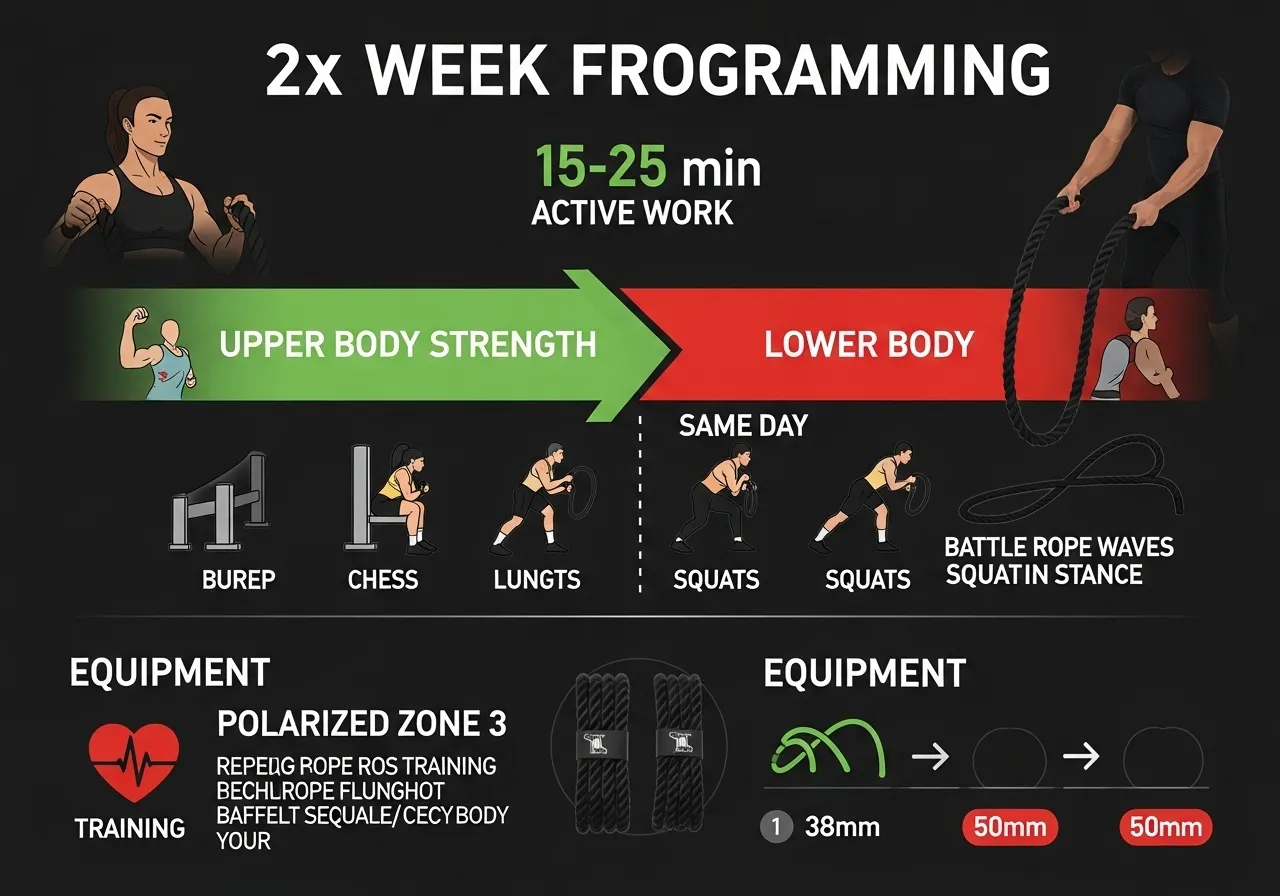
Two battle rope sessions per week is the research-validated frequency that produced the upper body VO2max and strength improvements in the 6-week study. One session per week provides maintenance of adaptations already developed but is insufficient for continued development. Three sessions per week is appropriate for trainees using battle ropes as their primary cardiovascular training tool, provided upper body recovery from the shoulder-dominant demand is monitored.
Total weekly battle rope volume: 15 to 25 minutes of active work time (not including rest periods) is appropriate for most trainees. Below this volume, the cardiovascular stimulus is insufficient for continued adaptation. Above 30 minutes of active work time weekly, recovery demands may compromise upper body strength training quality in the same weekly schedule.
Where Battle Ropes Fit in the Training Week
Effective battle rope session placement within a training week follows three principles. First, separate battle rope sessions from heavy upper body strength training by at least 24 hours to prevent compound upper body fatigue. Second, battle rope sessions can be performed on the same day as lower body strength training without meaningful interference, as the upper body dominant demand does not create lower body fatigue. Third, for trainees using polarised cardiovascular training, battle ropes fit naturally as Zone 3 high-intensity sessions within the weekly structure. The Zone 1 and Zone 3 intensity distribution that supports battle rope HIIT placement within a complete training week is covered in the polarised training guide.
Equipment Considerations: Rope Length and Diameter
Battle rope specifications significantly affect the training demand. Standard rope lengths are 9 metres and 15 metres. Longer ropes require more force to propagate waves to the anchor and create greater resistance per wave. Shorter ropes are more appropriate for beginners and for confined spaces. Standard rope diameters are 38 mm (lighter, more grip-friendly, appropriate for beginners and high-volume conditioning work) and 50 mm (heavier, greater resistance per wave, appropriate for advanced trainees and power-focused sessions). For most gym settings without specialist equipment, a 9-metre, 38 mm rope provides adequate resistance for the full range of training goals from beginner conditioning to advanced HIIT.
Incorporating Battle Ropes Into Circuit Training
Battle ropes integrate effectively into circuit training structures where they provide the cardiovascular component between strength stations. A typical integration: alternate one battle rope station (30 to 45 seconds) with one strength station (lower body or core exercise) for 4 to 6 rounds. This structure provides cardiovascular conditioning during the strength session without the additional time investment of a separate dedicated cardio session, maintaining elevated heart rate throughout the circuit while allowing upper body recovery between rope stations.
When to Expect Results: The Battle Rope Timeline
The research documents meaningful improvements in upper body VO2max and strength within 3 weeks of twice-weekly battle rope HIIT. For trainees new to upper body HIIT, improvements in shoulder endurance — the ability to maintain wave amplitude and frequency throughout longer intervals without degradation — typically appear within the first 2 to 3 weeks. Cardiovascular improvements measurable by reduced resting heart rate and improved heart rate recovery after sessions appear at 4 to 6 weeks. Visible changes in upper arm and shoulder muscular development from battle rope training, while secondary to the cardiovascular benefits, become apparent at 8 to 12 weeks of consistent twice-weekly sessions.
Frequently Asked Questions About Battle Ropes
Are battle ropes effective for fat loss?
Battle rope HIIT produces significant caloric expenditure during sessions — research measuring oxygen consumption during battle rope intervals finds values equivalent to vigorous running — and the post-exercise oxygen consumption (EPOC) elevation following high-intensity battle rope sessions extends caloric expenditure for 30 to 90 minutes after the session ends. For fat loss, battle ropes are as effective as other HIIT modalities of matched intensity and duration. Their advantage over running-based fat loss protocols is the simultaneous upper body conditioning development that running does not provide, meaning the training time investment produces both the fat loss stimulus and the upper body fitness development simultaneously.
Can beginners use battle ropes?
Yes. Beginners should start with alternating waves at moderate intensity for 20-second intervals with 60-second rest, gradually building toward 30-second intervals and shorter rest periods as fitness develops. The most common beginner mistake is starting with too-heavy ropes (50 mm diameter) or too-long intervals before shoulder endurance is developed, producing forearm failure in the first 2 to 3 intervals and discouragement from the exercise. Beginning with a 38 mm rope, manageable interval lengths, and generous rest periods produces the progressive introduction that allows battle rope training to develop from a brief finisher into a primary conditioning tool over 4 to 8 weeks.
Do battle ropes build muscle?
Battle ropes build upper body muscular endurance and some hypertrophy in the shoulder, upper back, and forearm musculature. The 6-week study documented increases in shoulder strength alongside upper body VO2max improvements. However, the loading profile of battle ropes — high-repetition, low-per-rep resistance — favours muscular endurance development over the progressive overload hypertrophy that resistance training with increasing loads produces. For trainees specifically targeting shoulder or arm hypertrophy, battle ropes should supplement rather than replace resistance training as the primary hypertrophy stimulus.
How long should a battle rope session be?
For pure HIIT conditioning: 15 to 20 minutes of active work time (not including rest periods) represents a productive session. With 1:1 work-to-rest ratios, this translates to 30 to 40 minutes total session time including rest and warm-up. For power-focused sessions with longer rest periods, the total session time may be similar despite less total work time. Sessions shorter than 10 minutes of active work time produce insufficient cardiovascular stimulus for meaningful adaptation. Sessions longer than 30 minutes of active work time exceed what the shoulder musculature can sustain at quality intensity and typically involve significant pacing or technique degradation that reduces the stimulus of the final portion.
Is battle rope training safe for people with shoulder problems?
The answer depends on the specific shoulder pathology. Battle rope wave exercises place sustained demand on the rotator cuff and shoulder girdle through dynamic loading at moderate to high velocities. Active rotator cuff tears, acute shoulder impingement, and recent shoulder surgeries represent contraindications until the specific pathology is cleared by a physiotherapist or orthopaedic specialist. Chronic shoulder stiffness from postural restriction, mild anterior shoulder tightness from desk work, and previous shoulder injuries that are fully healed can typically tolerate battle rope training at conservative intensity with gradual progression. The smaller amplitude, lower velocity alternating wave pattern places less rotator cuff stress than the larger explosive movements and is the appropriate starting variation for trainees with any shoulder history concern.
- Battle rope HIIT produces upper body VO2max improvements comparable to treadmill and cycle HIIT in as little as 3 weeks, while simultaneously developing shoulder strength, power, and muscular endurance that running and cycling cannot provide.
- Rope slams produce the highest total body power and energy expenditure. Alternating waves produce the most sustainable cardiovascular endurance stimulus. Double waves and lateral waves address intermediate and rotation-specific demands respectively.
- Most battle rope technique errors reduce training stimulus rather than injury risk: insufficient distance from anchor, wrist-dominant movement, and pacing within intervals all produce less cardiovascular demand than the exercise’s potential.
- Two battle rope sessions per week at 10 × 30-second alternating waves with 30-second rest produces the upper body cardiovascular improvements the research documents. Progressive overload: increase rope weight at 3-week intervals as intervals are completed at maintained intensity.
- Battle ropes complement rather than replace lower body cardiovascular training. The complete cardiovascular programme uses battle ropes for upper body conditioning alongside running or cycling for lower body cardiovascular development.