Altitude training is the gold standard endurance performance intervention for decades. The reduced oxygen partial pressure at altitude stimulates erythropoietin release, increases red blood cell mass and haemoglobin, and produces measurable improvements in VO2max and endurance performance when the athlete returns to sea level. It is also expensive, logistically complex, and inaccessible to most athletes who cannot spend weeks at 2,000 to 3,000 metres above sea level.
Heat training has emerged as a practical alternative that produces many of the same physiological adaptations through a different mechanism. Training in hot conditions — above 35 degrees Celsius, or in thermally insulative clothing at temperate temperatures — produces plasma volume expansion, haemoglobin mass increases, and cardiac adaptations that improve maximal oxygen consumption and endurance performance in ways that closely parallel the haematological benefits of altitude training, at a fraction of the logistical and financial cost.
This guide covers the research on heat training versus altitude training for performance enhancement, the specific physiological mechanisms by which heat produces these adaptations, what the protocol characteristics research shows about optimal heat training duration and structure, how to implement heat training safely, and the practical considerations for athletes who want to use heat acclimatisation as a performance tool.
Research 1: Heat Acclimatisation vs Altitude Training : How Similar Are the Adaptations?
Heat vs Combined Heat and Hypoxia: The Head-to-Head Evidence
📌 Key Finding
Heat acclimatisation alone produces similar endurance performance improvements to combined heat and altitude exposure. Adding normobaric hypoxia to heat training does not provide additional performance benefit over heat training alone in well-trained athletes — heat is sufficient.
Protocol Characteristics and Adaptation Kinetics: What the Meta-Analysis Shows
📌 Key Finding
Plasma volume expands rapidly within 5 to 12 days of heat training. Haemoglobin mass increases require 25 to 40+ days. Short heat protocols produce cardiovascular and plasma adaptations; long protocols produce the haematological adaptations that most closely parallel altitude training.
Long-Term Heat Acclimatisation and Haematological Adaptation
📌 Key Finding
Five weeks of heat training increases haemoglobin mass in elite cyclists. The heat acclimatisation erythropoietic cascade differs from altitude’s hypoxia-driven pathway but produces comparable haematological outcomes over extended training periods.
The Performance Difference: Heat vs Altitude vs Combined
The current evidence suggests that short-term heat training (5 to 12 days) produces meaningful plasma volume and cardiovascular adaptations that improve performance in hot environments and show modest carry-over to temperate conditions through the cardiovascular efficiency benefits of expanded plasma volume. Long-term heat training (25 to 40+ days) produces haematological adaptations that improve VO2max and endurance performance in temperate conditions, with magnitudes of improvement approaching the 1 to 3% improvements typically documented for altitude training. The combined approach of heat training with altitude sleeping has not consistently shown additive benefits over well-designed single-stressor protocols in the research available to date.
The Accessibility Advantage: Why Heat Training Matters for Non-Elite Athletes
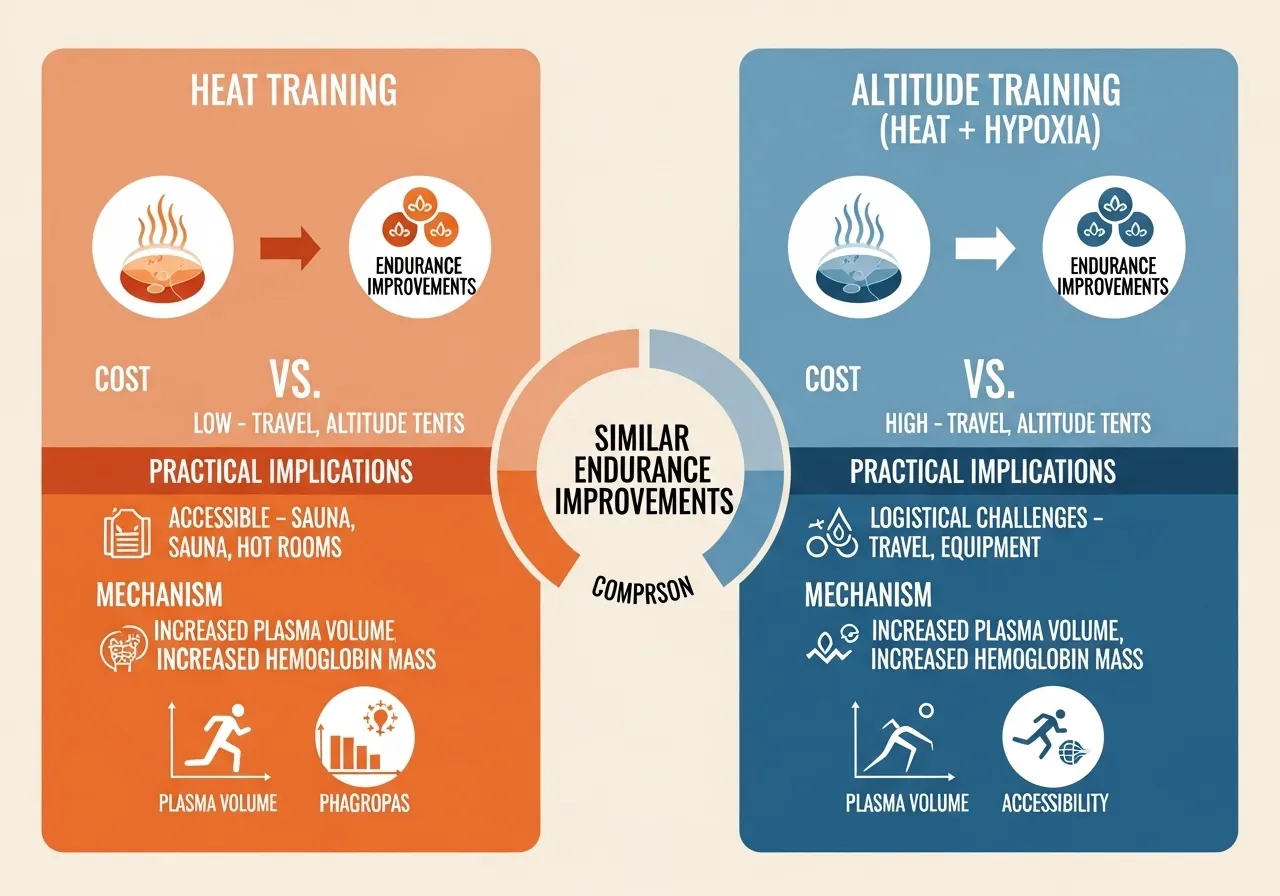
Altitude training requires travel to elevation or expensive altitude tents and simulated hypoxic systems. Heat training requires a sauna, a hot environment, or thermally insulative clothing worn during regular training. The accessibility difference is enormous. An amateur endurance athlete who can access a gym sauna or train outdoors in summer heat can perform meaningful heat acclimatisation that produces measurable VO2max and performance improvements at zero additional equipment cost and minimal travel requirement.
The Physiology: How Heat Produces Performance Adaptations
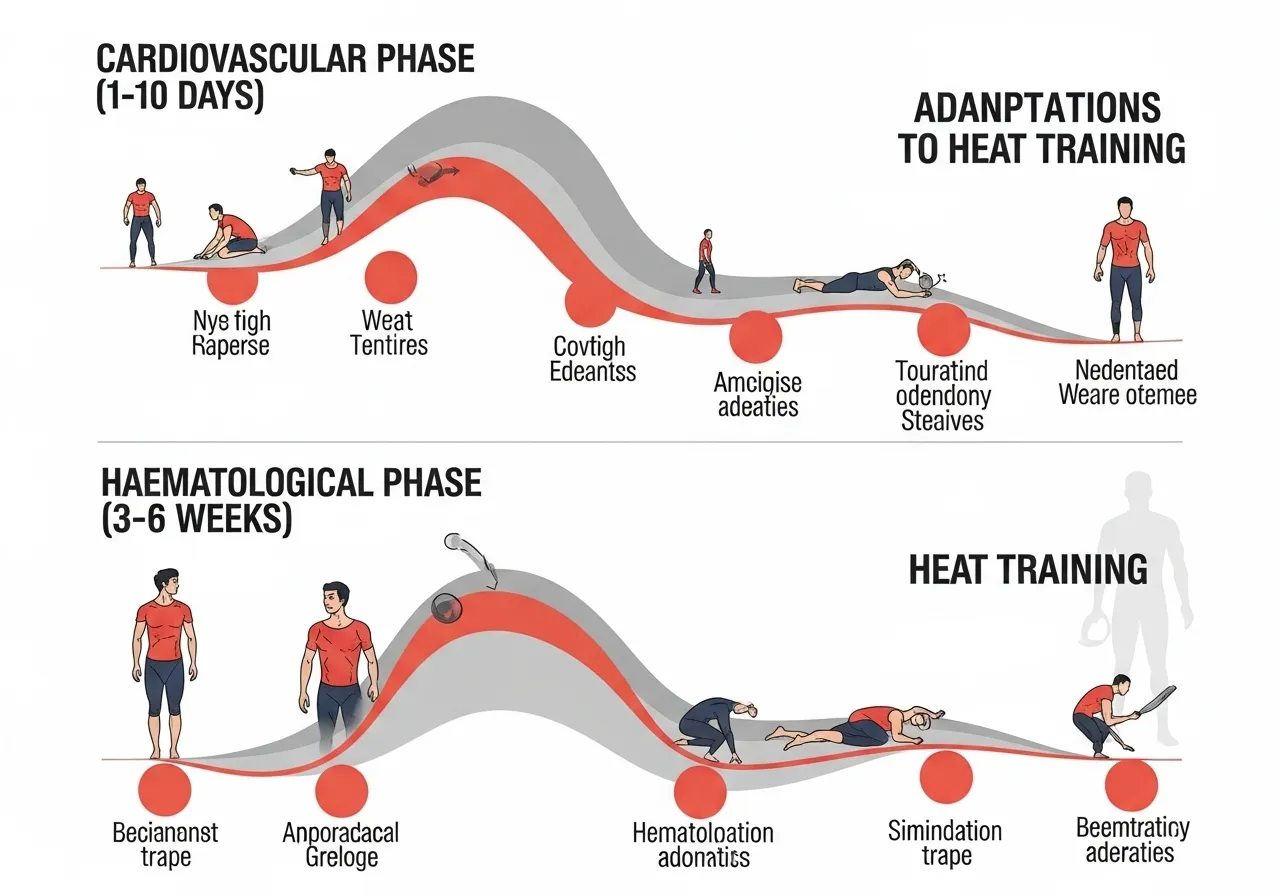
The Two-Phase Adaptation: Cardiovascular First, Haematological Second
Heat training produces adaptations in two temporal phases with different physiological mechanisms. The first phase (days 1 to 10) is primarily cardiovascular: plasma volume expands, heart rate at fixed workloads decreases, stroke volume increases, and the body becomes more efficient at redistributing cardiac output between active muscles and the skin for thermoregulation. These cardiovascular adaptations improve both heat tolerance and exercise economy, reducing the cardiovascular strain of exercise at any given intensity.
The second phase (weeks 3 to 6+) involves haematological adaptations: the expanded plasma volume dilutes blood haemoglobin concentration, stimulating a secondary erythropoietic response that increases total red blood cell mass and haemoglobin mass over weeks. This haematological response is the mechanism that produces the altitude-like VO2max improvements, because increased haemoglobin mass directly increases the oxygen-carrying capacity of each litre of blood and the maximum rate of oxygen delivery to working muscles.
Plasma Volume Expansion: The Fastest Adaptation
Plasma volume expands within 3 to 5 days of consistent heat training sessions. The mechanism involves increased aldosterone and antidiuretic hormone release in response to the cardiovascular strain of thermoregulation, promoting renal water and sodium retention that adds volume to the blood’s non-cellular component. A typical short heat acclimatisation protocol produces 10 to 15% plasma volume expansion, the equivalent of adding 400 to 600 ml of blood plasma volume to the circulation.
This expanded plasma volume improves exercise performance through several mechanisms: greater pre-load on the heart increases stroke volume and cardiac output at any given heart rate; improved blood viscosity aids oxygen delivery to peripheral tissues; increased sweat production capacity reduces body temperature at any given exercise intensity, reducing the cardiovascular strain of thermoregulation during exercise.
Heart Rate Reduction and Cardiac Output Efficiency
The cardiovascular improvements from heat acclimatisation produce reductions in exercising heart rate of 5 to 10 beats per minute at fixed exercise intensities within the first 5 to 10 days of training. This heart rate reduction allows either greater absolute intensity at the same perceived exertion, or lower cardiovascular strain at matched absolute intensity — both useful performance improvements. The cardiac output efficiency improvement means that the same oxygen delivery to working muscles requires less cardiac work, improving exercise economy at submaximal intensities.
Heat Shock Proteins and Cellular Protection
Heat training upregulates heat shock protein expression in muscle and other tissues, providing cellular protection against the oxidative and thermal stress of high-intensity training. Heat shock proteins function as molecular chaperones that protect proteins from denaturation under thermal stress and assist in refolding damaged proteins. The elevated heat shock protein expression from heat acclimatisation may reduce training-induced muscle damage and inflammation, potentially accelerating recovery between training sessions and reducing the performance decrements from heavy training loads that heat shock protein upregulation protects against.
The Temperate Performance Carry-Over
The performance improvements from heat training carry over to temperate conditions primarily through the haematological adaptations rather than the thermoregulatory improvements. In temperate conditions, the improved thermoregulation developed for hot environments is not significantly challenged, so the temperate performance benefit derives from the plasma volume expansion and, after prolonged heat training, the haemoglobin mass increases that improve oxygen-carrying capacity regardless of the ambient temperature. The Zone 2 aerobic base and how cardiovascular efficiency improvements from heat training interact with aerobic base development is covered in the Zone 2 training guide.
Heat Training Protocols: Short, Medium, and Long-Term Applications
The 5 to 12-Day Protocol: Cardiovascular and Plasma Adaptation
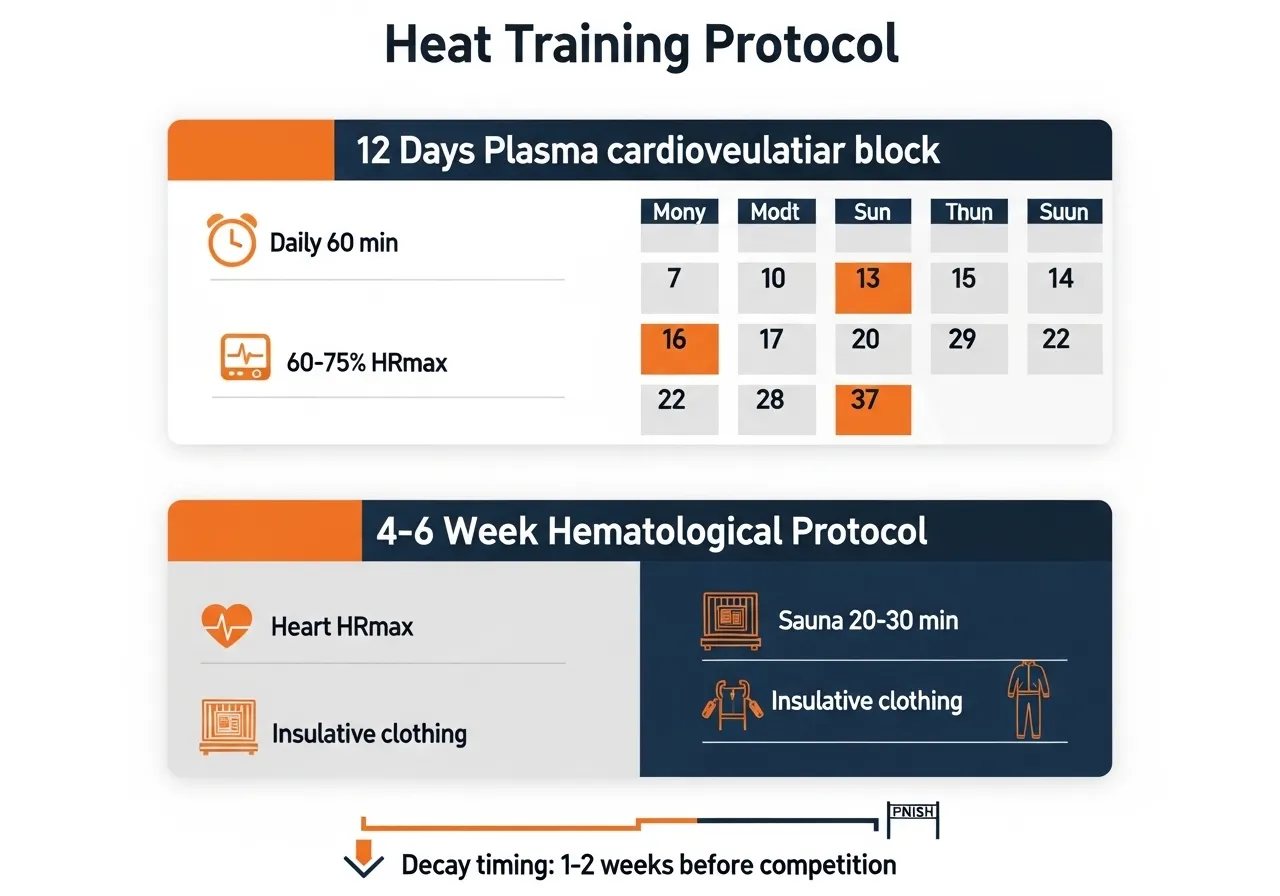
The most accessible heat training application for most athletes is the 5 to 12-day heat acclimatisation block targeted at plasma volume expansion and cardiovascular adaptation before an important competition, particularly one contested in hot conditions. This protocol requires approximately 60 minutes of daily heat exposure at exercise intensity sufficient to raise core temperature meaningfully — typically 60 to 75% of maximum heart rate in a hot environment (35 to 40 degrees Celsius) or in thermally insulative clothing at temperate temperatures.
📅 12-Day Pre-Competition Heat Block
Days 1 to 3: 45 minutes at 60% HRmax in hot environment, familiarisation
Days 4 to 8: 60 minutes at 65 to 70% HRmax, developing heat tolerance
Days 9 to 12: 60 to 75 minutes at 70 to 75% HRmax, consolidating adaptations
Session timing: at least 2 hours before or after main training sessions
Hydration: replace sweat losses precisely — weigh before and after each session
Expected outcomes at 12 days: 8 to 15% plasma volume expansion, 5 to 8 bpm heart rate reduction at fixed workloads, improved heat tolerance for hot-weather competition, and modest temperate performance carry-over through cardiovascular efficiency improvements.
The 4 to 6-Week Protocol: Haematological Adaptation
Athletes targeting the haematological adaptations that improve VO2max and temperate performance must commit to 4 to 6 weeks of consistent heat training. The research documents haemoglobin mass increases after 5 weeks in elite cyclists, suggesting this is the minimum duration for meaningful haematological adaptation. The daily volume and intensity can be lower than the short-term protocol’s maximum effort — 45 to 60 minutes at moderate intensity daily — because the haematological response is driven by cumulative heat exposure duration rather than peak heat stress per session.
Passive Heat Acclimatisation: The Sauna Protocol
Passive heat acclimatisation through sauna use after training sessions has research support for cardiovascular and plasma volume adaptations. Post-training sauna immersion of 20 to 30 minutes at 80 to 100 degrees Celsius, performed immediately after completing a regular training session, provides the thermal stimulus for heat shock protein upregulation and the cardiovascular strain that drives plasma volume expansion without requiring exercise in the hot environment itself.
This makes sauna-based heat training accessible to athletes who cannot train outdoors in hot weather and who do not have access to an environmental chamber. The sauna protocol requires 3 to 4 sessions per week for 3 to 4 weeks to produce measurable cardiovascular adaptations, and longer sustained periods for haematological benefits. The VO2 max interval training and how heat-derived VO2max improvements interact with high-intensity interval protocols is covered in the VO2 max interval training guide.
Thermally Insulative Clothing at Temperate Temperatures
A practical heat training approach that requires no special environment is training in thermally insulative clothing — additional layers that trap body heat and raise core temperature without requiring a hot ambient temperature. Research on elite cyclists using this approach to implement heat training in temperate training environments confirms that thermally insulative clothing produces equivalent heat acclimatisation adaptations to training in a hot chamber at matched internal temperature elevation, making it accessible in any training location regardless of ambient climate. The practical implementation is adding a thermal base layer, an insulating mid-layer, and light wind-blocking outer layer, then training at Zone 1 to Zone 2 intensity until the desired heat exposure duration is achieved.
Retaining Heat Adaptations: How Long Do They Last?
Plasma volume expansion from short-term heat training is partially lost within 5 to 7 days after training ends as the body returns to normal fluid regulation without the thermoregulatory challenge. Cardiovascular efficiency adaptations persist for 1 to 3 weeks. Haematological adaptations from prolonged heat training (4 to 6+ weeks) persist longer, with haemoglobin mass remaining elevated for 3 to 4 weeks after the heat training block ends. This decay timeline is important for competition timing: the heat training block should end 1 to 2 weeks before a target competition to allow the acute heat fatigue to dissipate while the plasma and haematological adaptations are still near their peak magnitude.
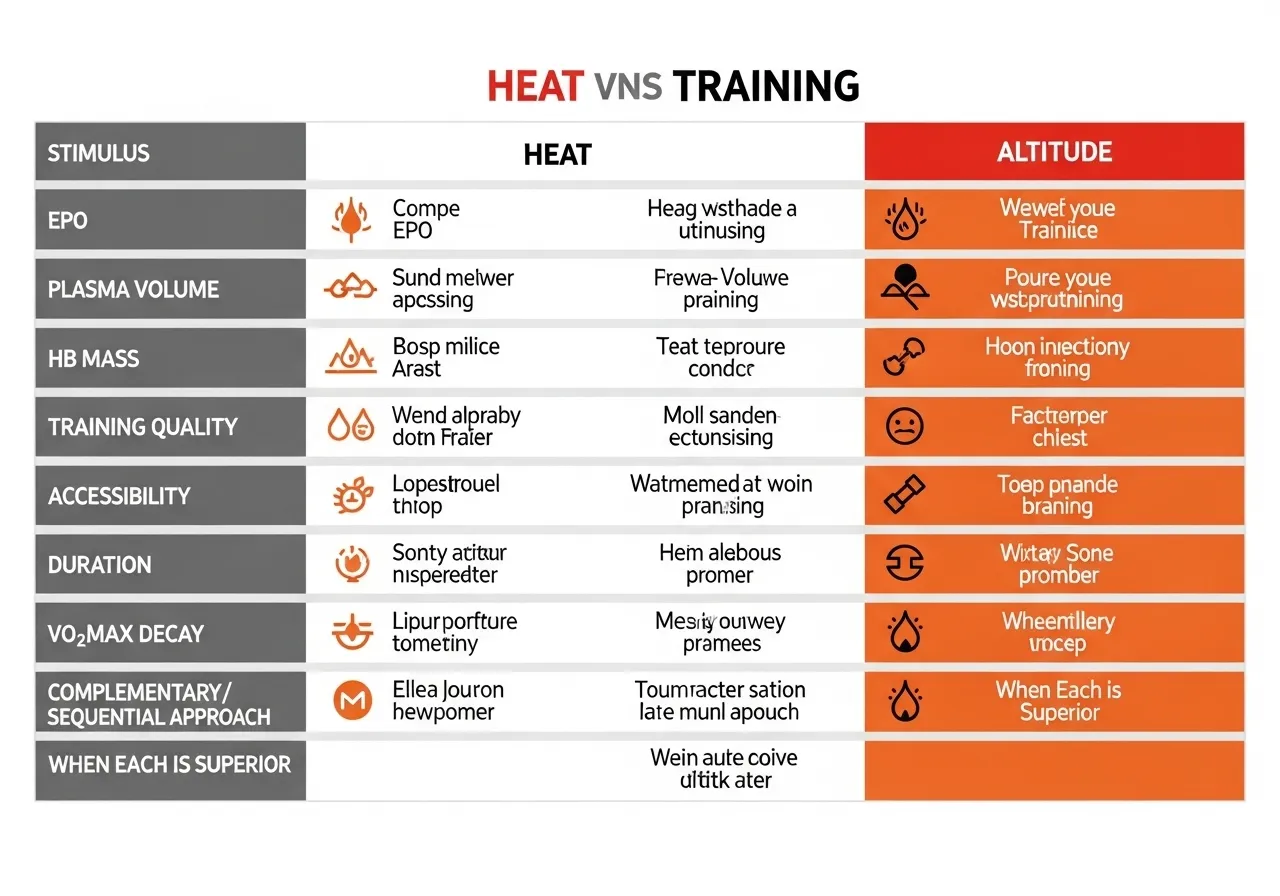
Heat Training vs Altitude Training: A Direct Comparison
The Mechanisms Are Different, the Outcomes Are Similar
Understanding how heat training and altitude training differ mechanistically clarifies why they can produce similar performance outcomes despite relying on completely different physiological triggers.
Variable
Altitude Training
Heat Training
Primary stimulus
Reduced oxygen partial pressure (hypoxia)
Elevated core temperature and cardiovascular strain
EPO stimulus
Direct hypoxia-driven EPO release
Secondary EPO from plasma dilution (long-term)
Plasma volume
Decreases acutely at altitude
Increases within 3 to 5 days
Haemoglobin mass
Increases with 3 to 4+ weeks at 1800–3000 m
Increases with 25 to 40+ days of heat training
Training quality
Reduced at altitude (hypoxic impairment)
Potentially reduced in heat but less than altitude
Accessibility
Requires travel or expensive equipment
Sauna, thermally insulative clothing, or hot climate
Duration for VO2max gains
3 to 4 weeks minimum
4 to 6 weeks for haematological VO2max gains
Adaptation decay
Rapid after descent (7 to 14 days)
Moderate decay (2 to 4 weeks post-training)
When Heat Training Is the Better Choice
Heat training is the more appropriate primary intervention when: the athlete cannot access meaningful altitude (above 1,800 metres) for 3 to 4 weeks; when the competition is contested in hot conditions where thermoregulatory adaptation is specifically valued; when cost or logistics prevent altitude training; or when a shorter 2-week acclimatisation block before competition is the goal, where heat training’s faster plasma volume expansion advantage makes it more effective than altitude training for the same duration.
When Altitude Training Remains Superior
Altitude training retains advantages for athletes who specifically need the maximum haematological adaptation in the shortest time. The direct hypoxia-driven EPO stimulus at altitude produces faster and larger haemoglobin mass increases than heat training’s secondary erythropoietic pathway, particularly in the 3 to 4-week intervention window where most altitude training blocks occur. For an elite athlete with access to a 4-week altitude camp, altitude training produces greater haematological gains than 4 weeks of heat training, even though equivalent heat training duration (6+ weeks) would eventually produce comparable haemoglobin mass increases. The polarised training model and how heat training fits within a structured periodised programme is covered in the polarised training guide.
The Complementary Approach: Using Both
Some elite athletes use heat training to extend the haematological benefits of altitude camps by continuing heat exposure after returning to sea level, slowing the decay of altitude-derived haemoglobin mass. Research on combining heat and altitude training has not consistently shown additive benefits when applied simultaneously, but sequential application — altitude camp followed by heat maintenance training — provides a practical approach to maintaining the altitude adaptation while training quality returns to sea-level standards.
Safety and Practical Implementation
Heat Illness Risk: The Most Important Safety Consideration
Heat training requires elevation of core temperature to drive the adaptation. The distinction between therapeutic heat stress that drives adaptation and dangerous heat stress that produces heat illness is the degree of core temperature elevation and the duration of exposure at elevated core temperature.
⚠️ Heat Illness Warning Signs — Stop Immediately
Confusion, disorientation, or unusual behaviour during a heat session
Cessation of sweating despite continued heat exposure (anhidrosis — serious warning)
Nausea or vomiting that does not resolve with a brief rest
Core temperature above 40 degrees Celsius (if measured)
Muscular cramps severe enough to limit movement
Heat exhaustion (weakness, dizziness, heavy sweating) is manageable with rest and cooling. Heat stroke (confusion, cessation of sweating, very high core temperature) is a medical emergency requiring immediate cooling and emergency services.
Hydration: The Non-Negotiable Foundation
Heat training increases sweat rate significantly — 1 to 2 litres per hour in moderate heat, more in extreme conditions. Replacing this fluid loss is essential for both safety and adaptation quality. Sweat losses that exceed 2% of body weight impair cardiovascular function and reduce the training adaptation from the session. Weigh before and after each heat training session: each kilogram of weight lost represents approximately one litre of sweat loss that should be replaced with water and electrolytes during and after the session. Sodium replacement is specifically important alongside water replacement — plain water without sodium during high sweat-rate sessions dilutes blood sodium concentration and impairs the renal water retention that drives plasma volume expansion.
Gradual Introduction: The First-Week Approach
Beginning heat training with 30 to 40-minute sessions at 60% of maximum heart rate before progressing to the full protocol duration and intensity respects the body’s need to develop basic heat tolerance before the higher heat stress of the target protocol is applied. Most heat illness events during acclimatisation occur in the first 3 to 5 days, before the cardiovascular adaptations have provided the thermoregulatory efficiency needed to manage the full thermal load. First-week sessions at moderate intensity and shorter duration provide the initial heat stimulus with lower heat illness risk than immediately beginning at the target protocol intensity.
When Not to Heat Train
Heat training is contraindicated during febrile illness, with any active infection producing elevated body temperature, during periods of significant sleep deprivation that impair thermoregulatory capacity, and in individuals with cardiovascular conditions that limit the ability to increase cardiac output in response to simultaneous exercise and thermoregulatory demands. Medications that impair heat tolerance — antihistamines, diuretics, beta-blockers, and some psychotropic medications — require medical clearance before beginning heat training protocols. Athletes with a history of heat stroke or heat illness should consult a sports medicine physician before undertaking structured heat training, as prior heat illness can impair thermoregulatory function and increase vulnerability to subsequent heat illness.
Integration With Training Load
Heat training sessions add a physiological stress to the training load that must be accounted for in the overall programme structure. A 60-minute heat session at Zone 2 intensity in a hot environment produces greater cardiovascular and hormonal stress than the same session at temperate temperature. Adding heat sessions to a full training programme without reducing other training load risks accumulating excessive total training stress. The standard approach is to perform heat training sessions at Zone 1 to Zone 2 intensity (lower than the main training sessions) and to treat heat training days as moderate-load training days rather than light recovery days when calculating weekly training stress.
Frequently Asked Questions About Heat Training
Is heat training effective for non-elite athletes, or only for professionals?
Heat training produces measurable physiological adaptations in athletes across the fitness spectrum. The plasma volume expansion and cardiovascular efficiency improvements from short-term heat training are not limited to elite athletes — recreational athletes show comparable percentage improvements in plasma volume and heart rate reductions from equivalent heat acclimatisation protocols. The absolute performance improvement is smaller in recreational athletes because their baseline performance is lower, but the physiological mechanisms and adaptation magnitudes are similar to those observed in more trained populations.
The practical implication is that a recreational runner preparing for a summer race in warm conditions can benefit meaningfully from a 10 to 12-day heat acclimatisation block before the event, reducing heat-related performance decrement during the race and potentially improving performance through cardiovascular efficiency gains. The protocol is the same regardless of training level; only the absolute intensity targets need adjustment to reflect the individual’s aerobic capacity.
Can I use a hot bath instead of a sauna for heat training?
Hot water immersion (bath or hot tub at 39 to 42 degrees Celsius for 20 to 30 minutes) after training sessions is a valid and research-supported heat acclimatisation method that produces plasma volume expansion and cardiovascular adaptations comparable to sauna use. Research on post-exercise hot water immersion as a heat acclimatisation method confirms meaningful plasma volume expansion and cardiovascular improvements within 10 to 14 days of daily 30-minute immersion sessions. The practical advantage of hot water immersion over sauna is that the heat is applied uniformly to the whole body including the legs, which produce the largest sweat response and cardiovascular strain when immersed, and the session can be performed at home without gym access.
How does heat training affect training quality?
Heat training sessions at the same absolute intensity as normal training produce greater cardiovascular strain, higher perceived exertion, and earlier fatigue than equivalent sessions in temperate conditions. This is expected and does not indicate that the session should be made easier or that the heat training is failing. The additional cardiovascular demand of thermoregulation on top of the exercise demand is what drives the adaptation. However, it does mean that performance metrics — pace per kilometre, power output, running economy — will be lower during heat sessions than equivalent temperate sessions. Judging heat training performance by absolute metrics rather than by the physiological strain (heart rate and perceived exertion) produces unnecessary concern about apparent performance decrements that are a natural consequence of the additional thermoregulatory load.
How does heat training compare to altitude tents for home use?
Altitude tents (normobaric hypoxic tents) that simulate sleeping at 2,500 to 3,000 metres altitude require 8 to 14 hours of daily hypoxic exposure for 3 to 4+ weeks to produce meaningful haematological adaptations, at a cost of 2,000 to 5,000 USD for commercial systems. Post-exercise sauna sessions of 20 to 30 minutes daily over 4 to 6 weeks produce cardiovascular and early haematological adaptations at the cost of gym sauna access — typically included in a standard gym membership. For athletes evaluating home performance enhancement investments, short-term heat training through sauna use is the more accessible option for cardiovascular and plasma adaptations, while altitude tents retain an advantage for athletes specifically targeting the maximum haematological adaptation in the shortest time without modifying training intensity or duration.
The combined approach for budget-conscious athletes: use heat training through sauna or insulative clothing as the primary haematological stimulus over 5 to 6 weeks, and consider altitude tent use only if budget and specific haematological goals justify the substantial additional cost. Research on the two approaches at equivalent durations shows comparable performance outcomes, making the cost differential difficult to justify for non-elite athletes for whom even modest performance improvements translate to meaningful race results.
Does heat training help with cold-weather performance?
The temperate and cold-weather performance benefits of heat training derive from the haematological adaptations (plasma volume expansion and haemoglobin mass increases) rather than from thermoregulatory improvements. Plasma volume expansion improves cardiovascular efficiency and exercise economy in any ambient temperature, and haemoglobin mass increases improve VO2max regardless of the competition environment. Cold-weather athletes who use heat training primarily for the haematological benefits — particularly those in cold-weather endurance sports where VO2max is a primary performance determinant — can expect meaningful performance improvements from well-implemented long-term heat training protocols even when competing in cold conditions.
Key Takeaways
Heat acclimatisation alone produces endurance performance improvements comparable to combined heat and altitude exposure. Adding normobaric hypoxia to heat training does not provide additional benefit over heat training alone.
Short protocols (5 to 12 days) produce plasma volume expansion and cardiovascular adaptations. Long protocols (25 to 40+ days) produce haemoglobin mass increases comparable to altitude training — the key variable is total heat exposure duration.
Heat training’s primary advantages over altitude training are accessibility (sauna, insulative clothing, or natural hot climate), lower cost, and faster plasma volume expansion that makes it superior for short pre-competition blocks.
The decay timeline of heat adaptations requires timing the training block to end 1 to 2 weeks before competition — plasma volume peaks by day 10 to 14 and begins declining without maintenance stimuli, while haematological adaptations from prolonged protocols persist for 3 to 4 weeks post-training.
Safety requires progressive introduction (first-week sessions at reduced intensity), meticulous hydration with sodium replacement, and immediate cessation if heat illness warning signs appear. Heat stroke is a medical emergency requiring immediate cooling and emergency services.
Treadmill running gets dismissed as the inferior version of real running. It removes terrain variation, wind resistance, and the natural speed fluctuations that make outdoor running physiologically rich. These criticisms are partially true and largely overstated. The treadmill also offers something outdoor running cannot: precise, repeatable training conditions. Exact speed. Exact incline. No traffic, no…
⚠️ Cardiovascular Monitoring Safety NoteHRV monitoring is a wellness and performance tool — not a medical diagnostic device. Consistently low HRV accompanied by symptoms such as chest pain, unexplained breathlessness, palpitations, or severe fatigue may indicate an underlying cardiovascular or systemic condition requiring medical evaluation. Do not use HRV data alone to override symptoms that…
⚠️ Health & Fitness DisclaimerThis article is for general educational and informational purposes only. It does not replace professional medical or fitness advice. If you have any pre-existing condition, injury, or health concern — consult a qualified healthcare professional or certified personal trainer before starting or modifying any exercise program. Sandbag training occupies a unique…
⚠️ Fitness Disclaimer: The information in this article is for general educational purposes only and does not constitute professional fitness or medical advice. Exercise carries inherent risks. Always consult a qualified healthcare professional or certified personal trainer before starting or modifying any exercise program, especially if you have a pre-existing medical condition, injury, or health…
⚠️ Health & Fitness DisclaimerThis article is for general educational purposes only and does not replace professional medical advice. If you have any lower back, knee, or cardiovascular conditions, please consult a qualified healthcare professional before beginning a rowing machine mastery guide program. The rowing machine training guide machine — or ergometer — produces a…
Why Running Is the Most Accessible and Most Misstarted Fitness Activity Running has the lowest barrier to entry of any fitness activity — it requires no equipment beyond supportive shoes, no gym membership, and no specific skill level to begin. It is also the fitness activity most commonly attempted and abandoned within the first few…