Barbell Lunge: The Mechanics Behind the Most Functional Leg Exercise and How to Programme It for Maximum Development
The barbell squat is the king of lower body exercises. Nobody argues this. But the squat trains both legs simultaneously, allows the stronger leg to compensate for the weaker, and does not replicate the single-leg mechanics of every sport, every staircase, and every walking stride.
The barbell lunge addresses what squatting leaves untrained. It loads each leg independently through a range of motion that mirrors real movement. It develops quad, glute, and hamstring strength in the positions the body actually uses them. It exposes asymmetries between legs that bilateral training conceals. And it does this with a barbell, which means progressive overload is straightforward and the strength developed transfers directly to other compound lifts.
This guide covers the EMG evidence on lunge muscle activation, how step length and stride variation change which muscles work, the mechanics that make lunges distinct from squats and split squats, technique for five variations, common errors, and an 8-week lunge programming block.
The EMG Evidence: What Lunge Research Shows About Muscle Activation
Step Length Determines Which Muscles Work
A study examining the effects of step length and stride variation on lower extremity muscle activity during forward lunges found that quadriceps, hamstrings, gastrocnemius, hip adductor, and gluteus maximus EMG activities were all significantly greater in lunges with a long step compared to lunges with a short step, while gluteus maximus and gluteus medius activities were significantly greater in lunges performed with a stride compared to lunges performed without a stride, and significant interactions were found for gluteus medius which showed greater activation with long steps, and for quadriceps which showed significantly greater activation in long-step stride lunges compared to short-step stride lunges, confirming that step length is a primary determinant of lunge muscle activation across all major lower limb muscle groups.
Longer steps produce greater activation across quadriceps, hamstrings, glutes, and hip adductors simultaneously. Step length is the single most impactful lunge variable for maximising muscle activation. Short-step lunges are not a harder or easier version. They represent a fundamentally different exercise stimulus.
Forward Lunge vs Squat: The VMO and Hamstring Comparison
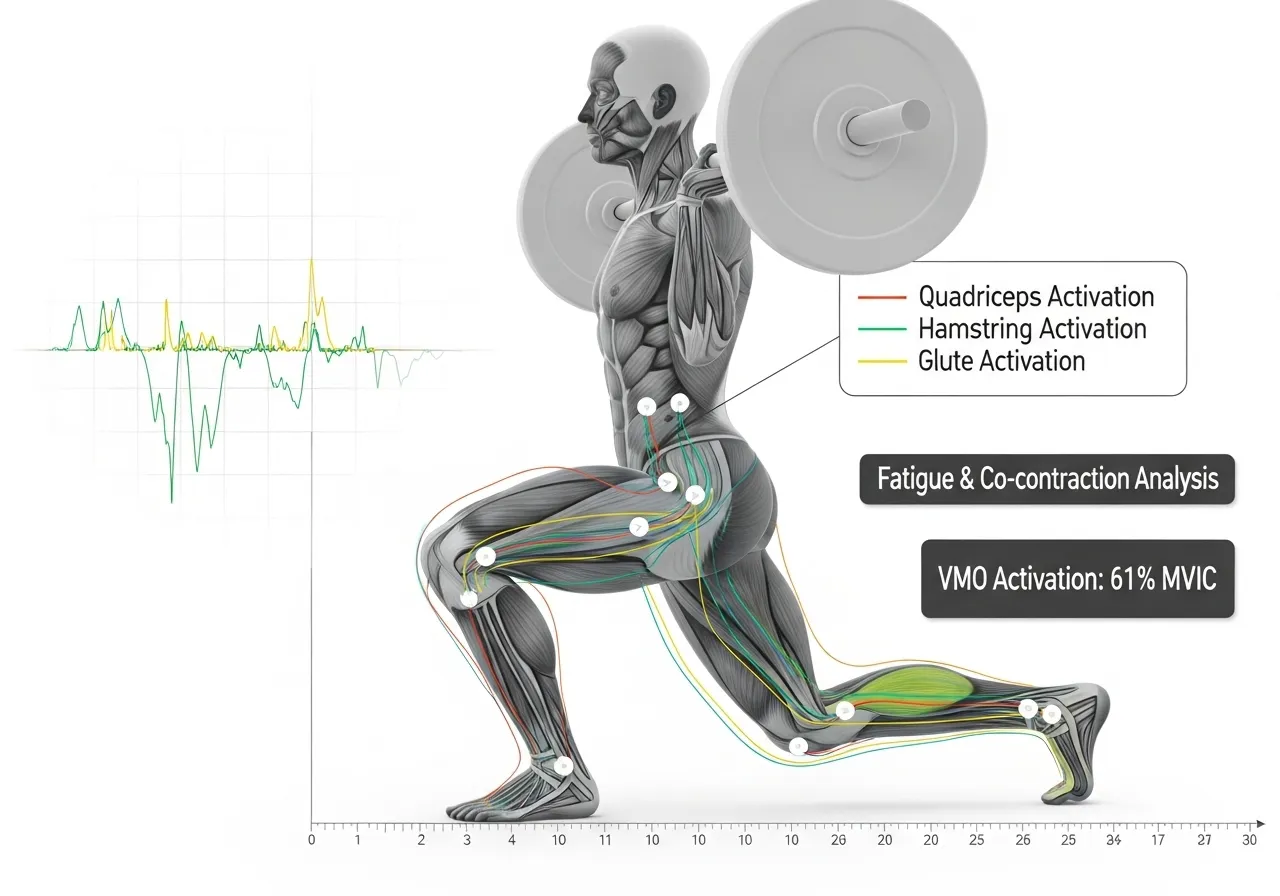
A study examining EMG activity of trunk, core, and thigh muscles during common rehabilitation exercises including forward lunge and squat found that the forward lunge produced significantly higher activation in the vastus medialis at 61.1 percent of MVIC, the vastus lateralis at 59.2 percent, and the rectus femoris at 32 percent, with the forward lunge and glute bridge producing considerably higher activation of biceps femoris and semitendinosus compared to squat and sit-up variations, supporting the integration of the forward lunge into training programmes for enhancing both quadriceps and hamstring function.
The forward lunge produces VMO activation of 61% MVIC and significantly greater hamstring (BF and ST) activation than the squat. The lunge trains both the quadriceps and hamstrings through the range that ACL rehabilitation and athletic performance require.
Fatigue Response: How Lunge Activation Changes Under Prolonged Effort
A study examining quadriceps and hamstring muscle activation during forward lunges performed to volitional failure found that there was a significant increase in activation of the vastus lateralis, vastus medialis, and biceps femoris during performance of the forward lunge to volitional failure, with these three muscles activating as a functional unit during both the concentric and eccentric phases of the lunge cycle, suggesting that the lunge recruits the quadriceps and biceps femoris in a co-contraction pattern that provides knee joint stabilisation throughout the entire movement.
VL, VM, and BF activate together as a co-contraction unit during lunging, providing dynamic knee joint stabilisation. This co-contraction pattern makes lunges valuable for knee health and ACL injury prevention beyond their primary strength development role.
The Mechanics of the Lunge: Why It Trains Differently From the Squat and Split Squat
Bilateral vs Unilateral Mechanics
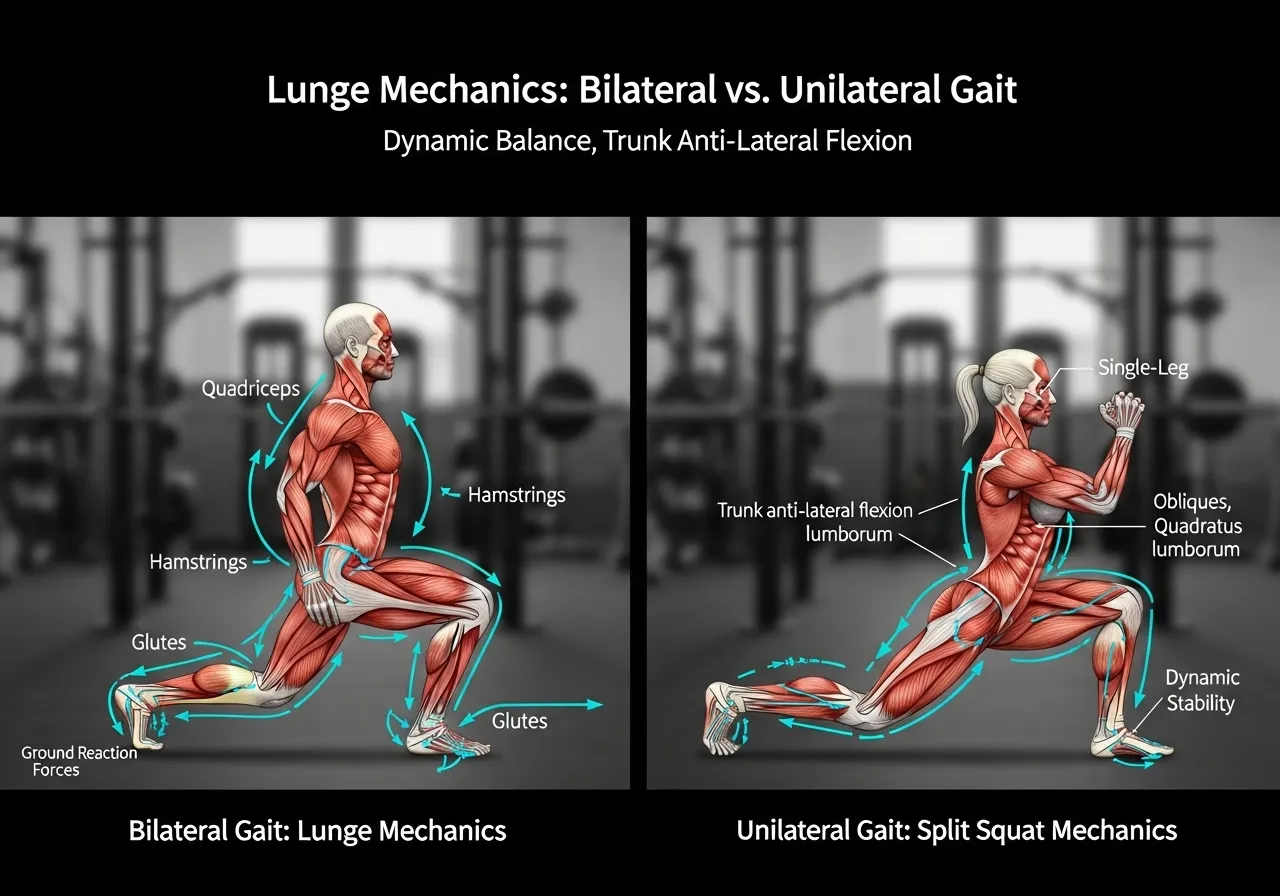
The fundamental mechanical difference between the squat and the lunge is single-leg versus double-leg propulsion. In a bilateral back squat, both legs push the floor simultaneously. Force production is shared across both limbs, which allows the stronger leg to compensate for the weaker without either the trainee or the barbell detecting the imbalance. A 100 kg squat could involve 60 kg from one leg and 40 kg from the other. The bar rises regardless.
In a barbell lunge, the front leg is responsible for the primary concentric drive. The rear leg assists in balance and provides a degree of push in the forward lunge variation, but the front leg cannot offload its responsibility to the rear. This forces each leg to produce adequate force independently. The weaker leg is exposed. Strength asymmetries that bilateral squatting has masked for months become apparent within the first set of lunges at meaningful loads. This is not a disadvantage of lunging. It is the diagnostic value that makes lunging a necessary complement to bilateral squatting for any serious training programme.
Lunge vs Split Squat: The Dynamic Difference
The lunge and the Bulgarian split squat both train each leg independently, and they are often treated as interchangeable. The mechanical distinction matters for programming decisions. The Bulgarian split squat is a static exercise: the feet stay fixed throughout all reps of a set. The movement occurs within a fixed base of support, and the stability challenge remains constant from the first rep to the last.
The walking lunge and reverse lunge involve continuous foot repositioning. Each rep requires balance in transit: the moment between foot placements, the single-leg stance during the stride, and the landing under load all demand dynamic stability that static split squat positions do not require. This dynamic stability challenge is what makes walking lunges specifically valuable for sport performance and functional fitness. An athlete who can Bulgarian split squat heavy but struggles to transfer that strength into athletic movements often lacks the dynamic stability that only lunging under load develops.
The Trunk and Core Demand
A barbell lunge places the load on the upper back in the same position as a back squat, but the unilateral base of support creates a much greater demand for lateral trunk stability. The obliques and quadratus lumborum must prevent the trunk from collapsing toward the stance leg with every step. This demand is absent in bilateral squatting and only partially present in the Bulgarian split squat, where the rear foot provides bilateral grounding. The barbell lunge, particularly the walking version, develops anti-lateral-flexion trunk strength that no bilateral lower body exercise can provide.
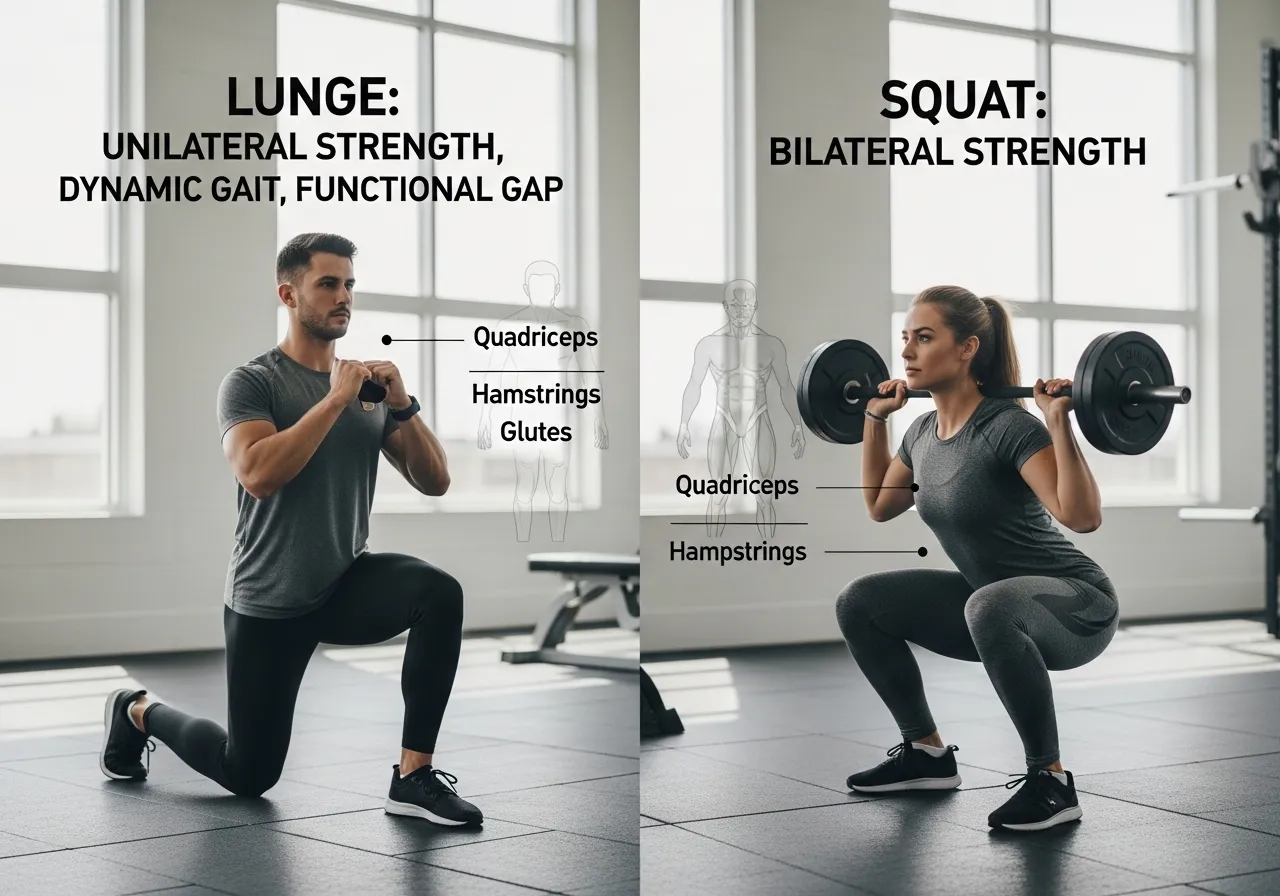
Is the Lunge Better Than the Squat for Leg Development?
What Squatting Develops That Lunging Does Not
The barbell back squat allows maximum absolute loading of the lower body. A trainee can squat 150 kg before they can lunge anywhere near that load, because the balance and stability demands of lunging limit the load independent of leg strength. For maximum lower body strength and neural drive to the quadriceps, glutes, and posterior chain under heavy axial loading, the bilateral squat is superior. The hormonal and systemic response to heavy bilateral squatting, driven by the large muscle mass involved and the high absolute loads possible, exceeds what unilateral loading can produce at matched lower body stress.
For trainees whose primary goal is maximal lower body strength for powerlifting, Olympic weightlifting, or sport-specific strength requirements, the bilateral squat is the primary movement and lunges serve as accessories. The barbell back squat and how to maximise its depth, bar position, and programming is covered in the barbell back squat guide.
What Lunging Develops That Squatting Does Not
The lunge develops three qualities that bilateral squatting cannot provide regardless of volume: unilateral leg strength through gait-pattern mechanics, dynamic balance under loaded single-leg stance transitions, and the ability to produce force in the split position that every sport, every step up stairs, and every change of direction requires. These are not aesthetic qualities. They are functional movement capacities that determine whether gym strength transfers to real-world athletic performance.
Trainees who squat heavily but never lunge often report that their squat strength does not translate to sports performance as expected. Their bilateral squat is strong. Their single-leg mechanics are undertrained. The lunge fills this gap in a way that no amount of additional squatting can address, because the single-leg stance during a lunge is mechanically irreproducible in bilateral movements regardless of load. The Bulgarian split squat is the closest static equivalent, but its static foot placement removes the dynamic transition component that makes the lunge sports-specific. The Bulgarian split squat’s unique contributions and programming are covered in the Bulgarian split squat guide.
The Answer: Neither Replaces the Other
The bilateral squat and the barbell lunge are not competing for the same training effect. They develop overlapping but distinct leg strength qualities through different mechanical demands. A leg programme that includes both heavy bilateral squatting and progressive barbell lunge work develops a more complete lower body than maximising either movement alone. The practical programming question is not which to choose but how to distribute volume between them based on individual goals, training phase, and recovery capacity.
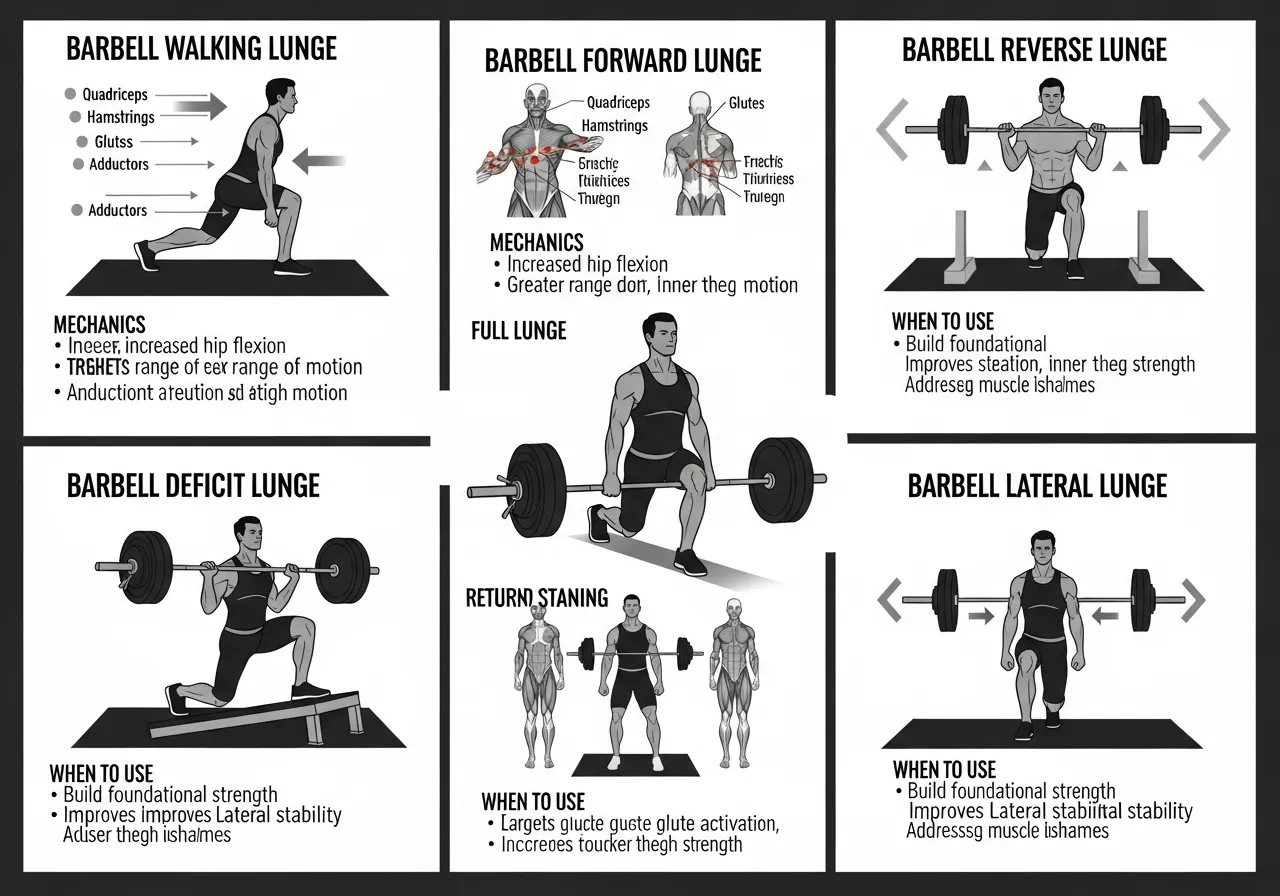
5 Barbell Lunge Variations: Mechanics, Targets, and When to Use Each
🏋️ 1. Forward Barbell Lunge (Stride Return)
Target: Quadriceps, glutes, hamstrings, dynamic balance
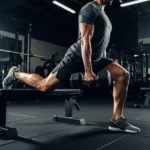
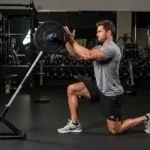
How: Step one foot forward onto the heel, lower until the front thigh is parallel to the floor, then drive back to the starting position by pushing off the front foot. Return the front foot to stand beside the rear foot between reps.
Key point: The stride return version requires the front leg to both lower and drive back to standing, increasing front-leg concentric demand compared to the walking lunge. This is the highest-demand forward lunge variation for front-leg quad and glute development per rep.
🏋️ 2. Walking Barbell Lunge
Target: Continuous quad and glute work, dynamic stability, gait mechanics
How: Step forward into a lunge position, then instead of returning to start, bring the rear foot forward into the next lunge. Continue walking forward for a set distance or number of reps. Each stride requires a balance transition between lunges.
Key point: Walking lunges accumulate more total leg work per metre covered than any other lunge variation because there is no pause between reps. The continuous nature of the movement and the balance transition between strides make this the most sport-specific lunge variation. Progress by increasing distance, then load.
🏋️ 3. Reverse Barbell Lunge
Target: Glutes and hamstrings emphasised over quads, lower knee stress
How: Step one foot backward from a standing position, lower the rear knee toward the floor, then drive the rear foot forward back to standing. The movement begins with a backward step rather than a forward step.
Key point: The reverse lunge shifts the centre of mass over the heel of the front foot rather than the mid-foot as in forward lunging. This reduces anterior knee stress and increases glute and hamstring demand on the front leg. For trainees with anterior knee pain or patellofemoral sensitivity, reverse lunges often allow pain-free loading that forward lunges cannot.
🏋️ 4. Deficit Lunge (Rear Foot Elevated)
Target: Increased hip flexor stretch and glute activation through greater range
How: Place the rear foot on a low platform of 5 to 10 cm. Step forward into the lunge position, allowing the greater hip extension on the rear leg. The small elevation increases the range of motion at the hip without fully converting the movement to a Bulgarian split squat.
Key point: The deficit lunge provides a middle ground between the flat-ground lunge and the Bulgarian split squat. It increases hip flexor stretch and glute activation range while preserving the dynamic stepping component. Appropriate for intermediate trainees who have mastered flat lunges and need greater stimulus without static split squat loads.
🏋️ 5. Lateral Lunge
Target: Hip abductors, adductors, medial quad, frontal plane stability
How: Step one foot directly to the side, pushing the hip back into a single-leg squat on the stepping leg while keeping the opposite leg straight. Drive back to standing from the stepping leg. This is the only lunge variation that trains the frontal plane movement pattern.
Key point: The lateral lunge trains hip abductor and adductor strength in a functional position that sagittal-plane lunges and squats do not address. Athletes whose sports involve lateral movement benefit significantly from lateral lunge loading. Typically performed with lighter loads than sagittal variations due to the unfamiliar movement plane.
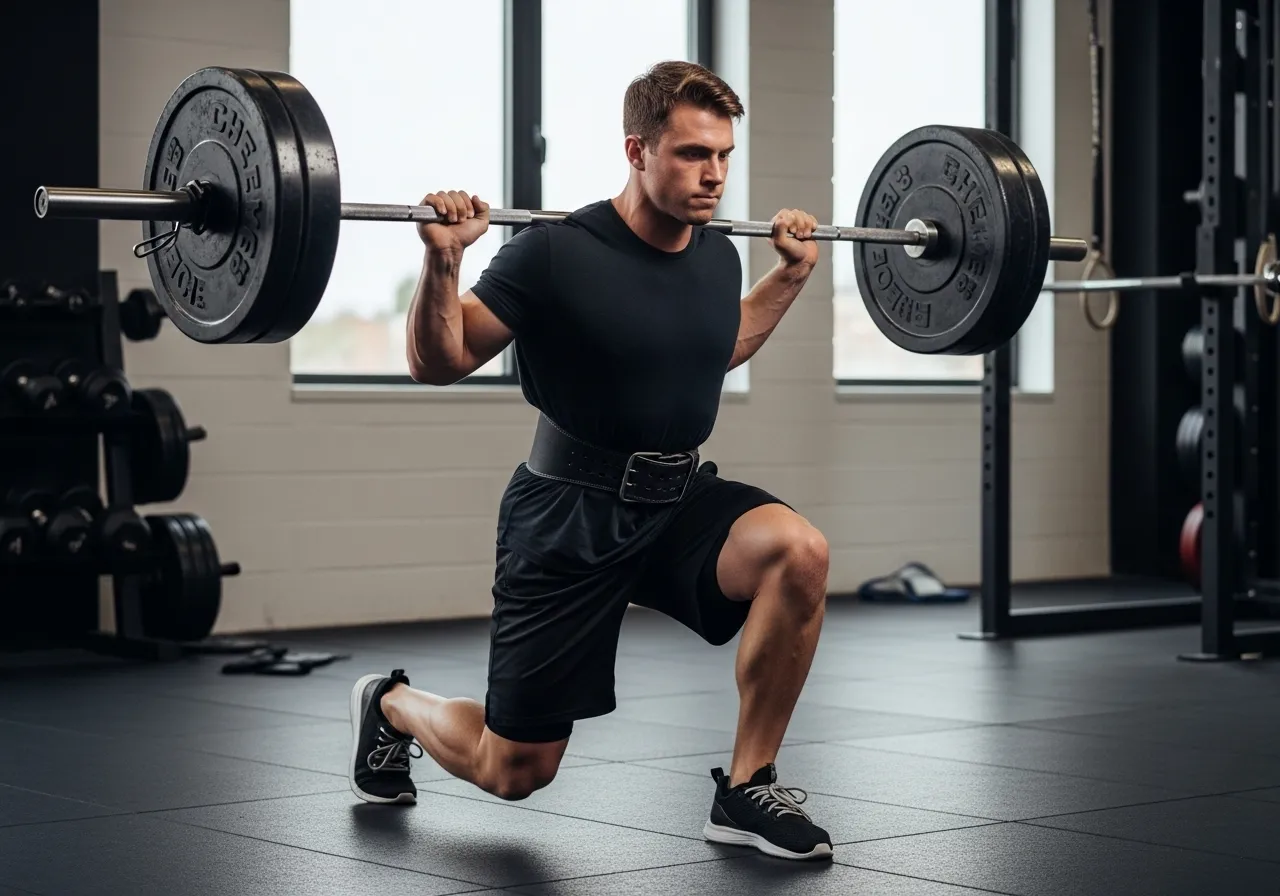
Barbell Lunge Technique: The Details That Determine Safety and Effectiveness
Barbell lunges load the knee in a single-leg stance under axial compression. Individuals with active patellofemoral syndrome, medial knee pain, or recent meniscal or ACL injury should obtain clearance before performing loaded lunges. The reverse lunge variation typically places less anterior knee stress than the forward lunge. Individuals with lumbar instability should ensure core bracing is established before each rep, as the unilateral base creates greater lateral trunk demand than bilateral squatting at matched loads.
Setup and Bar Position
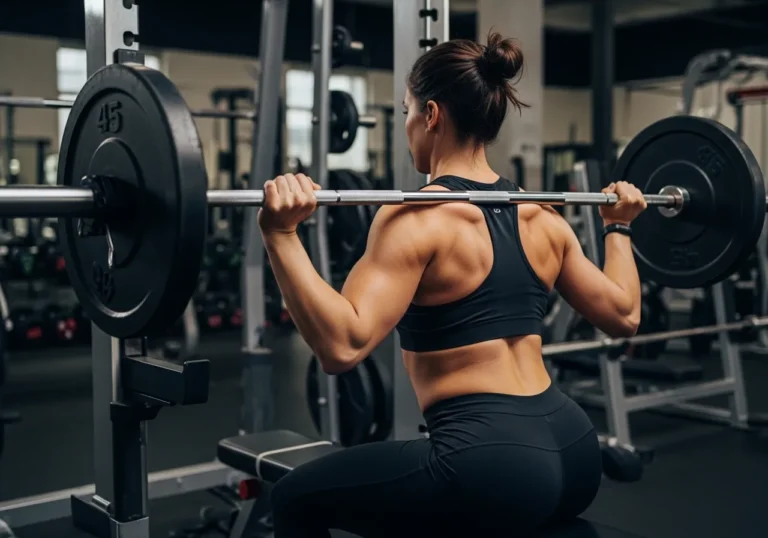
Set the bar in the same high bar or low bar position used for back squats. The lunge does not require a separate bar position. High bar placement provides slightly less forward lean, which can be easier to manage during the dynamic balance demands of lunging. Low bar placement allows heavier absolute loading but requires more forward lean management during the movement.
Unrack the bar with the same braced, tight setup as the back squat. Take a conservative step back from the rack before beginning the first rep. Starting lunges from directly under the rack without adequate clearance creates a collision risk during the backward steps of reverse lunges or during longer walking lunge strides. Two to three large steps backward from the rack provides adequate clearance for all lunge variations.
The Front Knee Path
The front knee should track over the second and third toes throughout the lunge. Unlike the bilateral squat where knee caving is primarily an adductor weakness issue, knee caving during lunges often reflects both adductor and gluteus medius weakness. A single leg cannot rely on the contralateral leg for medial stability. The gluteus medius on the stance leg must work continuously to prevent knee valgus throughout the full range.
The front knee can travel forward past the toes during lunges. Restricting the front knee from passing the toes forces excessive trunk lean and hip compensation that does not protect the knee. The knee-over-toes concern from older exercise prescription guidance no longer holds under current biomechanical research. What matters is not whether the knee passes the toes but whether it tracks in line with the foot while doing so.
Torso Position and Depth
Maintain a relatively upright torso throughout the lunge. Excessive forward lean shifts the movement toward a hip-dominant hinge pattern that reduces quad stimulus. The torso angle should remain within 15 to 20 degrees of vertical in the forward lunge, similar to the front squat angle. Lower until the front thigh is parallel to the floor or slightly below. Stopping short of parallel reduces the range of motion that the quad and glute must work through and limits the development stimulus.
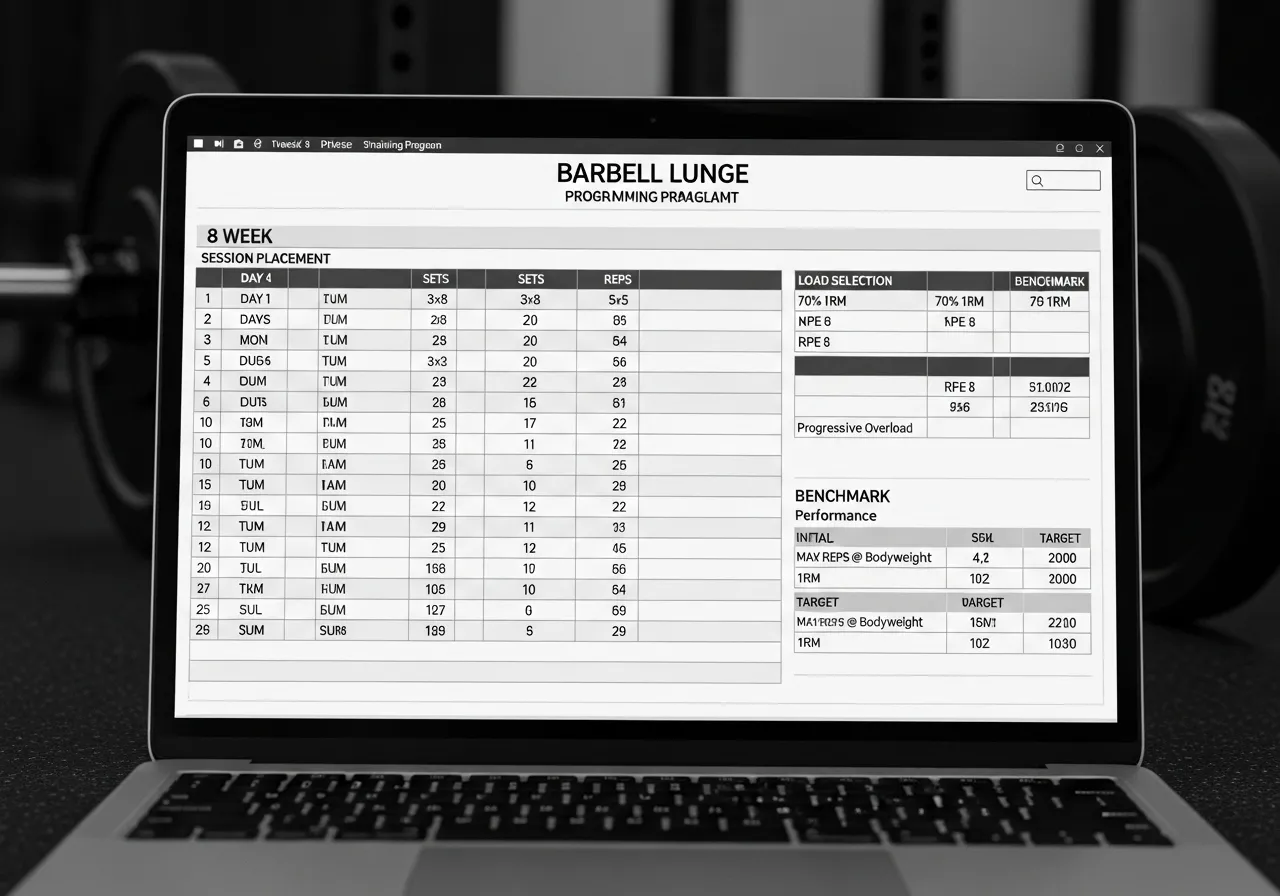
Programming Barbell Lunges: Where They Fit and How to Progress
Session Placement
Barbell lunges belong after primary bilateral leg movements in a session. Squats and deadlifts require bilateral stability and maximal neural drive. Performing lunges before heavy squats reduces squat performance by prefatiguing the quads and, more importantly, the dynamic stabilisers that unilateral loading demands. Lunges as a secondary movement after squats or deadlifts extend leg training volume at a load the fatigued bilateral system cannot safely handle.
An exception applies when lunges are the primary lower body movement for a session, which is appropriate in training phases where bilateral squat or deadlift work is reduced due to fatigue management or injury. In these phases, lunges can be performed first in the session at higher loads than typical secondary-exercise loads.
Sets, Reps, and Load Selection
Barbell lunge working loads are typically 30 to 50% of the back squat 1RM for most trainees. The balance and stability demands cap the load below what pure leg strength could theoretically handle. For walking lunges, counting repetitions per leg rather than total reps ensures equal volume across limbs: 10 reps per leg equals 20 total lunge steps.
Rep ranges across goals: 6 to 8 reps per leg for strength development at higher relative loads, 10 to 15 reps for hypertrophy at moderate loads, 15 to 20 reps or distance-based sets for conditioning. The glute development framework and how lunge glute activation compares to hip thrusts and squats in a complete programme is covered in the hip thrust guide.
8-Week Barbell Lunge Programme
📅 Phase 1: Weeks 1 to 3: Pattern Establishment
- Reverse lunge: 3 sets of 8 per leg at 25 to 30% back squat 1RM
- Walking lunge bodyweight: 3 sets of 10 per leg for pattern development
- Focus: front knee tracking, torso position, equal depth both legs
- Perform after primary squat work, not before
The reverse lunge is the lowest-knee-stress entry point. Mastering it before forward and walking variations builds the single-leg stability that loaded forward lunges demand.
📅 Phase 2: Weeks 4 to 6: Load Development
- Barbell reverse lunge: 4 sets of 8 per leg, increase load weekly
- Introduce barbell walking lunge: 3 sets of 12 per leg at moderate load
- Identify and address any depth or balance asymmetry between legs
Progressive load on both variations. If one leg consistently loses balance or depth at matched loads, add one extra set on the weaker side until the gap closes.
📅 Phase 3: Weeks 7 to 8: Peak Volume and Benchmark
- Barbell reverse lunge: 4 sets of 6 per leg at near-maximal load for the variation
- Barbell walking lunge: 3 sets of 20 metres at working load
- Week 8: compare working loads to Week 1 starting loads for both variations
- Expected: 15 to 25% load increase from Phase 1 to Phase 3
The walking lunge distance benchmark provides a practical fitness measurement that weights and reps cannot capture. Twenty metres of barbell walking lunges is a demanding and satisfying strength-endurance benchmark for intermediate trainees.
Frequently Asked Questions About the Barbell Lunge
Can I use the barbell lunge as my primary leg exercise instead of squatting?
Yes, with qualifications. The barbell lunge develops single-leg strength and dynamic stability more effectively than squatting and can serve as the primary leg movement in a programme. However, the load capacity of the lunge is limited by balance rather than leg strength for most trainees, which means the absolute mechanical tension and neural drive stimulus is lower than what bilateral squatting at comparable effort produces.
Trainees who cannot or choose not to squat bilaterally, such as those with hip impingement, bilateral knee pathology, or specific sport demands prioritising unilateral movement, can build excellent leg strength and hypertrophy through barbell lunge work as the primary modality. Adding Bulgarian split squats as a secondary exercise alongside the lunge provides the static unilateral strength development that complements the dynamic stability of lunging. For most trainees, the combination of bilateral squatting and barbell lunging as secondary work produces the most complete leg development outcome.
How do I stop wobbling during heavy barbell lunges?
Wobbling during barbell lunges almost always reflects one of three issues: insufficient gluteus medius strength, stepping too narrow, or too rapid a descent. The gluteus medius stabilises the pelvis in single-leg stance. When it is too weak to control the lateral pelvic shift that each lunge step creates, the trunk sways and the knee caves.
The fix is not to reduce the load immediately. It is to slow the descent to a controlled 3-second eccentric, widen the step slightly, and focus on driving the knee outward over the second toe throughout the rep. If the wobbling persists despite these technique adjustments, the load exceeds what the current gluteus medius strength can stabilise. Reduce the load until the movement is stable, then build back progressively. Lateral lunge work as an accessory exercise specifically develops gluteus medius endurance under load.
Forward lunge vs reverse lunge: which should I use?
Both develop the same primary muscle groups but through different stress profiles on the knee joint. The forward lunge places more anterior knee stress through the deceleration phase of each step. The reverse lunge reduces this anterior stress by eliminating the deceleration component and shifting the centre of mass over the heel of the front foot.
Trainees without knee history should use both: the forward lunge for dynamic balance and gait-specific mechanics, the reverse lunge for lower-knee-stress volume accumulation and glute emphasis. Trainees with anterior knee sensitivity should prioritise the reverse lunge during symptomatic periods and introduce forward lunges gradually once knee tolerance improves. For sport athletes who need to develop deceleration strength specifically, the forward lunge’s braking demand is a feature, not a limitation, and should be trained progressively.
How heavy should I lunge relative to my squat?
Most trainees barbell lunge at 35 to 50% of their back squat 1RM for working sets. Early in lunge training, the balance limitation often sits below even this range. A trainee who squats 120 kg may begin barbell lunges at 40 to 50 kg per side, not because their legs are too weak to handle more but because their single-leg dynamic stability is underdeveloped relative to their bilateral squat strength.
As lunge technique develops over weeks of consistent training, the limiting factor transitions from balance to leg strength and the load-to-squat ratio rises. Experienced lungers with well-developed single-leg stability often reach 55 to 65% of their back squat load. The ratio improvement over a training block is a useful marker of single-leg stability development, separate from and complementary to bilateral squat progress.
- Longer step length produces significantly greater activation across quads, hamstrings, glutes, and hip adductors simultaneously. Step length is the primary lunge variable for maximising muscle activation.
- The forward lunge produces VMO activation of 61% MVIC and significantly greater hamstring activation than the squat. VL, VM, and BF activate as a co-contraction unit providing dynamic knee stability throughout both eccentric and concentric phases.
- The lunge develops dynamic single-leg stability through gait-pattern mechanics that bilateral squatting and static split squats cannot replicate. Athletes who squat heavily but never lunge have a functional strength gap that more squatting cannot close.
- The reverse lunge reduces anterior knee stress compared to the forward lunge by eliminating the braking component and shifting load over the heel. Both variations belong in a complete programme.
- Begin at 35 to 50% of back squat 1RM. The limiting factor early in lunge training is single-leg balance stability, not leg strength. As stability develops over weeks, the appropriate load rises independently of squat strength progress.