Most training programmes develop either strength or power. Powerlifters squat heavy and get strong. Sprinters sprint fast and get explosive. The two qualities rarely develop in the same session, in the same set pairing, or even in the same training block.
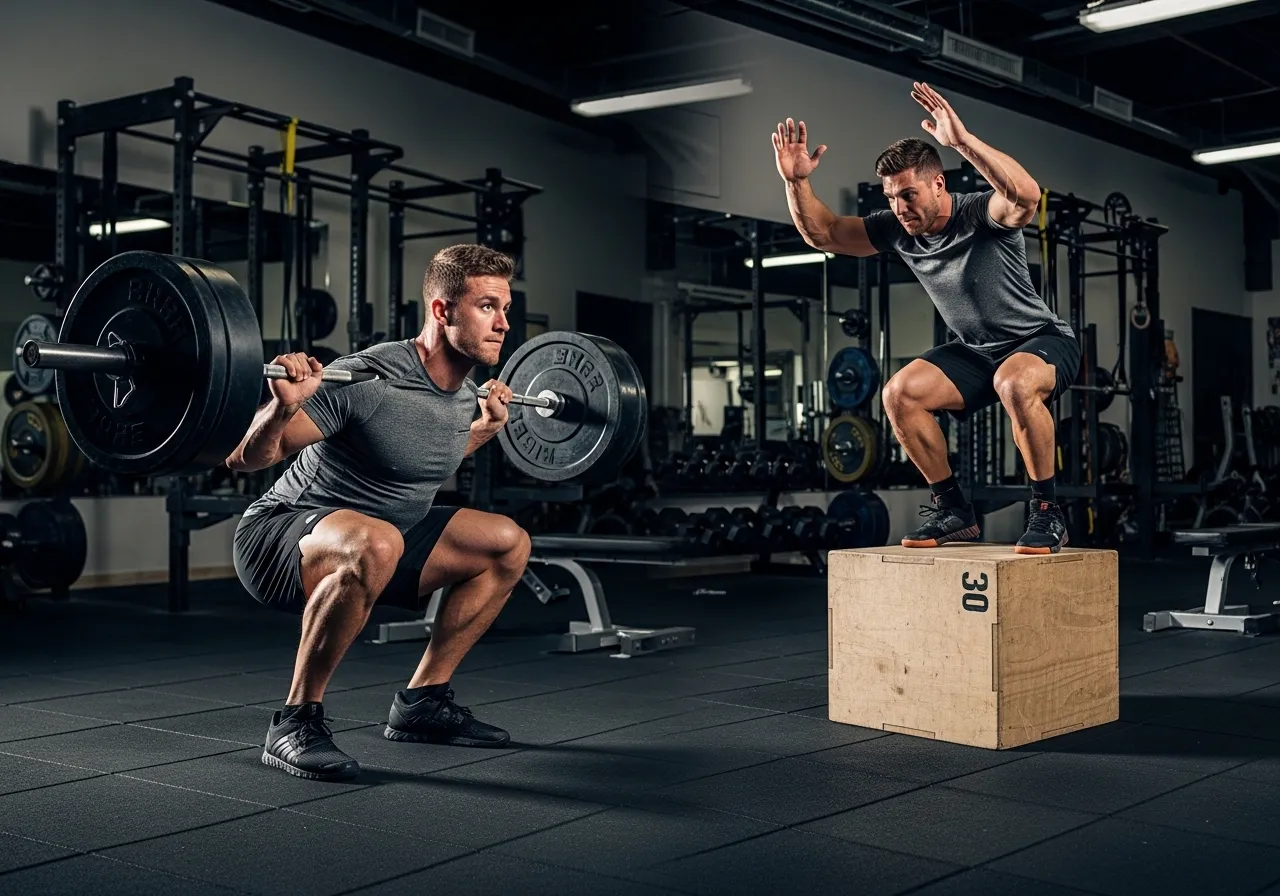
Contrast training challenges this separation. By pairing a heavy compound lift with an explosive movement in the same set complex, it triggers a neurological phenomenon called post-activation potentiation (PAP), the muscle’s temporary increase in force production capacity following a maximal or near-maximal contraction. The heavy lift primes the nervous system for enhanced force production. The explosive movement harvests that priming. Both qualities improve simultaneously.
This guide covers the physiological mechanism of PAP and why contrast training exploits it more efficiently than separate strength and power sessions, what the research shows about optimal protocols, how to build contrast training pairs for different athletic goals, and how to introduce the method progressively whether you are new to structured power training or a competitive athlete seeking an edge.
Why Contrast Training Works: The Post-Activation Potentiation Mechanism
What PAP Actually Is
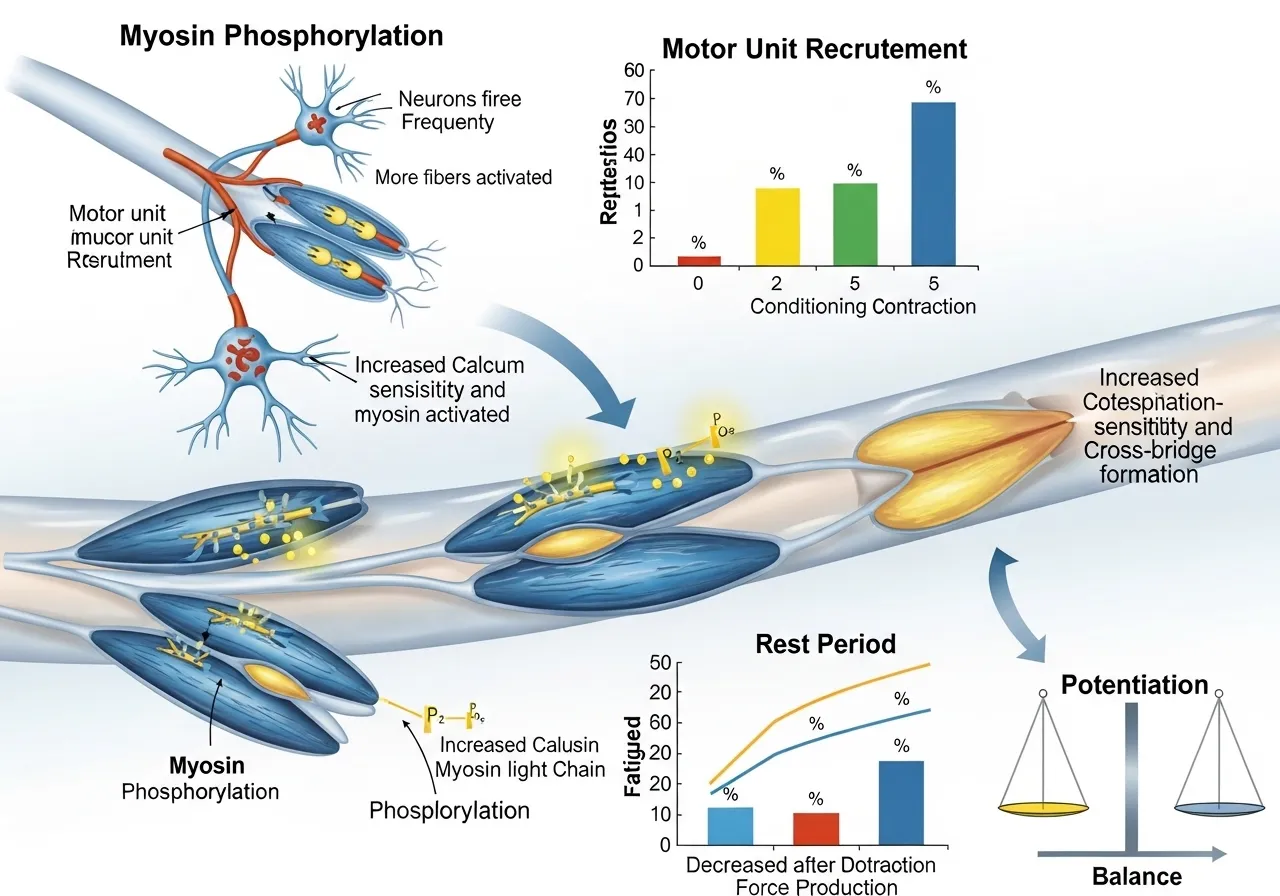
Post-activation potentiation refers to the phenomenon by which acute muscle force output is enhanced as a result of prior contractile history. A maximal or near-maximal contraction activates several neurological and muscular mechanisms that persist for minutes after the contraction ends, temporarily increasing the muscle’s capacity to produce force and rate of force development in subsequent efforts.
📌 Key Finding
PAP increases both peak force and rate of force development through myosin light chain phosphorylation and greater motor unit recruitment. The enhanced neural state persists for minutes after the conditioning contraction, creating a window where explosive movements produce greater power output than they would without the prior heavy stimulus.
The Fatigue-Potentiation Balance
PAP and fatigue co-exist after a heavy conditioning contraction. The heavy lift produces both the potentiation effect and metabolic fatigue. The rest period between the heavy lift and the explosive movement determines which effect dominates at the time of the explosive effort. Too little rest and fatigue overshadows potentiation, reducing explosive performance below baseline. Too much rest and potentiation dissipates before it can be harvested.
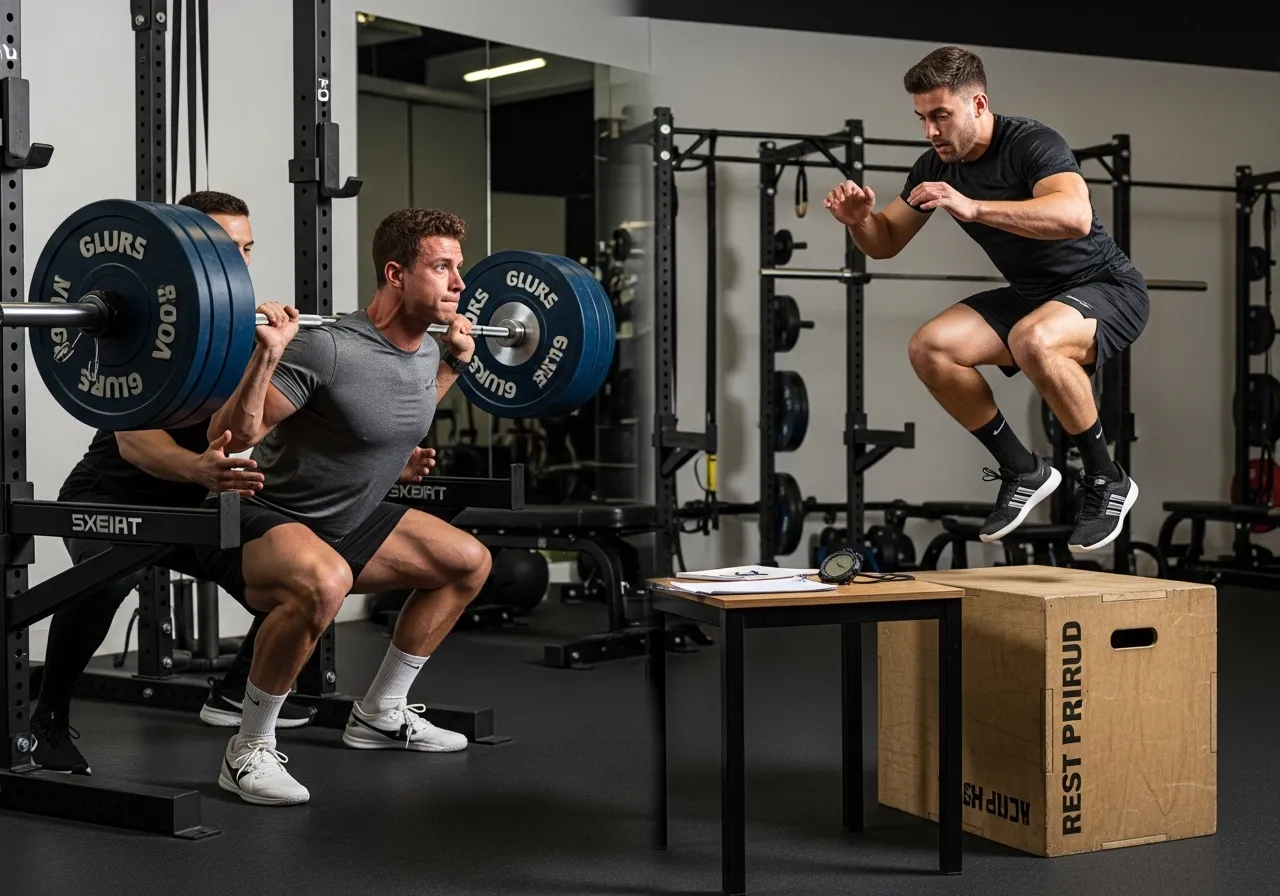
Research on optimal rest periods shows that 3 to 12 minutes typically produces the best net potentiation for most trainees, with stronger, more trained individuals benefiting from longer rest periods than beginners. Stronger athletes generate greater absolute PAP but also greater fatigue from near-maximal efforts, requiring more recovery time before the potentiation effect dominates the fatigue effect. This rest period specificity is one reason contrast training requires more deliberate programme design than simply pairing any heavy lift with any jump.
Contrast Training vs Traditional Complex Training
Contrast training and complex training are closely related but mechanistically distinct training methods. Complex training pairs a strength exercise with a biomechanically similar plyometric movement, using the plyometric to reinforce the movement pattern under reduced load. Contrast training specifically targets the PAP window, using the heavy lift as a neurological primer for the explosive movement rather than primarily as a technical reinforcement. The distinction matters for rest periods: complex training uses shorter rests (30 to 90 seconds) while contrast training uses longer rests (3 to 8 minutes) that allow fatigue to dissipate while potentiation remains elevated.
What the Research Shows About Contrast Training Effectiveness
📌 Key Finding
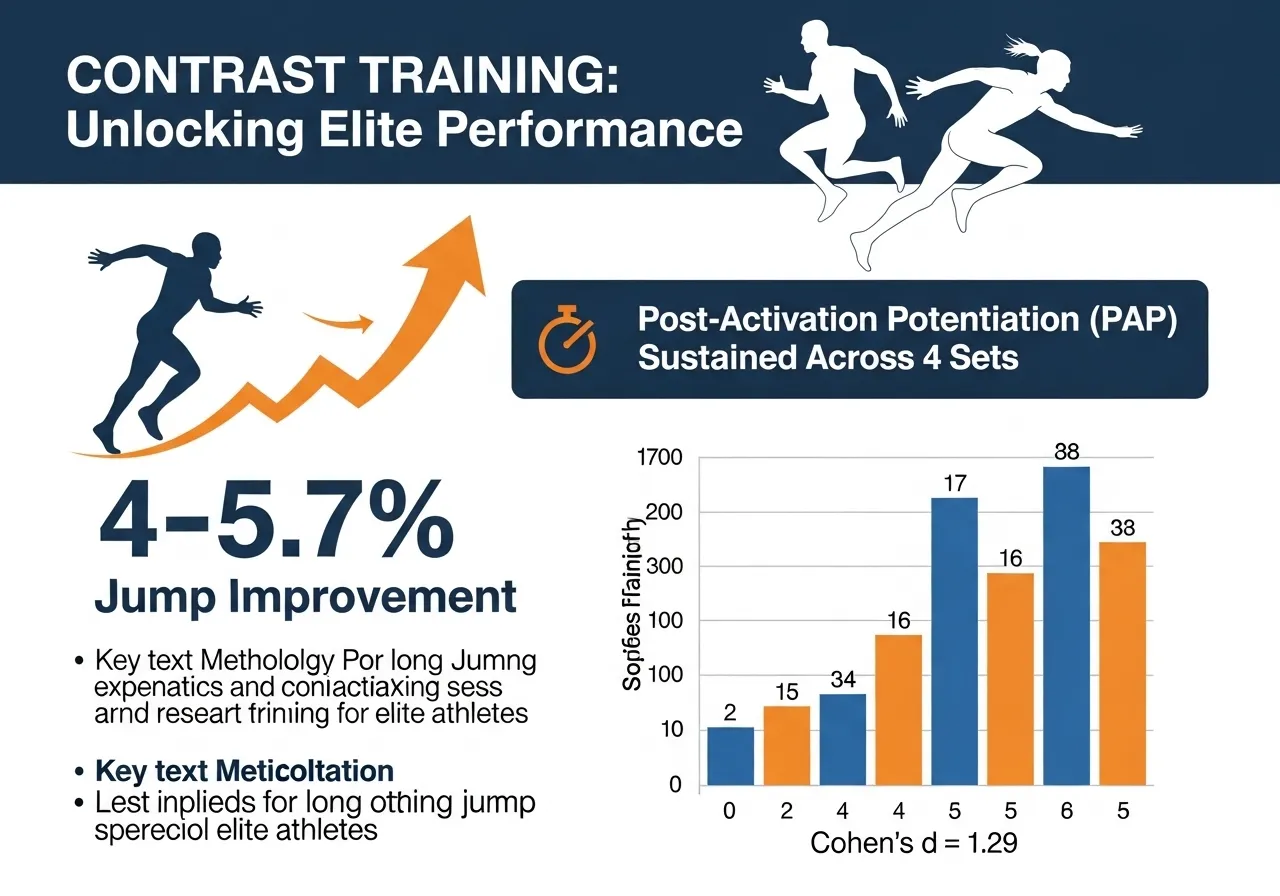
PAP produces 4 to 5.7% jump performance improvement sustained across 4 sets, with a large effect size (Cohen’s d = 1.29) in stronger athletes. Stronger trainees benefit more from contrast training because they generate greater absolute potentiation with near-maximal efforts.
📌 Key Finding
Contrast training at elite level uses 5×5 heavy squat superseted with squat jumps. PAP increases CNS excitability and contractile function through the heavy load stimulus, producing a neurological enhancement that carries over into the explosive movement regardless of sport-specific requirements.
Who Benefits Most From Contrast Training
The research evidence consistently shows that stronger, more trained individuals experience greater PAP effects than untrained individuals. This relationship reflects the fundamental mechanism: a heavier absolute conditioning contraction produces more myosin light chain phosphorylation and greater motor unit recruitment enhancement. A trainee who can squat 140 kg will generate more potentiation from a near-maximal squat than a trainee who squats 80 kg, even when both perform the same percentage of their maximum.
The practical implication is that contrast training produces its most substantial benefits for intermediate and advanced trainees who have built a meaningful strength foundation. Beginners who attempt contrast training typically have conditioning contractions that are insufficiently heavy to produce meaningful PAP while also creating significant metabolic fatigue from the effort. The result is worse explosive performance than without the conditioning contraction rather than enhanced performance. A minimum of 6 to 12 months of consistent strength training before introducing structured contrast training is a reasonable threshold for most recreational athletes.
How to Build Contrast Training Pairs: The Biomechanical Matching Principle
Why Matching Matters for PAP Transfer
The PAP effect transfers most effectively to explosive movements that share the same primary muscle groups and movement pattern as the conditioning contraction. A heavy back squat potentiates vertical jumping because both involve explosive hip and knee extension from similar joint angles. The neural drive enhancement from the squat primes exactly the motor units that the jump requires. A heavy bench press does not potentiate a vertical jump for the same reason it does not train the same muscles.
Effective contrast pairs follow the biomechanical matching principle: the conditioning exercise and the explosive exercise share primary muscle groups, movement planes, and joint angle requirements. The table below shows standard contrast pairs used across strength and conditioning programmes:
Conditioning Exercise (Heavy)
Explosive Counterpart
Primary Transfer
Back squat (85 to 95% 1RM)
Box jump, vertical jump, broad jump
Lower body explosive power
Romanian deadlift (80 to 90% 1RM)
Broad jump, bounding, sprint start
Hip extension power and sprint mechanics
Bench press (85 to 95% 1RM)
Medicine ball chest throw, push-up with explosive clap
Upper body horizontal pushing power
Barbell row (85% 1RM)
Medicine ball overhead slam, pull-up with explosive drive
Upper body pulling and hip power
Trap bar deadlift (85 to 90% 1RM)
Vertical jump, kettlebell swing, broad jump
Total lower body and hip extension power
Load Selection for the Conditioning Exercise
The conditioning contraction must be heavy enough to generate meaningful PAP without creating so much fatigue that explosive performance degrades. Research consistently identifies 85 to 95% of 1RM as the effective range for conditioning contractions, with 3 to 5 repetitions at this intensity sufficient to trigger potentiation without accumulating excessive fatigue from higher rep sets.
Single repetitions at 90 to 95% produce strong PAP in well-trained athletes but require longer recovery periods (5 to 8 minutes) before the explosive movement. Sets of 3 at 85 to 90% produce slightly less potentiation but require only 3 to 5 minutes of rest, making them more practical for time-constrained sessions. The squat programming and how heavy squat loads transfer to athletic power development is covered in the barbell back squat guide.
The Explosive Movement: What Qualifies and What Does Not
Not every fast movement qualifies as the explosive counterpart in a contrast pair. The explosive movement must require genuine maximal intent: the trainee performs it as fast and powerfully as possible with no holding back. A box jump performed at moderate effort or a medicine ball throw with deliberately conservative power output generates minimal PAP benefit because neither movement fully expresses the potentiated neural state that the conditioning contraction produced.
The explosive movement should also be brief, typically 1 to 5 seconds of actual effort, to remain within the PAP window rather than extending the recovery window. A 30-second sprint placed 3 minutes after a conditioning squat is too long to qualify as a contrast pair exercise because the sustained effort duration shifts the metabolic demands away from the pure neurological potentiation that brief explosive movements harvest. Box jumps, standing broad jumps, medicine ball throws, and 10-metre acceleration sprints represent the primary movement categories that most effectively use the available PAP window in structured contrast training.
Monitoring Potentiation: How to Know if It Is Working
The most reliable indicator that contrast training is producing potentiation rather than fatigue is subjective explosive performance quality immediately following the rest period. A well-potentiated athlete feels their explosive movement as lighter, faster, and more effortless than normal. Jump height feels greater. Sprint starts feel more explosive. Medicine ball throws leave the hands faster than in a fresh, non-potentiated state.
When this subjective enhancement is absent or the explosive movement feels harder than usual, the protocol parameters need adjustment. Keep a simple session log noting whether each explosive set felt enhanced or impaired relative to the baseline explosive performance established during the first week of contrast training. Over the first three to four weeks, this data identifies the rest period and conditioning load combination that reliably produces potentiation for the individual trainee, since optimal rest periods and conditioning loads vary meaningfully between individuals and cannot be accurately predicted from population averages alone.
Rest Period Protocols by Training Level
The optimal rest period between the conditioning contraction and the explosive movement varies by training level and the load used:
Intermediate trainees (1 to 3 years training): 3 to 5 minutes rest after 3 to 5 reps at 80 to 85% 1RM. Shorter rest periods accumulate fatigue that overshadows potentiation at this training level.
Advanced trainees (3+ years, 1RM squat above 1.5x bodyweight): 5 to 8 minutes rest after 1 to 3 reps at 90 to 95% 1RM. Greater PAP generated requires more recovery time before the explosive movement.
Beginner-intermediate trainees learning the method: Start with 70 to 75% 1RM and 3-minute rest periods. Focus on learning the protocol structure before prioritising potentiation magnitude.
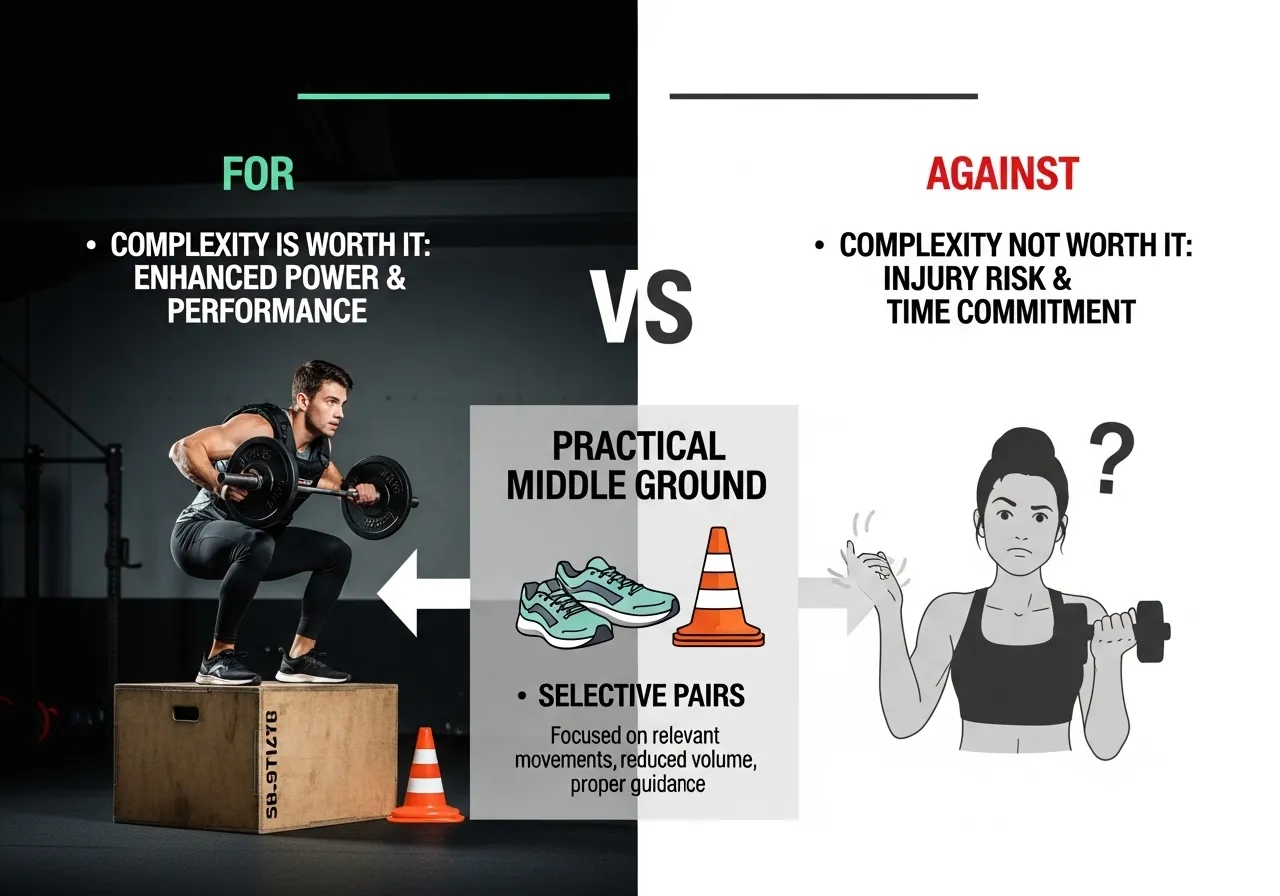
Is Contrast Training Worth the Complexity, or Just a Fancy Superset?
The Argument Against Complexity
Contrast training requires near-maximal conditioning contractions, extended rest periods, biomechanically matched exercise pairs, and careful load management for the explosive movements. A standard hypertrophy or strength programme produces gains in both strength and (over time) power without this complexity. The question is whether the additional benefit justifies the additional session management burden.
For general fitness trainees whose goal is health, body composition, or functional strength without specific power requirements, the answer is probably not. The complexity of contrast training is most justified when the training outcome requires measurable power development: athletic performance in sprinting, jumping, throwing, or change of direction sports. Trainees who simply want to be stronger and fitter derive approximately the same long-term benefit from progressive overload in compound movements without the PAP complexity.
The Argument For
For athletes with specific power requirements, contrast training produces the dual adaptation of strength and power simultaneously rather than sequentially. A rugby player who spends six weeks developing strength followed by six weeks developing power loses some strength during the power block and some power expression during the strength block. Contrast training maintains both simultaneously, which may produce superior long-term athletic performance even if the individual adaptations in either quality are smaller than dedicated single-quality blocks.
The research showing that stronger athletes benefit more from PAP also supports a self-reinforcing cycle: contrast training used during strength development increases the PAP available for subsequent explosive work, which further develops power expression, which contributes to better overall athletic output than strength and power training conducted separately. The box jump programming that pairs with squat-based contrast pairs is covered in the box jump guide.
The Practical Middle Ground
The most useful application of contrast training for recreational athletes is not necessarily a full contrast training programme but selective use of contrast pairs at the end of primary strength sessions. Performing 2 to 3 sets of near-maximal squats followed by 3 to 5 box jumps adds power development stimulus to an existing strength session without restructuring the entire programme around contrast methodology. This targeted approach provides the PAP benefit without the full session complexity that dedicated contrast training requires.
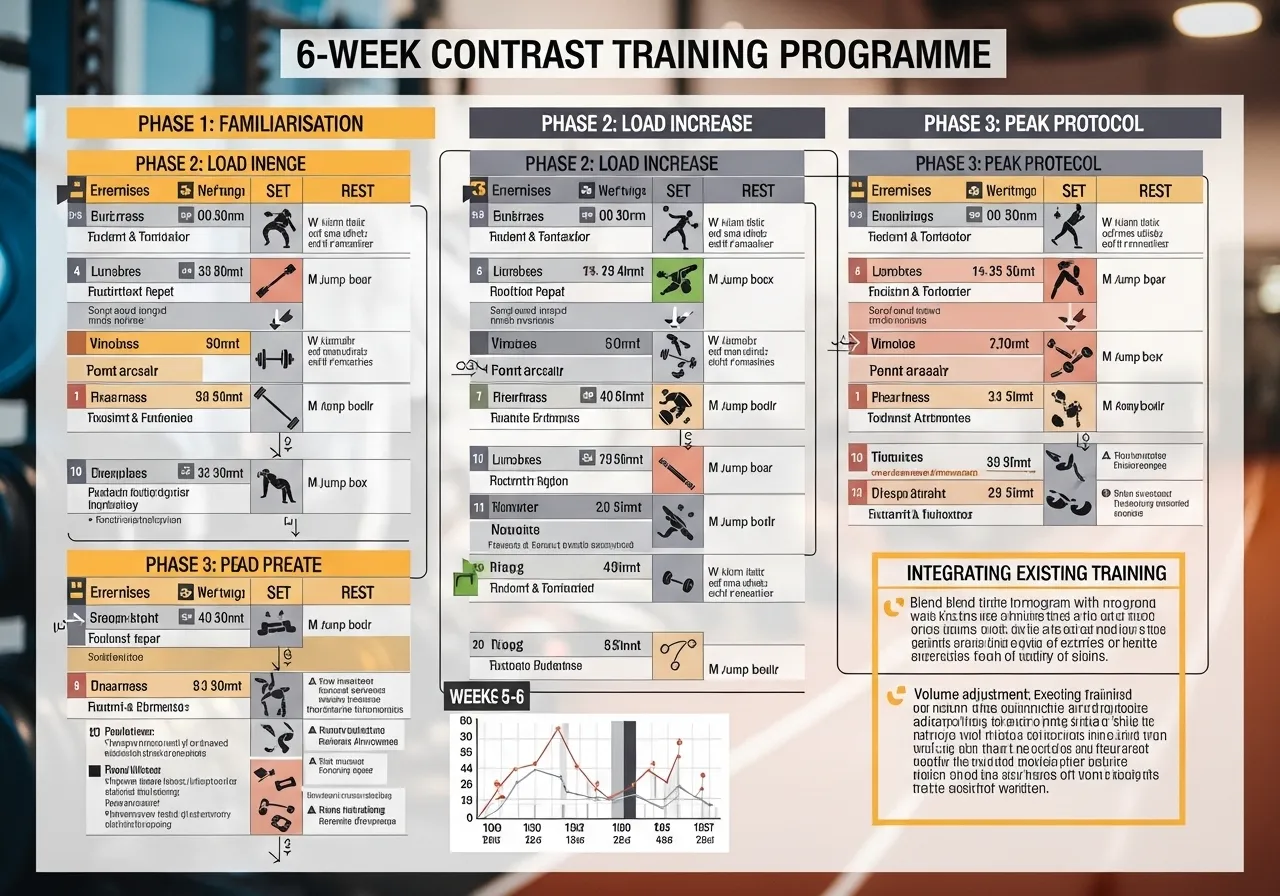
Building a Contrast Training Programme: Progressive Introduction Over 6 Weeks
📅 Phase 1: Weeks 1 to 2: Protocol Familiarisation
2 contrast pairs per session, twice per week
Conditioning load: 75 to 80% 1RM, 3 reps
Rest period: 3 minutes between conditioning contraction and explosive movement
Pair 1: back squat (3 reps) → box jump (3 reps), rest 3 min
Pair 2: barbell row (3 reps) → medicine ball slam (5 reps), rest 3 min
Perform 3 sets of each pair with 2 minutes between sets
Focus: Learn the rest period timing, the transition between exercises, and how the explosive movement feels after the conditioning contraction. Do not increase load until the protocol timing is consistent.
📅 Phase 2: Weeks 3 to 4: Load and Complexity Increase
3 contrast pairs per session, twice per week
Conditioning load: 82 to 87% 1RM, 3 reps
Rest period: 4 to 5 minutes between conditioning contraction and explosive movement
Add a third pair: Romanian deadlift (3 reps) → broad jump (3 reps)
Assess: does jump performance feel enhanced relative to Phase 1? If not, extend rest period
The increased conditioning load should produce a perceptible potentiation effect on the explosive movements. Jump height or distance should feel greater immediately after the conditioning contraction than in a fresh state.
📅 Phase 3: Weeks 5 to 6: Peak Protocol
3 to 4 contrast pairs per session, twice per week
Conditioning load: 88 to 93% 1RM, 1 to 2 reps
Rest period: 5 to 7 minutes between conditioning contraction and explosive movement
Benchmark: measure vertical jump height or broad jump distance in Week 6 versus Week 1 baseline
Expected: 3 to 8% improvement in jump performance from Phase 1 baseline
At this phase the conditioning contractions are close to maximal. Ensure adequate warm-up before each session. The explosive movements should be performed with full intent to maximise output, not controlled for form concerns.
How Contrast Training Fits Into an Existing Programme
Contrast training pairs are most effective when performed at the very beginning of a session when the nervous system is fully fresh and fatigue from previous exercise is minimal. Placing contrast pairs after extended warm-up but before accessory work ensures the conditioning contractions are near-maximal and the explosive movements are performed in an optimal neurological state. Performing contrast pairs at the end of a full training session when fatigue is already accumulated produces minimal PAP benefit because the fatigue from previous work overshadows the potentiation effect from the conditioning contraction. The unilateral training approaches that complement contrast training for complete athletic development are covered in the unilateral training guide.
Frequently Asked Questions About Contrast Training and the Contrast Method
How is contrast training different from just doing supersets?
Standard supersets pair two exercises back-to-back with minimal rest for metabolic efficiency or time saving. Contrast training pairs a heavy conditioning contraction with an explosive movement separated by a deliberate 3 to 8 minute rest period specifically calibrated to allow fatigue to dissipate while potentiation remains elevated. The rest period is not for recovery convenience. It is a performance tool that determines whether the PAP mechanism operates effectively or not.
Performing a heavy squat and immediately jumping (as in a superset) produces fatigue-impaired jumping because the metabolic and mechanical fatigue from the heavy squat overshadows the potentiation within the first 30 to 90 seconds. The potentiation benefit emerges as fatigue dissipates over the subsequent minutes. A true contrast training protocol harvests this window deliberately, which requires the longer structured rest that distinguishes it from conventional superset training.
Can beginners use contrast training?
Beginners can be introduced to contrast training concepts at lower conditioning loads (70 to 75% 1RM) with shorter rest periods, but the PAP mechanism produces its greatest benefits in more trained individuals whose near-maximal conditioning contractions generate stronger neurological potentiation signals. Beginners primarily lack the strength baseline to generate meaningful PAP, and directing their limited training capacity toward basic strength development typically produces better long-term outcomes than contrast training specialisation at the early stages.
The exception is beginners with an athletic background in explosive sports who already have movement competency in jumping, sprinting, and throwing. These athletes can introduce lower-load contrast pairs after three to four months of consistent strength training because their nervous system already knows how to express power even if their absolute strength is still developing.
How often should I use contrast training per week?
Two dedicated sessions per week of structured contrast training pairs is the standard recommendation for most intermediate and advanced trainees. Full contrast training sessions with near-maximal conditioning contractions create significant central nervous system fatigue that requires 48 to 72 hours of recovery before the next high-quality session. Three sessions per week is possible for advanced athletes in short peaking blocks but is not sustainable across extended training periods without accumulated CNS fatigue.
Adding one or two contrast pairs to the end of existing strength sessions, rather than dedicating full sessions to contrast training, reduces the CNS demand while still providing PAP stimulus. This modified approach is appropriate for recreational athletes who want power development benefits without restructuring their entire programme around contrast methodology.
What should I do if I feel more fatigued after the contrast pair than before?
Increased fatigue after a contrast pair typically indicates one of three problems: the conditioning load is too heavy for the current training level, the rest period is too short for fatigue to dissipate before the explosive movement, or the overall training session volume is too high for the contrast pairs to be performed in an adequately recovered neurological state.
The solution is to reduce the conditioning contraction load by 10% and extend the rest period by 1 to 2 minutes, then reassess whether the explosive movement feels enhanced or impaired relative to performing it without the prior conditioning contraction. If jump performance improves with the contrast pair after the adjustment, the PAP mechanism is working. If it remains impaired, reduce load further until the net effect is positive before attempting to increase conditioning intensity again.
Key Takeaways
PAP is produced by myosin light chain phosphorylation and increased motor unit recruitment following near-maximal conditioning contractions, temporarily increasing both peak force and rate of force development in subsequent explosive efforts.
Contrast training produces 4 to 5.7% jump performance improvement sustained across 4 sets, with a large effect size (Cohen’s d = 1.29) in stronger athletes. Stronger trainees benefit more from contrast training.
The optimal rest period between conditioning contraction and explosive movement is 3 to 8 minutes, calibrated by training level and conditioning load. Too little rest produces fatigue-impaired performance; too much allows potentiation to dissipate.
Effective contrast pairs match the primary muscles and movement plane of the conditioning exercise with the explosive movement. Back squat pairs with vertical or broad jumps. Bench press pairs with medicine ball chest throws.
Contrast training is most valuable for intermediate to advanced trainees with sport performance goals requiring measurable power development. General fitness trainees achieve approximately equivalent long-term outcomes from progressive strength training alone.
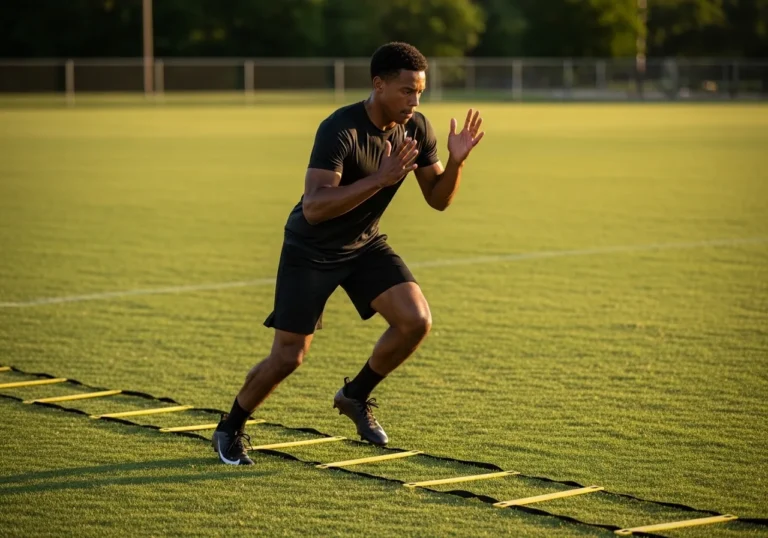
⚠️ Ankle and Lower Limb Safety NoteAgility ladder drills involve rapid foot placement changes at high step frequencies. Individuals with active ankle sprain (within 4 weeks), Achilles tendinopathy, or stress fracture history should obtain physiotherapy clearance before starting ladder training. Begin all drills at slow speed to establish correct foot placement patterns before adding velocity…
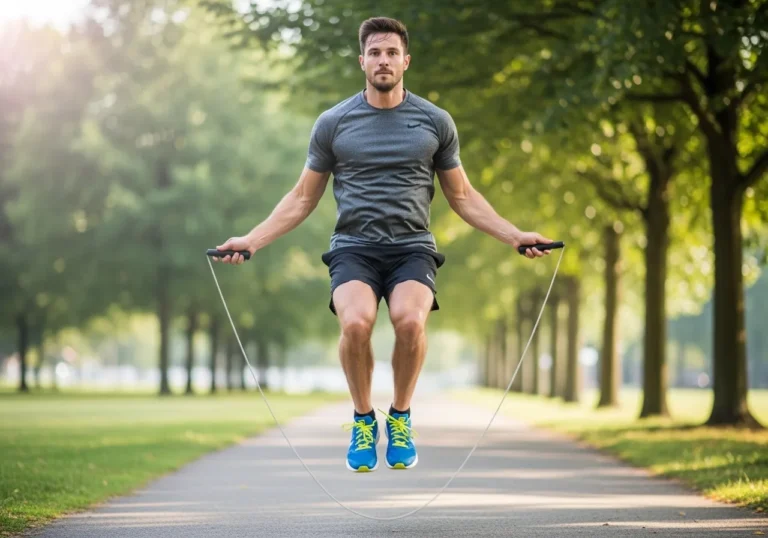
⚠️ Health & Fitness DisclaimerThis article is for general educational purposes only and does not replace professional medical or fitness advice. If you have any cardiovascular or joint concerns, consult a healthcare professional before starting a new exercise program. Jump rope is one of the most underrated training tools available — a piece of equipment…
⚠️ Health & Fitness DisclaimerThis article is for general educational purposes only and does not replace professional medical advice. If you have any pre-existing shoulder, wrist, or back conditions, please consult a qualified healthcare professional before beginning medicine ball training. The medicine ball is one of the oldest and most versatile training implements in existence…
⚠️ Shoulder, Spine, and Core Safety NoteLandmine exercises involve rotational and asymmetric loading that stresses the shoulder in an oblique pressing pattern and the lumbar spine in lateral and rotational planes. Individuals with active shoulder impingement, rotator cuff tears, lumbar disc herniation, or diagnosed spinal instability should obtain medical clearance before landmine training. During rotation-based…
⚠️ Health & Fitness DisclaimerThis article is for general educational purposes only and does not replace professional medical advice. If you have any lower limb, knee, or ankle conditions, please consult a qualified healthcare professional before beginning plyometric training overview training. Plyometric training — exercise that uses the stretch-shortening cycle (the rapid lengthening of a…
⚠️ Fitness Disclaimer: The information in this article is for general educational purposes only and does not constitute professional fitness or medical advice. Always consult a qualified healthcare professional before starting any new exercise program. ⚠️ Cardiovascular Health Notice: If you have a history of heart disease, high blood pressure, or any cardiovascular condition, obtain…