Hamstring Flexibility: Why Tight Hamstrings Limit More Than Your Deadlift and How to Build Lasting Range
Tight hamstrings are the most commonly cited flexibility limitation in recreational athletes. They are also the most commonly treated incorrectly.
The standard approach: stretch the hamstrings for 30 seconds, three times, after training. Sometimes before training. Consistently for a few weeks, then irregularly, then not at all, because nothing seems to change. The hamstrings feel temporarily looser after stretching and then return to exactly the same restriction the next morning.
This cycle persists because the most widely practised approach to hamstring flexibility addresses the wrong physiological mechanism. Understanding why hamstrings become and stay tight, and why stretching alone often fails to produce lasting change, is the prerequisite to fixing it properly. This guide covers the mechanisms of hamstring tightness, what the research shows about stretching versus eccentric loading, how hamstring restriction affects performance beyond the obvious, and a 6-week protocol that produces lasting range rather than temporary relief.
The Physiology of Hamstring Tightness: Why Stretching Alone Often Fails
Structural vs Neurological Tightness
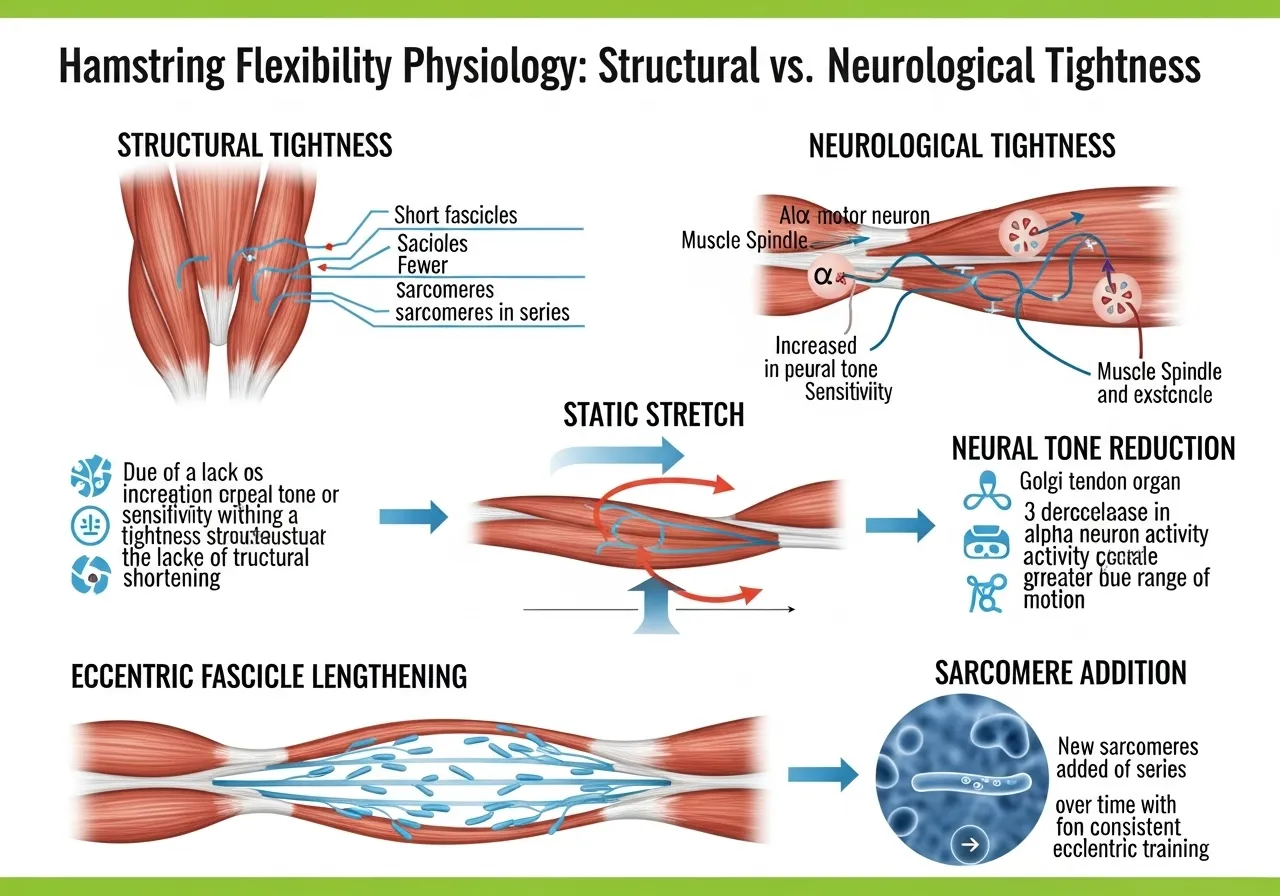
Hamstring tightness exists on a spectrum between two distinct mechanisms that require different interventions. Structural tightness occurs when the muscle fascicles are genuinely shorter than optimal, restricting the range of motion the joint can achieve regardless of neural input. Neurological tightness occurs when the nervous system maintains the muscle in a heightened state of activation, creating a sensation of tightness without actual structural shortening.
Static stretching primarily addresses neurological tightness. It temporarily reduces neural tone and increases stretch tolerance, creating the sensation of greater range. When the neural reset wears off, typically within 30 to 60 minutes for most individuals, the perceived tightness returns to baseline. This is why stretching produces immediate improvement that does not persist.
Structural change, genuine lengthening of the muscle fascicles through sarcomere addition in series, requires a different stimulus. Eccentric loading under stretch creates the mechanical environment that drives sarcomere addition and produces lasting structural change. This is why eccentric hamstring training produces more durable flexibility improvements than equivalent volumes of static stretching in most research.
The Fascicle Length Mechanism
Research on long-term stretching and range of motion found that stretch training performed frequently for at least two weeks can chronically increase the range of motion of a joint, with long-term static stretching and proprioceptive neuromuscular facilitation stretching producing greater range of motion gains compared to dynamic and ballistic stretching, while females showed higher gains in range of motion compared to males after long-term stretching training, confirming that consistent frequency over weeks is necessary for chronic ROM improvement rather than high-volume infrequent sessions.
Chronic range of motion improvement requires frequent consistent stretching over at least two weeks, not high-volume occasional sessions. Two to three weekly sessions of 30-second holds produce less long-term change than daily sessions of shorter duration.
Why Eccentric Training Produces More Durable Change
A study comparing a low-load eccentric training protocol to static stretching for hamstring flexibility found that low volume Nordic hamstring exercises were as effective as static stretching when the intention is to increase hamstring muscle length as measured via the passive knee extension test, with the study concluding that individuals with time constraints or heavy training volumes may substitute low volumes of Nordic hamstring exercise for passive stretching when the goal is increased muscle length, with the added benefit of a simultaneous strengthening stimulus.
Low-volume eccentric hamstring exercises produce equivalent flexibility gains to static stretching while also developing hamstring strength. For time-constrained athletes, eccentric loading addresses both hamstring flexibility and injury prevention in a single intervention.
How Long Stretching Effects Last Without Maintenance
The durability of flexibility gains depends on whether the improvement is neurological or structural. Neurological improvements from stretching, the reduced neural tone that creates immediate sensation of looseness, dissipate within hours to days without consistent maintenance. Structural improvements from eccentric loading, the actual fascicle lengthening through sarcomere addition, persist for weeks to months without maintenance training.
This difference has direct programming implications. Trainees who rely exclusively on static stretching for hamstring flexibility must maintain high stretching frequency indefinitely to preserve their gains. Trainees who have completed a structured eccentric loading programme maintain their gains with significantly reduced weekly maintenance volume: two to three sets of Nordic hamstring exercises or single-leg RDL per week is sufficient to maintain structural fascicle length once the training programme establishes it.
The clinical evidence supports this pattern. Athletes who complete pre-season eccentric hamstring programmes and then continue two weekly maintenance sessions maintain their fascicle length improvements throughout the competitive season. Those who complete the programme and then stop entirely show progressive regression back toward their pre-training baseline within eight to twelve weeks. The maintenance requirement is modest but non-negotiable for preserving structural gains. Two weekly sessions is a manageable and sustainable standard that fits within any training programme without significant time or recovery cost.
What Tight Hamstrings Actually Limit: Beyond the Obvious
Deadlift and Hinge Performance
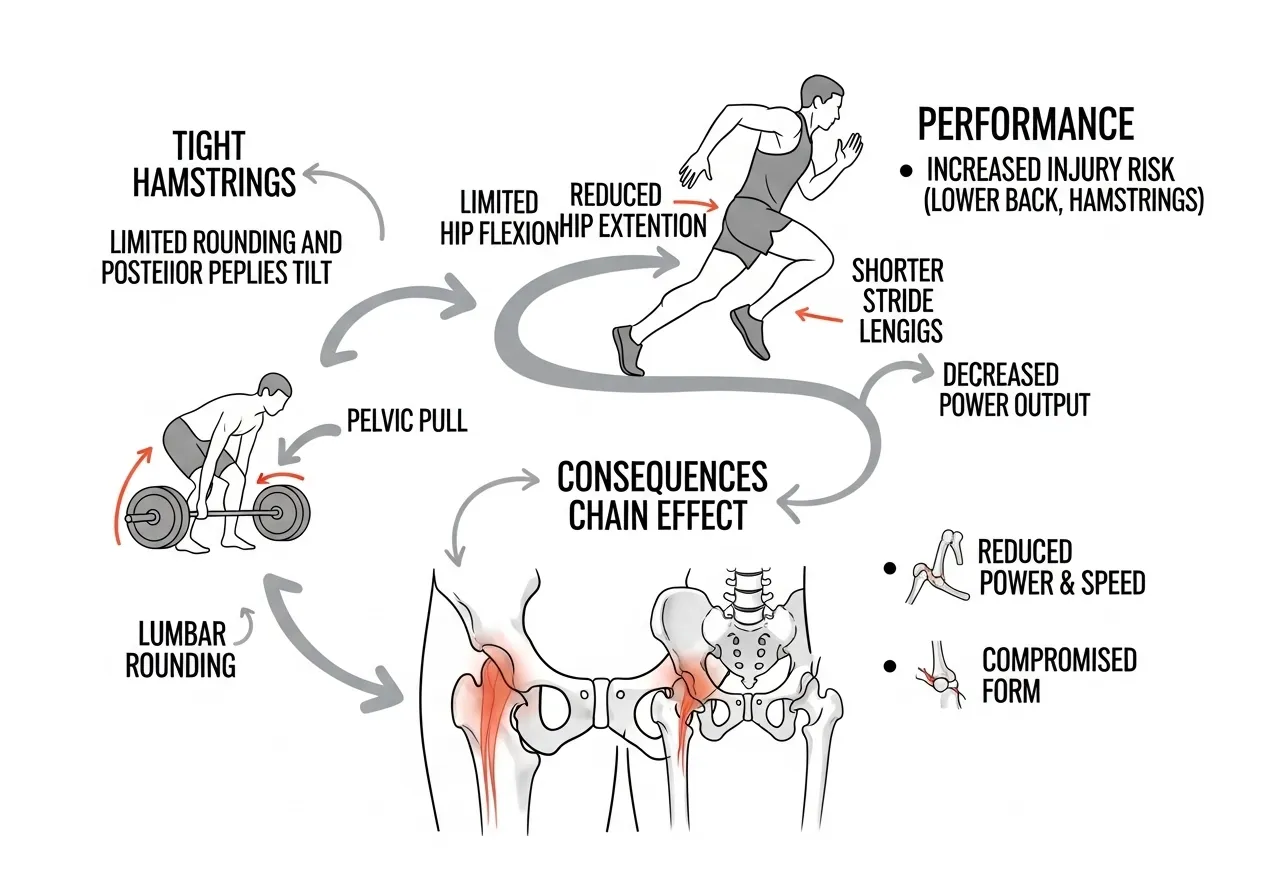
The most obvious consequence of hamstring tightness is restricted hip hinge range. When the hamstrings lack the length to allow the hip to flex fully while the knee remains relatively extended, the lower back rounds to compensate for what the hamstrings cannot permit. This lumbar flexion under load is the primary mechanism of lower back injury during deadlifting and Romanian deadlift movements.
Trainees who pull with rounded lower backs in the bottom position are often blamed for poor technique. The technique instruction to maintain a neutral spine is correct. The limitation that prevents it is frequently hamstring length rather than technique understanding. Addressing the hamstring restriction removes the root cause rather than repeatedly cueing a correction that the body cannot execute. The Romanian deadlift and its hamstring stretch requirements are covered in the Romanian deadlift guide.
Posture and Pelvic Position
The hamstrings attach to the ischial tuberosity at the base of the pelvis. When they are chronically short or in high neurological tone, they pull the pelvis into posterior tilt: the bottom of the pelvis tilts forward and the lumbar spine flattens or reverses its natural curve. This posterior pelvic tilt reduces the lumbar lordosis, changes the loading pattern on the intervertebral discs, and creates the flat-back posture associated with hamstring tightness.
Trainees who sit for extended periods develop progressive hamstring shortening from the sustained flexed hip position. The hamstrings adapt to the shortened position they spend most hours in and resist the lengthened positions required for exercise. Addressing hamstring flexibility in desk-bound trainees is not purely a performance priority. It directly affects spinal loading mechanics during every training session.
The Posterior Pelvic Tilt Compensation Pattern
When the hamstrings pull the pelvis into posterior tilt habitually, a predictable compensation cascade develops. The flattened lumbar spine changes the loading angle on the lumbar discs. The hip flexors lengthen and weaken in response to the repositioned pelvis. The glutes are mechanically disadvantaged in their shortened position at the bottom of the posterior tilt. The entire posterior chain becomes progressively less efficient at producing hip extension force.
This compensation pattern develops so gradually that most trainees never identify it until a physiotherapist points it out. The trainee experiences vague lower back fatigue, reduced glute activation during training, and increasing hip flexor tightness, all symptoms managed in isolation without addressing the hamstring restriction that created them. Treating the posterior tilt directly without addressing the hamstring restriction that causes it produces temporary improvements that recur as the underlying limitation persists.
Sprint Mechanics and Running Economy
During sprinting, the hamstrings produce peak force in the late swing phase as the leg extends behind the body before foot contact. This high-speed eccentric contraction under a significantly lengthened position demands both adequate hamstring length and eccentric strength through that lengthened range. Hamstrings that are too short to reach the required lengthened position without resistance create a braking effect that both slows the stride and dramatically increases strain injury risk.
Hamstring strain injuries in sprinters and field sport athletes almost always occur in this late swing phase, when the hamstring is at its longest and producing maximum eccentric force. The injury is not simply a muscle that is too tight. It is a muscle that lacks both the length and the eccentric strength to tolerate the load at that length. Both must be addressed simultaneously for effective injury prevention, not flexibility alone.
Static Stretching vs Eccentric Loading vs PNF: Which Method Produces Lasting Change?
The Injury Prevention Evidence
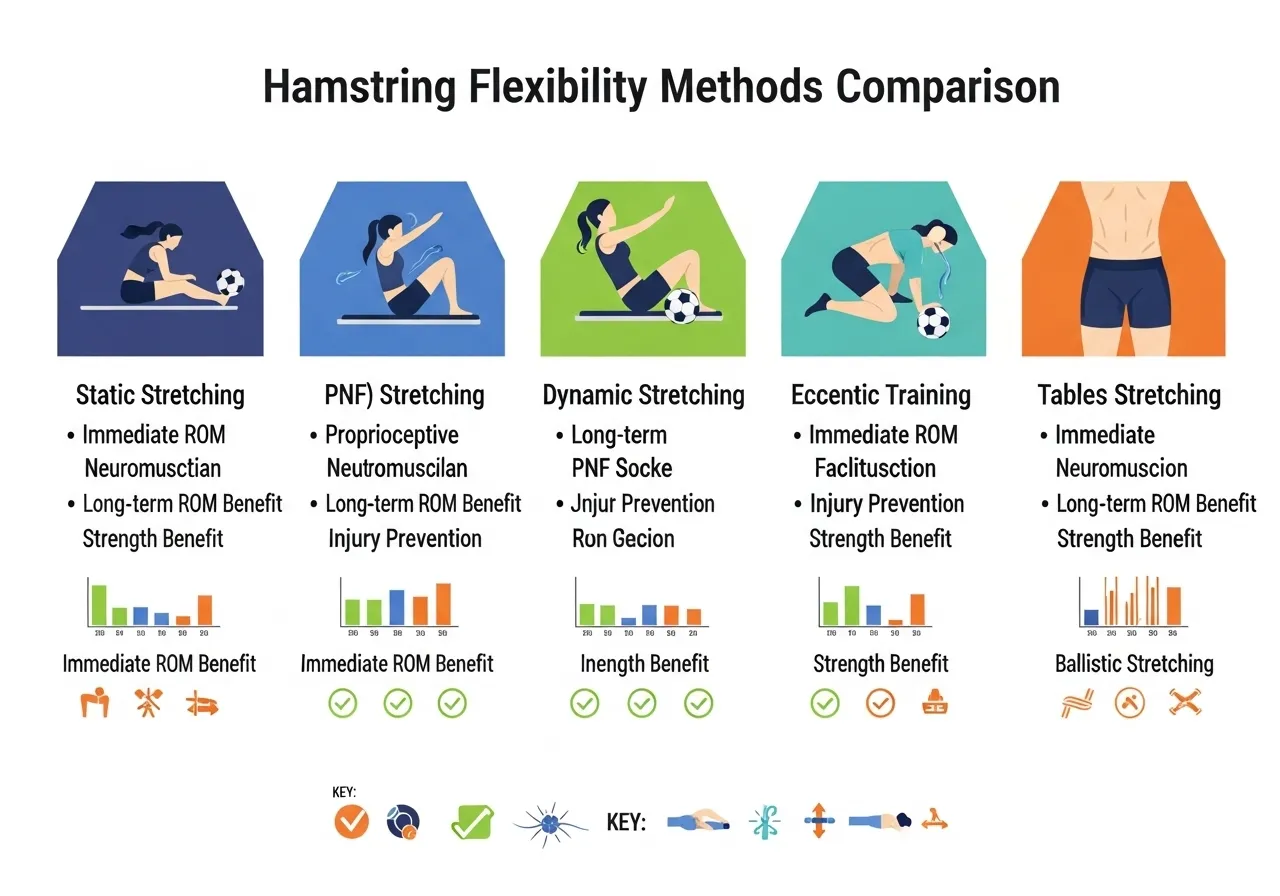
A systematic review and meta-analysis of randomised controlled trials on hamstring injury prevention found that eccentric training reduced the incidence of hamstring injury by 56.8 to 70.0 percent, with static stretching producing greater immediate flexibility gains measured in degrees compared to proprioceptive neuromuscular facilitation and dynamic stretching, but the effects of static techniques being more transient than eccentric training, and fascicle length increasing with eccentric and sprint training while decreasing with concentric training, establishing that eccentric loading produces the structural hamstring changes most relevant to injury prevention.
Eccentric training reduces hamstring injury by 56.8 to 70 percent and increases fascicle length structurally. Static stretching produces larger acute ROM gains but the effects are more transient. For durable hamstring flexibility improvement, eccentric loading is the superior long-term intervention.
The Comparison: Method by Method
| Method | Immediate ROM Gain | Long-term ROM Gain | Injury Prevention | Strength Benefit |
|---|---|---|---|---|
| Static stretch | High | Moderate (if consistent) | Limited | None |
| PNF | High | Moderate | Limited | Minimal |
| Dynamic stretch | Moderate | Lower | Limited | None |
| Eccentric loading | Moderate | High (structural) | 56 to 70% reduction | Significant |
The Practical Conclusion
Static stretching and PNF are valuable for immediate flexibility management before training and for maintaining the range gained through eccentric loading. Eccentric loading is the primary tool for structural hamstring lengthening and genuine injury prevention. The research evidence consistently shows these methods as complementary rather than competing. Combining stretching modalities with eccentric loading produces the most durable hamstring flexibility improvement.
Does Hamstring Flexibility Actually Transfer to Performance, or Is It Just Injury Prevention?
The Performance Case
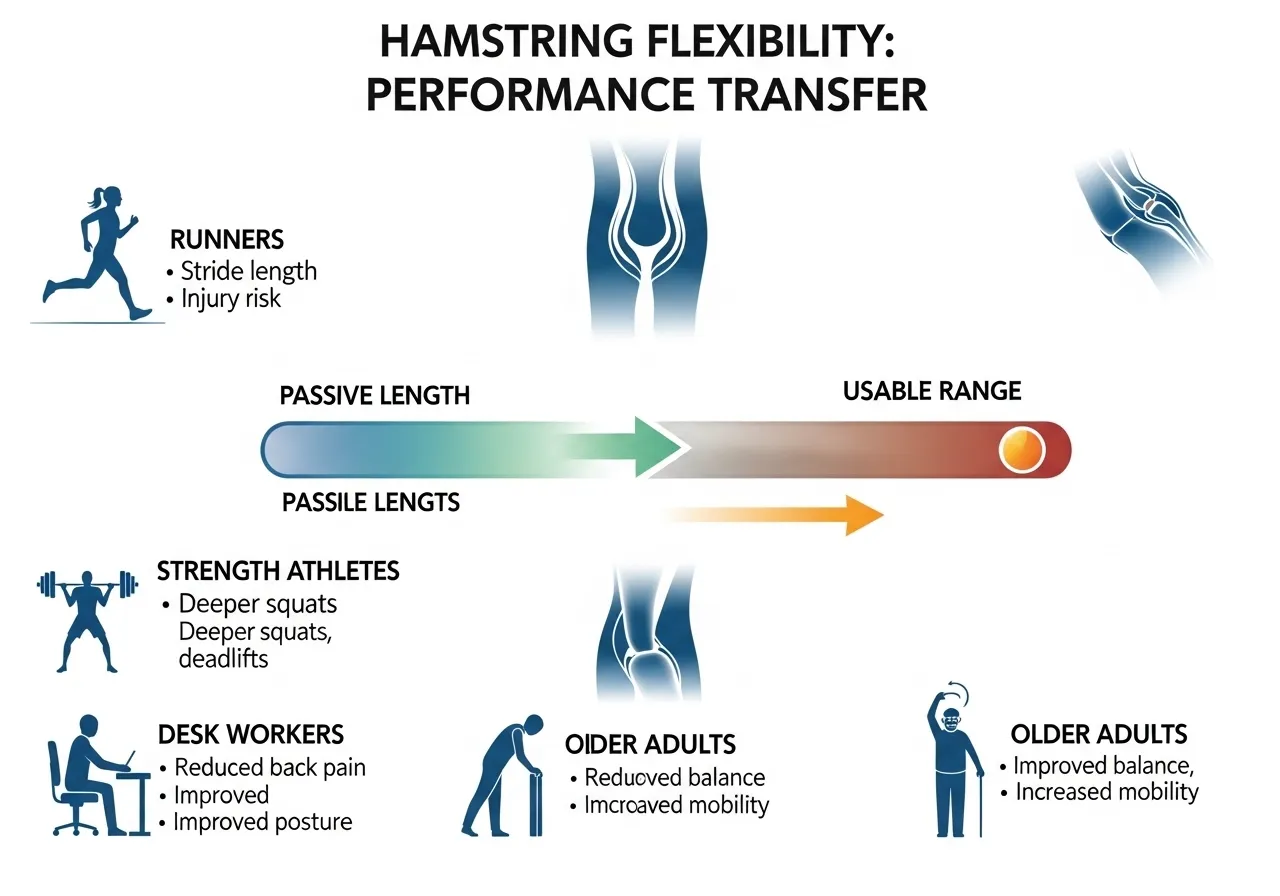
The performance argument for hamstring flexibility is strongest in three domains: hip hinge depth and safety under load, running stride length and economy, and the ability to produce force through the full lengthened range relevant to athletic movement.
Trainees who improve hamstring flexibility consistently report improved Romanian deadlift depth, reduced lower back fatigue during sessions, and improved squat depth without heel elevation. These are not minor quality-of-life improvements. They represent genuinely different and more effective mechanical loading of the posterior chain that produces greater training stimulus per session.
In running and field sports, athletes with longer hamstring fascicle lengths produced through eccentric training can achieve greater hip extension range during late swing, allowing longer effective stride length without increased injury risk. The combination of greater range and higher eccentric strength through that range produces measurable speed improvements in sprint-based athletes.
What Flexibility Cannot Do Alone
Hamstring flexibility without corresponding eccentric strength through the increased range is potentially counterproductive for athletes. A muscle that can be passively stretched to 90 degrees of hip flexion but cannot produce force through that range under load is not functionally flexible. It is passively long and actively weak, which is the condition associated with the highest hamstring strain risk during high-speed running.
The target for athlete hamstring training is not maximum passive length but maximum usable range: the range over which the hamstring can produce adequate eccentric force to tolerate the loads of athletic movement. The Nordic hamstring curl specifically develops this usable range by training the muscle eccentrically at progressively greater lengths. Its complete protocol and injury prevention evidence base is covered in the Nordic hamstring curl guide.
The Neurological Component: Why Some Trainees Cannot Improve With Stretching Alone
A subset of trainees experience persistent hamstring tightness that does not respond to consistent stretching over months. In these cases, the limitation is often not the hamstring muscle itself but the sciatic nerve running through it. Neural tension from the sciatic nerve produces a sensation indistinguishable from hamstring muscular tightness and does not respond to muscle stretching because the nerve, not the muscle, is the limiting tissue.
Neural tension causes the hamstring muscles to maintain protective tone to guard the nerve. Stretching against this protective tone is ineffective and can aggravate neural symptoms. The appropriate intervention is neural mobilisation, specifically sciatic nerve flossing, which involves gentle rhythmic movement through the nerve’s path rather than sustained stretch. If adding ankle dorsiflexion to a supine straight-leg raise dramatically increases the sensation compared to the same position without dorsiflexion, neural tension rather than hamstring muscular tightness is the primary limiting factor.
Identifying this distinction early prevents weeks of futile stretching and directs the trainee toward the correct intervention rather than repeating an approach that cannot address the actual source of the problem. Persistent tightness that does not respond to four weeks of consistent daily stretching warrants assessment by a physiotherapist familiar with neural tension presentations before continuing with conventional flexibility approaches.
Who Benefits Most From Hamstring Flexibility Work
- Runners and field sport athletes: Reduced strain injury risk, improved stride mechanics, faster sprint speeds through greater usable range
- Strength athletes: Greater hip hinge depth, reduced lumbar compensation under load, improved RDL stimulus
- Desk workers: Posterior pelvic tilt correction, reduced lower back loading during training
- Older adults: Fall risk reduction through improved hip mobility range and confidence in extreme range positions
6-Week Hamstring Flexibility Protocol: Combining Stretching and Eccentric Loading
Individuals with active hamstring strains should not perform static stretching or eccentric loading of the injured muscle until pain-free range of motion at bodyweight is fully restored. Stretching an acutely strained hamstring delays healing and increases re-injury risk. Begin this protocol only after full pain-free daily function is restored. Individuals with sciatic nerve involvement producing radiating pain down the leg should obtain assessment before beginning hamstring stretching, as the limitation may be neural rather than muscular.
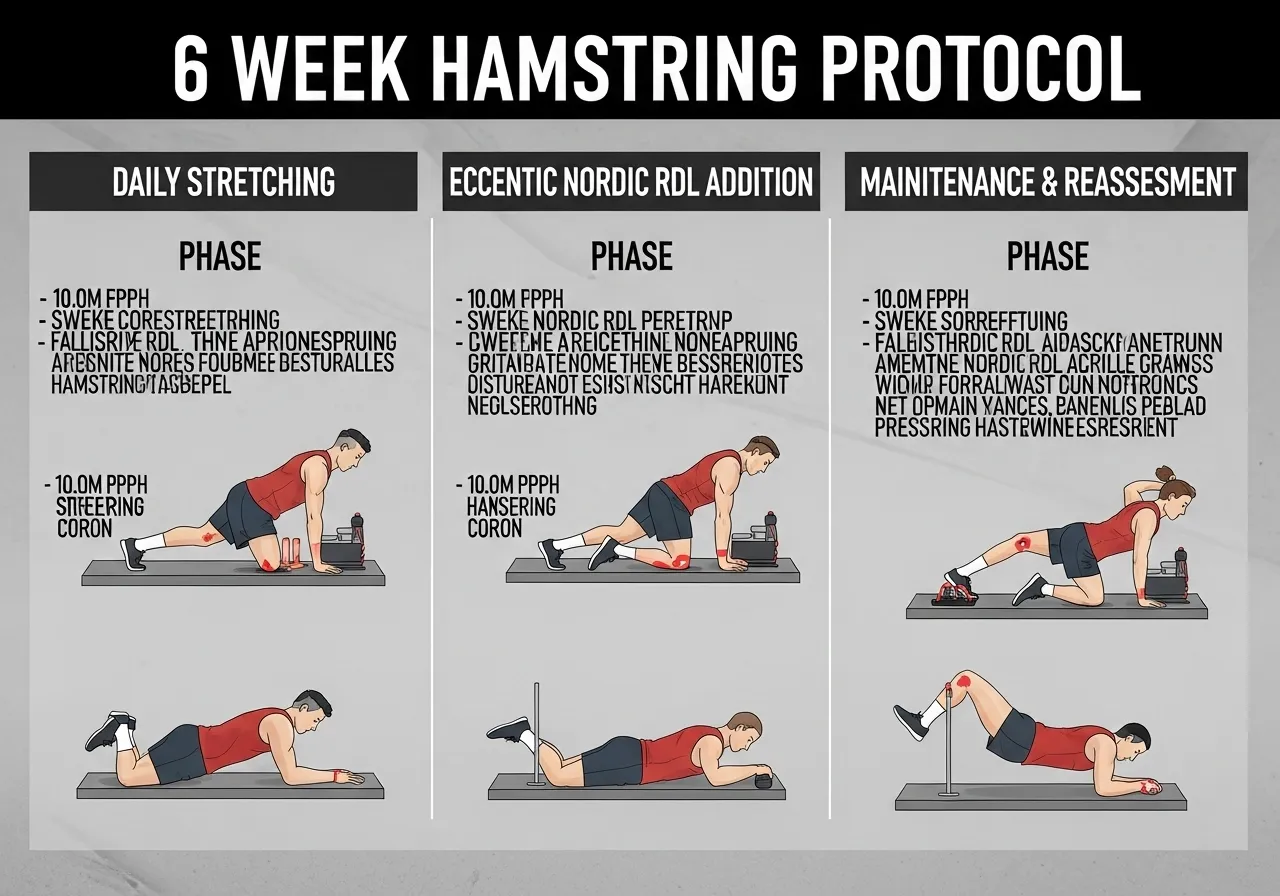
📅 Phase 1: Weeks 1 to 2: Baseline and Consistent Stretching
- Supine hamstring stretch (towel or strap): 3 sets of 45 seconds per side, daily
- Standing hamstring stretch: 2 sets of 30 seconds per side, after every training session
- Baseline test: passive knee extension angle with hip at 90 degrees (note starting point)
- No eccentric loading yet. Establish the stretching habit first
Focus: Establish daily consistency. Two weeks of daily stretching begins the chronic ROM process that infrequent sessions cannot produce.
📅 Phase 2: Weeks 3 to 4: Adding Eccentric Loading
- Continue daily stretching from Phase 1
- Add Nordic hamstring curl (assisted): 3 sets of 5 reps, twice per week
- Add single-leg RDL with light load: 3 sets of 8 per side, twice per week
- Slow eccentric tempo on both exercises: 3 to 4 seconds on the lowering phase
Focus: Begin structural fascicle length development through eccentric loading. Expect increased hamstring soreness in weeks 3 and 4. This is the adaptation signal, not injury.
📅 Phase 3: Weeks 5 to 6: Integration and Reassessment
- Maintain stretching: once daily (not twice as in Phase 1)
- Nordic hamstring curl: 3 sets of 6 to 8 reps, twice per week
- Single-leg RDL: increase load from Phase 2, 3 sets of 8 per side
- Week 6: retest passive knee extension angle and compare to baseline
- Expected: 8 to 15 degree improvement in passive knee extension range
Focus: Consolidate and measure. The retest provides objective evidence of structural change and guides the next training block’s stretching and eccentric loading prescription.
Frequently Asked Questions About Hamstring Flexibility
How long does it take to genuinely improve hamstring flexibility?
Neurological flexibility improvements, the reduction in neural tone that makes stretching feel effective immediately, occur within single sessions. Structural flexibility improvement, actual fascicle lengthening through sarcomere addition, requires a minimum of four to six weeks of consistent eccentric loading and stretching combined.
Trainees who stretch consistently for two weeks and then test their flexibility are measuring improved stretch tolerance rather than structural change. The structural change that persists without ongoing maintenance typically requires six to twelve weeks of consistent eccentric loading to become durable. After this period, the new range is maintained with reduced weekly maintenance volume rather than requiring the same intensity of initial intervention.
Should I stretch before or after training for hamstring flexibility?
Static hamstring stretching before strength training acutely reduces hamstring force production for 15 to 60 minutes post-stretch. For sessions involving heavy deadlifts, Romanian deadlifts, or hamstring-dominant exercises, static pre-training hamstring stretching may reduce performance and increase injury risk by reducing the force capacity at a critical time.
The standard recommendation: dynamic hamstring warm-up movements (leg swings, walking lunges, inchworms) before training sessions, and static stretching as the primary flexibility development tool after training or on dedicated mobility days. The evidence on stretching timing and optimal dosage for chronic range improvement is covered in the stretching guide.
Why do my hamstrings feel tight every morning even though I stretch consistently?
Morning hamstring tightness in consistent stretchers typically has two explanations. First, the overnight reduction in neural activity allows resting muscle tone to return to baseline, producing the familiar morning stiffness that resolves within minutes of movement. This is normal and does not indicate that stretching is failing.
Second, if the tightness is genuinely restrictive and not just stiff-feeling, the hamstrings may have a significant neurological component to their tightness that passive stretching is not addressing. Sciatic nerve tension produces a sensation identical to hamstring tightness because the sciatic nerve runs through the hamstring muscle group. The neural floss test, where the leg is raised with the knee extended and the foot dorsiflexed simultaneously, differentiates hamstring muscular tightness from sciatic nerve tension by reproducing the symptom with ankle dorsiflexion added at a range where hamstring-only tightness would not feel different.
How do I assess my own hamstring flexibility?
The passive knee extension test is the most reliable self-assessment tool for hamstring length without any specialist equipment or laboratory access. Lie on your back. Bring one hip to 90 degrees of flexion with both the hip and the knee bent. Then slowly extend the knee until you feel a stretch in the hamstring. The angle of knee flexion remaining at the point of first stretch is the passive knee extension deficit. A deficit of less than 20 degrees indicates adequate hamstring length for most activities. A deficit of 30 degrees or more indicates clinically meaningful hamstring tightness worth addressing.
The sit-and-reach test is more widely known but measures a combination of hamstring length, lower back flexibility, and posterior pelvic mobility simultaneously. A poor sit-and-reach result therefore does not specifically confirm hamstring muscular tightness as the primary cause. The passive knee extension test is more diagnostically specific. Performing both tests and comparing the results provides a clearer overall picture of whether the primary limitation is hamstring length, spinal mobility, or pelvic control.
Can I have too much hamstring flexibility?
Passive hamstring length beyond what active eccentric strength can control increases injury risk rather than reducing it. Athletes who can passively reach extreme hamstring length positions but lack the eccentric strength to control those positions under load are at higher risk of strain than moderately flexible athletes with proportionate eccentric strength.
The target is not maximum passive length but adequate usable range: passive flexibility slightly greater than what training and sport movements demand, with eccentric strength throughout that range. For most recreational athletes, this is approximately 80 to 90 degrees of hip flexion with the knee extended in the passive knee extension test. Pursuing flexibility beyond what activities require without proportional eccentric strengthening produces diminishing returns and potential risk increase.
- Hamstring tightness has two components: structural (short fascicles) and neurological (high resting tone). Static stretching primarily addresses neurological tightness; eccentric loading addresses structural shortness.
- Chronic ROM improvement requires consistent stretching frequency over at least two weeks. Daily shorter sessions produce more lasting change than infrequent high-volume sessions.
- Eccentric training reduces hamstring injury incidence by 56.8 to 70 percent and produces structural fascicle lengthening that static stretching cannot match. For athletes, eccentric loading is the primary hamstring flexibility intervention.
- Hamstring tightness causes lower back rounding under load, posterior pelvic tilt, restricted RDL depth, and sprint mechanics limitations. Addressing it improves both performance and injury resistance simultaneously.
- Passive flexibility without eccentric strength through the range is not functional flexibility. The goal is usable range: passive length slightly exceeding training demands with adequate eccentric control throughout.