Romanian Deadlift: EMG Research, Hamstring Stretch Science, Technique, and Progressive Loading
Most lower body training is quad-dominant. Squats, leg presses, and lunges all drive the knee into flexion under load, challenging the quadriceps as the primary mover. The hamstrings assist but rarely lead.
The Romanian deadlift reverses this. The movement is a hip hinge under load, not a knee hinge. The hamstrings must eccentrically control the descent and concentrically drive the ascent. More importantly, the bar hanging below hip level during the movement means the hamstrings work at a long muscle length, where the stretch-mediated hypertrophy stimulus is greatest.
This guide covers what the EMG research shows about how the Romanian deadlift targets the posterior chain differently from both conventional deadlifts and leg curl machines, the technique details that determine whether the hamstrings or the lower back bears the load, RDL variations and their activation profiles, and an 8-week progressive loading programme.
What the EMG Research Shows: Romanian Deadlift vs Conventional Deadlift
The Posterior Chain Activation Difference
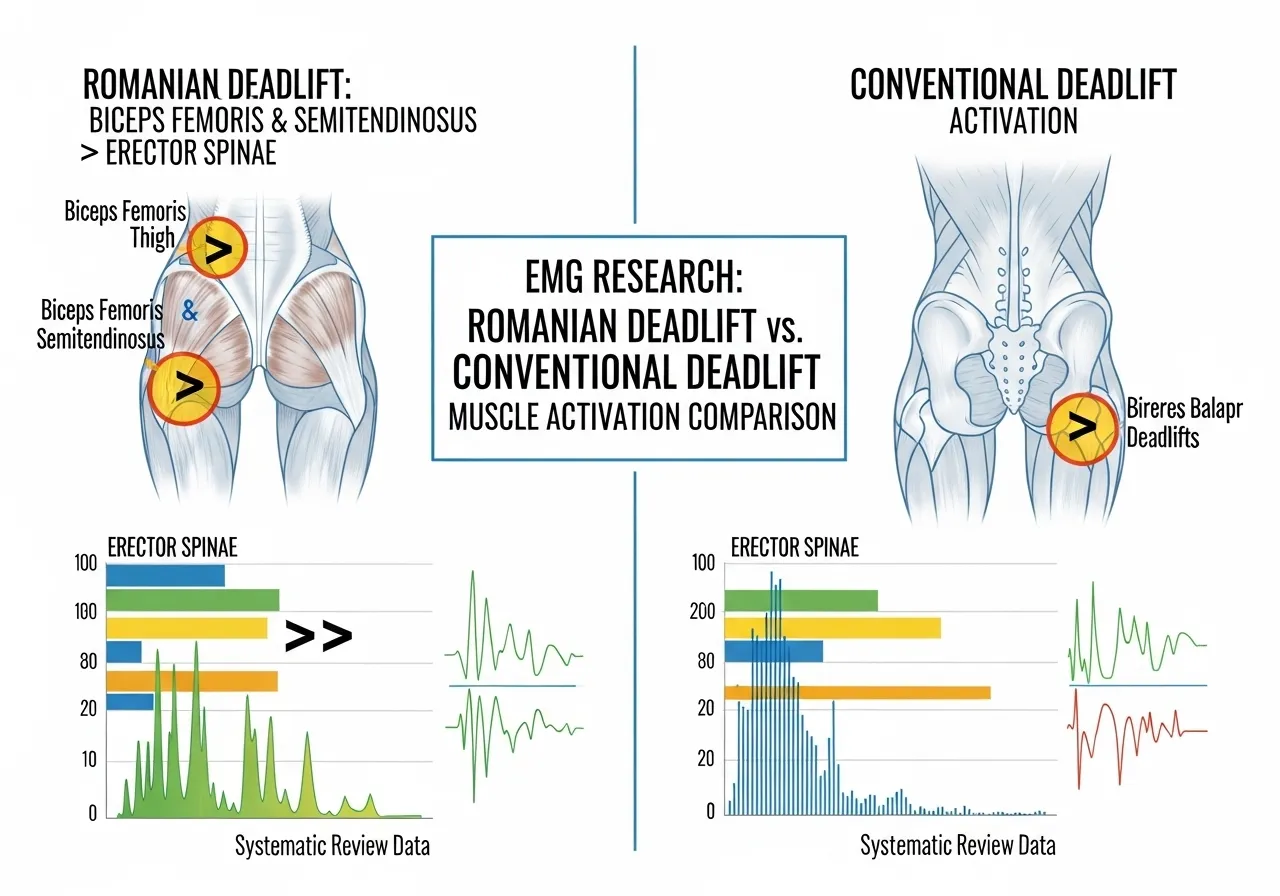
A systematic review of EMG activity in deadlift exercise and its variants found that the Romanian deadlift is associated with lower activation for erector spinae than for biceps femoris and semitendinosus, which represents a fundamentally different activation profile from the conventional deadlift where erector spinae and quadriceps muscles reported greater activation than gluteus maximus and biceps femoris muscles, confirming that the Romanian deadlift is the superior variation for specifically targeting the hamstring musculature while reducing lumbar erector demand compared to the conventional lift.
The Romanian deadlift produces greater biceps femoris and semitendinosus activation than erector spinae. The conventional deadlift produces the reverse. This distinction makes the RDL the more targeted hamstring developer and the conventional deadlift the more complete posterior chain exercise.
The Kinematic and Kinetic Comparison
A study comparing EMG and kinetics between conventional and Romanian deadlifts in 21 trained males found that significantly greater normalized EMG values showed significantly greater values for rectus femoris and gluteus maximus during the conventional deadlift compared to the Romanian deadlift, while the Romanian deadlift produced relatively greater biceps femoris activation and a greater hip net joint torque across the movement, with the conventional deadlift showing greater knee and ankle net joint torques, confirming that the two variations train the lower body through distinct joint demand distributions rather than being interchangeable exercises at different loads.
Conventional deadlift: greater rectus femoris, gluteus maximus, and knee/ankle joint demand. Romanian deadlift: greater biceps femoris and hip-dominant joint torque. Neither is superior overall. They are complementary exercises targeting different aspects of lower body development.
The Lengthened Position Advantage
Recent hypertrophy research has consistently found that training muscles at longer muscle lengths produces equal or greater hypertrophy than training at shorter lengths, and in some cases superior growth in specific muscle regions. The Romanian deadlift trains the hamstrings under load at a significantly longer muscle length than any knee flexion-based hamstring exercise.
At the bottom of a Romanian deadlift with appropriate range, the hamstrings are simultaneously stretched at the hip (hip flexion) and the knee (knee remaining relatively extended). This dual-joint stretch creates a specific mechanical environment where the passive tension from the stretch adds to the active contractile tension, producing a greater total mechanical stimulus than isolated hamstring curl variations at matched load.
The practical evidence: trainees who add Romanian deadlifts to a programme that previously included only hamstring curls typically report distal hamstring soreness in the posterior thigh and behind the knee that hamstring curls never produced. This distal soreness indicates the lengthened-position loading is reaching muscle regions that knee-flexion exercises underload.

RDL Variations and Their Activation Profiles
Romanian Deadlift vs Step-Romanian Deadlift vs Stiff-Leg Deadlift
A study examining posterior chain muscle excitation in the Romanian, step-Romanian, and stiff-leg deadlift in competitive bodybuilders found that during the ascending phase, gluteus maximus activation was greater in the step-Romanian deadlift than in both the standard Romanian deadlift and stiff-leg deadlift, while biceps femoris and semitendinosus activation during the descending phase was highest in the step-Romanian deadlift, confirming that performing the Romanian deadlift with the feet elevated on a step or plate significantly increases both hamstring and gluteus maximus excitation by allowing a greater range of motion at the hip and creating a more extended hamstring stretch at the bottom position.
Standing on a step or elevated platform during the Romanian deadlift increases both hamstring and gluteal activation compared to floor-level RDL. The elevation increases the effective range of motion at the hip, loading the hamstrings through a longer stretch.
Barbell RDL vs Dumbbell RDL vs Single-Leg RDL
| Variation | Primary Advantage | Limitation | Best For |
|---|---|---|---|
| Barbell RDL | Heaviest loading, bilateral stability | Bar path limited by knees | Primary strength development, progressive overload |
| Dumbbell RDL | Greater range of motion, wrist freedom | Grip limits load | Hypertrophy focus, beginners learning hip hinge |
| Single-leg RDL | Unilateral balance, hip stabiliser demand | Lower absolute load | Asymmetry correction, functional strength, athletic performance |
| Step RDL | Increased range of motion, greater EMG | Requires platform, flexibility demand | Advanced trainees seeking maximum hamstring stimulus |
Cable RDL: The Constant Tension Alternative
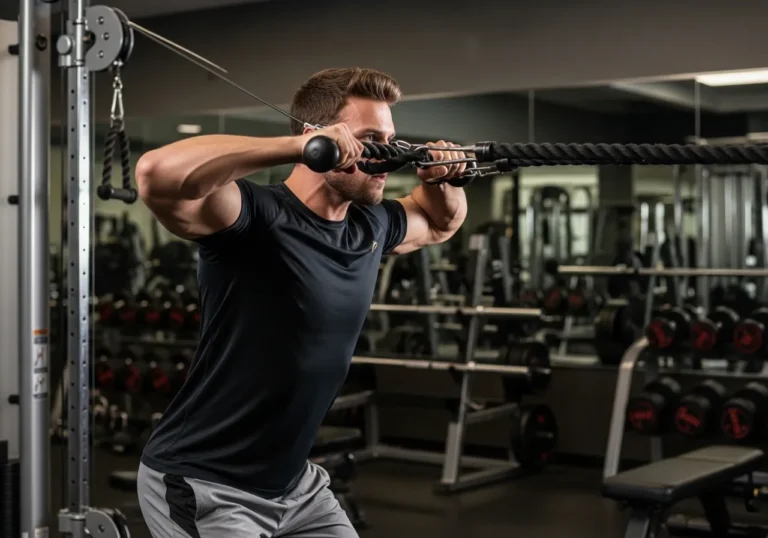
Performing Romanian deadlift movements with a cable set at floor level or using a cable machine creates a resistance profile that differs from free weights. A barbell RDL provides maximum resistance when the hamstrings are shortest (standing upright) and minimum resistance at the bottom when the hamstrings are most stretched, because gravity acts vertically while the barbell hangs straight down.
A cable set behind the trainee during a hip hinge creates resistance that is higher when the hamstrings are in a lengthened position, complementing rather than replicating the free weight RDL stimulus. Including both free weight and cable RDL variations in a programme addresses the full resistance-length relationship of the hamstring rather than loading only one portion of the curve.
Romanian Deadlift Technique: Setup and Execution
The Romanian deadlift places the lumbar spine in a loaded flexion-extension pattern. Individuals with active disc herniations, lumbar stenosis, or acute lower back pain should obtain medical clearance before performing loaded Romanian deadlifts. Individuals with hamstring strains should not perform RDL through full range until the injury has fully healed and range of motion is pain-free at bodyweight. Any sharp radiating pain into the legs during the exercise indicates possible spinal nerve involvement and requires immediate assessment.
Setup: Bar Position and Starting Point
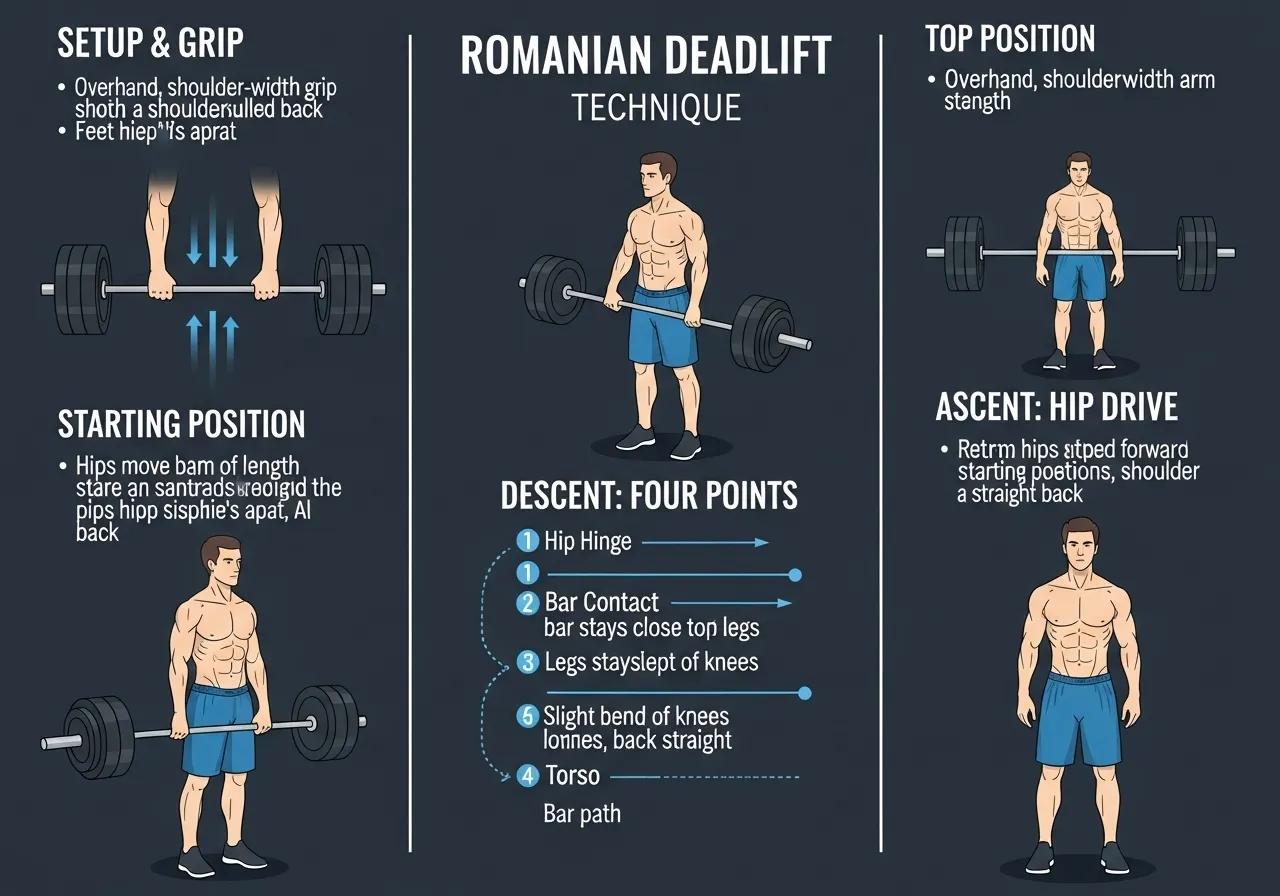
2. Starting position: Stand tall with the bar at hip height, arms straight, shoulders pulled back and down, core braced fully.
3. Foot position: Hip-width or slightly narrower, toes pointed forward or very slightly out. Unlike the conventional deadlift, the RDL does not benefit from a wide stance.
4. Knee position: Slight bend of 10 to 20 degrees, maintained consistently throughout the movement. The knees do not drive forward into deeper flexion as they do in a squat or conventional deadlift.
The Descent: Maintaining the Hip Hinge
Initiate the descent by pushing the hips backward, not by bending forward at the waist. The torso will lean forward as a consequence of the hips moving back, but the forward lean is driven by the hips, not by the spine flexing.
Keep the bar in contact with the thighs throughout the descent. The bar should drag along the shins and thighs on the way down, staying as close to the centre of mass as possible. As the bar passes the knees, it will naturally move slightly forward. Do not let the bar swing away from the body.
Lower until a strong stretch is felt in the hamstrings. For most trainees with normal hamstring flexibility, this is mid-shin level. For trainees with restricted hamstring mobility, the stretch sensation will occur higher, sometimes just below the knees. Stop at the point of stretch, not at a fixed height.
The Ascent: Driving Through the Hips
Drive the hips forward to return to standing. The cue “push the floor away with your feet” is useful to initiate the ascent without allowing the lower back to extend prematurely before the hips have returned to neutral.
At the top, squeeze the glutes and stand fully tall before beginning the next descent. The full hip extension at the top is where the gluteus maximus completes its range of motion in the movement. Cutting this short reduces the glute stimulus and creates a pattern of incomplete hip extension that transfers negatively to other hip extension exercises.
The Technical Errors That Make Romanian Deadlifts Hurt Backs
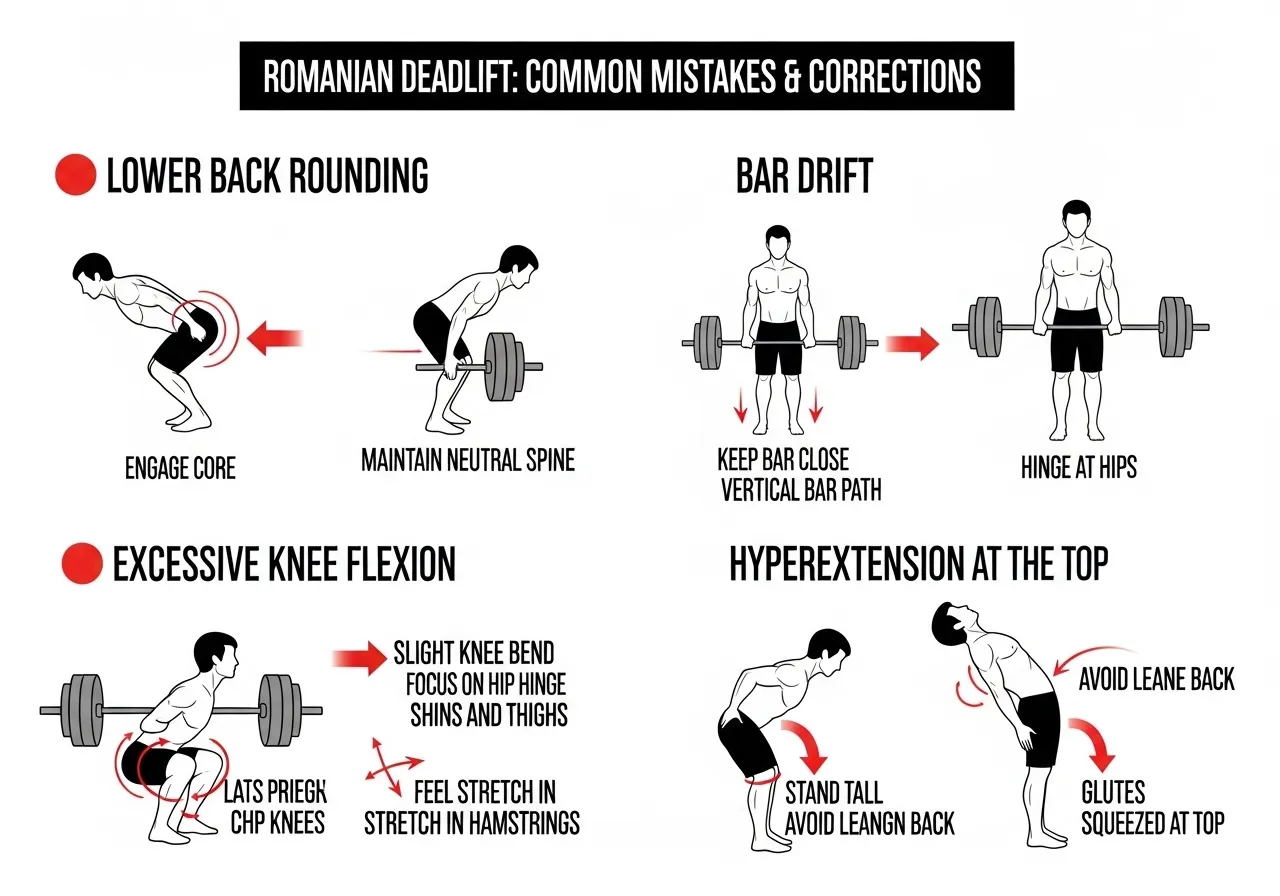
Error 1: Rounding the Lower Back Under Load
The most consequential Romanian deadlift error is allowing the lumbar spine to flex under load during the descent. This occurs when the trainee reaches for more range of motion than their hamstring flexibility actually allows, bending the spine to extend the apparent depth of the movement.
The lower back should maintain a neutral or very slightly extended position throughout the entire movement. A practical check: place a hand on the lower back during the descent. If the lower back rounds outward into the hand, the range of motion is exceeding what the hamstring flexibility can support in neutral spine.
The correction: reduce range of motion to the point where the lower back remains neutral. This may be well above the floor initially. Range of motion will improve over weeks as hamstring flexibility develops through the loaded stretch. Attempting to rush depth by sacrificing spinal position is how lower back injuries from Romanian deadlifts occur.
Error 2: Bar Drifting Away From the Body
Allowing the bar to swing forward and away from the legs during the descent dramatically increases the lumbar moment arm. The further the bar is from the body’s centre of mass, the more force the lumbar erectors must produce to maintain spinal position. At a bar distance of 20 to 30 cm from the thighs, lumbar stress increases by a factor that makes the exercise significantly more dangerous than when the bar remains in contact with the body.
The bar should drag along the thighs during the entire descent. Trainees who leave marks on their thighs are performing the bar path correctly. If the legs are unmarked after a set of Romanian deadlifts, the bar is drifting forward and the technique requires correction before loading increases.
Error 3: Treating the RDL as a Squat
Some trainees allow the knees to drive forward significantly during the Romanian deadlift, effectively converting it into a Romanian squat rather than a hip hinge. As the knees flex more than 20 to 30 degrees, the movement shifts toward quad-dominant mechanics and the hamstring stretch stimulus is reduced.
The knee angle should remain relatively constant from start to finish: the slight initial bend maintained consistently. If the knees are flexing and extending significantly during the movement, it is not functioning as a Romanian deadlift. This error often appears when the load is too heavy for the hamstring strength available and the body compensates by involving the knee extensors to assist the concentric phase.
Error 4: Hyperextending at the Top
At the top of the movement, some trainees hyperextend the lumbar spine and thrust the hips forward beyond neutral to maximise the glute squeeze sensation. This places the lumbar facet joints under compressive stress with every repetition.
Standing fully tall with the hips at neutral, not hyperextended, is the correct top position. The glutes can be fully contracted at neutral hip extension without requiring lumbar hyperextension. A cue that helps: think about stacking the hips under the shoulders at the top, rather than driving the hips through past vertical.
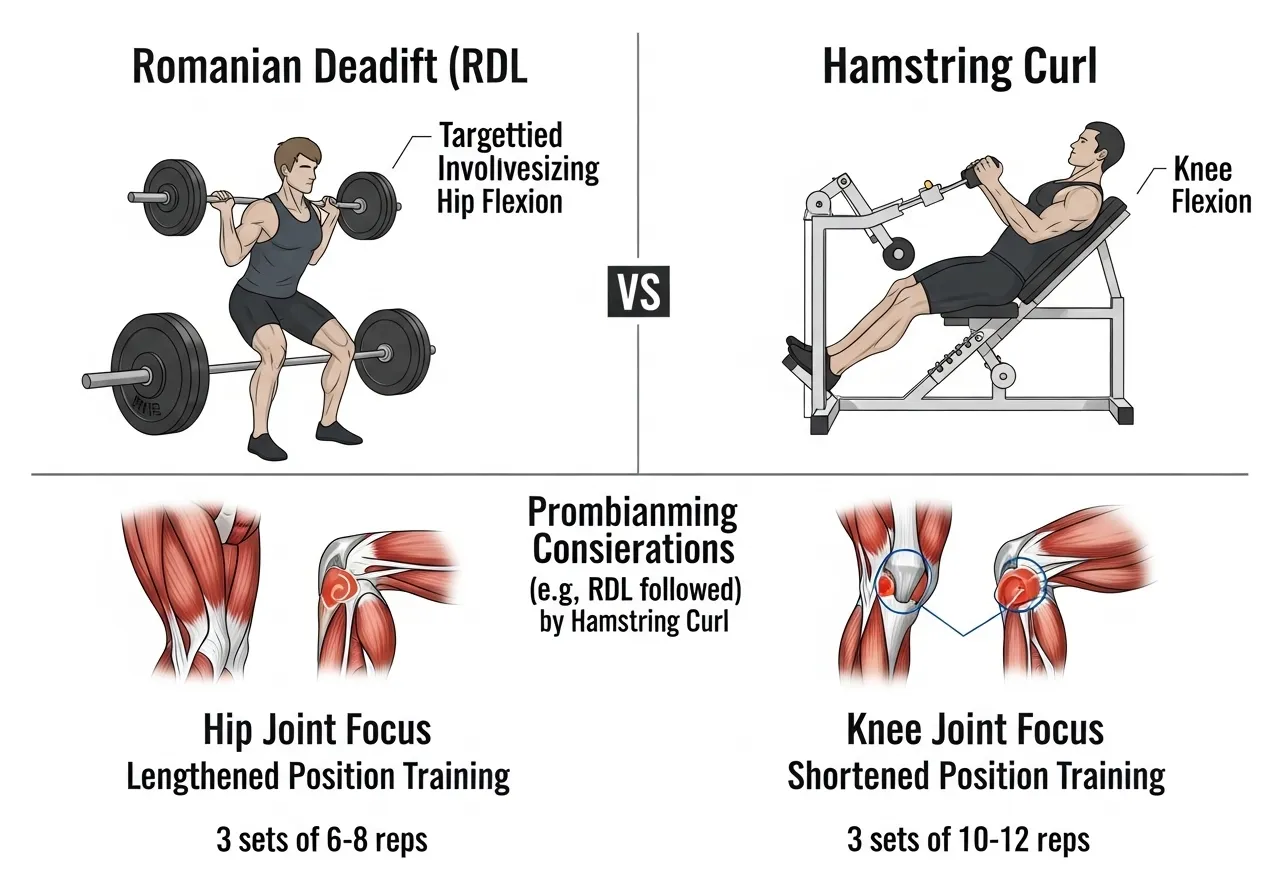
Romanian Deadlift vs Hamstring Curls: The Complete Hamstring Stimulus
Why Both Are Necessary
The hamstring is a two-joint muscle. It crosses both the hip joint (producing hip extension) and the knee joint (producing knee flexion). Complete hamstring development requires training through both joints in both lengthened and shortened positions.
The Romanian deadlift trains the hamstrings through the hip joint, with the muscle at its longest length during the movement. Leg curl machines train the hamstrings through the knee joint, with the muscle working through a shorter range than during hip extension exercises. Neither covers the full spectrum of hamstring function alone.
Research consistently shows that combining hip extension and knee flexion hamstring exercises within the same programme produces greater total hamstring hypertrophy than either exercise type alone. The practical recommendation: Romanian deadlifts as the primary hamstring exercise, supplemented by hamstring curl variations to address the knee flexion function that RDL does not provide. The Nordic hamstring curl and its role in hamstring injury prevention is covered in the Nordic hamstring curl guide.
Hamstring Curl vs RDL: The Activation Comparison
The systematic review evidence shows that Romanian deadlift produces greater biceps femoris activation than prone leg curl in some studies, while the Nordic hamstring curl and seated leg curl produce greater hamstring activation than the stiff-leg deadlift in others. The comparison is complicated by different load selection methods across studies.
The practical interpretation: at matched proximity to failure, the RDL and hamstring curls produce comparable hamstring activation, but through different portions of the hamstring’s functional range. The RDL loads the muscle at long length. The curl loads it at shorter length. Both are necessary for complete development.
Programming the Combination
The most effective hamstring programming pairs the Romanian deadlift as a compound primary movement with one or two hamstring curl variations as secondary exercises. A practical split:
- Primary: Barbell RDL, 3 to 4 sets of 6 to 10 reps, as the first accessory after the day’s main compound lift (squat or deadlift day)
- Secondary: Lying or seated leg curl, 2 to 3 sets of 10 to 15 reps, after the RDL sets
- Optional: Single-leg RDL, 2 to 3 sets of 8 to 12 reps, on a second lower body day to address unilateral balance and add volume without the spinal load of a second barbell session
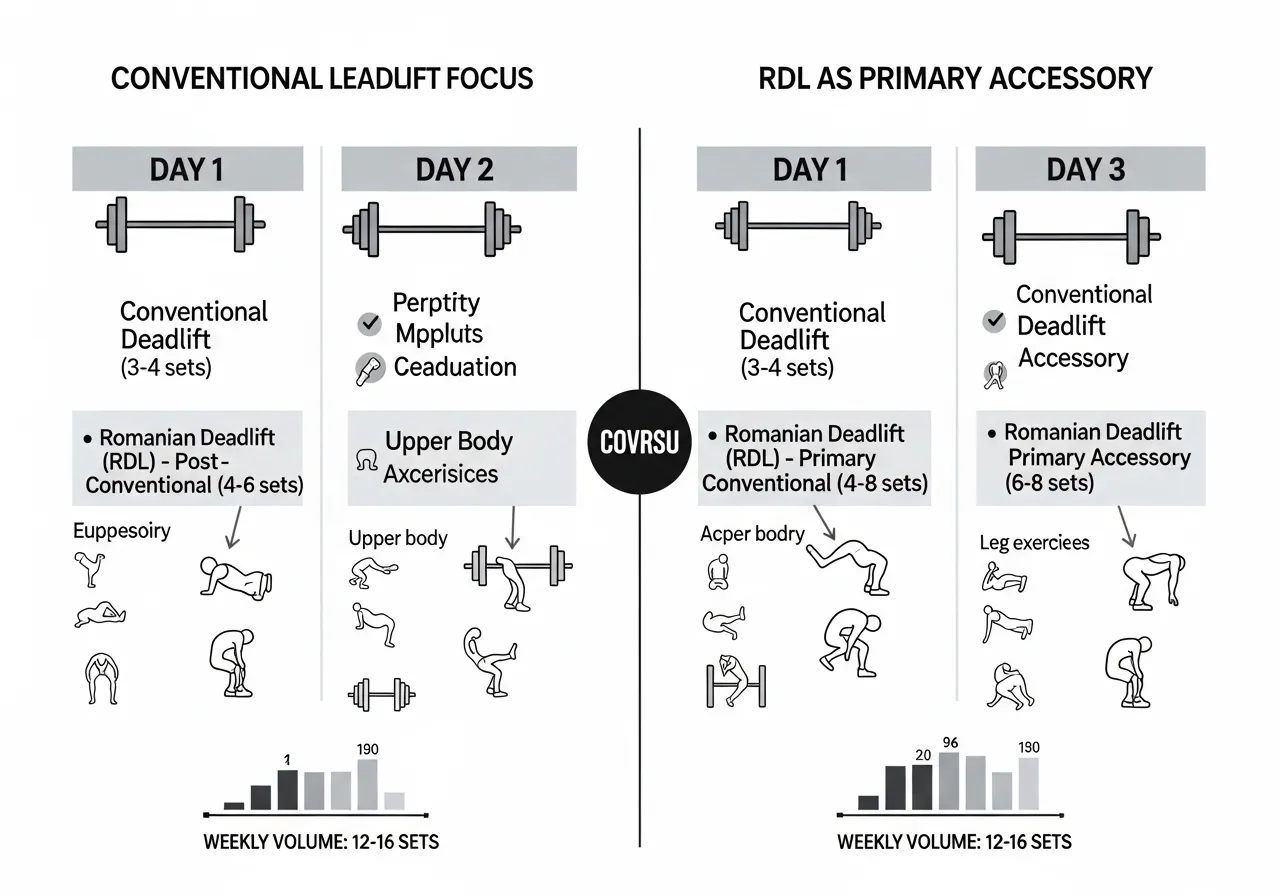
How the Romanian Deadlift Fits Into a Complete Lower Body Programme
Placement Within the Session
The Romanian deadlift is a demanding compound movement that requires significant posterior chain output and spinal stability. It should be placed early in the session, typically as the second or third exercise, after the primary compound lift but before isolation work.
Performing Romanian deadlifts after heavy conventional deadlifts or squats when the posterior chain is already fatigued significantly compromises technique and reduces the training stimulus. The ideal placement: primary compound lift (squat, conventional deadlift, or leg press), then Romanian deadlift as the first accessory movement, then isolation exercises for hamstrings, glutes, or calves.
Romanian Deadlift Alongside the Conventional Deadlift
Many trainees assume that if they perform conventional deadlifts, they do not need Romanian deadlifts. The EMG and kinetic data shows this is incorrect. The conventional deadlift and RDL train the lower body through different joint demands and different muscle activation profiles.
Conventional deadlift provides greater rectus femoris and gluteus maximus stimulus and trains the full lower body through a floor-to-standing range. Romanian deadlift provides greater biceps femoris stimulus through a loaded stretch that the conventional lift does not replicate. Including both in a lower body programme provides a more complete posterior chain stimulus than either alone.
For trainees who deadlift heavy twice per week, the Romanian deadlift can replace the second conventional deadlift session as a lower-load, higher-hamstring-specificity alternative that reduces lumbar fatigue while maintaining posterior chain training frequency. The barbell back squat programming and how it interacts with deadlift variations is covered in the barbell back squat guide.
Weekly Volume Guidelines
The hamstrings, like most muscle groups, respond to 10 to 20 working sets per week for hypertrophy. For trainees whose programme includes both conventional deadlifts and Romanian deadlifts:
- Conventional deadlift: 2 to 3 sets of heavy working sets contribute to hamstring volume but primarily target the full posterior chain
- Romanian deadlift: 3 to 4 sets of 6 to 10 reps constitutes the primary hamstring-specific volume
- Hamstring curl: 3 to 4 sets of 10 to 15 reps addresses the knee flexion function
Total hamstring-specific sets: 6 to 8 per session, 2 sessions per week for a total of 12 to 16 sets weekly. This falls within the effective volume range for most trainees and provides sufficient stimulus for both strength and hypertrophy development.
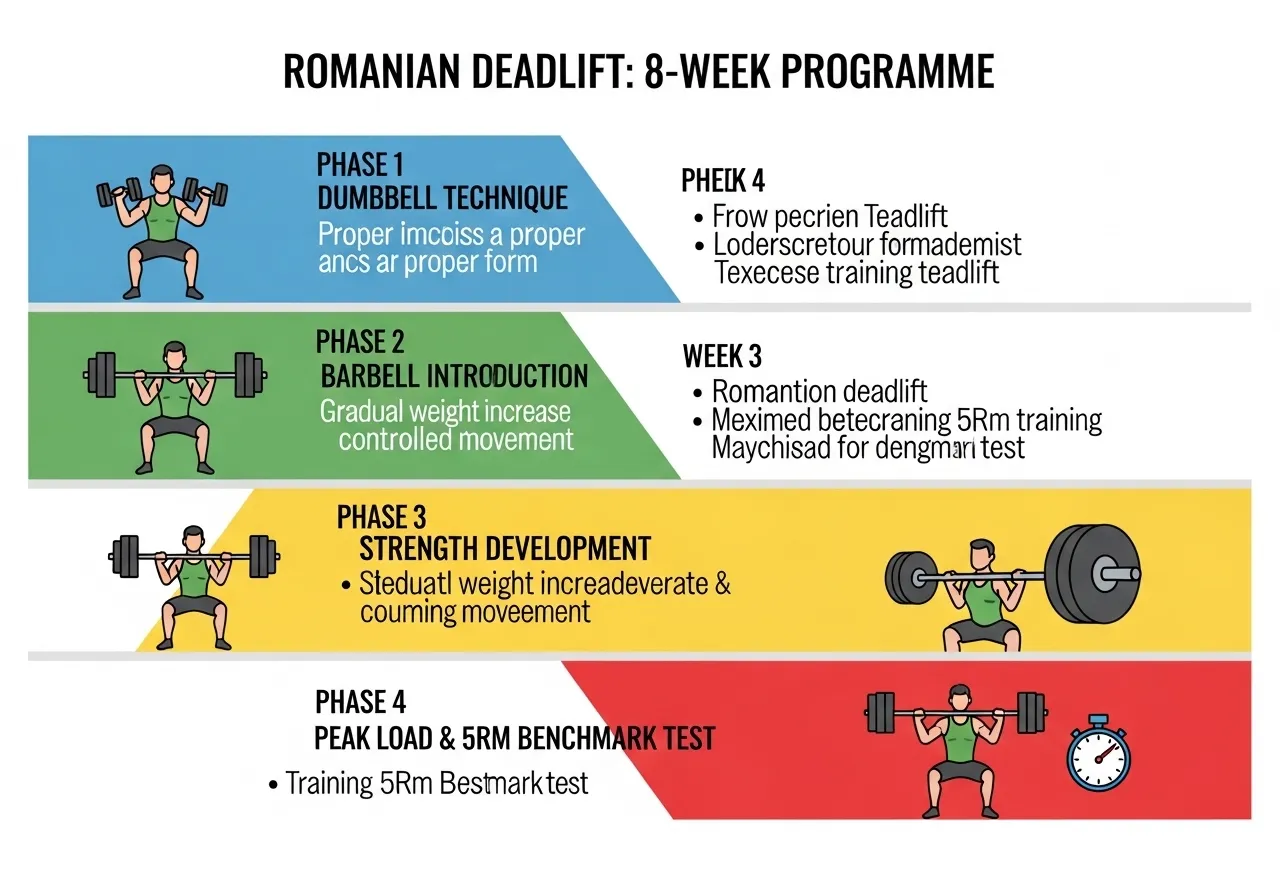
8-Week Romanian Deadlift Progressive Loading Programme
📅 Phase 1: Weeks 1 to 2: Technique and Range of Motion Establishment
- Dumbbell RDL: 3 sets of 10 reps at light load
- Focus: hip hinge pattern, bar path against legs, neutral spine throughout, range dictated by hamstring stretch not a fixed point
- Superset with: lying leg curl 3 sets of 12 reps
- No barbell until dumbbell technique is consistent across all reps
The dumbbell variation allows greater range of motion and immediate feedback on bar path. It establishes the hip hinge pattern before barbell loading increases spinal demands.
📅 Phase 2: Weeks 3 to 4: Barbell Introduction and Load Build
- Barbell RDL: 3 sets of 8 reps at 40 to 50% of conventional deadlift 1RM
- Focus: maintain all Phase 1 technique cues with barbell, confirm bar contact with legs throughout
- Superset with: seated leg curl 3 sets of 12 reps
- Add single-leg RDL (bodyweight or light dumbbell): 2 sets of 8 per side
The transition to barbell maintains all technique elements from Phase 1. Load is deliberately conservative to allow technique consolidation before progression.
📅 Phase 3: Weeks 5 to 6: Strength Development
- Barbell RDL: 4 sets of 6 to 8 reps at 55 to 65% of conventional deadlift 1RM
- 1 back-off set of 12 reps at 45%
- Add step RDL (standing on 10 to 15 cm platform): 2 sets of 8 reps to increase range of motion
- Nordic hamstring curl or lying leg curl: 3 sets of 8 to 10 reps
The step variation introduces greater range of motion and hamstring stretch. The back-off set maintains hypertrophy volume after the strength-focused primary sets.
📅 Phase 4: Weeks 7 to 8: Peak Load and Benchmark
- Barbell RDL: 4 sets of 5 reps at 68 to 75% of conventional deadlift 1RM
- Week 8: test 5RM Romanian deadlift and compare to Phase 1 starting load
- Expected outcome: 20 to 30% load increase from Phase 1 starting weight over 8 weeks
- Continue step RDL and single-leg RDL as supplementary variations
The 5RM test establishes a strength benchmark and guides load selection for the next training block. Compare to conventional deadlift performance as a ratio check.
Frequently Asked Questions About the Romanian Deadlift
How much should I Romanian deadlift compared to my conventional deadlift?
Most trainees Romanian deadlift 60 to 80% of their conventional deadlift 1RM for working sets. The RDL is lighter than the conventional deadlift for two reasons: the starting position without the initial pull from the floor eliminates the leg drive contribution, and the hamstring-specific demand limits load more than the full lower body recruitment of the conventional lift.
A Romanian deadlift that exceeds 85% of a conventional deadlift 1RM usually indicates either the RDL range of motion is very limited (not reaching adequate hamstring stretch), or the conventional deadlift is limited by factors other than lower body strength. Both warrant investigation before adding more load.
How deep should I go on Romanian deadlifts?
As deep as the hamstring stretch can be felt with the lower back remaining in a neutral position. For most trainees, this is somewhere between knee level and mid-shin. Individuals with restricted hamstring flexibility may find the stretch occurs above the knees initially.
Depth is not a fixed target. It is a response to the individual’s hamstring flexibility and hip mobility. The goal is maximum hamstring stretch in a neutral spine, not reaching the floor or any other arbitrary depth marker. Range of motion will increase naturally over weeks as the hamstrings adapt to the loaded stretch stimulus.
Should I use a mixed grip or straps for heavy Romanian deadlifts?
Grip becomes a limiting factor for many trainees during heavy Romanian deadlift sets because the bar must be held for the full set duration without setting it down. The overhand double-pronated grip develops grip strength alongside hamstring strength, which is valuable.
When grip consistently fails before the hamstrings are adequately fatigued, straps are an appropriate tool that allows the target muscles to be trained without grip becoming the limiting factor. A mixed grip is less recommended for RDL than for conventional deadlift because the asymmetric shoulder and arm position can introduce subtle rotational compensation through the descent that affects bar path consistency.
Can the Romanian deadlift replace the conventional deadlift?
Not as a complete substitute, but as an effective alternative for trainees whose primary goal is hamstring and posterior chain hypertrophy rather than maximum strength development. The conventional deadlift trains the full lower body through a complete range and allows greater absolute loading. The RDL trains the hamstrings more specifically but sacrifices the complete lower body stimulus.
Trainees who cannot conventional deadlift due to lower back issues often find the Romanian deadlift a viable alternative that develops posterior chain strength with reduced lumbar demand. The reduced lumbar erector requirement documented in the EMG research supports this application. The trap bar deadlift is another lower-lumbar-demand alternative that covers more of the conventional deadlift’s movement pattern than the RDL does. Its EMG comparison is covered in the trap bar deadlift guide.
- The Romanian deadlift produces greater biceps femoris and semitendinosus activation than erector spinae, which is the opposite pattern from the conventional deadlift, making it the superior variation for specifically targeting the hamstrings
- Conventional deadlift produces greater rectus femoris and gluteus maximus EMG; Romanian deadlift produces greater relative biceps femoris and hip torque. They are complementary, not interchangeable.
- Standing on a step or platform during the RDL significantly increases both hamstring and gluteal activation by extending the effective hip range of motion through a longer stretch
- The bar should maintain contact with the thighs throughout the entire descent. If the thighs are unmarked after a set, the bar is drifting and lumbar stress is increasing
- Romanian deadlifts train hamstrings at long muscle length through the hip joint. Hamstring curls train them through the knee joint. Both are required for complete hamstring development.