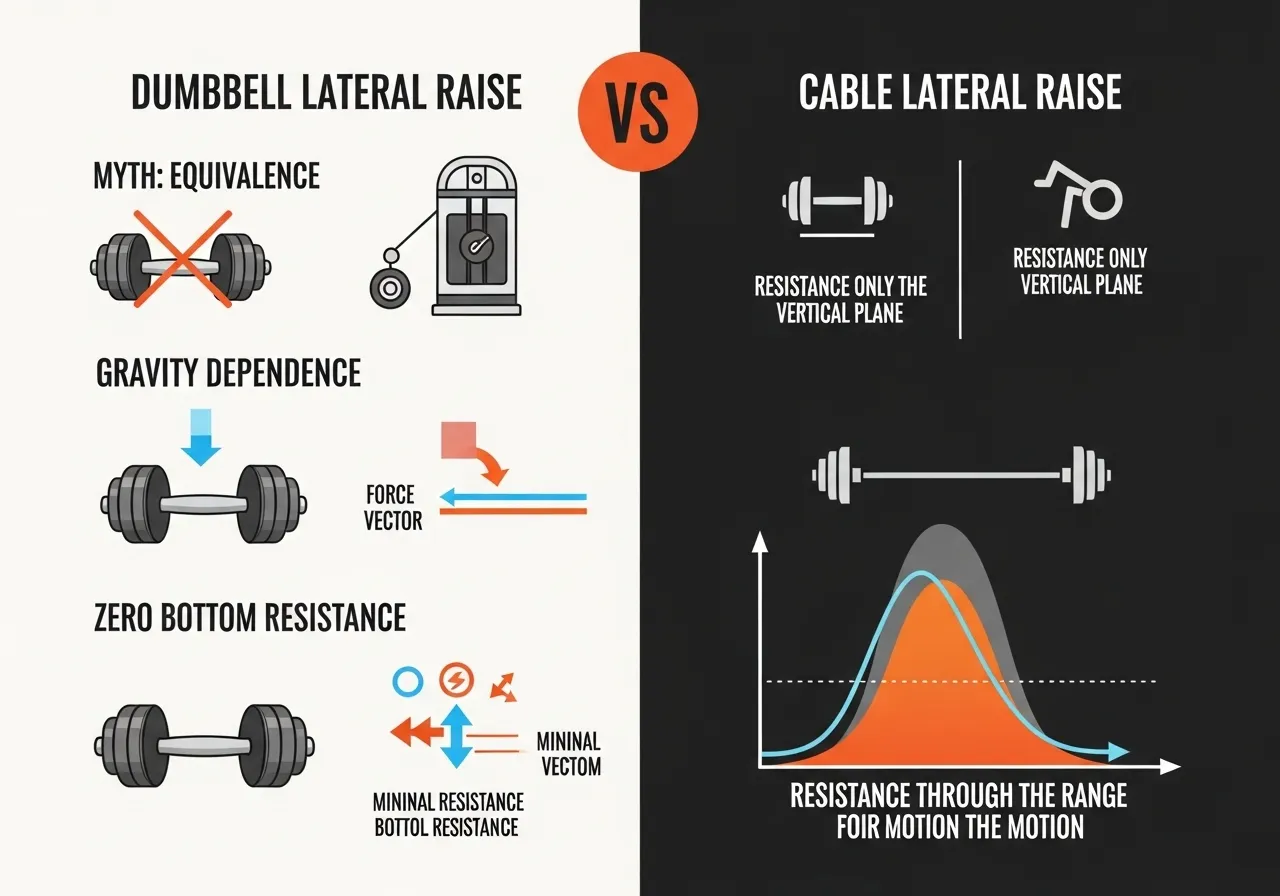
The dumbbell lateral raise is the standard side deltoid exercise for generations. It is available in any gym, requires no special equipment, and has a clear movement pattern that most trainees learn quickly. It also has a fundamental mechanical limitation: the resistance is zero at the bottom of the movement and maximum at the point of least muscular advantage, creating a loading profile that is precisely mismatched with the lateral deltoid’s strength curve.
The cable lateral raise loads the lateral deltoid differently. With the cable pulling from a low pulley at the side, resistance is applied throughout the full range of abduction — including the bottom position where the dumbbell provides no stimulus. The constant tension profile matches the shoulder’s available strength more consistently across the range than the gravity-dependent dumbbell, and the stretched position loading at the bottom provides the stimulus at long muscle length that research on hypertrophy has repeatedly shown produces superior muscle growth compared to loading only at shortened positions.
The 2025 RCT by Schoenfeld and colleagues confirmed these mechanical predictions with an 8-week within-participant study: cable lateral raises produced superior lateral deltoid hypertrophy compared to matched dumbbell lateral raises, with greater growth in the proximal lateral deltoid specifically — the region where the cable’s bottom-range loading advantage is most pronounced. This guide covers the resistance profile research, the cable’s specific mechanism advantages, technique, variations, and programming within a complete shoulder development programme.
Do Dumbbells and Cables Produce the Same Lateral Deltoid Development, or Is That a Training Myth?
Why the Equivalence Assumption Was Plausible but Wrong
The assumption that dumbbells and cables produce equivalent lateral deltoid development was reasonable before direct comparison research. Both exercises involve shoulder abduction to approximately 90 degrees, both are performed at similar loads, and both produce subjective lateral deltoid fatigue during a set. The mechanisms by which they load the lateral deltoid differently were known from biomechanics, but whether these mechanical differences produced measurable hypertrophy differences over weeks of training was not established until the 2025 RCT.
The RCT by Larsen, Wolf, Schoenfeld and colleagues found that they are not equivalent. Over 8 weeks of matched-volume training with the same participants’ left and right arms randomly assigned to dumbbell or cable lateral raise, the cable condition produced greater lateral deltoid hypertrophy at the proximal measurement site. The difference confirms that the mechanical advantage of cable’s constant tension is not merely theoretical but produces detectable hypertrophy differences over a meaningful training period.
The Gravity-Dependence Problem With Dumbbells
Dumbbell lateral raise resistance is determined entirely by gravity. The resistance applied to the lateral deltoid equals the weight of the dumbbell multiplied by the horizontal distance between the weight and the shoulder joint — a function of the sine of the shoulder abduction angle. At zero degrees of abduction (arm hanging at the side), this horizontal distance is zero, and the dumbbell provides no resistance to the lateral deltoid regardless of its weight. At 90 degrees, the horizontal distance is maximised and resistance is at its peak.
The lateral deltoid’s strength curve does not follow this profile. The muscle is capable of producing significant force at the bottom of the range (near zero degrees of abduction), where it is at a long length and where its cross-sectional area is available for force production, but the dumbbell provides no stimulus at this position. As abduction increases past 90 degrees, the lateral deltoid’s mechanical advantage begins to decrease at the same time that the dumbbell’s effective resistance also begins to decrease from the maximum at 90 degrees. The result is a reasonable match in the upper range (60 to 90 degrees) but a significant mismatch in the lower range (0 to 45 degrees) where the cable loads the muscle and the dumbbell does not.
The Length-Tension Advantage of Cable Loading
Research on muscle hypertrophy has repeatedly documented that loading muscles at long lengths produces superior hypertrophy compared to loading at short lengths matched for total volume. The lateral deltoid is at its longest length at the bottom of the abduction range — the position where the dumbbell applies no load and the cable applies maximum tension relative to the muscle’s position. This means the cable lateral raise loads the lateral deltoid at precisely the position where the length-tension relationship predicts the greatest hypertrophic stimulus, while the dumbbell provides no stimulus at this position.
📌 Key Finding
Cable lateral raises produced greater proximal lateral deltoid hypertrophy than matched dumbbell lateral raises over 8 weeks. The cable’s constant tension and loaded-stretch advantage translates to measurable superior hypertrophy — not just theoretical mechanical superiority.
The Practical Implication: When to Prioritise Cable Over Dumbbell
The 8-week RCT evidence positions the cable lateral raise as the superior choice for lateral deltoid hypertrophy when both options are available. Trainees who have plateaued in lateral deltoid development despite consistent dumbbell lateral raise training should switch to cable lateral raises as a primary intervention. The bottom-range loading that the cable provides is the stimulus the dumbbell cannot deliver, and it is this specific stimulus that appears to drive the cable’s hypertrophy advantage at the proximal lateral deltoid region where growth is most visible in the shoulder’s aesthetic width development.
Research: Deltoid EMG and Exercise Selection for Lateral Head Development
Lateral Raise Produces the Highest Medial Deltoid Activation Among Common Exercises
📌 Key Finding
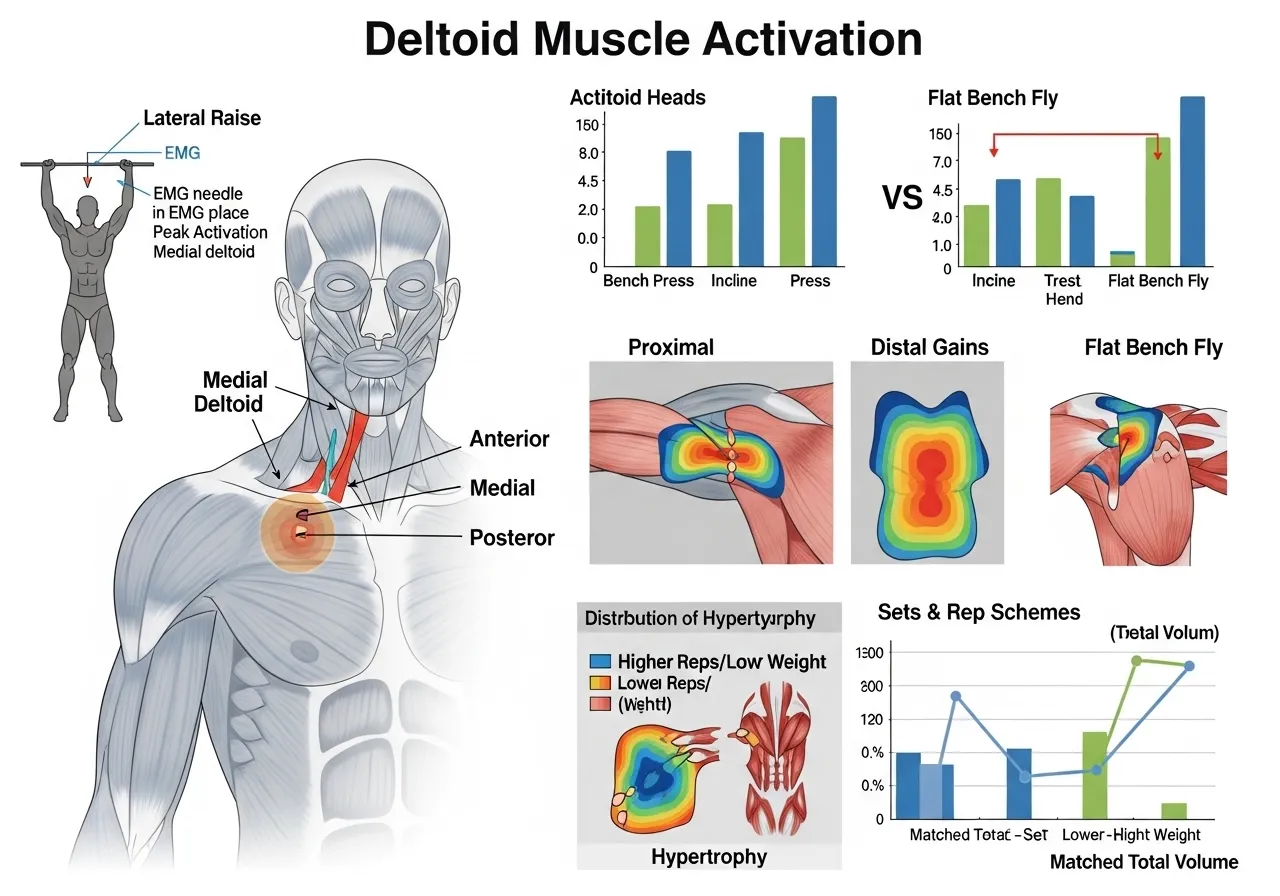
Lateral raises produce significantly higher medial deltoid activation than shoulder press, bench press, or dumbbell fly. Lateral raises are not optional volume additions to pressing — they are the primary medial deltoid stimulus that pressing exercises cannot replicate.
Shoulder Abduction Angle and Muscle Activation Profiles
📌 Key Finding
The shoulder abduction angle significantly changes which muscles are activated and how much. Loading the lateral deltoid at different positions in the range produces different activation patterns — confirming that the cable’s ability to load the bottom position produces a genuinely different stimulus than the dumbbell’s top-loaded profile.
The Proximal vs Distal Hypertrophy Distribution
The 2025 RCT found greater cable versus dumbbell advantage at the proximal lateral deltoid specifically. This regional distribution reflects the anatomical location where the lateral deltoid is longest (near its proximal attachment at the acromion) during the bottom-range position where the cable provides its unique loading advantage. The proximal lateral deltoid is the region most responsible for the rounded, wide appearance of developed shoulder width, making the cable’s hypertrophy advantage in this specific region directly relevant to the shoulder aesthetic development goal that lateral raises typically target.
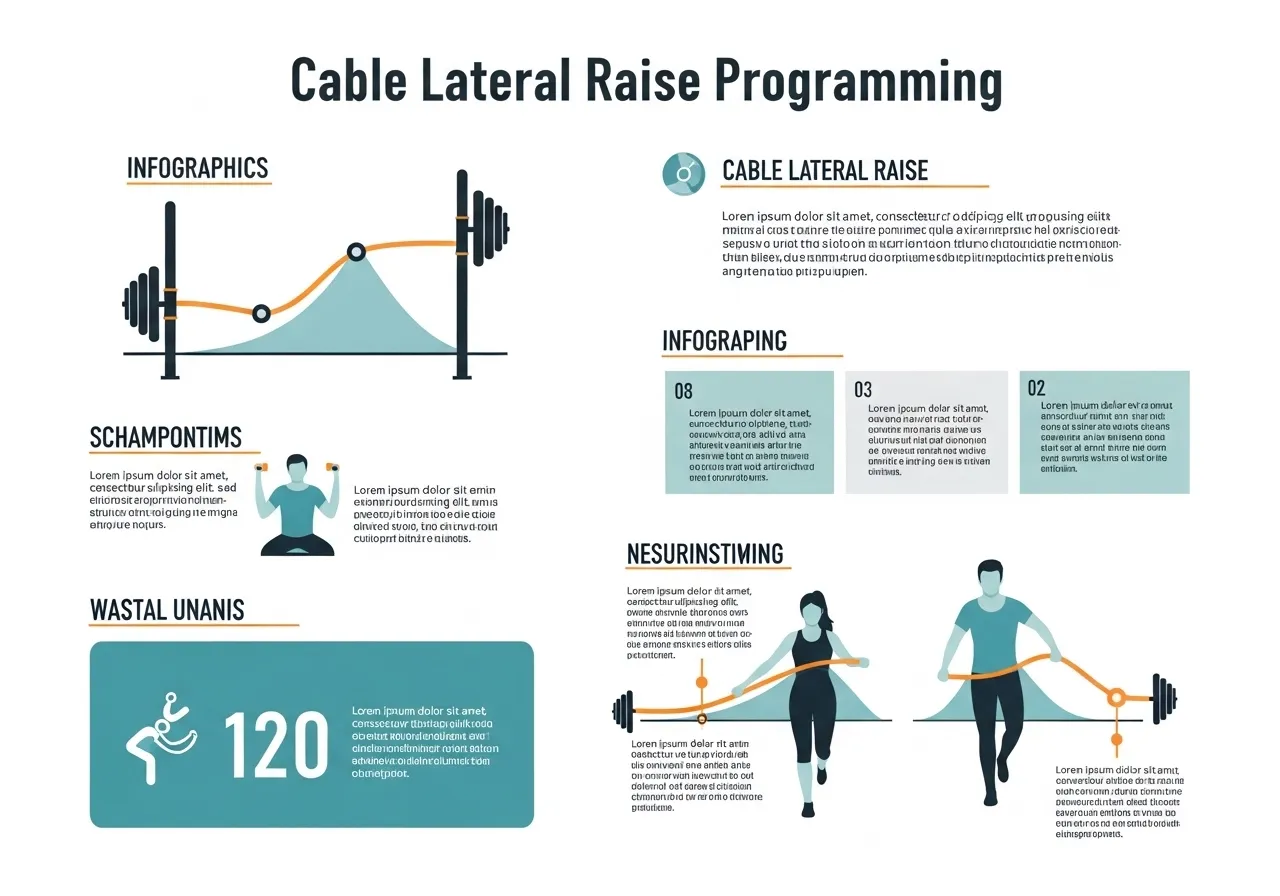
The Resistance Profile Comparison: Visualising the Loading Difference
At 0 degrees of shoulder abduction (arm at side), the dumbbell produces zero effective resistance on the lateral deltoid while the crossed cable produces near-maximum resistance. At 45 degrees of abduction, the dumbbell produces approximately 71% of its peak resistance while the cable maintains its resistance throughout. At 90 degrees, both produce high lateral deltoid resistance, though through different force vectors. The net result is that a cable lateral raise set applies meaningful resistance to the lateral deltoid for the full 90 degrees of the movement, while a dumbbell set applies meaningful resistance for only the upper 45 to 60 degrees.
This difference in effective loading range is why cable lateral raises produce more total mechanical work per rep at matched absolute load, and why the lateral deltoid reaches fatigue faster per set at the same weight. The additional work is concentrated at the bottom range where the lateral deltoid is longest — precisely the position where the length-tension relationship predicts superior hypertrophic stimulus. Understanding this resistance profile difference helps trainees appreciate why the weight on the cable stack should not be expected to match the dumbbell weight used previously, and why reducing cable load to allow full-range technique with controlled eccentric produces more hypertrophy stimulus per set than attempting to match dumbbell loads at the expense of range or eccentric control.
Why Matched Volume Does Not Equalise Outcomes
The 8-week RCT matched volume between conditions — same number of sets and reps to momentary failure. This means the cable’s superior hypertrophy was not a function of performing more total sets or reps. The cable lateral raise produced more growth per set because each set contained more stimulative reps at the muscle’s long length. A dumbbell lateral raise set to failure at the same rep count involves more partially stimulative reps (low-range, low-resistance) than a cable lateral raise set to failure, even at the same total volume. The cable’s superior stimulus per unit of volume is the mechanism behind its hypertrophy advantage.
Cable Lateral Raise Technique: The Mechanics of Constant Tension
Setup: Pulley Height and Body Position
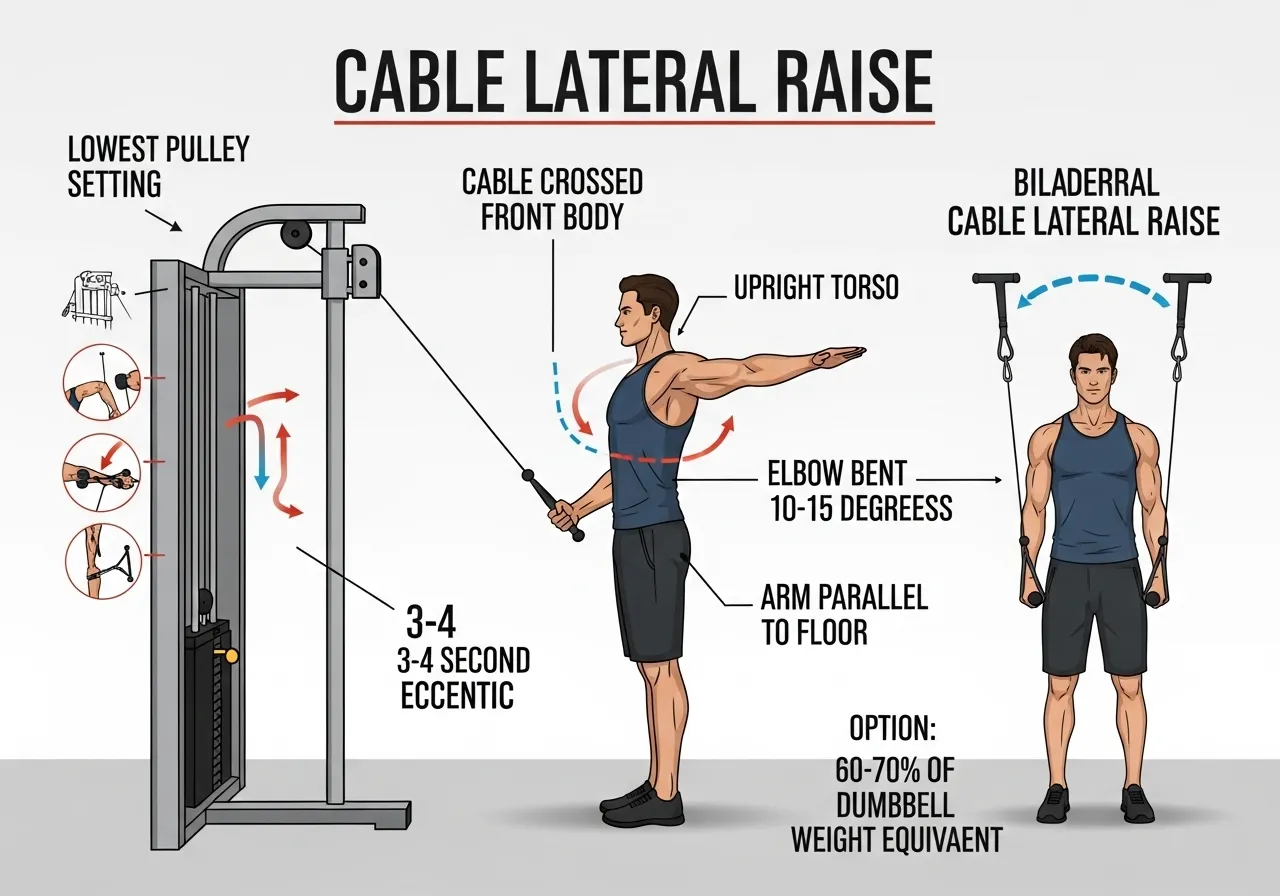
Stand beside a cable machine with the cable set to the lowest pulley position. The cable should run from the low pulley, across the body, to the hand of the arm being trained — the cable crosses in front of the torso for a standard unilateral cable lateral raise. This crossed-cable setup creates the specific bottom-position resistance that is the exercise’s primary advantage over the dumbbell: as the arm hangs naturally at the side, the low cable creates a horizontal pull that loads the lateral deltoid at its resting length.
Hold the cable handle in the hand furthest from the machine, with the cable crossing in front of the lower abdomen. The opposite hand can hold the machine upright for stability, or the exercise can be performed without support for additional core stability demand. Feet hip-width, slight knee bend, torso upright.
The Movement: Lateral Abduction With Constant Cable Pull
Raise the working arm laterally through the sagittal plane, leading with the elbow rather than the hand. The elbow should be slightly bent (10 to 15 degrees) throughout to reduce the mechanical demand on the elbow joint while maintaining the shoulder abduction movement. Raise to approximately parallel (90 degrees of shoulder abduction) — above this range, the upper trapezius increasingly substitutes for the lateral deltoid and the cable’s advantage decreases as the arm approaches vertical.
The key mechanical element is maintaining awareness of the cable’s tension direction throughout the movement. At the bottom, the cable pulls horizontally inward across the body — the lateral deltoid must resist this horizontal pull isometrically while also resisting gravity. As the arm raises to parallel, the cable’s effective pull direction changes, providing a different resistance vector than the dumbbell’s purely vertical gravity resistance. This variable but continuous resistance throughout the range is the constant tension advantage.
Eccentric Phase: Where the Cable’s Advantage Is Greatest
The eccentric (lowering) phase is where the cable lateral raise’s hypertrophy advantage over the dumbbell is most concentrated. As the arm lowers from 90 degrees toward the resting position, the cable maintains tension at the lateral deltoid throughout the descent. The dumbbell’s resistance decreases toward zero as the arm approaches the resting position. Deliberately slowing the eccentric phase of cable lateral raises — 3 to 4 seconds — maximises the time under tension at the stretched position that drives the cable’s hypertrophy advantage. A rushed descent eliminates most of the cable’s bottom-range advantage and produces a stimulus closer to the dumbbell’s gravity-dependent profile.
Load Selection and Progressive Overload
Cable lateral raises are typically performed at lighter loads than dumbbell lateral raises because the cable’s constant tension means the muscle is loaded throughout the full range rather than only in the mechanically challenging upper range. A trainee who uses 12 kg dumbbells for lateral raises may find 6 to 8 kg of cable load challenging for the same rep range because the additional bottom-range loading means the muscle works harder per rep at the cable’s lower absolute weight. Start at 60 to 70% of the dumbbell working weight when first transitioning to cable lateral raises and adjust based on execution quality rather than matching the dumbbell’s absolute load.
Bilateral Cable Lateral Raise Option
Some trainees use bilateral cable lateral raises with two low cables (one on each side) to train both arms simultaneously. This bilateral version eliminates the need to perform the exercise twice (once per side) but requires a cable crossover machine. The crossed-cable setup used in the unilateral version is not replicable bilaterally — each arm requires its own low cable pulling from the opposite side. The bilateral version provides less bottom-range stretch tension than the crossed unilateral version because each cable pulls laterally from its own side rather than across the body, reducing the inward horizontal pull that creates the stretch at the bottom position. Unilateral crossed-cable is preferable for the hypertrophy goal; bilateral is appropriate when time efficiency is the primary consideration.
Cable Lateral Raise Variations: Angles, Attachments, and Positions
Choosing Variations Based on Equipment and Goal
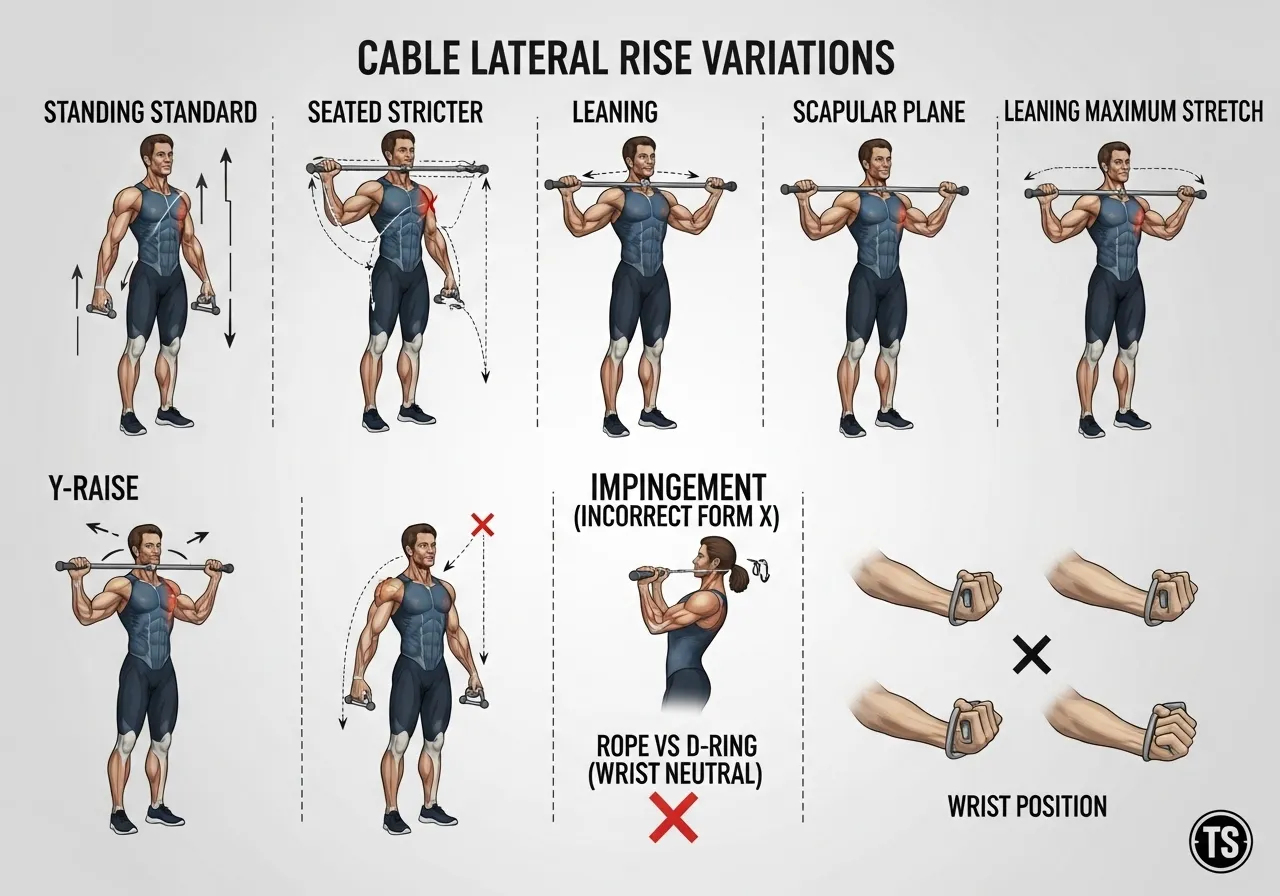
The standard standing unilateral cable lateral raise is the foundation. The four variations below address specific goals or constraints — different body positions that change the deltoid’s resting length at the start position, different cable angles that modify the resistance curve, and seated options that reduce lower body involvement for stricter isolation.
Target: Lateral deltoid, full range constant tension; the primary cable lateral raise variation
How: Cable from lowest pulley, crossed in front of the body, raised laterally to parallel with slow eccentric.
Best for: Primary lateral deltoid development with maximum bottom-range loading advantage. The benchmark variation for lateral deltoid hypertrophy based on the 2025 RCT.
🏋️ 2. Seated Cable Lateral Raise
Target: Lateral deltoid with eliminated lower body momentum; stricter isolation
How: Sit on a bench placed beside the low cable machine. The cable crosses the torso as in the standing version. Raise and lower with strict shoulder-only movement, no torso lean or hip involvement.
Best for: Trainees who use body lean or hip drive during standing lateral raises to assist the movement. The seated position physically prevents lower body compensation and forces the shoulder to produce all the force independently.
🏋️ 3. Leaning Cable Lateral Raise
Target: Extended lateral deltoid stretch at bottom position; maximum long-length loading
How: Hold the machine upright with the non-working hand and lean the body away from the machine, increasing the distance between the cable’s anchor point and the working shoulder. The lateral lean increases the stretch on the lateral deltoid at the bottom position, extending the cable’s length-tension advantage.
Best for: Advanced trainees seeking maximum lateral deltoid stretch loading. The leaning position amplifies the bottom-range stimulus beyond the standard standing version.
🏋️ 4. Cable Y-Raise (Scaption)
Target: Lateral deltoid and supraspinatus in the scapular plane; functional shoulder stability
How: Face the cable machine with the low cable. Raise the arm in the scapular plane (30 to 45 degrees forward of true lateral abduction) rather than pure lateral abduction. This Y-raise position is the plane in which the supraspinatus and lateral deltoid co-activate most efficiently.
Best for: Shoulder rehabilitation contexts and trainees with subacromial impingement who experience pain in the pure lateral abduction plane. The scapular plane abduction reduces the impingement risk compared to pure lateral abduction above 90 degrees.
When to Use a Rope Attachment vs a D-Ring Handle
The standard D-ring handle is appropriate for most cable lateral raise applications. A rope attachment allows neutral wrist positioning throughout the movement and reduces the pronation demand at the wrist that some trainees find uncomfortable with the D-ring. For trainees with wrist sensitivity, a rope attachment provides a more comfortable grip option without changing the exercise’s primary mechanical properties. A lateral raise with a dumbbell alongside the cable for comparison and how the dumbbell’s limitations motivate the cable switch is covered in the lateral raise guide.
Programming Cable Lateral Raises: Integration With Shoulder Development
Where Cable Lateral Raises Fit in Shoulder Training
Cable lateral raises are an isolation exercise targeting the lateral deltoid, appropriate as a secondary or supplementary shoulder movement after primary pressing (overhead press, dumbbell press) rather than as a primary compound movement. The typical placement is after the primary shoulder pressing movement — 2 to 4 sets of cable lateral raises after overhead pressing provides the lateral deltoid isolation volume that pressing exercises insufficiently address.
Volume and Frequency Recommendations
Lateral deltoid hypertrophy responds to moderate to high weekly volume: 10 to 20 sets per week across 2 to 3 sessions is the range where most trainees see continued lateral deltoid development. Cable lateral raises’ superior hypertrophy per set means that the upper end of this range may be achievable with cable work where it would not be sustainable with the higher fatigue of equivalent dumbbell volume. Start at 10 to 12 weekly sets of cable lateral raises and progress toward 16 to 20 sets over 4 to 6 weeks as recovery allows, using performance maintenance (consistent rep quality across all sets) as the primary indicator that current volume is within recovery capacity.
📅 Sample Shoulder Session Structure
Overhead press (barbell or dumbbell): 4 × 6 to 8 (primary compound)
Cable lateral raise: 3 to 4 × 12 to 15 with 3-second eccentric (lateral deltoid)
Rear delt cable fly or face pull: 3 × 15 (posterior deltoid)
Optional: Cable front raise 2 × 15 (anterior deltoid, if not covered by pressing)
This structure develops all three deltoid portions with exercise-specific emphasis: compound pressing for anterior deltoid and overall shoulder strength, cable lateral raise for lateral deltoid hypertrophy, and rear delt work for posterior deltoid and shoulder health.
Drop Sets and Extended Techniques With Cable Lateral Raises
Cable lateral raises are particularly well-suited to drop sets because the cable’s weight stack allows rapid load reductions between drops without changing equipment. Performing 3 drops (reduce weight by 20 to 25% per drop, continue to failure) extends the time under tension at the stretched position significantly, providing an advanced intensity technique that is more convenient on cable than on dumbbells where multiple pairs must be arranged in advance. A single cable lateral raise drop set of 3 drops produces approximately 30 to 40 reps of lateral deltoid stimulus at progressively lower but continuous tension — a stimulus magnitude that equivalent dumbbell sets would require significantly more equipment preparation to replicate.
Combining Cable and Dumbbell Lateral Raises
The RCT evidence does not require abandoning dumbbell lateral raises entirely. The dumbbell’s advantage over the cable is its availability — most trainees have dumbbells at home or easy dumbbell access, while cable machines require gym access. Using dumbbell lateral raises in a time-efficient superset or circuit context and cable lateral raises as the primary dedicated lateral deltoid exercise combines the accessibility of dumbbells with the hypertrophy advantages of cable loading. The shoulder press and how its anterior deltoid emphasis complements the cable lateral raise’s lateral emphasis for complete deltoid development is covered in the shoulder press guide.
Progressive Overload for Cable Lateral Raises
Progressive overload for cable lateral raises operates through three variables: load increase (adding weight to the cable stack as the target rep range becomes consistently achievable), rep range progression (advancing from 12 reps to 15 reps at the same load before increasing weight), and technique intensification (adding a slow eccentric, pause at the bottom stretch, or drop sets after the primary sets). The cable’s small weight stack increments — typically 2 to 5 kg steps — allow more precise progressive overload than the larger dumbbell jump increments that most gym settings provide, making load progression more gradual and consistent for cable lateral raise programming.
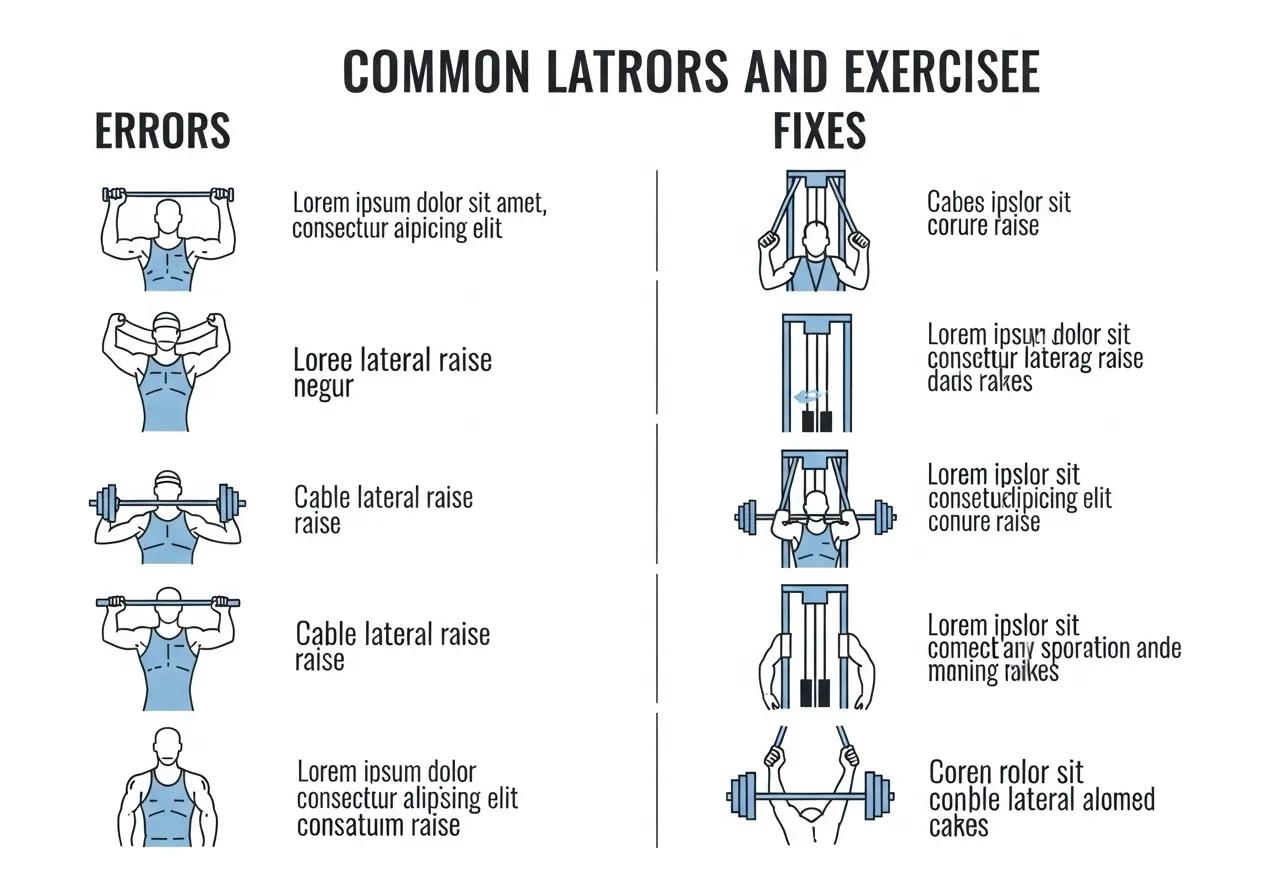
Common Cable Lateral Raise Errors and Their Fixes
Why Cable Lateral Raises Have Specific Technique Problems
The cable lateral raise’s errors typically reflect one of two problems: treating it like a dumbbell lateral raise without utilising the cable’s specific bottom-range advantage, or performing the movement at an angle that shifts the target from the lateral deltoid to the upper trapezius. Both errors produce a technically completed exercise that fails to access the hypertrophy stimulus that makes the cable superior to the dumbbell.
❌ Error 1: Rushing the Eccentric Descent
What happens: The arm is lowered quickly from the top position, eliminating the time under tension at the stretched bottom position that is the cable’s primary hypertrophy advantage over dumbbells.
Fix: 3 to 4-second eccentric on every rep without exception. If this pace cannot be maintained consistently throughout the set, the load is too heavy for the target rep range. Reduce load until a full controlled eccentric is achievable across all reps of all sets.
What happens: Raising the arm above 90 degrees shifts the primary mover from the lateral deltoid to the upper trapezius, reducing the lateral deltoid stimulus per rep and accumulating upper trapezius fatigue instead of lateral deltoid fatigue.
Fix: Stop at parallel — when the upper arm is approximately horizontal. The elbow should not travel above the shoulder height. If the upper trap is fatiguing before the lateral deltoid, the arm is consistently going above parallel. Use a mirror or film the movement to confirm the end-point position.
❌ Error 3: Using Body Lean and Momentum
What happens: The torso leans away from the cable and the hip and lower back assist the raise, making the lateral deltoid’s contribution smaller than the total range of motion implies.
Fix: Maintain upright torso throughout. If body lean is impossible to control, switch to the seated cable lateral raise variation that physically prevents it. Alternatively, reduce load until the movement is achievable without momentum at the current weight.
❌ Error 4: Cable Height Too High
What happens: Setting the cable at mid-height or above instead of at the lowest pulley position changes the resistance direction, reducing or eliminating the bottom-position loading advantage that makes cable superior to dumbbells.
Fix: Always set the pulley at the lowest position available. The cable should run from the floor-level pulley to the hand, maximising the horizontal tension component at the arm’s resting position that loads the lateral deltoid in its stretched state.
The Wrist Position Issue
Many trainees pronate the wrist (thumb points down) during cable lateral raises in an attempt to increase the stretch sensation. While mild pronation does slightly alter the deltoid’s mechanical position, excessive pronation at the wrist creates stress at the distal radioulnar joint that can produce wrist and elbow discomfort at higher volumes. A neutral wrist position (thumb pointing forward) or very slight pronation (thumb slightly down) is appropriate and safe throughout the full set without the discomfort risk of full pronation.
Frequently Asked Questions About Cable Lateral Raises
Should I switch entirely from dumbbells to cables for lateral raises?
The RCT evidence supports preferring cable lateral raises as the primary lateral deltoid exercise when cable access is available. The superior hypertrophy per set in the research makes cable the optimal tool for the lateral deltoid development goal. However, complete replacement is not necessary if practical considerations make dumbbell lateral raises more accessible for some sessions. A programme that uses cable lateral raises as the primary exercise (2 to 3 sets per session at the gym) and dumbbell lateral raises as supplementary or home-workout volume produces lateral deltoid development superior to dumbbell-only training while accommodating the reality that cable access is not always available.
Why does the cable lateral raise feel harder than dumbbells at the same weight?
The cable feels harder because it is performing more total work per rep. The dumbbell provides zero resistance at the bottom of the range and maximum resistance only at the top. The cable provides resistance throughout the full range, including the bottom position where the dumbbell does nothing. The total mechanical work per rep is greater for the cable at matched absolute load, which is why the lateral deltoid reaches fatigue sooner at the same weight. This is the correct response — the cable is providing more stimulus per rep, not indicating that the weight is wrong. Adjusting expectations downward when switching from dumbbell to cable weights is appropriate.
Is the cable lateral raise suitable for shoulder impingement?
Cable lateral raises performed in the pure lateral plane above 90 degrees can aggravate subacromial impingement by increasing the supraspinatus compression at the acromion above horizontal. For trainees with impingement, two modifications make cable lateral raises more appropriate: first, stopping below 90 degrees (at 60 to 70 degrees of shoulder abduction) reduces the impingement risk by keeping the movement below the range where supraspinatus compression is greatest; second, using the cable Y-raise (scapular plane) variation rather than pure lateral abduction reduces impingement risk because the scapular plane abduction aligns the supraspinatus more favourably under the acromion.
Can I use cable lateral raises to rehabilitate a weak lateral deltoid?
Yes, and the cable’s continuous bottom-range loading makes it particularly appropriate for rehabilitation contexts where the goal is developing the lateral deltoid across its full length range rather than only in the upper portion where dumbbells load it. Begin at very light loads (1 to 3 kg) focusing on the quality of the lateral deltoid contraction rather than the load, using the cable’s bottom-range tension to develop the awareness of the muscle’s resting activation that rehabilitation protocols require before progressing to heavier loads for hypertrophy development. The EZ bar and its grip mechanics alongside cable lateral raise for complete shoulder and arm isolation work is covered in the EZ bar curl guide.
How does the cable lateral raise compare to the machine lateral raise?
Machine lateral raises provide a consistent resistance profile across the range, similar to the cable’s constant tension advantage over dumbbells. The specific resistance curve of a lateral raise machine depends on the machine’s cam design — well-designed machines provide increasing resistance through the bottom to mid-range that matches or approaches the cable’s length-tension advantage. Poorly designed machines may replicate the dumbbell’s top-loaded resistance profile despite their fixed movement path. Cable lateral raises are preferred over most machine variations because the cable’s resistance direction is directly controllable through pulley height and body position adjustments, while the machine’s resistance curve is fixed and not adjustable.
Key Takeaways
An 8-week RCT by Schoenfeld and colleagues found that cable lateral raises produce greater lateral deltoid hypertrophy than matched dumbbell lateral raises, confirming that the cable’s constant tension and loaded-stretch advantage translates to measurable superior muscle growth over meaningful training periods.
The dumbbell’s gravity dependence means zero resistance at the bottom of the range, where the lateral deltoid is longest and most susceptible to the length-tension hypertrophy advantage. The cable loads this position, providing the stimulus the dumbbell cannot.
The lateral raise produces significantly greater medial deltoid activation than shoulder press, bench press, or dumbbell fly — confirming that dedicated lateral raise work is the primary medial deltoid stimulus and not replaceable with pressing volume.
Technique priority: lowest pulley position, crossed cable in front, 3 to 4-second eccentric, stop at parallel (not above). The slow eccentric is the single most important technical element for accessing the cable’s bottom-range hypertrophy advantage.
Cable lateral raises are the superior primary lateral deltoid exercise when cable access is available. Dumbbell lateral raises remain a practical supplementary option for sessions without cable access.
The shoulder press machine gets dismissed in most serious training environments. The reasoning is consistent: it is a machine, which means it does the stability work for you, which means it produces inferior results compared to free weights. This reasoning is correct in one dimension and wrong in another. The machine shoulder press does trade…
⚠️ Fitness Disclaimer: The information in this article is for general educational purposes only and does not constitute professional fitness or medical advice. Always consult a qualified healthcare professional before starting any new exercise program, especially if you have existing injuries or medical conditions. The Lat Pulldown: The Most Underestimated Back Builder in the Gym…
⚠️ Health & Fitness DisclaimerThis article is for general educational purposes only. It does not replace professional medical advice. If you have shoulder, elbow, or wrist conditions, consult a qualified healthcare professional before starting any pressing programme. The flat dumbbell vs barbell bench builds the chest. Everyone knows this. (see also: bench press fixes) (see…
⚠️ Health & Fitness DisclaimerThis article is for general educational purposes only and does not replace professional medical advice. If you have any shoulder, back, or joint conditions, please consult a qualified healthcare professional before beginning a Smith machine vs free weights program. The Smith machine — a barbell constrained to a vertical or near-vertical…
⚠️ Health & Fitness DisclaimerThis article is for general educational and informational purposes only.It does not replace professional medical or fitness advice.If you have any pre-existing condition, injury, or shoulder concern — please consult a qualified healthcare professional or certified personal trainer before starting or modifying any exercise program. The lat pulldown mastery guide is…
⚠️ Knee and Lower Back Safety NoteThe hack squat machine places the spine in a fixed incline that concentrates lower body loading at the knee joint. Individuals with active patellofemoral pain syndrome, patellar tendinopathy, or recent ACL reconstruction should obtain medical clearance before hack squat training — the fixed pad position prevents natural forward trunk…