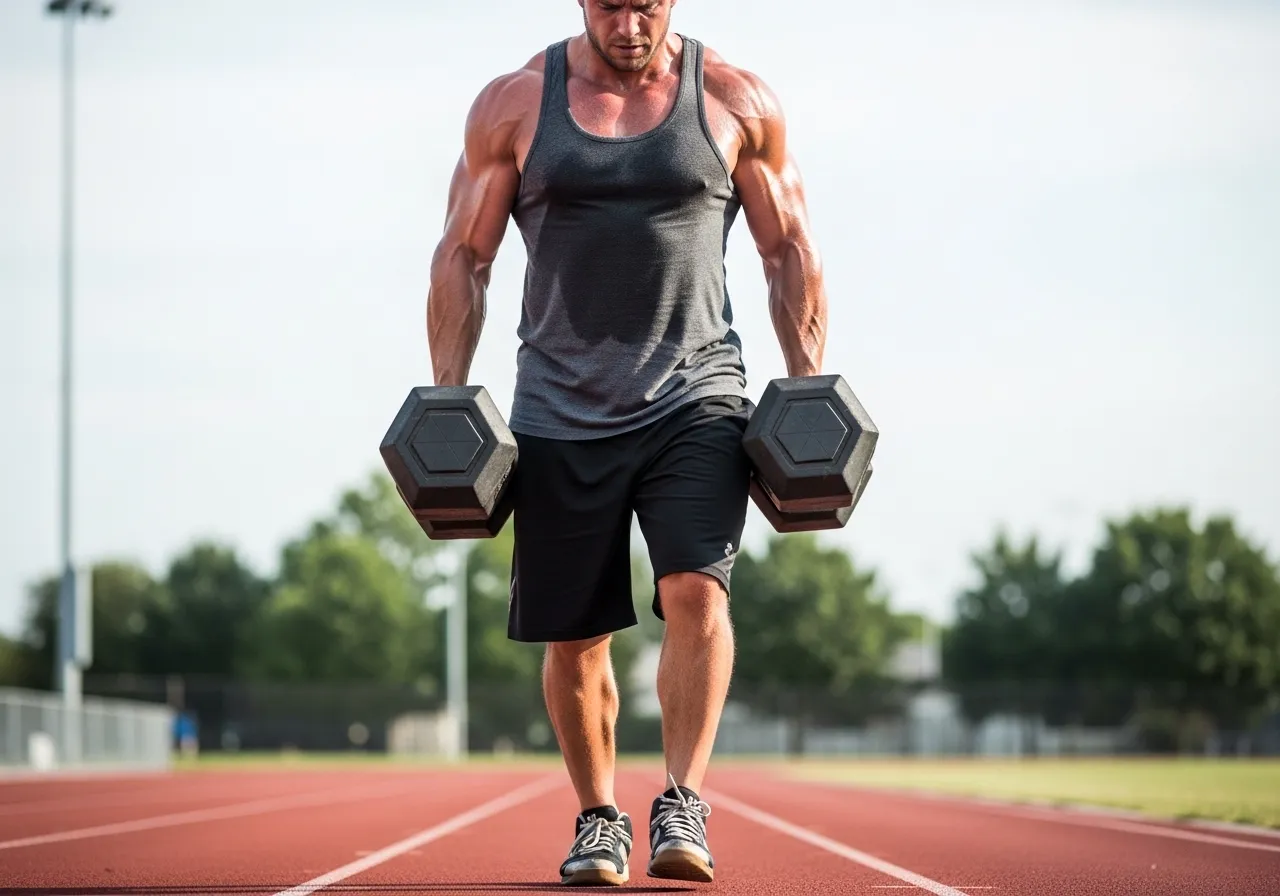
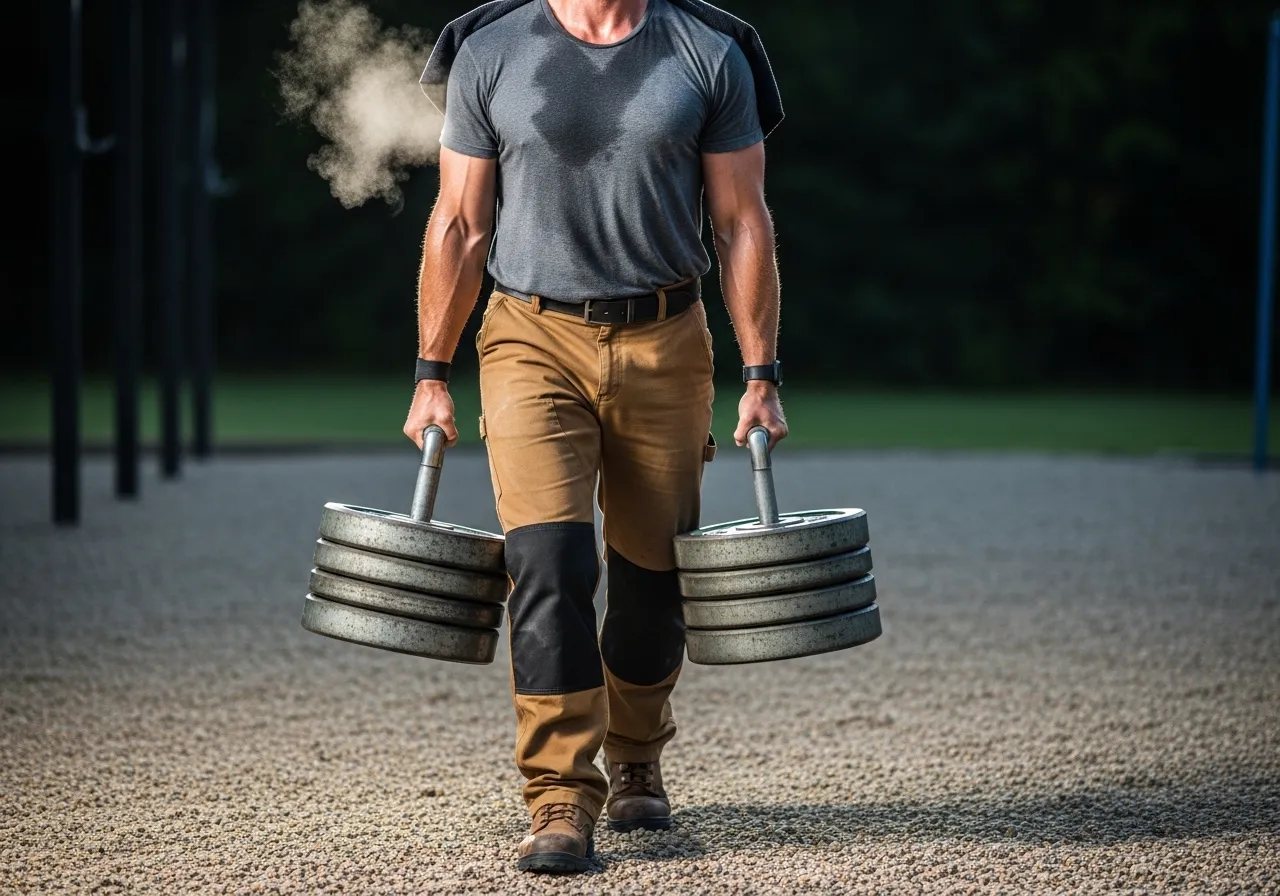
The farmer’s walk may be the most honest exercise in strength training. You pick up something heavy in each hand, walk until you cannot continue, and put it down. There is no technique to hide behind, no momentum to exploit, and no machine to stabilise the load. If the grip fails, the set ends. If the core buckles, the spine pays for it. If the posture collapses, the weight determines the consequences.
This simplicity is deceptive. The farmer’s walk simultaneously develops grip endurance, spinal anti-flexion stability, anti-lateral-flexion core strength, upper back trap and rhomboid endurance, lower body conditioning, and cardiovascular demand in a single exercise performed at any load from a light warm-up to strongman competition weight. No other commonly available exercise produces this combination of simultaneous adaptations across so many systems at once.
This guide covers what the EMG research shows about farmer’s walk muscle activation compared to hold variations and other carries, the biomechanics that make it distinct from the deadlift and unloaded walking, technique for safe and effective execution, five variations for different goals and equipment, and programming frameworks for incorporating farmer’s walks at every training level.
Research 1: Farmer’s Walk Core Muscle Activation vs Holding, Suitcase Carry, and Plank
📌 Key Finding
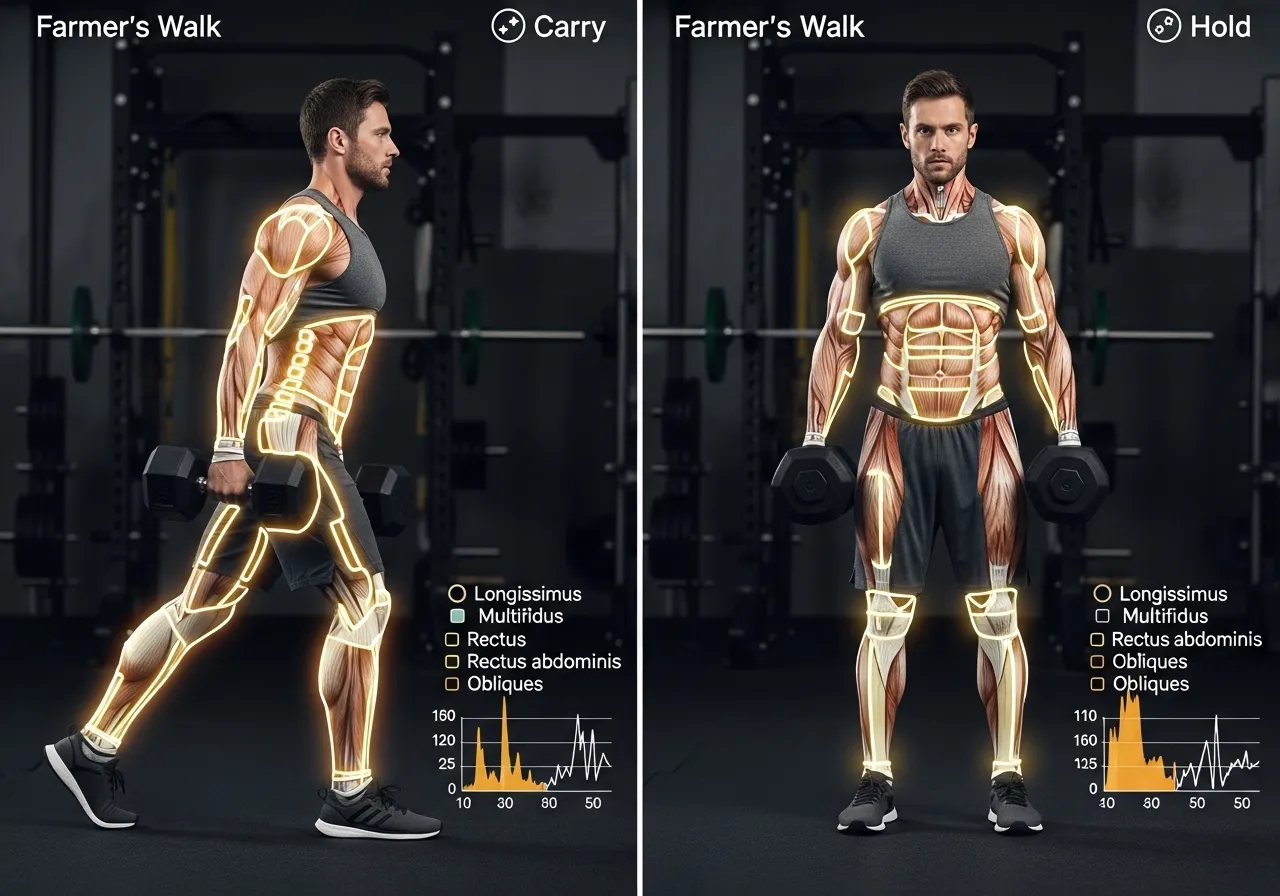
The farmer’s carry produces greater activation of the longissimus, multifidus, rectus abdominis, and external oblique than the farmer’s hold at matched load. Walking with the load provides a superior core stimulus to simply standing and holding it, because each stride requires active re-stabilisation against the constantly shifting load vector.
Why Walking Beats Holding for Core Activation
The superiority of the carry over the hold in core activation is mechanically straightforward. During a static farmer’s hold, the spine stabilisers must resist a constant gravitational force in a fixed position. The demand is sustained but not dynamic. During the farmer’s walk, each stride creates a brief period of single-leg support where the loaded weight shifts laterally toward the stance leg, requiring immediate reactive stabilisation from the spinal extensors and obliques. This gait cycle-driven oscillation means the core musculature must produce repeated rapid stabilisation responses rather than a single sustained isometric contraction.
The multifidus and longissimus are particularly sensitive to this gait-driven demand because they are the primary dynamic inter-segmental stabilisers of the lumbar spine. Their activation during walking, even unloaded, is linked to the rotational moment control that bipedal gait requires. Adding bilateral loads amplifies the demand at each stride transition and produces the higher EMG values the research documents compared to static holding of the same weight.
The Suitcase Carry vs Farmer’s Walk: When to Use Which
The bilateral farmer’s walk and the unilateral suitcase carry both produce superior core activation to their hold equivalents, but the specific muscles emphasised differ. The suitcase carry produces higher ipsilateral rectus abdominis and external oblique activation on the loaded side because the unilateral load creates an additional anti-lateral-flexion demand on the loaded side that bilateral farmer’s walk loading does not create to the same magnitude.
For anti-lateral-flexion core development specifically, the suitcase carry is the more targeted stimulus. For overall bilateral spinal stability development and higher absolute loading capacity, the bilateral farmer’s walk is more appropriate. The choice should reflect the specific training goal rather than treating them as equivalent alternatives with different equipment.
Comparison With the Plank
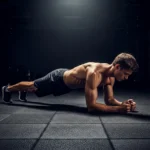
The study found the farmer’s carry produced greater core activation than the plank during the carry movement, confirming that loaded locomotive exercises activate the trunk musculature more completely than static bodyweight stability positions. The plank remains a useful training tool for learning core bracing patterns and for lower-load rehabilitation contexts, but it does not provide the same core stimulus as the farmer’s walk at loads sufficient to challenge the locomotion system. For trainees who have already mastered plank progressions, the farmer’s walk represents the logical loaded and dynamic progression that the plank alone cannot provide.
Cardiovascular Demand: The Underappreciated Farmer’s Walk Benefit
Heavy farmer’s walks at distances of 20 to 40 metres produce heart rate responses in Zone 3 to Zone 4 for most trainees, a cardiovascular stimulus comparable to moderate-intensity interval running. This cardiovascular demand comes without the impact forces of running, making farmer’s walks one of the few resistance exercises that simultaneously develops muscular endurance across grip, upper back, and core and provides a meaningful cardiovascular training stimulus within the same set. For strength trainees who need cardiovascular conditioning but want to minimise interference with strength adaptation, farmer’s walks provide this combination more efficiently than separate dedicated cardio sessions at equivalent cardiovascular intensity.
Research 2: Gluteus Medius Activation and Muscle Strength Ratios During the Farmer’s Walk
Why the Gluteus Medius Activates During Loaded Bilateral Gait
📌 Key Finding
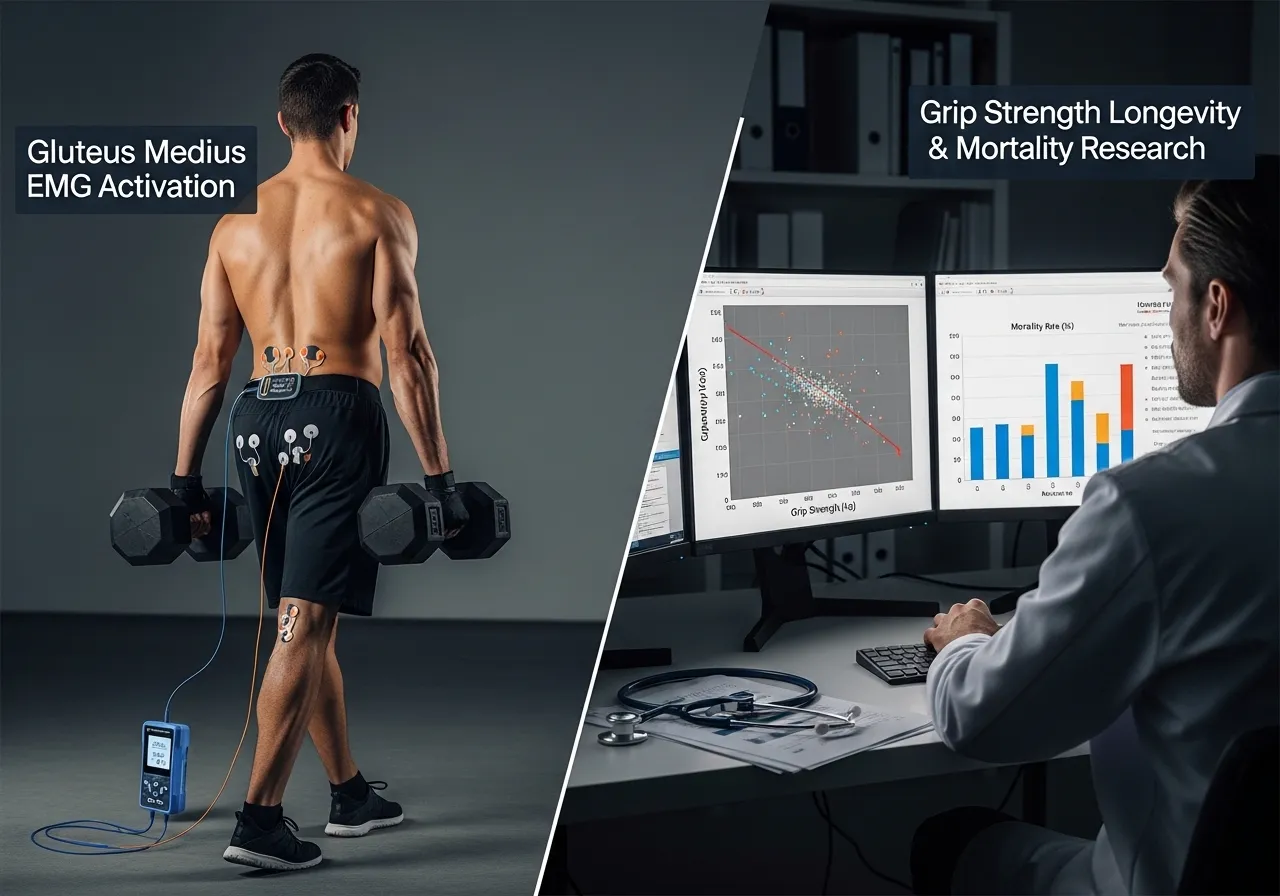
Individuals with weaker gluteus medius relative to their hamstrings and quadriceps show significantly greater gluteus medius activation (42 to 47% MVIC) during the farmer’s walk. The exercise provides the greatest gluteus medius stimulus to those who need it most, making it an ideal intervention for hip abductor weakness.
The Single-Leg Stance Phase and Glute Activation
The gluteus medius activation during the farmer’s walk occurs primarily during the single-leg stance phase of each stride, where it prevents lateral pelvic drop on the swing leg side. During bilateral loaded gait with heavy farmer’s walk implements, this anti-Trendelenburg function requires substantially more gluteus medius force than unloaded walking because the additional gravitational load amplifies the lateral pelvic moment at each stride transition.
This makes the farmer’s walk an effective gluteus medius strengthening exercise in the functional single-leg stance position that squats and deadlifts do not replicate. Hip abductor weakness that leads to knee valgus during squatting and lateral pelvic drop during running is partially addressable through farmer’s walk training, because the exercise develops the specific gluteus medius endurance capacity that sustains correct hip mechanics during dynamic single-leg loaded gait.
The Hip Abductor Weakness Diagnosis
Trainees who consistently show lateral pelvic drop during single-leg squats, excessive knee valgus during bilateral squatting, or IT band tightness from chronic gluteus medius under-activation can use the farmer’s walk as both a diagnostic and a therapeutic tool. The diagnosis: perform a set of moderately loaded farmer’s walks and observe whether one hip consistently drops more than the other during each stride. The asymmetric drop identifies the weaker gluteus medius side. The therapy: consistent bilateral farmer’s walk training develops the weaker gluteus medius through repeated single-leg stance loading across multiple strides per set.
Grip Strength as a Longevity and Performance Marker
📌 Key Finding
Higher grip strength is associated with reduced all-cause mortality, cardiovascular disease, and stroke risk. Grip strength serves as a proxy for general muscular strength and long-term health status, making farmer’s walk training a health investment beyond its immediate strength and conditioning benefits.
Why Farmer’s Walks Are the Most Effective Grip Training Exercise
Farmer’s walks develop grip strength through two mechanisms that most dedicated grip exercises cannot replicate simultaneously. First, the sustained grip under heavy bilateral loading progressively fatigues the finger flexors and forearm musculature through the duration of each set, producing a stimulus proportional to the load carried and the distance covered. Second, the dynamic nature of walking with the load creates micro-adjustments in grip position at each stride, challenging the intrinsic hand muscles in ways that static holding and pinch exercises do not.
For trainees whose deadlift, barbell row, or pull-up progress is limited by grip failure before back and arm fatigue, farmer’s walk training provides the most functional grip development available because it trains grip under the same bilateral, hanging, heavy-load conditions that most compound pulling exercises demand.
Is the Farmer’s Walk Just a Deadlift With Steps, or Does the Biomechanics Tell a Different Story?
Trunk Position: The Primary Mechanical Difference
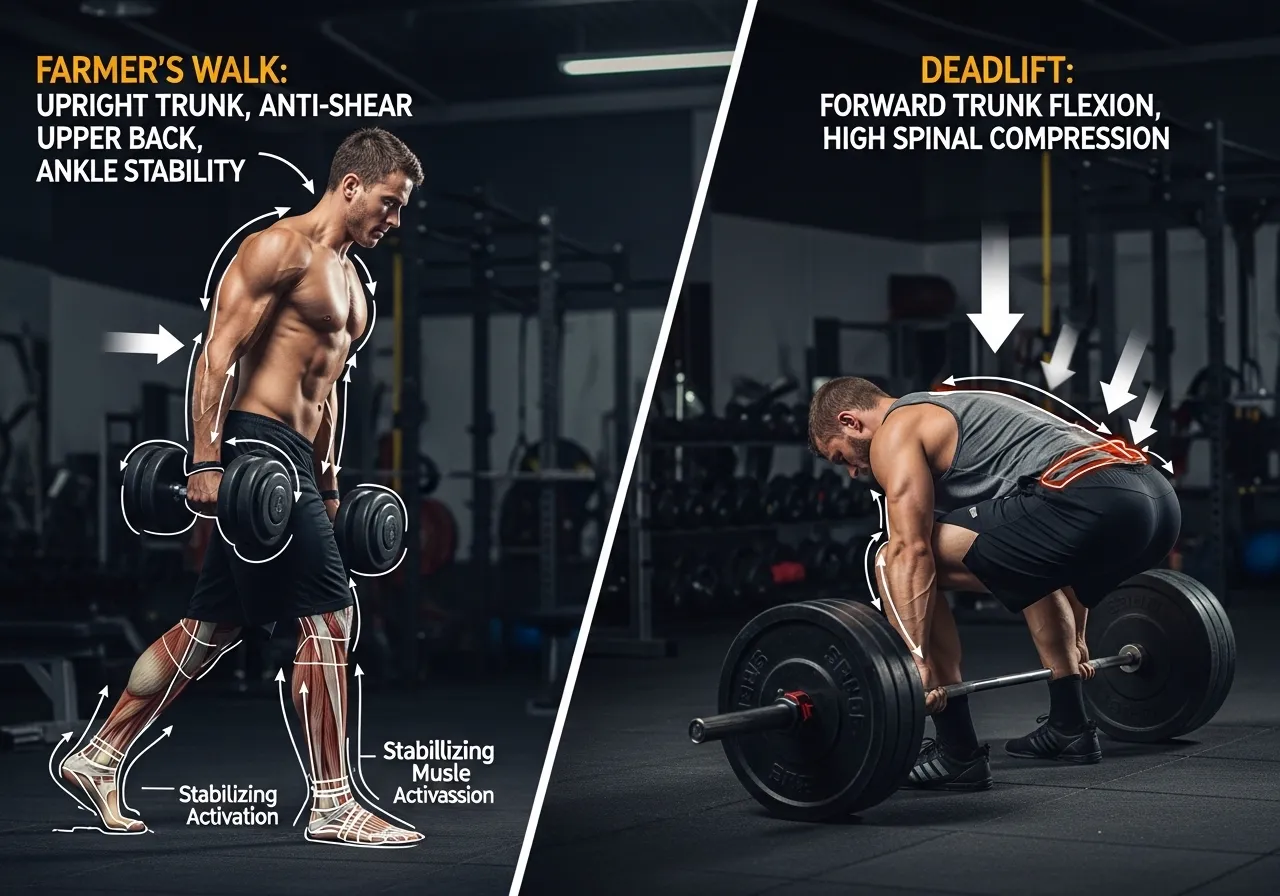
The biomechanical comparison of the farmer’s walk with the deadlift reveals a fundamentally different trunk position throughout the movement. The farmer’s walk maintains a significantly more upright trunk than the conventional deadlift, producing less hip flexion moment and transferring the primary anti-flexion demand from the hip extensors to the spinal extensors. This more vertical trunk position means the farmer’s walk places less compressive and shear stress on the lumbar spine at matched relative loads compared to the deadlift, making it an appropriate loaded exercise for trainees with lumbar sensitivity who can tolerate axial loading but not the forward-leaning position of conventional deadlift mechanics.
Gait Kinematics: How Loading Changes the Walk Pattern
The farmer’s walk produces significantly different gait kinematics than unloaded walking. Stride length decreases by up to 36% while stride rate increases by up to 61% compared to unloaded walking at the same intended pace. Ground contact time shortens and swing time decreases as the loaded walker adopts a more cautious, shorter-stride pattern that maintains balance under the increased gravitational demand. These gait adaptations place higher frequency demands on the gluteus medius, hip abductors, and ankle stabilisers per unit of distance compared to normal walking, amplifying the stabilisation training stimulus per metre covered.
The Anti-Shear Demand on the Lumbar Spine
The farmer’s walk’s upright trunk position reduces the anterior shear force on the lumbar spine compared to the deadlift while increasing the compressive axial load from the bilateral hanging weights. For individuals whose lower back pain is shear-sensitive rather than compression-sensitive, the farmer’s walk provides loaded spinal stability training with a more favourable force vector than horizontal rowing exercises or the deadlift. This biomechanical profile makes it particularly valuable in rehabilitation contexts where loaded spinal training must avoid the forward-lean positions that provoke shear-sensitive lumbar pathology.
Upper Back and Trap Loading: Why It Feels Different From Rows
The upper trapezius and rhomboids work continuously during the farmer’s walk to resist the downward and forward pull of the bilateral hanging loads on the shoulder girdle. This sustained isometric and intermittent dynamic stabilisation of the scapula under load produces upper back endurance that horizontal rowing exercises, which train through a dynamic concentric-eccentric cycle, do not directly develop. Many trainees with strong rows but weak sustained scapular stability, evident during long sets of pull-ups or during prolonged overhead work, benefit specifically from farmer’s walk upper back endurance development.
Ankle and Foot Stability Under Load
The shortened stride length and increased stride rate of the loaded farmer’s walk creates greater demands on ankle stability per unit of distance than normal walking. The peroneal muscles and tibialis posterior, which prevent ankle inversion and pronation under load, must work more continuously during farmer’s walk gait than during unloaded walking. For trainees who have had ankle sprains or who show ankle instability during loaded single-leg work, the farmer’s walk provides progressive ankle stability training through functional loaded gait that calf raises and balance exercises do not replicate at the same functional specificity. The ankle mobility development that complements farmer’s walk ankle stability training is covered in the ankle mobility guide.
Farmer’s Walk Technique: Setup, Execution, and the Details That Prevent Injury
⚠️ Grip and Lumbar Safety Note The farmer’s walk places sustained compressive load on the lumbar spine through the bilateral hanging weight and requires continuous grip strength to prevent dropping the implements. Individuals with active lumbar disc pathology, acute lower back pain, or significant grip pathology (active De Quervain’s tenosynovitis, wrist tendinopathy) should begin with very light loads and shorter distances, progressing conservatively. Never use loads that compromise upright posture. A collapsed trunk position during farmer’s walks converts the exercise into a loaded forward lean that places shear stress on the lumbar discs.
The Setup: How to Pick Up Farmer’s Walk Implements
Set the implements (dumbbells, kettlebells, farmer’s walk handles, or trap bar) on either side. Stand between them with feet hip-width. Hinge at the hip with a neutral spine exactly as in a deadlift setup to grip both implements simultaneously. Drive through the floor to stand fully upright before taking the first step. The initial pick-up position is the most technically demanding moment because it requires the transition from hinged to upright position under maximal grip load. Rushing this transition with a rounded thoracic spine creates the forward lean that compromises the farmer’s walk’s upright trunk advantage.
Walking Mechanics: Posture, Gaze, and Stride
Maintain an upright torso with the chest tall and shoulders retracted throughout the walk. The implements should hang directly at the sides with arms extended, not slightly forward or backward. Gaze should be forward at eye level, not downward. Downward gaze consistently produces slight cervical flexion that progresses to thoracic and lumbar flexion as fatigue accumulates. Look straight ahead and let the implements hang naturally.
Take controlled, deliberate strides at approximately 70 to 80% of normal unloaded stride length. Short, controlled strides maintain better balance and posture than attempts to maintain normal stride length under heavy load. The pace should be purposeful but not rushed. Walking too quickly under heavy load produces the lateral swaying and trunk drop that the exercise is intended to train against.
The Set Termination Decision: Grip vs Form
A farmer’s walk set should end when either grip fails to the point where the implements are at risk of being dropped, or when posture can no longer be maintained in the upright position that the exercise requires. Continuing a farmer’s walk with a significantly forward-leaning trunk converts the exercise from an anti-flexion stability exercise into a loaded spinal flexion exercise, which is not the intended stimulus and increases injury risk. Training the grip to failure deliberately is appropriate for grip development sessions. Training form collapse is never appropriate.
The Put-Down: As Important as the Pick-Up
The put-down at the end of a heavy farmer’s walk set is the moment of highest injury risk because fatigue has accumulated in the grip, core, and postural muscles simultaneously. Never drop heavy implements from height. Perform a controlled hip hinge with a neutral spine to lower the implements to the floor, even if grip is at its limit. Practicing the put-down technique with light loads during early farmer’s walk training develops the habit that prevents the rushed, compromised put-down that causes most farmer’s walk-related lower back incidents.
Breathing and Bracing During the Walk
Unlike static lifts where a single Valsalva brace can be maintained throughout the effort, farmer’s walks require a dynamic breathing pattern across multiple strides. Exhale briefly during the swing phase of each stride and inhale during the stance phase, maintaining continuous intra-abdominal pressure without attempting to hold a full Valsalva for the entire walk distance. For shorter distances under 15 metres, a single held brace through the full distance is appropriate. For longer distances, rhythmic breathing while maintaining sufficient core tension to prevent posture collapse produces better endurance and safer execution than attempting a single held breath for the full set.
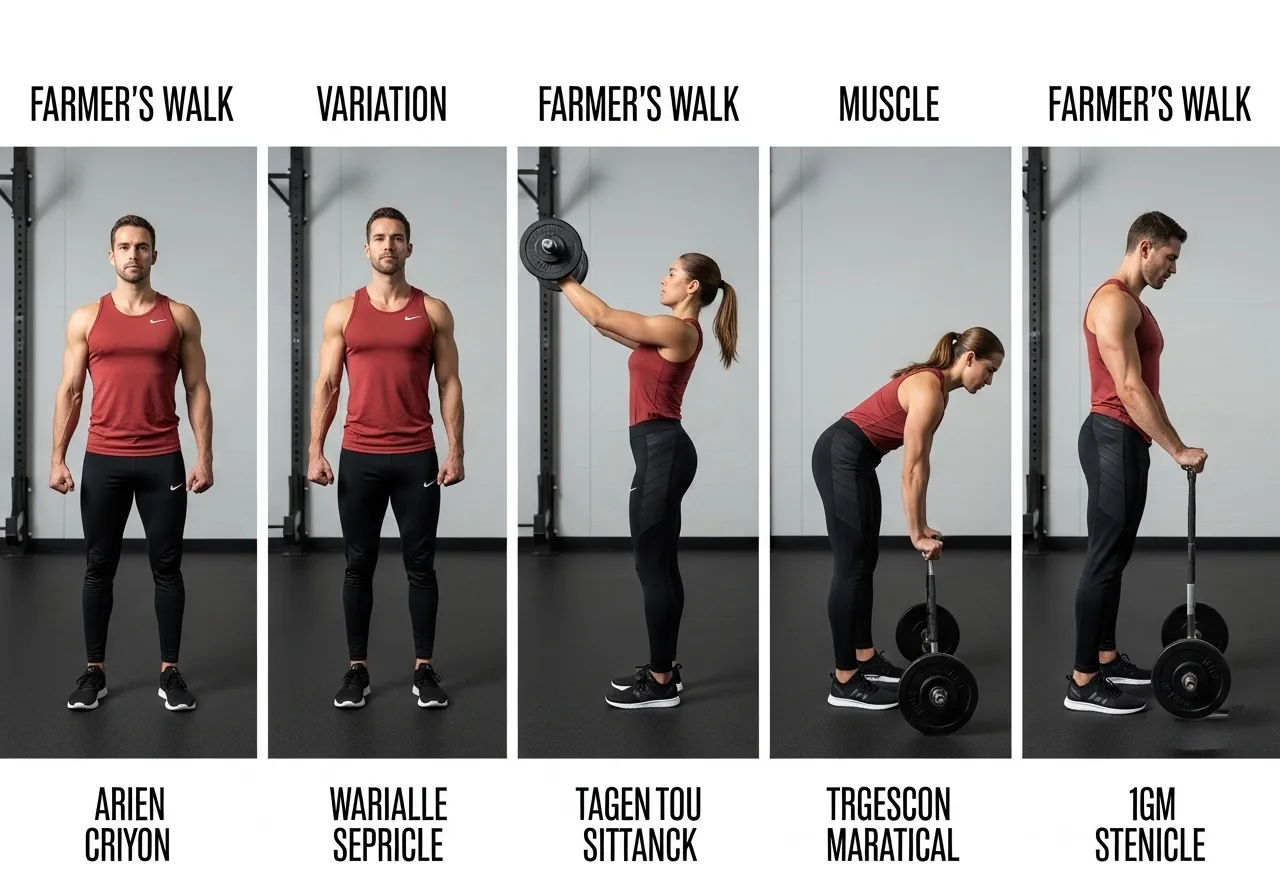
5 Farmer’s Walk Variations for Different Goals and Equipment
Selecting Variations Based on the Primary Training Goal
The five main farmer’s walk variations differ in their load symmetry, handle design, and movement demands. Selecting the appropriate variation requires identifying the primary training goal: grip development, anti-lateral-flexion core, total body conditioning, or sport-specific transfer. Using the same variation for all goals misses the specific adaptation that each variation’s unique mechanical demands produce.
🏋️ 1. Standard Bilateral Farmer’s Walk (Dumbbells or Kettlebells)
Target: Grip endurance, bilateral core stability, total body conditioning
How: Pick up a dumbbell or kettlebell in each hand. Walk for a prescribed distance or time, maintaining upright posture throughout. Set down under control.
Best for: The foundation farmer’s walk variation. Appropriate for all training levels. Dumbbells and kettlebells are the most accessible implements and allow load selection across a wide range without specialist equipment.
How: Hold a single dumbbell or kettlebell in one hand. Walk while preventing the torso from laterally flexing toward the loaded side. Equal distance on each side.
Best for: Core anti-lateral-flexion development. The unilateral load requires the opposite-side quadratus lumborum and obliques to resist lateral trunk flexion continuously, developing the specific anti-lateral-flexion capacity that bilateral farmer’s walks cannot isolate. Also ideal for identifying strength asymmetries between sides.
🏋️ 3. Trap Bar Farmer’s Walk
Target: Maximum load farmer’s walk, handle height advantage for taller lifters
How: Load a trap bar and pick it up using the trap bar deadlift setup. Walk with the trap bar hanging at the sides, using the hex frame handles.
Best for: Heavier loading than dumbbells and kettlebells allow, and for taller trainees whose grip position with standard handles produces excessive shoulder shrug. The trap bar’s higher handle position reduces the shoulder depression demand that low-handle farmer’s walk implements create.
🏋️ 4. Double Kettlebell Rack Walk
Target: Upper body pressing endurance, core stability in rack position, thoracic extension under load
How: Clean two kettlebells to the rack position (forearms vertical, kettlebells resting on forearms at shoulder height). Walk for a prescribed distance or time with both kettlebells held in the rack position.
Best for: Thoracic extension endurance, upper body pressing muscle conditioning, and core stability in an anterior load position. The rack position challenges thoracic extension endurance and serratus anterior stability in a way that no hanging-load carry variation replicates.
🏋️ 5. Farmer’s Walk with Grip Challenge (Towel or Fat Grip)
Target: Maximum grip strength development, forearm hypertrophy
How: Wrap a towel around dumbbell handles or use fat grip attachments to increase handle diameter. Perform the standard bilateral farmer’s walk with the thicker grip. Reduce load by 20 to 30% to account for the increased grip demand.
Best for: Advanced grip development when standard farmer’s walk loads no longer challenge grip before other muscles fatigue. The increased handle diameter reduces mechanical advantage, forcing greater finger flexor recruitment at lower absolute loads. The rack pull and its grip training applications alongside farmer’s walk grip work are covered in the rack pull guide.
Programming the Farmer’s Walk: Distance, Load, and Session Placement
The Load-Distance-Time Triangle
Farmer’s walk programming has three adjustable variables: load, distance, and total number of sets. Unlike most exercises where reps and sets are the primary programme variables, the farmer’s walk uses distance (or time) as the primary volume variable. This creates a different progression scheme: increase distance at a fixed load before increasing load, and increase number of sets only after a target distance is achievable without significant posture compromise.
A practical starting prescription: 3 to 4 sets of 20 to 30 metres at a load where posture can be maintained for the full distance with a challenging but sustainable effort. For most trainees, this is approximately body weight total in the implements, or 50% of body weight in each hand. Progress by extending distance to 40 metres before increasing load.
Session Placement: Finisher or Primary Movement
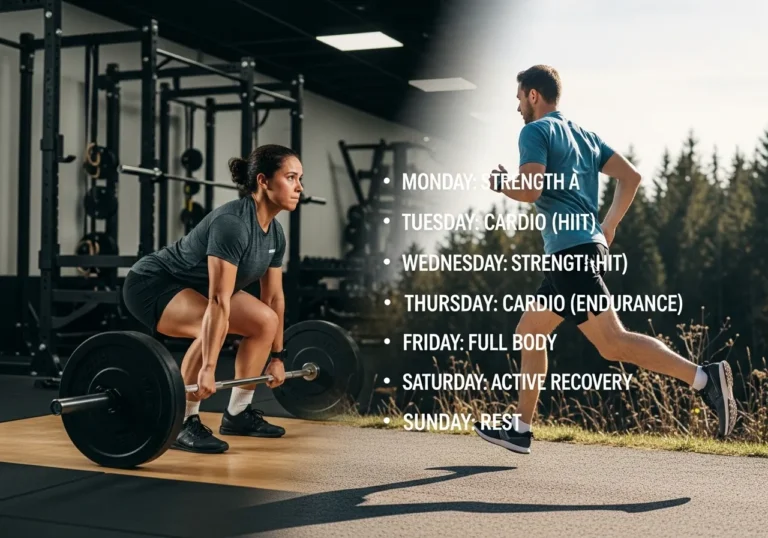
Farmer’s walks work in two distinct programming positions. As a finisher after primary strength work (squat, deadlift, row), they provide a high-fatigue grip, core, and cardiovascular stimulus that extends training stress without adding significant recovery demand to the primary movements. As a primary movement in a conditioning-focused session, they become the main stimulus and can be loaded and distanced progressively across weeks like any strength exercise.
Placing heavy farmer’s walks before primary lower body strength work is not recommended because grip and core fatigue from farmer’s walks directly affects deadlift and squat performance quality. The one exception: a single moderate-load farmer’s walk set as part of the warm-up at the beginning of a session to activate the trap, upper back, and core before heavier pulling or carrying work.
Weekly Integration: How Many Sessions and How Much Volume
Two farmer’s walk sessions per week is the standard recommendation for trainees using them as a primary carry training tool. One session of heavier, shorter-distance work (3 to 4 sets of 20 to 30 metres) develops maximum grip strength and loaded carry power. One session of lighter, longer-distance work (3 to 4 sets of 50 to 80 metres) develops grip endurance and cardiovascular conditioning. This combination addresses both the strength and endurance dimensions of grip and carry fitness within the weekly training structure. The loaded carries framework and how farmer’s walk fits within a broader carry training programme is covered in the loaded carries guide.
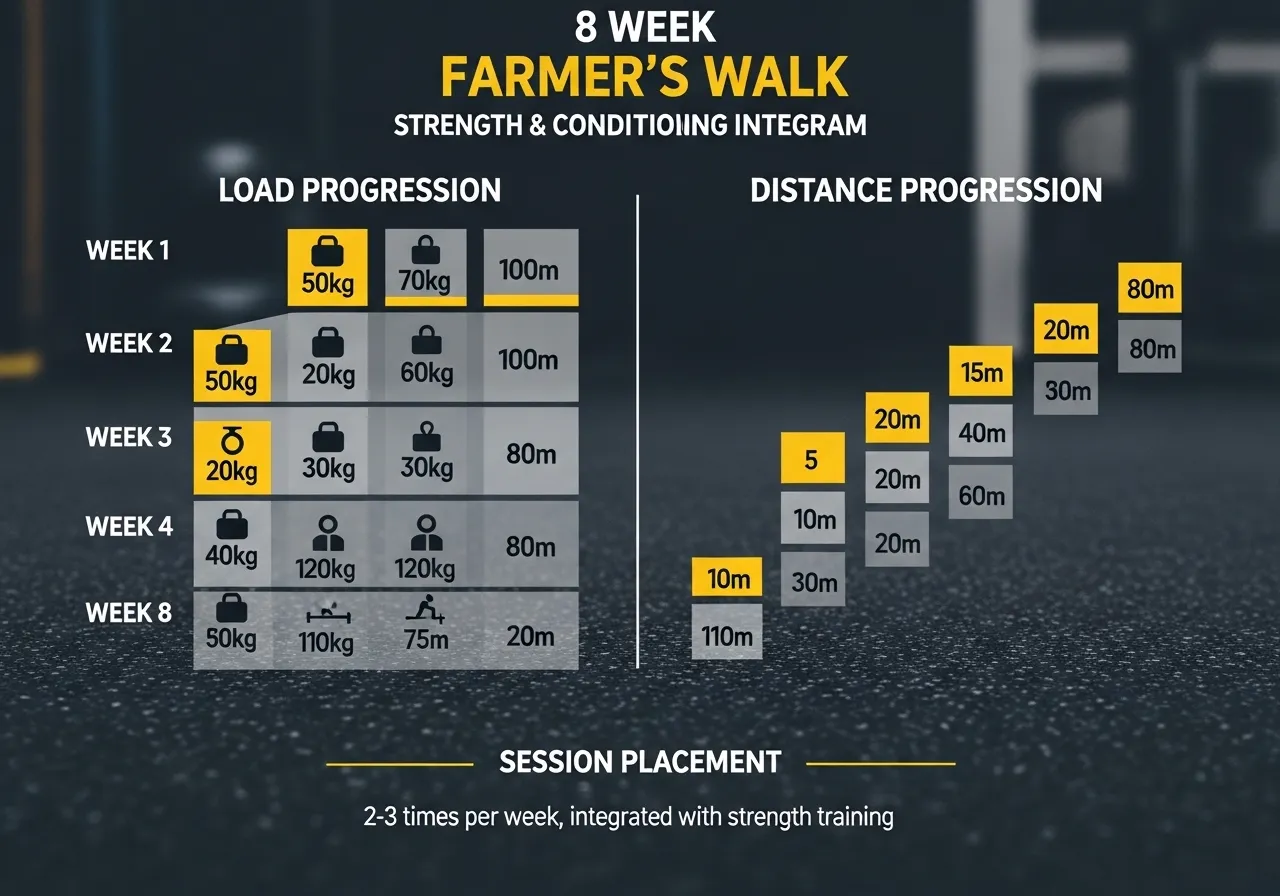
An 8-Week Farmer’s Walk Progression
📅 Phase 1: Weeks 1 to 3: Foundation Distance
3 sets of 20 metres at body weight total (50% BW each hand)
Progress: extend to 30 metres by week 3 if posture is maintained
Distance before load is the Phase 1 principle. Technique under fatigue must be established before increasing the load that produces the fatigue.
📅 Phase 2: Weeks 4 to 6: Load Development
4 sets of 30 metres at increasing load: add 5 to 10% each week
Add one suitcase carry session per week: 3 sets of 20 metres per side
Introduce fat grip or towel grip on one set per session for grip overload
Progressive load at maintained distance. The suitcase carry addition develops the anti-lateral-flexion core that complements bilateral farmer’s walk training.
📅 Phase 3: Weeks 7 to 8: Distance and Conditioning Peak
Heavy session: 3 sets of 25 metres at maximum load that maintains form
Conditioning session: 4 sets of 60 to 80 metres at 60% of Phase 2 working load
Week 8 benchmark: maximum distance at Phase 2 peak load as a fitness test
Phase 3 develops both strength and endurance dimensions. The week 8 distance benchmark provides an objective measurement of farmer’s walk fitness improvement from the Phase 1 starting point.
Integrating With Strength and Conditioning Goals
Strength athletes use farmer’s walks to develop grip and upper back endurance without adding significant fatigue to their primary competition movements. Placing 2 to 3 sets of farmer’s walks after the main lifting session, at loads that challenge grip but do not produce systemic fatigue that compromises the next day’s training, provides the carry-specific development without competitive interference. Conditioning-focused athletes use farmer’s walks as a primary cardiovascular and full-body conditioning tool, treating them as loaded interval training rather than an accessory exercise.
Frequently Asked Questions About the Farmer’s Walk
How heavy should I farmer’s walk?
A common starting point is 50% of body weight in each hand (total body weight carried). For a 75 kg trainee, this means approximately 37 to 38 kg per hand. This load is challenging enough to produce meaningful grip and core stimulus while allowing the upright posture that makes the exercise effective. Trainees who immediately reach for the heaviest available weight typically sacrifice posture within the first 10 metres, converting the exercise from a stability and endurance challenge into a loaded postural collapse.
Progress load when the target distance can be completed for all sets with maintained posture and 30 to 40% more distance available before grip failure would occur. If grip fails before posture, the load is appropriate for grip development. If posture fails before grip, reduce load until posture can be sustained throughout the prescribed distance.
Should I use straps for farmer’s walks?
Straps are appropriate for farmer’s walk training when the goal is core, back, or conditioning development rather than grip development. When grip is the limiting factor before the target training stimulus is achieved, straps allow higher loads and longer distances that develop the non-grip qualities the session is targeting. When grip development is the goal, no straps maximises the specific grip training stimulus that makes the farmer’s walk the most effective grip exercise available.
A practical approach: use straps for the heavier distance-focused sets where trunk and metabolic conditioning are the primary goals. Remove straps for one set per session where grip is allowed to reach its limit as the deliberate training target for that specific set.
Is the farmer’s walk safe for people with lower back problems?
The farmer’s walk’s upright trunk position makes it one of the more spine-friendly loaded exercises for many common lower back presentations compared to the deadlift’s forward-leaning mechanics. Individuals with shear-sensitive lumbar pathology, which worsens with forward trunk flexion, often tolerate farmer’s walk loads better than conventional deadlift loads because the vertical trunk position reduces the anterior shear force on the lumbar spine.
Individuals with compression-sensitive presentations, which worsen with axial loading, may find farmer’s walks aggravating because the bilateral hanging load directly compresses the lumbar spine. The key assessment: does the pain worsen with axial loading (standing upright with weight in hands) or with forward flexion (conventional deadlift position)? Shear-sensitive: farmer’s walk is appropriate. Compression-sensitive: farmer’s walk requires careful load management or avoidance. Medical clearance is appropriate for any individual with diagnosed lumbar pathology before beginning loaded carry training.
How does the farmer’s walk compare to the deadlift for overall strength development?
The farmer’s walk and deadlift develop overlapping but distinct strength qualities. The deadlift produces higher peak force output, greater hip extensor and hamstring loading, and more direct spinal erector development through the hip hinge pattern. The farmer’s walk produces greater grip endurance, spinal anti-flexion endurance under sustained load, gluteus medius functional strength through loaded gait, and cardiovascular conditioning alongside the muscular stimulus.
For maximum lower body and posterior chain strength development, the deadlift is the primary tool. For grip endurance, total body conditioning, and functional loaded gait strength, the farmer’s walk provides a stimulus the deadlift cannot replicate. Including both in a programme addresses the full spectrum of loaded movement capacity across strength, endurance, and functional stability dimensions that neither exercise alone covers comprehensively.
Can beginners do farmer’s walks, or is this only for advanced trainees?
Farmer’s walks are appropriate for all training levels, including complete beginners. The exercise requires no technical learning curve comparable to the Olympic lifts or even the conventional deadlift. The setup and execution are intuitive: pick up, stand upright, walk, put down. This accessibility makes the farmer’s walk one of the most practical introductory exercises for developing functional strength and grip simultaneously.
Beginners should start with lighter loads than experienced trainees use, typically 25 to 30% of body weight per hand rather than the 50% starting point for trained individuals. The primary beginner error is selecting loads based on grip capacity alone, choosing implements that grip can hold but that posture cannot sustain. Start conservatively, prioritise upright posture across the full distance, and increase load only when the prescribed distance is achievable with consistently maintained form across all sets.
Key Takeaways
The farmer’s carry produces greater activation of the longissimus, multifidus, rectus abdominis, and external oblique than the farmer’s hold at matched load. Walking with the load provides a superior core stimulus to standing and holding it because each stride requires active re-stabilisation.
Individuals with weaker gluteus medius relative to hamstrings and quadriceps show 42 to 47% MVIC gluteus medius activation during the farmer’s walk, confirming it as an effective gluteus medius strengthening exercise for those who need it most.
Grip strength is associated with reduced all-cause mortality, cardiovascular disease, and stroke risk. Farmer’s walk training is a health investment beyond its immediate conditioning benefits.
The farmer’s walk’s upright trunk position produces less lumbar shear stress than the conventional deadlift at matched relative loads, making it appropriate for many shear-sensitive lower back presentations that limit deadlift training.
Begin at body weight total (50% BW per hand) and progress distance before increasing load. Posture maintenance throughout the prescribed distance is the primary technique standard from which load should never deviate.
⚠️ Health & Fitness DisclaimerThis article is for general educational purposes only and does not replace professional medical advice. If you have any pre-existing shoulder, wrist, or back conditions, please consult a qualified healthcare professional before beginning medicine ball training. The medicine ball is one of the oldest and most versatile training implements in existence…
⚠️ Health & Fitness DisclaimerThis article is for general educational purposes only and does not replace professional medical advice. If you have any shoulder, wrist, or lower back conditions, please consult a qualified healthcare professional before beginning suspension training. Suspension training — using adjustable straps anchored overhead to leverage bodyweight as resistance — offers a…
Most people who exercise do both strength training and cardiovascular work. They are not strength athletes or endurance athletes. They are general fitness trainees who want to be strong, have good cardiovascular health, and maintain a body composition that reflects consistent training. For these people, concurrent training is not a choice. It is the default….
Battle ropes sit in most gyms but get used by a minority of members. The exercise looks unusual — swinging heavy ropes in wave patterns doesn’t resemble any conventional cardiovascular or strength exercise — and its place in a training programme is less obvious than a treadmill interval or a barbell lift. The research tells…
Every squat you perform at 100 kg involves both legs. One leg may contribute 55 kg worth of force. The other may contribute 45 kg. The bar goes up. The asymmetry is invisible. This hidden asymmetry compounds over months and years of bilateral-only training. The dominant leg becomes increasingly stronger relative to the non-dominant leg….
There is no neat way to flip a tire. It does not fit into a defined movement category. It is not a deadlift. It is not a push press. It is all of them simultaneously, in a sequence, against an implement that shifts weight as it moves. This awkwardness is the point. Every clean movement…