Nordic Hamstring Curl Guide: Eccentric Science, 51% Injury Prevention Research, and Progressive Protocol
The Nordic hamstring curl places the biceps femoris and semimembranosus under maximum eccentric load at full knee extension — the position associated with the highest hamstring injury risk during sprinting. Individuals with active hamstring tears (Grade II or above), proximal hamstring tendinopathy, or recent posterior knee surgery should obtain medical clearance before starting Nordic curl training. Begin with very low volume (2–3 reps per session) and progress slowly — the eccentric loading is substantially greater than any other hamstring exercise and delayed-onset muscle soreness in the first 2 weeks can be severe even for trained athletes.
The Nordic hamstring curl is simultaneously one of the most effective and most avoided exercises in gym training.
Effective because the research on hamstring injury prevention is unequivocal — no other exercise reduces hamstring strain incidence as reliably. Avoided because the exercise is brutally difficult, produces severe delayed-onset muscle soreness in early training, and requires a training partner or specialised equipment to anchor the feet.
This guide covers the eccentric science behind why the Nordic curl is uniquely powerful, what the injury prevention meta-analyses actually show, how it compares to RDL and leg curl as a hamstring stimulus, the exact progression from zero capacity to functional strength, and an 8-week programme that develops genuine hamstring resilience.
Research 1: The Injury Prevention Evidence That Changed Elite Sport Forever
The Meta-Analysis That Shifted Everything
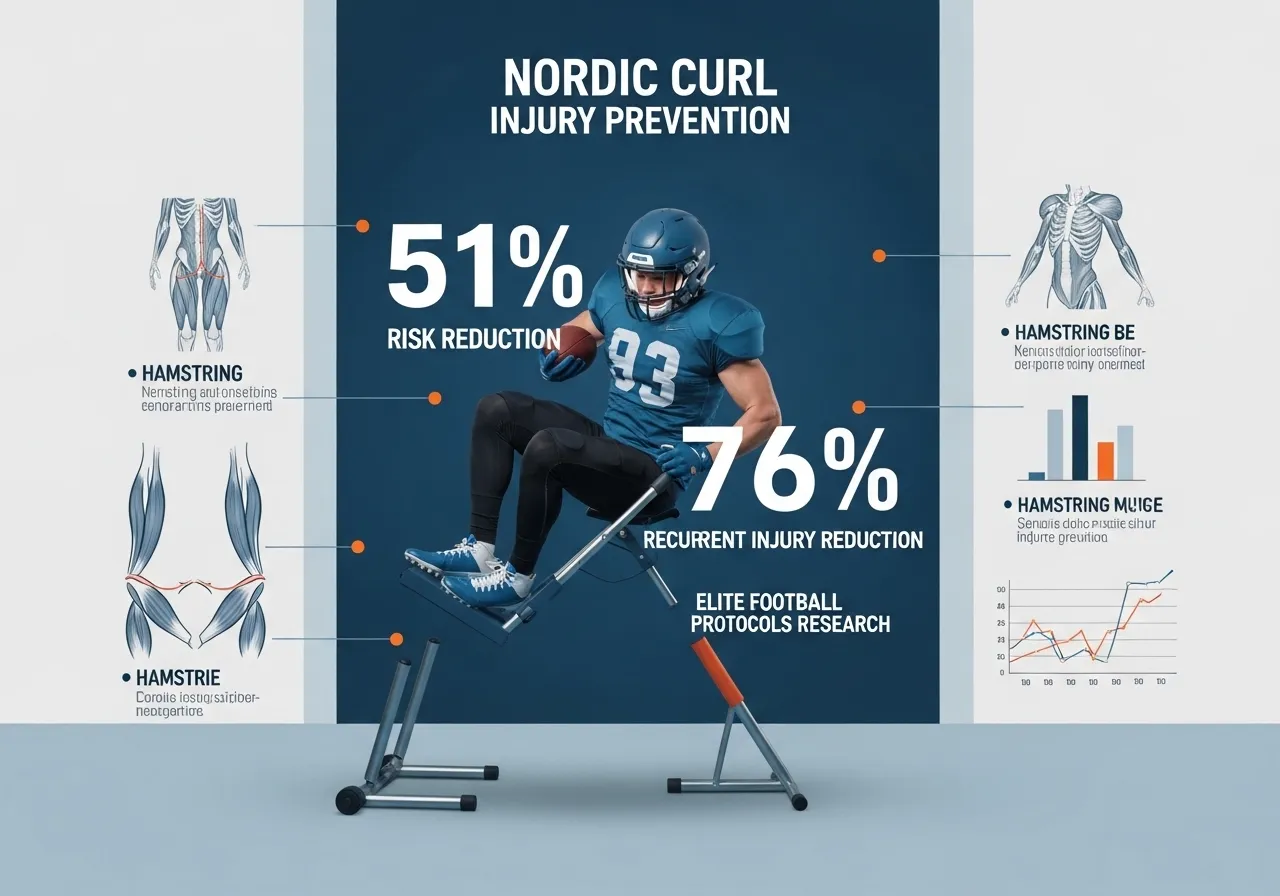
A systematic review and meta-analysis examining the effect of Nordic hamstring curl programs on hamstring injury incidence across multiple sports finds that Nordic hamstring curl training reduced the risk of hamstring injuries by 51% — with even greater risk reduction of 76% for recurrent hamstring injuries — across randomised controlled trials involving athletes from football, rugby, and track — confirming that the Nordic curl produces the largest and most consistently demonstrated hamstring injury prevention effect of any single exercise intervention currently available in sports medicine.
Nordic curl training reduces hamstring injury risk by 51% overall — and by 76% for recurrent injuries. No other exercise intervention approaches this magnitude of injury risk reduction for the hamstring.
Why Elite Sport Now Mandates It
Following the publication of the Oslo Sports Trauma Research Centre’s landmark Nordic hamstring curl study, multiple elite football governing bodies — including UEFA and the English Premier League — incorporated the exercise into mandatory warm-up and injury prevention protocols.
The adoption was not universal enthusiasm. Many coaches and athletes resisted the exercise because of its difficulty and the severe post-exercise soreness that early training produces. The injury incidence data left no room for argument: teams that implemented consistent Nordic curl training showed statistically significant reductions in hamstring injury rates; teams that did not, did not.
The Eccentric Mechanism: Why This Exercise and Not Others
Hamstring strains almost always occur during high-speed running — specifically during the late swing phase, when the hamstring decelerates the extending knee while simultaneously stretching. This is an eccentric contraction under high load at a long muscle length.
The Nordic curl replicates this exact demand: the hamstring produces eccentric force to decelerate the lowering torso from knee extension toward the floor. The load occurs at a progressively longer muscle length as the rep progresses — the lengthened eccentric position that produces the greatest hypertrophic stimulus and the specific mechanical resilience that prevents sprint-related strains.
No other common hamstring exercise — not the leg curl, not the RDL, not the hip thrust — produces this combination of high load, eccentric contraction, and lengthened muscle position simultaneously. This is why the injury prevention data is so dramatically superior to other interventions.
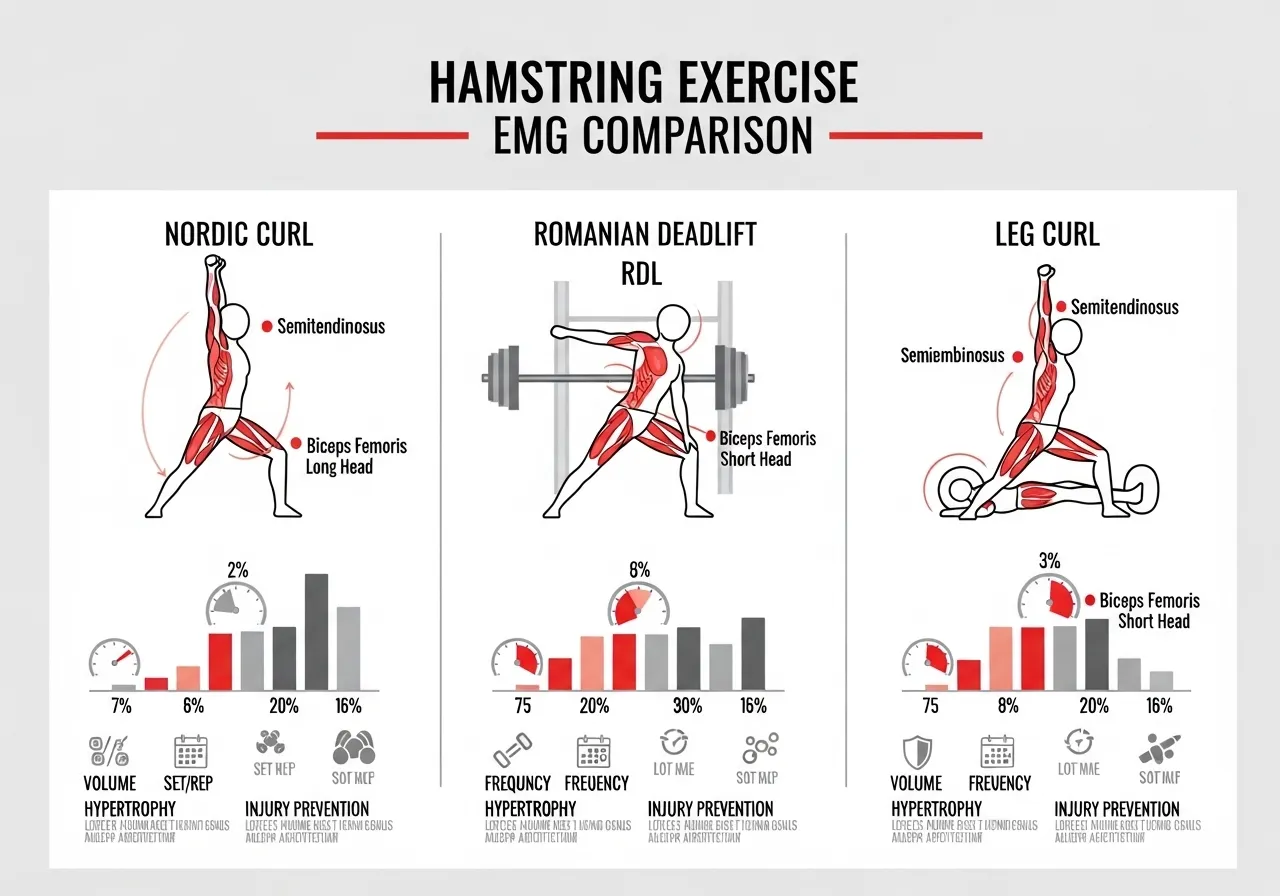
Research 2: Nordic Curl vs RDL vs Leg Curl — Which Trains the Hamstring Best?
The EMG Comparison Study
A study comparing hamstring muscle activation between the Nordic hamstring curl, Romanian deadlift, and prone leg curl using surface electromyography finds that the Nordic hamstring curl produced significantly greater biceps femoris long head activation than both the Romanian deadlift and the leg curl across the full range of motion — with peak activation occurring in the lengthened position near full knee extension — while the Romanian deadlift produced greater proximal hamstring (semimembranosus) activation — confirming that the three exercises activate the hamstring complex through different primary heads and at different points in the range, making them complementary rather than interchangeable.
Nordic curl = greatest biceps femoris long head activation (sprint-relevant head). RDL = greater proximal hamstring. Leg curl = moderate across both. No single exercise trains all hamstring heads equally.
The Volume and Frequency Optimisation Study
A randomised controlled trial examining different Nordic hamstring curl training volumes and frequencies over 10 weeks finds that higher volume Nordic curl training (3 sets per session) produced significantly greater biceps femoris muscle thickness gains than lower volume training (1 set per session) — while both frequency groups (1× and 2× per week) showed similar injury prevention benefits — confirming that volume is the primary driver of hamstring hypertrophy from Nordic curl training, while the injury prevention benefit appears even at low training frequencies.
3 sets per session drives significantly more hamstring hypertrophy than 1 set. But the injury prevention benefit requires only 1–2 sessions per week — making it the minimum effective dose for athletes focused on protection over development.
Practical Application: What Each Study Tells You About Programming
The combined research picture creates clear programming guidance:
- For injury prevention: 1–2 Nordic curl sessions per week, 1–2 sets per session — minimum effective dose produces meaningful protection
- For hamstring hypertrophy: 2–3 sets per session, twice per week — volume drives muscle development
- For complete hamstring development: Nordic curls (biceps femoris, eccentric) + RDL (proximal hamstring, hip hinge) + leg curl (overall volume, isolation) — no single exercise covers all three heads and both contraction types adequately
- For athletes: Nordic curls are non-negotiable if sprint speed or cutting is involved in the sport — the injury prevention data justifies inclusion regardless of other programming considerations
The Lengthened Position Hypertrophy Principle Applied to Hamstrings
The emerging consensus in hypertrophy research — that muscles trained at longer lengths produce greater growth — directly explains the Nordic curl’s superior injury prevention data.
Sprint-related hamstring strains occur at long muscle lengths during the late swing phase. Training the hamstring specifically at long lengths (the Nordic curl’s entire range) produces structural adaptations — increased fascicle length, improved force production at long lengths, greater eccentric strength — that directly address the mechanical conditions of sprint injury.
This is why the Nordic curl outperforms all other hamstring exercises for injury prevention: it is the only common exercise that loads the biceps femoris at the exact lengths and contraction type where sprint injuries occur. Leg curls, RDLs, and hip thrusts each provide valuable hamstring stimulus — but none replicates the specific demand that the Nordic curl addresses.
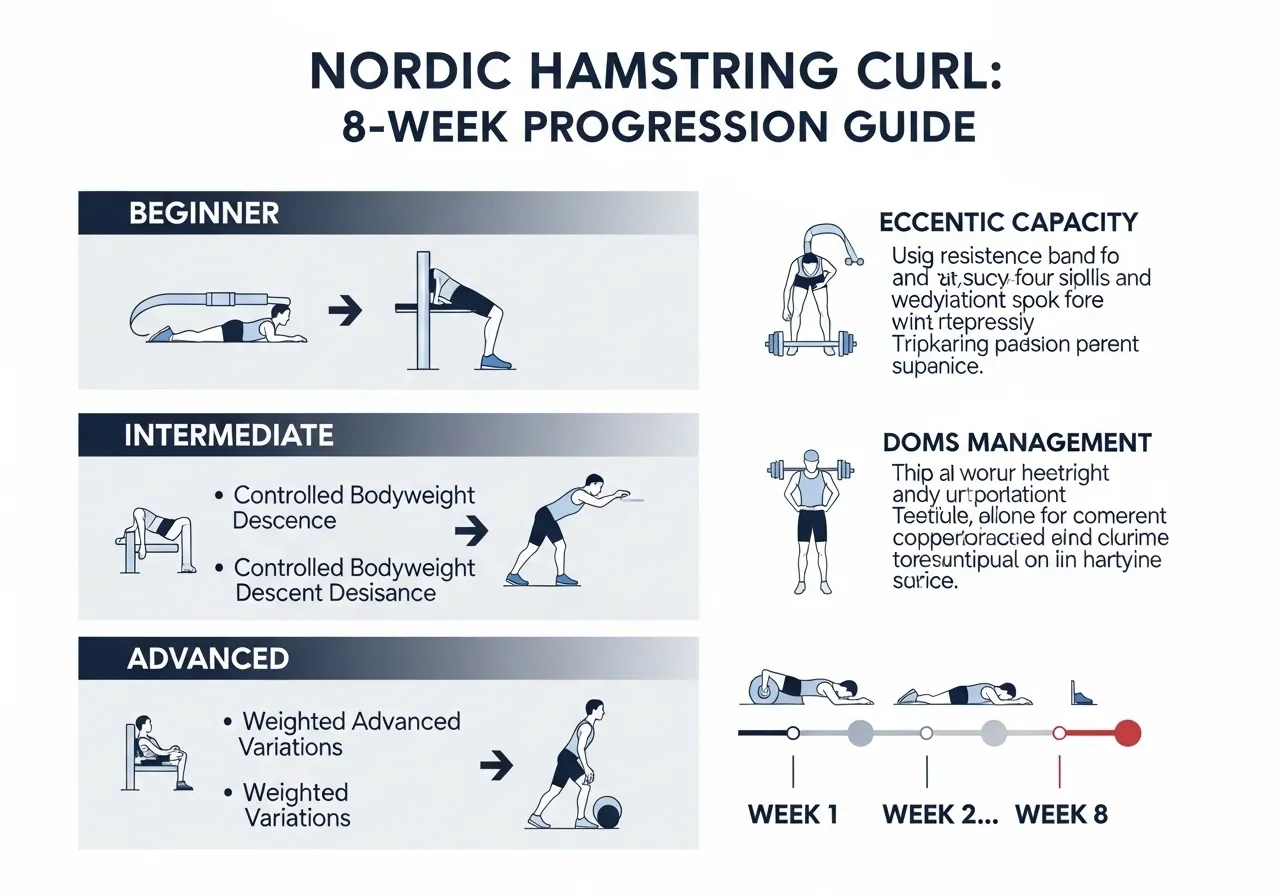
Why Is the Nordic Curl So Hard — and How Do You Actually Progress From Zero?
The Brutal First Session Problem
Most trainees who attempt their first Nordic curl lower approximately 20° from vertical before the hamstrings give out and they drop to the floor. This is not a failure of effort — it is the expected response from a muscle that has never been loaded eccentrically at this intensity and range.
The Nordic curl requires the hamstrings to produce eccentric force against essentially full bodyweight through a progressively longer muscle length. The biceps femoris long head — the primary mover — is capable of this under training, but not without systematic preparation. Attempting to perform “full” Nordic curls without progression is both ineffective and a reliable way to produce the severe DOMS that discourages continued training.
The Progression Ladder
The evidence-supported progression builds eccentric hamstring capacity over 6–8 weeks before attempting full Nordic curls:
| Stage | Exercise | Eccentric Demand | Target Before Progressing |
|---|---|---|---|
| 1 | Glute-ham raise (assisted) | Low | 3×10 controlled |
| 2 | Nordic curl negative (partner assist concentric) | Moderate | 3×5 with 4-sec descent |
| 3 | Band-assisted Nordic curl | Moderate-High | 3×5 to 45° descent |
| 4 | Full Nordic curl | High | 3×5 full range |
| 5 | Weighted Nordic curl | Very High | 3×4 with plate or vest |
The DOMS Management Strategy
The first 1–2 weeks of Nordic curl training produce severe DOMS — often worse than any other leg exercise the trainee has ever attempted. This is not injury; it is the normal response to an eccentric overload the hamstrings have never experienced.
Three strategies to manage early DOMS without abandoning the programme:
- Ultra-low initial volume: 2–3 reps per session in Week 1, regardless of how easy those reps feel. The DOMS response is dose-dependent — starting with 3 reps rather than 3 sets reduces DOMS to manageable levels while still initiating the adaptation.
- 72-hour minimum recovery: Nordic curls once every 3–4 days in the first 4 weeks. The eccentric damage requires longer recovery than concentric-dominant exercises.
- Active recovery between sessions: Light cycling, walking, and foam rolling of the posterior thigh accelerates DOMS resolution without adding additional damage. See also: foam rolling guide for the recovery protocol that pairs most effectively with Nordic curl training.
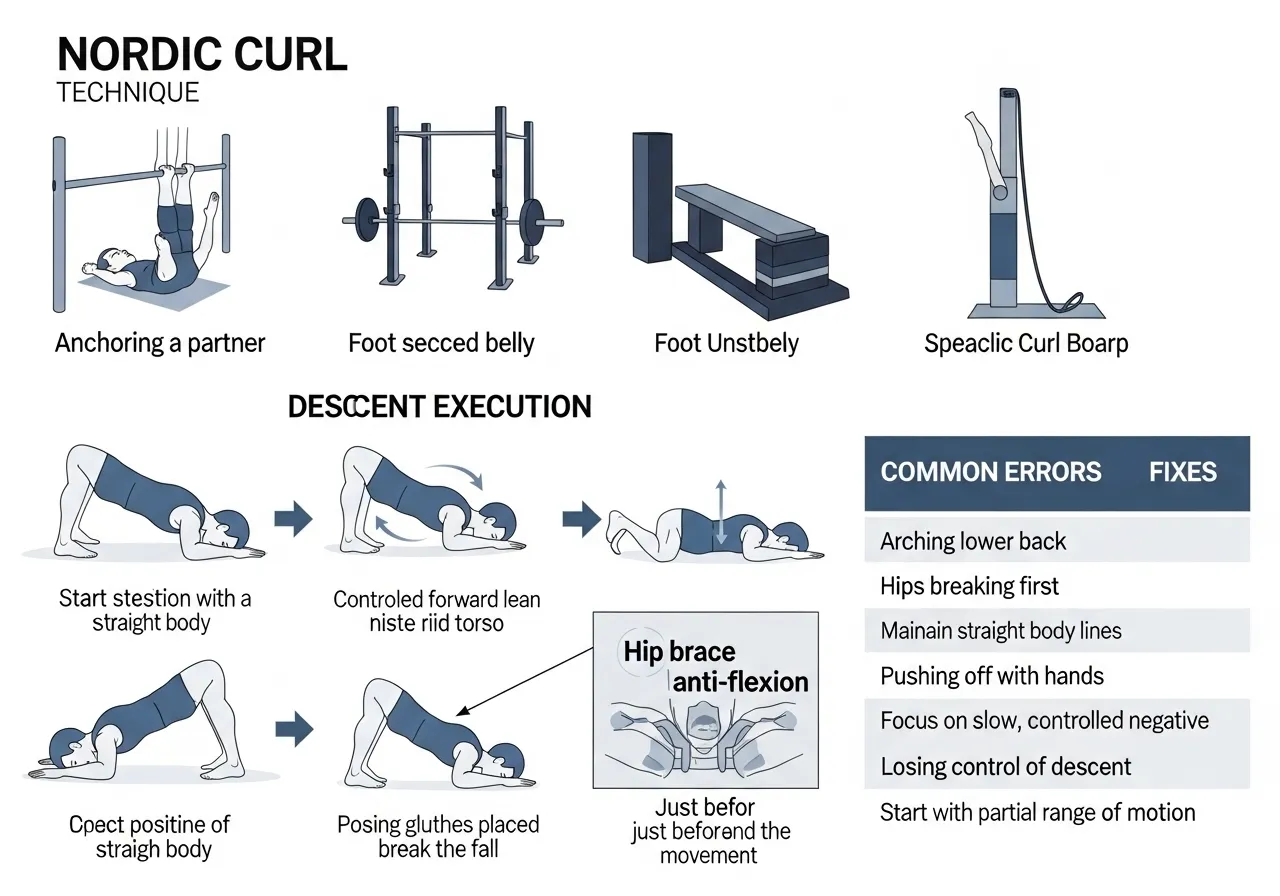
Nordic Curl Technique: Setup, Execution, and the Details That Matter
Foot Anchoring Options
The Nordic curl requires the feet to be anchored firmly against a fixed surface while the knees remain on a padded surface. Four practical anchoring setups:
- Training partner: Partner kneels behind and holds both ankles down. Most accessible; requires a cooperative partner.
- Lat pulldown machine seat: Position the knees on the seat and tuck the heels under the knee pad. Works well for most machine configurations.
- Glute-ham raise machine: The most biomechanically precise setup — designed specifically for this movement. Not available in all gyms.
- Barbell with a loaded plate as anchor: Kneel behind a barbell on the floor with a heavy plate. Hook the heels under the bar. Requires a pad under the knees.
Knee Pad Position
The knees should rest on a firm pad or folded mat — not directly on the floor. Hard floor contact on the knee creates discomfort that limits rep quality. The pad height matters: too thick a pad reduces the effective range by raising the starting knee angle; a folded yoga mat (approximately 6 mm) is appropriate.
Execution: The Descent
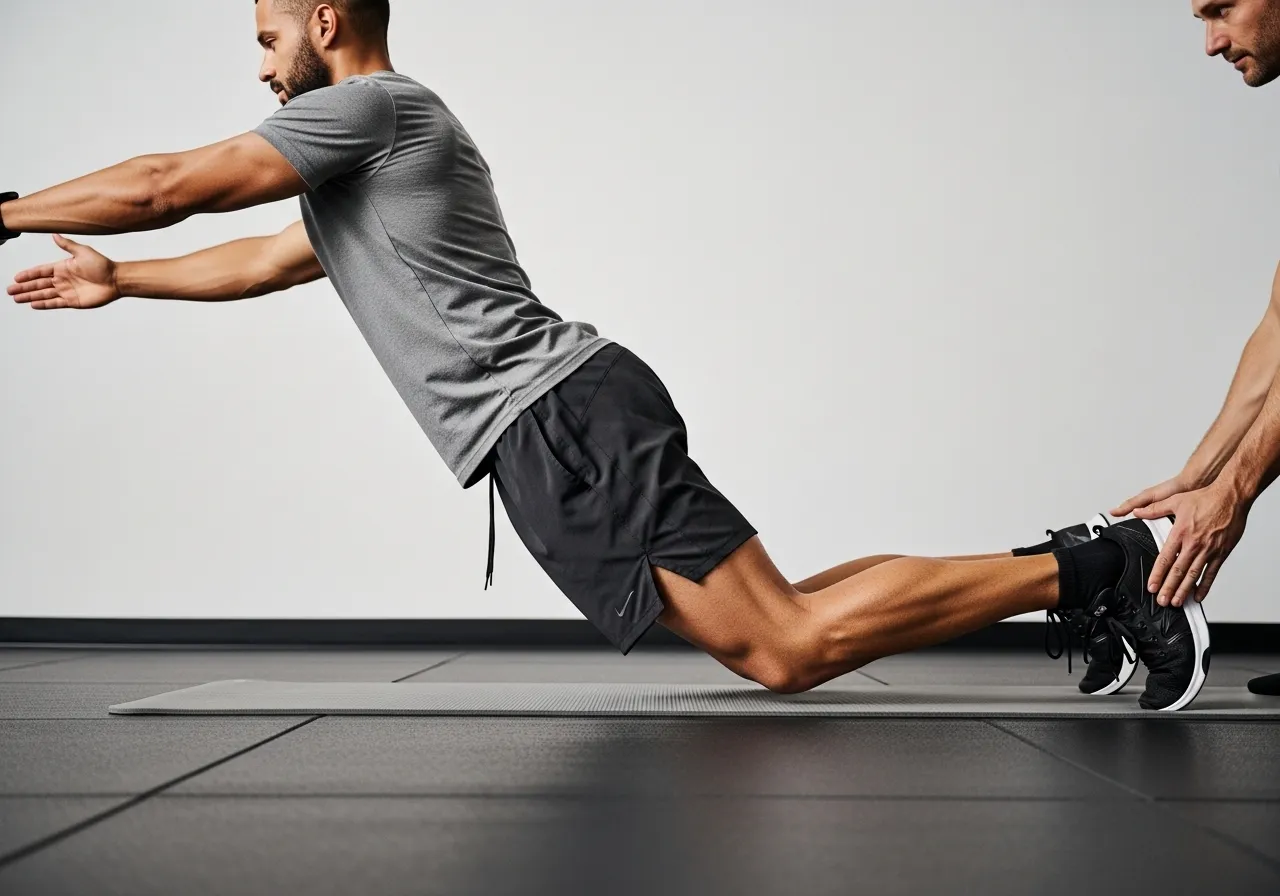
Begin kneeling upright, hips extended, torso vertical. Cross the arms across the chest or extend them forward. Lower the torso toward the floor by allowing the knees to extend slowly — the hamstrings eccentrically decelerate this movement. Maintain a rigid torso — the hips should not flex during descent.
Lower as slowly as possible. The training stimulus comes from the eccentric deceleration, not from reaching the floor. A 4–6 second descent on each rep produces significantly more hamstring activation than a fast, uncontrolled drop. Stop the descent when the hamstrings can no longer control the movement — this point moves lower over weeks as strength develops.
The Concentric Return
Beginners cannot complete the concentric return from the floor under hamstring power alone. Two options:
- Push-up assist: Allow the body to fall to the floor, then push back up with the hands (push-up position) while the hamstrings initiate the early concentric phase from the bottom.
- Band assistance: A resistance band attached above provides progressive assistance — most resistance at the bottom of the movement where the hamstring is weakest concentrically.
As strength develops over 4–8 weeks, the push-up assist becomes progressively less necessary — the hamstrings develop concentric capacity alongside the eccentric strength the exercise primarily trains.
Common Errors
| Error | Effect | Fix |
|---|---|---|
| Hip flexion during descent | Reduces hamstring load; becomes hip hinge | Brace the glutes and maintain rigid torso throughout |
| Dropping rapidly to floor | Eliminates eccentric stimulus; injury risk | 4–6 second controlled descent every rep |
| Full volume in Week 1 | Severe DOMS; programme abandonment | 2–3 reps only in Week 1 regardless of capacity |
| Anchoring at the ankle bone | Pain; unstable anchor | Anchor at the Achilles tendon / lower calf, not bone |
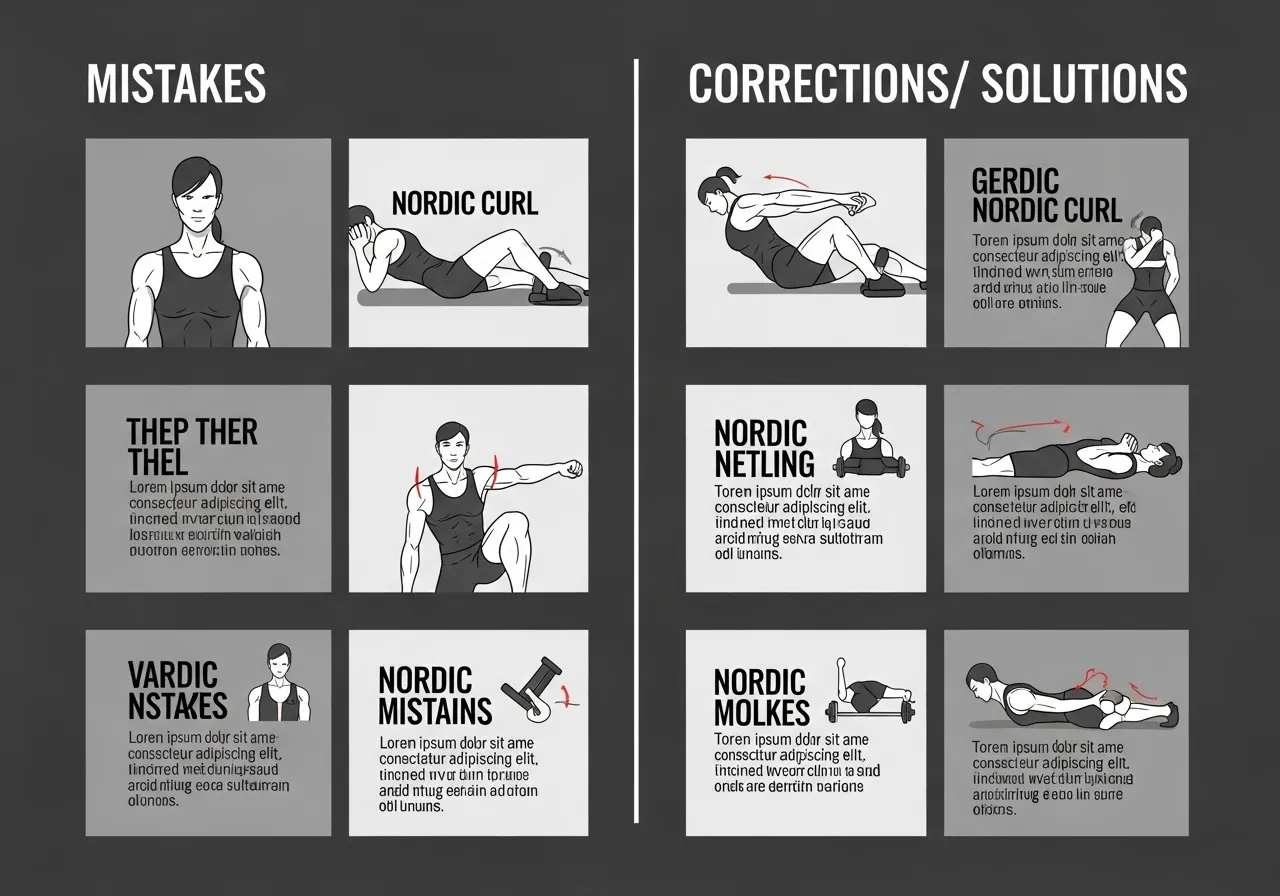
Why Most Trainees Quit Nordic Curls After One Session — and Why That Is a Mistake
The DOMS Misinterpretation
The most common reason Nordic curls get abandoned: the posterior thigh soreness after the first session is unlike anything most trainees have experienced. Three days post-session, stair descent feels genuinely painful. Sitting down requires careful positioning. The sensation is alarming enough that many trainees conclude the exercise is inappropriate for their hamstrings.
This DOMS is not pathological. It is the predictable response to maximum-intensity eccentric loading of a muscle that has never experienced this specific demand. The same response occurs in anyone performing deep eccentric squats for the first time — just localised to the posterior thigh. The adaptation process that follows this initial response is what produces the injury prevention benefit and the hypertrophy.
The correct response to first-session DOMS: reduce volume further for sessions 2 and 3 (1–2 reps only), allow full recovery between sessions, and recognise that the severity diminishes rapidly after the first 3–4 sessions as the muscle adapts to the eccentric stimulus.
Starting With Full Reps Instead of Progressions
Attempting full Nordic curls — kneeling upright, lowering fully to the floor — before building the progression ladder produces two outcomes: the trainee drops immediately (no eccentric control) and sustains the maximum possible DOMS from a completely uncontrolled fall against the floor.
The progression ladder exists precisely to build the eccentric capacity that makes full reps achievable. Spending 3–4 weeks on negatives and band-assisted reps produces the neural adaptation and connective tissue resilience that allows full reps to be performed safely and productively.
Using the Nordic Curl as an Isolated Exercise Without Integration
The Nordic curl trains the biceps femoris eccentrically — it does not train the proximal hamstring, the hip extensors, or the glute-hamstring interface comprehensively. Trainees who add Nordic curls without maintaining their hip hinge and glute training occasionally develop an eccentric biceps femoris strength that outpaces the proximal hamstring and hip extensor capacity — creating a new imbalance that can cause different injury patterns.
The Nordic curl complements but does not replace the Romanian deadlift, hip thrust, and leg curl. Programming all four provides complete posterior chain development across concentric, eccentric, lengthened, and shortened positions. See also: Romanian deadlift guide for the complementary hip-hinge hamstring exercise that pairs with Nordic curls for complete posterior chain programming.
The Frequency Question: Every Day vs Twice a Week
Daily Nordic curl training is not recommended — even for advanced trainees. The eccentric loading produces structural muscle damage that requires 48–72 hours of recovery to repair and strengthen. Training before recovery is complete accumulates damage rather than building resilience.
Twice per week, on non-consecutive days, is the optimal frequency for both hypertrophy and injury prevention. This aligns with the volume-frequency research: 2 sessions per week produces equivalent injury prevention benefit to 3 sessions, with substantially less recovery burden and lower cumulative DOMS throughout the programme.
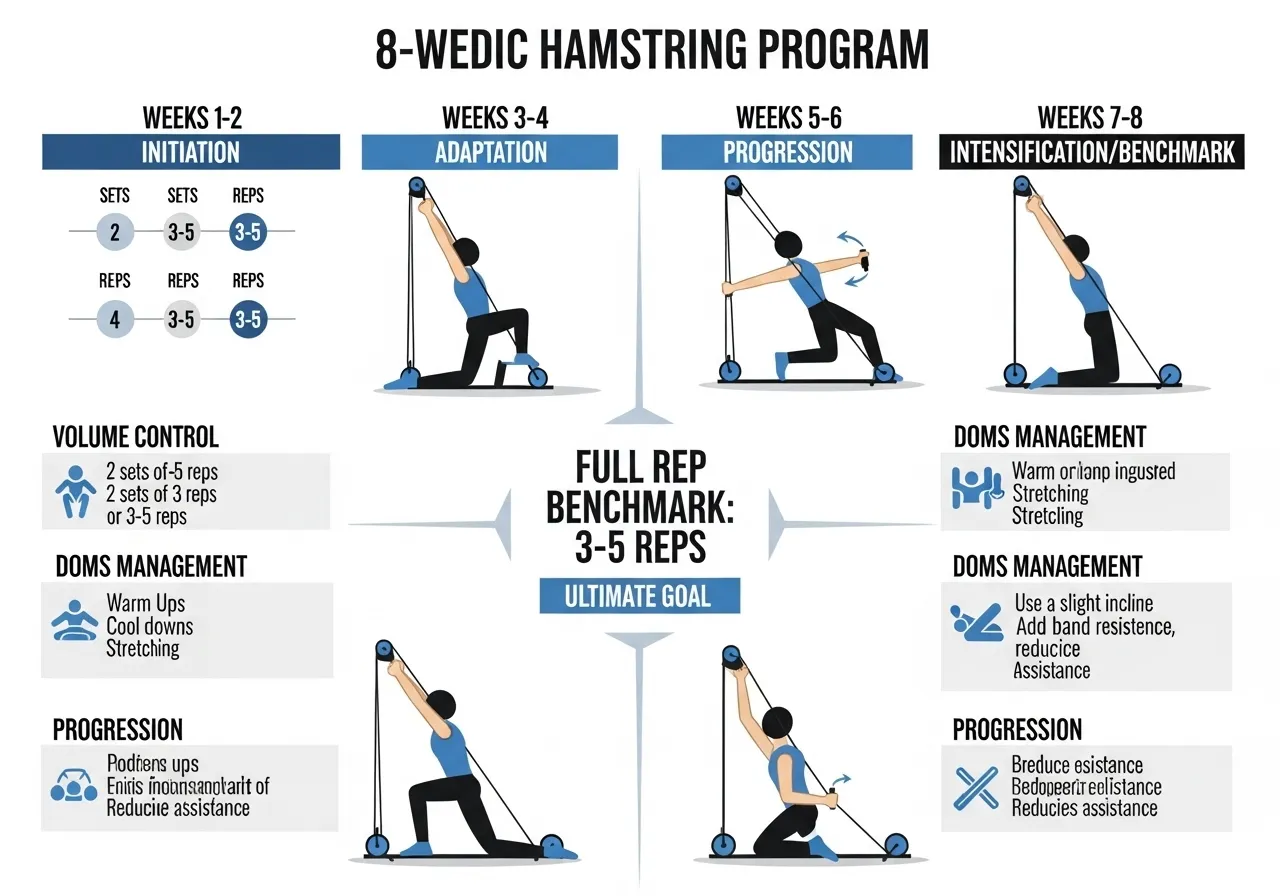
8-Week Nordic Hamstring Curl Programme
This programme progresses from the glute-ham raise through negatives and band-assisted reps to full Nordic curls. It runs two sessions per week on non-consecutive days. Begin Week 1 with absolute minimal volume — the temptation to do more will be strong, and should be resisted entirely.
This programme assumes no previous Nordic curl training. Experienced trainees who already perform Nordic curls can start at Phase 2 or 3 depending on current capacity.
📅 Phase 1 — Weeks 1–2: Eccentric Introduction (Critical Volume Control)
- Session A: Nordic curl negative 2×3 (4-sec descent, push-up return) | Glute-ham raise 2×8 | Romanian DL 3×10
- Session B: Nordic curl negative 2×3 | Leg curl 3×12 | Hip thrust 3×10
- Critical rule: Maximum 6 total Nordic reps per week in Weeks 1–2 regardless of how easy they feel
Focus: DOMS management — if DOMS is severe after Session A, reduce to 2 reps per set in Session B
📅 Phase 2 — Weeks 3–4: Band-Assisted + Volume Build
- Session A: Band-assisted Nordic curl 3×4 (5-sec descent) | Romanian DL 4×8
- Session B: Nordic negative 3×4 | Leg curl 3×12 | Hip thrust 4×10
- Assess: can you lower to 45° before losing control? → proceed to Phase 3
Focus: Descent range extending — each week aim to reach a slightly lower position before the hamstrings give out
📅 Phase 3 — Weeks 5–6: Full Rep Introduction
- Session A: Full Nordic curl 3×4 (push-up assist at bottom) | Band-assisted 2×5 after
- Session B: Full Nordic curl 3×4 | Romanian DL 4×8 | Leg curl 3×10
- Note descent range each session — the depth before losing control should visibly increase week over week
Focus: First full reps — push-up assist at the bottom is expected and correct at this stage
📅 Phase 4 — Weeks 7–8: Volume Peak + Benchmark
- Session A: Nordic curl 3×5 | Romanian DL 4×6
- Session B: Nordic curl 3×5 | Leg curl 4×10 | Hip thrust 4×8
- Week 8 Benchmark: Assess max reps with full eccentric control (no push-up assist). 3–5 full reps with 4-sec descent from zero at Week 1 is a typical 8-week outcome. Most meaningful benchmark: how far can you lower before losing control vs Week 1 (20° → 60–70° is realistic).
Focus: The 8-week outcome is the beginning of Nordic curl capacity, not the end — continue at 2× per week as a permanent programme component
Frequently Asked Questions About the Nordic Hamstring Curl
How many Nordic curls should I do per week?
For injury prevention: 1–2 sessions per week, 2–3 sets per session — the volume optimisation research confirms this is the minimum effective dose for meaningful injury risk reduction. For hamstring hypertrophy: 2–3 sessions per week at 3 sets produces significantly greater muscle thickness gains. Do not exceed 3 sessions per week — the eccentric loading requires more recovery time than concentric-dominant exercises, and overtraining the eccentric pathway produces the proximal hamstring tendinopathy it is partially intended to prevent.
Do I need a partner or special equipment?
No — though both make the exercise easier to perform. Effective anchoring options without a partner include the lat pulldown machine seat, a loaded barbell with heels tucked under the bar, or a dedicated Nordic curl bench (sold commercially for £40–200). The barbell-on-floor method works well in a home gym setting with a heavy plate loaded on the bar for stability.
Should runners and sprinters specifically prioritise Nordic curls?
Yes — the injury prevention data is most robust for this population. The biceps femoris long head is the most commonly strained hamstring muscle during sprinting, and the Nordic curl specifically loads this head eccentrically at the long muscle lengths where sprint-related strains occur. Including Nordic curls twice per week year-round — not just in pre-season — represents the evidence-based approach to hamstring injury prevention for any sprinting or cutting sport. See also: running guide for integrating Nordic curls into a structured running programme for comprehensive hamstring resilience.
How is the Nordic curl different from a leg curl machine?
The leg curl machine trains the hamstring concentrically and eccentrically through knee flexion — with the hip in a neutral position and the hamstring at a moderate length throughout. The Nordic curl trains the hamstring eccentrically at progressively lengthening muscle positions — approaching the range and loading pattern of sprint-related strains. The leg curl builds hamstring strength and hypertrophy broadly; the Nordic curl builds specifically the eccentric resilience that prevents strain injuries. Both have distinct value; neither is a substitute for the other.
Why does my lower back feel involved during Nordic curls?
Lower back involvement during Nordic curls indicates hip flexion is occurring during the descent — the torso is bending at the hips rather than descending as a rigid plank from the knees. Cue: squeeze the glutes before beginning each descent, brace the core, and maintain the hip angle constant throughout the lowering. If the back still engages significantly, reduce the descent range and build from a shallower starting depth. The exercise should be felt almost entirely in the posterior thigh, not the lower back.