⚠️ Ankle and Lower Limb Safety Note Agility ladder drills involve rapid foot placement changes at high step frequencies. Individuals with active ankle sprain (within 4 weeks), Achilles tendinopathy, or stress fracture history should obtain physiotherapy clearance before starting ladder training. Begin all drills at slow speed to establish correct foot placement patterns before adding velocity — rapid entry into high-speed patterns without pattern mastery is the primary cause of ankle inversion injuries during ladder training.
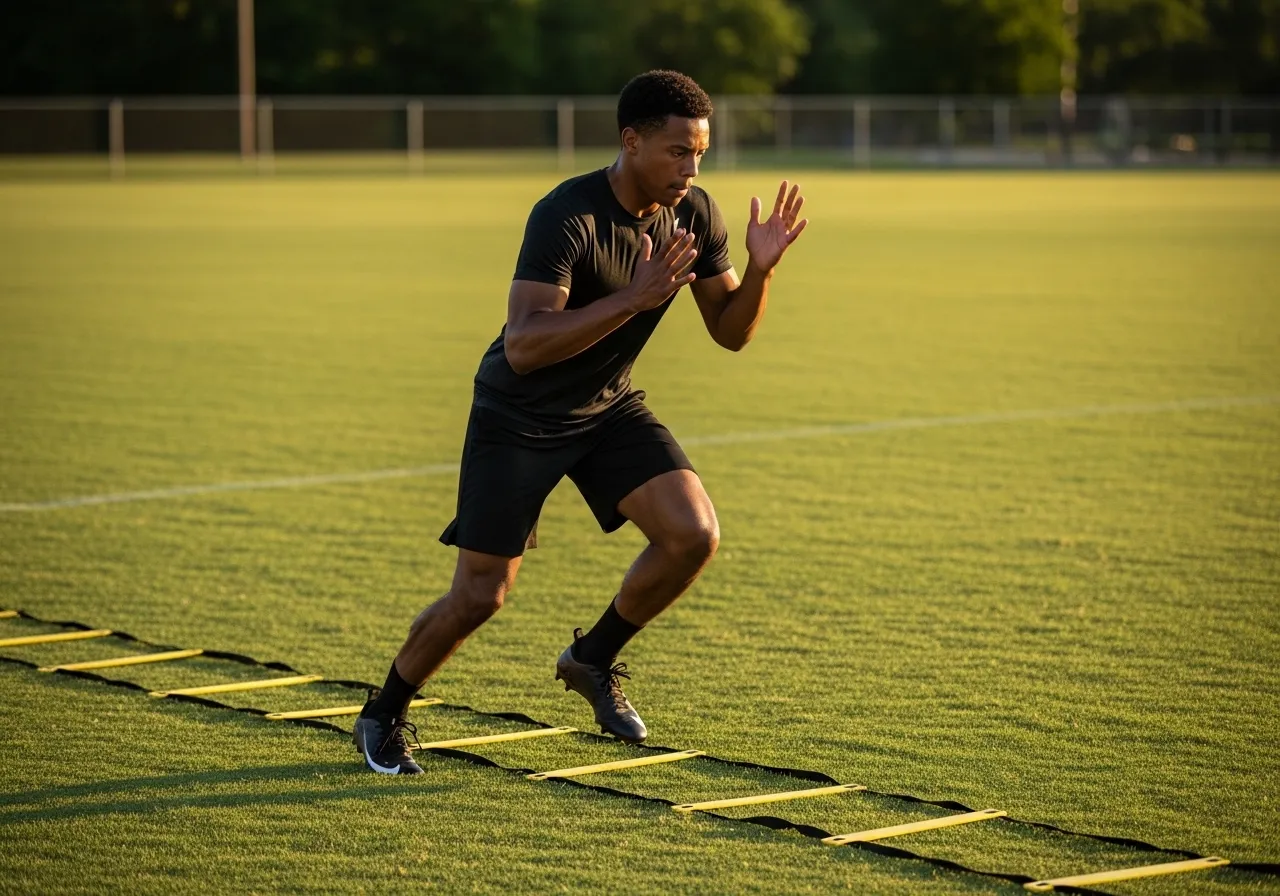
The agility ladder costs less than £20. It stores in a kit bag. It requires no gym, no equipment beyond the ladder itself, and no partner.
It also trains something that almost no gym exercise directly develops: the ability to move your feet quickly, accurately, and in complex patterns under neuromuscular demand. Speed, coordination, ground contact time, proprioception, and cognitive processing of movement sequences all adapt specifically to ladder training — and none of these adapt significantly to conventional strength or cardio training alone.
This guide covers the research on what agility ladder training actually produces, why it belongs in programmes beyond just athletic training, the 12 most effective drills, and a 6-week programme that produces measurable improvements in foot speed and coordination.
What the Research Shows: Agility Ladder Training and Neuromuscular Adaptation
The Dual-Task Study: Physical and Cognitive Benefits Combined
📌 Key Finding
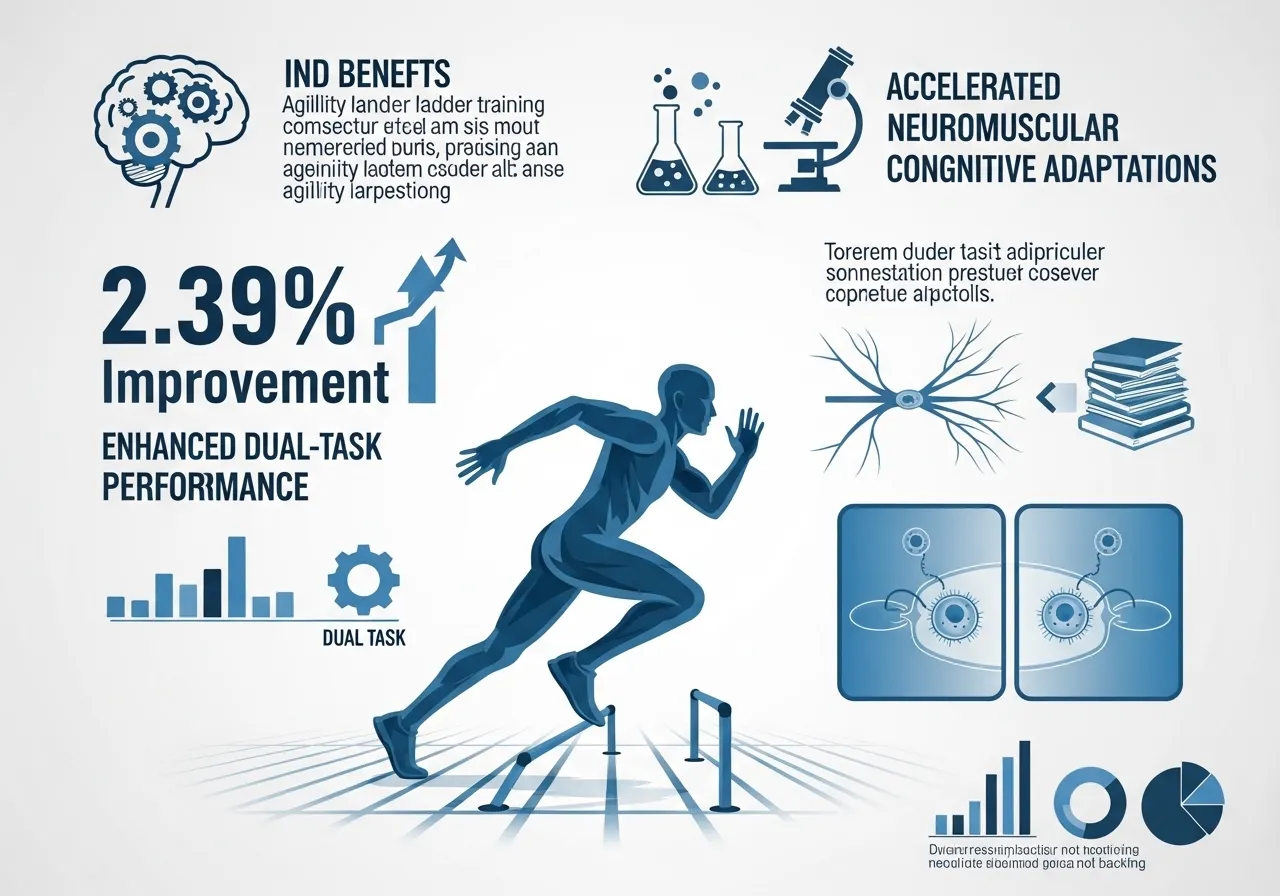
Agility ladder training produces neuromuscular, balance, and cognitive adaptations simultaneously — particularly when combined with cognitive challenge. No single conventional exercise modality delivers this combination.
📌 Key Finding
6 weeks of ladder training improved 10 m sprint by 2.39% in young athletes — a meaningful improvement for sports performance. The fast-twitch fibre recruitment from high-cadence footwork patterns transfers directly to sprint acceleration.
The Long-Term Agility Study: 1 Year in Older Adults
📌 Key Finding
One year of agility training improved neuromuscular, cardiovascular, and cognitive function simultaneously — confirming it as a multi-domain training tool, not just an athletic performance exercise.
Why Agility Ladder Training Belongs in Every Programme — Not Just Athletic Training
The Motor Learning Gap in Standard Gym Training
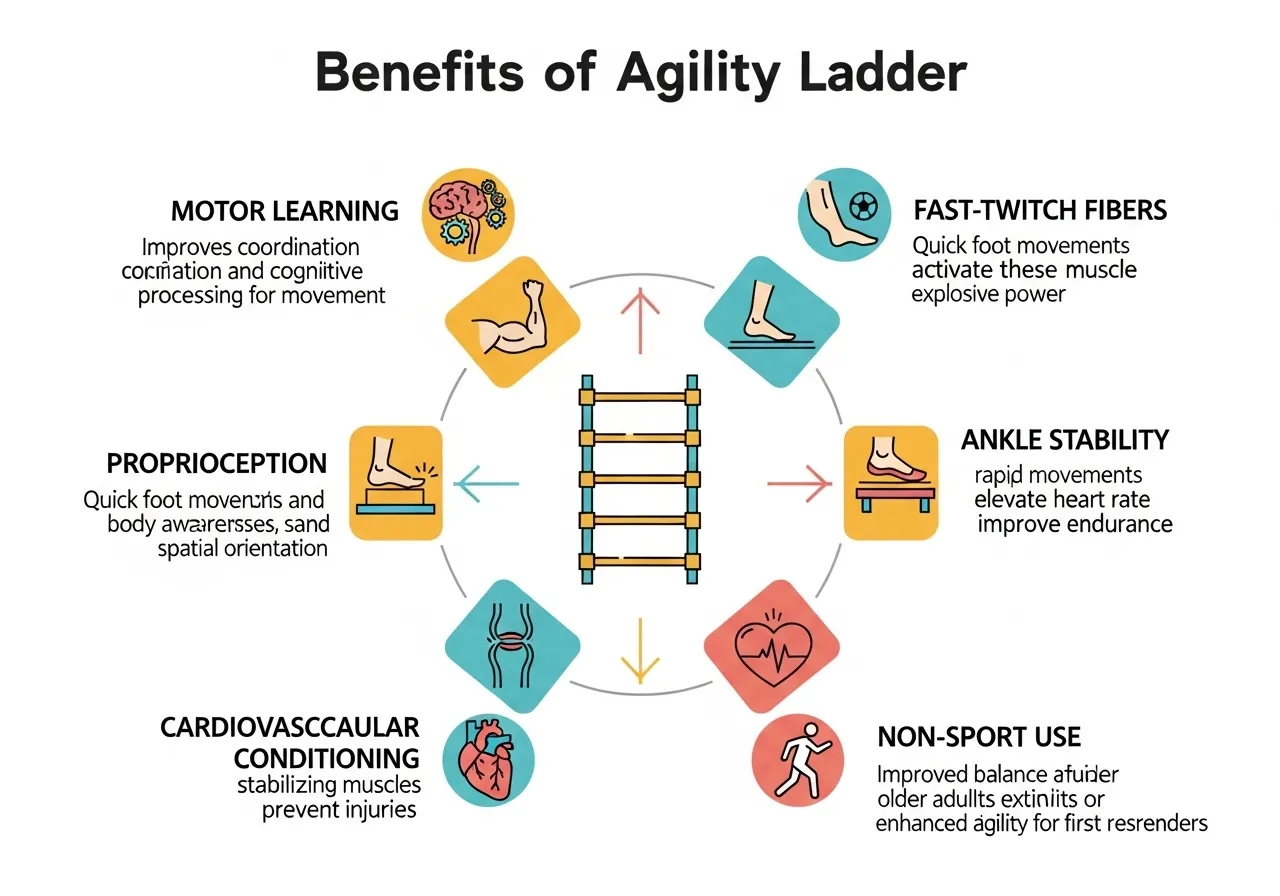
Conventional resistance training and cardiovascular exercise develop strength, hypertrophy, and aerobic capacity — but they do not substantially develop motor learning: the brain’s ability to rapidly sequence complex movement patterns, adapt foot placement under time pressure, and coordinate bilateral limb movements in non-repetitive patterns.
Agility ladder drills train this motor learning capacity directly. Each new drill pattern requires the brain to sequence a novel foot placement programme, coordinate it with arm movement, maintain it under increasing speed, and retrieve it rapidly from working memory during the drill. This cognitive-motor challenge is entirely absent from a conventional set of squats or a 30-minute run.
The Fast-Twitch Fibre Stimulus
High-cadence ladder drills — where both feet complete 1–2 contacts per second with the ground — recruit fast-twitch (Type IIx) muscle fibres in the calves, tibialis anterior, and hip flexors specifically. These fibres are minimally activated during slow steady-state cardio and moderately activated during most resistance training.
For trainees who want to improve ground reaction time, sprint acceleration, and explosive first-step quickness, ladder training provides a direct fast-twitch stimulus that barbell training and running at moderate pace cannot replicate. The combination of high step frequency and precise foot placement creates a unique neuromuscular demand that transfers to athletic movement quality.
Proprioception and Ankle Stability
Ladder drills require precise ankle and foot positioning on every step — the foot must land accurately within each rung without stepping on the ladder itself. This precision demand trains the proprioceptive system (the sensory receptors that track joint position and movement) and the ankle stabilisers simultaneously.
Trainees who perform regular ladder training typically develop improved ankle stability and proprioception that reduces ankle sprain incidence during sports — not because the ladder directly strengthens the ankle, but because it trains the neuromuscular reflexes that catch and correct minor balance perturbations before they become ankle injuries.
Cardiovascular Conditioning: The Underrated Benefit
A 20-minute agility ladder circuit — rotating through multiple drill patterns with minimal rest — produces heart rates of 75–85% of maximum and a caloric expenditure comparable to moderate-intensity interval running. For trainees who find steady-state cardio monotonous, ladder training provides cardiovascular conditioning through skill development rather than pure endurance repetition. See also: plyometric training guide for complementary fast-twitch power development.
Agility Training Beyond Sport: Daily Life and Injury Prevention
The benefits of agility ladder training extend well beyond athletic performance contexts.
Falls are the leading cause of injury-related death in adults over 65. The reactive stepping, proprioceptive development, and ankle stabiliser training that agility ladder work provides are among the most evidence-supported interventions for fall prevention in older adults — precisely because they train the neuromuscular reflexes that catch balance perturbations before a fall occurs, rather than only building the strength to recover after one.
For working-age adults, the coordination and proprioceptive development from regular ladder training reduces ankle sprain incidence, improves stair navigation under load (carrying objects up and down stairs), and develops the reactive stepping capacity that prevents trips and stumbles in uneven terrain. These functional benefits accumulate over months of regular practice and are difficult to quantify in the same way as a 1RM improvement — but they represent genuine quality-of-life gains that conventional gym training does not systematically develop.
Does Agility Ladder Training Actually Improve Athletic Speed — or Just Footwork?
The Nuanced Answer
The research on agility ladder training and sprint speed is mixed — which is important to understand accurately before incorporating it into a programme.
The 6-week soccer study found meaningful sprint improvements in the ladder group. But the same study found no significant between-group differences when comparing the ladder group to the control group on agility tests, dribbling speed, or slalom tests. The within-group sprint improvement was real; the advantage over a control group doing regular training was not statistically significant for most athletic metrics.
What This Means in Practice
Agility ladder training is not a replacement for sprint training if the goal is sprint speed. Resisted sprints, acceleration mechanics coaching, and plyometric power development produce greater sprint speed improvements than ladder work alone.
What ladder training does uniquely well:
Ground contact time reduction: High-cadence drills train the foot to spend less time in contact with the ground — a key determinant of sprint acceleration regardless of strength levels
Foot placement precision: Accurate, rapid foot landing trains the proprioceptive patterns that determine change-of-direction efficiency
Movement pattern acquisition: Learning and performing novel footwork sequences develops the motor learning capacity that transfers to sport-specific agility
Coordination under cognitive load: Performing complex patterns at speed trains the cognitive-motor processing that determines reactive agility in game situations
The Correct Framing: Ladder as a Coordination Tool
Agility ladder training is primarily a coordination and motor learning tool — not a primary speed or strength development tool. It belongs in a complete programme alongside sprint training, plyometrics, and resistance training — not as a standalone conditioning modality.
A trainee who performs ladder drills 3× per week while neglecting strength training will not develop the force production capacity that underpins true athletic speed. A trainee who strength trains but never does coordination work may have the engine but not the transmission — force production capacity without efficient neuromuscular sequencing to apply it.
How to Combine Ladder Training With Strength and Sprint Work
The most effective placement of ladder training within a complete programme depends on the training goal for that session:
Before strength training (neurological activation): 5–8 minutes of moderate-pace ladder drills activates the fast-twitch fibres and neuromuscular system before heavy compound lifting — without producing the fatigue that would compromise lifting performance
Before sprint training (coordination primer): Ladder drills immediately before sprint acceleration work activates the same foot-strike patterns used in sprint mechanics — particularly the high knee, quick ground contact pattern that efficient sprinting requires
As a dedicated session (maximum adaptation): A full 15–20 minute ladder session 2–3 hours after or on a separate day from heavy strength or sprint training produces the most focused coordination adaptation without fatigue interference
Equipment Considerations: Choosing the Right Ladder
Agility ladders vary in rung spacing, total length, and construction quality. Standard specifications:
Rung spacing: 45 cm (18 inches) is standard for adult training. Shorter spacing for foot-speed focus; wider spacing for stride length and hip mobility drills
Length: 8–10 rungs (4–5 metres) is sufficient for most drill patterns. Longer ladders (12+ rungs) allow more consecutive pattern repetitions but require more setup space
Construction: Flat plastic rungs on fabric straps are durable and lay flat on most surfaces. Avoid rungs with raised edges that catch the foot and create unnecessary tripping risk
12 Agility Ladder Drills: Progressions From Beginner to Advanced
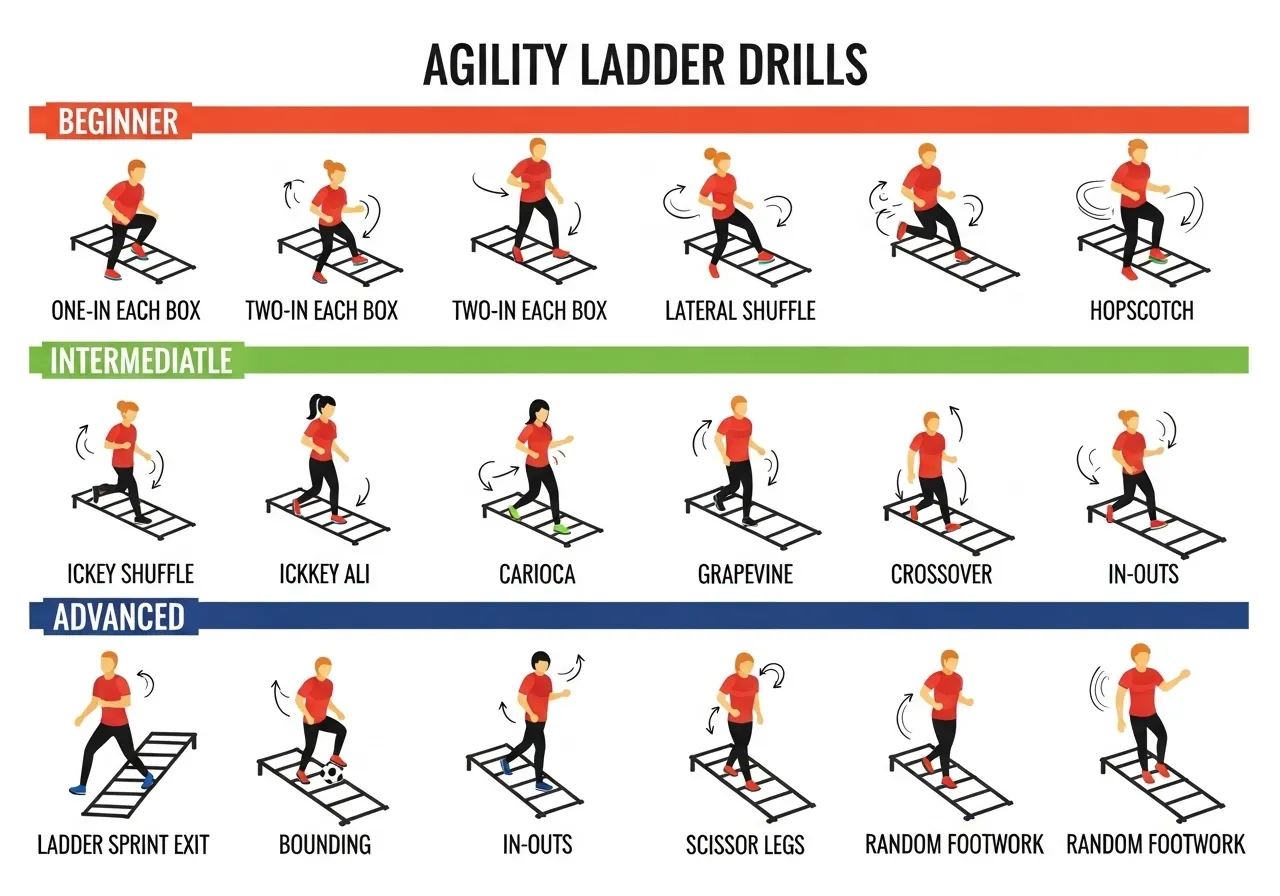
Group these drills into three tiers. Master Tier 1 before attempting Tier 2; master Tier 2 before Tier 3. The progression principle: each drill should be performed accurately at slow speed before adding velocity.
Tier 1 — Beginner (Single Foot Patterns)
🏋️ 1. One-In Run
Pattern: One foot inside each rung, alternating left-right. Simple forward walk/jog pace.
Key point: The foundation drill — establishes spatial awareness of the ladder and basic step rhythm. Do not skip this drill regardless of fitness level.
🏋️ 2. Two-In Run
Pattern: Both feet inside each rung before stepping forward. Left foot in, right foot in, step forward.
Key point: Introduces the concept of coordinating a specific foot sequence per rung — the foundational cognitive challenge of ladder training.
🏋️ 3. Lateral Shuffle
Pattern: Travel sideways across the ladder, stepping one foot in each rung. Lead foot steps in, trail foot follows, move laterally.
Key point: Introduces lateral movement — essential for most sports agility applications. Keep hips low, maintain athletic stance throughout.
🏋️ 4. In-In-Out-Out
Pattern: Both feet inside the rung, then both feet outside, then both inside the next rung. Continuous lateral rhythm.
Key point: The first pattern that requires genuine coordination — many beginners find this surprisingly challenging at speed. This is correct; the challenge is the training stimulus.
Tier 2 — Intermediate (Alternating and Complex Patterns)
🏋️ 5. Ickey Shuffle
Pattern: Left foot in, right foot in, left foot out (left side), step forward. Right foot in, left foot in, right foot out (right side), step forward. Alternates sides.
Key point: The Ickey Shuffle is the benchmark intermediate ladder drill — mastering it indicates adequate coordination for sport-specific agility work.
🏋️ 6. Hopscotch
Pattern: Both feet outside the ladder, jump with both feet inside the rung, jump back outside with feet split wide, repeat.
Key point: Introduces bilateral jump mechanics — trains landing stability and reactive power alongside the coordination demand.
🏋️ 7. Ali Shuffle
Pattern: One foot in, other foot out to the side, cross the inside foot to outside the other side, repeat. Continuous lateral crossover pattern.
Key point: High hip rotation and crossover demand — directly trains the crossover step pattern used in lateral athletic movement and change-of-direction scenarios.
🏋️ 8. Single-Leg Hops
Pattern: Hop forward on one foot, landing inside each rung consecutively. Switch legs on the return.
Key point: Develops unilateral landing stability and reactive strength — identifies side-to-side coordination and power asymmetries clearly.
Tier 3 — Advanced (High-Speed and Directional Change)
🏋️ 9. T-Pattern Drill
Pattern: Two-in run to the midpoint, lateral shuffle to the right end, lateral shuffle across to the left end, lateral shuffle back to centre, backpedal to start.
Key point: Combines multiple patterns in sequence — tests the ability to transition between movement modes rapidly, mirroring real sport movement demands.
🏋️ 10. Carioca Through
Pattern: Lateral carioca (grapevine step — cross behind, step, cross in front, step) through the ladder at speed.
Key point: Demands hip rotation, thoracic rotation, and foot coordination simultaneously — the highest neuromuscular coordination demand of any standard ladder drill.
🏋️ 11. Sprint-Out Drill
Pattern: Two-in run through the ladder at maximum speed, then immediately sprint 10–15 m beyond the end.
Key point: The bridge drill between ladder coordination and athletic sprint application — the transition from controlled footwork to maximal velocity sprint trains the acceleration mechanics that follow ladder patterns in sport contexts.
🏋️ 12. Random Pattern (Coach-Called)
Pattern: Partner or coach calls a pattern change mid-drill (switch from two-in to lateral, from lateral to backpedal) and athlete transitions on command.
Key point: The most cognitively demanding ladder application — mirrors the reactive agility of sport where movement decisions are externally cued rather than pre-planned. This is where the cognitive training benefits of ladder work are maximised.
4 Mistakes That Prevent Agility Ladder Training From Producing Results
Mistake 1: Rushing to Maximum Speed Before Mastering the Pattern
The most common and consequential ladder training error: performing drills at maximum speed before the foot placement pattern is neurologically established. When the pattern is not yet automatic, high speed produces sloppy footwork — feet clip the ladder, patterns break down, and the brain reinforces incorrect movement sequences.
A poorly executed fast drill produces less motor learning than a correctly executed slow drill. Speed should be added only when the pattern can be performed at slow speed for the full ladder length without errors. For most new drills, this means 3–5 slow passes before adding pace. Rushing this process does not accelerate learning — it delays it by embedding incorrect patterns that must later be unlearned.
Mistake 2: Neglecting Arm Action
Arm action during ladder drills is not cosmetic. Proper arm swing — elbows at 90°, driving alternately forward and backward — counterbalances the rotational forces from rapid leg movement, increases ground clearance speed, and activates the same upper-lower limb coordination patterns required for sprint mechanics and athletic movement.
Trainees who perform ladder drills with passive arms or hands clasped behind the back are training foot coordination in isolation from the full movement system. Adding active arm action increases the cardiovascular demand, the neuromuscular complexity, and the sport-specific transfer of every drill.
Mistake 3: Only Doing Forward-Facing Drills
Most ladder trainees perform forward-facing drills exclusively — one-in run, two-in run, Ickey shuffle. Lateral, diagonal, and backward movement patterns train the hip abductors, external rotators, and posterior chain in ways forward movement never requires, and they directly develop the multi-directional agility that sport and functional movement demand.
A complete ladder programme includes at least one lateral drill and one backward/diagonal drill per session alongside forward-facing patterns. The lateral shuffle, Ali shuffle, and carioca each develop different aspects of multi-directional coordination.
Mistake 4: Treating It as Warm-Up Only
Many trainees use the ladder for 5 minutes as a warm-up before “real” training. At 5 minutes, the neuromuscular system is just beginning to acquire new patterns — session length is insufficient for genuine motor learning to occur.
Dedicated ladder training sessions of 15–20 minutes — with deliberate pattern practice, progressive speed increases, and rest between drill sets — produce the adaptation that brief warm-up use cannot. If the goal is coordination and agility development rather than just elevating heart rate, the ladder deserves a dedicated training block, not incidental warm-up use. See also: sled training guide for combining explosive power work with ladder coordination training.
6-Week Agility Ladder Programme
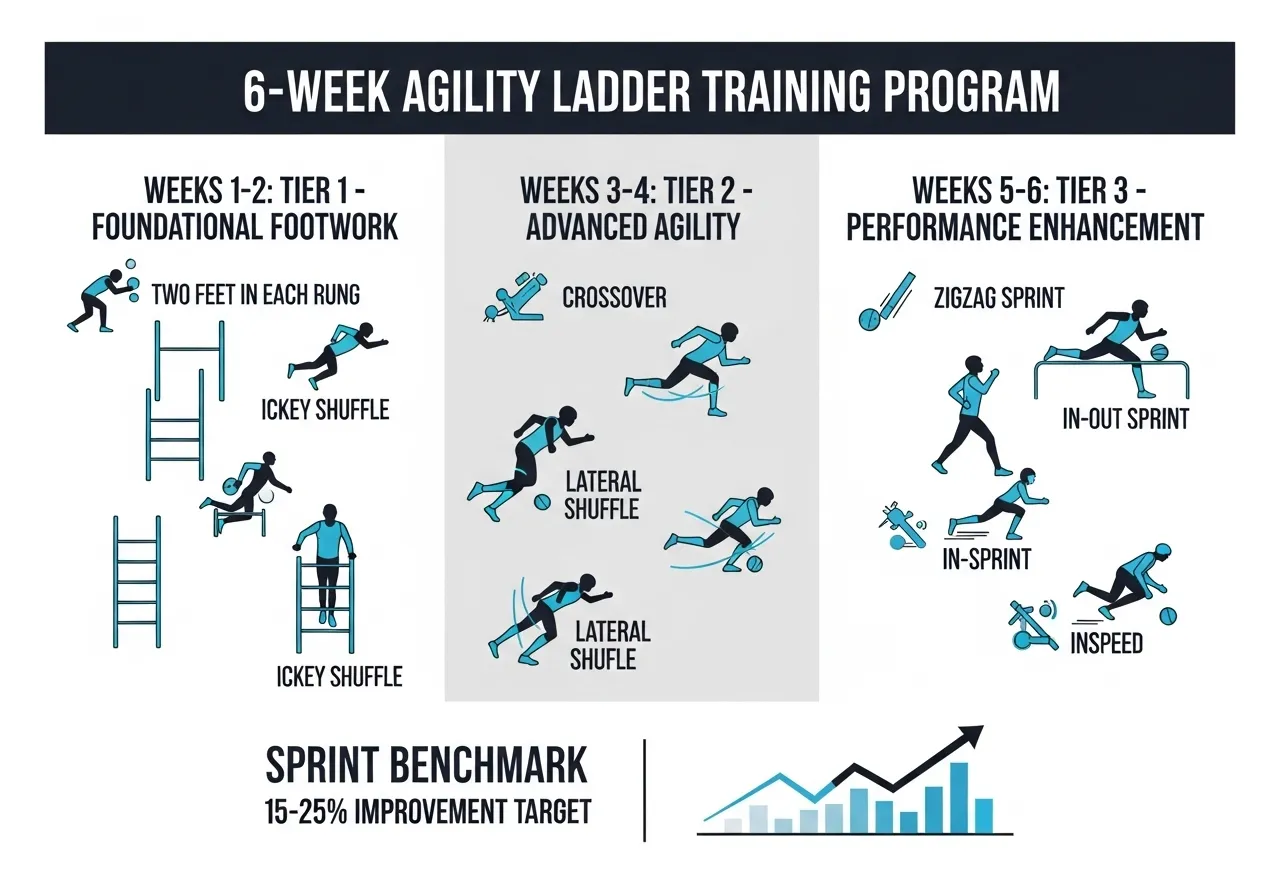
This programme runs 3 sessions per week. Each session takes 15–20 minutes of dedicated ladder work. It progresses from Tier 1 pattern acquisition through Tier 2 combination drills to Tier 3 reactive and sprint-integrated work.
Equipment needed: one agility ladder (8–10 rungs), flat ground or gymnasium floor, athletic footwear with ankle support.
📅 Week 1–2: Tier 1 Pattern Acquisition
One-In Run: 4 passes slow → 4 passes moderate pace
Two-In Run: 4 passes slow → 4 passes moderate pace
Lateral Shuffle: 4 passes each direction at slow pace
In-In-Out-Out: 4 passes slow (expect pattern breakdowns — this is normal)
Rest 60 sec between each drill set
Focus: Pattern accuracy first, speed second. Walk through each new drill before jogging it.
📅 Week 3–4: Tier 2 Introduction + Speed Build
Review Tier 1 drills at increased speed (2 passes each)
Ickey Shuffle: 6 passes — slow → moderate → fast (only if pattern holds)
Hopscotch: 4 passes focusing on soft landing mechanics
Ali Shuffle: 4 passes each direction at slow to moderate pace
Single-Leg Hops: 3 passes each leg
Focus: Ickey Shuffle mastery — this is the benchmark. Can you perform it at full speed without pattern breakdown?
Full Tier 2 circuit at speed (1–2 passes each, minimal rest)
Sprint-Out Drill: 6 sets — two-in run at max speed → 15 m sprint
Carioca Through: 4 passes each direction
Random Pattern (self-directed): 4 passes — change direction at the midpoint based on pre-set cue
Week 6 Benchmark: Time yourself through the standard one-in run and two-in run. Compare to Week 1. A 15–25% reduction in time for the same ladder length is typical after 6 weeks of consistent practice.
Focus: Speed and reactive transitions — the programme shifts from pattern learning to performance expression
Frequently Asked Questions About Agility Ladder Training
How long does it take to see results from agility ladder training?
Motor learning adaptations — improved pattern accuracy and drill speed — typically become noticeable within 2–3 weeks of consistent practice (3 sessions per week). Sprint speed and athletic agility improvements require 4–6 weeks and are most pronounced in less trained individuals. Trainees who are already fast and well-coordinated will see smaller performance gains but still benefit from the coordination and cognitive challenge that ladder training uniquely provides.
Should I use an agility ladder for warm-up or as a main workout?
Both — but with different intent. As a warm-up: 5 minutes of basic drills (one-in run, lateral shuffle) elevates heart rate, activates ankle stabilisers, and prepares the neuromuscular system for explosive training. As a main workout: 15–20 minutes of progressive drill practice with deliberate speed progression produces genuine coordination and agility adaptation. If agility is a training priority, dedicate a full block to it rather than limiting it to warm-up use.
Does agility ladder training help with fat loss?
It contributes. High-intensity ladder circuits (minimal rest, complex patterns, 15–20 minutes) produce heart rates of 75–85% maximum and caloric expenditure comparable to interval running. The combination of cardiovascular demand and high-frequency leg movement makes it a reasonable conditioning tool for metabolic goals alongside its primary coordination benefits. It is not as calorie-dense per minute as heavy compound lifting or sustained running, but it adds variety and develops qualities those modalities miss.
Can I do agility ladder training every day?
Low-intensity pattern practice (slow speed, Tier 1 drills) could be done daily as skill acquisition work without significant recovery demand. High-intensity ladder sessions — maximum speed, complex patterns, sprint-out drills — produce meaningful neuromuscular fatigue and benefit from 48 hours of recovery between sessions. Three sessions per week is the research-supported frequency for meaningful agility adaptation. Daily high-intensity ladder work typically produces diminishing returns and increased ankle fatigue over time. Combining ladder sessions with jump rope training on the same day creates an efficient dual-stimulus session.
Is agility ladder training useful if I do not play sport?
Yes. The coordination, proprioception, and neuromuscular benefits of ladder training transfer to general functional movement quality — balance, ankle stability, reactive stepping during daily activities (navigating stairs, uneven ground, unexpected obstacles). The cognitive engagement of complex footwork patterns provides a brain-body challenge that purely aesthetic or cardiovascular gym training does not offer. For older adults specifically, the research confirms meaningful fall prevention and cognitive benefits from regular agility training.
Every squat you perform at 100 kg involves both legs. One leg may contribute 55 kg worth of force. The other may contribute 45 kg. The bar goes up. The asymmetry is invisible. This hidden asymmetry compounds over months and years of bilateral-only training. The dominant leg becomes increasingly stronger relative to the non-dominant leg….
⚠️ Fitness Disclaimer: The information in this article is for general educational purposes only and does not constitute professional fitness or medical advice. Always consult a qualified healthcare professional before starting any new exercise program, especially if you have existing injuries or medical conditions. The Ball That Made My Conventional Training Feel Incomplete I added…
Walk into any gym and you will find cable stacks, pull-up bars, and Smith machines. Gymnastic rings are the one piece of equipment almost nobody uses. They also happen to be the one piece that trains the quality every other tool ignores: three-dimensional shoulder stability under dynamic load. Rings hang freely. They rotate, swing, and…
Power is not the same as strength. A trainee can deadlift 200 kg but be unable to jump 50 cm if they have never trained for explosive force production. The gap between strength capacity and power expression is where box jump training operates. The box jump trains the stretch-shortening cycle: the rapid eccentric loading and…
⚠️ Health & Fitness Disclaimer This article is for general educational purposes only and does not replace professional medical advice. If you have any joint, tendon, or cardiovascular condition, please consult a qualified healthcare professional before beginning any isometric training programme. Isometric training — contracting a muscle without any change in joint angle or muscle…
There is no neat way to flip a tire. It does not fit into a defined movement category. It is not a deadlift. It is not a push press. It is all of them simultaneously, in a sequence, against an implement that shifts weight as it moves. This awkwardness is the point. Every clean movement…