Walk into any gym and you will find cable stacks, pull-up bars, and Smith machines. Gymnastic rings are the one piece of equipment almost nobody uses.
They also happen to be the one piece that trains the quality every other tool ignores: three-dimensional shoulder stability under dynamic load.
Rings hang freely. They rotate, swing, and shift with every micro-adjustment your body makes. That instability is not a disadvantage. It is the training stimulus.
This guide covers what the EMG research shows about rings versus fixed equipment and why the instability advantage is real but misunderstood.
It also introduces six foundational exercises with correct progressions and an 8-week programme from first contact to genuine ring competency.
The Instability Advantage: What the Research Actually Shows
Why Rings Feel So Much Harder Than a Pull-Up Bar
The first time most trainees attempt a ring push-up, the shock is immediate. A movement they perform for 20 or more reps on the floor becomes a shaking, unstable struggle at 8 reps.
The rings are not harder because the load is heavier. Bodyweight is bodyweight. They are harder because the nervous system must work simultaneously to stabilise the implement, stabilise the shoulder joint, and produce the movement itself.
This three-way demand is the defining characteristic of ring training. Fixed bars and cables separate stabilisation from force production. The equipment handles stability. The muscles produce force. Rings collapse that separation entirely.
The Meta-Analysis: Unstable Training and Muscle Activation
📌 Key Finding
Unstable training produces significantly greater biceps, triceps, and core activation than equivalent stable exercises. Ring training is the most accessible form of instability resistance training for upper body development.
📌 Key Finding
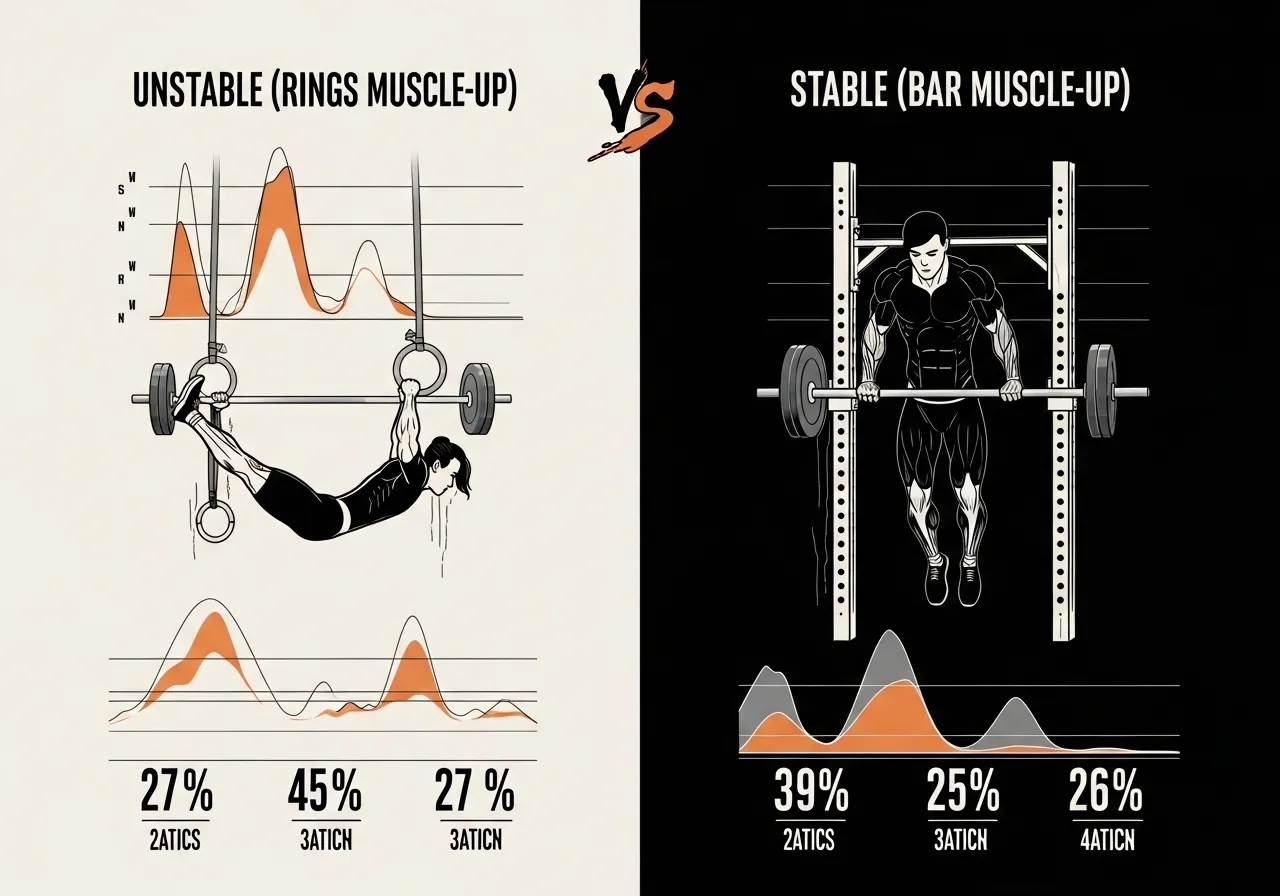
Ring muscle-ups produce greater biceps and triceps activation than bar muscle-ups at both the pull and push phases. The rings are not just harder. They recruit more muscle at every stage of the same movement.
The Critical Nuance: Instability Does Not Always Win
The instability advantage is real. But it operates within boundaries that most ring training content ignores.
Research on pulling movements shows that latissimus dorsi activation does not increase significantly on unstable surfaces compared to stable bars. The lat anchors to the spine. The spine provides its own stability platform, so the lat does not need to work harder to stabilise the implement.
What does increase on rings: the rotator cuff, biceps brachii, forearm flexors, triceps, and core. These are the stabilising structures that protect the shoulder and elbow joints.
Ring training is therefore less a hypertrophy tool for the largest muscles and more a joint-protection and stabiliser-development system. It complements conventional pressing and pulling rather than replacing it.
Trainees who add two ring sessions per week alongside existing training typically notice improved shoulder comfort, grip strength, and pressing stability within four to six weeks.
Bench vs Bar vs Ring Dip: What the EMG Numbers Show
The Dip Research That Reframes Which Variation to Choose
📌 Key Finding
Ring dips match bar dips for triceps activation while allowing natural wrist rotation throughout the movement. This is the key reason trainees with anterior shoulder discomfort find ring dips more comfortable than bar dips at equivalent loads.
Why Wrist Rotation Changes the Shoulder Equation
During a bar dip, the wrists remain fixed in a pronated position throughout the entire movement. The shoulder compensates for this fixed grip by adjusting its rotation angle at each point in the range.
For individuals whose shoulder anatomy does not align with the bar’s fixed geometry, this creates impingement stress at the bottom of the descent.
On rings, the hands rotate freely. They typically begin in a neutral position at the top, internally rotate slightly through the descent, and return to neutral at lockout. This rotation follows the shoulder’s natural arc rather than constraining it to a fixed path.
This is why ring dips resolve anterior shoulder pain for trainees whose bar dip discomfort has resisted every technical adjustment. For a detailed breakdown of all dip variations, the dip guide covers bench vs bar vs ring mechanics in full.
The Support Position: The Foundation Skill Nobody Teaches
The ring support position, arms fully extended with hands at hip level and body vertical above the rings, is the starting and ending point of ring dips, muscle-ups, and L-sits. It looks simple. It is profoundly difficult.
In the support position, the rings naturally want to rotate outward. The lifter must actively turn the rings out by externally rotating the shoulders so the rings face forward, while maintaining full elbow lockout and depressed scapulae.
The muscles working to maintain this position include the pectoralis minor, serratus anterior, posterior deltoid, triceps, and the entire rotator cuff. For most trainees, this is the first time these muscles co-contract under this specific combined load.
Most beginners cannot hold the support position for more than five to ten seconds on the first attempt. This is not a strength failure. It is a coordination and neuromuscular activation failure.
The muscles exist. They have never been asked to co-contract in this pattern before. Consistent support position practice produces rapid improvement. Most trainees reach a 20-second hold within two weeks of daily practice.
Exercise
Stability Demand
Primary Additional Stimulus
Approx. Load vs Floor
Floor push-up
None
Baseline
~65% bodyweight
Ring push-up (high)
Moderate
Rotator cuff, serratus anterior
~50-55% bodyweight
Ring push-up (low)
High
Rotator cuff, core, wrist stabilisers
~65-70% bodyweight
Ring dip
Very high
Full shoulder stabiliser complex
~90-100% bodyweight
6 Key Ring Exercises: From First Contact to Competent Athlete
⚠️ Shoulder and Wrist Safety Note Gymnastic rings place the shoulder joint in end-range positions under load, including deep external rotation during the support position and end-range extension during the muscle-up transition. Individuals with rotator cuff tears, anterior shoulder instability, SLAP lesions, or wrist impingement should obtain medical clearance before beginning ring training. Beginners should start with ring height set low enough that both feet can touch the floor as an emergency support during all exercises.
🏋️ 1. Ring Support Hold
Target: Rotator cuff, triceps, serratus anterior, pectoralis minor
How: Set rings at hip height. Jump or press to the support position with arms locked, rings at hip level, body vertical. Actively turn the rings out so they face forward. Hold for target duration. Step off when control breaks.
Key point: The ring turn-out at the top is non-negotiable. It engages the external rotators and stabilises the shoulder. A support with no turn-out is a shoulder impingement risk, not a productive exercise.
How: Set rings at waist height. Hang below with arms extended and heels on floor. Pull the chest to the rings by driving elbows back and squeezing shoulder blades together. Allow the rings to rotate naturally throughout the pull.
Key point: Adjusting body angle changes the load. A more horizontal body increases load. The ring row is the most accessible ring exercise and the correct starting point for trainees who cannot yet perform a pull-up. For a complete pull-up progression, the pull-up guide covers EMG research and progressions in full.
How: Rings at knee height for beginners (body at 45 degrees); rings near floor for advanced. Perform a push-up with hands on rings, maintaining a rigid body line. At the top, actively press the rings together slightly and turn them out to maximise pectoral contraction.
Key point: Ring height determines the effective bodyweight load. Higher rings mean less load. Progress by lowering ring height, not by adding reps. When floor-level ring push-ups reach 3 sets of 12, advance to the next variation.
How: Hang from rings at full arm extension. Begin with a scapular pull by depressing and retracting the shoulder blades without bending the elbows. Then pull to chin-over-ring height. Lower slowly over 3 to 4 seconds. Allow the rings to rotate naturally, typically from neutral at the bottom to slightly supinated at the top.
Key point: The slow eccentric is critical for developing the stabiliser strength that makes ring pull-ups sustainable. Trainees who use momentum or kip never develop the shoulder stability that makes rings valuable in the first place.
How: From the support position, lower by bending the elbows to approximately 90 degrees. Allow the rings to rotate naturally throughout. Do not force them to stay turned out during the descent. Press back to lockout and actively turn rings out at the top.
Key point: Ring dips require a solid support hold first. If you cannot hold the support for 15 seconds, ring dips are premature. Practice controlled 2-second descents before attempting full-depth ring dips.
🏋️ 6. Ring L-Sit
Target: Hip flexors, rectus abdominis, triceps, anterior core stabilisers
How: From the support position, extend both legs forward to horizontal. Hold for target duration. Progression: tuck L-sit (knees bent, thighs horizontal) then single-leg L-sit (one leg extended, one tucked) then full L-sit (both legs extended horizontal).
Key point: The tuck L-sit is achievable within two to three weeks for most trainees. The full L-sit requires months of progressive hip flexor and anterior core development. Do not skip the tuck stage. It builds the pressing base that makes the full L-sit accessible.
Why Ring Training Exposes Weaknesses That Conventional Training Hides
The Scapular Stability Connection
Ring training and scapular stability are inseparable. Every ring exercise demands coordinated scapular movement. The shoulder blade must upwardly rotate, depress, retract, and protract in a controlled sequence as the arm moves through its range.
Trainees who have underdeveloped scapular stabilisers, specifically the serratus anterior and lower trapezius, find ring training immediately exposes this weakness. It shows up as shoulder discomfort or an inability to hold the support position for more than a few seconds.
The scapular stability guide covers the foundational exercises that address these weaknesses before ring training begins.
Ring training does not create shoulder problems for trainees with good scapular function. It reveals pre-existing weaknesses that conventional training allows you to compensate around.
Identifying and addressing those weaknesses is exactly what beginner ring training accomplishes. This makes it arguably more appropriate for beginners than for advanced trainees who already have developed stabilisers.
The Beginner Entry Sequence
The correct beginner approach to ring training follows a strict prerequisite sequence:
Step 1: Ring row at 45 degrees. Rings at waist height, body angled at 45 degrees. If this produces shoulder discomfort, reduce the angle further until a pain-free position exists.
Step 2: Ring push-up at 45 degrees. Rings at chest height, body angled at 45 degrees. The reduced bodyweight load makes the instability manageable while still training the stabiliser co-contraction.
Step 3: Support hold. Five-second holds with feet available as backup. Progress to 15-second unassisted holds before advancing to ring dips or push-ups at lower angles.
Step 4: Full ring push-up and ring dip. Only after Step 3 produces a reliable 20-second support hold with rings turned out.
Static Before Dynamic: The Core Safety Principle
Ring training injuries almost universally occur when trainees skip prerequisite steps or perform dynamic ring exercises before developing the static strength that makes dynamic control possible.
Hold the support before performing dips. Hold a dead hang before performing pull-ups. Hold a horizontal body ring row before advancing to a steeper angle. The strength to maintain a position guarantees the strength to move through it safely.
⚠️ Important: Ring training with existing shoulder instability or rotator cuff pathology should proceed only with physiotherapy guidance. The shoulder positions in ring training are specifically provocative for common shoulder pathologies.
4 Ring Training Errors That Make Every Session Less Effective
Error 1: Skipping the Ring Turn-Out
The ring turn-out is the single most important technical detail in ring training. It means actively externally rotating the shoulder so the rings face forward at the support position.
Most beginners skip it because it is uncomfortable and easy to ignore when no coach is watching.
Without the turn-out, the support position places the shoulder in a neutral-to-internally-rotated position under axial load. Over repeated sessions, this creates cumulative anterior shoulder stress.
With the turn-out, the posterior shoulder muscles and external rotators engage, sharing the load across a larger muscle group and maintaining the joint in its most stable position.
A practical cue: at the top of every ring push-up or dip, pause and actively try to make the rings point directly forward. The forearms should rotate outward until the rings are roughly parallel with the direction of movement. Hold this for one second before the next rep.
Error 2: Attempting the Muscle-Up Too Early
The ring muscle-up is the exercise most associated with ring training in mainstream fitness content. It is also the exercise most responsible for ring-related shoulder injuries in recreational trainees.
The false kipping muscle-up bypasses the shoulder stability prerequisites entirely. The joint moves rapidly through the impingement zone at the transition point while the stabilisers are unprepared. The resulting anterior shoulder pain is common and often persists for months.
The correct progression requires 10 or more strict ring pull-ups, 10 or more strict ring dips, and a reliable transition drill before attempting the combined movement. Most trainees need six to twelve months before the muscle-up is structurally appropriate.
Error 3: Replacing Loaded Work Entirely
Ring training develops joint stability, co-activation patterns, and neuromuscular coordination. It does not develop the absolute strength ceiling that heavy barbell and dumbbell work provides.
Trainees who switch entirely to ring training often see initial improvements in shoulder health and bodyweight strength. This is followed by a plateau at the strength level their bodyweight can provide.
Ring-only trainees rarely develop the posterior chain strength, leg strength, or absolute pressing numbers that loaded training uniquely produces. These qualities require progressive external load, which bodyweight alone cannot provide past a certain threshold.
The effective approach: two ring sessions per week alongside existing strength training. The rings address stabiliser development. The barbells and cables address the absolute strength ceiling that rings cannot reach.
Error 4: No Progressive Structure
Because ring training uses bodyweight, many trainees treat it as unstructured skill practice. They perform support holds until they feel like moving on, ring push-ups until their arms feel tired, and ring rows until they get bored. No rep targets, no set counts, no progression plan.
This produces the same result as any unstructured training: initial improvement followed by rapid plateau.
Ring training responds to the same progressive overload principles as any other modality. Increasing set volume, decreasing ring height, adding pauses at end range, or progressing to harder variations all constitute progressive overload. All require deliberate planning to implement consistently.
Frequently Asked Questions About Gymnastic Rings
What is the minimum prerequisite strength before starting ring training?
For beginner-accessible exercises including ring rows and ring push-ups at 45 degrees, there is no minimum prerequisite beyond basic movement quality.
For intermediate exercises including full ring push-ups, ring pull-ups, and the support hold, the ability to perform 5 controlled chin-ups and 15 push-ups provides an appropriate foundation.
For advanced exercises including ring dips, L-sit, and muscle-up progressions, a reliable 20-second support hold and 10 strict ring pull-ups are reasonable prerequisites.
How do wooden rings compare to plastic or metal rings?
Wooden rings provide better grip friction than plastic or metal. This advantage becomes more significant as training progresses to heavier loads and longer hold durations.
For beginners performing rows and push-ups at angles, plastic rings are functionally adequate. For intermediate and advanced ring work, wooden rings are the standard choice used in all gymnastics contexts.
How should ring height be set for different exercises?
Ring rows work at waist to chest height depending on the desired body angle and load. Ring push-ups range from chest height, the easiest and lightest load, to just above floor level, which approaches full bodyweight.
Ring dips and support hold work with rings at hip height when standing. Ring pull-ups require rings at full overhead reach when standing.
A setup at standing chest height provides flexibility to adjust body position for the full range of beginner-to-intermediate exercises without repositioning the rings between exercises.
Can ring training help with shoulder pain from conventional pressing?
Often yes, but the mechanism is indirect. Ring training develops the rotator cuff, serratus anterior, and posterior shoulder stabilisers that conventional pressing systematically underloads.
Over four to eight weeks of consistent ring training, many trainees find that their conventional bench press, overhead press, and dip become more comfortable as stabiliser function improves.
The exception: if pressing pain originates from a structural pathology such as a rotator cuff tear or labral tear, ring training addresses the surrounding musculature without treating the structural issue. Professional assessment is appropriate before using ring training as a shoulder pain management strategy.
How many ring sessions per week produces the best results?
Two sessions per week produces measurable improvements in stabiliser strength and ring-specific competency for most trainees while allowing adequate recovery between sessions.
Three sessions per week is sustainable once basic competency is established. Daily ring training of the support hold and ring rows at moderate volume is appropriate once the shoulder structures have adapted over six to twelve weeks of progressive work.
Key Takeaways
A meta-analysis confirms unstable training significantly increases biceps, triceps, and core activation over stable equivalents
Ring muscle-ups produce greater upper trapezius, biceps, and triceps activation than bar muscle-ups at both the pull and push phases
Ring dips match bar dips for triceps activation while allowing natural wrist rotation, making them preferable for trainees with anterior shoulder discomfort
Static before dynamic is the fundamental safety principle: hold the support before ring dips; perform strict ring pull-ups before muscle-up progressions
Ring training works best as a complement to loaded gym training, not a replacement
⚠️ Health & Fitness Disclaimer This article is for general educational purposes only and does not replace professional medical advice. If you have any joint, tendon, or cardiovascular condition, please consult a qualified healthcare professional before beginning any isometric training programme. Isometric training — contracting a muscle without any change in joint angle or muscle…
⚠️ Health & Fitness DisclaimerThis article is for general educational purposes only and does not replace professional medical advice. If you have any lower limb, knee, or ankle conditions, please consult a qualified healthcare professional before beginning plyometric training overview training. Plyometric training — exercise that uses the stretch-shortening cycle (the rapid lengthening of a…
⚠️ Health & Fitness DisclaimerThis article is for general educational purposes only and does not replace professional medical advice. If you have any pre-existing shoulder, wrist, or back conditions, please consult a qualified healthcare professional before beginning medicine ball training. The medicine ball is one of the oldest and most versatile training implements in existence…
⚠️ Health & Fitness DisclaimerThis article is for general educational purposes only. It does not replace professional medical advice. If you have cardiovascular, joint, or lower back conditions, consult a qualified healthcare professional before starting sled training. The training sled is one of the most underused tools in general fitness — despite being standard in…
⚠️ Health & Fitness DisclaimerThis article is for general educational purposes only and does not replace professional medical or fitness advice. If you have any cardiovascular or joint concerns, consult a healthcare professional before starting a new exercise program. Jump rope is one of the most underrated training tools available — a piece of equipment…
⚠️ Fitness Disclaimer: The information in this article is for general educational purposes only and does not constitute professional fitness or medical advice. Always consult a qualified healthcare professional before starting any new exercise program, especially if you have existing injuries or medical conditions. Why the kettlebell research guide Is the Most Efficient Training Tool…