⚠️ Health & Fitness Disclaimer This article is for general educational purposes only and does not replace professional medical or fitness advice. If you have any cardiovascular or joint concerns, consult a healthcare professional before starting a new exercise program.
Jump rope is one of the most underrated training tools available — a piece of equipment that costs less than a gym day pass yet delivers cardiovascular intensity, coordination training, and caloric expenditure that rivals far more expensive modalities.
This guide covers what the research says about complete jump rope guide‘s benefits, breaks down the most effective techniques and progressions, and provides a complete 8-week training plan for all levels.
Why Jump Rope Produces Such Strong Cardiovascular Stimulus
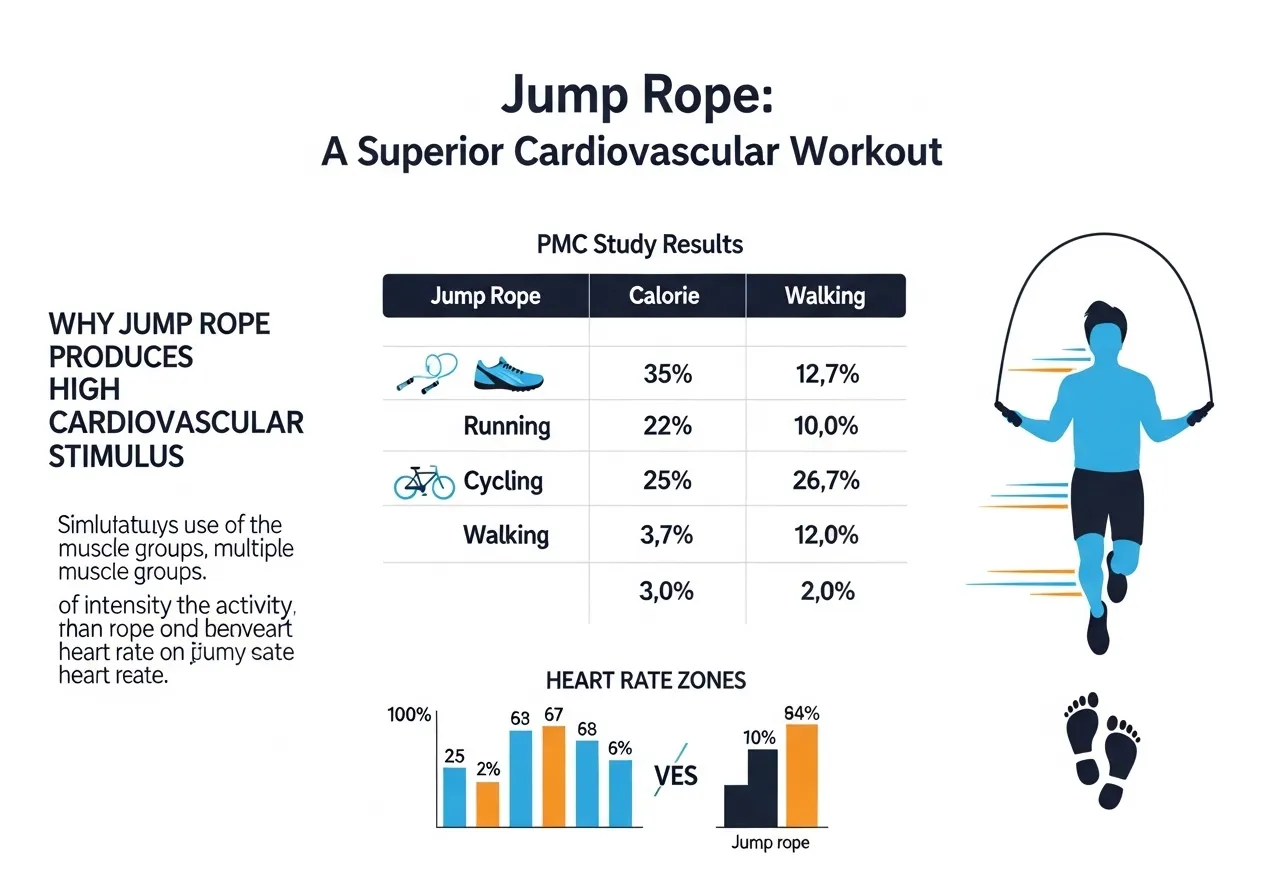
Jump rope generates a high cardiovascular response for several interconnected reasons:
Continuous lower body loading: Every jump requires the calves, quadriceps, and glutes to produce force — maintaining muscular demand across the entire session
High stroke frequency: At 120–160 jumps per minute, the heart must sustain elevated output continuously, unlike circuit training where transitions briefly reduce intensity (see also: heart rate zones)
Upper body coordination: Wrist rotation and arm positioning engage the shoulders and forearms as active stabilizers throughout
Coordination demand: The timing requirement keeps the central nervous system engaged, contributing to overall metabolic cost
Caloric Expenditure: How Jump Rope Compares
Activity (30 min vigorous)
Estimated Calories (70 kg person)
Jump rope (vigorous)
300–400 kcal
Running (moderate pace)
300–360 kcal
Cycling (moderate)
210–280 kcal
Walking (brisk)
130–160 kcal
Individual caloric expenditure varies significantly with body weight, intensity, and fitness level. These figures are broad estimates — actual effort (reflected by heart rate) is a more reliable intensity indicator than calorie displays.
Bone Density and Coordination Benefits
Beyond cardiovascular adaptations, jump rope training produces two additional benefits that are often overlooked:
Bone density: The repeated low-impact loading from jumping stimulates osteogenic (bone-building) adaptation in the ankle, shin, and hip bones — relevant for long-term skeletal health, particularly in aging populations
Coordination and proprioception: The timing demands of jump rope training — synchronizing arm rotation, jump timing, and landing — develop neuromuscular coordination that transfers to athletic movement and reduces fall risk in older adults
Mental Health and Cognitive Benefits
Rhythmic, repetitive exercise like jump rope has been associated with mood improvement and stress reduction — consistent with the broader body of evidence on aerobic exercise and mental health.
The focus required to maintain jump rope rhythm creates a mild meditative effect — the mind is occupied with timing and footwork, providing a natural break from ruminative thought that many trainees find beneficial as a stress management tool.
Research on rope jumping and cognitive function in children has shown improvements in attention and executive function following jump rope interventions — suggesting neurological benefits alongside the physical adaptations.
Cost and Accessibility Advantages
From a practical standpoint, jump rope offers remarkable value:
A quality PVC speed rope costs less than a single gym visit in most markets
The rope fits in a jacket pocket — the most portable exercise tool available
Training requires only 2–3 square meters of clear floor space
No electricity, screen, or subscription is required
This combination of low cost, high portability, and genuine training effectiveness makes jump rope one of the highest return-on-investment fitness tools available to any budget level.
How Jump Rope Compares to Running for Cardiovascular Development
Jump rope and running produce similar cardiovascular adaptations — both develop VO2max, reduce resting heart rate, and improve cardiac efficiency with consistent training.
The key practical differences:
Impact: Running generates 2–3× bodyweight ground reaction forces per stride; jump rope generates lower per-jump forces due to the brief ground contact and bilateral loading
Skill requirement: Running requires minimal coordination learning; jump rope has a technique learning curve of approximately 2–4 weeks for consistent basic bouncing
Space requirement: Running requires outdoor space or a treadmill; jump rope requires only 2–3 square meters of clear floor space
Weather dependence: Running is weather-dependent outdoors; jump rope can be performed indoors year-round
For trainees who cannot run due to joint sensitivity or space limitations, jump rope provides a viable high-intensity cardiovascular alternative that develops similar fitness qualities through a lower-impact mechanism.
EPOC: The Post-Exercise Caloric Benefit
Vigorous jump rope sessions — particularly jump rope HIIT formats — produce significant excess post-exercise oxygen consumption (EPOC, sometimes called the “afterburn effect”).
After a high-intensity jump rope session, the body continues consuming oxygen at an elevated rate for 1–4 hours as it restores phosphocreatine stores, clears lactate, and returns core temperature and hormonal levels to baseline.
Research suggests HIIT-style training produces greater EPOC than steady-state cardio — adding approximately 6–15% to the session’s total caloric cost beyond what is burned during the workout itself. While not the dramatic “burn calories for 48 hours” sometimes claimed in fitness marketing, consistent EPOC accumulation across multiple weekly sessions contributes meaningfully to total energy expenditure.
Integrating Jump Rope Into a Weekly Training Schedule
For trainees adding jump rope to an existing resistance training program, the following integration approach minimizes interference while maximizing cardiovascular benefit:
Day
Primary Training
Jump Rope Role
Monday
Lower body strength
5 min warm-up only
Tuesday
Rest / active recovery
20 min conditioning session
Wednesday
Upper body strength
5 min warm-up + 10 min post-session
Thursday
Rest
Rest
Friday
Full body strength
5 min warm-up only
Saturday
Dedicated cardio
25 min HIIT jump rope session
Sunday
Full rest
Rest
This structure provides two dedicated jump rope conditioning sessions per week — sufficient for cardiovascular adaptation — while preserving strength session quality by not placing intense cardio immediately before lower body lifting days.
Choosing the Right Jump Rope
Rope Types and Their Applications
Jump rope selection significantly affects technique development and training quality:
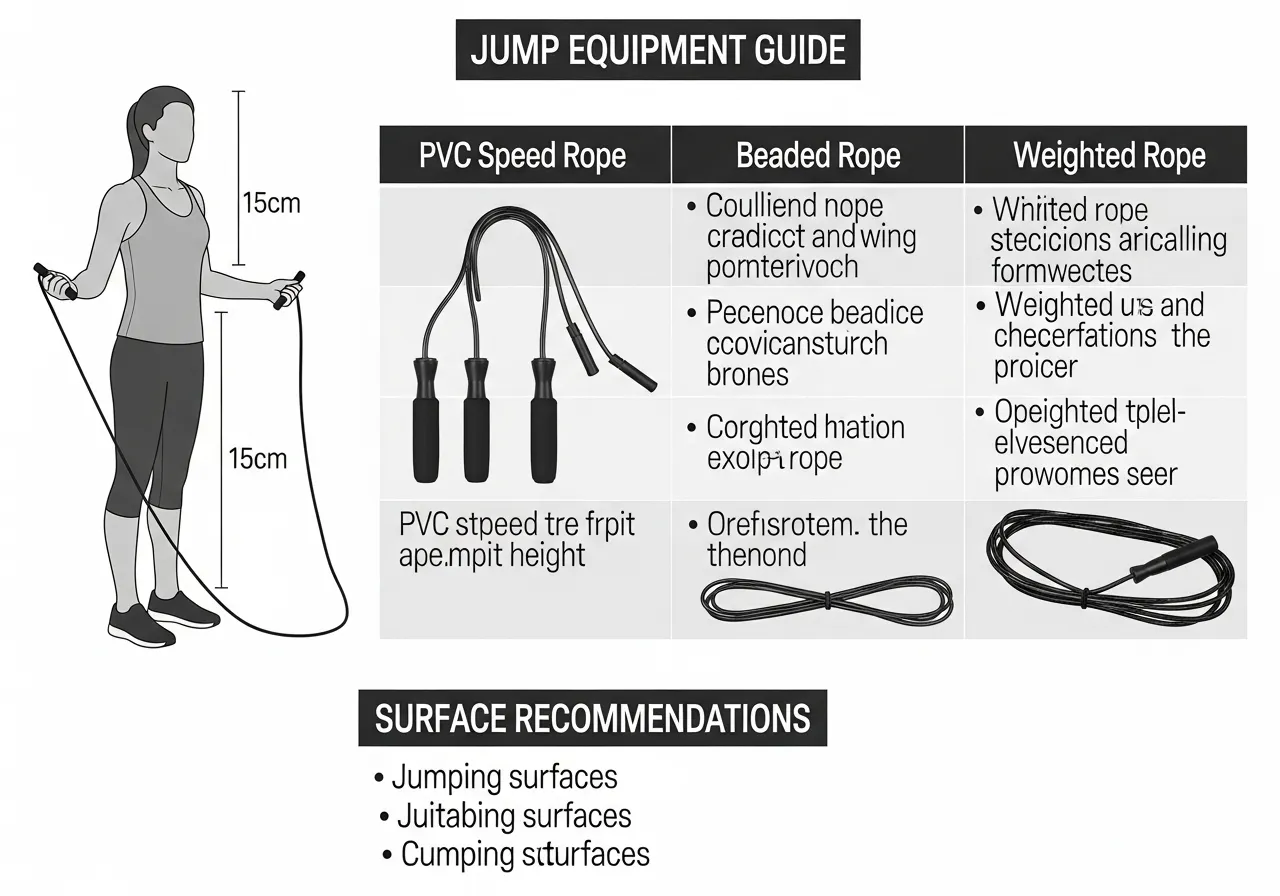
PVC speed rope: Lightweight and fast — ideal for cardio conditioning, double unders, and high-speed work. The most versatile choice for fitness training.
Beaded rope: Individual plastic beads on a cord — heavier, slower, and more forgiving for beginners learning rhythm and timing. Excellent feedback when the rope hits the ground.
Weighted rope: Heavier handles or cable — increases upper body and grip demand. Useful for strength-conditioning hybrid training, though slower than PVC ropes.
Cable/steel rope: Used primarily by competitive speed jumpers — very fast, unforgiving of timing errors. Not recommended for beginners.
How to Size Your Rope Correctly
Rope length determines how efficiently the arc clears your head during each jump:
Quick sizing method: Stand on the center of the rope with both feet. Pull the handles upward — for beginners, handles should reach armpit height. For more experienced jumpers, handle height can drop to chest level as technique improves, which increases rope speed.
A rope that is too long creates a slow arc that disrupts rhythm and makes consistent timing difficult. A rope that is too short catches on the feet before the arc clears properly. When starting out, slightly longer (armpit height) is more forgiving.
Surface and Footwear Considerations
Jump rope training is most effective on a surface with some give:
Rubber gym flooring: Ideal — absorbs impact and protects both the rope and the floor
Hardwood floor: Acceptable — produces more impact than rubber but is manageable with correct landing technique
Concrete: Usable outdoors — the hardest surface; higher cumulative joint impact with extended sessions
Grass/soft ground: Difficult — the rope catches and the surface varies, disrupting rhythm
Cross-training shoes or lightweight trainers with moderate cushioning are appropriate for most jump rope training. Barefoot jumping is practiced by some experienced jumpers indoors on soft surfaces, but is not recommended for beginners or extended sessions.
Rope Maintenance and Care
A well-maintained rope lasts significantly longer and performs more consistently:
Avoid jumping on concrete if possible — concrete surfaces wear PVC ropes quickly compared to rubber flooring
Uncoil and hang the rope between uses rather than storing it coiled tightly, which creates kinks that disrupt the arc during jumping
Inspect the handles periodically — loose handle connections cause the rope to spin inconsistently
Replace PVC cables when visible fraying appears — frayed ropes snap under load unexpectedly
Jump Rope as a Travel Training Solution
For frequent travelers or those with unpredictable schedules, jump rope is arguably the most practical solution to maintaining cardiovascular fitness away from home:
A quality PVC rope weighs under 200 grams and occupies minimal luggage space
Any hotel corridor, parking level, or outdoor space provides adequate training space
No electricity, internet connection, or other infrastructure is required
A 15–20 minute session with a jump rope maintains cardiovascular fitness during travel periods that would otherwise produce detraining
Maintaining even 2 sessions per week during travel periods — far below optimal training volume — is sufficient to preserve most cardiovascular adaptations built during normal training blocks.
Children and Jump Rope: Developmental Benefits
Jump rope has exceptional developmental value for children and adolescents beyond its fitness benefits:
Rhythm and timing development — foundational to musical ability, dance, and sport coordination
Social play — the historically communal nature of playground jump rope develops turn-taking and cooperation
Bone density stimulus during the critical developmental window when bone-building response to loading is greatest
Research has documented improvements in cognitive function and attention in school-age children following jump rope programs — suggesting neurological development benefits that extend beyond physical fitness.
Investing in quality equipment and proper maintenance from the start of a jump rope practice produces compounding returns — consistent, reliable equipment removes the friction that can otherwise interrupt training momentum across months and years of practice.
Jump Rope Technique: From Basic Bounce to Advanced Skills
The Basic Two-Foot Bounce
The foundational jump rope technique used for most conditioning work:
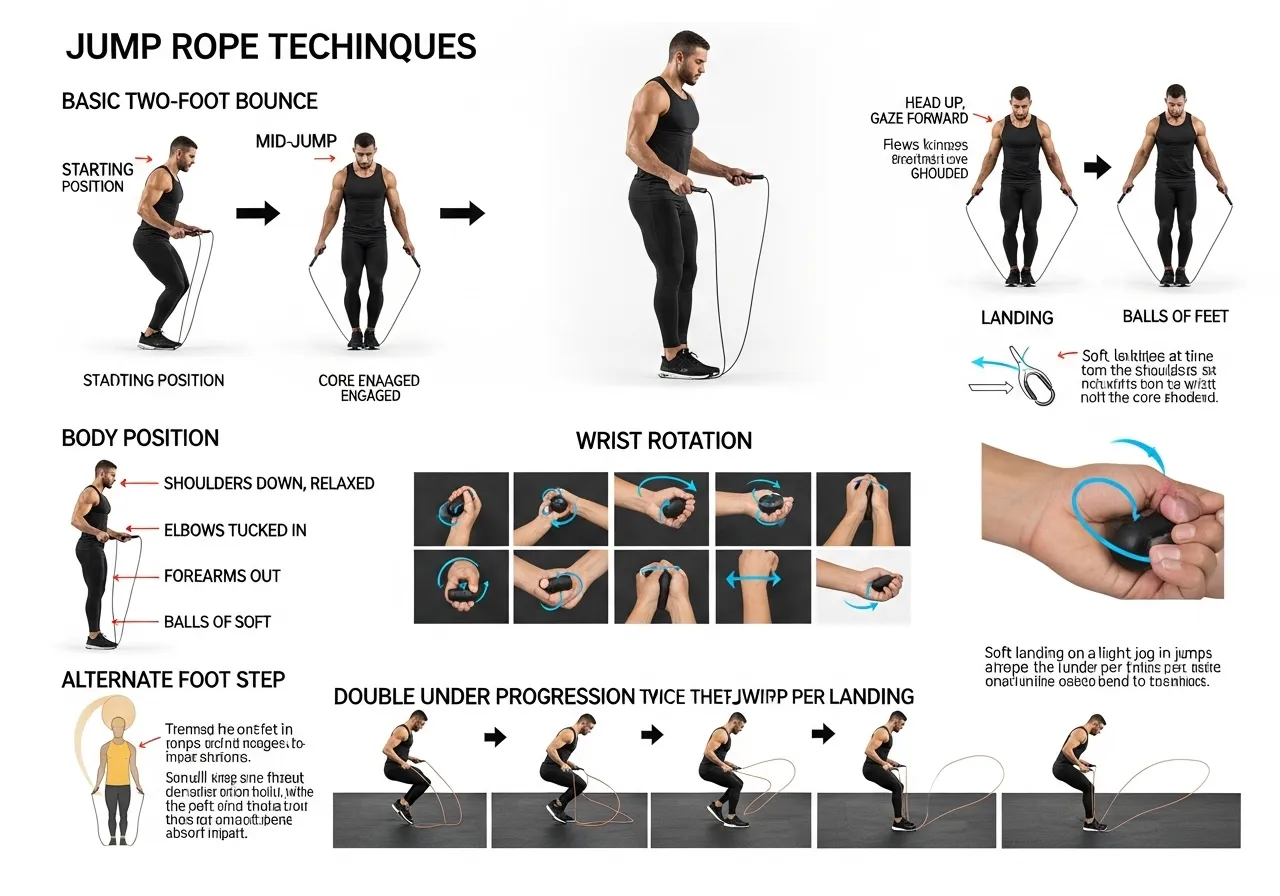
Body position: Stand upright, slight forward lean from the hips. Eyes forward, not down at the rope. Arms: Elbows close to the sides, forearms parallel to the floor. The rope turns from the wrists — not the shoulders. Jump height: 2–3 cm off the ground — just enough to clear the rope. Higher jumps waste energy and increase joint impact. Landing: Land on the balls of the feet (the padded area just behind the toes) — not flat-footed. The calves act as shock absorbers. Rhythm: Find a consistent cadence — most beginners naturally settle at 60–80 jumps per minute.
The Alternate Foot Step
A running-in-place motion — transfer weight from foot to foot with each rope pass. More natural for many beginners than the two-foot bounce, and produces slightly higher caloric expenditure due to greater hip flexor involvement.
The alternate foot step is also more sustainable for longer continuous sessions — the load alternates between legs rather than accumulating bilaterally.
Double Unders: The Intensity Multiplier
A double under passes the rope twice under the feet in a single jump. It requires:
A slightly higher jump than the standard bounce (10–15 cm)
A brief “power jump” — an explosive push through the toes
Faster wrist rotation to complete two rope passes in the air
Double unders roughly triple the cardiovascular intensity per jump compared to single jumps — they are a central tool in conditioning programs for this reason. Most beginners should spend 2–4 weeks developing consistent single jumps before attempting double unders.
Common Technique Errors and Their Corrections
Error
Consequence
Correction
Turning rope with shoulders
Arms fatigue rapidly; inconsistent arc
Elbows pinned to sides; rotate from wrists
Jumping too high
Excess impact; rapid fatigue; slower pace
2–3 cm clearance only; visualize the rope height
Landing flat-footed
Higher ankle and knee joint stress
Land on balls of feet; bend knees slightly
Looking down at the rope
Forward head posture; balance disruption
Fix gaze on a point at eye level
Rope too long
Slow, difficult arc; inconsistent rhythm
Shorten until handles reach armpit height
The High Knee Variation
High knees during jump rope — driving the knees to waist height alternately while jumping — substantially increases the cardiovascular and hip flexor demand compared to the basic bounce.
The higher knee drive requires significantly more power from the hip flexors and core stabilizers, elevating heart rate faster than standard jumping at the same rope speed. It is a useful progression between basic alternate foot jumping and double unders for trainees looking to increase intensity without the timing complexity of double unders.
Box Jumps vs. Jump Rope: Different Demands
A common question from trainees is whether box jumps and jump rope are interchangeable as plyometric tools. They are not — they address distinct qualities:
Box jumps: Maximum single explosive effort; trains peak power in the lower body; low cardiovascular demand due to extended rest between jumps
Jump rope: Repeated submaximal effort; trains cardiovascular endurance and sustained lower body power; high cardiovascular demand due to continuous movement
Box jumps and jump rope complement each other well in the same program — they do not compete for the same adaptation.
Jumping Rope Without a Rope: Phantom Jump Rope
When noise is a genuine constraint — late night training in an apartment building, for example — the “phantom jump rope” technique allows training the cardiovascular and coordination demands without the actual rope:
Hold imaginary handles at the sides; perform the wrist rotation motion as if turning a real rope
Jump in the same rhythm and foot pattern as regular jump rope training
The cardiovascular demand is essentially identical to rope jumping at the same cadence
The coordination benefit is reduced without the rope — there is no consequence for timing errors — but the cardiovascular stimulus is maintained. Phantom jumping is a practical workaround when noise is a legitimate concern.
Jumping Surface Impact Calculation
For trainees concerned about cumulative joint loading, understanding the relative impact of different surfaces helps make informed choices:
Rubber gym flooring (10mm+): Highest impact absorption — recommended for high-volume training
Sprung hardwood: Moderate absorption from the spring subfloor
Foam mat (EVA tiles): Soft but unstable — can interfere with foot positioning and ankle stability
Asphalt: Higher impact than concrete paradoxically — the slight surface texture increases friction forces at landing
For trainees performing more than 20 minutes of cumulative jump rope per session, investing in a 10mm rubber mat specifically for jump rope training is a practical long-term joint protection measure.
Safety Guidelines for Jump Rope Training
Jump rope is generally safe for healthy adults, but a few key precautions reduce the most common injury risks:
Build volume gradually: The Achilles tendon and calf complex adapt more slowly than cardiovascular fitness — increasing jump volume by no more than 10% per week prevents overuse strain that commonly affects new trainees who progress too quickly
Stop if you feel sharp pain: Mild muscle fatigue and cardiovascular effort are normal; sharp pain in the ankle, knee, or Achilles tendon is not — stopping and resting is appropriate, with return to training only after the pain has fully resolved
Adequate footwear: Worn-out shoes with compressed midsoles provide significantly less impact protection — replacing training footwear when cushioning is noticeably reduced reduces cumulative joint stress across high-volume sessions
Allow recovery: Rest days are as important for jump rope training as for strength training — the tendon and joint adaptations that allow progressive loading occur during rest, not during training sessions
Any persistent joint pain lasting more than 48–72 hours after jump rope sessions, or pain that worsens with each session rather than improving, warrants evaluation by a physiotherapist or sports medicine clinician before training continues. Early intervention for overuse injuries consistently produces faster and more complete recovery than continuing to train through developing pain.
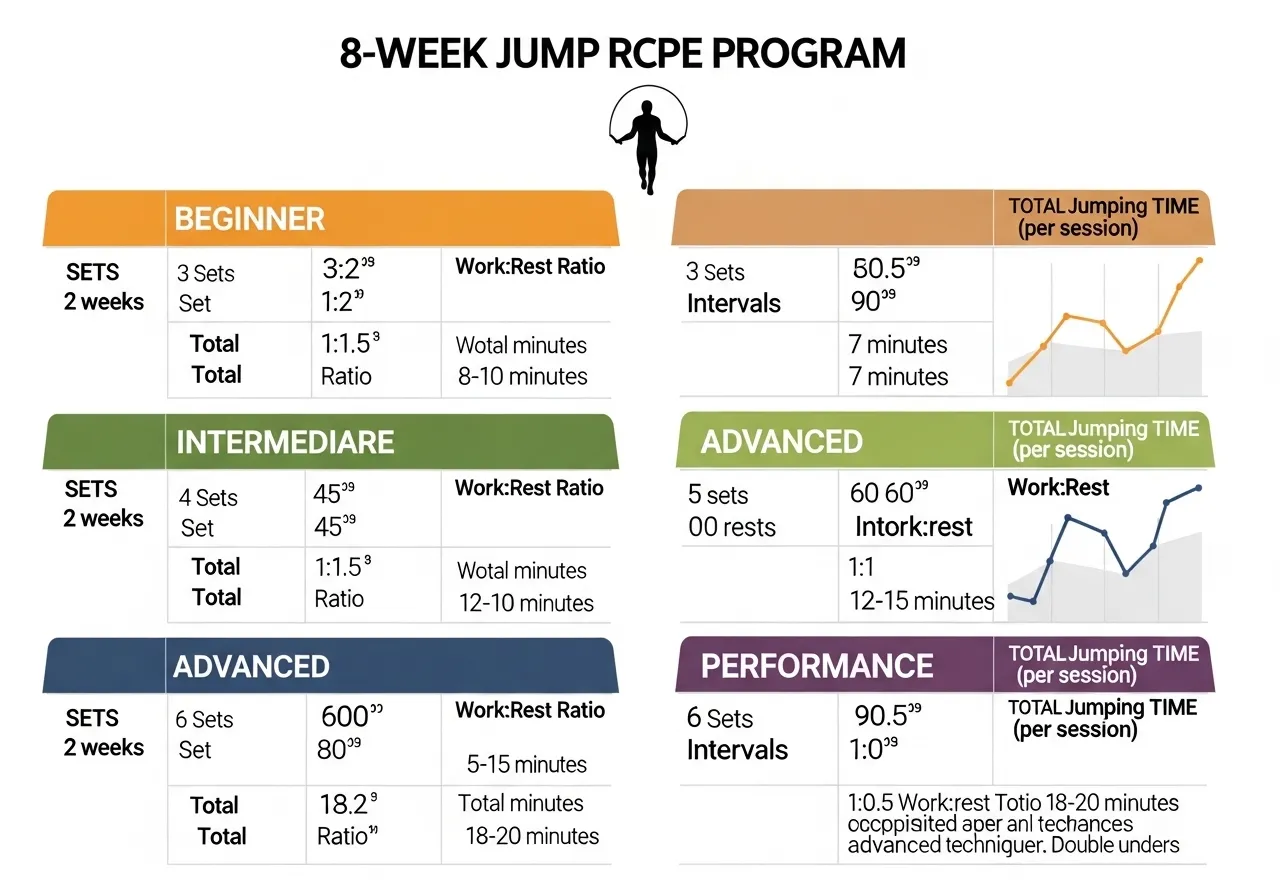
8-Week Jump Rope Training Program
Phase 1 — Weeks 1–2: Building the Foundation
3 sessions per week:
Set 1: 30 sec jump / 30 sec rest × 6 rounds
Set 2: 30 sec jump / 30 sec rest × 6 rounds
Total jumping time: ~6 minutes per session
Focus: Consistent rhythm, wrist rotation, soft landing technique. Missing the rope is fine — restart calmly and continue.
Phase 2 — Weeks 3–4: Endurance Build
3 sessions per week:
Set 1: 45 sec jump / 30 sec rest × 8 rounds
Set 2: 60 sec continuous jump (2 attempts if needed)
Total jumping time: ~8–10 minutes per session
Goal: First 60-second continuous jump by end of week 4
Phase 3 — Weeks 5–6: Intensity Introduction
4 sessions per week:
Session A: 10 × 45 sec hard / 20 sec easy (HIIT format)
Session B: 3 × 3 min continuous moderate pace / 2 min rest
Total jumping time: 10–12 minutes per session
Introduce: Alternate foot step; first double under attempts
Phase 4 — Weeks 7–8: Performance
4 sessions per week:
Session A: 15 × 30 sec all-out / 15 sec rest (Tabata-style)
Session B: 5 × 3 min moderate / 90 sec rest
Session C: Mixed: 5 min single / 2 min double under practice / 5 min single
Total jumping time: 12–15 minutes per session
Progressive Overload in Jump Rope Training
Unlike weight training where load increases are measured in kilograms, jump rope progressive overload involves:
Duration: Increasing continuous jumping time from 30 seconds to 1 minute to 3 minutes
Work-to-rest ratio: Moving from 1:1 (30 sec work / 30 sec rest) toward 2:1 and 3:1
Speed: Tracking jumps per minute at a consistent effort level — improvements confirm fitness gains
Heart Rate Monitoring During Jump Rope Training
Monitoring heart rate during jump rope sessions provides the most objective intensity measure available:
For aerobic conditioning work: target 65–80% of maximum heart rate (Zone 2 training–3)
For HIIT intervals: target 80–95% during work periods (Zone 4–5), recovering to 65–70% during rest
Maximum heart rate rough estimate: 220 minus age — individual variation is significant, so this is a starting point rather than a precise value
Chest-strap heart rate monitors are more accurate during jump rope than wrist-based optical monitors — the repetitive wrist motion of rope turning can interfere with optical sensor readings. If using a wrist monitor, take momentary pauses to get stable readings rather than relying on continuous display during active jumping.
Tracking Progress in Jump Rope Training
Several metrics allow meaningful progress tracking across a jump rope training program:
Maximum continuous jumps: The simplest benchmark — how many jumps you can complete without a miss. Track this monthly.
Jumps per minute at a fixed RPE: How fast you jump at a perceived effort of 7/10 — improvements indicate cardiovascular adaptation
Heart rate recovery: How quickly your heart rate drops from peak to 65% max during the rest interval — faster recovery indicates improving cardiovascular fitness
Double under consistency: Track consecutive double unders as a skill benchmark — moving from 1–2 to 10–20+ consecutive double unders over 4–8 weeks reflects both skill and power development
Keeping a simple training log — date, session format, total jump time, and one benchmark metric — takes less than two minutes per session and provides the motivating evidence of progress that sustains long-term consistency.
Warming Up Before Jump Rope Sessions
Jump rope places significant demand on the Achilles tendon and calf complex — particularly for new trainees whose tendons are not yet adapted to the repeated loading.
A brief, targeted warm-up reduces Achilles and ankle strain:
Ankle circles: 10 each direction each foot
Calf raises: 15 slow reps each leg
Light marching in place: 60 seconds
Slow jump rope practice: 30 seconds at 50% normal speed
The most common jump rope training injury — Achilles tendinopathy (irritation and degradation of the Achilles tendon connecting the calf to the heel bone) — nearly always results from excessive volume too soon without adequate warm-up and progressive loading. Building volume slowly and warming up thoroughly prevents most cases.
The combination of objective tracking data and the intrinsic satisfaction of skill development makes jump rope one of the most engaging long-term fitness practices available — trainees who commit to developing genuine jump rope proficiency consistently report higher training adherence than those using passive cardio machines.
Jump Rope for Different Fitness Goals
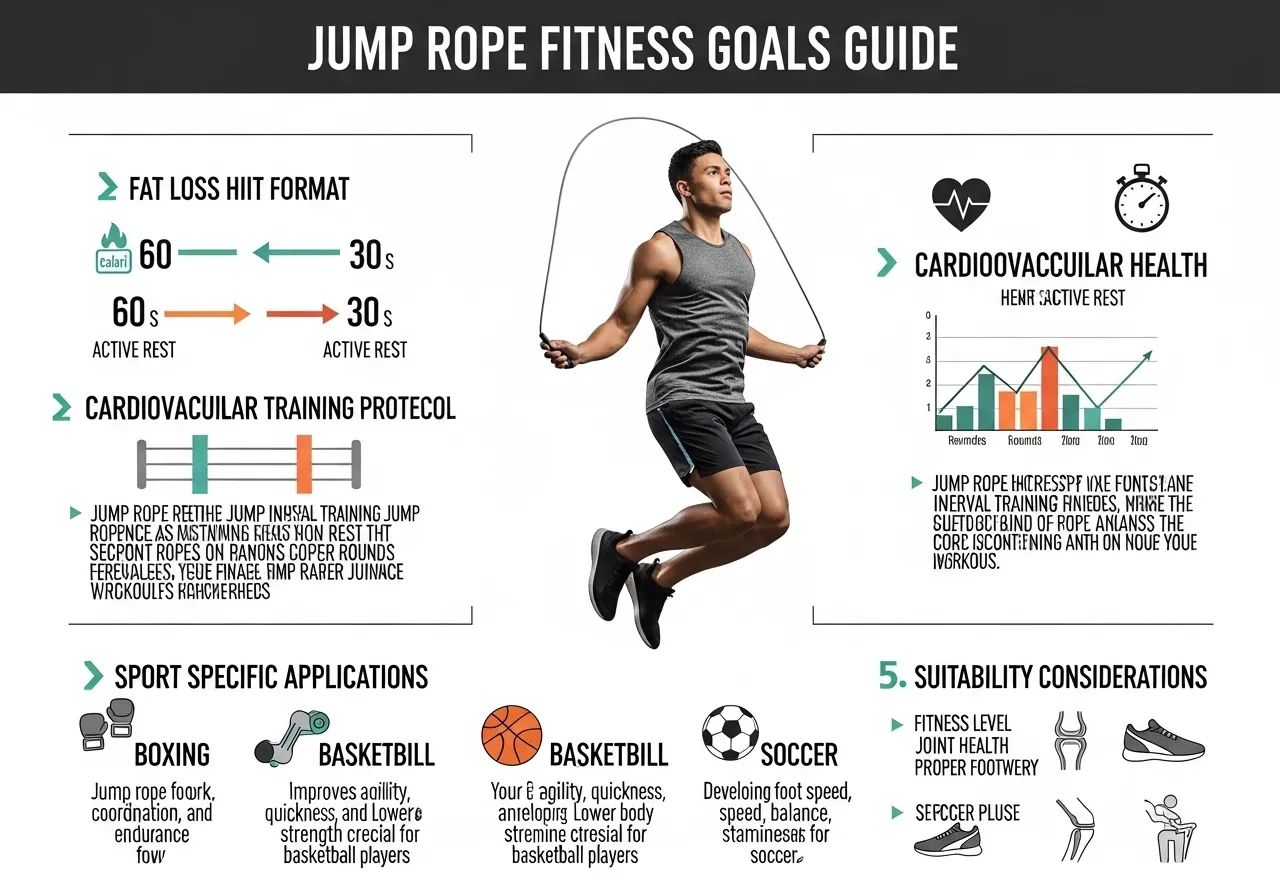
For Fat Loss and Conditioning
Jump rope’s high caloric expenditure per minute combined with its portability makes it one of the most practical fat-loss tools available.
The HIIT format — alternating maximum-effort intervals with brief rest — is particularly effective. Ten minutes of genuine HIIT jump rope can produce comparable cardiovascular stimulus to 30+ minutes of moderate-pace jogging, with significantly greater metabolic disturbance and post-exercise oxygen consumption.
For Cardiovascular Fitness Development
For VO2max improvement and cardiovascular fitness, longer moderate-intensity sessions (10–20 minutes of continuous jumping at 70–80% max heart rate) provide the sustained aerobic demand that drives cardiovascular adaptation.
Combining one HIIT session and one longer moderate session per week targets both the anaerobic and aerobic systems — producing comprehensive cardiovascular development in just two weekly sessions.
For Athletes: Sport-Specific Applications
Jump rope has specific transfer value for sports requiring footwork, coordination, and repeated short-burst effort:
Boxing and combat sports: Jump rope has been a foundational boxing conditioning tool for generations — the footwork, rhythm, and cardiovascular demand directly transfer to in-ring movement
Basketball and court sports: Rapid foot repositioning, ankle stability, and sustained cardiovascular output all develop through consistent jump rope practice
Soccer: Repeated sprint capacity and change-of-direction agility benefit from jump rope training as a conditioning supplement
Is Jump Rope Suitable for Everyone?
Jump rope is appropriate for most healthy adults, but some considerations apply:
Joint concerns: Individuals with knee, ankle, or hip conditions may need to start with very short intervals and low rope speed — the impact, while lower than running, is still present
Cardiovascular conditions: Anyone with diagnosed heart conditions should obtain medical clearance before starting any vigorous exercise including jump rope
Beginners: Starting with 2–3 minutes of total jumping per session and building gradually prevents the Achilles tendon soreness that commonly discourages new jump rope trainees
If you experience sharp joint pain, significant shortness of breath beyond normal exercise effort, or dizziness during jump rope training, stop and consult a healthcare professional before continuing.
✅ Key Takeaways
Research supports jump rope for cardiovascular fitness, body composition, and muscular strength improvements
Rope turns from the wrists — not the shoulders — and jumps need only 2–3 cm clearance
Double unders multiply intensity approximately 3× compared to single jumps
Start with 30-second intervals and build duration progressively to prevent Achilles strain
Jump rope is one of the most calorie-efficient exercises available per minute of training
Combining Jump Rope With Strength Training
Jump rope integrates well with resistance training programs without creating recovery conflict:
Before strength sessions: 5–10 minutes of light jump rope as a dynamic warm-up elevates core temperature and heart rate without causing lower body fatigue at the loads used in typical conditioning warm-ups
After strength sessions: 15–20 minutes of moderate jump rope adds cardiovascular volume without competing with the primary training stimulus of the session
Separate conditioning days: Dedicated jump rope HIIT sessions on non-strength days provide cardiovascular training without accumulating fatigue from the primary lifting sessions
Trainees combining heavy lower body strength training (squats, deadlifts) with jump rope on the same day should generally place strength work first — preserved technique and power output under fresh conditions produces safer and more productive strength sessions than training under accumulated fatigue.
Group and Online Jump Rope Communities
Jump rope has developed a significant online training community — with tutorials, challenges, and structured programs available across video platforms.
Following structured beginner programs from experienced jump rope coaches rather than self-directing training from the start typically produces faster technique development and fewer early injuries.
Key aspects of a good beginner jump rope tutorial resource:
Clear slow-motion technique demonstration with specific cues for arm position and landing
Progressive difficulty — starting from very short intervals and building over weeks
Common error identification and specific correction cues
Jump rope training, like most physical skills, benefits disproportionately from early technique investment — correct habits established in the first 2–4 weeks pay dividends across months and years of training.
Long-Term Jump Rope Development: From Beginner to Proficiency
A realistic long-term development timeline for jump rope:
Weeks 3–4: First 1-minute continuous intervals; alternate foot step developing
Weeks 5–8: 3–5 minute continuous sets; first double unders appearing
Months 3–6: 10+ consecutive double unders; HIIT protocols sustainable; first high knee integration
Year 1+: Consistent double under sets of 20–50+; advanced skill variations; competitive potential if desired
Progress is highly individual — coordination background, previous athletic experience, and training frequency all significantly influence how quickly technique develops. Consistent practice 3–4 times per week produces faster skill development than infrequent longer sessions.
Structuring jump rope sessions with deliberate intensity zones — alternating moderate steady-state work with brief all-out intervals — allows comprehensive cardiovascular development across both aerobic and anaerobic energy systems within a single compact training session.
Most training programmes develop either strength or power. Powerlifters squat heavy and get strong. Sprinters sprint fast and get explosive. The two qualities rarely develop in the same session, in the same set pairing, or even in the same training block. Contrast training challenges this separation. By pairing a heavy compound lift with an explosive…
Power is not the same as strength. A trainee can deadlift 200 kg but be unable to jump 50 cm if they have never trained for explosive force production. The gap between strength capacity and power expression is where box jump training operates. The box jump trains the stretch-shortening cycle: the rapid eccentric loading and…
Battle ropes sit in most gyms but get used by a minority of members. The exercise looks unusual — swinging heavy ropes in wave patterns doesn’t resemble any conventional cardiovascular or strength exercise — and its place in a training programme is less obvious than a treadmill interval or a barbell lift. The research tells…
⚠️ Health & Fitness DisclaimerThis article is for general educational purposes only and does not replace professional medical advice. If you have any shoulder, wrist, or lower back conditions, please consult a qualified healthcare professional before beginning suspension training. Suspension training — using adjustable straps anchored overhead to leverage bodyweight as resistance — offers a…
Most athletic training focuses on going faster: building power for acceleration, developing explosive force for jumping, increasing speed across distances. Training to slow down receives a fraction of this attention, despite the fact that most non-contact ACL injuries occur during deceleration, not acceleration. Deceleration is the act of rapidly reducing speed during running, landing, or…
⚠️ Fitness Disclaimer: The information in this article is for general educational purposes only and does not constitute professional fitness or medical advice. Always consult a qualified healthcare professional before starting any new exercise program. ⚠️ Cardiovascular Health Notice: If you have a history of heart disease, high blood pressure, or any cardiovascular condition, obtain…