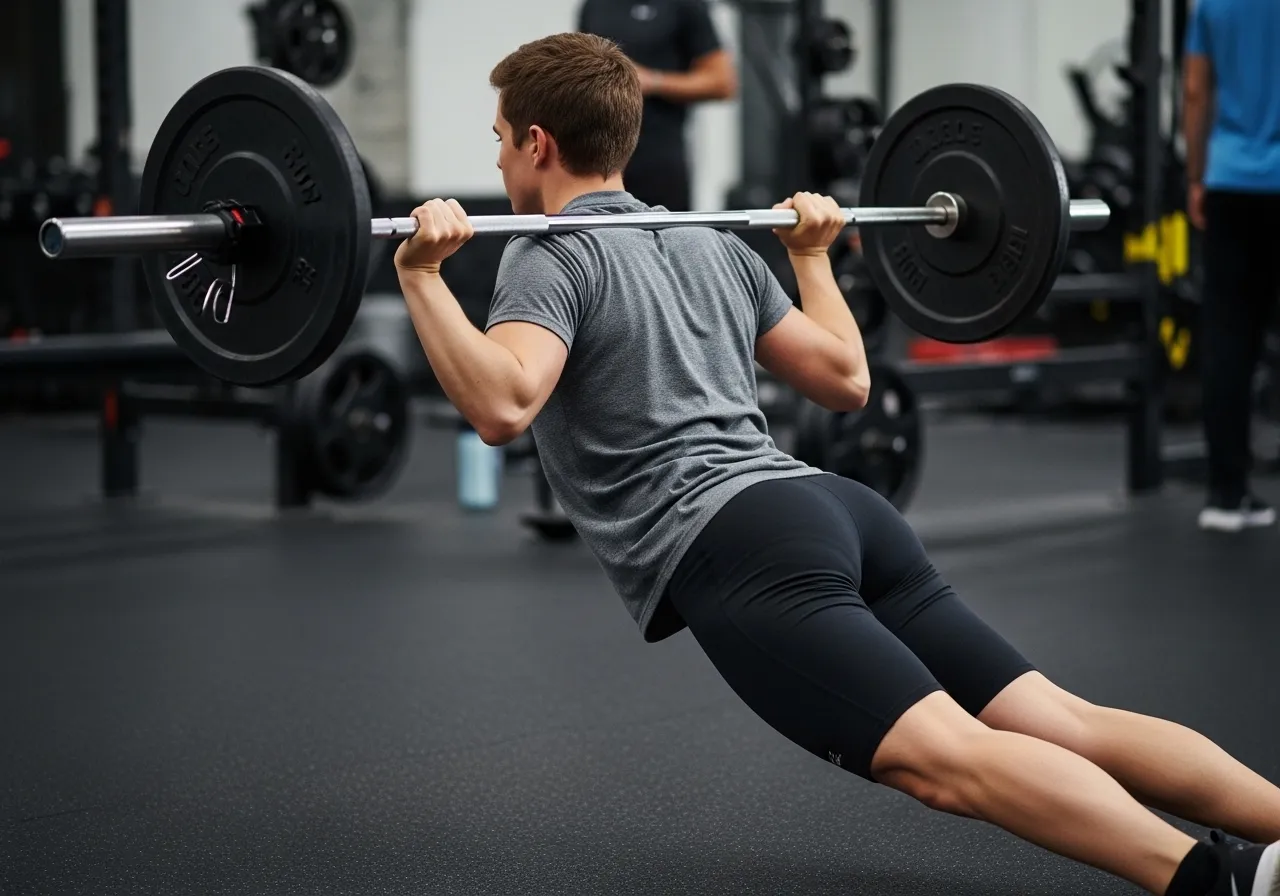
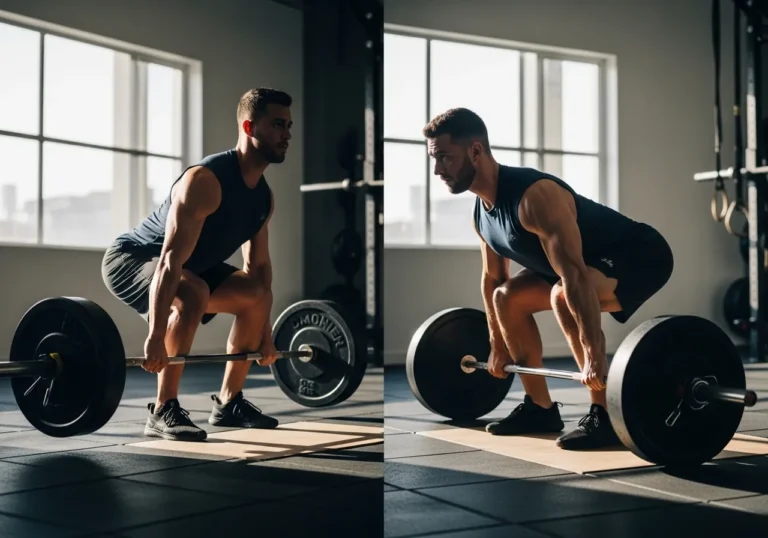
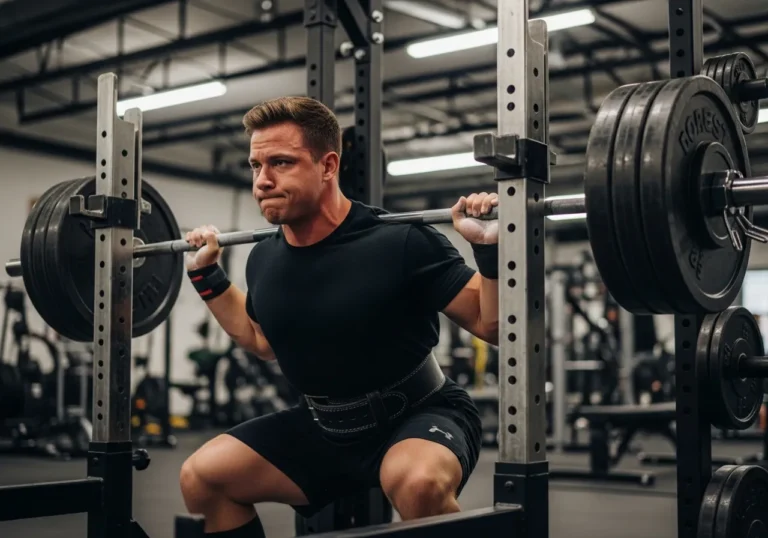
The good morning is one of the most effective posterior chain exercises in existence. It is also one of the most avoided.
The name sounds casual. The movement is not. A barbell loaded across the upper back while the torso hinges forward to near-parallel creates a tremendous demand on the spinal erectors, hamstrings, and glutes simultaneously. Heavy good mornings develop the same posterior chain structures that make squats and deadlifts possible at maximal loads.
The avoidance comes from the exercise’s reputation for lower back injury. This reputation is earned when the good morning is performed incorrectly: excessive lumbar flexion, too much load too soon, or insufficient hamstring flexibility to maintain a neutral spine throughout the range. Performed correctly with appropriate load progression, the good morning is a spinal strengthening exercise, not a spinal loading injury.
This guide covers what the EMG research shows about good morning muscle activation, how it compares to the Romanian deadlift, correct technique, four variations, and how to programme it as a supplementary movement within a strength programme.
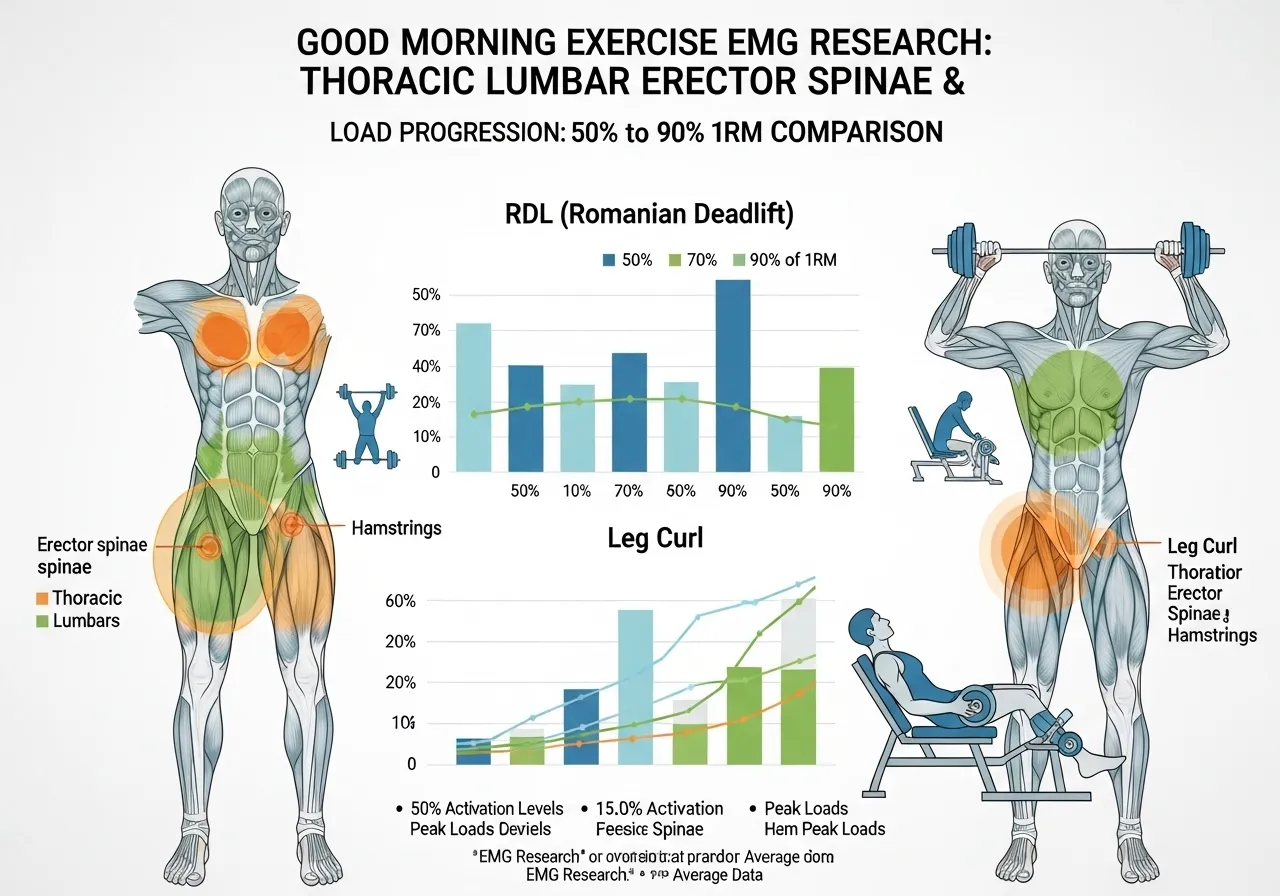
What the EMG Research Shows About Good Morning Muscle Activation
📌 Key Finding
Good morning EMG activation increases with load. Both thoracic and lumbar erector spinae are primary targets, with hamstrings contributing significantly throughout. The exercise trains the spinal extensors under a dynamic hip hinge load that static back extension exercises cannot replicate.
Good Morning vs Romanian Deadlift vs Leg Curl: Direct Comparison
📌 Key Finding
The good morning produces comparable erector spinae and hamstring activation to the Romanian deadlift while loading the muscles through a different lever arm and bar position. Both exercises belong in a complete posterior chain programme rather than treating them as interchangeable alternatives.
The Unique Lever Arm of the Good Morning
The critical mechanical difference between the good morning and the Romanian deadlift lies in bar position. In the RDL, the bar hangs from the hands at approximately hip height. In the good morning, the bar sits on the upper back. This positioning creates a fundamentally different mechanical demand on the spinal erectors.
In the RDL, the spinal erectors work primarily to maintain a neutral lumbar spine against the pulling force of the bar. In the good morning, the bar sits above the centre of mass and creates a greater spinal extensor moment as the torso descends. The spinal erectors must produce more force to control the descent and drive the ascent because the bar is positioned further from the hip joint. This greater spinal extensor demand is both the exercise’s primary training stimulus and the reason inappropriate loading produces injury risk.
Is the Good Morning Too Dangerous to Include in a Training Programme?
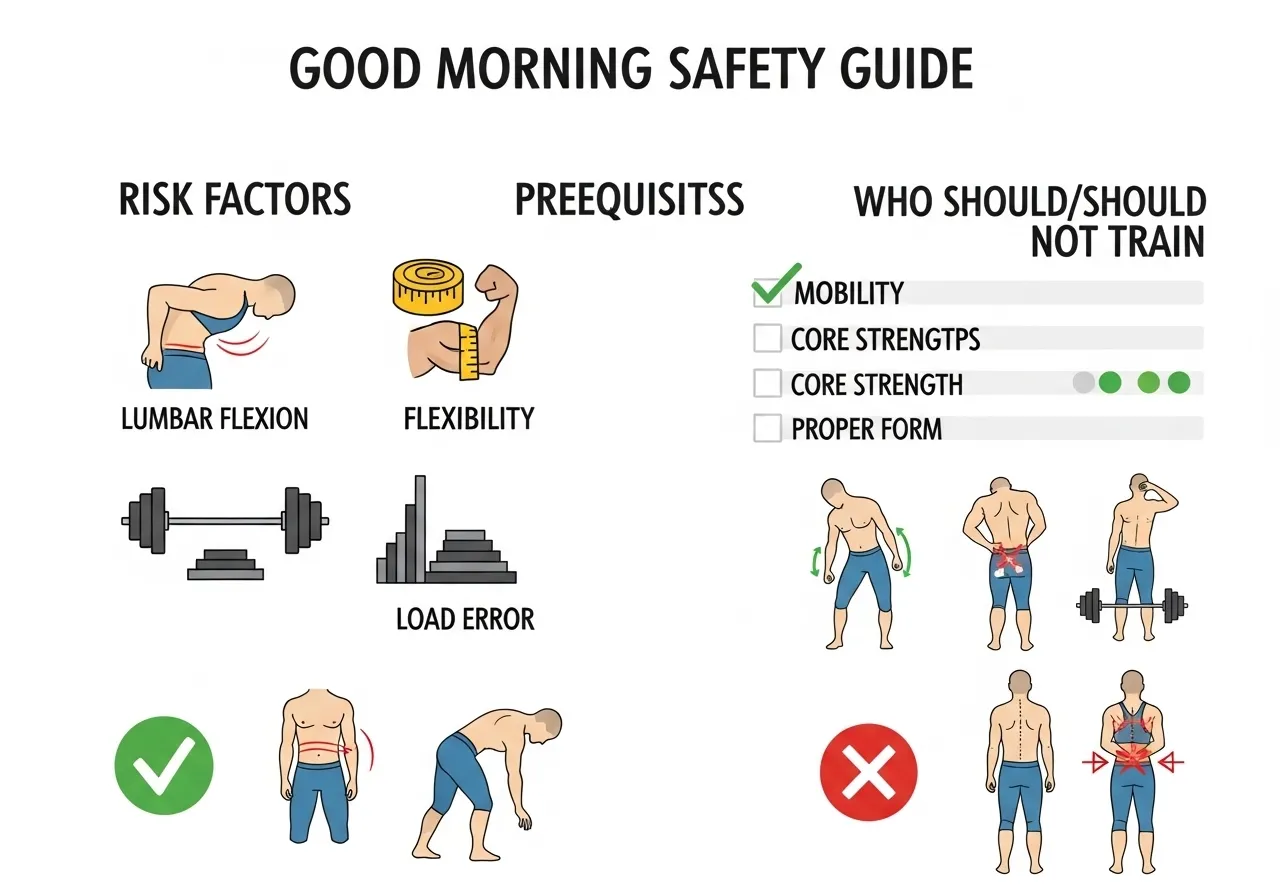
The good morning’s injury reputation comes from specific loading errors rather than from inherent danger in the movement itself. Three conditions consistently produce lower back injury in good morning training:
Excessive lumbar flexion: Allowing the lower back to round under load transfers compressive force to the posterior disc. The lumbar spine must remain neutral throughout the entire range.
Insufficient hamstring flexibility: When the hamstrings lack the flexibility to allow the torso to hinge forward without the lower back rounding, the lumbar spine flexes to compensate. This is the most common cause of good morning-related injury.
Load that exceeds technical capacity: The good morning’s lever arm amplifies the effect of excessive load on the lumbar spine. Trainees who attempt to progress load before mastering form at lighter weights create spinal stress that increases exponentially with poor mechanics.
Trainees with adequate hamstring flexibility, a practised hip hinge pattern, and a conservative load progression approach experience good morning training as a spinal strengthening tool without injury. The same trainees who safely deadlift heavy also safely good morning when they apply the same technical discipline to the movement.
Who Should and Should Not Train the Good Morning
The good morning is appropriate for trainees who can maintain a neutral lumbar spine through the full range of motion at bodyweight before any bar is added. A simple prerequisite test: hinge forward with hands behind the back until the torso is approximately 45 degrees from vertical. If the lower back rounds before reaching 45 degrees, hamstring flexibility and hip hinge mechanics must be developed before loading.
The good morning is not appropriate for trainees with active lumbar disc pathology, acute lower back pain, or insufficient hamstring flexibility to maintain neutral spine through the intended range of motion. In these cases, the Romanian deadlift provides a comparable posterior chain stimulus with the bar hanging below the hip, reducing spinal extensor demand to a more manageable level.
The Good Morning and Squat Carryover: Why Powerlifters Prioritise It
Powerlifting coaches consistently identify good mornings as a primary squat accessory for a specific mechanical reason. At the bottom of a heavy back squat, the torso is inclined forward and the spinal erectors are working under a significant moment. This is the position where most squats fail or technique breaks down. The good morning trains exactly this position under load.
Research and practical coaching experience both support the observation that trainees who add good morning training to a squat programme maintain better torso position under maximal squat loads. The erector endurance and positional strength developed by good morning training transfers directly to the sticking point in a heavy squat. This transfer is most pronounced for high bar squatters who develop forward lean issues at depth and for low bar squatters whose torso angle demands significant erector output throughout the lift.
The relationship works in both directions. Trainees who improve their squat technique often find their good morning strength improves simultaneously, because the hip hinge pattern and spinal position in both movements share the same posterior chain requirements. Training one develops the other, making the exercises complementary in a way that most other squat accessories are not.
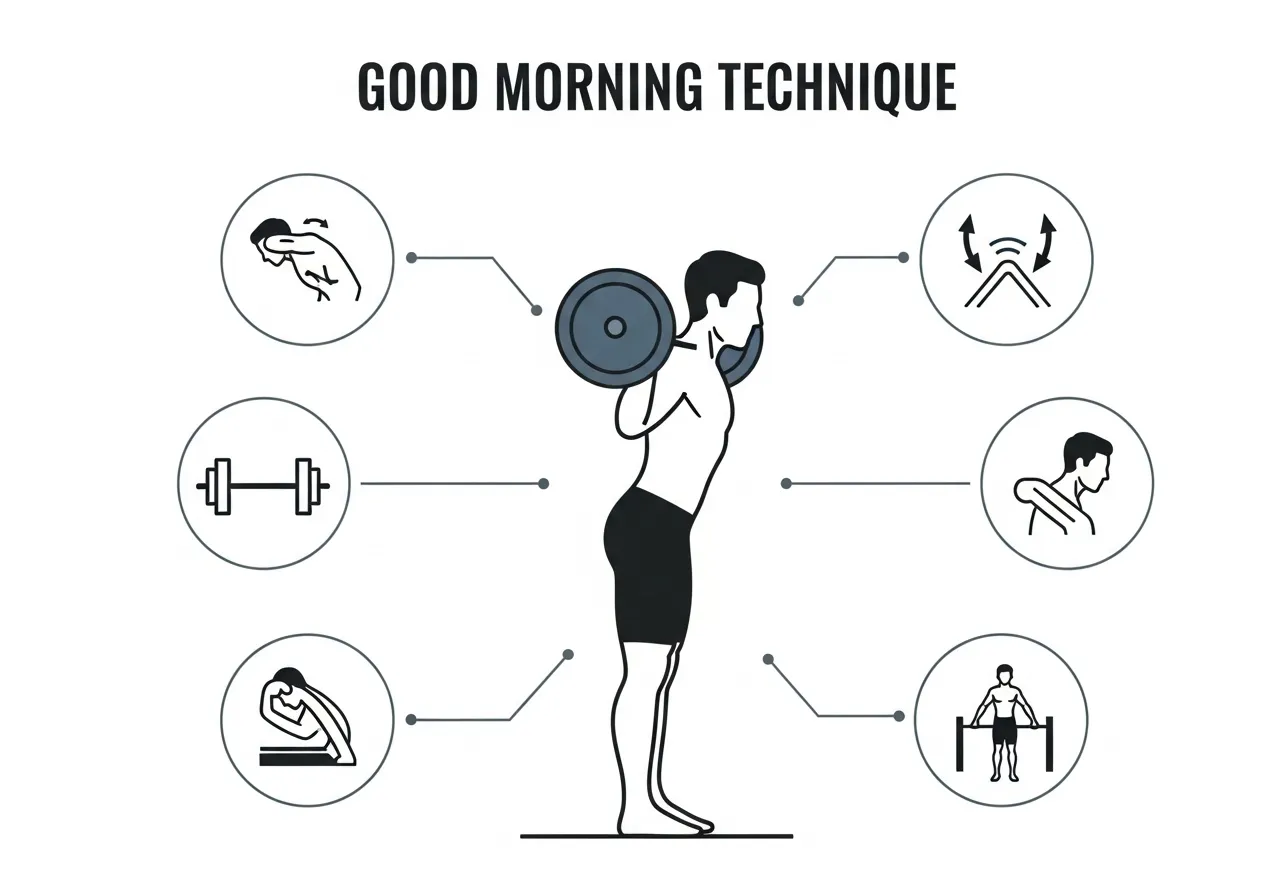
Good Morning Technique: Every Detail That Determines Whether the Back Develops or Gets Injured
⚠️ Spinal Loading Safety Note The good morning places the barbell above the centre of mass in a forward-hinged position, creating significant spinal extensor moment. Individuals with active lumbar disc herniations, stenosis, spondylolisthesis, or recent spinal surgery should not perform good mornings without specific medical clearance. Any sharp radiating pain or tingling into the legs during the exercise requires immediate cessation and professional assessment before continuing.
Setup and Starting Position
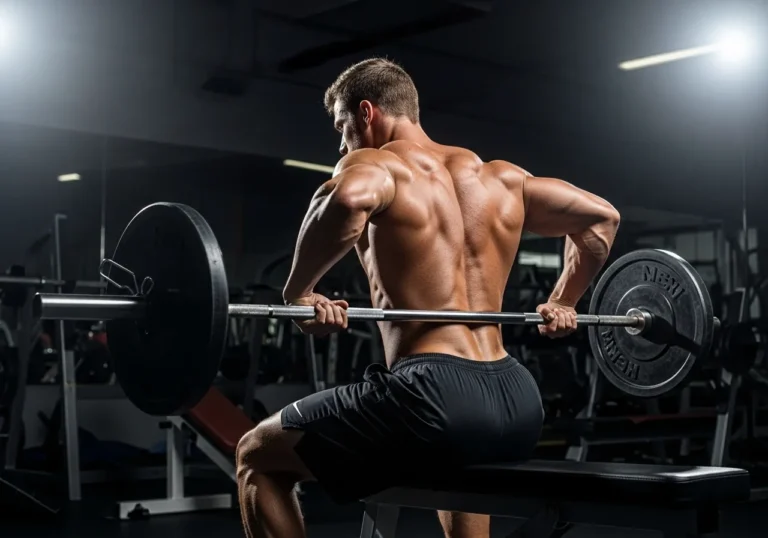
1. Bar position: Slightly higher than back squat, across the upper trapezius. The bar should not rest on the cervical spine. A higher bar position increases the spinal extensor moment; a lower position is more similar to a squat bar. Most trainees use a slightly lower bar than their back squat position. 2. Foot position: Hip-width or slightly narrower, feet parallel or very slightly out. The good morning is a hip hinge, not a squat, so a narrow stance with straight feet promotes the hip hinge pattern. 3. Grip: Same as back squat. Hands retract the shoulder blades and create the shelf for the bar. Avoid gripping too wide, which limits upper back tension. 4. Brace: Full 360-degree abdominal brace before initiating the hinge. This intra-abdominal pressure is critical for maintaining lumbar position throughout.
The Descent: Hip Hinge, Not Spinal Flexion
Initiate the descent by pushing the hips backward as in a Romanian deadlift. The torso descends as a consequence of the hip moving back, not because the spine bends forward. The distinction is subtle to observe but fundamental to mechanics: a hip hinge maintains a rigid torso that tilts as a unit, while a spine flexion error maintains fixed hips while the back rounds.
The knees have a slight bend throughout. They do not drive forward into squat position. The hamstrings should feel a progressive stretch as the hips push back and the torso descends. The stretch tension in the hamstrings is the natural limiter for depth: lower only until the hamstrings are comfortably stretched without the lower back rounding.
The Ascent: Driving the Hips Forward
Drive the hips forward to return to standing, using the same cue as the Romanian deadlift ascent. The spinal erectors maintain their braced position while the hip extensors drive the movement. At the top, stand fully tall before beginning the next descent. Cutting the range of motion at the top by beginning the descent before full hip extension is complete reduces the range of motion the glutes work through and limits the stimulus.
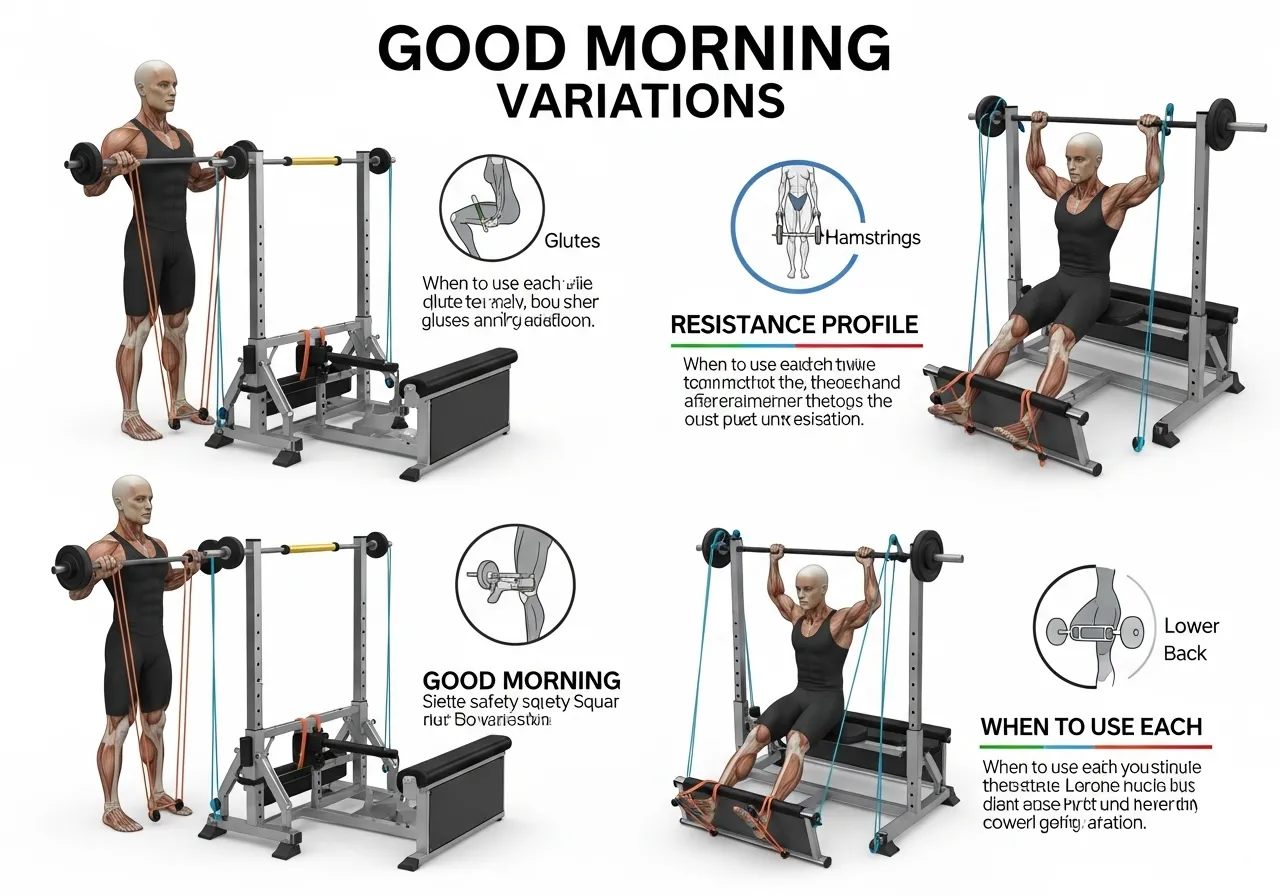
4 Good Morning Variations for Different Training Goals
🏋️ 1. Conventional Good Morning (Straight Leg)
Target: Spinal erectors, hamstrings, glutes
How: Standard barbell good morning with knee bend of 15 to 20 degrees maintained consistently throughout. Hinge to approximately parallel or until hamstring tension limits depth. The primary variation for spinal erector development.
Key point: The “straight leg” refers to minimal knee bend throughout. Allowing the knees to flex progressively during the descent converts the movement toward a squat pattern and reduces the hamstring and erector emphasis.
How: Sit at the end of a bench with legs spread. Perform the same hip hinge as the standing version, descending the torso between the thighs. The seated position restricts hip extension, increasing the hamstring and spinal erector stretch at the bottom.
Key point: The seated version typically uses significantly lighter loads than the standing version because the seated position eliminates leg drive and hip extension contribution at the bottom. It is particularly valuable for developing flexibility and positional strength at the bottom of the hinge range.
🏋️ 3. Banded Good Morning
Target: Hip hinge mechanics, spinal erectors at lighter loads, movement pattern development
How: Loop a resistance band around the back of the neck or upper trapezius and stand on the band. Perform the hip hinge against band resistance. The band provides resistance at the top of the movement where a barbell provides maximum resistance at the bottom.
Key point: The resistance profile is the opposite of a barbell: challenging at the top position (upright) rather than at the bottom (bent forward). This makes banded good mornings excellent for teaching the hip hinge pattern and developing spinal extensor strength at the lockout range that is specific to squat and deadlift performance.
🏋️ 4. Safety Squat Bar Good Morning
Target: Spinal erectors and hamstrings with reduced shoulder and wrist demand
How: Perform the good morning with a safety squat bar, which allows the arms to hold handles at the front rather than gripping the bar behind the neck. This variation is preferred by trainees with shoulder or wrist mobility limitations that make standard barbell back placement uncomfortable.
Key point: The safety squat bar’s forward-offset weight distribution slightly increases the demand on the upper back extensors compared to a standard barbell. This makes it an effective variation for trainees who find the standard good morning insufficiently challenging for upper back development.
Programming the Good Morning: Where It Fits and How to Progress It
As a Squat Accessory
Powerlifters and strength athletes have used the good morning as a primary squat accessory for decades, and with good reason. The good morning strengthens the specific posterior chain position that determines whether a heavy squat ascent succeeds: the forward-hinged torso position at the bottom, where the spinal erectors and hamstrings must produce enough force to return the bar to vertical while the body is most mechanically disadvantaged.
Trainees who struggle with forward lean in the squat, the descent and especially the ascent from the bottom, consistently improve when good morning training is added. The good morning develops the exact pattern that breaks down under maximal squat load. For the complete squat programme and how posterior chain development integrates with squat performance, the barbell back squat guide covers the programming context.
As a Deadlift Accessory
The good morning complements deadlift training by developing the spinal erector strength required to maintain a neutral thoracic and lumbar position throughout a heavy pull. Deadlift failures above the knee often involve thoracic rounding, which is a spinal extensor weakness, not a leg strength weakness.
Good mornings at moderate intensity (60 to 75% of 1RM) performed for sets of 6 to 10 reps twice per week develop the specific endurance capacity the spinal erectors need to remain rigid for the duration of a maximal deadlift attempt. This differs from the maximum force production trained by heavy deadlifts themselves. The good morning addresses the positional endurance component that heavy pulling alone undertrains. The hamstring eccentric strength that complements this development is covered in the Nordic hamstring curl guide.
Load and Rep Progression
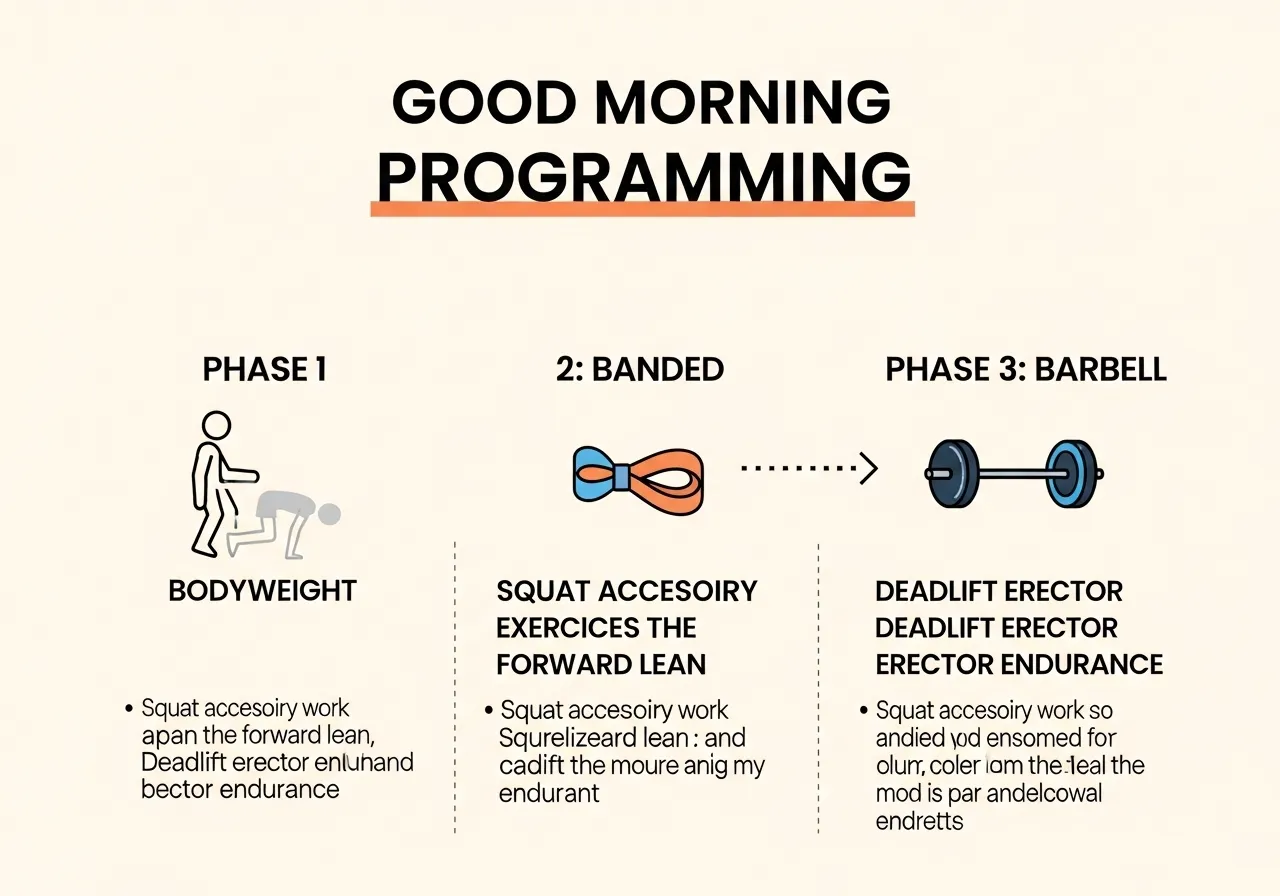
📅 Phase 1: Weeks 1 to 3: Pattern Establishment
Bodyweight good morning: 3 sets of 10 reps daily for the first week
Banded good morning: 3 sets of 12 reps in weeks 2 and 3
Focus: consistent neutral lumbar spine through full range, hamstring stretch at bottom
📅 Phase 2: Weeks 4 to 6: Light Bar Loading
Barbell good morning: 3 sets of 10 reps at 30 to 40% of back squat 1RM
Maintain Phase 1 technique standards throughout
Any lumbar rounding terminates the set immediately
📅 Phase 3: Weeks 7 to 10: Working Load Development
Barbell good morning: 3 to 4 sets of 6 to 8 reps at 50 to 65% of back squat 1RM
Add seated good morning: 2 sets of 8 reps for lengthened position development
Progress load only when all reps of all sets maintain perfect lumbar position
How Long to Keep Good Mornings in a Programme
The good morning is most effective as a rotating supplementary movement rather than a permanent fixture. Using it for 8 to 12 week blocks, then cycling to other posterior chain accessories such as Romanian deadlifts, Nordic curls, or hyperextensions, allows continued spinal erector and hamstring development without the adaptation plateau that prolonged use of any single exercise produces.
Powerlifters and dedicated strength athletes often keep the good morning in their programmes year-round at lower volumes between specific strength blocks. Recreational trainees typically benefit from 8 to 10 weeks of good morning training two to three times per year, with other posterior chain work filling the intervening periods. This rotation ensures the specific spinal extensor position trained by good mornings stays developed without the staleness and reduced stimulus that continuous high-frequency use produces.
The pairing of good morning training with squatting frequency matters practically. On lower body training days that include heavy back squats, good mornings should be performed after the squats with at least 10 to 15 minutes of recovery from the primary work before the accessory sets begin. The spinal erectors need adequate recovery after heavy squatting to maintain the neutral position that good morning training requires. Performing good mornings immediately after maximal squat work when the erectors are already significantly fatigued compromises both technique and training stimulus.
Frequently Asked Questions About the Good Morning Exercise
How much should I good morning compared to my squat?
Most intermediate trainees good morning 30 to 50% of their back squat 1RM for working sets. This lower percentage relative to the squat reflects the greater spinal extensor moment that the bar-above-centre-of-mass position creates at any given load.
Beginning very conservatively, often at 20 to 30% of squat 1RM for the first month, allows the spinal erectors and hamstrings to adapt to the specific loading pattern before heavier work begins. Rushing load progression on the good morning is the primary cause of the lower back injuries that give the exercise its negative reputation.
Should good mornings be performed before or after squats and deadlifts?
Good mornings should almost always be performed after the primary compound movements. They pre-fatigue the spinal erectors and hamstrings that are also required for squats and deadlifts, which would reduce the quality and load of the primary movements if performed first.
As a secondary exercise after squatting, the good morning extends posterior chain training volume at a load that is appropriate when the primary muscles are partially fatigued. As a secondary exercise after deadlifting, it maintains hamstring and erector stimulus on days when heavy pulling is the primary focus.
Is the good morning appropriate for beginners?
The good morning is not an appropriate first exercise for beginners to strength training. The exercise requires an established hip hinge pattern, adequate hamstring flexibility, and developed proprioceptive awareness of lumbar position under load. These prerequisites take several months of consistent training to develop.
Beginners benefit more from Romanian deadlifts, which develop the same posterior chain through a similar hip hinge pattern with the bar at a lower, less mechanically demanding position. Once Romanian deadlift technique is well established, typically after 3 to 6 months of consistent training, the good morning can be introduced at bodyweight with full technical focus.
Why do powerlifters use the good morning so extensively?
Powerlifters use good mornings for two specific reasons. First, they directly train the forward-lean squat position that heavy competition squats require. A competition squat is not performed with a perfectly upright torso. It involves controlled forward lean that the spinal erectors and hamstrings must manage. The good morning trains exactly this position under load.
Second, good mornings develop the spinal erector endurance capacity that sustains deadlift mechanics through maximal pulling attempts. The erectors must hold a rigid thoracic and lumbar position for 3 to 5 seconds of maximal deadlift effort. Good morning training at moderate loads for higher reps develops this positional endurance specifically. The Romanian deadlift and its complementary role alongside good morning training for complete posterior chain development is covered in the Romanian deadlift guide.
How does the good morning differ from a hyperextension machine?
The hyperextension or back extension machine trains the spinal erectors in a similar movement pattern but with the hips and pelvis supported at the edge of the pad and the feet anchored. This hip-and-pelvis support changes the mechanics significantly: the hamstrings contribute less because the hip hinge range is limited, and the lower body stabilisation demand is eliminated.
The good morning, by contrast, trains the spinal erectors in a standing, loaded hip hinge where the hamstrings stretch substantially throughout the movement and the entire posterior chain must work together to control the descent and drive the ascent. The free-standing nature of the good morning develops positional strength that transfers to squatting and deadlifting in ways that machine-supported back extension cannot fully replicate.
Both exercises have a place in programming. The hyperextension machine is more accessible for beginners, allows higher rep ranges, and is joint-friendly for trainees with hip discomfort from bar contact. The good morning is more specific to the squat and deadlift position and develops greater functional posterior chain strength under load. Using both across a training programme provides complementary posterior chain stimulus.
Key Takeaways
Good morning EMG activity increases with load. Thoracic erector spinae is the primary target, with lumbar erectors and hamstrings contributing significantly throughout.
The good morning produces comparable erector spinae and hamstring activation to the Romanian deadlift while loading the spinal extensors through a greater moment arm due to the bar-on-back position.
The exercise is not inherently dangerous. Injury occurs with excessive lumbar flexion, insufficient hamstring flexibility, or load progression that exceeds technical capacity.
Begin at bodyweight or very light load. Progress conservatively, using lumbar neutrality as the primary constraint on both depth and load.
The good morning’s primary programming application is as a squat and deadlift accessory that develops posterior chain positional strength and endurance in the specific forward-hinged pattern that heavy compound lifting demands.
⚠️ Health & Fitness DisclaimerThis article is for general educational purposes only and does not replace professional medical advice. If you have any elbow, shoulder, or wrist conditions, please consult a qualified healthcare professional before beginning any tricep training programme. The triceps brachii makes up roughly two-thirds of upper arm mass — yet most trainees…
The sumo deadlift divides training communities more than almost any other exercise. One camp dismisses it as a range-of-motion cheat, a way to lift more weight by pulling from a shorter bar path. The other treats it as a legitimately different movement that suits specific anthropometry better than the conventional deadlift and develops different muscular…
⚠️ Health & Fitness DisclaimerThis article is for general educational purposes only and does not replace professional medical advice. If you have any lower back, hip, or knee conditions, please consult a qualified healthcare professional before beginning a hip thrust program. The barbell hip thrust has become one of the most researched and most debated…
Why the Barbell Row Is the Most Misunderstood Back Exercise in the Gym I spent three years doing barbell rows without ever actually feeling them in my back. I would load up the bar, bend over, and pull — and walk away with tired biceps and a sore lower back, wondering why my back never…
⚠️ Fitness Disclaimer: The information in this article is for general educational purposes only and does not constitute professional fitness or medical advice. Always consult a qualified healthcare professional before starting any new exercise program, especially if you have existing injuries or medical conditions. The Posterior Chain Exercise Debate That Every Serious Lifter Faces I…
⚠️ Fitness Disclaimer: The information in this article is for general educational purposes only and does not constitute professional fitness or medical advice. Exercise carries inherent risks. Always consult a qualified healthcare professional or certified personal trainer before starting or modifying any exercise program, especially if you have a pre-existing medical condition, injury, or health…