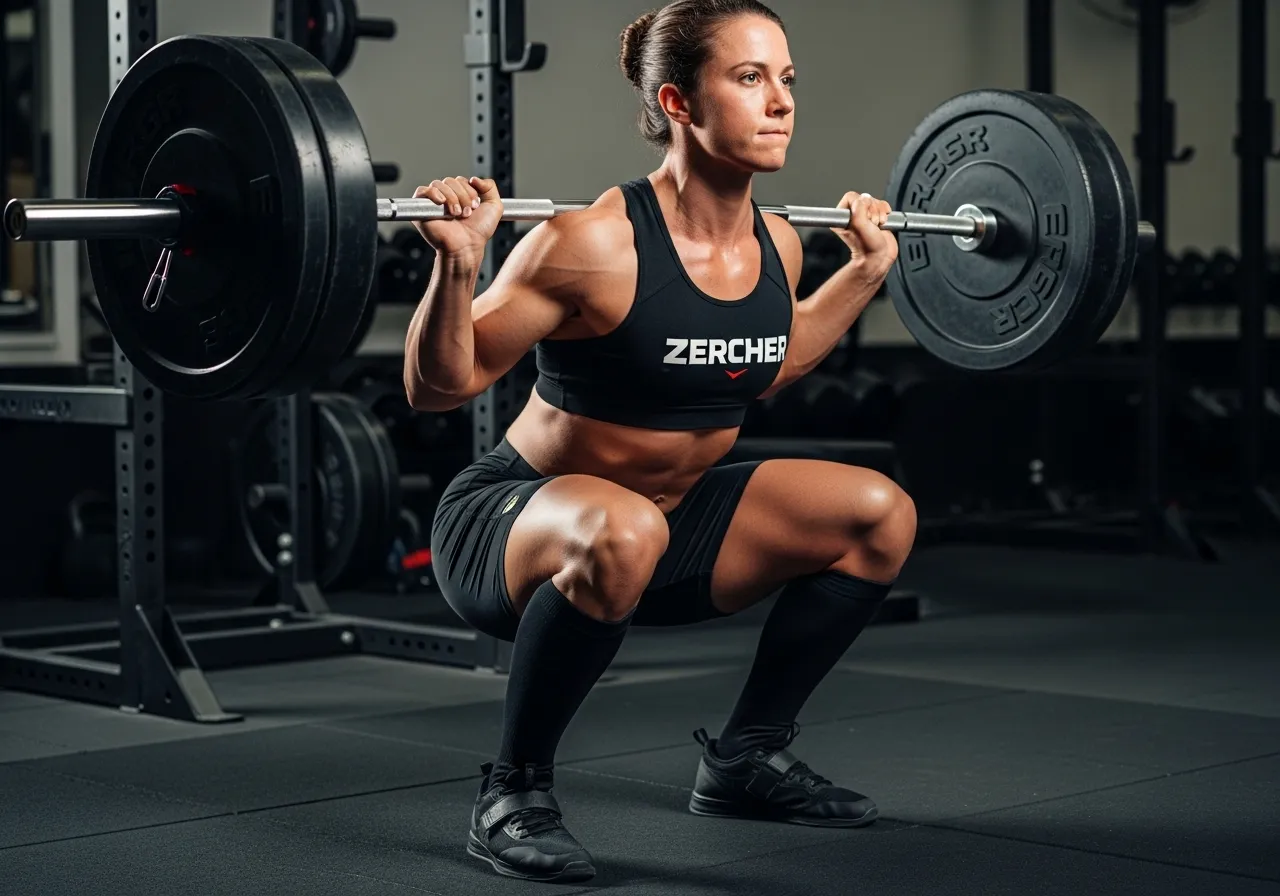
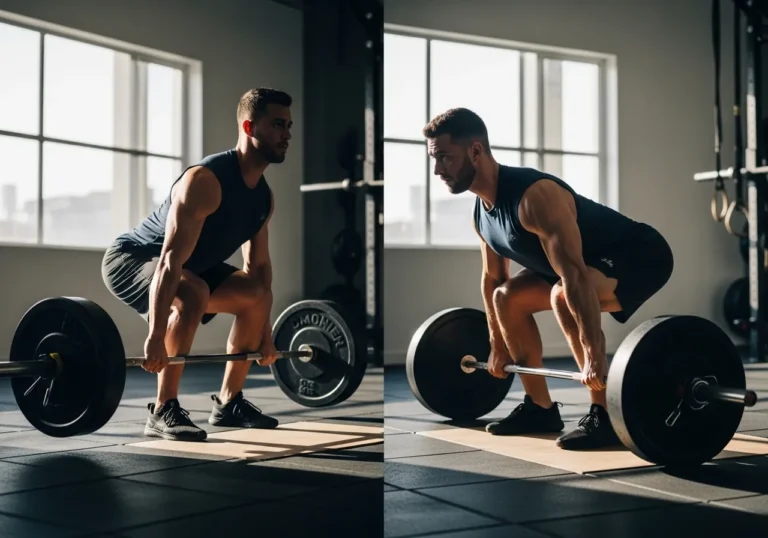
The Zercher squat looks uncomfortable. It is. That discomfort is also precisely what makes it effective.
Named after Ed Zercher, a strongman from the 1930s who reportedly squatted this way because he lacked a squat rack, the Zercher squat holds the barbell in the crease of the elbows rather than on the back or front shoulders. This position forces a dramatically upright torso, loads the anterior core against the forward pull of the bar, and simultaneously demands significant upper back activation to maintain the hold under load.
It is not a replacement for the back squat or front squat. It is a distinct training stimulus that neither of those movements can replicate. This guide covers what the biomechanical and EMG research shows about anterior load squatting, how the Zercher specifically compares to front and back squats, complete technique, variations, and how to programme it alongside conventional squatting movements.
The Biomechanics of Anterior Load Squatting: Why Bar Position Changes Everything
📌 Key Finding
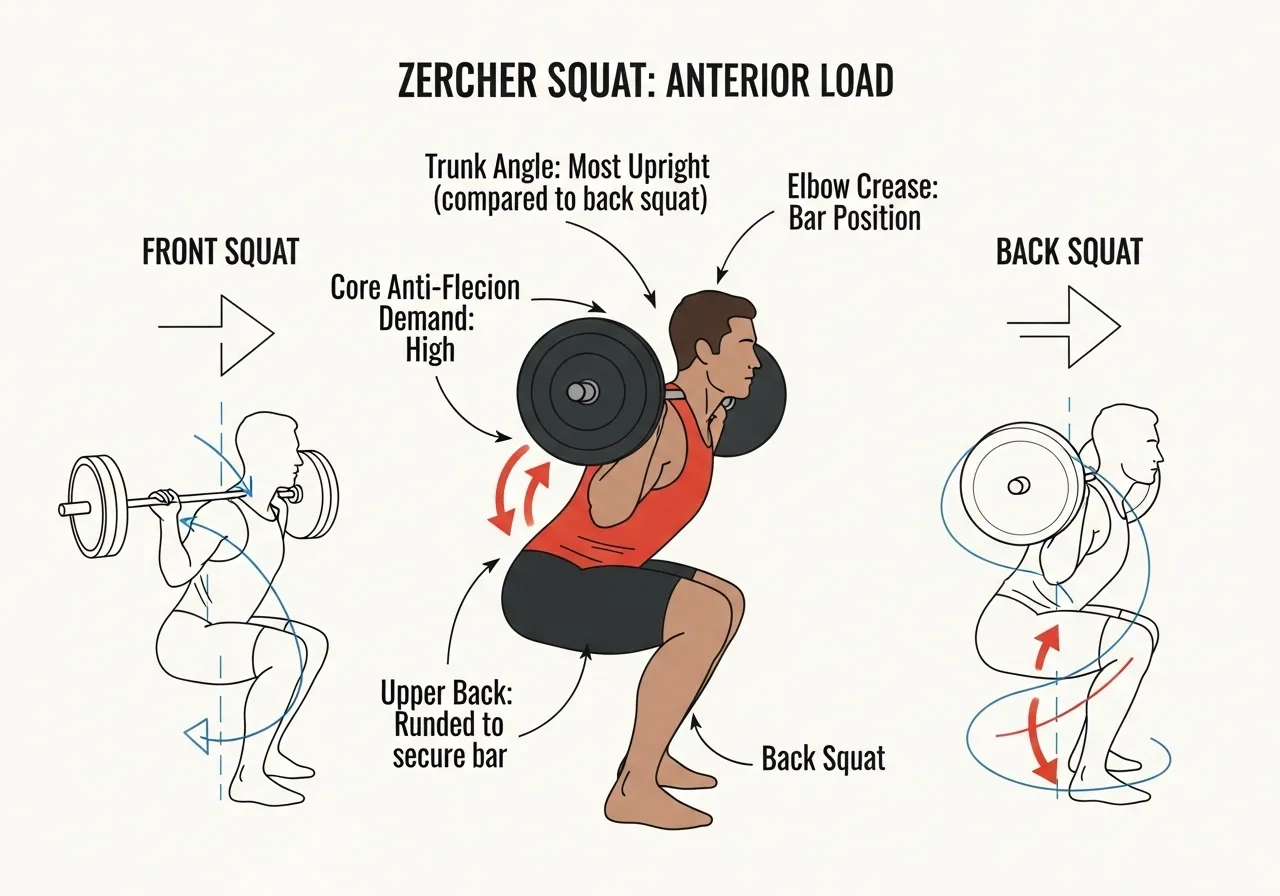
Anterior load placement forces a more upright trunk, shifting the moment arm distribution toward the knee and increasing relative quadriceps demand. The Zercher squat’s elbow-crease bar position creates the most anterior load position possible, producing greater upright torso demand than even the barbell front squat.
The Zercher Position and Core Demand
The Zercher squat places the bar below the centre of mass of the upper body, in the crease of the elbows at approximately mid-torso height. This position creates a forward moment that the anterior core must resist continuously throughout the movement. The rectus abdominis and transverse abdominis work not just for intra-abdominal pressure as in a back squat, but for active anti-flexion against the bar’s forward pull.
The upper back extensors, specifically the thoracic erector spinae and rhomboids, must also work significantly harder than in a back squat to maintain the shoulder position that keeps the elbows high and the bar from pulling the torso into excessive forward lean. The Zercher squat is therefore simultaneously a quad exercise, a core anti-flexion exercise, and an upper back endurance exercise in a single movement.
Why the Elbow Position Is the Key Mechanical Variable
The height at which the elbows are held during the Zercher squat determines the effective bar position and therefore the torso angle required. Higher elbows, approximately at shoulder height, place the bar higher and create a more vertical torso. Lower elbows, dropping toward the hips, shift the bar downward and forward, increasing the forward lean demand.
Maintaining elbows at approximately shoulder height throughout the Zercher squat requires significant shoulder flexor and upper back effort that adds to the total training stimulus. This is the Zercher’s unique training value: the shoulder and upper back are loaded as stabilisers throughout the entire lower body movement, producing a systemic anterior chain and upper back stimulus that neither the front squat nor the back squat provides simultaneously.
Zercher Squat vs Front Squat vs Back Squat: The EMG and Biomechanical Comparison
📌 Key Finding
Front loading shifts quad activation higher relative to posterior chain compared to back squats. The Zercher squat, as an anterior load variation, follows this same pattern while adding the distinctive core anti-flexion and upper back demand that front squats at rack position do not produce.
📌 Key Finding
Anterior load squat variations produce greater glute and quad activation during descent and ascent respectively compared to back squats. The Zercher squat, sharing this anterior load characteristic, benefits from the same activation pattern while also requiring sustained upper body holding work.
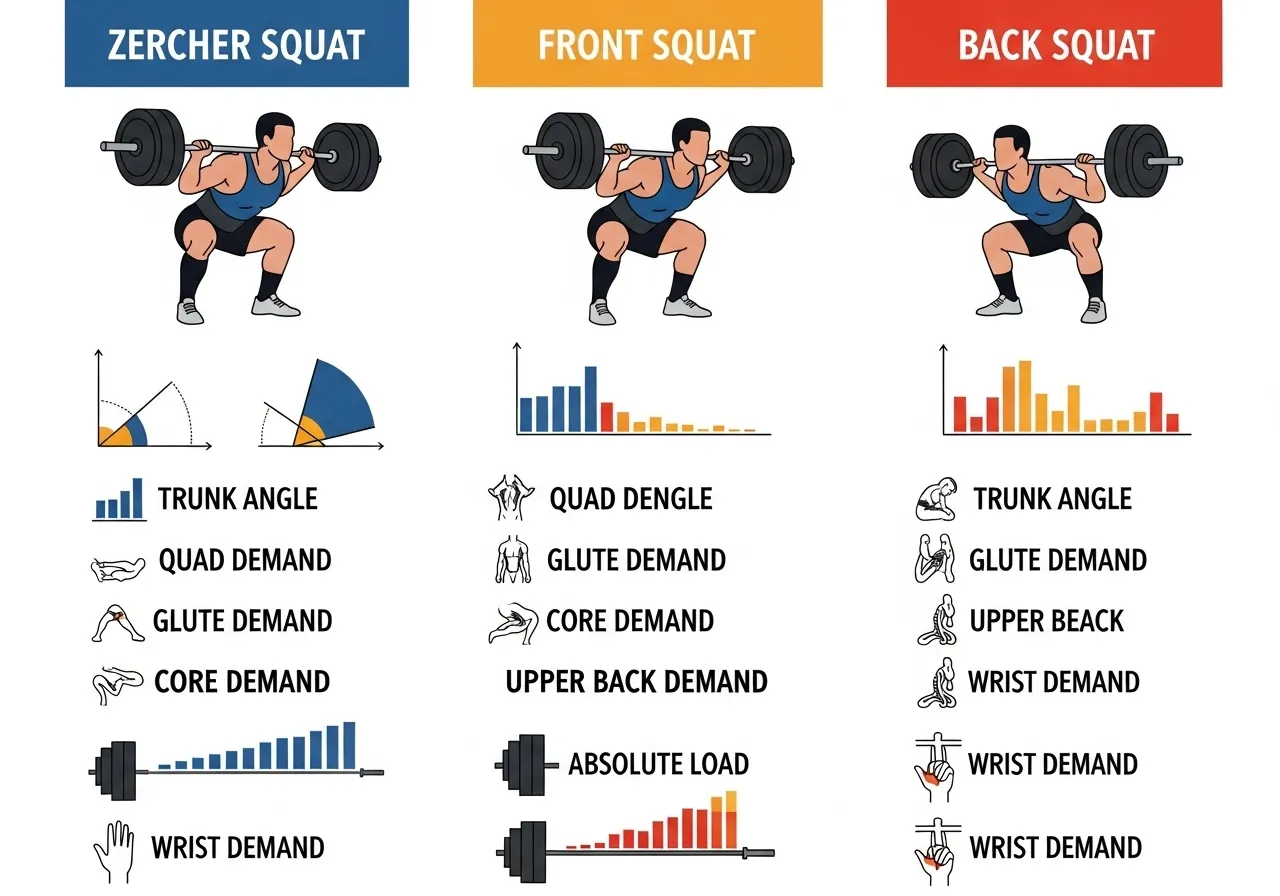
The Three-Way Comparison
Factor
Back Squat
Front Squat
Zercher Squat
Bar position
Upper back
Front shoulders
Elbow crease
Trunk angle
More inclined
More upright
Most upright
Quad demand
High
Highest
High (similar to front)
Core anti-flexion
Moderate
High
Highest
Upper back demand
Moderate
High (rack position)
High (elbow hold)
Absolute load capacity
Maximum
Moderate
Lower (limited by hold)
Wrist/shoulder demand
Moderate
High (rack position)
Minimal wrist, high elbow
Zercher Squat Technique: Setup and Execution
⚠️ Elbow and Spine Safety Note The Zercher squat places the barbell directly against the elbow crease, creating localised pressure that can be uncomfortable and, at heavier loads, cause bruising of the soft tissue in the elbow fold. Using a barbell pad, towel wrap, or foam sleeve around the bar at the contact point significantly reduces this discomfort. Individuals with active elbow tendinopathy or medial elbow pathology should obtain assessment before performing Zercher squats. The lumbar spine must remain neutral throughout; any rounding of the lower back under Zercher load increases spinal risk beyond what conventional squatting produces.
Setup: Getting the Bar Into Position
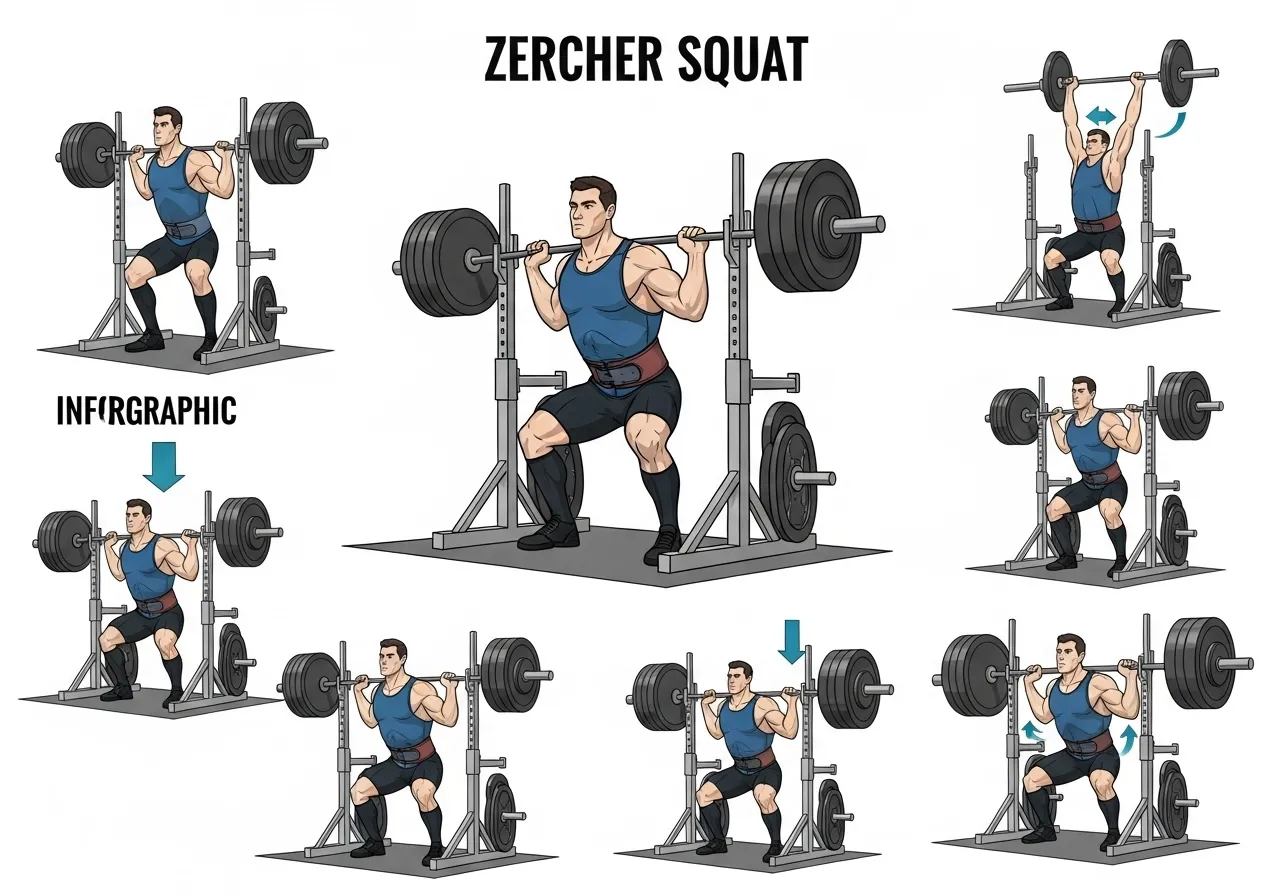
1. Rack height: Set the bar at approximately hip height, lower than a back squat rack position. The bar should be at a height that allows it to be scooped into the elbow crease without requiring a significant lift from a low position. 2. Elbow position: Walk under the bar and position the elbows under it, bending the arms so the bar rests in the crease of the elbows. Hands can clasp together in front of the chest or be held open palms-up. 3. Elbow height: Drive the elbows upward until they are approximately at shoulder height before unracking. This position keeps the bar as high as possible and minimises the forward lean it creates. 4. Foot position: Slightly wider than a conventional squat, toes pointed out 30 to 45 degrees. The wider stance allows the elbows to travel between the knees at depth without being blocked by the thighs.
The Descent
Initiate the descent by pushing the knees out in the direction of the toes. The combination of the anterior bar position and the forced upright torso means the knees will travel significantly further forward over the toes than in a back squat. This is not a technique error. It is a natural consequence of the anterior load position and the upright torso it creates.
Lower until the elbows contact or approach the inner thighs, similar to the bottom position of a goblet squat. At the bottom, the elbows pressing against the thighs provide a useful proprioceptive cue that confirms adequate depth. The complete goblet squat bottom position and its relationship to the Zercher is covered in the goblet squat guide.
The Ascent
Drive through the entire foot, focusing on keeping the elbows high and preventing the torso from collapsing forward. The most common ascent error is allowing the elbows to drop, which shifts the bar forward and downward, increasing the forward lean that collapses the upright position. Keep a deliberate mental cue to drive the elbows up throughout the entire ascent.
Is the Zercher Squat Worth the Discomfort, and Who Should Be Using It?
The Case For
The Zercher squat provides a unique training stimulus that no other barbell exercise delivers in the same combination. The simultaneous quad-dominant squat pattern, anterior core anti-flexion demand, and upper back holding work makes it genuinely complementary to all other squatting variations rather than redundant with any of them.
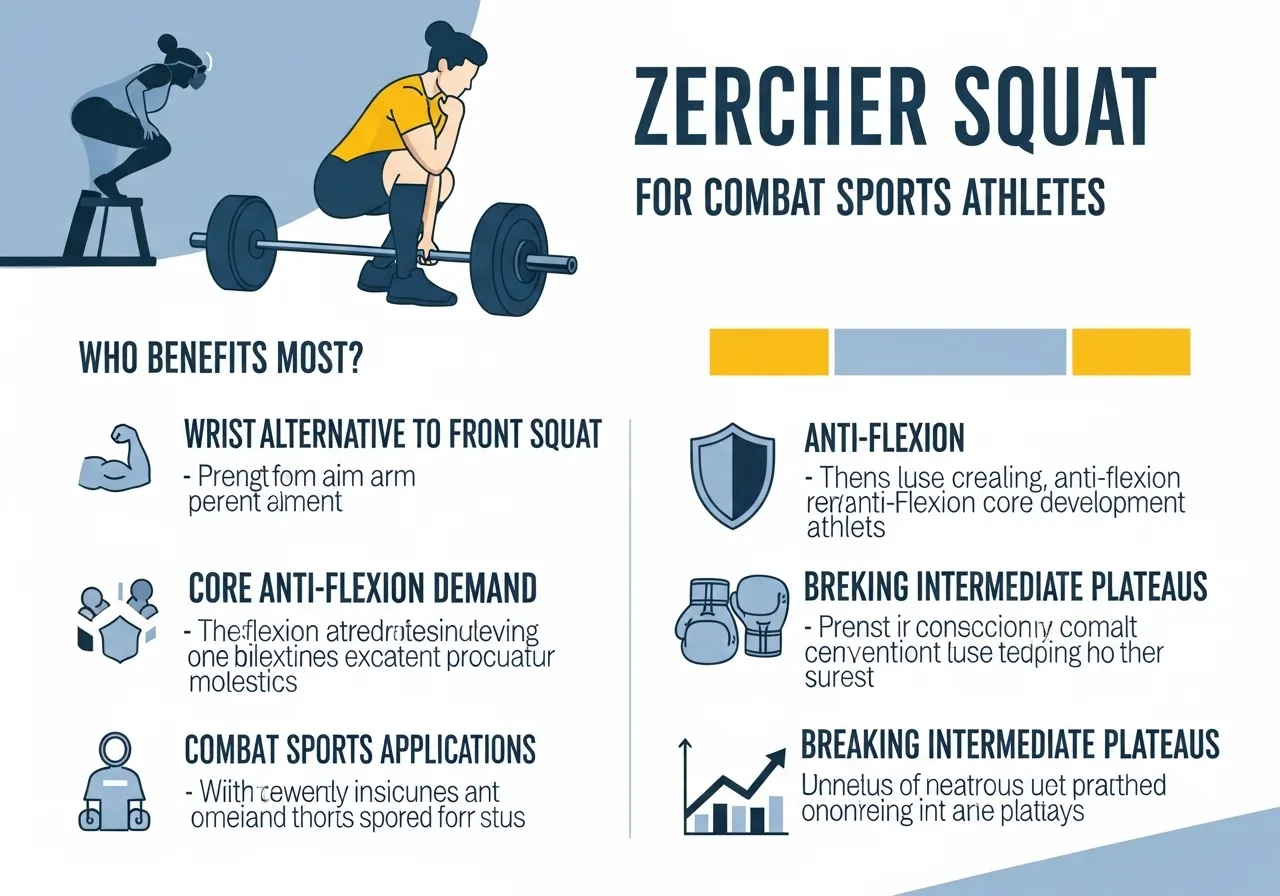
For trainees who struggle with front squat rack position, either due to wrist mobility limitations or shoulder anatomy that makes the clean grip uncomfortable, the Zercher provides comparable anterior load benefits without any wrist position requirement. The elbows bear the load rather than the wrists and shoulders, making it accessible to trainees whom front squatting excludes.
For trainees looking to develop the specific core anti-flexion strength that transfers to wrestling, mixed martial arts, and contact sports where opponents push and pull the torso, the Zercher replicates these demands under progressive load in a way that conventional core exercises cannot match.
The Case Against
The Zercher squat allows significantly less absolute load than the back squat, typically 50 to 70% of a trainee’s back squat 1RM, because the hold position is the limiting factor rather than the leg strength. Trainees whose primary goal is maximum lower body strength development will always achieve this more efficiently with back squats or trap bar deadlifts that allow heavier absolute loading.
The elbow discomfort is also a genuine barrier. Many trainees who try Zercher squats abandon them due to the localised pressure on the elbow crease, particularly at early stages before the tissue adapts. Barbell padding reduces this significantly but does not eliminate it entirely at heavier loads. Trainees with acute elbow sensitivity should begin with very light loads and assess tolerance before adding weight.
Who Benefits Most
Trainees who cannot perform front squats due to wrist or shoulder mobility limitations
Combat sports athletes needing anterior core and upper back strength under squat load
Intermediate lifters whose back squat has plateaued and who need a novel anterior stimulus
Powerlifters using Zercher squats as a squat accessory to develop upper back and core position under load
Trainees wanting a single exercise that trains lower body, core, and upper back simultaneously
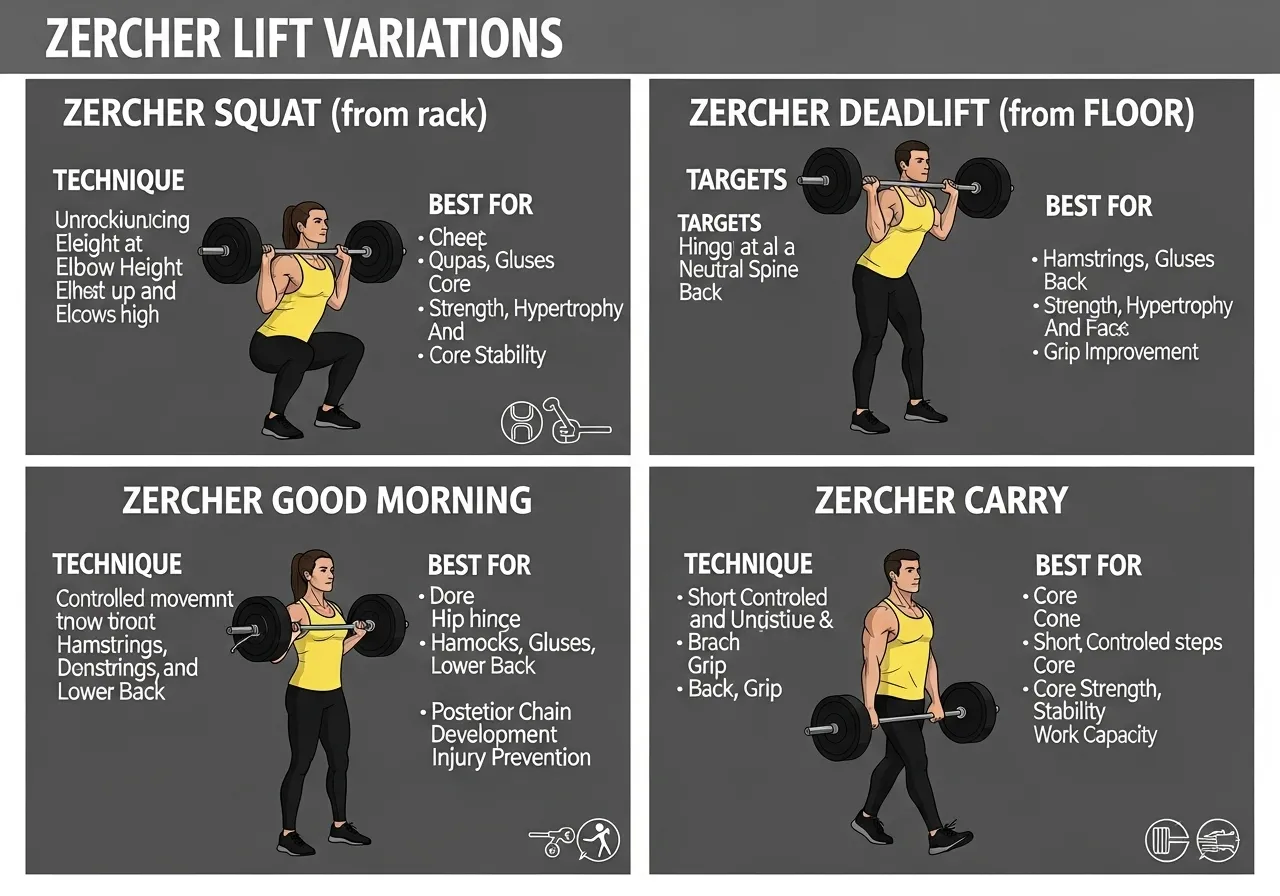
4 Zercher Squat Variations for Different Goals and Equipment
🏋️ 1. Standard Zercher Squat (Barbell from Rack)
Target: Quads, glutes, anterior core anti-flexion, upper back
How: The standard variation described in the technique section. Barbell unracked from a squat rack at hip height, held in the elbow crease, squatted to full depth.
Best for: Primary Zercher squat training. The rack unrack allows the heaviest loading. Most appropriate for general programming as the primary Zercher stimulus.
🏋️ 2. Zercher Deadlift (From Floor)
Target: Posterior chain + anterior core, hip hinge with anterior load
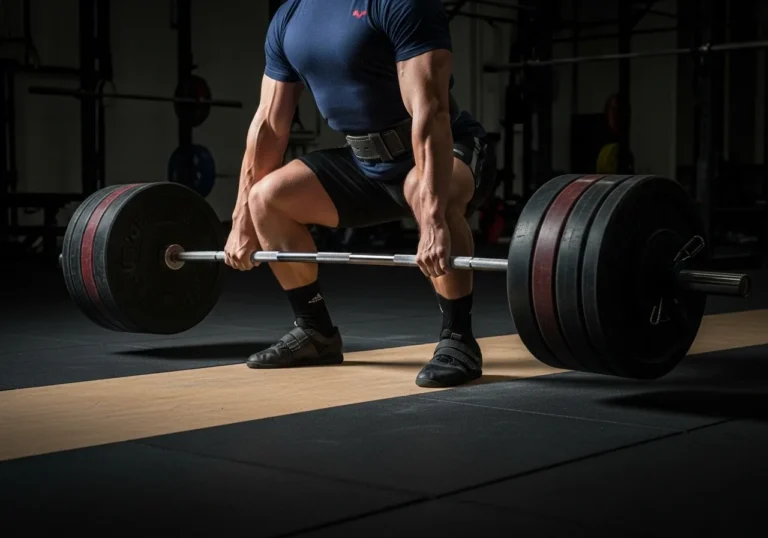
How: The bar starts on the floor. The trainee squats down, wraps the elbows under the bar, and stands by driving the hips forward. This is a hybrid of a deadlift and Zercher carry rather than a squat, and trains the posterior chain through the initial lift phase before transitioning to the anterior core at the top.
Best for: Full posterior chain and anterior core stimulus in a single movement. Used in strongman and functional fitness programming where picking awkward loads from the floor is a competition or work requirement.
🏋️ 3. Zercher Good Morning
Target: Spinal erectors, hamstrings, anterior core: the combination of Zercher hold and good morning mechanics
How: Hold the bar in the Zercher position and perform a hip hinge rather than a squat, hinging forward to near-parallel while maintaining the elbow hold. The forward hinge against the Zercher hold creates a novel spinal extensor and anti-flexion core demand.
Best for: Posterior chain development with an unusual anterior load, as an accessory for deadlift and good morning training. Creates a movement that is difficult to replicate with any other equipment.
🏋️ 4. Zercher Carry
Target: Anterior core stability, upper back, lower body conditioning under anterior load
How: Hold the bar in the Zercher elbow position and walk for a set distance or time. The carry develops the anti-flexion core and upper back endurance capacity that the Zercher squat trains dynamically, but under sustained isometric demand.
Best for: Core endurance, adding conditioning to a Zercher training block, and developing the specific anterior load carrying capacity relevant to combat sports and functional fitness competitions.
How to Programme the Zercher Squat: Session Placement and Load Progression
Where It Fits in a Lower Body Programme
The Zercher squat occupies the same session position as the front squat: a secondary lower body movement after the primary back squat or deadlift, or as the primary lower body movement in a dedicated anterior-load session.
Using the Zercher as a primary lower body movement on a dedicated leg day works well for trainees who want to develop anterior core and upper back strength alongside quad development, particularly those who cannot front squat comfortably. The front squat’s equivalent position in a training programme and the progression from goblet squat through to heavier anterior load variations is covered in the front squat guide.
Load Selection: Start Much Lighter Than Expected
Most trainees significantly overestimate how much they can Zercher squat on their first attempt. The elbow hold is unfamiliar, the core demand is novel, and the upright torso position at depth requires ankle dorsiflexion and hip mobility that the wider stance partly compensates for but does not eliminate.
Starting at 40 to 50% of back squat 1RM for the first two to three sessions allows the body to adapt to the hold position, the core demand, and the movement pattern before loading increases. Rushing load on the Zercher squat produces the elbow discomfort and technique breakdown that leads most trainees to abandon the exercise prematurely.
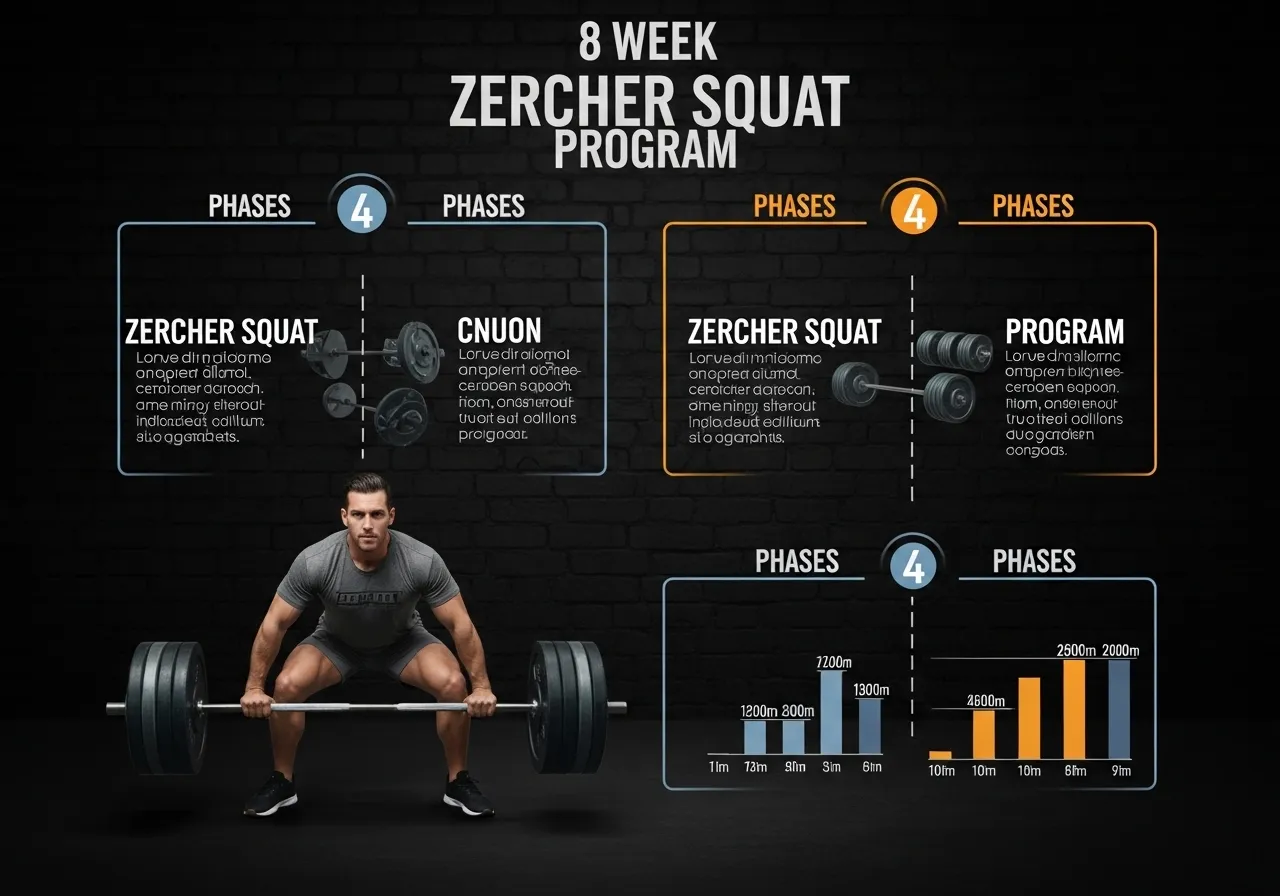
8-Week Zercher Squat Programme
📅 Phase 1: Weeks 1 to 2: Pattern and Position
Zercher squat: 3 sets of 6 reps at 40 to 45% of back squat 1RM
Focus: elbow height, upright torso at all depths, foot width
Use barbell pad if elbow discomfort is significant
The load is deliberately light. The novel position demands attention to technique that heavy loading prevents.
📅 Phase 2: Weeks 3 to 4: Load Introduction
Zercher squat: 4 sets of 5 reps at 50 to 55% of back squat 1RM
Add Zercher carry: 3 × 20 metres as a core endurance finisher
Rest: 2 minutes between sets
Build load tolerance while beginning to develop the anterior core endurance that sustains Zercher position under heavier loads.
📅 Phase 3: Weeks 5 to 6: Strength Development
Zercher squat: 4 sets of 4 reps at 58 to 65% of back squat 1RM
Back-off set: 2 sets of 8 reps at 45% for volume
Zercher carry: 3 × 30 metres at working weight
The combination of heavier sets and volume back-offs develops both strength and hypertrophy within the same session.
📅 Phase 4: Weeks 7 to 8: Peak and Benchmark
Zercher squat: 4 sets of 3 reps at 68 to 72% of back squat 1RM
Week 8: test 3RM Zercher squat and compare to Phase 1 starting load
Expected: 15 to 25% load increase from Phase 1 to Phase 4
The 3RM test establishes a Zercher squat benchmark for future programming cycles.
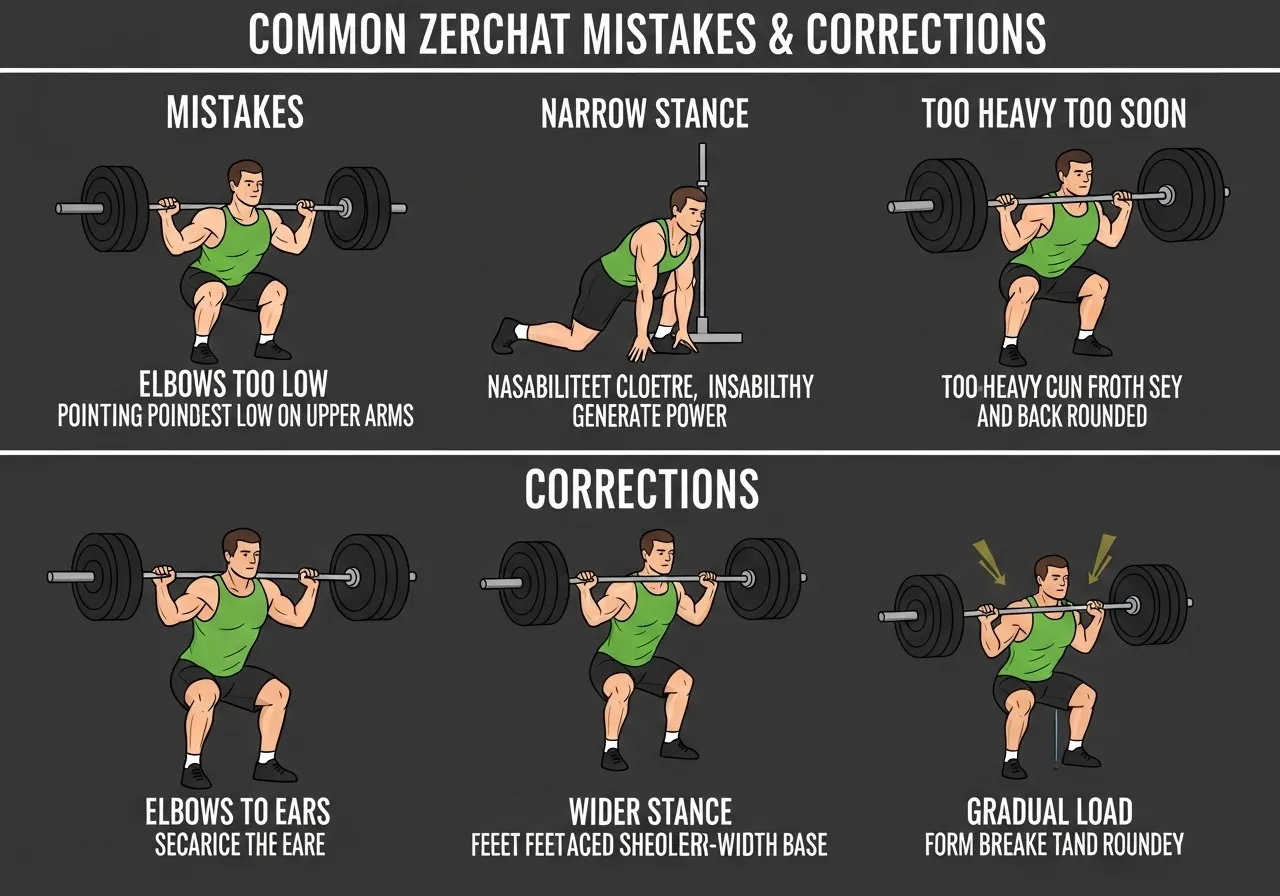
Common Zercher Squat Mistakes and How to Fix Them
Mistake 1: Elbows Too Low
The most common Zercher error is allowing the elbows to drop below shoulder height during the movement. Low elbows shift the bar further forward and downward, dramatically increasing the forward lean demand on the torso and reducing the upright position that makes the Zercher distinct from a back squat.
The fix: consciously drive the elbows upward before initiating each descent and maintain this cue throughout the entire set. A useful coaching cue is “elbows to ears”: an exaggeration that ensures the elbows remain high even as they inevitably drop slightly under fatigue.
Mistake 2: Stance Too Narrow
A narrow squat stance prevents the elbows from travelling between the knees at depth. When the elbows contact the outer thighs rather than passing between them, the trainee either stops short of adequate depth or shifts the elbows laterally to allow descent, both of which compromise the position.
Widening the stance to hip-width plus and pointing the toes out 30 to 45 degrees creates the space for the elbows to travel to the inside of the thighs at the bottom position. The stance will feel wider than a conventional squat, which is correct for the Zercher.
Mistake 3: Loading Too Heavy Too Soon
The Zercher squat’s elbow position is genuinely unfamiliar and the tissue in the elbow crease needs time to adapt to the pressure. Trainees who load aggressively in the first sessions consistently report that elbow discomfort, not leg fatigue, terminates their sets.
Building load gradually over the first four weeks allows the soft tissue to adapt and the technique to consolidate before the load demands attention. The back squat’s load progression principles and how they relate to squat variation programming are covered in the barbell back squat guide.
Frequently Asked Questions About the Zercher Squat
Is the Zercher squat bad for the elbows?
The Zercher squat is not inherently harmful to the elbows in healthy individuals. The localised pressure on the elbow crease is uncomfortable but does not damage joint structures when load progression is conservative and the tissue is given time to adapt. Using a barbell pad or towel around the bar significantly reduces the acute discomfort, particularly in early training.
Individuals with active medial epicondylitis, cubital tunnel syndrome, or recent elbow injuries should avoid Zercher squats or obtain medical clearance before attempting them. The elbow flexor tendons and medial elbow structures bear load continuously throughout the Zercher squat, making the exercise inappropriate for individuals whose elbow pathology is aggravated by sustained flexed-elbow loading.
How much should I Zercher squat compared to my back squat?
Most trainees can Zercher squat approximately 50 to 70% of their back squat 1RM for working sets. The limiting factor is the elbow hold rather than leg strength for most trainees, which constrains the absolute load. As elbow tolerance improves over training weeks, the ratio typically improves toward the higher end of this range.
A Zercher working weight that exceeds 75% of the back squat 1RM usually indicates either very strong elbow flexors and upper back relative to lower body, or a limited back squat due to factors other than lower body strength. Both warrant further investigation before using the ratio as a programme guide.
Can the Zercher squat replace the front squat?
The Zercher squat can serve as a functional substitute for the front squat for trainees who cannot front squat due to wrist or shoulder mobility limitations. Both exercises provide anterior load, upright torso, and higher relative quad demand than the back squat. The Zercher achieves this without requiring the clean grip or crossed-arm rack position that prevents many trainees from front squatting comfortably.
The two exercises are not identical despite their similar mechanics. The Zercher creates greater anterior core anti-flexion demand due to the bar’s lower position. The front squat allows heavier absolute loading due to the more mechanically efficient rack position. For trainees who can perform both, including both provides a more complete anterior load training stimulus than either exercise alone.
Key Takeaways
Anterior load placement forces a more upright trunk, shifting moment arm distribution toward the knee and increasing quadriceps demand. The Zercher squat’s elbow-crease position is the most anterior load position achievable with a barbell.
Front-loaded squats produce greater glute and quad activation during specific movement phases compared to back squats. The Zercher shares this activation characteristic while adding greater anterior core anti-flexion demand.
The Zercher squat trains quads, anterior core, and upper back simultaneously in a single movement. No other conventional barbell exercise produces this specific combination.
Start at 40 to 50% of back squat 1RM for the first two to three sessions. The elbow hold, not leg strength, limits load in early training.
The Zercher is a viable front squat alternative for trainees with wrist or shoulder mobility limitations, producing comparable anterior load benefits without requiring rack position.
The sumo deadlift divides training communities more than almost any other exercise. One camp dismisses it as a range-of-motion cheat, a way to lift more weight by pulling from a shorter bar path. The other treats it as a legitimately different movement that suits specific anthropometry better than the conventional deadlift and develops different muscular…
The front squat is the most technically honest squat in any strength programme. The barbell sits on the front of the shoulders. The elbows point forward. The torso stays vertical. When the technique is correct, it works. When one element breaks, whether wrist immobility, collapsed elbows, or forward lean, the bar rolls forward and the…
Back-Dominant pull-up mastery programme Blueprint This framework targets maximal back growth with safe shoulder mechanics. It builds pulling strength and total stability. Key principles:– Depress and retract the scapula before pulling.– Pull elbows toward ribs, not behind the torso.– Maintain a slight hollow body for core tension.– Progress volume and intensity in planned waves.– Track…
The single-arm dumbbell row is in almost every training programme. It requires no special equipment, allows heavier loading than most other unilateral back exercises, and intuitively feels like it should build back thickness. Yet it is one of the exercises where the gap between what trainees think they are doing and what they are actually…
⚠️ Shoulder and Rotator Cuff Safety NoteThe lateral raise elevates the arm through shoulder abduction — a movement that narrows the subacromial space and can provoke impingement in individuals with existing rotator cuff pathology or AC joint irritation. Those with diagnosed supraspinatus tears, active shoulder impingement syndrome, or a history of shoulder surgery should obtain…
⚠️ Fitness Disclaimer: The information in this article is for general educational purposes only and does not constitute professional fitness or medical advice. Always consult a qualified healthcare professional before starting any new exercise program, especially if you have existing injuries or medical conditions. The Posterior Chain Exercise Debate That Every Serious Lifter Faces I…