Most trainees learn to squat wrong and never unlearn it. They lean forward. They cave the knees. They sit shallow. They add weight to these compensations until injury forces a reset.
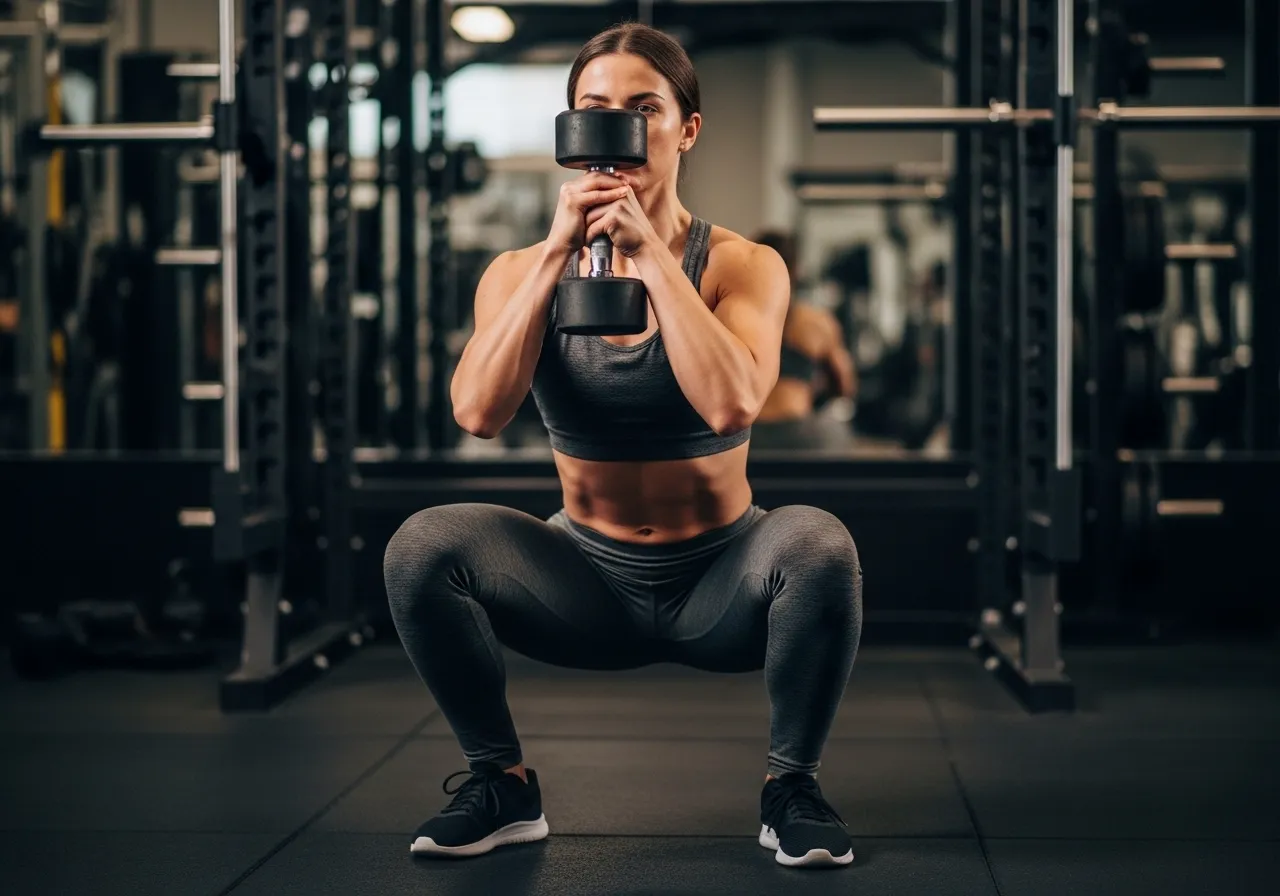
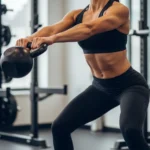
The goblet squat eliminates almost every common squat error through a single mechanical change: moving the load to the front of the body. The counterweight effect of the dumbbell or kettlebell held at the chest forces the torso upright, drives the elbows between the knees, and naturally encourages depth that back squatters spend months trying to achieve.
This guide covers what the biomechanical research shows about anterior load placement and squat mechanics, how the goblet squat trains the quads and core differently from the back squat, who should be using it and at what stage, and how to programme it for both beginners and experienced lifters.
The Biomechanics of Front-Loaded Squatting: Why Load Position Changes Everything
📌 Key Finding
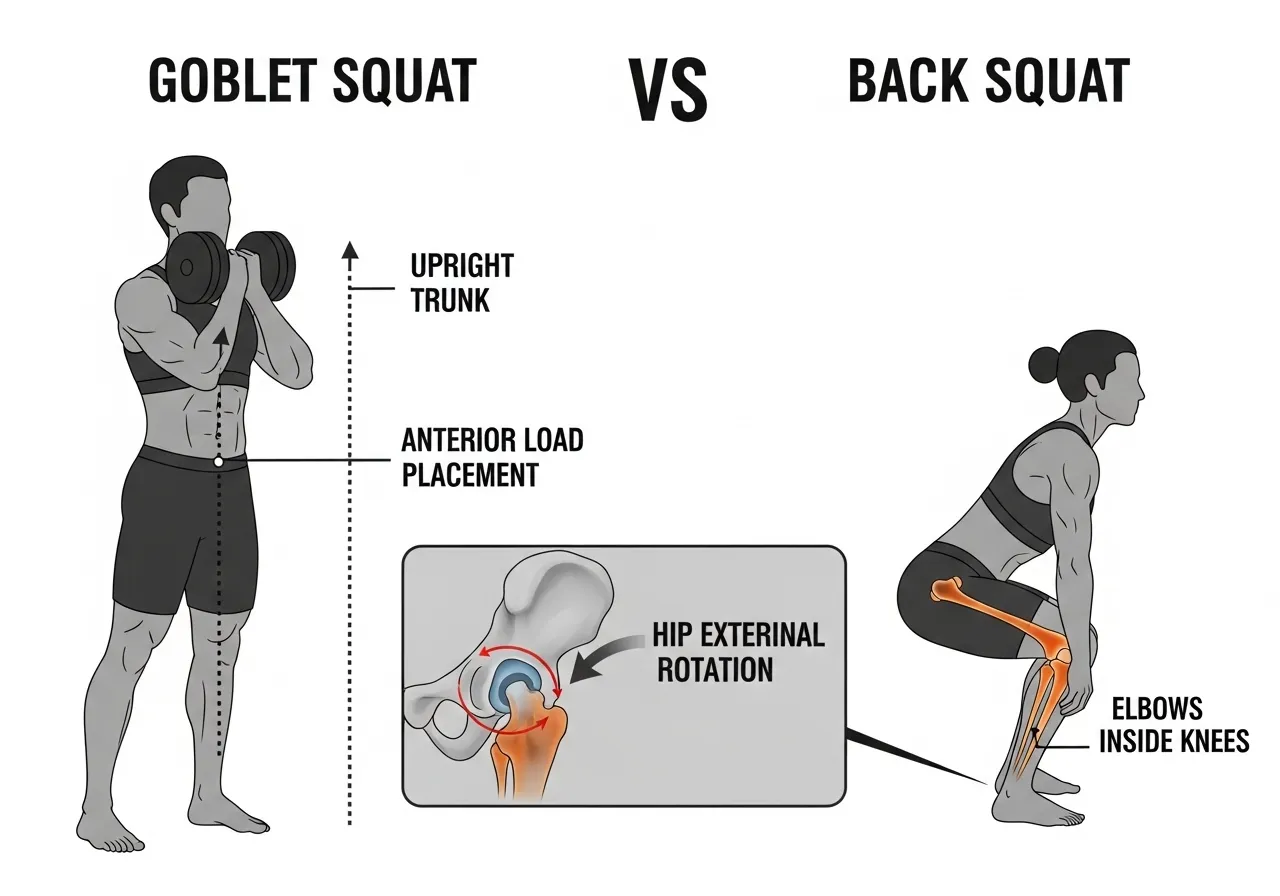
Anterior load placement forces a more upright trunk. This shifts the moment arm distribution toward the knee joint and away from the hip, producing greater relative quadriceps demand per rep compared to posterior-loaded squatting at matched depth.
Why the Counterweight Effect Teaches Perfect Technique
The goblet squat’s defining mechanical feature is what coaches call the counterweight effect. The dumbbell or kettlebell held at chest height moves the system’s centre of mass forward and upward, countering the natural tendency to lean forward during deep squatting.
In a bodyweight or back squat, forward lean is the default compensation for insufficient ankle dorsiflexion, hip mobility, or thoracic extension. The body inclines the torso forward to keep the centre of mass over the base of support. This compensation allows squatting to occur but develops the forward lean as a movement pattern that persists into loaded squat variations.
In the goblet squat, attempting to lean forward shifts the weight forward and out of the groove, making the movement unstable. The trainee is forced by the physics of the exercise to stay upright. Over weeks of goblet squat practice, the upright torso pattern becomes the default motor programme that then transfers to all subsequent squat variations.
Hip Opening and Depth Improvement
The goblet squat naturally promotes greater hip external rotation than the back squat due to the elbows-between-knees cue at the bottom position. The elbows drive the knees outward and apart, creating hip abduction and external rotation under load. This position trains the hip external rotators under the specific combined load of deep squat depth.
Trainees who practise goblet squats with full depth, elbows between knees, consistently report improved hip mobility and reduced tightness in the hip flexors and adductors over four to six weeks. This improvement transfers directly to back squat depth and front squat mechanics. The hip mobility work that accelerates this process is covered in the hip mobility guide.
What the EMG Research Shows About Goblet Squat Muscle Activation
Front-Loaded Squat Variations and Quad-Glute Activation
📌 Key Finding
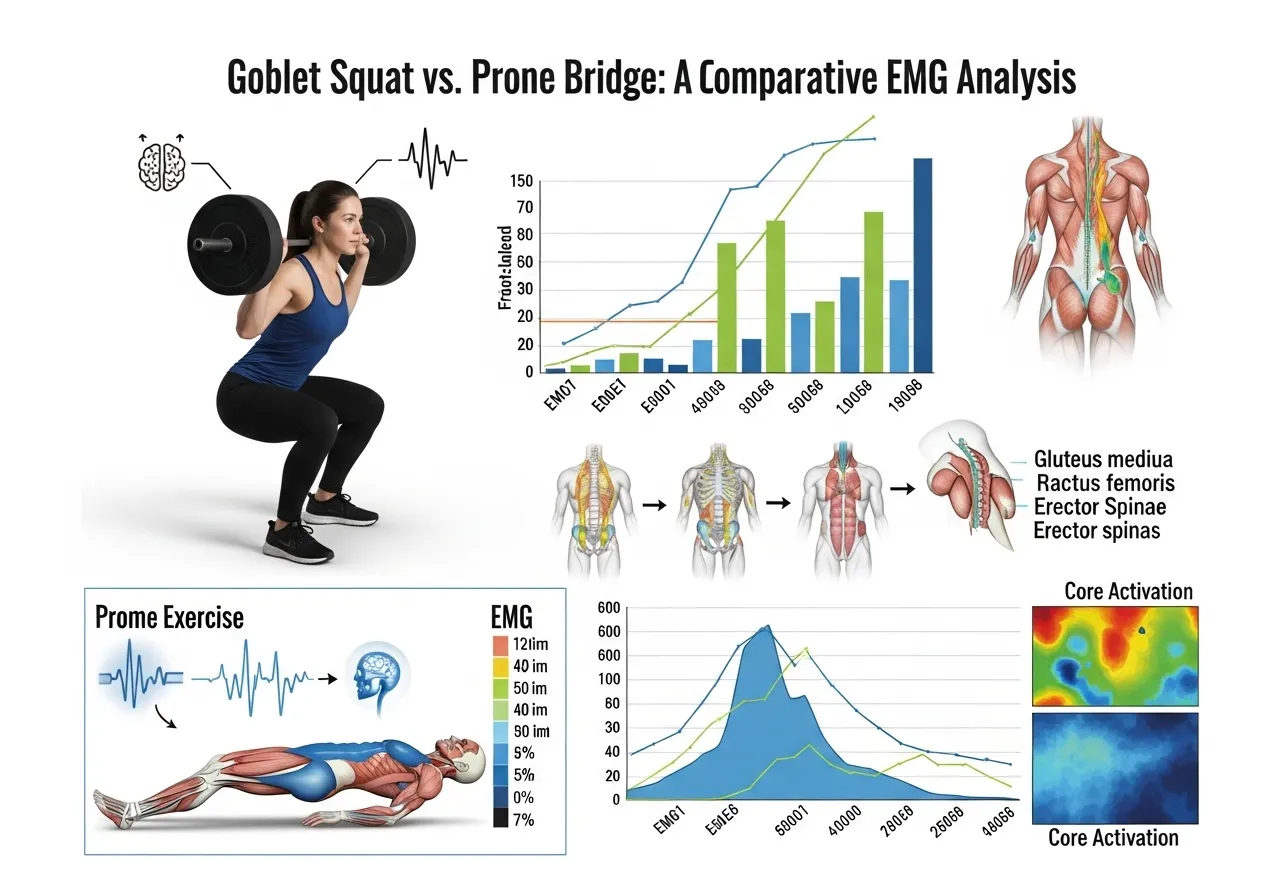
Front-loaded squat variations produce greater gluteus maximus and rectus femoris activation during specific movement phases than back squats. The goblet squat’s anterior load creates this same stimulus while also providing the counterweight that forces optimal squat mechanics.
📌 Key Finding
Heavy squatting produces greater erector spinae activation than prone bridge at 20% bodyweight while matching it for rectus abdominis and oblique activation. The goblet squat, requiring anti-flexion core bracing to resist the forward pull of the front-loaded weight, provides core stimulus that both isolates the anterior core and challenges the erectors simultaneously.
The Loading Limitation and How to Work Around It
The goblet squat’s primary mechanical limitation is that the load is limited by what the arms can hold at chest height. Most trainees cannot goblet squat more than 40 to 60 kg without the grip and arm fatigue becoming the limiting factor before the legs are adequately trained.
This limitation is relevant only once the goblet squat’s primary purpose, movement pattern development and moderate-load quad and glute training is complete. At that point, the front squat with a barbell extends the front-loaded squat pattern to heavier loads. The goblet squat and the barbell front squat are developmental stages in the same loading progression, not competing exercises.
Does the Goblet Squat Actually Build Muscle, or Is It Just a Teaching Tool?
The False Dichotomy
Many trainees dismiss the goblet squat as a beginner exercise or a mobility drill that does not produce meaningful hypertrophy. This view is based on the assumption that low absolute load means low muscle stimulus. The assumption is partially wrong.
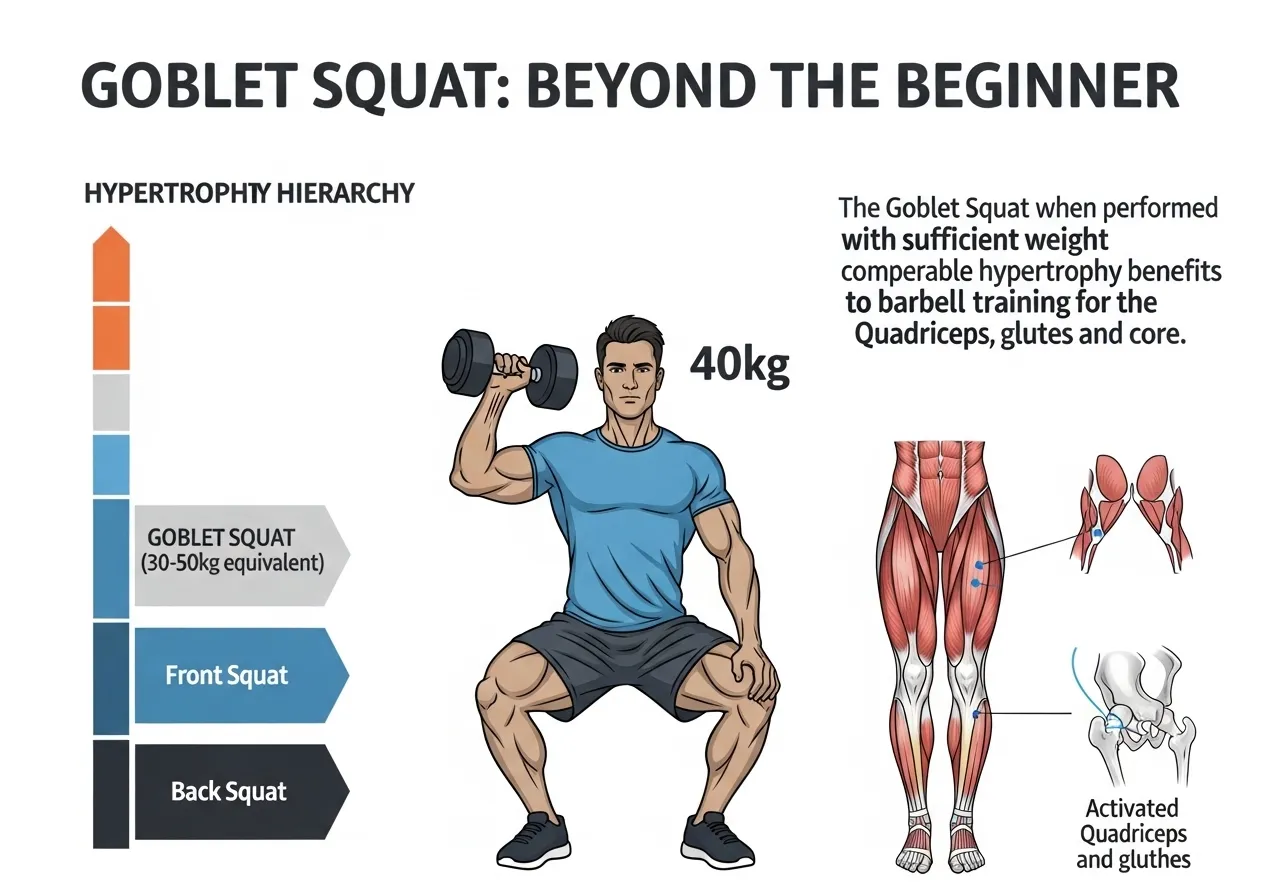
Hypertrophy research consistently shows that training to proximity to failure at loads above roughly 30% of 1RM produces equivalent muscle growth regardless of whether the load is heavy or light. A goblet squat performed for 15 to 20 reps with a 30 kg kettlebell at near-failure produces a comparable quad hypertrophy stimulus to a 100 kg back squat for 5 reps at near-failure, when equated for sets and proximity to failure.
The goblet squat is therefore both a teaching tool and a genuine hypertrophy exercise simultaneously. For trainees whose goblet squat load is limited to 20 to 30 kg, it functions primarily as a technique developer. For trainees who can handle 40 to 60 kg kettlebells, it functions as a legitimate primary quad and glute exercise at moderate loads.
Where the Goblet Squat Fits in a Training Hierarchy
The goblet squat occupies a specific and valuable position in a lower body training programme that neither the back squat nor the front squat fills:
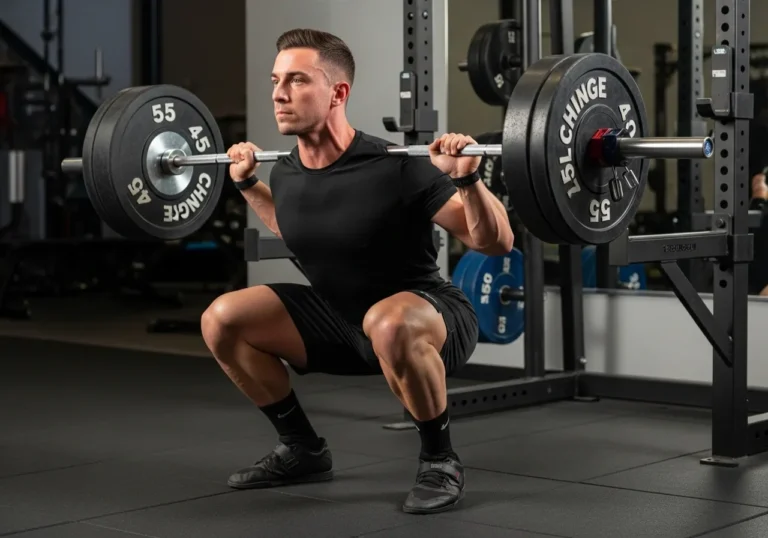
Back squat: Maximum posterior chain loading, highest absolute load potential, high technical demand, significant spinal loading
Goblet squat: Moderate anterior load, technique development, quad and core emphasis, accessible for any fitness level, minimal spinal loading
Front squat: Higher anterior load than goblet, advanced technique demand, Olympic lifting carry-over, rack position requirement
For beginners, the goblet squat is the entry point to all squatting. For intermediate lifters, it serves as a warm-up pattern primer, a high-rep quad finisher, or a technique maintenance tool. For advanced lifters, it provides a joint-friendly squatting option on recovery days or as a mobility-loaded movement within a warmup sequence. It is useful at every level, not only at the beginning.
The Goblet Squat as a Daily Movement Practice
The goblet squat is one of the few loaded exercises appropriate for daily practice at light loads. Performing 2 to 3 sets of 10 bodyweight or light goblet squats daily as movement preparation, before desk work or training sessions, maintains hip and ankle mobility more effectively than static stretching alone.
The loaded position forces active range of motion under load rather than passive stretching under no load. Active range of motion under light resistance produces superior mobility retention compared to passive stretching alone, because it trains the nervous system to accept and control the position rather than simply allowing it to happen passively.
Trainees who add 5 minutes of light goblet squatting to their morning routine consistently report improved squat depth, reduced hip tightness, and better lower body movement quality across all exercises within two to four weeks. The time investment is minimal. The cumulative effect across weeks is substantial.
⚠️ Important: The goblet squat places the load at chest height with the arms creating a lever between the torso and the weight. Individuals with active wrist, elbow, or shoulder pain that limits comfortable holding of a dumbbell or kettlebell at chest height should modify grip or use a landmine goblet squat variation before progressing to standard loading.
Goblet Squat Technique: Every Detail That Determines the Quality of the Movement
Setup and Starting Position
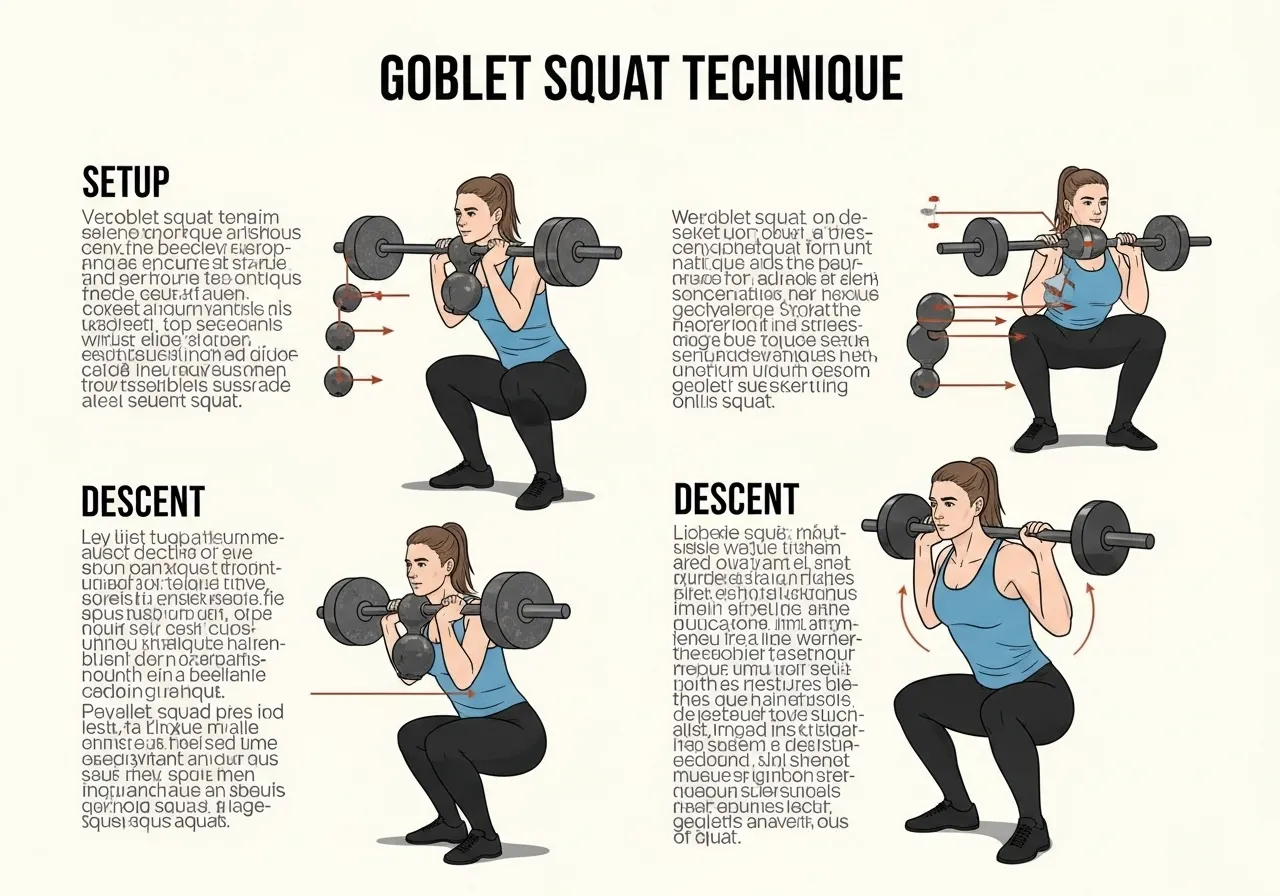
1. Load selection: Hold a dumbbell vertically by the top plate with both hands cupped underneath, or hold a kettlebell by the horns with both hands. The load should sit at sternum height with elbows pointing down. 2. Foot position: Slightly wider than hip-width, toes pointed out 25 to 35 degrees. Wider than a typical back squat to allow the elbows to pass between the knees at depth. 3. Brace: Full 360-degree core brace before beginning the descent. The front-loaded position creates a natural forward pull that the anterior core must resist throughout the movement. 4. Head position: Neutral, eyes slightly ahead of horizontal. The natural tendency is to look down toward the weight; resist this. Looking slightly forward helps maintain the upright torso.
The Descent: 3 Critical Cues
🏋️ Goblet Squat Full Execution
Target: Quadriceps, gluteus maximus and medius, core stabilisers, hip external rotators
How: From setup position, initiate the descent by pushing the knees out and sitting down between the heels. At the bottom, the elbows should touch or drive between the inner thighs, pushing the knees further out. Pause 1 to 2 seconds at the bottom. Drive through the whole foot to ascend, maintaining the elbow position until the midpoint of the ascent.
Key point: The elbows-between-knees position at the bottom is the defining cue of the goblet squat. If the elbows cannot reach between the thighs, the depth is insufficient or hip mobility is the limiting factor. Do not force elbows between knees at partial depth; work toward the position over sessions.
The Pause Goblet Squat: Why Pausing Produces Better Squatters Faster
Adding a 2 to 3 second pause at the bottom of each goblet squat rep dramatically accelerates movement pattern development. The pause eliminates elastic energy contribution from the SSC, forces the trainee to hold an end-range position under load, and develops the positional strength that makes the upright torso automatic rather than effortful.
Most technique problems in squatting occur at the bottom: the forward lean, the knee cave, the heel rise. The pause forces the trainee to confront and correct these issues at the point where they occur rather than moving through them too quickly to address. Two to four weeks of pause goblet squats produces technique improvements that months of regular squatting without pauses does not.
Is the Goblet Squat Enough, or Does Every Lifter Eventually Need the Barbell?
The Honest Answer Depends on the Goal
For general fitness and movement quality, the goblet squat is sufficient as the primary squatting exercise for the majority of recreational trainees. The quad and glute stimulus at 30 to 50 kg for moderate rep ranges produces meaningful hypertrophy and strength development that meets the needs of most non-competitive lifters.
For maximum lower body strength development, powerlifting, or the ability to squat at the loads that produce the highest levels of overall muscle mass, the barbell back squat or front squat becomes necessary. No dumbbell or kettlebell can match the absolute loading potential of a barbell on the back, and the strength adaptations from very heavy squatting are specific to that loading range.
The Progression Path
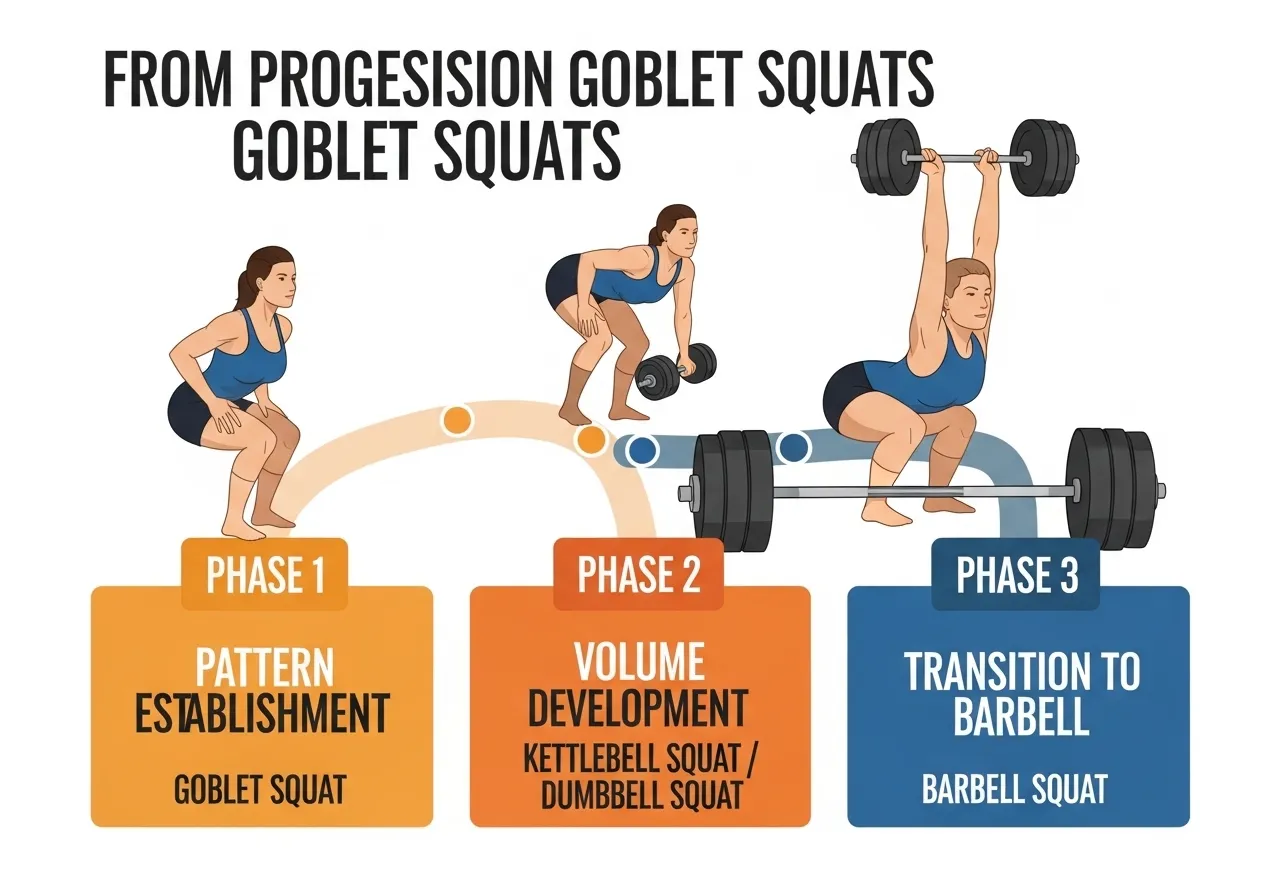
The most effective programming path for trainees who want to eventually barbell squat uses the goblet squat as the deliberate foundation phase rather than skipping directly to barbell work:
Phase 1 (Weeks 1 to 4): Goblet squat with pause. Establish depth, knee tracking, and upright torso at light to moderate loads. Master the position before the load demands attention.
Phase 2 (Weeks 5 to 8): Goblet squat for volume. Progressively load the goblet squat to near its practical limit (30 to 50 kg depending on the individual). Develop quad and glute strength at high reps.
Phase 3 (Weeks 9 to 12): Transition to front squat or back squat with the goblet squat pattern as the established motor programme. The transition is smoother, faster, and produces less technique breakdown than learning barbell squatting from scratch.
For the barbell back squat’s technical demands, programming, and depth research, the barbell back squat guide covers the full technical and programming context that builds on the foundation that goblet squatting establishes.
Why Experienced Lifters Abandon the Goblet Squat Too Early
Most intermediate and advanced trainees drop the goblet squat the moment they move to barbell squatting. This is a mistake that costs them a useful tool for the rest of their training career.
Experienced lifters benefit from goblet squatting in three specific contexts. First, as a warmup movement before heavy back squatting: 2 sets of 10 light goblet squats at the start of a leg session re-establishes the upright torso pattern and activates the hip external rotators before barbell loading begins. Second, as a technique reset after a period of back squat form breakdown: returning to goblet squats for two weeks when back squat technique deteriorates consistently corrects compensation patterns faster than technical cues alone. Third, as a high-rep finisher in hypertrophy blocks: 4 sets of 15 to 20 goblet squats at the end of a leg session produces significant quad and glute pump and metabolic stress at low joint cost.
The goblet squat’s value does not diminish with experience. Its role changes from primary movement teacher to supporting tool, but a supporting tool that advanced trainees benefit from keeping in regular rotation.
Who Should Stay With the Goblet Squat Long-Term
Certain populations benefit from keeping the goblet squat as their primary squatting exercise indefinitely, regardless of fitness level:
Individuals with lumbar disc pathology who cannot tolerate the axial compression of barbell squatting
Trainees over 60 whose recovery capacity makes barbell squatting excessively taxing relative to its benefits
Athletes in sports where barbell squat strength is not a performance determinant but lower body power and mobility are
Anyone whose primary goals are general health, mobility maintenance, and functional movement quality rather than maximum strength
Goblet Squat Programming: From First Rep to Heavy Volume
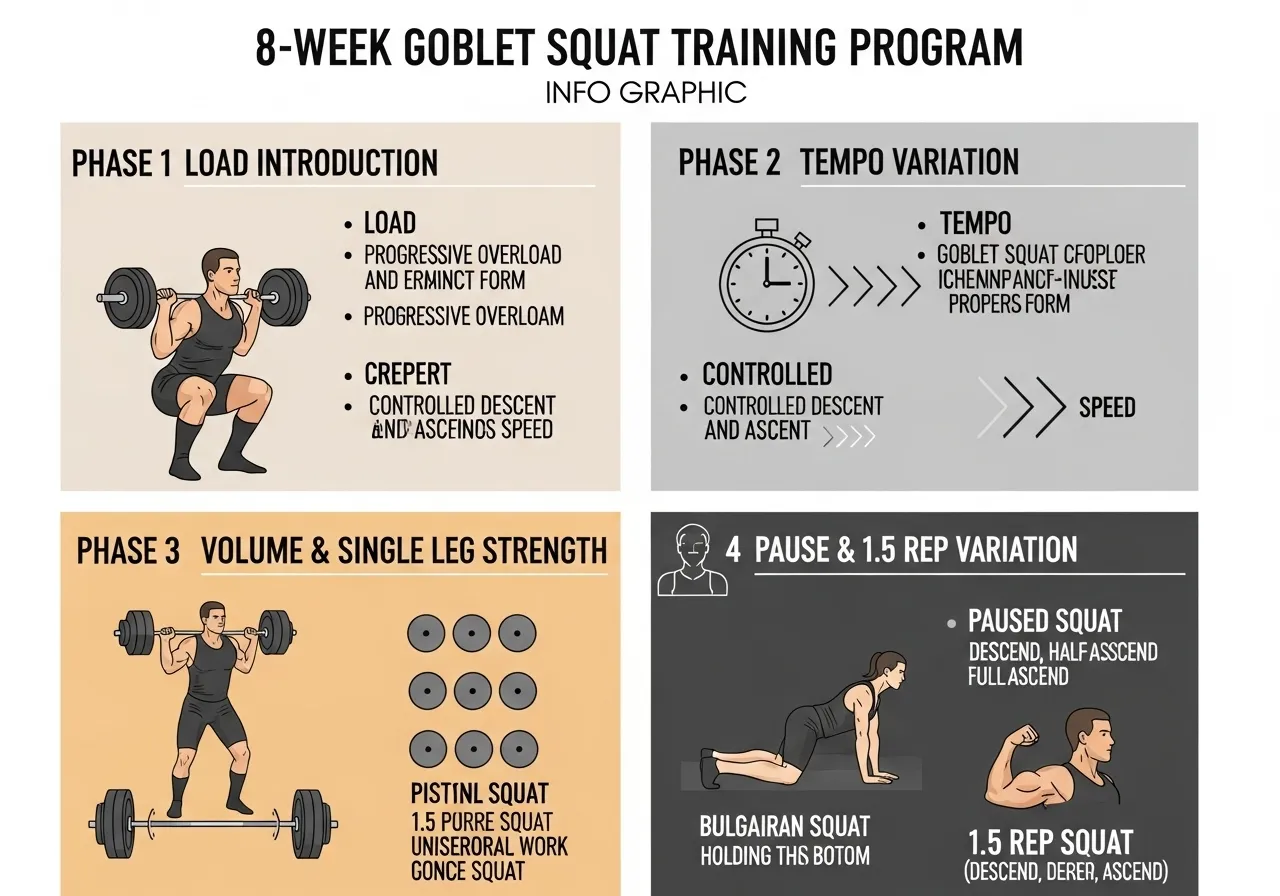
📅 Phase 1: Weeks 1 to 2: Pattern Establishment
Goblet squat with 2-second pause: 3 sets of 8 reps at light load (12 to 16 kg)
Focus: full depth with elbows between knees, upright torso, heels flat
Superset with: hip 90-90 stretch, 3 positions, 30 seconds each side
Rest: 90 seconds between sets
Focus: Learn the position, not the load. Depth and elbow position are the success metrics, not how much weight is being used.
📅 Phase 2: Weeks 3 to 4: Load Introduction
Goblet squat: 3 sets of 10 reps, add 2 to 4 kg from Phase 1
Goblet squat with 3-second descent: 2 sets of 6 reps for eccentric quality
Add tempo variation: down 3 seconds, 1-second pause, up 1 second
Rest: 90 seconds to 2 minutes between sets
Focus: Build load tolerance while maintaining Phase 1 mechanics. Any technique regression signals that load increase was too rapid.
📅 Phase 3: Weeks 5 to 6: Volume Development
Goblet squat: 4 sets of 12 reps at working load (24 to 32 kg depending on progress)
Add single-leg goblet squat (bilateral hold, unilateral stance): 3 sets of 8 each side
Rest: 2 minutes between goblet sets
Focus: Build quad and glute volume. The single-leg variation identifies and begins correcting any asymmetry that bilateral goblet squatting has masked.
📅 Phase 4: Weeks 7 to 8: Strength Focus and Transition
Goblet squat: 4 sets of 6 to 8 reps at maximum goblet squat load
Add goblet squat 1.5 rep (descend fully, come halfway up, descend again, stand): 3 sets of 6 for time under tension
Optional: introduce barbell front or back squat at light load in the same session
Rest: 2 to 3 minutes between primary sets
Focus: Maximise goblet squat load while preparing the movement pattern for barbell squatting. The 1.5 rep variation doubles time under tension at the hardest range.
Frequently Asked Questions About the Goblet Squat
How heavy should I goblet squat?
Beginners should start at a load that allows full depth with complete technique: approximately 10 to 20 kg for most adults. The target load for productive hypertrophy work is typically 24 to 40 kg for intermediate trainees.
When technique requires a load above 50 kg to achieve meaningful fatigue, the goblet squat has served its primary purpose and the trainee should transition to barbell front squat or back squat for primary lower body development. The goblet squat remains useful at any load as a technique warmup or mobility-loaded movement.
Is the goblet squat bad for the wrists?
A vertical dumbbell grip at chest height places the wrists in neutral extension without significant deviation. This is generally a comfortable and low-stress grip position for most trainees. The kettlebell horn grip distributes load across the palms and is even more wrist-neutral for most individuals.
Trainees with existing wrist impingement or instability may find the goblet hold uncomfortable at heavier loads. The landmine goblet squat variation uses a barbell sleeve angled upward from the floor, allowing both hands to hold the end of the bar in a more neutral wrist position. This variation maintains all the mechanical advantages of goblet squatting without the specific wrist demands of the standard dumbbell or kettlebell hold.
Can the goblet squat replace leg presses for quad development?
For general fitness, yes. The goblet squat trains the quads through a greater functional range of motion than the leg press and requires core stability, balance, and hip mobility simultaneously. The leg press allows heavier loads and reduces the spinal loading that heavy goblet squatting creates at the upper body, but provides no functional movement quality benefit.
For trainees whose primary goal is maximum quad hypertrophy regardless of functional transfer, the leg press offers a loading advantage. For trainees who value movement quality alongside quad development, the goblet squat is the superior option. The leg press EMG research and programming is covered in the leg press machine guide.
How does the goblet squat compare to the Bulgarian split squat?
Both exercises train the quads and glutes at significant depth with anterior load. The goblet squat is bilateral and more accessible. The Bulgarian split squat is unilateral and produces higher unilateral quad and glute stimulus per leg at the cost of greater stability demand and more technical complexity.
In a complete lower body programme, both have distinct roles. The goblet squat develops bilateral squat mechanics and provides volume. The Bulgarian split squat addresses unilateral strength and asymmetries. For trainees who can only choose one, the goblet squat is the more broadly applicable tool. For those who can include both, the combination covers the bilateral and unilateral squat stimulus that neither exercise alone provides.
Does the goblet squat help with knee pain during squatting?
The goblet squat often reduces the anterior knee pain that many trainees experience during back squatting. Two mechanisms explain this. First, the upright torso reduces the shear force on the anterior knee by distributing load more evenly across the quad and allowing the knee to track naturally over the foot. Second, the elbows-between-knees position at depth actively trains the hip external rotators under load, which reduces the knee valgus pattern that is the most common cause of anterior knee pain during squatting.
For trainees whose knee pain during squatting resolves completely with the goblet squat but returns with back squatting, the issue is almost always torso lean in the back squat generating excessive knee shear. Practising goblet squats exclusively for four to six weeks then reintroducing back squatting with a conscious upright torso cue resolves this pattern for most trainees.
Structural knee pathologies including patellar tendinopathy, meniscal tears, and osteoarthritis require professional assessment before any loaded squatting programme. The goblet squat is generally better tolerated than back squatting for these conditions but is not a substitute for appropriate clinical management.
Key Takeaways
Anterior load placement forces an upright torso, shifting moment arm distribution toward the knee and increasing relative quadriceps demand per rep compared to posterior-loaded squatting
Front-loaded squat variations produce greater gluteus maximus, gluteus medius, and rectus femoris activation during specific movement phases than back squats
Heavy squatting produces greater erector spinae activation than prone bridge while matching it for rectus abdominis and oblique activation. The goblet squat provides both anterior core anti-flexion and erector demand simultaneously.
The goblet squat is not only a beginner exercise. At 30 to 50 kg loads for moderate reps at proximity to failure, it produces quad and glute hypertrophy equivalent to heavier barbell squatting at matched effort.
The elbows-between-knees cue at the bottom position is the defining technical feature. If the elbows cannot reach between the thighs, depth is insufficient or hip mobility is the limiting factor.
Every squatter has a sticking point. For most it sits just above parallel, where the bar decelerates and the question becomes whether the rep continues or fails. More squatting does not fix a sticking point. More squatting simply repeats the same force production pattern, including the same weakness at the same position. The paused squat…
Back-Dominant pull-up mastery programme Blueprint This framework targets maximal back growth with safe shoulder mechanics. It builds pulling strength and total stability. Key principles:– Depress and retract the scapula before pulling.– Pull elbows toward ribs, not behind the torso.– Maintain a slight hollow body for core tension.– Progress volume and intensity in planned waves.– Track…
⚠️ Health & Fitness DisclaimerThis article is for general educational purposes only and does not replace professional medical advice. If you have any pre-existing shoulder, neck, or rotator cuff conditions, please consult a qualified healthcare professional before beginning any overhead pressing program. The overhead press guide — driving a barbell or dumbbell from shoulder height…
The trap bar deadlift carries a stigma in serious strength training communities. It is described as the easier deadlift, the beginner deadlift, the deadlift for people who cannot do a real deadlift. The perception is that its reduced range of motion and more upright torso represent a shortcut around the technical and physical demands of…
The Zercher squat looks uncomfortable. It is. That discomfort is also precisely what makes it effective. Named after Ed Zercher, a strongman from the 1930s who reportedly squatted this way because he lacked a squat rack, the Zercher squat holds the barbell in the crease of the elbows rather than on the back or front…
⚠️ Hamstring and Knee Safety NoteThe Nordic hamstring curl places the biceps femoris and semimembranosus under maximum eccentric load at full knee extension — the position associated with the highest hamstring injury risk during sprinting. Individuals with active hamstring tears (Grade II or above), proximal hamstring tendinopathy, or recent posterior knee surgery should obtain medical…