Sumo Deadlift Guide: The Hip-Dominant Pulling Variation That Suits Different Anatomy and Develops Posterior Chain Strength
The sumo deadlift divides training communities more than almost any other exercise. One camp dismisses it as a range-of-motion cheat, a way to lift more weight by pulling from a shorter bar path. The other treats it as a legitimately different movement that suits specific anthropometry better than the conventional deadlift and develops different muscular qualities through its distinct mechanics.
The research supports neither extreme position. The sumo deadlift is not a shortcut. Its wider stance requires greater hip abductor and adductor strength, produces multi-planar hip and knee demands that the conventional deadlift does not, and loads the spine differently in ways that benefit certain presentations and challenge others. It is a different exercise from the conventional deadlift, not a superior or inferior version of the same exercise.
This guide covers what the current EMG and biomechanical research reveals about sumo versus conventional differences, how hip anatomy determines which stance is mechanically better suited to specific individuals, complete technique, the most common sumo deadlift errors, variations, and programming for the sumo deadlift as either the primary pulling movement or as an accessory to conventional deadlifting.
Research 1: EMG and Biomechanical Differences Between Sumo and Conventional Deadlift
The Comprehensive 2025 Comparison: Kinematics, Kinetics, and EMG
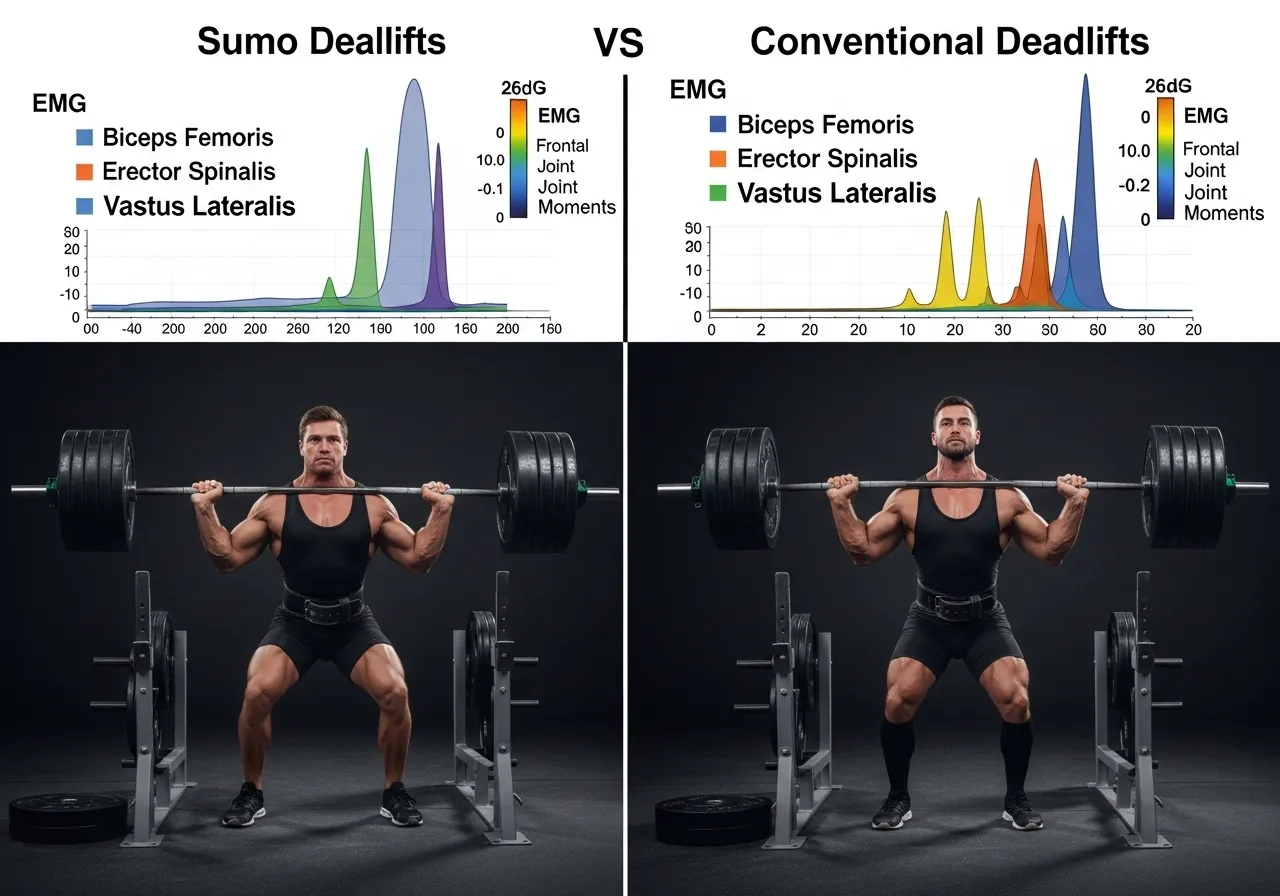
A biomechanical analysis of conventional and sumo deadlifts in 30 experienced male lifters at 85% of 1RM found that the sumo deadlift showed greater range of motion in the frontal and transverse planes particularly at the hip and knee, whereas conventional deadlift involved greater hip flexion and ankle dorsiflexion, the conventional deadlift generated higher hip extension moments while sumo produced greater frontal and transverse plane joint moments at the hip and knee, and regarding EMG peak values the biceps femoris exhibited greater activation in conventional deadlift across both phases while the tibialis anterior and erector spinae thoracis demonstrated greater activation in conventional deadlift, and the vastus lateralis exhibited higher peak activation in sumo deadlift during phase 1, with the conclusion that conventional deadlift is more effective for targeting the posterior chain particularly hip extensors while sumo deadlift emphasises anterior chain involvement and induces greater mediolateral stabilisation demands.
Conventional deadlift activates biceps femoris and erector spinae more. Sumo deadlift activates vastus lateralis more and produces greater frontal and transverse plane hip and knee demands. These are different exercises with different primary targets, not the same exercise with different grip width.
Sumo Deadlift in Women: Comparison With Conventional and Hex Bar
A biomechanical comparison of conventional, sumo, and hex-bar deadlifts among resistance-trained women found that sumo and conventional deadlifts may be more effective for targeting the hip extensors near the lockout during the last repetition of three-repetition-maximum deadlifts compared to hex-bar deadlifts, with the study suggesting that when training maximal deadlifts, hex-bar deadlifts may be beneficial for targeting knee extensors and enhancing barbell velocity among strength trained women, while sumo and conventional deadlifts produce superior hip extensor loading during the lockout phase that is particularly relevant for posterior chain development in competition and functional strength contexts.
Both sumo and conventional deadlifts produce superior hip extensor loading at lockout compared to hex-bar deadlifts. For posterior chain development specifically, the sumo deadlift is not inferior to conventional, despite the common perception that its shorter range makes it less effective.
Joint Moments and Anterior Chain Emphasis in Sumo
A study examining joint kinetics and muscle activation during conventional and sumo deadlifts found that conventional deadlift is more effective for targeting posterior chain particularly hip extensors while sumo deadlift emphasises anterior chain involvement and induces greater mediolateral stabilisation demands supporting its relevance for knee reinforcement and functional rehabilitation contexts where frontal plane hip and knee demands are beneficial, and that SDL exhibited multi-planar demands with elevated knee extension involvement that CDL does not produce to the same degree.
Sumo deadlift produces greater frontal plane hip and knee demands relevant for knee reinforcement and functional rehabilitation. The multi-planar demand profile of sumo deadlifting develops mediolateral stability that sagittally dominant conventional deadlift training does not address.
Spinal Loading: What the Lumbar Mechanics Research Shows
The lumbar spine loading comparison between sumo and conventional deadlift is one of the most frequently cited reasons for selecting the sumo stance. The conventional deadlift’s greater hip flexion at the starting position creates a longer moment arm between the barbell and the lumbar spine, producing greater lumbar extensor demands and higher anterior shear force on the lumbar discs. The sumo deadlift’s more upright trunk position at the start reduces this moment arm and decreases lumbar shear force at matched loads.
This does not make the sumo deadlift spine-safe and the conventional deadlift spine-dangerous. Both are loaded spinal movements requiring appropriate bracing and technique. The sumo deadlift may be more appropriate for individuals with lumbar disc pathology who are shear-sensitive because it reduces the forward-lean moment arm, but it still produces significant lumbar compressive force through the bilateral loading at the sides. The clinical decision between sumo and conventional for individuals with lumbar pathology depends on whether they are shear-sensitive or compression-sensitive, not on a universal preference for one stance.
The Shorter Bar Path Question: Cheating or Mechanics?
The criticism that sumo deadlifters lift less total distance and therefore the lift is somehow less legitimate misunderstands the relationship between bar path and mechanical difficulty. The sumo deadlift’s shorter vertical bar path is accompanied by substantially greater hip abductor and adductor demands through the wider stance, greater mediolateral stabilisation requirements, and the multi-planar joint moment profile that the research confirms. The exercises are not equivalent in mechanical demand for a shorter range. They distribute the demands differently across muscle groups and movement planes.
Does Anatomy Determine Whether You Should Sumo or Conventional Deadlift?
The Hip Socket Depth and Angle Argument
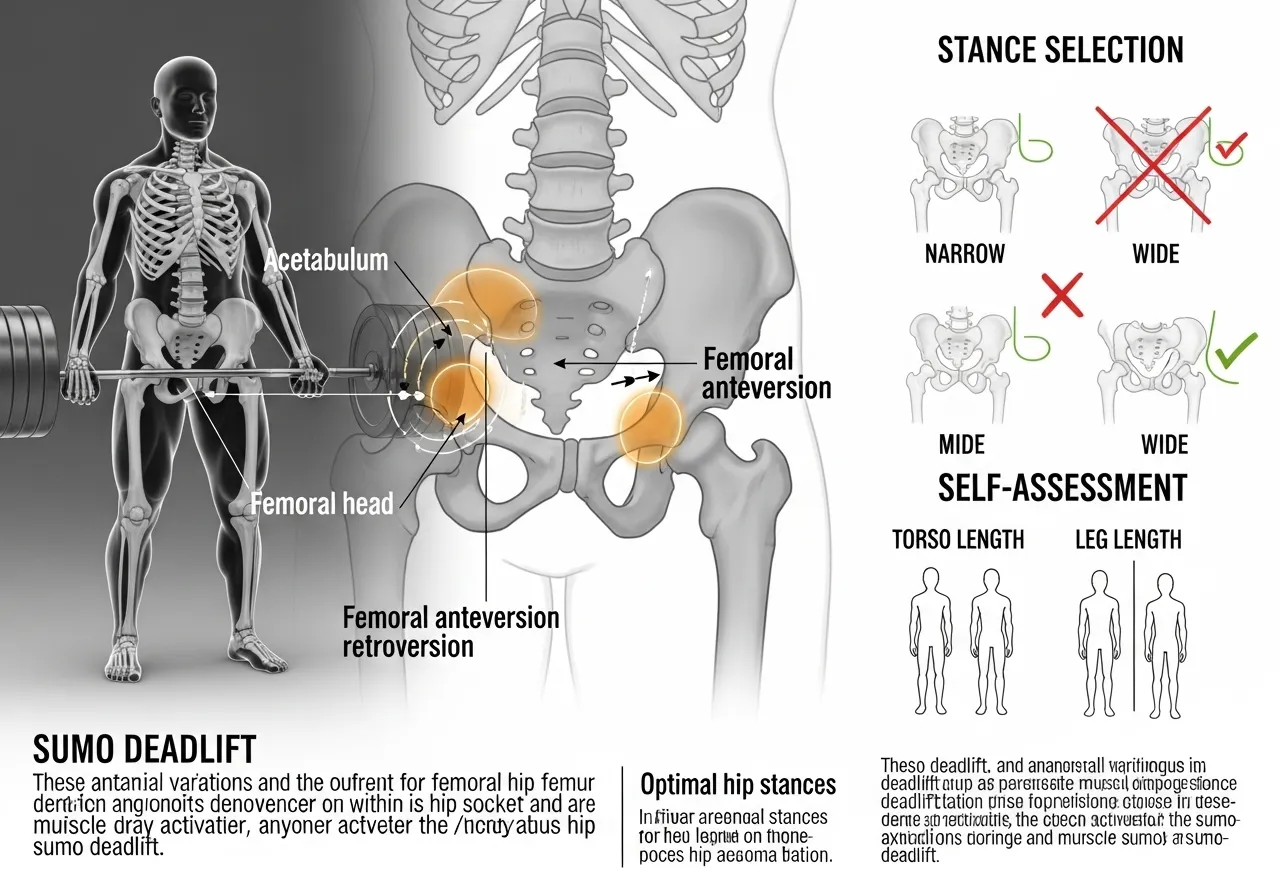
Hip anatomy significantly influences which deadlift stance allows an individual to maintain neutral lumbar position throughout the pull. The acetabulum (hip socket) varies between individuals in its depth, its angle of facing (anteversion and retroversion), and the angle at which the femoral head inserts into it. These structural variables determine how much hip external rotation a given individual can produce before the femoral head begins to impinge on the acetabular rim, which in turn limits the maximum comfortable stance width for the sumo deadlift.
An individual with significant femoral anteversion (femur angled forward) will find externally rotated wide stances uncomfortable and limited, because external rotation of the angled femur creates impingement at shallower angles than a retroverted femur. This individual will typically find a narrower, more conventional stance easier to execute with maintained neutral spine. Conversely, an individual with hip retroversion or a more laterally-facing acetabulum may find that external rotation of the hip in the sumo stance produces a comfortable, well-positioned pull that a more neutral stance with internal femoral rotation does not.
The Self-Assessment: Which Stance Allows Neutral Lumbar?
The most practical anatomy self-assessment for stance selection is the squat assessment: stand with feet hip-width and squat as deep as possible while maintaining a neutral lumbar spine, without any specific foot external rotation. Observe the foot angle that the squat naturally produces. This angle reflects the hip external rotation available without forced positioning. The foot angle that produces a comfortable deep squat with neutral spine is the foot angle that will work for the sumo deadlift stance.
If a conventional deadlift stance (feet hip-width or slightly narrower, toes slightly outward) allows a neutral lumbar at the bottom position, the conventional stance is mechanically appropriate. If achieving a neutral lumbar at the conventional deadlift starting position requires significant forward lean or lumbar flexion that a wider stance reduces, the sumo stance may suit the individual’s anatomy better. Neither assessment determines the only acceptable stance permanently. Both can be trained and both can be developed regardless of initial anatomy.
Torso Length, Leg Length, and Their Effect on Stance Preference
Body segment proportions influence which deadlift stance produces more favourable mechanics without specifically determining which is best. Individuals with longer torsos relative to their legs often find conventional deadlifting more comfortable because the longer torso distributes the forward lean demand over a greater segment length, reducing the relative lumbar flexion required at the starting position. Individuals with very long femurs relative to their torso often find that the conventional starting position requires so much forward lean that the lumbar spine cannot maintain neutrality, making the sumo stance’s more upright position mechanically preferable.
These are tendencies, not deterministic rules. Elite powerlifters with long femurs deadlift conventionally. Elite lifters with short legs deadlift sumo. The proportional tendencies provide a starting hypothesis for which stance to explore first, not a rule that overrides individual technique development and preference.
The Practical Starting Point: Try Both
The most honest approach to stance selection is to train both conventional and sumo deadlifts at moderate loads for 4 to 6 weeks before deciding which to prioritise. Most trainees who have only conventional deadlifted discover either that sumo feels immediately more natural and comfortable, or that it feels significantly more awkward and constrained than conventional. Either response is informative. If sumo feels immediately more natural at a comfortable load, anatomy likely favours the wider stance. If it feels significantly more constrained after 6 weeks of dedicated practice, anatomy likely favours conventional.
Why Not to Choose Based on What Allows More Weight
Some trainees select sumo over conventional because they can lift more weight in the sumo stance, and more weight means more mechanical tension and therefore more adaptation. This reasoning is partially valid but overlooks the muscle group specificity question. If the extra weight in sumo comes primarily from the shorter bar path and not from greater posterior chain loading, the extra load does not provide more posterior chain stimulus. Choose the stance that best targets the muscles you are trying to develop, not the stance that allows the most weight in the short term.
Sumo Deadlift Technique: Setup, Pull, and the Details That Make It Work
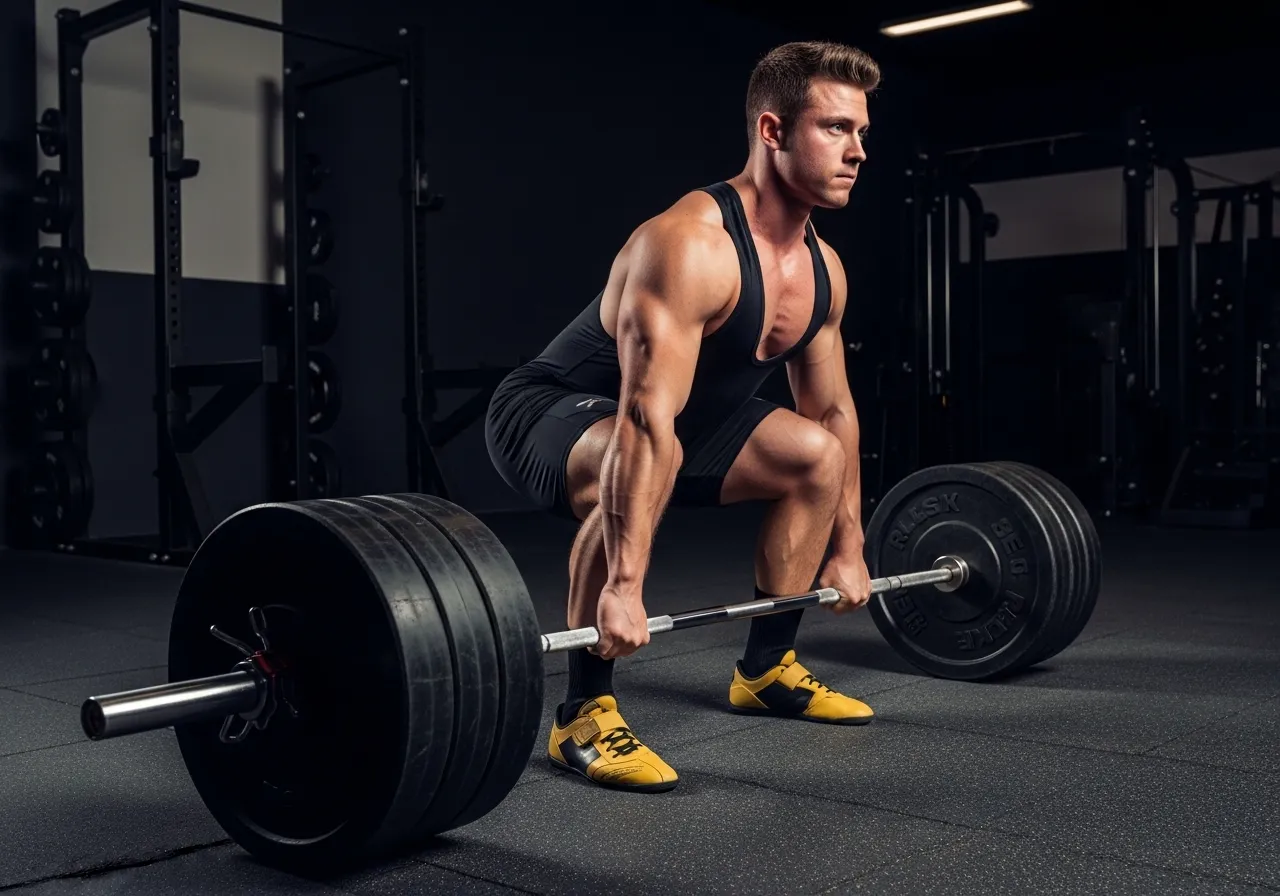
The sumo deadlift’s wide stance places greater demand on the hip abductors and adductors and greater frontal plane stress at the hip joint compared to conventional deadlifting. Individuals with active hip labral tears, femoro-acetabular impingement (FAI), or groin pathology should obtain hip-specific assessment before training sumo deadlifts, as the wide external rotation position may aggravate these conditions. The lumbar spine must maintain a neutral position throughout. The sumo stance’s reduced lumbar shear advantage disappears if the lumbar spine rounds at the starting position.
Foot Position and Stance Width: Finding Your Setup
The sumo deadlift stance width varies between individuals based on hip anatomy, but most trainees find that a stance somewhere between 1.5 and 2 times shoulder width is appropriate. Toes should point outward at the angle that hip external rotation naturally produces: typically 30 to 45 degrees from straight forward. The toes should point in the same direction as the knees throughout the lift. If the knees track over the toes during the descent, the foot angle is correct. If the knees collapse inward despite the toes-out position, the foot angle exceeds available hip external rotation and should be reduced.
The bar should bisect the foot from above, positioned over the mid-foot exactly as in the conventional deadlift. A common sumo setup error is standing too far from the bar, which increases the horizontal distance the bar must travel before it passes the knee, lengthening the early-phase pull and increasing the hip extension demand before the mechanical advantage of the sumo stance is engaged.
Grip and Hand Position
The hands grip the bar inside the legs in the sumo deadlift, using either a double overhand grip or an alternating (mixed) grip as load increases. The grip width is typically 15 to 25 cm narrower than the conventional deadlift because the hands must fit between the inner thighs at the wide sumo stance. Many sumo practitioners find that a narrower grip with slightly more external shoulder rotation is necessary to clear the inner thighs at the bottom of the pull. A hook grip (thumb wrapped around the bar, fingers over the thumb) is commonly used in the sumo deadlift for heavy loads because the alternating grip creates slight torso rotation that the sumo stance amplifies compared to conventional.
The Starting Position: Creating Tension Before the Pull
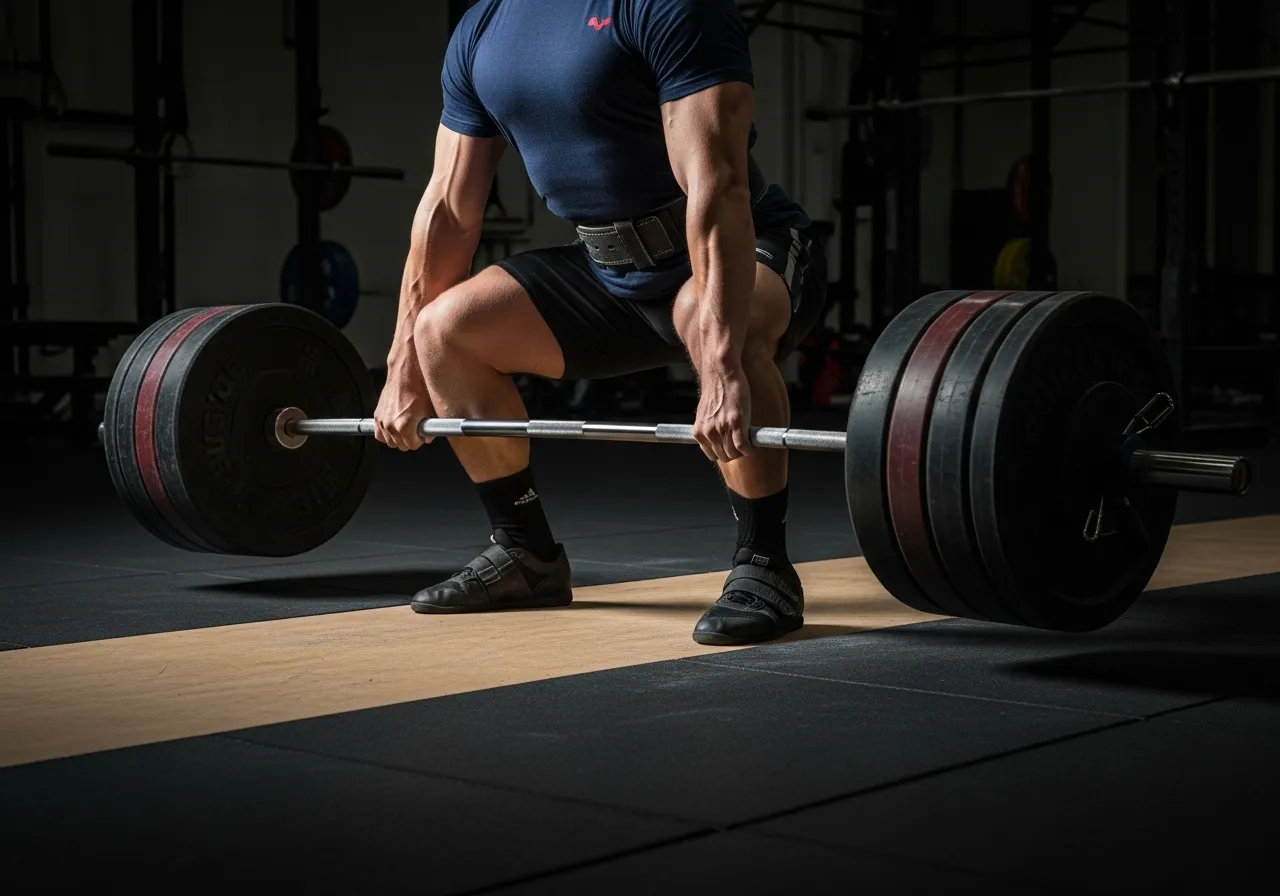
The sumo deadlift starting position requires explicit attention to three specific positions simultaneously. First, hips drop lower toward the bar than in a conventional deadlift, reflecting the sumo’s more squat-like hip position at the start. Second, the chest drives up and forward to establish thoracic extension before the pull begins. Third, the knees drive outward in the direction of the toes to engage the hip abductors and prevent the knees from collapsing inward as the pull initiates. The cue of pushing the floor apart with the feet engages this knee-out position more reliably than directly cueing the knees.
The Pull: Leg Drive, Hip Drive, and Lockout
The sumo deadlift initiates with leg drive rather than the hip hinge emphasis of the conventional deadlift. As the bar breaks from the floor, the primary movement is pushing the floor away rather than extending the hips back. This leg drive continues until the bar passes the knee, at which point the hips drive forward to complete the lockout. The lockout requires full hip extension with the glutes contracted and the torso upright, matching the conventional deadlift lockout position. A common sumo lockout failure is reaching the hips and not completing full hip extension because the wide stance has already provided a sense of completion before true lockout is achieved.
The Descent: Control and Reset
The sumo deadlift descent requires deliberate control to prevent the hips from rising faster than the bar on the return, which creates a forward lean that compromises the starting position for the next rep. Hinge at the hip simultaneously with lowering the bar, maintaining the same squat-like hip position on the way down that characterises the starting position. In competition and high-intensity training, each rep from the floor begins with a fresh brace and tension creation sequence rather than a touch-and-go approach that removes the opportunity to re-establish the correct starting position.
Sumo vs Conventional: Which Should Be Your Primary Deadlift?
The Case for Sumo as Primary
The sumo deadlift is the appropriate primary choice when hip anatomy genuinely favours the wider stance, when lumbar sensitivity limits the forward lean that conventional deadlifting requires, when knee reinforcement and frontal plane stability development is a specific training goal, or when the trainee is a competitive powerlifter for whom sumo produces a higher absolute 1RM that serves competition goals. In each of these cases, the sumo deadlift provides a training stimulus that conventional deadlifting does not replicate as effectively for the specific goal.
For powerlifters specifically, stance selection should ultimately be determined by which stance produces the highest 1RM with maintained technique, regardless of the biomechanical preferences suggested by anatomy assessment. The goal in competition is maximum legal weight, and the rules of powerlifting federation (which mandate specific lockout criteria) must be met regardless of which stance achieves them.
The Case for Conventional as Primary
The conventional deadlift is the appropriate primary choice when posterior chain development is the primary goal and biceps femoris and erector spinae activation is higher in conventional at matched loads. It is also preferred when anatomy does not present compelling evidence for the sumo stance, when the trainee’s sports-specific needs require hip hinge sagittal plane strength, or simply when conventional deadlifting serves as the primary movement long enough that the neurological efficiency advantage significantly favours it over the newly learned sumo stance.
The complete conventional deadlift setup, EMG research, and programming framework is covered in the conventional deadlift guide.
The Complementary Approach: Using Both
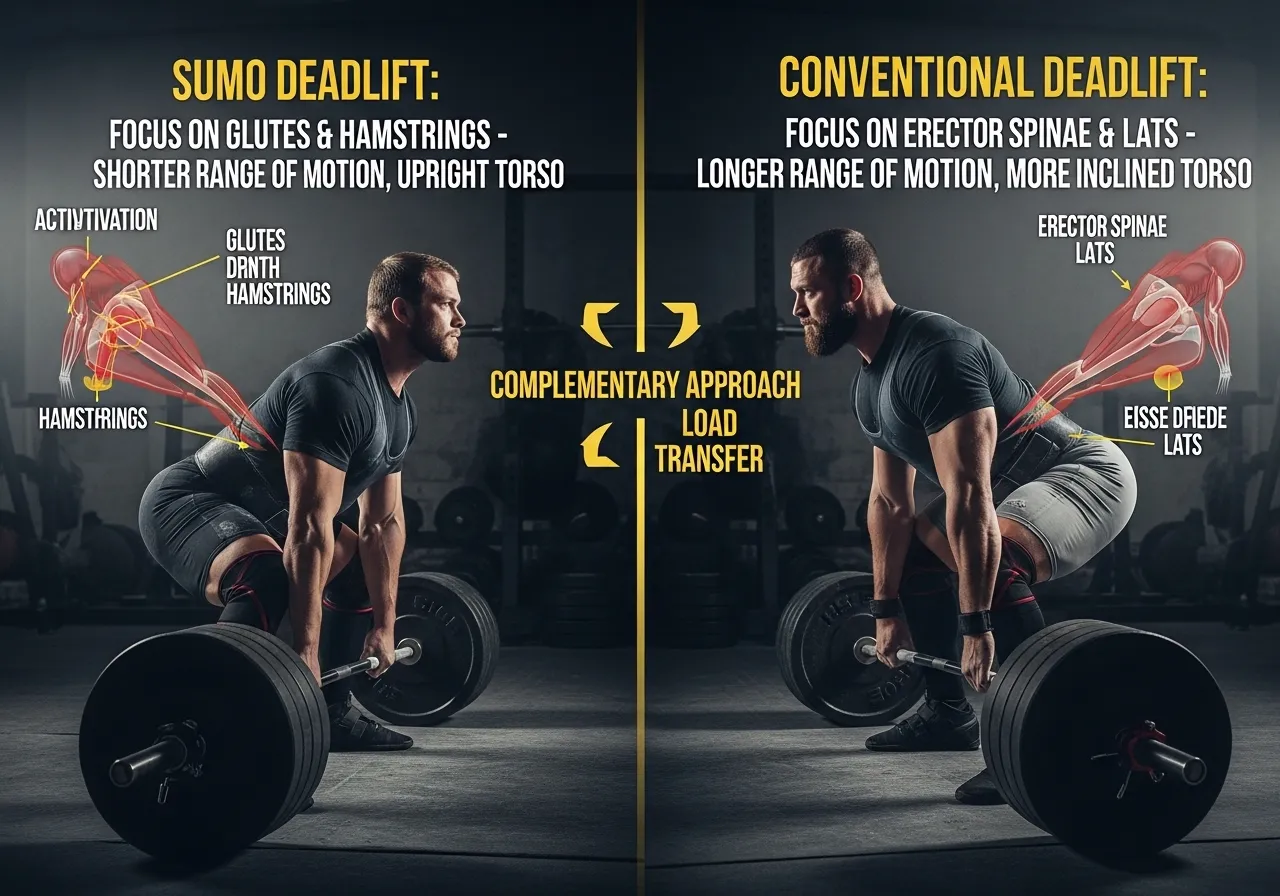
Many intermediate and advanced trainees who have developed both stances use sumo and conventional deadlift in complementary roles. Conventional deadlifts as the primary strength movement for maximum posterior chain development and total load. Sumo deadlifts as an accessory movement to develop hip abductor strength, frontal plane stability, and the mediolateral hip and knee demands that conventional pulling does not provide.
This approach also prevents the technical stagnation that comes from always training the same stance. Each stance challenges different aspects of hip mechanics, and training both maintains broader posterior chain and hip stability development that single-stance training leaves partially unaddressed.
Load Transfer Between Stances: What to Expect
Trainees who switch primary stances typically discover that their maximum sumo load is 5 to 10% different from their conventional maximum in either direction, depending on anatomy and training history. Some trainees can sumo deadlift more than they can conventionally pull; others find the opposite. After 3 to 4 months of dedicated sumo training from a conventional-dominant background, most trainees achieve within 3 to 5% of their conventional maximum in the sumo stance, confirming that both are effective primary pulling movements rather than fundamentally different in their loading potential.
Combining With Other Posterior Chain Exercises
Whether sumo or conventional is the primary deadlift, the posterior chain programme is most complete when supplemented with exercises that address what neither deadlift stance fully develops: Romanian deadlifts for hamstring isolated lengthening under load, hip thrusts for peak glute activation at terminal hip extension, and good mornings for spinal erector endurance in the hip-flexed position. The barbell lunge mechanics and how they complement deadlift posterior chain training are covered in the barbell lunge guide.
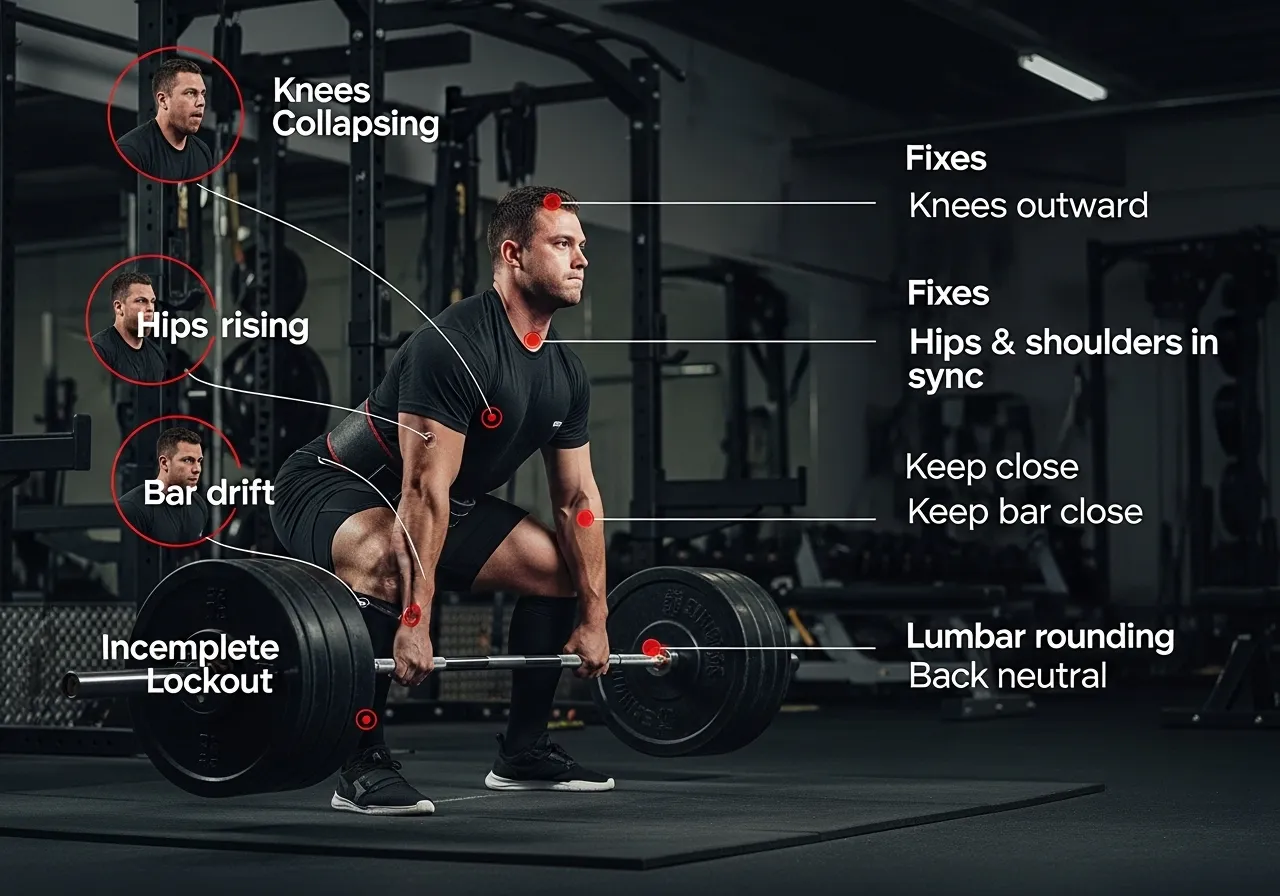
Sumo Deadlift Technique Errors: The 5 Most Common Problems and Their Fixes
Why Sumo Has More Setup Errors Than Conventional
The sumo deadlift requires three simultaneous position variables to be correct at the start, where the conventional deadlift requires two. The additional frontal plane dimension of the wide stance, where knee tracking, hip external rotation, and foot angle must all align, creates more opportunities for initial setup errors that compound into technique breakdown during the pull. Most sumo deadlift problems trace back to the setup rather than the pull itself.
❌ Error 1: Knees Collapsing Inward During the Pull
Cause: Insufficient hip abductor strength to maintain knee tracking over toes under load, or foot angle exceeding available hip external rotation.
Fix: Reduce load and practice the push-the-floor-apart cue at lighter weights until the knee-out position is maintained automatically. Add clamshell and lateral band walk work to develop hip abductor capacity. Check that foot angle does not exceed available external rotation range.
❌ Error 2: Hips Rising Faster Than the Bar From the Floor
Cause: Starting with hips too high (treating sumo as a conventional deadlift with wide feet), causing the initial movement to be a hip rise rather than a leg drive.
Fix: Drop the hips lower in the starting position until the shins are more vertical and the chest is higher. The sumo starting position should resemble the bottom of a squat more than the conventional deadlift starting position. If the hips rise before the bar moves, the starting position is too high.
❌ Error 3: Bar Drifting Forward Away From the Shins
Cause: Bar placed too far from the body in setup, or arms pulling forward rather than driving elbows back during the initiation.
Fix: Position the bar over mid-foot at setup, exactly as in conventional deadlift. Maintain contact between the bar and the inner thighs/shins through the entire pull. Bar drift creates an extended moment arm that undermines the mechanical advantage of the sumo position.
❌ Error 4: Incomplete Hip Lockout
Cause: The wide stance produces a sense of completion before full hip extension is reached, causing the lifter to terminate the rep slightly short of lockout.
Fix: Cue full glute contraction at the top of every rep and drive the hips through to full extension. In competition, referees judge lockout based on knees, hips, and shoulders, all being fully extended simultaneously. Practise full lockout from the first training session with sumo rather than allowing partial lockout to become the trained pattern.
❌ Error 5: Lumbar Rounding at the Starting Position
Cause: Limited hip mobility preventing the low hip position needed for the sumo starting position while maintaining a neutral lumbar spine, causing the lumbar to flex in order to reach the bar.
Fix: Develop hip mobility through deep squat mobility work, hip flexor stretching, and gradual depth progression before adding significant sumo deadlift load. Alternatively, elevate the bar using plates under the collars to reduce the range until hip mobility allows the full-depth starting position with maintained lumbar neutral. The hip mobility development that underpins the sumo deadlift starting position is covered in the hip mobility guide.
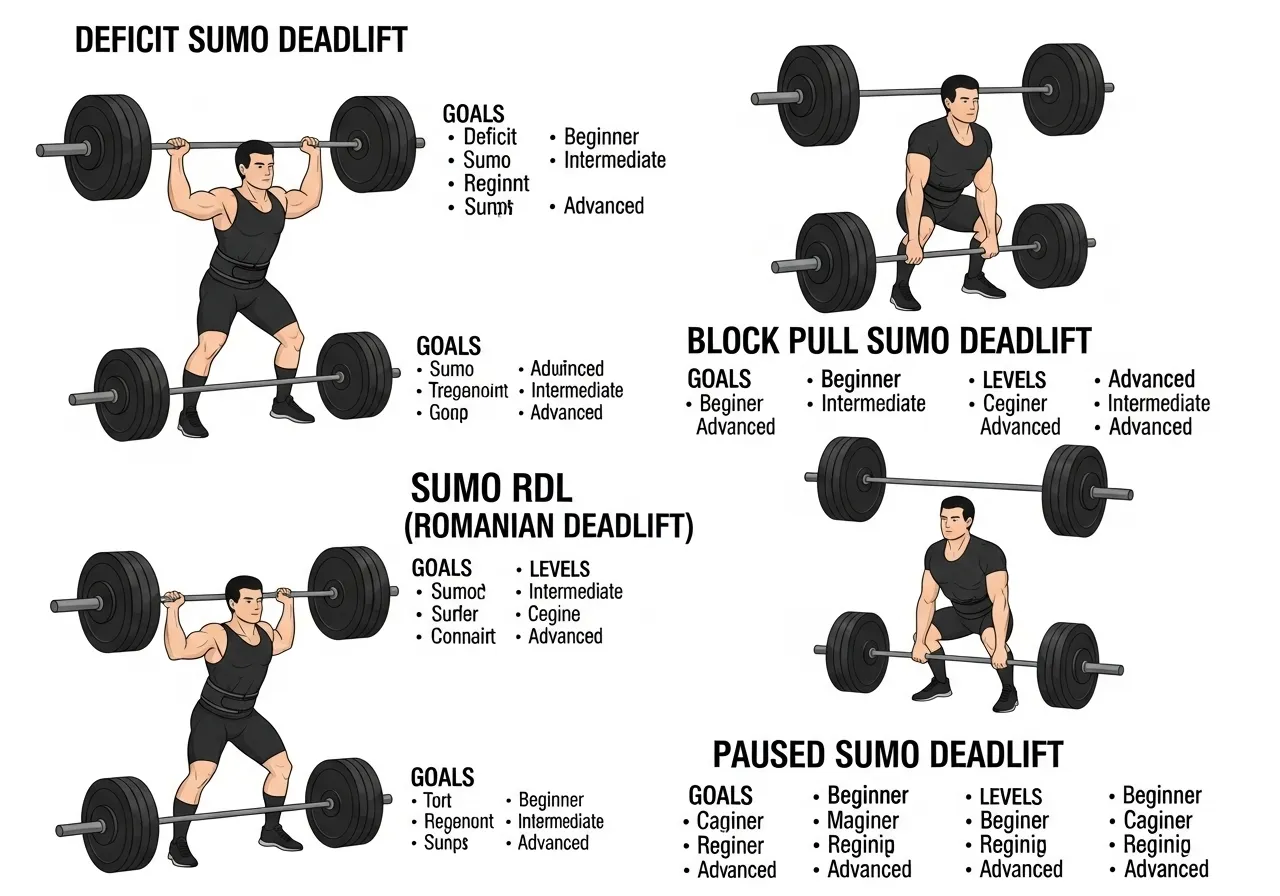
Sumo Deadlift Variations for Different Goals and Training Levels
Standard Sumo Deadlift (Floor Pull)
The standard sumo deadlift from the floor is the foundational variation appropriate for all training levels. It develops the complete sumo deadlift pattern from the most mechanically demanding starting position and should be the primary variation for most trainees learning the sumo stance before progressing to other variations. The technique principles described in the technique section apply fully to this base variation.
Deficit Sumo Deadlift
The deficit sumo deadlift is performed from an elevated platform (typically 3 to 5 cm) that increases the range of motion by requiring the bar to travel further before it clears the floor height. This extended range increases the demand on the hip abductors and adductors at the bottom of the pull and develops the bottom-position strength that transfers to improved floor-level pulling. Appropriate for intermediate and advanced trainees who have already mastered the standard sumo technique and need a range-of-motion progression stimulus.
Block Pull Sumo Deadlift
The block pull sumo deadlift sets the bar at knee height or slightly below, reducing the range and allowing supra-maximal loading relative to the floor pull. It specifically develops lockout strength in the sumo stance and can be used for the same supra-maximal neurological adaptation purpose that the rack pull serves for conventional deadlifters. The rack pull programming principles for partial range deadlift work are covered in the rack pull guide.
Sumo Romanian Deadlift
The sumo Romanian deadlift performs the hip hinge pattern from the standing position with a wide stance and externally rotated toes. It provides the hamstring and posterior chain hip hinge stimulus of the conventional RDL with the hip abductor and adductor engagement of the sumo stance. Appropriate for trainees who want to develop both sumo-specific hip external rotation strength and hamstring flexibility simultaneously within a single exercise.
Paused Sumo Deadlift
The paused sumo deadlift holds the starting position for 2 to 3 seconds before initiating the pull, eliminating the stretch reflex contribution and forcing the hip abductors and quads to produce force from a dead stop in the wide stance. This variation directly addresses the bottom-position strength that many sumo deadlifters find limiting and is the sumo-specific equivalent of the paused squat for sticking point development.
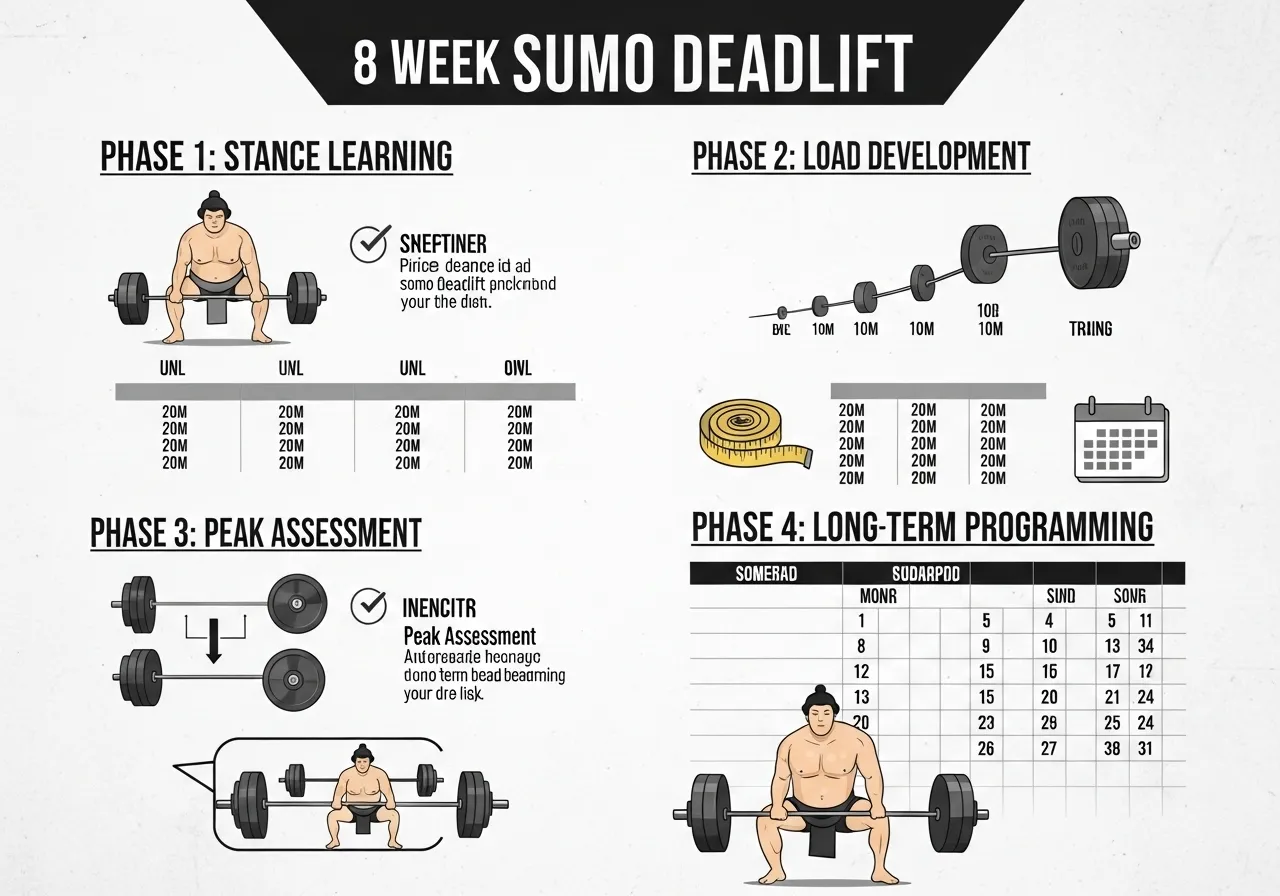
8-Week Sumo Deadlift Programme for New Sumo Practitioners
The Learning Phase Challenge
Trainees switching from conventional to sumo deadlift typically experience a significant initial load reduction as the new movement pattern is learned. This load reduction is expected and should not prompt a return to conventional before the sumo technique is established. Most trainees need 8 to 12 weeks of consistent sumo-focused training before approaching their conventional deadlift loads in the sumo stance, because the new stance requires motor pattern development in the hip abductors and the multi-planar hip mechanics that conventional training does not develop.
📅 Phase 1: Weeks 1 to 3: Stance and Position Learning
- Sumo deadlift: 4 sets of 5 reps at 60 to 70% of conventional deadlift 1RM
- Primary focus: knee tracking over toes, hip position at start, complete lockout
- Add paused sumo RDL: 3 sets of 8 reps to develop hip hinge in wide stance
- Hip abductor work: clamshells and lateral band walks, 3 sets of 15 per side
Load is deliberately below capacity. The sumo stance requires new motor patterns that heavy loads compromise before they are established. Build the pattern first.
📅 Phase 2: Weeks 4 to 6: Strength Development
- Sumo deadlift: 4 sets of 4 reps, increase load weekly (5 to 10 kg per week)
- Include 1 to 2 sets of paused sumo at bottom position for continued pattern reinforcement
- Conventional deadlift: 2 maintenance sets of 3 reps at moderate load
- Continue hip abductor accessory work
Progressive loading phase. Maintain a small conventional deadlift volume to preserve that pattern while the sumo stance develops. Most trainees reach 80 to 90% of conventional load in sumo by the end of Phase 2.
📅 Phase 3: Weeks 7 to 8: Peak and Assessment
- Week 7: 3 to 5 rep max test at near-maximum sumo load
- Week 8: reduced volume, deload, then 1RM or 3RM sumo deadlift assessment
- Compare sumo maximum to conventional baseline to assess transfer progress
- Decision: continue sumo as primary, return to conventional, or train both
Expected: 90 to 100% of conventional 1RM achievable in sumo after 8 weeks of dedicated training for trainees with anatomy that suits the stance. Trainees whose anatomy does not suit sumo typically plateau below 85% of conventional load despite consistent effort.
Long-Term Programming: Sumo and Conventional Together
After establishing sumo deadlift technique and approaching conventional deadlift loads in the sumo stance, the most productive long-term approach for most trainees is programming both stances across alternating training blocks: 6 to 8 weeks of sumo-primary followed by 6 to 8 weeks of conventional-primary. Each block maintains the other stance at maintenance volume. This prevents the technical regression that occurs in either stance during extended monostance periods and produces broader posterior chain and hip stability development than permanent single-stance training.
Frequently Asked Questions About the Sumo Deadlift
Is the sumo deadlift easier than the conventional deadlift?
The sumo deadlift is not easier than the conventional deadlift. It is differently demanding. The shorter bar path is accompanied by greater hip abductor and adductor demand, multi-planar hip and knee loading, and the hip external rotation requirement that many trainees find significantly more challenging than conventional hip mechanics. Trainees who claim sumo is easier are typically comparing their performance at a practiced stance to a new one, not comparing equivalent levels of technical development.
For some individuals, sumo does allow more weight due to anatomy that favours the stance. For others, sumo allows less weight than conventional. The direction of the difference depends entirely on individual hip anatomy, strength profile, and training history. The statement that sumo is easier or harder is only meaningful for specific individuals, not as a general characterisation of the exercise.
Does the sumo deadlift count for my hamstrings?
Yes, the sumo deadlift trains the hamstrings, but the research consistently shows lower biceps femoris activation in sumo compared to conventional deadlift at matched loads. The hamstrings contribute to hip extension during the pull, but the wider stance and more upright torso position reduces the hip flexion at the starting position that creates maximal hamstring pre-stretch and subsequent eccentric-concentric loading. For trainees whose primary goal is hamstring development, the conventional deadlift and Romanian deadlift provide greater hamstring stimulus. For trainees whose primary goal is hip abductor and quad development alongside posterior chain work, the sumo deadlift’s muscle emphasis profile is more appropriate.
How wide should my sumo stance be?
The sumo stance width should be the widest stance at which the following conditions can be simultaneously met: the shin is nearly vertical at the starting position, the toes point in the same direction as the knees, the lumbar spine remains neutral throughout the pull, and the knees do not collapse inward during the concentric phase. These conditions define the effective sumo stance for a specific individual.
Starting with feet at approximately 1.5 times shoulder width and adjusting outward by 5 to 10 cm per session over 2 to 3 weeks, assessing the above conditions at each width, identifies the individual optimal stance width more accurately than any proportional formula. Most experienced sumo pullers settle in the range of 60 to 85 cm between feet, but this range accommodates substantial individual variation.
Can I sumo deadlift with hip impingement?
Hip impingement (femoroacetabular impingement, FAI) involves bony overgrowth at the femoral head or acetabular rim that creates pinching pain at end-range hip flexion combined with internal rotation. The sumo deadlift’s hip external rotation position typically produces less impingement than the hip flexion combined with internal rotation that provokes most FAI presentations. Many individuals with FAI find sumo deadlifting more comfortable than conventional precisely because the external rotation stance moves the femoral head away from the impingement zone.
However, the deep hip position at the sumo starting position involves significant hip flexion that may approach the impingement zone for some FAI presentations. Assessment with a physiotherapist or orthopaedic specialist before loading the sumo deadlift with active FAI symptoms is the appropriate approach. Starting with a higher block pull position that reduces hip flexion depth while maintaining the external rotation stance allows sumo-pattern loading with less hip flexion provocation during the assessment and treatment period.
Should I wear a belt for sumo deadlifts?
A weightlifting belt is appropriate for sumo deadlifts at high intensities where the additional intra-abdominal pressure support contributes meaningfully to performance and safety. The sumo deadlift’s more upright trunk position compared to the conventional deadlift does not eliminate the benefit of a belt. The lumbar spine still requires significant anti-flexion stability under heavy bilateral loads, and a belt augments the bracing that generates this stability.
For learning the sumo deadlift technique at moderate loads, training without a belt develops the intrinsic core bracing that provides the foundational stability the belt then augments. A trainee who relies on a belt before developing adequate beltless bracing technique will find their sumo deadlift technically compromised whenever the belt is absent. The practical standard: develop beltless sumo technique up to approximately 80% of 1RM before introducing a belt for heavier training sets. This sequence produces both the intrinsic stability development and the performance benefit of belt use at appropriate loads.
- Conventional deadlift activates biceps femoris and erector spinae more. Sumo deadlift activates vastus lateralis more and produces greater frontal and transverse plane hip and knee demands. These are different exercises with different primary targets.
- Sumo deadlift emphasises anterior chain involvement and produces mediolateral stabilisation demands that support knee reinforcement and frontal plane hip stability development.
- Hip anatomy, particularly femoral anteversion and acetabular orientation, influences which stance allows neutral lumbar maintenance at the starting position. Assess by observing natural squat foot angle and which stance allows neutral spine at the starting position.
- The sumo deadlift is not easier than conventional deadlifting. The shorter bar path is accompanied by greater hip abductor demand, multi-planar loading, and external rotation requirements that are absent from conventional mechanics.
- Expect 8 to 12 weeks of consistent practice before approaching conventional deadlift loads in the sumo stance. The new motor pattern requires time to develop regardless of raw strength levels.