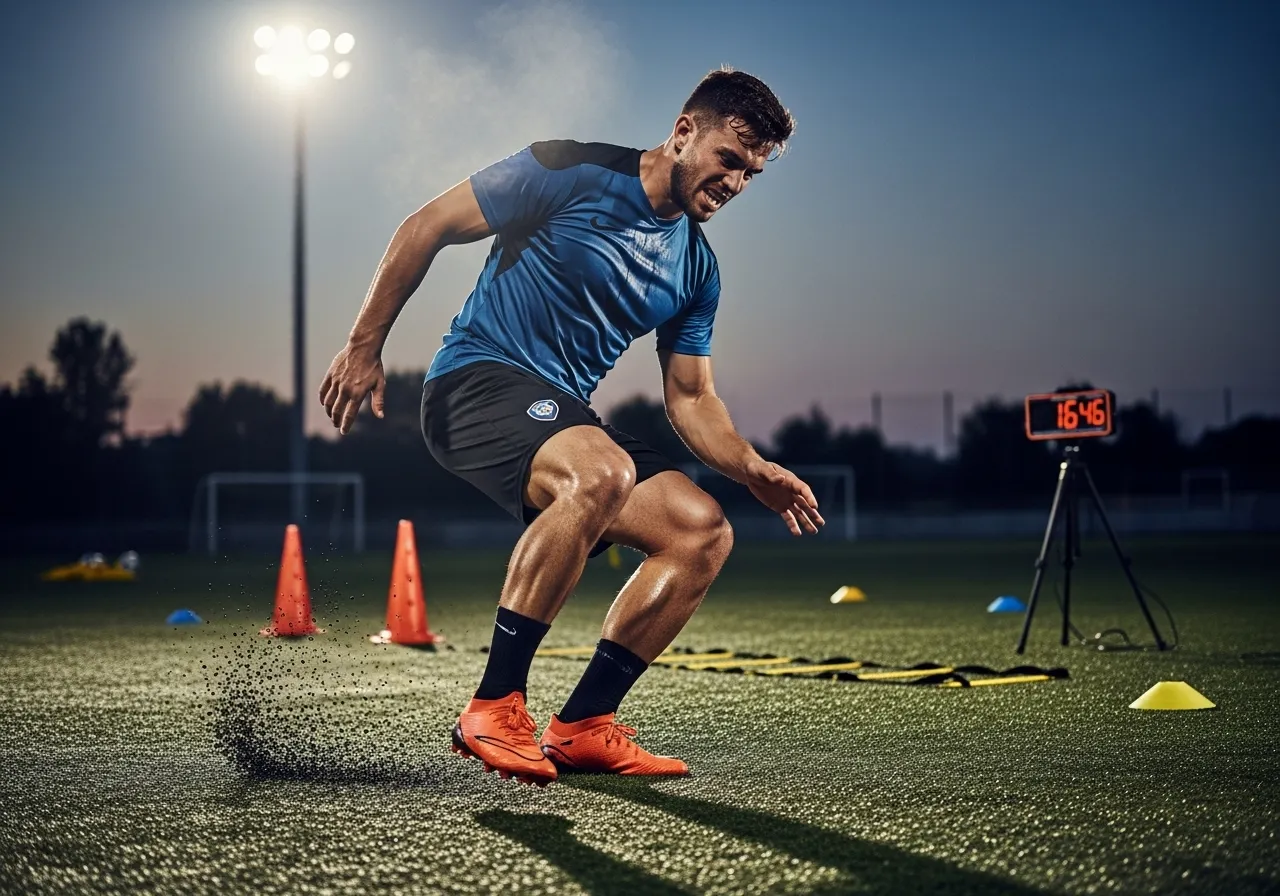
Most athletic training focuses on going faster: building power for acceleration, developing explosive force for jumping, increasing speed across distances. Training to slow down receives a fraction of this attention, despite the fact that most non-contact ACL injuries occur during deceleration, not acceleration.
Deceleration is the act of rapidly reducing speed during running, landing, or changing direction. It requires the lower limb musculature to absorb kinetic energy through rapid eccentric contractions and demands faster neuromuscular response times than acceleration because the mechanical forces being managed are larger and occur more suddenly. A sprinter who develops excellent acceleration through plyometric training but never specifically trains deceleration mechanics develops an asymmetry: high force production capacity with inadequate force absorption capacity. This combination characterises many athletes who sustain ACL injuries.
This guide covers the neuromuscular mechanics of deceleration, the research on ACL injury and deceleration deficits, how to diagnose deficient deceleration mechanics, beginner through advanced deceleration training protocols, and how to integrate deceleration work into a complete athletic training programme.
Why Deceleration Is the Missing Training Quality in Most Athletic Programmes
The Biomechanics of Deceleration vs Acceleration
Acceleration produces concentric muscle contractions: the quads extend the knee, the glutes extend the hip, the calves plantarflex the ankle, all under shortening muscle conditions. The force direction is from the ground upward and backward, propelling the athlete forward. The neuromuscular challenge is producing maximum force rapidly in well-practised directions that training consistently develops.
Deceleration requires the opposite: eccentric muscle contractions that absorb the athlete’s kinetic energy as the muscles lengthen under load. The quads must absorb the forward momentum by resisting knee flexion as the foot contacts the ground. The hamstrings must rapidly co-contract with the quads to stabilise the knee joint against the anterior shear forces that deceleration creates on the ACL. The hip extensors must absorb the forward trunk lean that sudden stops produce. All of these eccentric absorption demands occur faster and with higher force than the concentric demands of acceleration, and they require neuromuscular coordination that concentric-focused training does not specifically develop.
The Neuromuscular Deficit in Athletes Who Sustain ACL Injuries
📌 Key Finding
ACL-injured patients show altered muscle onset timing during deceleration compared to healthy controls. Deceleration-specific neuromuscular deficits distinguish injury-prone from injury-resistant athletes, confirming that deceleration training addresses a specific vulnerability that general strength and plyometric training does not target.
Why Plyometric Training Alone Does Not Train Deceleration
Plyometric training develops the stretch-shortening cycle: the rapid eccentric loading followed by an explosive concentric response. This is the mechanism behind jumping, bounding, and sprinting power. It does not specifically develop the eccentric absorption capacity required for deceleration because plyometric training immediately follows the eccentric loading phase with maximal concentric output. The training goal is to minimise ground contact time and maximise subsequent propulsion.
Deceleration training inverts this priority. Instead of minimising ground contact time, deceleration exercises require the athlete to absorb the kinetic energy through a controlled eccentric loading phase without an immediate explosive concentric response. The training goal is sustained eccentric muscle control under high loading, which activates different motor unit populations and develops different neuromuscular coordination than the brief eccentric pre-loading of plyometric training.
The Role of Hip Strength in Deceleration Mechanics
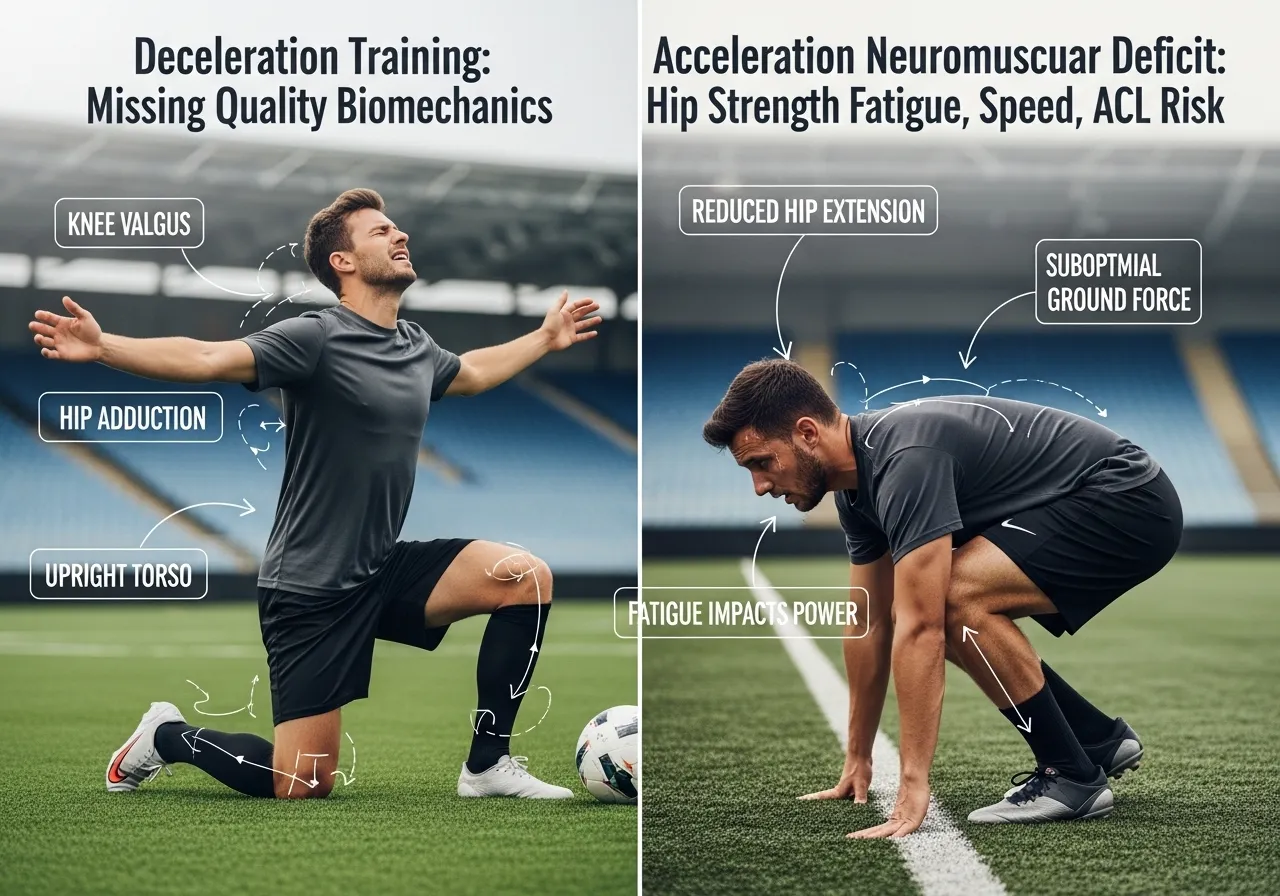
Inadequate hip abductor and external rotator strength is the most commonly identified modifiable risk factor for poor deceleration mechanics. When the hip abductors cannot maintain pelvic stability during single-leg landing, the pelvis drops on the swing leg side, creating a hip adduction and internal rotation moment at the stance leg that directly increases knee valgus and ACL loading. This Trendelenburg pattern during deceleration creates the exact mechanical situation that produces the valgus collapse and tibial rotation that characterise non-contact ACL injuries.
Speed and Fatigue Effects on Deceleration Quality
Deceleration mechanics deteriorate significantly with both increasing speed and accumulated fatigue. An athlete who demonstrates acceptable landing and stopping mechanics at moderate speed and in the first half of a training session may show dramatically compromised mechanics at maximal speed and in the final quarter of a match. ACL injuries disproportionately occur late in matches and at high running speeds, reflecting this fatigue-and-speed interaction. Deceleration training must therefore include progressions that develop mechanics under increasingly fatigued conditions and at progressively higher approach speeds.
Research: What ACL Prevention Programmes Show About Deceleration and Neuromuscular Training
Neuromuscular Training Consistently Reduces ACL Injury Risk
📌 Key Finding
Neuromuscular training combining plyometrics, balance, agility, and dynamic stabilisation consistently reduces ACL injury risk. Deceleration drills are a core component of the neuromuscular training approach that produces these injury rate reductions across multiple sports and populations.
The Meta-Analysis Evidence on ACL Prevention Programme Effectiveness
📌 Key Finding
ACL prevention programmes that target landing and deceleration mechanics produce significant injury rate reductions. The landing phase after jumping and deceleration from running are the primary biomechanical targets of effective prevention interventions.
Sex Differences in Deceleration Mechanics and ACL Risk
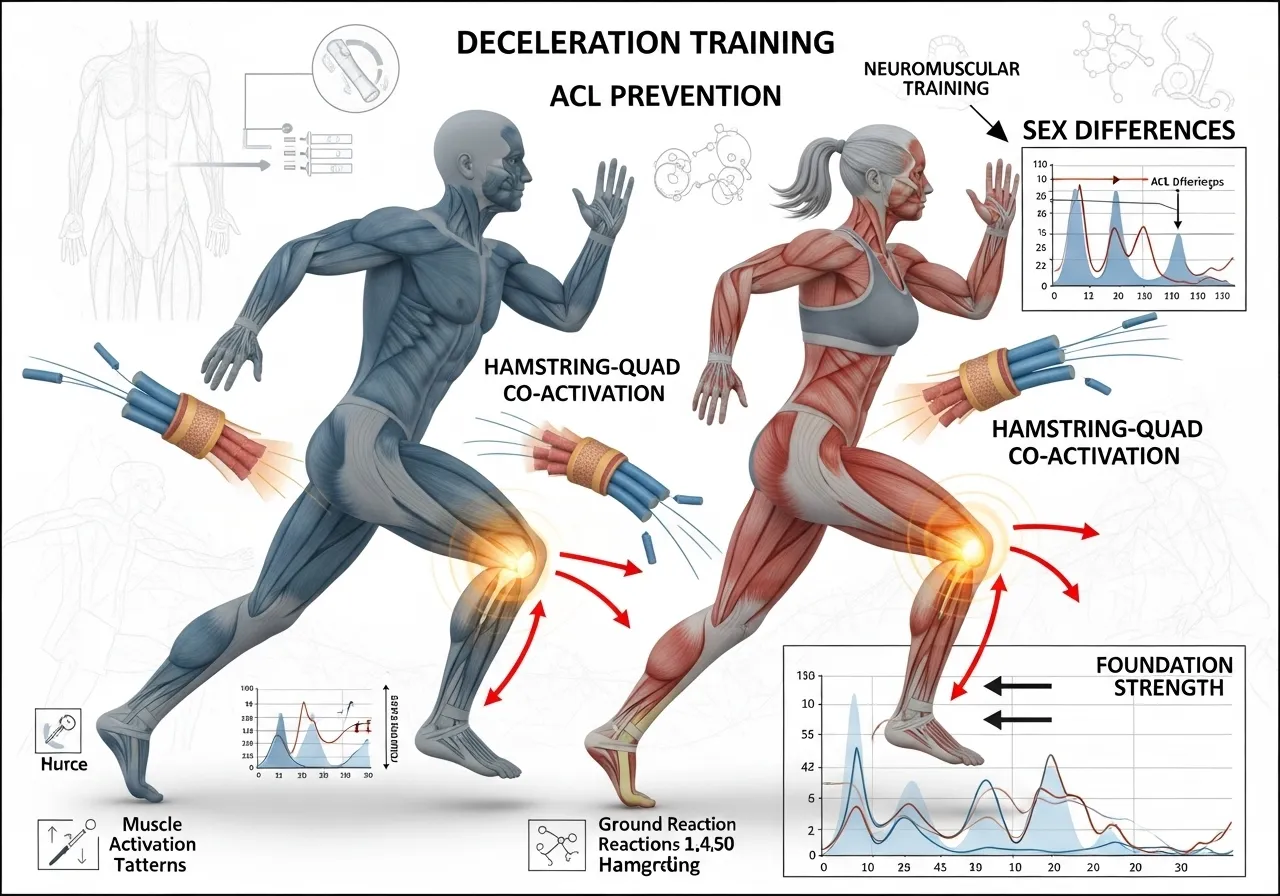
Female athletes sustain ACL injuries at 2 to 3 times the rate of male athletes in equivalent sports. This disparity reflects sex-specific differences in deceleration mechanics that include greater knee valgus during landing, reduced knee flexion angle at initial contact, and lower hamstring-to-quadriceps co-activation ratios. These mechanical differences are not fixed anatomical determinants but modifiable neuromuscular patterns that respond to deceleration-focused training.
Female athletes who complete structured deceleration training programmes show measurable improvements in landing knee flexion angle, reduced knee valgus at initial contact, and improved hamstring pre-activation timing that directly reduces the mechanical risk factors for ACL injury. The sex disparity in ACL injury rate is most pronounced in sports involving frequent deceleration, cutting, and landing tasks, confirming that the deceleration training deficit is a primary contributing mechanism to the injury rate difference.
The Hamstring-Quadriceps Co-Activation Ratio
The primary mechanical protection against ACL rupture during deceleration is the hamstring musculature co-contracting with the quadriceps to resist the anterior tibial shear force that the quadriceps produces during deceleration. When the hamstrings pre-activate before ground contact and maintain sufficient activation relative to the quadriceps throughout the deceleration phase, the net anterior tibial shear on the ACL is reduced to within tolerable limits.
Deceleration training specifically develops the hamstring pre-activation patterns that standard quad-dominant strength training does not address. Athletes who primarily squat and deadlift but never specifically train deceleration mechanics develop quad strength without the hamstring neuromuscular timing adaptations that protect the ACL under high-speed deceleration conditions.
Building the Deceleration Foundation: Strength Comes First
Effective deceleration training requires adequate strength in the hip extensors, knee flexors, and ankle dorsiflexors before the neuromuscular timing drills that constitute the core of the training are introduced. An athlete who cannot perform 3 sets of 10 single-leg squats with maintained knee alignment lacks the basic strength foundation to execute deceleration exercises safely at meaningful speeds. Introducing high-speed deceleration drills to underprepared athletes creates the injury risk it is intended to prevent.
Beginner Level: Building the Foundation for Safe Deceleration
What Beginners Need Before Deceleration Drills
Beginners to deceleration training typically include previously sedentary individuals beginning athletic training, youth athletes in their first structured training programme, and adults returning to sport after periods of inactivity. For all of these populations, the priority is developing the strength and body awareness that allows safe deceleration at controlled speeds before any high-speed work is introduced.
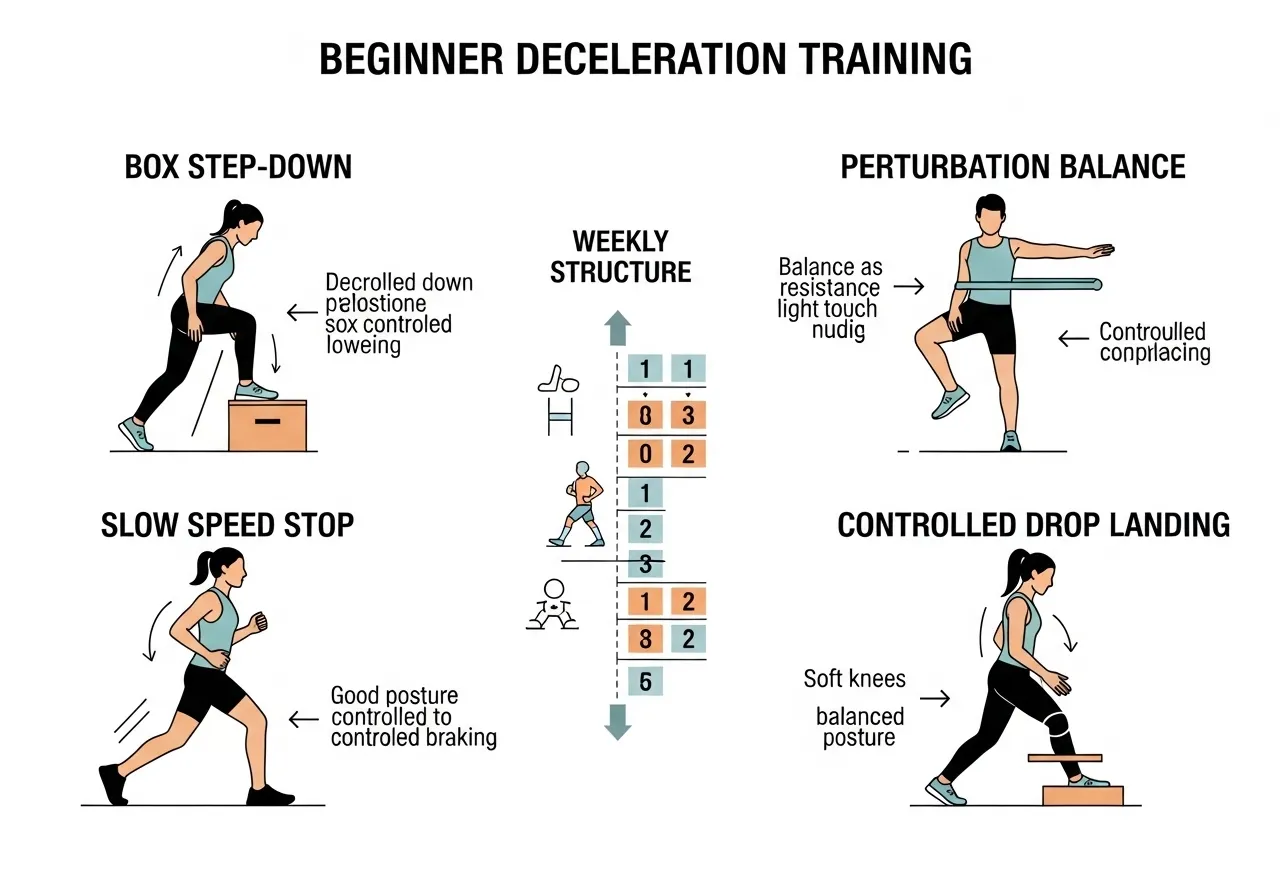
The Four Foundation Exercises
🏃 1. Box Step-Down (Eccentric Quad Loading)
How: Stand on a 20 to 30 cm box on one leg. Slowly lower the opposite foot toward the floor over 4 to 5 seconds, controlling the descent with the stance leg quad. The stance knee should track over the toes throughout, not cave inward. Touch the floor lightly, then stand back up. 3 sets of 10 reps per side.
Why: Develops the slow eccentric quad control that rapid deceleration demands at high speed. The 4 to 5 second descent develops the motor unit recruitment pattern for eccentric quad loading that transfer to deceleration mechanics.
🏃 2. Single-Leg Balance with Perturbation
How: Stand on one leg. A partner applies light pushes to the shoulders and hips in random directions. Maintain single-leg balance for 30 to 45 seconds. Progress to eyes closed for greater proprioceptive demand. 3 sets per side.
Why: Develops the reactive neuromuscular stabilisation that deceleration demands when external forces are unpredictable. The perturbation training specifically targets the same rapid reactive stabilisation that deceleration from running requires when ground contact is sudden and the body’s response must be immediate.
🏃 3. Slow-Speed Stop Practice (Walking to Stop)
How: Walk at normal pace. On command (or at a cone), decelerate to a complete stop in 2 to 3 steps. Focus on landing with the knee flexed (not straight), the foot under the body (not in front), and the trunk upright (not leaning forward). Repeat 10 times.
Why: The first step in teaching deceleration mechanics at a speed where self-correction is possible. Beginners consistently land with the knee extended and the foot in front of the body, creating the straight-knee high-load position that transfers directly to landing mechanics at running speeds. Correcting this at walking speed is the foundation for all subsequent deceleration work.
🏃 4. Controlled Drop Landing (Two-Foot)
How: Stand on a 20 to 25 cm box. Step off (do not jump) and land softly on both feet, bending the knees to approximately 90 degrees to absorb the landing. Hold the landing position for 2 seconds to confirm control. 3 sets of 8 reps.
Why: The bilateral drop landing teaches the coordinated knee and hip flexion that absorbs landing force safely. The 2-second hold requirement forces active eccentric control rather than a passive bounce landing that does not develop the neuromuscular timing the exercise is intended to train.
Beginner Weekly Structure
Beginners should perform foundation deceleration work 2 to 3 times per week, after primary strength training but before cardiovascular conditioning. Total deceleration training duration: 15 to 20 minutes per session. The exercises above provide the strength and movement awareness foundation for intermediate deceleration training introduction after 4 to 6 weeks.
Intermediate Level: Speed Introduction and Directional Deceleration
The Transition From Controlled to Speed-Dependent Deceleration
Intermediate deceleration training introduces the speed variable that beginners’ controlled exercises cannot provide. Mechanics that look acceptable at walking pace frequently break down at jogging speed because the time available for movement correction is dramatically reduced. The primary intermediate training challenge is maintaining the mechanics developed in slow controlled environments as approach speed increases toward sport-relevant velocities.
Intermediate Deceleration Exercises
🏃 5. Jog to Stick Landing (One Foot)
How: Jog at 50 to 60% of maximum speed for 10 metres. On the final stride, decelerate by landing on one foot and holding the landing position for 2 seconds. The knee must flex to at least 60 degrees, the knee must track over the toes, and the trunk must remain upright. Alternate landing legs across sets. 4 sets of 6 per side.
Why: Introduces speed into the single-leg landing mechanics that box step-downs develop at slow pace. The 2-second hold requirement prevents relying on momentum to manage the landing and forces active eccentric control at sport-relevant approach speeds.
🏃 6. Sprint to 2-Step Stop
How: Sprint at 70% effort for 15 metres. Decelerate to a complete stop in exactly 2 steps using bilateral ground contacts. The first ground contact should be a penultimate step that begins the deceleration, the second should complete the stop. Focus on the penultimate step landing with knee flexion, not a straight-leg braking position. 5 sets with full recovery between repetitions.
Why: Trains the specific two-step deceleration mechanics that field sports require when stopping from sprint speed. The penultimate step is the highest ACL-risk contact point in deceleration, and specifically training its mechanics at progressively higher speeds is the primary intermediate deceleration intervention.
🏃 7. 45-Degree Cut After Deceleration
How: Sprint to a cone at 70% effort. Decelerate in the 2 steps before the cone, then accelerate away at a 45-degree angle. The transition from deceleration to change of direction at the cone is the specific training target. Alternate cut directions. 4 sets of 6 reps per side.
Why: Most non-contact ACL injuries occur during change of direction after deceleration, not during deceleration alone. Adding the directional change after the deceleration introduces the rotational forces that combine with the deceleration load to create the highest ACL risk condition.
Monitoring Technique at Intermediate Speeds
Video analysis from behind and from the side during intermediate deceleration work provides objective assessment of knee valgus, trunk lean, and foot placement that subjective real-time observation cannot reliably capture. A training partner recording 10-second clips of deceleration attempts allows post-session review of whether mechanics deteriorate as speed increases. The target is maintaining the same knee alignment, trunk position, and foot placement at 70% sprint speed that was achieved at walking and jogging speeds during the beginner phase. The hip rotation mechanics that determine deceleration knee alignment are covered in the hip rotation mobility guide.
Advanced Level: Maximum Velocity, Reactive Deceleration, and Fatigue Resistance
What Separates Advanced From Intermediate Deceleration Training
Advanced deceleration training operates at or near maximum approach velocity and introduces reactive elements where the deceleration cue is unpredicted rather than pre-planned. Most ACL injuries occur during reactive deceleration, where the athlete must stop or change direction in response to an opponent, ball, or environmental stimulus that is not anticipated in advance. Pre-planned deceleration drills at speed develop mechanics but do not specifically train the reactive response that high-risk sport situations demand.
Maximum Velocity Deceleration Mechanics
At maximum running velocity, the kinetic energy the musculature must absorb during deceleration is proportional to the square of the velocity. A 10% increase in running speed produces a 21% increase in kinetic energy that the eccentric musculature must manage. The neuromuscular demands at maximum velocity therefore far exceed what intermediate-speed practice develops, and mechanics that remain intact at 70 to 80% of maximum speed often break down at 95 to 100% unless specifically trained.
Maximum velocity deceleration training is introduced gradually: 3 to 4 weeks at 80% approach speed, then 3 to 4 weeks at 90%, then full velocity. Each step requires demonstrating adequate mechanics before advancing. An athlete who cannot maintain knee alignment and trunk position at 90% should not advance to full velocity regardless of overall fitness level.
Reactive Deceleration Drills
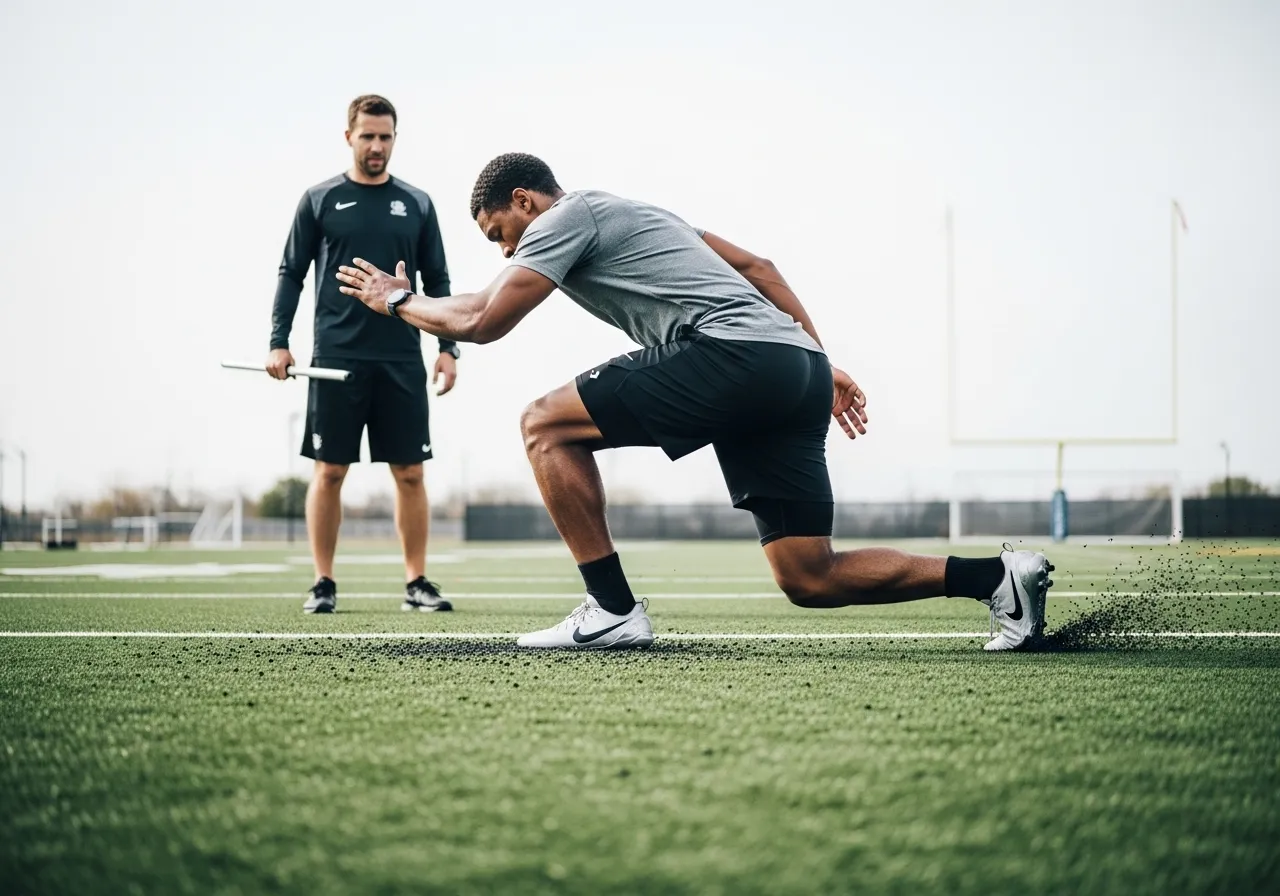
Reactive deceleration drills replace the predetermined stop point or direction change with an auditory or visual cue that the athlete must respond to. A coach standing at the deceleration zone calls left, right, or stop as the athlete approaches. This reactive format reduces the athlete’s preparation time from several strides to a single stride, creating a mechanical demand much closer to the sport-specific situation that produces non-contact ACL injuries.
Reactive drills should only be introduced after pre-planned mechanics at the intended approach speed are consistently acceptable. Introducing reactive elements before mechanical quality is established at that speed produces the same injury risk that unstructured sport without deceleration training creates. The contrast training and PAP principles that can be applied to deceleration power development are covered in the contrast training guide.
Fatigue-State Deceleration: Training the Late-Match Condition
The most important and most neglected component of advanced deceleration training is performing deceleration drills in a fatigued state. ACL injuries occur disproportionately in the final 15 to 20 minutes of matches when neuromuscular fatigue has compromised motor control. Deceleration training that only occurs on fresh athletes at the start of sessions develops mechanics that may not withstand the neuromuscular demands of late-match fatigue.
Fatigue-state deceleration protocols introduce deceleration drills after 20 to 30 minutes of moderate-intensity aerobic work that replicates the fatigue state of match play without the specific injury risk of full match conditions. Athletes perform their standard deceleration drills at the same target speeds but after the aerobic fatigue loading. The goal is to maintain acceptable mechanics at fatigue that match the mechanics achieved in the fresh state at the same speed.
Integration With Strength Training for Maximum Transfer
Advanced deceleration training produces its greatest transfer to injury resistance when combined with ongoing strength development in the hip abductors, hamstrings, and single-leg squat strength that provide the muscular foundation for neuromuscular timing. An athlete who develops excellent deceleration mechanics without the underlying strength to sustain them through a full match is vulnerable to mechanical breakdown late in high-intensity competition. Monthly assessment of single-leg squat depth with maintained knee alignment and hip abductor strength ensures the strength foundation keeps pace with the neuromuscular sophistication of the deceleration training.
How Do You Know If Your Deceleration Mechanics Are Actually Putting You at Risk?
The Single-Leg Squat Screen
The single-leg squat screen is the most accessible and informative assessment for deceleration mechanical risk. Stand on one leg and squat as deep as comfortably possible. Observe the knee position throughout the movement. A knee that tracks directly over the toes across the full range indicates adequate hip abductor control. A knee that collapses inward (valgus) before the thigh reaches horizontal indicates hip abductor weakness that will manifest as valgus collapse during deceleration at speed.
Assess both legs and note whether the collapse is equal or asymmetric. Asymmetric valgus collapse identifies the higher-risk side for deceleration mechanics and directs unilateral hip strengthening emphasis. Symmetric collapse indicates a bilateral deficit that requires general hip abductor development alongside deceleration training.
The Landing Error Scoring System
The Landing Error Scoring System (LESS) assesses landing mechanics during a jump-land task and quantifies mechanical risk factors for ACL injury including trunk lean, knee valgus, knee flexion angle at landing, and foot placement relative to the body’s centre of mass. Higher LESS scores indicate more landing errors and correlate with increased ACL injury risk. Many sports medicine clinics use the LESS as a screening tool before competitive season.
A simplified self-assessment version: perform a squat jump from a 30 cm box and stick the bilateral landing. Video from the front and side allows assessment of knee valgus at initial contact, knee flexion angle at deepest point, and whether the feet land under the body or significantly in front of it. Each error identified provides a specific training target for the deceleration programme.
The Deceleration Step Count Test
A practical deceleration quality assessment: sprint at 80% effort for 15 metres, then decelerate to a complete stop. Count the number of steps required to stop completely. Fewer steps indicate better deceleration efficiency and neuromuscular capacity to absorb kinetic energy rapidly. More steps indicate lower deceleration efficiency. Compare the step count to baseline over training months: a decrease in steps required to stop at the same approach speed confirms improved deceleration mechanics.
Asymmetry Detection: The Critical Risk Factor
Side-to-side deceleration asymmetry is a more reliable ACL injury risk predictor than overall deceleration quality. An athlete who decelerates acceptably on the dominant leg but shows valgus collapse on the non-dominant leg is at substantially higher injury risk than an athlete with mildly sub-optimal mechanics on both sides equally. Unilateral deceleration screening should be included in any return-to-sport protocol following lower limb injury.
Using the Box Jump as a Deceleration Indicator
The bilateral box jump landing provides a standardised deceleration assessment because the kinetic energy of the drop is consistent at matched box heights. Poor landing mechanics (valgus collapse, straight-knee landing, excessive forward trunk lean) indicate the same neuromuscular deficits that produce poor run-to-stop mechanics and predict higher injury risk during sport. The box jump and its role in assessing and training landing mechanics is covered in the box jump guide.
Integrating Deceleration Training Into a Complete Athletic Programme
Where Deceleration Training Fits in the Training Week
Deceleration training fits best at the beginning of a speed and agility session when the neuromuscular system is fresh. Performing deceleration drills after heavy lower body strength training, when quad and hamstring fatigue is already present, reduces the quality of mechanical output and fails to develop the deceleration coordination that fresh-state practice provides. The exception is the deliberate fatigue-state deceleration protocols for advanced athletes, which are programmed specifically to develop fatigue-state mechanics.
Two deceleration training sessions per week is the standard recommendation during a preparation phase: one session focused on the current technical level’s primary mechanics at building intensities, and one session reinforcing those mechanics at the week’s target approach speed. During a competitive season, one deceleration maintenance session per week preserves the mechanics developed during preparation without the recovery cost of two full sessions alongside competition load.
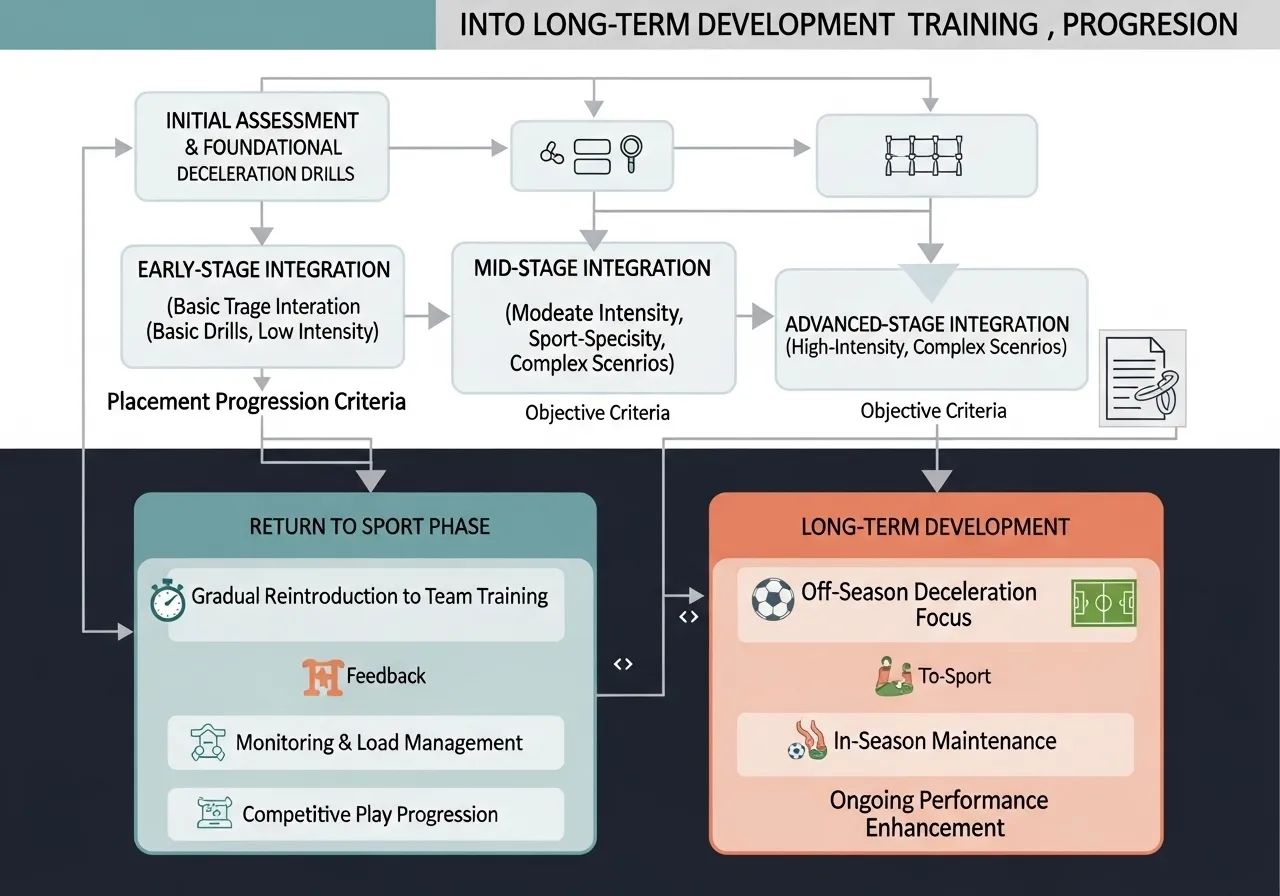
Progressing Through Levels: The Decision Criteria
Movement from beginner to intermediate deceleration training requires demonstrating the following consistently across 3 consecutive sessions: box step-down with maintained knee-over-toes alignment for 10 reps per side at full depth, bilateral drop landing with knee flexion to 90 degrees without valgus collapse, and walking-pace stop with foot placement under the body (not in front). Meeting all three criteria signals adequate mechanical foundation for speed introduction.
Movement from intermediate to advanced requires maintaining acceptable knee alignment and trunk position at 80% sprint approach speed across 5 consecutive deceleration repetitions per side, without deterioration across the full set. This criterion specifically tests whether mechanics hold up under accumulated repetition fatigue before maximum velocity and reactive elements are introduced.
Return to Sport After ACL Injury: Deceleration Testing
Deceleration mechanics testing is an essential component of return-to-sport decision-making after ACL reconstruction. Standard return-to-sport criteria (quad strength symmetry, hop tests, time from surgery) do not assess deceleration mechanics, which may remain deficient despite passing functional strength tests. Including the single-leg stick landing test, the LESS jump-land assessment, and deceleration step count comparison between limbs in return-to-sport criteria provides a more complete mechanical clearance than strength-only criteria.
Seasonal Periodisation of Deceleration Training
Deceleration training volume and intensity should follow the same periodisation principles as other athletic training components. During the pre-season preparation phase (8 to 16 weeks before competition), deceleration training volume is highest and progressions move rapidly through beginner to intermediate to advanced levels. During the in-season competitive phase, deceleration training volume reduces to maintenance (one session per week) while intensity remains high to preserve the mechanics developed during preparation without accumulating excessive fatigue alongside competition load. Post-season recovery phases eliminate structured deceleration training entirely for 3 to 6 weeks to allow accumulated neuromuscular fatigue from the season to dissipate before the next preparation phase begins.
Long-Term Deceleration Development: The Multi-Year View
Deceleration mechanics develop over multiple training years rather than weeks, because the neuromuscular adaptations required for high-quality reactive deceleration at maximum speed involve central nervous system changes in motor unit coordination and pre-activation timing that take months to years to fully develop. A single pre-season deceleration training block produces meaningful improvement but not complete development. Consistent inclusion of deceleration-specific work across multiple training years, progressively increasing in speed and reactivity as mechanics improve, produces the durable neuromuscular deceleration capacity that provides lasting ACL injury protection across an athletic career.
Frequently Asked Questions About Deceleration Training
How is deceleration training different from landing training?
Landing training focuses on absorbing the vertical force of a drop or jump onto a relatively stationary landing position. Deceleration training addresses the horizontal component: reducing running speed over multiple ground contacts in a forward direction. Both involve eccentric lower limb loading but in different force vectors and movement patterns. Complete ACL prevention training includes both landing mechanics development and deceleration mechanics development because the two patterns have different primary contributors to injury risk and respond to different training stimuli.
The most dangerous athletic movement combines both: the jump-land followed immediately by a deceleration or direction change. This combined pattern requires both landing mechanics quality and deceleration mechanics quality to be maintained simultaneously under the highest load conditions. Advanced deceleration training includes these combined patterns specifically because the combination creates a greater injury risk than either component alone.
At what age should athletes begin deceleration training?
Deceleration training at the foundation level (box step-downs, controlled landings, slow-speed stops) is appropriate from early youth sport participation. Children as young as 8 to 10 years old benefit from learning correct landing and deceleration mechanics because the neuromuscular patterns established in childhood persist into adult sport participation. Teaching correct mechanics before high-speed sport-specific movements are introduced establishes the foundation pattern that subsequent training builds upon rather than correcting later.
ACL injuries occur in young athletes, with female athletes aged 14 to 22 years at peak risk. Beginning deceleration training before this high-risk period, ideally at 10 to 12 years as sport-specific training intensifies, provides the maximum prevention benefit by establishing correct mechanics well before the combination of high-speed sport demands and rapid growth spurts that characterise the peak injury age range.
Can I do deceleration training if I have knee pain?
Mild, non-specific knee discomfort during or after athletic activity does not necessarily preclude deceleration training at beginner level. Box step-downs and controlled bilateral landings can typically be performed with minor knee discomfort because the loads are controlled and the approach speed is zero. Higher-speed deceleration drills should wait until the knee discomfort is assessed, because performing high-speed deceleration with compromised mechanics and existing knee irritation may accelerate rather than prevent tissue damage.
Sharp knee pain during any deceleration exercise, pain that worsens across a session, or pain that persists beyond 30 minutes after session completion all indicate that the knee requires assessment before deceleration training continues. Given that deceleration training is specifically designed to reduce ACL injury risk, performing it through significant pain that may indicate existing pathology produces the opposite of its intended outcome.
How does strength training support deceleration mechanics?
Strength training provides the muscular foundation that deceleration training builds mechanics upon. The specific strength qualities most relevant to deceleration are eccentric quad strength (assessed by single-leg squat depth with controlled descent), hip abductor strength (assessed by single-leg squat knee alignment), and hamstring strength at long muscle lengths (assessed by nordic curl performance). Deficits in any of these three qualities create a ceiling on deceleration mechanics improvement, because the mechanics being trained cannot be sustained if the underlying musculature lacks the strength to execute them consistently.
A practical strength threshold before advanced deceleration training: the ability to perform 5 single-leg squats with the thigh reaching parallel to the floor on each leg with maintained knee-over-toes alignment, and the ability to perform 3 nordic curls through at least 50% of the full range without the torso falling rapidly. Athletes who cannot meet these thresholds should prioritise building the strength foundation before advancing deceleration training beyond the intermediate level.
Is deceleration training only relevant for team sport athletes?
Deceleration training is relevant for any athlete who performs running at speed in their sport or training. Recreational runners, trail runners, tennis players, and recreational football participants all decelerate frequently during their activities and benefit from developing the mechanics that make deceleration safe at sport-relevant speeds. Even recreational gym-goers who include any sprint or agility work benefit from foundation deceleration training because the mechanics of stopping safely from even moderate running speeds require training that general gym work does not provide.
Key Takeaways
ACL-injured athletes show altered muscle onset timing during deceleration compared to healthy controls, confirming that deceleration-specific neuromuscular deficits are a primary injury risk factor that targeted training can address.
Neuromuscular training combining plyometrics, balance, agility, and dynamic stabilisation consistently reduces ACL injury risk. Deceleration drills are a core component of effective prevention programmes.
Plyometric training does not specifically train deceleration because it prioritises minimal ground contact and maximal concentric response. Deceleration training requires sustained eccentric absorption without immediate concentric output.
Mechanics must be established at each speed level before advancing. Valgus collapse at beginner controlled speeds predicts valgus collapse at sport speeds. Fix the pattern at the slower speed first.
Maximum ACL injury risk occurs late in matches at high running speeds. Advanced deceleration training must include both maximum velocity and fatigue-state deceleration to develop the mechanics that protect athletes when they are most vulnerable.
⚠️ Fitness Disclaimer: The information in this article is for general educational purposes only and does not constitute professional fitness or medical advice. Always consult a qualified healthcare professional before starting any new exercise program, especially if you have existing injuries or medical conditions. The Ball That Made My Conventional Training Feel Incomplete I added…
The farmer’s walk may be the most honest exercise in strength training. You pick up something heavy in each hand, walk until you cannot continue, and put it down. There is no technique to hide behind, no momentum to exploit, and no machine to stabilise the load. If the grip fails, the set ends. If…
Why TRX training overview and Suspension Training Belong in Every Serious Training Program The TRX suspension trainer — two adjustable straps with handles anchored to a single point, allowing the exerciser to use their own bodyweight and gravity as resistance through an infinite range of angles and positions — has earned a permanent place in…
⚠️ Fitness Disclaimer: The information in this article is for general educational purposes only and does not constitute professional fitness or medical advice. Exercise carries inherent risks. Always consult a qualified healthcare professional or certified personal trainer before starting or modifying any exercise program, especially if you have a pre-existing medical condition, injury, or health…
Why the Landmine Is the Most Versatile and Underused Training Tool in the Gym The landmine — a barbell anchored at one end in a pivot device or wedged into a corner, with the free end loaded with plates — is one of the most versatile training tools available in any gym and one of…
Battle ropes sit in most gyms but get used by a minority of members. The exercise looks unusual — swinging heavy ropes in wave patterns doesn’t resemble any conventional cardiovascular or strength exercise — and its place in a training programme is less obvious than a treadmill interval or a barbell lift. The research tells…